
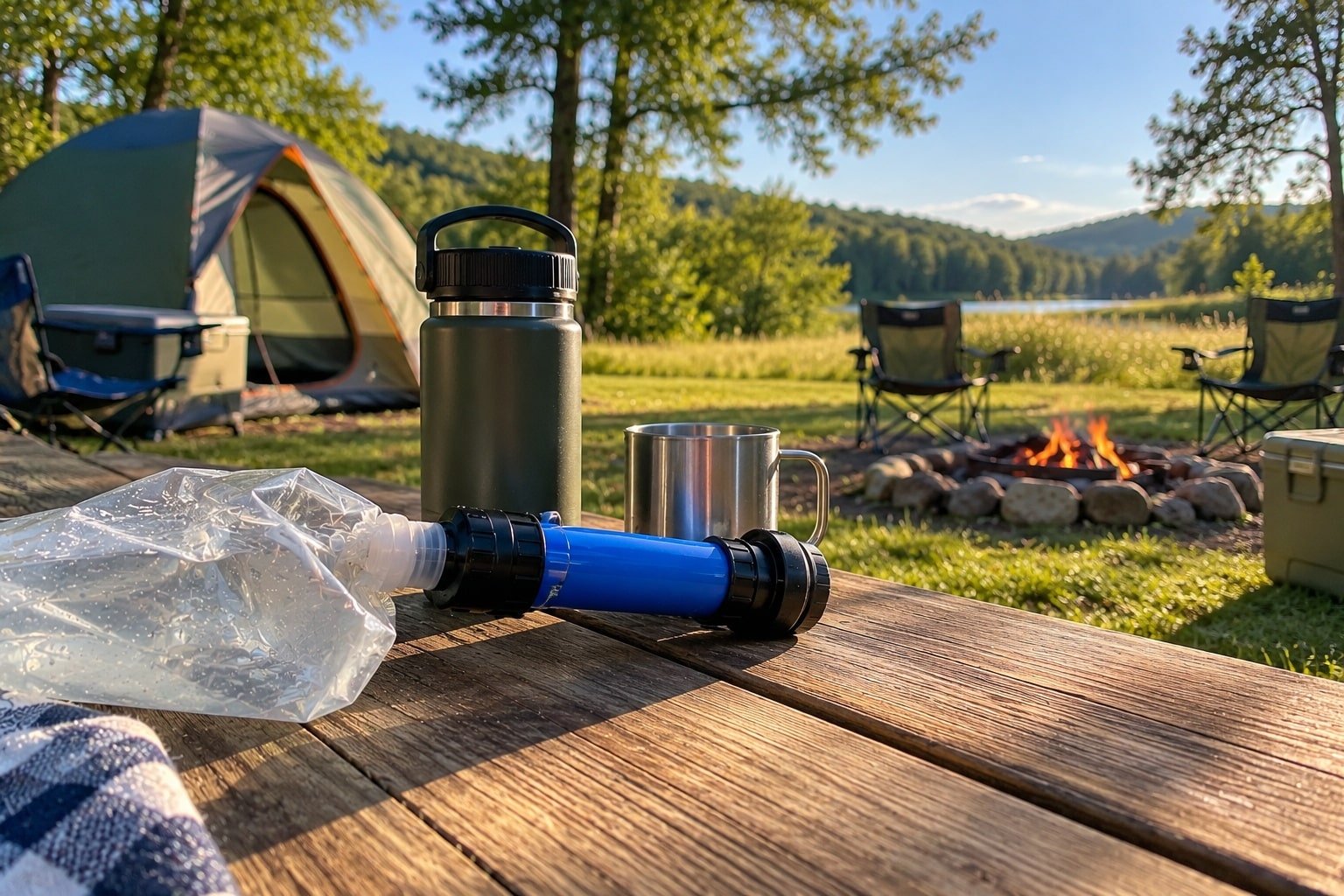
Finding the best camping water filtration system starts with one question: where are you getting your drinking water?
We’ve compared five options for backpackers, tent campers, and RV owners using manufacturer specifications, filtration capabilities, and published product information.
A lightweight trail filter makes sense for hiking, while a gravity system saves effort at a family campsite. RV owners have different requirements, particularly when connecting to campground drinking water.
Quick Comparison: Best Camping Water Filters
| Product | Best For | Weight | Price Tier |
|---|---|---|---|
| Sawyer Squeeze | Overall camping and hiking | Approx. 3 oz, filter | Mid-range |
| Katadyn BeFree 1.0L | Solo backpacking | Approx. 2.2 oz, system | Mid-range |
| LifeStraw Peak Series Straw | Compact backup | 2.3 oz | Budget |
| Platypus GravityWorks 4.0L | Families and groups | Approx. 11.5 oz, system | Premium |
| Camco TastePURE 40043 | RV campground hookups | Check listing | Budget |
Weights are approximate and may exclude accessories, depending on the manufacturer’s measurement.
How to Choose The Best Camping Water Filtration
The best filter isn’t necessarily the one with the smallest pore size or the longest advertised lifespan. You need to match the treatment method to your water source and consider how you’ll collect, filter, and store water.
What Contaminants Does the Filter Remove?
Most portable backpacking filters use hollow-fiber membranes to reduce bacteria and protozoan parasites. Giardia and Cryptosporidium are two organisms worth understanding before drinking from untreated freshwater.
Viruses are another matter. Many common microfilters aren’t designed to remove them.
The CDC’s camping guidance recommends boiling water as the preferred treatment when practical, or filtering followed by appropriate disinfection when boiling isn’t possible.
Chemical contamination also needs separate consideration. A filter designed to remove bacteria doesn’t automatically remove pesticides, dissolved metals, or other chemical pollutants.
How Much Water Do You Need?
A solo backpacker might only need enough water to fill a bottle at each stop. A family campsite needs considerably more for drinking and meal preparation.
Squeeze filters work well for smaller quantities. Gravity systems become more attractive when several people need water throughout the day.
For RV camping, the calculation changes. You’re often treating water as you fill a freshwater tank or use a campground hookup rather than collecting water from a stream.
How Much Weight Are You Willing to Carry?
Weight matters more on a 15-mile hike than at a campsite 20 feet from your truck.
For backpacking, we’d prioritize a compact filter that works with your existing bottles. Extra bags, hoses, and fittings need to justify their weight.
One lesson from years of camping is that unnecessary gear adds up quickly. After one particularly difficult descent with an overloaded backpack, I’ve paid much more attention to what earns a place in my pack.
For car camping, convenience can reasonably take priority over shaving off another ounce.
How Easy Is the Filter to Clean?
Flow rate matters, but so does maintenance.
Fine sediment can clog filter membranes. Some systems require backflushing, while others use a swishing or shaking cleaning method.
Check the manufacturer’s cleaning instructions before your first trip. A filter that needs a special cleaning tool is less convenient if you’ve left that tool at home.
Many hollow-fiber filters can also suffer damage if they freeze after becoming wet. Follow the manufacturer’s freezing and replacement guidance rather than assuming a thawed filter is safe.
Is an RV Water Filter Different?
Yes. Most RV inline filters are intended to improve water supplied through a potable-water hookup. Their carbon media can reduce unpleasant tastes and odors, while sediment filtration helps catch particles.
That doesn’t make them suitable for untreated lake or river water.
For the best RV water filtration setup, we’d start by confirming the campground supply is potable, then choose a filter with clearly documented contaminant-reduction claims.
The CDC filter guide explains why buyers should check what a filter is certified to reduce instead of relying on general claims about clean water.
Sawyer Squeeze Water Filtration System: Best for Overall Camping
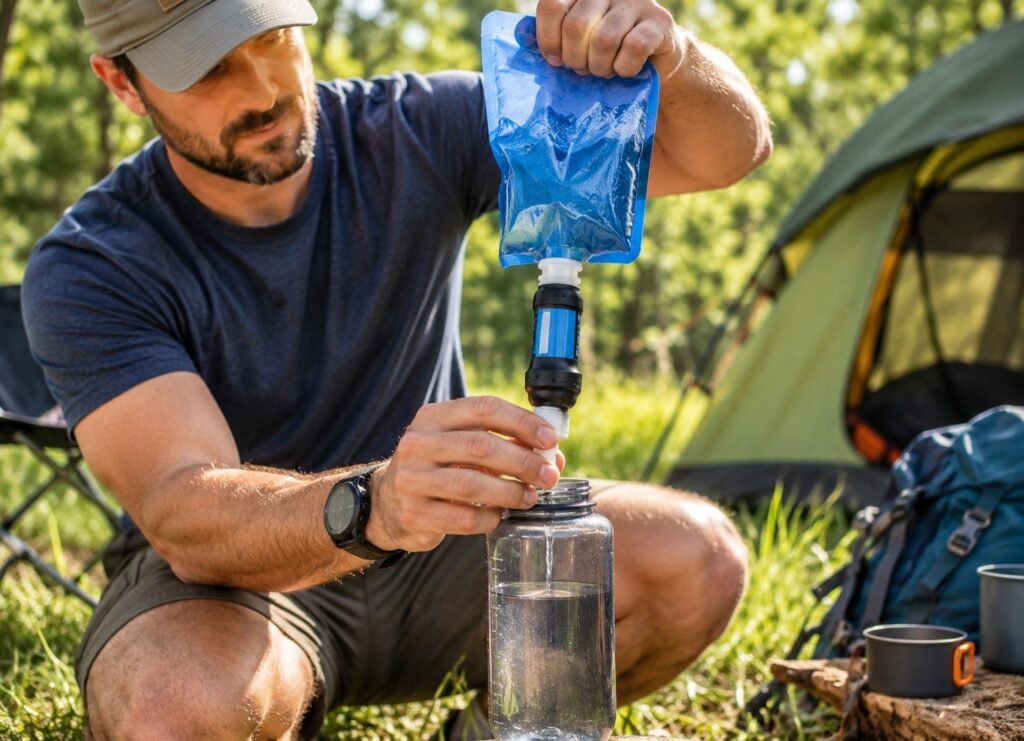
The Sawyer Squeeze Water Filtration System is our overall recommendation because the filter works with squeeze pouches and compatible bottles, making it useful for several camping styles.

Sawyer specifies a 0.1-micron absolute hollow-fiber filter designed to remove bacteria and protozoa. The filter itself weighs approximately 3 oz, which is reasonable for backpacking.
What Works
The biggest advantage is flexibility.
You can collect water in a compatible pouch, attach the filter, and squeeze the water into a clean container. The system also works with certain compatible bottle threads, reducing the need to carry a dedicated reservoir.
Sawyer’s product documentation describes its filtration capabilities and backflushing maintenance method.
The long advertised filter lifespan is attractive, although that figure assumes proper maintenance and suitable operating conditions. We wouldn’t treat a theoretical lifespan as a guarantee of years without problems.
What Doesn’t
The included squeeze pouches aren’t our favorite part of the arrangement. Filling a narrow opening from shallow water can be awkward.
Backflushing also becomes part of your routine, particularly with silty water. You’ll need to carry the appropriate cleaning equipment and understand how to use it.
The filter doesn’t provide comprehensive virus or chemical removal.
Who It Suits
We’d choose the Sawyer Squeeze for backpackers who want one practical filter for weekend trips and longer hikes.
It also makes sense for car campers who occasionally collect untreated freshwater.
Compared with the Katadyn BeFree, the Sawyer offers a more flexible bottle-based arrangement. The BeFree has a simpler integrated flask design.
Katadyn BeFree 1.0L: Best for Lightweight Backpacking

The Katadyn BeFree 1.0L Water Filtration System is an appealing choice for backpackers who want to collect water and drink directly from the same soft flask.

The system combines a collapsible 1 L bottle with a 0.1-micron hollow-fiber membrane. At approximately 2.2 oz, the standard model keeps weight down.
What Works
The integrated design is the main attraction.
Fill the flask, screw on the filter cap, and drink through the nozzle or squeeze water into another container. There’s no separate dirty-water pouch to connect for ordinary use.
Katadyn’s BeFree documentation describes the EZ-Clean membrane, which can be cleaned in the field according to the manufacturer’s instructions.
We particularly like the idea of having fewer separate components to organize during a short stop.
What Doesn’t
The soft flask is also the weak point.
If the bottle develops a leak or suffers damage, you may need a compatible replacement. The BeFree’s connection isn’t interchangeable with every ordinary disposable water bottle.
Its filter also has a shorter advertised service life than the Sawyer Squeeze, and performance can decline as sediment accumulates.
For groups, repeatedly filling a 1 L flask gets tedious.
Who It Suits
This would be our choice for solo hikers who prioritize quick drinking stops and compact packing.
The Sawyer makes more sense if you prefer using several compatible bottles or want a more flexible camp filtration setup.
LifeStraw Peak Series Straw: Best for Compact Backup

The LifeStraw Peak Series Straw is a compact personal filter that earns consideration as a backup or minimalist drinking option.
Emergency, Survival, and Ultralight Hydration, BPA-Free, Dark Mountain Gray

Weighing 2.3 oz, the straw uses a 0.2-micron membrane microfilter. LifeStraw claims removal of 99.999999% of bacteria and 99.999% of parasites under its stated testing conditions.
What Works
Its strongest feature is the compact design.
You don’t need a pump or a large filtration bag to drink through the straw. It can also connect to compatible bottles and gravity hoses, giving it more flexibility than a straw-only filter suggests.
LifeStraw’s published specifications list a filtration lifespan of up to 4,000 L and provide details about its tested contaminant reductions.
For someone assembling a small emergency kit, those are useful characteristics.
What Doesn’t
Drinking directly through a straw isn’t always convenient.
If you need several liters for cooking or filling camp bottles, a squeeze or gravity system is easier to manage.
The Peak Series Straw also doesn’t remove dissolved chemicals, heavy metals, or viruses. LifeStraw identifies some of these limitations in its documentation.
The filter membrane isn’t replaceable.
Who It Suits
We’d recommend this for day hikers and campers who want a compact secondary filter.
For your primary filtration system on a multi-day backpacking trip, we’d favor the Sawyer Squeeze or Katadyn BeFree because collecting and transferring water is more straightforward.
Platypus GravityWorks 4.0L: Best for Group Camping
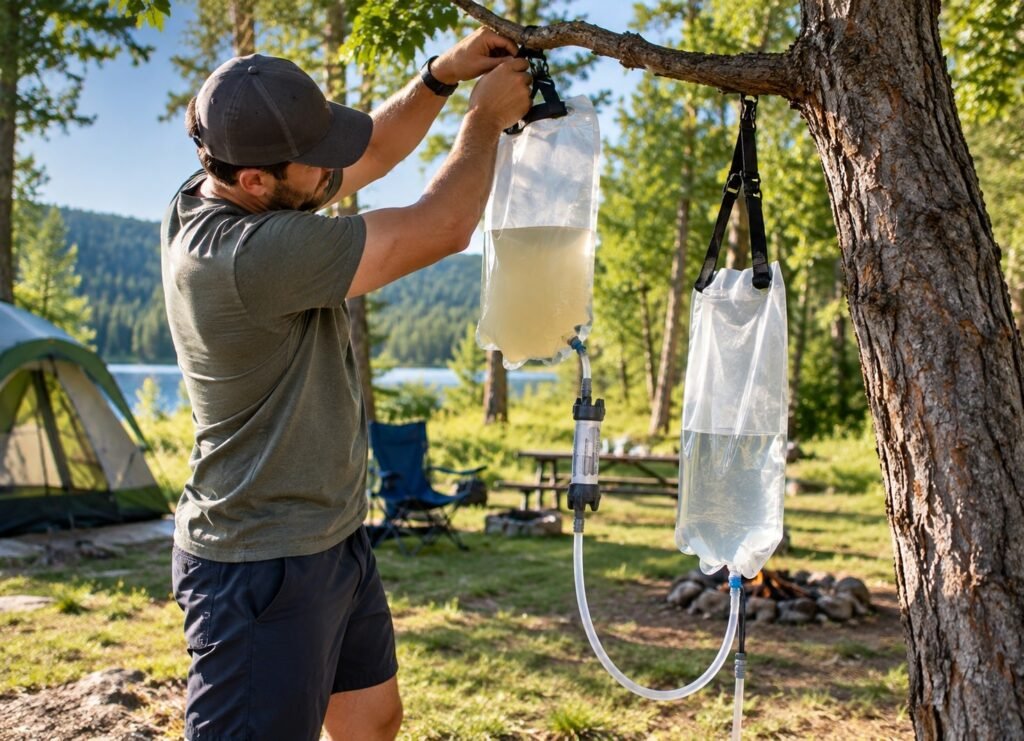
The Platypus GravityWorks 4.0L Water Filter System is our choice for group camping because it filters water using gravity rather than repeated squeezing or pumping.

The system uses separate dirty-water and clean-water reservoirs connected through a hollow-fiber filter. Platypus specifies a 0.2-micron filter and an advertised flow rate of up to 1.75 L per minute under suitable conditions.
What Works
The biggest advantage is how little attention the system needs once you’ve set it up.
Fill the dirty-water reservoir, hang it above the clean-water reservoir, and let gravity move water through the filter. The system can filter several liters while you’re preparing food or organizing camp.
That’s considerably more convenient than squeezing multiple small bottles for a family.
The separate reservoirs also make clean and untreated water easier to organize, provided you follow the manufacturer’s handling instructions.
Another useful feature is the ability to backflush the filter by reversing water flow according to the instructions.
What Doesn’t
At approximately 11.5 oz for the complete system, it’s heavier and bulkier than the personal filters in this comparison.
You’ll also need a suitable hanging point. That’s straightforward at some wooded campsites but less convenient in exposed areas.
The hoses and reservoirs introduce more components to clean, dry, and pack. The filtration system also doesn’t provide comprehensive virus removal.
For a solo overnight trip, we’d skip the extra equipment.
Who It Suits
This is the strongest choice for families, groups, and campers who stay in one place for several nights.
The Sawyer Squeeze is more practical for a solo hiker. The GravityWorks earns its extra weight when several people need filtered water throughout the day.
Camco TastePURE RV Inline Water Filter: Best for RV Camping
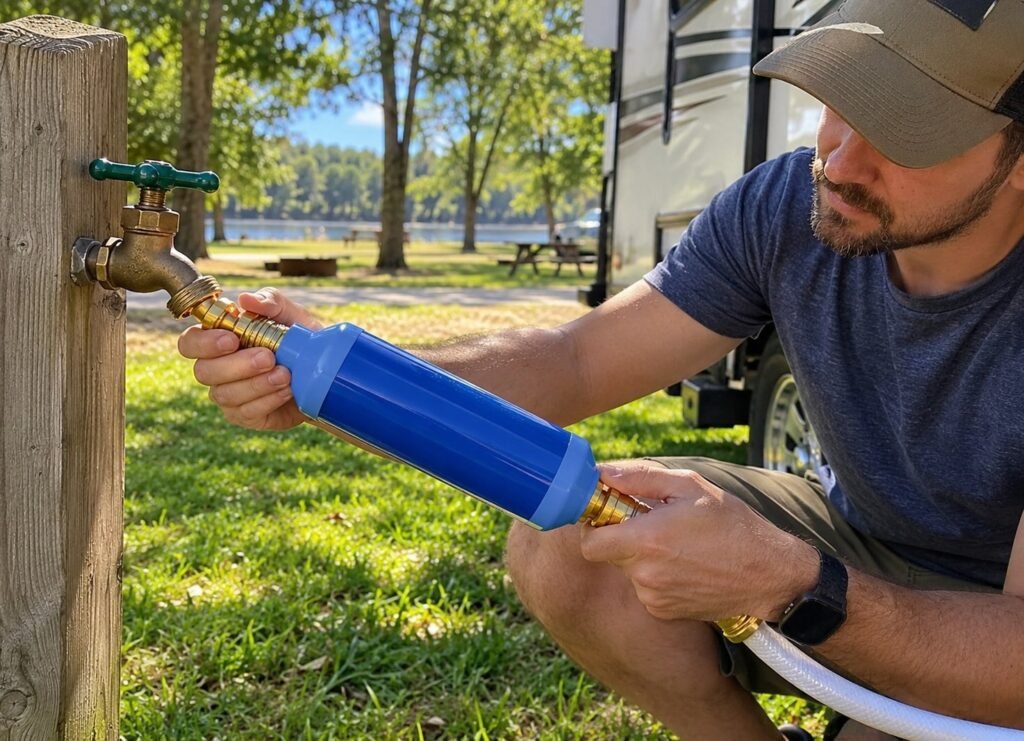
The Camco TastePURE RV Inline Water Filter 40043 serves a different purpose from the other four products.

It’s designed to connect to an RV’s potable-water supply hose, helping improve water taste and reduce sediment before water enters the vehicle.
For RV owners using established campgrounds, this is a more practical everyday choice than a backpacking filter.
What Works
The inline installation is straightforward. Connect the filter to a compatible potable-water hose, flush it as instructed, and use it with your campground water connection.
The TastePURE 40043 uses granular activated carbon and KDF filtration media. The manufacturer markets the combination for reducing chlorine taste, odors, and sediment.
The included flexible hose protector helps reduce strain on the connection.
We like that the filter addresses a common RV annoyance without requiring a complicated installation inside the vehicle.
You can also remove the filter when packing up, making it suitable for RV owners who regularly change campsites.
What Doesn’t
This isn’t a wilderness drinking-water filter.
You shouldn’t connect it to an untreated lake or stream supply and assume the output is microbiologically safe.
The carbon media has a limited working life, and the filter needs periodic replacement. Exact replacement intervals depend on usage and manufacturer guidance.
It’s also another connection to check for leaks, particularly when using campground hookups with varying water pressure.
Who It Suits
We’d recommend the Camco TastePURE for travel trailers, motorhomes, and fifth wheels using campground potable-water connections.
It’s our budget recommendation for routine RV water filtration, although owners dealing with specific contaminants should choose a treatment system with documented certifications for those contaminants.
For other practical RV equipment, see our RV toilet guide.
Which One Should You Buy?
Best for Backpackers
Choose the Sawyer Squeeze if you want one filter for different trips and compatible water containers.
We prefer its flexible arrangement over a dedicated flask when packing for longer hikes. Its low weight also makes it easier to justify carrying.
The Katadyn BeFree is the alternative we’d choose for short solo trips where quick drinking stops matter more than bottle compatibility.
Best for Car Campers
Choose the Platypus GravityWorks if several people will share a water supply collected from suitable freshwater sources.
Filtering larger quantities without constantly squeezing bottles makes a noticeable difference to the campsite routine.
For solo car camping, we’d save the space and choose the Sawyer instead.
Best for a Tight Budget
The LifeStraw Peak Series Straw is the budget option for personal drinking water.
It’s compact and requires little additional equipment. Just remember that filtering water for cooking is less convenient than with a squeeze system.
If your budget allows, the Sawyer Squeeze is the more useful primary filter for a wider range of camping activities.
Best for RV Owners
Choose the Camco TastePURE 40043 if your RV uses potable campground water and your main concerns are sediment, chlorine taste, and odor.
For boondocking with an uncertain water source, don’t assume an inline carbon filter is sufficient. Assess the source and the specific contaminants you need to address.
Common Questions About Camping Water Filtration
Can You Drink River Water After Filtering It?
Some filters can reduce bacteria and protozoa in untreated freshwater, but that doesn’t mean every river is safe after filtration. Viruses and chemical contamination may require additional treatment, and some contaminated sources should be avoided entirely.
Follow the CDC’s water treatment guidance and any local water advisories.
Do Camping Water Filters Remove Viruses?
Most common backpacking microfilters aren’t designed to remove viruses. Their membrane pores are generally too large to reliably capture these smaller pathogens.
If viruses are a concern, use an appropriate purifier or a treatment method recommended by public health authorities.
Is a 0.1-Micron Filter Better Than a 0.2-Micron Filter?
A smaller rated pore size isn’t automatically proof that one complete system is better. You also need to consider whether the rating is nominal or absolute and which contaminant-reduction claims have been independently verified.
Compare documented treatment performance rather than judging filters by pore size alone.
How Long Does a Camping Water Filter Last?
Filter lifespan varies significantly. Some manufacturers advertise thousands of liters, while others specify replacement after a shorter volume or when the membrane becomes clogged.
Sediment, maintenance, freezing damage, and storage conditions all affect practical service life. Follow the instructions for your specific model.
Can You Use a Backpacking Filter for RV Water?
A backpacking filter can treat small quantities of suitable freshwater, but it isn’t designed to handle the flow requirements of an entire RV water system.
For routine potable-water hookups, an inline RV filter is more convenient. For untreated sources, choose treatment equipment based on the actual contamination risks.
Final Recommendation
For most tent campers and backpackers, we’d buy the Sawyer Squeeze. Its combination of low weight, adaptable connections, and documented filtration performance makes sense for a wide range of trips.
The Katadyn BeFree is a close alternative for solo hikers who prefer an integrated flask. For family camping, the Platypus GravityWorks offers a more convenient way to filter larger quantities.
RV owners should consider the Camco TastePURE for improving an existing potable-water supply, rather than treating it as a substitute for microbiological purification.
One final point: test your filtration setup at home before heading out. Learn how to assemble, clean, and store the filter, and check that every component is present.
A missing connector is annoying in your kitchen. It’s considerably more annoying when you’re miles from your vehicle and need drinking water.
For more equipment recommendations, browse our camping equipment guides and camping safety resources.
CampEquipmentPlus relies on reader support. Purchases made via links on our website may earn us an affiliate commission at no extra cost to you, helping keep the site running.