
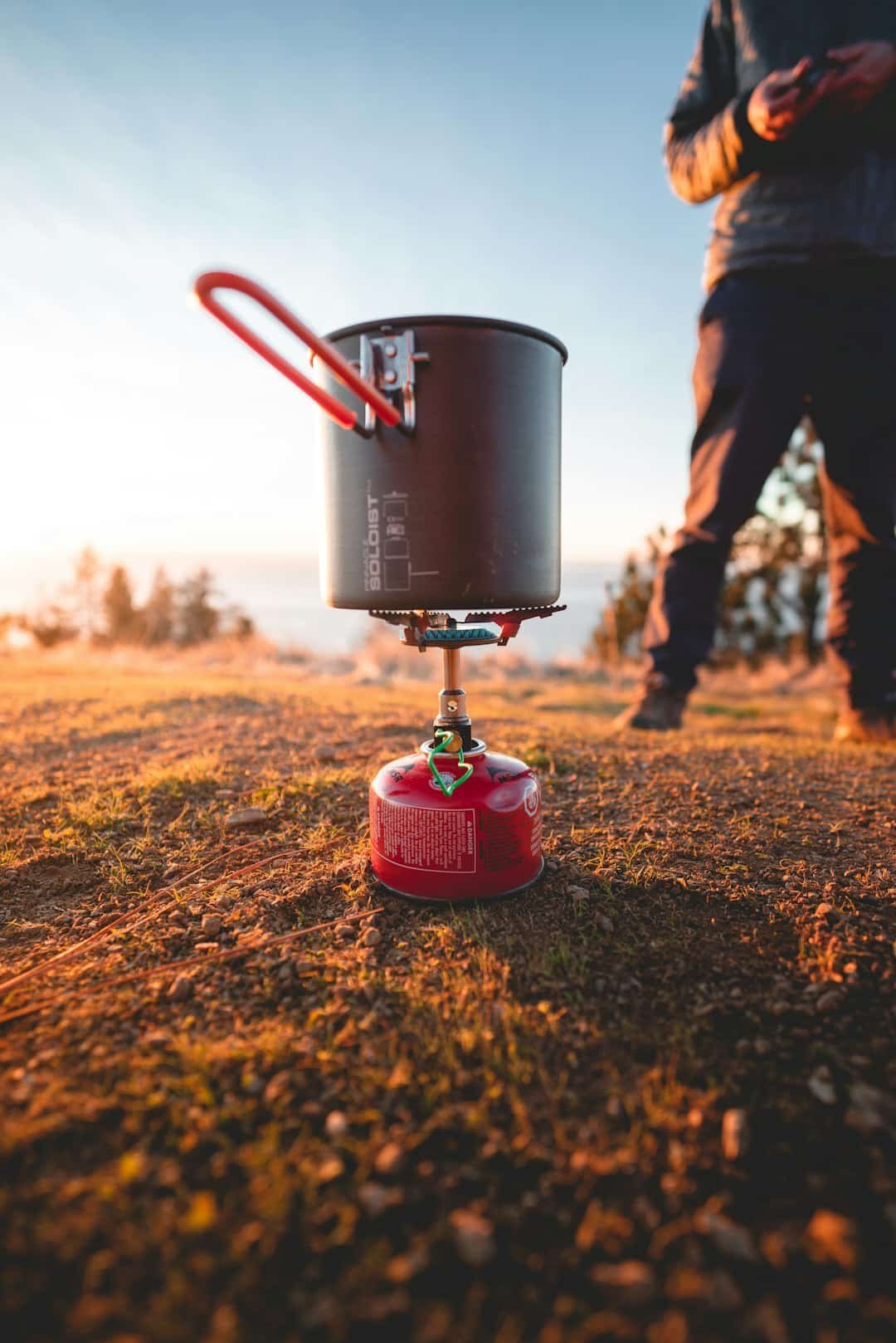
A half-full canister is not a meal plan.
A canister left over from the last trip may look sufficient until the second dinner needs a long simmer and Sunday’s breakfast happens in a cold wind. Plan from the menu, not the number of nights: count water for meals and drinks, then allow extra fuel for frying or simmering. For an upright isobutane stove, a sheltered boil often uses roughly 15–25 g per litre; real cooking can use considerably more.
Weigh the canister and subtract its marked empty weight to find the fuel remaining. If the estimate leaves less than a 25–30% margin, bring a spare. A windscreen or sheltered cooking spot helps, but never enclose the canister in a windscreen.
Burn time is not trip time
An advertised burn time usually means how long a stove runs continuously at a specified setting, often full output. A weekend meal rarely calls for an uninterrupted flame: boiling water may take minutes, while simmering food can keep the burner on much longer. The useful question is how many grams of fuel the planned meals will consume, not how many hours the stove can stay lit.
Fuel weight provides the starting point. A larger-looking canister may contain less usable fuel than expected because its metal container adds weight. Burner output matters too: a high-power stove can burn through fuel quickly at full throttle, but turning it down does not automatically save fuel if cooking then takes much longer.
Efficiency determines how much of that fuel heats the food rather than the surrounding air. A fitted pot lid, a pot matched to the burner, and shelter from wind can make a canister last longer across a trip. Manufacturer runtimes are useful for comparing stoves under similar conditions, not for predicting a weekend’s meals on their own.
Estimate fuel by the water boiled
For a sheltered canister stove, plan on roughly 10–20 g of fuel per liter of water brought to a boil. This is a planning range, not a burner specification: pot design, starting water temperature, flame setting, and how effectively the pot is shielded all affect consumption. Wind can push usage well beyond it.
A solo camper boiling water for drinks and dehydrated meals might use 3–4 liters over a two-night trip. At that rate, the boils consume about 30–80 g, so a full 100 g canister may suffice—but the high end leaves little margin. A second person can bring the total to 6–8 liters, or roughly 60–160 g before any simmering; a 230 g canister offers a more comfortable reserve.
Group cooking breaks the simple “one canister per weekend” rule. Pasta requires water to reach a boil and fuel to keep cooking; a shared skillet or pot of chili may simmer long after the initial boil. For those meals, list each boil separately, then allow additional fuel for cooking time rather than multiplying liters alone. The same distinction matters when comparing lightweight backpacking stove options: an efficient fast-boil setup may save fuel on rehydrated meals without being the best tool for prolonged simmering.
The menu changes the fuel budget
A meal that only needs hot water is usually the most fuel-efficient choice: bring water to a boil once, add it to the food, and let an insulated container do the waiting. Pasta can cost more fuel because it may require a larger pot of water and several minutes at a sustained boil. Absorption-style pasta uses less water, but still needs heat while it cooks.
Skillet meals create a different workload. Browning ingredients often takes longer than boiling a measured liter, especially when a small pan forces repeated batches. Long simmers keep the burner running even at a low setting; a lid and a retained-heat finish can reduce that time.
For a group, count pots heated, batches cooked, and minutes on the burner rather than multiplying a solo estimate by the number of people. One shared boil can serve four efficiently, while a cramped pan may turn dinner into several cooking cycles. Pot capacity matters when choosing a stove for a family of four.
Make more of each flame
A lid is one of the simplest fuel savers: it traps heat and limits evaporation while water comes to a boil. Once food is cooking, a gentle simmer under a partly open lid often does the job with less fuel than a vigorous boil. Stir when needed to prevent sticking rather than turning up the burner.
Pot width matters as much as capacity. A wider base can catch more heat from the burner, but a flame that extends beyond the base sends heat into the air instead of the meal. For a group, choosing a camping pot sized for four can eliminate a second cooking batch; the best choice is still wide enough for the burner and large enough for the meal. Turn the flame down once the pot reaches a boil.
How fuel formats compare
The label on a fuel container describes what is available; the stove’s BTU-per-hour rating describes how quickly it can burn fuel near full power. Comparing camping stove types and fuel trade-offs starts with keeping those two numbers separate.
- Upright isobutane-blend canisters commonly contain 100, 230, or 450 grams of net fuel. Stove output may be listed in BTU/hour or watts. Cold weather and falling canister pressure can reduce output before the canister is empty.
- Single-burner butane stoves typically use cassette-style cans containing about 220–227 grams. Their burner ratings may look similar to backpacking stoves’, but straight butane loses useful pressure in cool conditions; grams on the label do not guarantee the same cooking performance.
- Propane camp stoves often use disposable 1 lb cylinders, meaning roughly one pound of fuel, not a one-pound total cylinder weight. These stoves commonly have multiple burners, so the consumption rate depends on how many are lit and at what setting.
- Liquid-fuel stoves use refillable bottles, while white gas is usually sold by volume. Bottle capacity is not necessarily the amount filled, and priming consumes fuel before cooking starts.
A 1 lb propane cylinder holds about 21,000 BTU of fuel energy. Dividing by a burner rated at 10,000 BTU/hour gives roughly 2.1 hours of ideal continuous operation at full output, assuming comparable rating units. That is not a meal count: simmering draws less fuel, while wind, pot choice, pressure changes, and fuel left unusable in a cylinder all affect what gets cooked.
How conditions change fuel use
Wind and cold can both increase fuel use, but for different reasons. Wind carries heat away from the pot and can push the flame past its base. A sheltered cooking spot helps; a windscreen can help too, provided it does not enclose or heat the fuel canister.
Cold water adds a measurable heating cost. Raising one liter from 5°C to boiling takes about 63 kilojoules more than starting at 20°C—roughly 3–4 extra grams of fuel at typical stove efficiency. Cold air has another effect: it lowers canister pressure. Butane-heavy blends are particularly prone to weak flames near freezing, and performance may fade further as evaporation cools the canister. That makes butane performance in cold weather relevant to both fuel choice and cooking time.
Elevation changes the target temperature rather than simply adding a fuel penalty. Around 2,000 meters, water boils near 93°C, so reaching a boil can use less fuel. Yet beans, rice, and other foods that depend on sustained high heat may take longer to cook in cooler boiling water. For those meals, longer simmer time can outweigh the savings from an earlier boil.
Never surround an upright canister with a full windscreen. Trapped or reflected heat can dangerously raise its pressure.
Check what is left in a canister
A partly used canister is easiest to assess with a kitchen scale. Weigh the entire canister, then subtract its tare weight—the weight of the empty canister, if marked on the base or rim. A canister weighing 210 g with a marked tare of 110 g holds about 100 g of fuel. Do not subtract the advertised fuel capacity; that is the amount it held when full, not the weight of the empty container.
If tare is unmarked, a recorded weight from when the canister was new provides a useful comparison. Shaking can confirm that liquid remains, but cannot measure it accurately. Flame appearance is also a poor gauge: pressure, burner setting, and airflow all affect it. Manufacturer burn rates offer only a rough cross-check against the planned menu.
Fuel remaining is not the same as fuel reliably usable. A nearly empty canister may struggle to deliver a steady flame in cold weather, especially after its more volatile propane has been depleted. Keep a margin beyond the calculated meal requirement.
-
Compare the estimate with fuel actually available
Use the measured fuel remaining, not the canister’s original capacity. Add the planned boils, simmering, and any extra hot drinks before deciding whether it is enough.
-
Set a reserve for this trip
A sheltered weekend near an easy exit may justify a modest margin. Cold weather, uncertain cooking times, or a remote route call for more, especially when hot water is essential.
-
Make the packing decision
If the menu calls for 38 g and the measured remainder is 50 g, only 12 g remains for surprises. Carry another canister when that margin is too thin; otherwise, replace long-simmering meals with quick-boil options.
-
Check the plan against the group
Confirm that shared pots, hot drinks, and any backup meals are included in the same fuel budget.
- A canister with fuel left is not necessarily a canister with enough reserve.
The useful answer is the fuel required by the actual menu, plus a margin that reflects conditions and the cost of running out—not a fixed number of days per canister.
CampEquipmentPlus relies on reader support. Purchases made via links on our website may earn us an affiliate commission at no extra cost to you, helping keep the site running.