
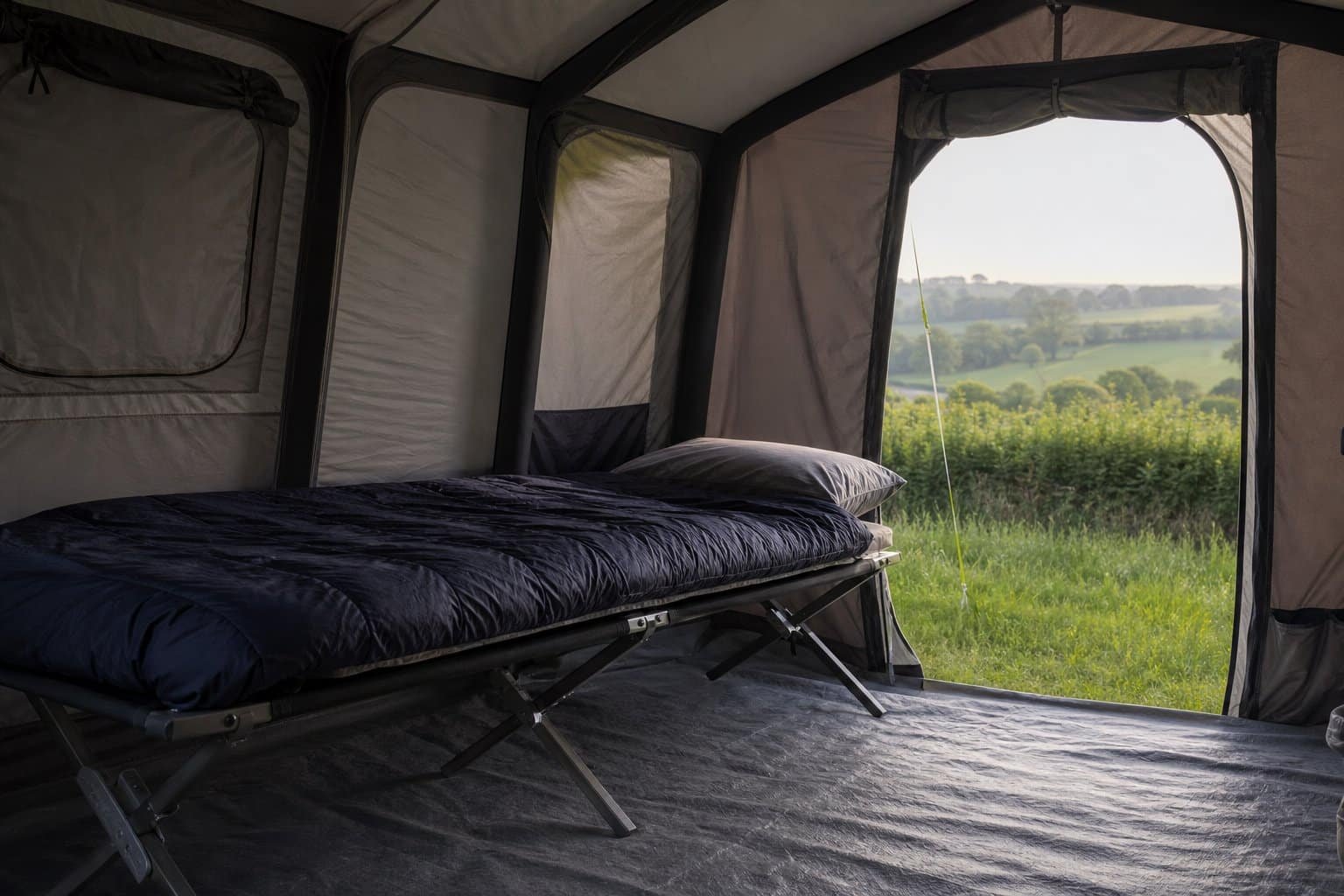
Best Folding Camping Beds UK
The best folding camping beds in the UK fold out quickly, lock solidly without a fight, pack small enough for your car boot or rucksack, and keep you off cold, lumpy ground all night.
Owners of folding camp beds tend to raise the same problems: the last end bar needs real force to fit, the frame wobbles or squeaks, the fabric sags over a trip, the folded bed is too long for the boot, cold air under the bed chills you, and a tall cot will not fit under sloping tent walls. We have picked five folding camping beds that tackle those problems differently: a no-assembly fold-out bed, a step-lock steel cot, a high/low cot, a 1.27 kg ultralight and a 180 kg-rated aluminium cot, with clear notes on height, size, load, weight and packed size.
- Fold-out beds are fastest; tension cots are lighter and pack smaller
- Check the folded length against your car boot
- Add a foam or self-inflating mat on cold nights
- Folding style Fold-out steel beds open in seconds with no parts. Pole-and-fabric tension cots weigh 1 to 3 kg but take practice.
- Packed size Fold-out beds can be over 1 m long folded. Aluminium cots pack to about 50 to 60 cm, ideal for small boots.
- Height and tent fit 38 to 48 cm beds are easy to get up from but need upright walls. 13 to 18 cm cots fit almost any tent.
- Load and warmth Ratings run from 120 to 180 kg here. All cots are cold underneath, so add a mat below about 10C.
Choosing between the folding camping beds UK retailers stock comes down to a few practical questions: how the frame opens and locks, how long it is once folded, how high it sits and how much weight it carries. Get those right and a folding camp bed turns a cold, lumpy pitch into a proper night’s sleep. This guide explains the thinking behind our five picks, from fold-out steel frames to light tension cots, so you can match a bed to your car, tent and body.



Best overall KingCamp XL | Best easy setup Easy-Step | Best high/low cot Supranubis | Best ultralight Helinox Lite | Best for heavier campers Supragris | |
|---|---|---|---|---|---|
|
|
|
|
|
| |
| Bed height | 48 cm | 38 cm | 40 cm or 15 cm | 13 cm | About 18 cm |
| Bed size | 188 x 66 cm | 183 x 76 cm (sleeping area) | 190 x 70 cm | 185 x 60 cm | 190 x 70 cm |
| Max load | 120 kg | 136 kg | 150 kg | 120 kg | 180 kg |
| Frame | Steel | Steel X-frame | 7075 aluminium | DAC aluminium | 7075 aluminium |
| Weight | 5.7 kg | Not quoted | Not quoted | 1.27 kg | 2.6 kg |
| Packed | 15 x 23 x 104 cm | Carry bag | Stuff sack | 13 x 13 x 53 cm | Not quoted |
| Folding style | Fold-out, no assembly | Step lock | Poles and lever lock | Shock-corded poles | Poles |
| Check price | Check price | Check price | Check price | Check price |
Best folding camping beds: our detailed reviews
Each review covers how the bed folds and locks, its height, size, strength, weight and packed size, plus the complaints owners raise most. For more full-size options see our guide to the best camping beds for adults, and if you prefer an inflatable, our picks of the best camping air beds for bad backs.
No-assembly fold-out steel cot, 48 cm high, 188 x 66 cm, with a built-in cotton pad
The biggest complaint about folding camp beds is the fight with the last end bar. This KingCamp cot avoids it completely: the carbon-steel frame is hinged, so you simply unfold it and the legs lock out, with nothing to slot together. Open, it measures 74 x 26 x 18.9 inches (about 188 x 66 x 48 cm), so you sit on it like a low chair, and it folds into a tall, slim package of about 15 x 23 x 104 cm that slides into most car boots.
Comfort is better than the bare-fabric norm. The bed is a double layer of thick 1000D Oxford polyester with a built-in cotton pad and a slight tilt at the head end, and a multi-layer side pocket holds your phone and torch. KingCamp rates it for people under 6 ft 2 in (188 cm) and up to 264 lb (120 kg). The trade-offs are weight and bulk: at 12.5 lb (5.7 kg) and over a metre long when folded, it is a car-camping bed only, and at 66 cm it is not the widest here.
- Unfolds with no assembly or end bars
- 48 cm height, easy to sit on and stand up
- Padded double-layer bed with head tilt
- Ten feet spread the load on the groundsheet
- Side pocket and carry bag
- 5.7 kg and 104 cm long folded
- 120 kg load limit
- 66 cm wide
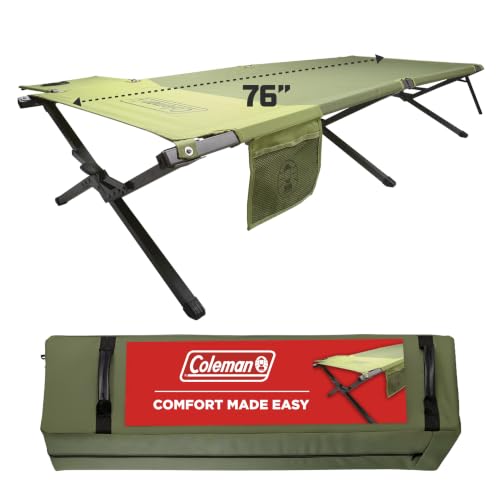
One-piece steel X-frame with a foot-operated step lock, 136 kg rating and a removable side table
Traditional cots like Coleman’s own Trailhead II need a firm shove to get the final cross bar in. The Trailhead Easy-Step fixes that with a one-piece, military-style steel X-frame: you open it out and press the step lock down with your foot to tension the bed, which is far kinder on hands and backs than levering a bar into place.
Coleman quotes a total size of 76 x 42 x 15 inches (about 193 x 107 x 38 cm) including the side table, with a 72 x 30 inch (about 183 x 76 cm) sleeping area. It is designed for people up to 6 ft (183 cm) and rated to 300 lb (136 kg), and comes with a side pocket, a removable side table with cup holder, a carry bag and a one-year limited warranty. The 38 cm height is easy to get up from. On the downside, the sleeping area is only 183 cm long, Coleman does not quote the weight (steel X-frames are heavy), and the table makes it over a metre wide.
- Foot-operated step lock, no bar to force in
- Wide 76 cm sleeping area
- 38 cm height for easy getting up
- Removable side table and pocket
- Carry bag and one-year warranty
- Only for sleepers up to 183 cm
- Weight not quoted
- 107 cm wide with the table
190 x 70 cm aluminium cot with legs for 40 cm or 15 cm height, rated to 150 kg
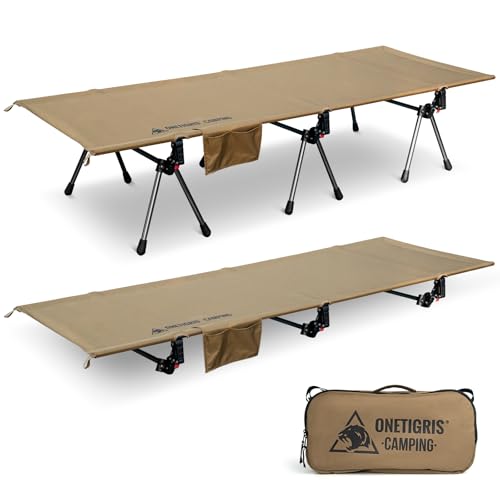
Choosing a camp bed height is a compromise: high beds are easier to get out of but foul sloping tent walls, while low beds fit anywhere but are harder to stand up from. The Supranubis lets you choose each trip. Its 12 extending legs give a 15.75 inch (40 cm) setting for grass, mud or using the bed as a bench, and a 5.9 inch (15 cm) setting for small tents and hard ground.
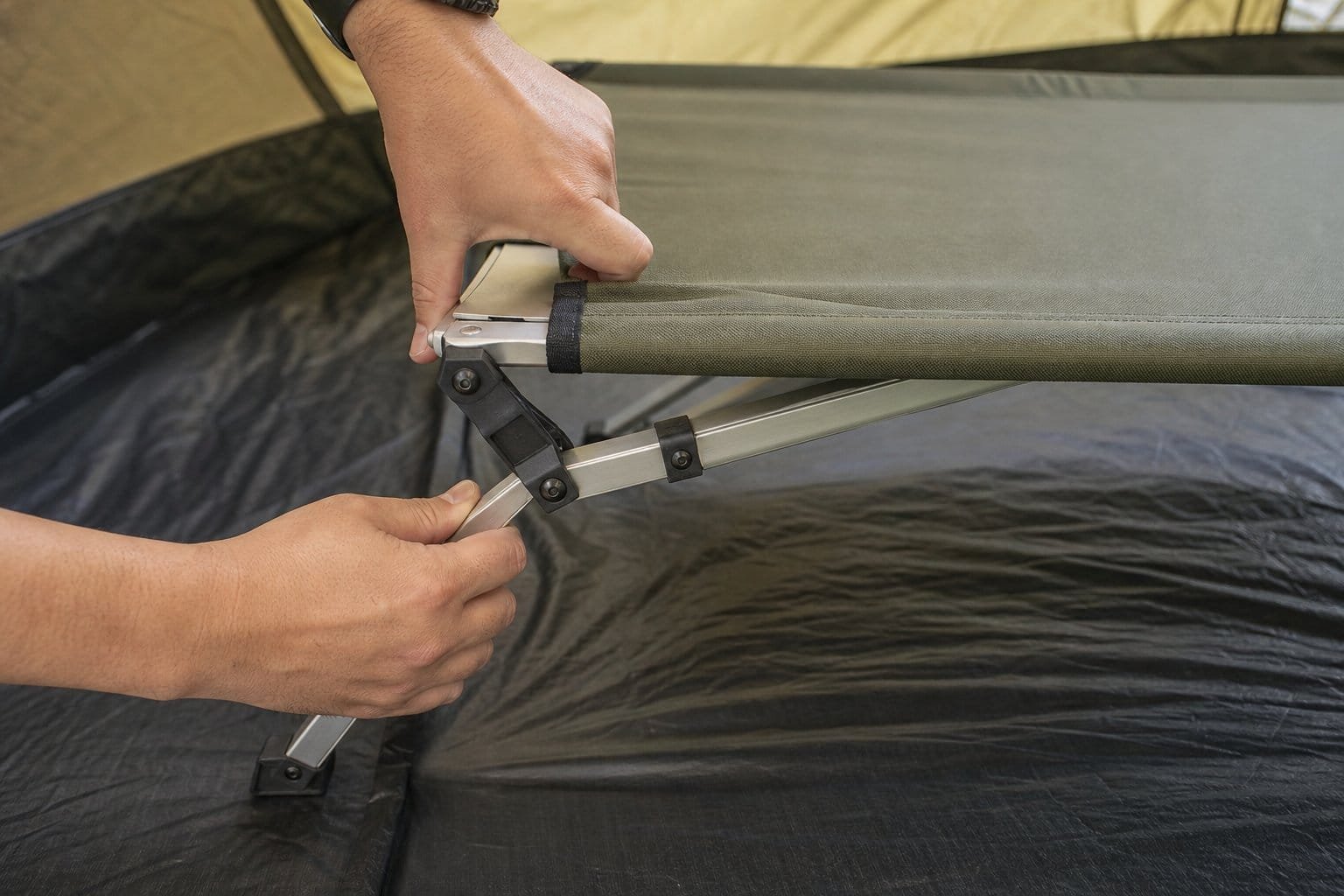
The bed is 74.8 x 27.5 inches (190 x 70 cm), wider than many lightweight cots, made from 300D rip-stop Oxford fabric on 7075 aluminium bars, and rated to 330 lb (150 kg). OneTigris has added a lever locking mechanism to make the final tensioning easier, plus a side pocket and a storage net under the bed for clothes. The listing does not state the weight or packed size, and swapping between heights means fitting or removing leg sections, so it is not as quick as a fold-out bed.
- Two heights: 40 cm or 15 cm
- Roomy 190 x 70 cm bed
- 150 kg rating on an aluminium frame
- Lever lock eases tensioning
- Side pocket and under-bed net
- Weight and packed size not quoted
- Changing height takes a few minutes
- Tension cots take practice
1.27 kg cot that packs to 13 x 53 cm, with a five-year warranty
If you walk, cycle or paddle to your pitch, most folding camp beds are simply too heavy. The Helinox Lite Cot weighs 2.8 lb (1.27 kg) and packs down to 5 x 5 x 21 inches (about 13 x 13 x 53 cm). The DAC aluminium poles are shock-corded with a single internal bungee, so they snap together on their own, and the cover and zipped case are 600D rip-stop polyester.
Open, it measures 73 x 23.5 x 5 inches (about 185 x 60 x 13 cm) and holds up to 265 lb (120 kg). Helinox backs it with a five-year warranty, the best here. The low 13 cm height fits under the sloping walls of backpacking tents, and Helinox says the gap underneath helps on cold nights, though in practice you still want a mat on top. The catches: it is narrow at 60 cm and short at 185 cm, it is the dearest bed here, and stretching the fabric onto the end bars needs firm hands.
- Only 1.27 kg, packs to 13 x 53 cm
- Self-assembling shock-corded poles
- Fits low backpacking tents
- Five-year warranty
- 120 kg load limit
- Narrow at 60 cm and 185 cm long
- Most expensive here
- Low to get up from
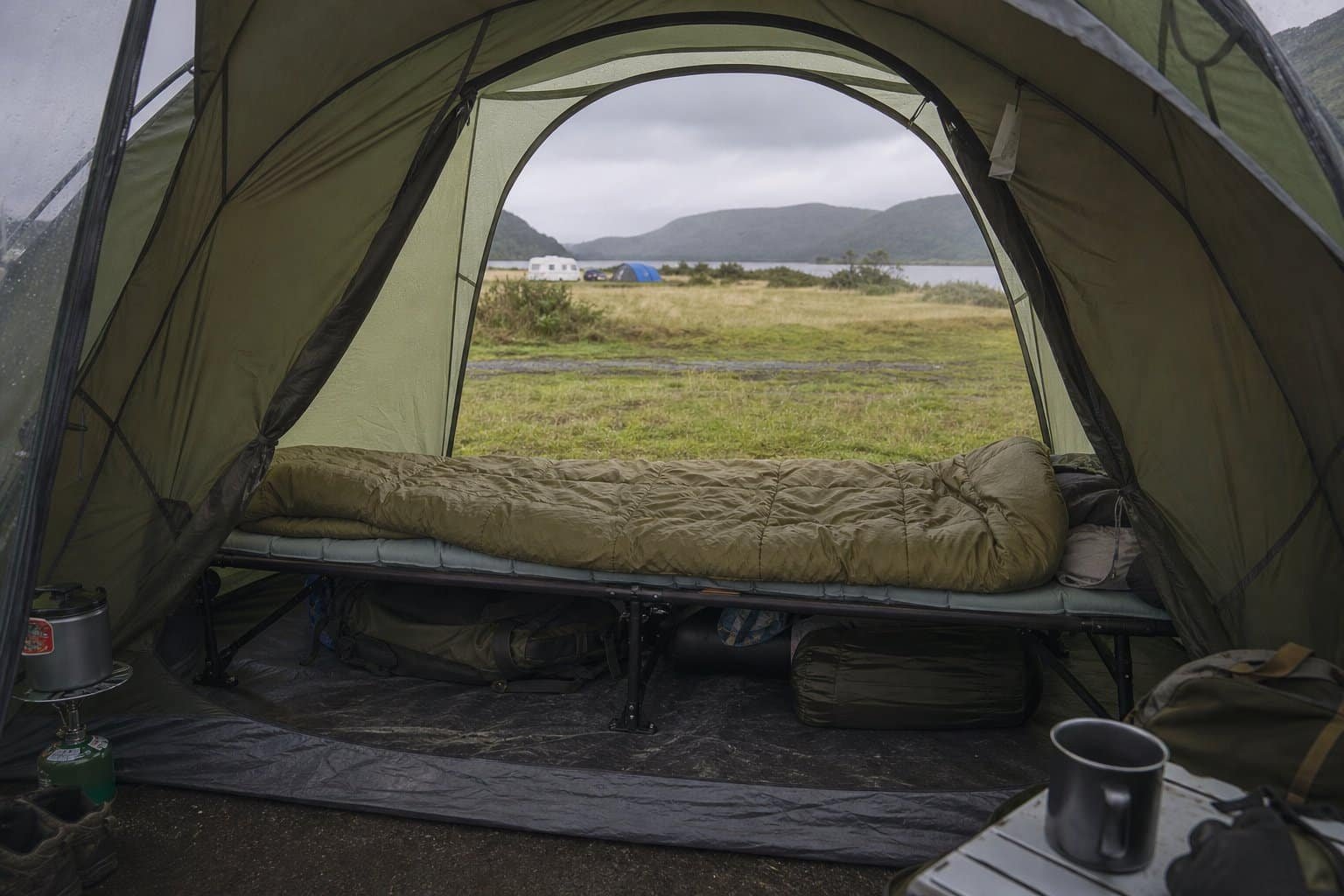
2.6 kg aluminium cot, 190 x 70 cm, rated to 180 kg, with a pillow pocket
Most folding beds top out at 120 to 136 kg, which leaves heavier campers worrying about a frame failing at 2am. The Supragris is rated to 396 lb (180 kg) on a 7075 aluminium frame, yet weighs only 5.7 lb (2.6 kg), less than half the KingCamp fold-out bed. It is 74.8 x 27.5 inches (190 x 70 cm), so there is room for broad shoulders, and it sits low at roughly 18 cm, which suits tents and vans.
Practical touches help too: a pillow pocket at the head stops your pillow or rolled-up jacket sliding off in the night, side pockets hold a bottle and torch, and the 300D Oxford fabric resists dirt and water. Setup uses a rod structure with poles that slot into the frame, so like other tension cots it takes a little practice. OneTigris does not quote the packed size, and the low height is not ideal if you struggle to get up from near the floor.
- Rated to 180 kg
- Only 2.6 kg
- Roomy 190 x 70 cm bed
- Pillow pocket stops slipping
- Low height fits tents and vans
- Packed size not quoted
- About 18 cm high, low to get up from
- Poles take practice
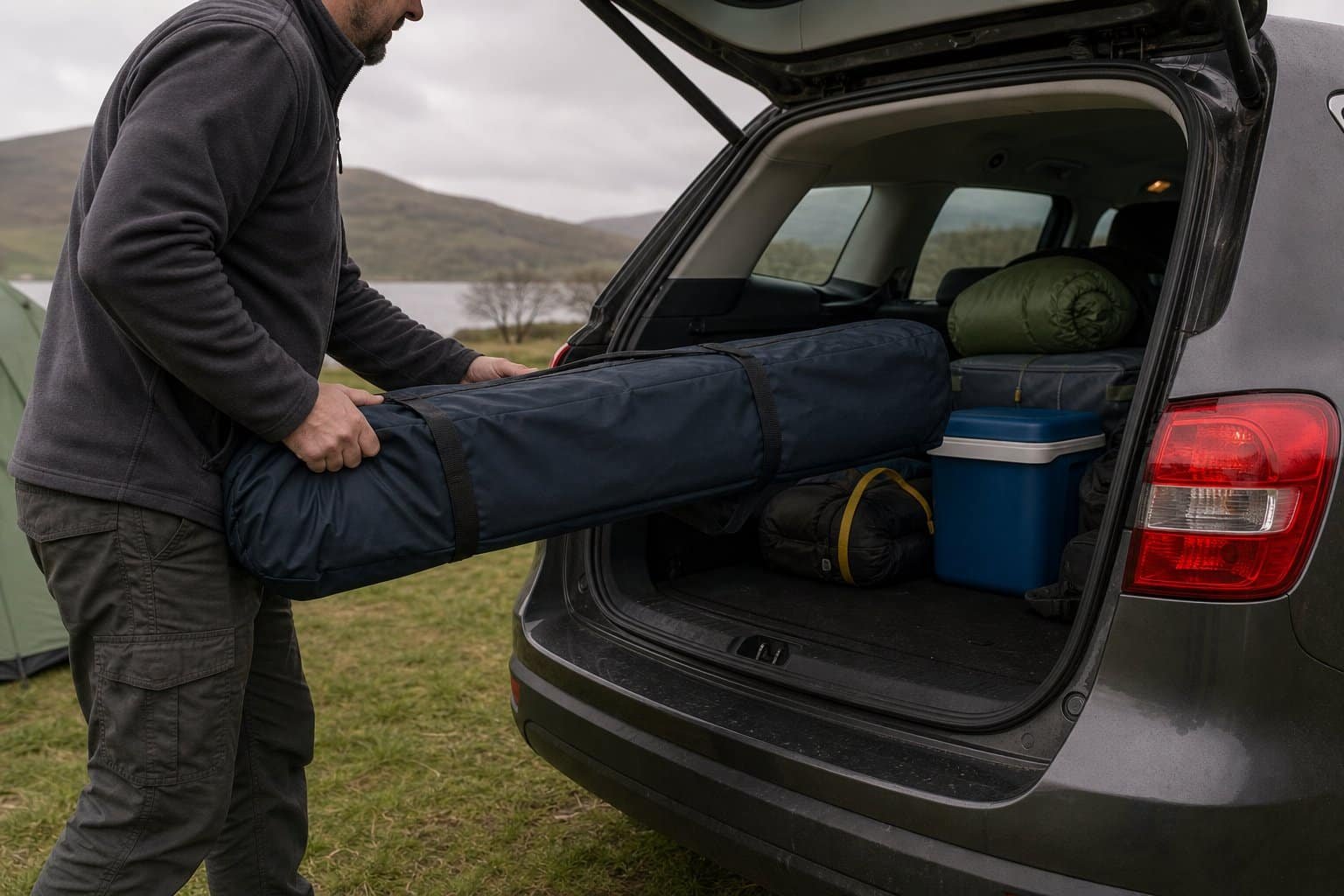
Folding camping beds: fold-out bed or tension cot?
Folding camping beds come in two main designs. Fold-out beds such as the KingCamp oversized cot and the Coleman Easy-Step have a hinged steel frame that opens in one piece, so setup takes seconds and there is no end bar to force in, but they weigh 5 kg or more and can be over a metre long folded. Tension cots such as the Helinox Lite and OneTigris models use shock-corded aluminium poles and a tight fabric bed: they weigh 1 to 3 kg and pack to around 50 to 60 cm, but the last bar takes firm hands. UK retailer UK Camping and Leisure notes that standard camp beds fold to roughly 90 to 100 cm, while ultra-compact designs get down to 55 to 60 cm; their compact camp bed guide is worth a look if boot space is tight. Before buying, check our guide to choosing a camping tent so your bed fits the bedroom.
Folding camping beds UK campers can choose from: the main types
Most folding camping beds UK shops sell fall into one of three families, and each suits a different kind of trip. Knowing which family a bed belongs to tells you most of what you need about setup, weight and packed length.
Fold-out steel beds
Fold-out beds such as the KingCamp oversized cot use a hinged steel frame that opens in one movement, with no loose poles or end bars. They are the easiest type to put up in the rain or in the dark, and they tend to sit higher off the ground, which makes them pleasant to sit on in the evening. The price you pay is weight and a long folded package, so they belong in the car.
Step-lock and lever cots
The Coleman Trailhead Easy-Step and the OneTigris Supranubis sit in the middle ground. They still stretch fabric across a frame, but a foot-operated step lock or a lever does the hard work instead of your thumbs. If you have tried a traditional camping cot and given up on the final bar, this style is worth a look, especially for anyone with weak hands or a stiff back.
Shock-corded tension cots
Lightweight cots such as the Helinox Lite Cot and the OneTigris Supragris use aluminium poles that click together and slot into the bed fabric or end fittings. They pack far smaller and weigh a fraction of a steel bed, so they suit cycle trips, canoe trips, vans and small cars. Expect a learning curve: the fabric has to be drum-tight to feel comfortable, and that takes practice the first few times.
How to choose the right size and height
Start with how you travel rather than with the bed itself. If the bed only ever goes from the boot to a family tent a few metres away, weight barely matters and a heavier, higher frame will feel more like a real bed. If you walk to your pitch or share a small hatchback with a family’s worth of gear, every kilogram and every centimetre of folded length counts.
Next, measure. Check the inside length and width of your tent bedroom at the height the bed will sit, not just at floor level, because sloping walls eat into the usable space in dome and tunnel tents. Then measure the boot, both flat and diagonally. A fold-out bed that is just over a metre long can block a parcel shelf or force you to fold down a rear seat.
Your own size matters too. Lie on your bed at home and note how far your head and feet reach, then compare that with the bed length. Broad shoulders need width as well as length, and heavier campers should check the load rating first; our guide to camping beds for heavy adults covers stronger frames. When you shortlist folding camping beds UK shoppers will often find listings in inches and pounds, so convert carefully before you decide.
Folding camp bed vs air bed vs self-inflating mat
Many people buying their first camp bed are really choosing between three ways of getting off the ground. A folding camp bed lifts you clear of the floor on a frame, an air bed cushions you on a sealed bladder, and a self-inflating mat gives a thinner layer of foam and air. Each has its place, and plenty of campers end up using two of them together.
The big advantage of a frame bed is that it cannot go flat. There is no valve to leak, no slow overnight sag and no pump to forget, and you can sit on it like a bench while you pull on your boots. It also lifts you clear of stones, roots and the damp that gathers on a groundsheet, which is why many families keep a folding bed for each adult.
The weak point is warmth. Air moves freely under a cot, so on cool nights it draws heat away from your body, which is why every bed in this guide benefits from a mat on top. An air bed on its own feels cold for a similar reason, while a good self-inflating mat insulates well but sits much closer to the ground. Combining a cot with a mat gives you the best of both, and our guide to the best self-inflating camping mats covers the mat side of that pairing.
Setting up, using and storing a folding camp bed
Where you put the bed in the tent matters more than most people expect. Place it on the flattest part of the bedroom and keep it a little away from the inner tent walls, so condensation on the fabric does not wick onto your sleeping bag. If the pitch slopes, line the bed up so your head is uphill. Putting the bed up before you unpack bags and bedding also gives you room to work.
With a fold-out bed, check that every leg has clicked fully into place before you sit down, because a half-locked joint is the usual cause of a sudden lurch or a bent hinge. With a tension cot, fit the end bars last and work inside the tent rather than on wet grass, where the feet slip and the fabric picks up mud that you then carry to bed.
Use the space underneath. A bed that stands 38 to 48 cm high leaves a useful gap for bags, boots and a spare blanket, which keeps the tent floor clear and your clothes off the groundsheet. Lower cots leave less room, but even 13 to 18 cm will take shoes and a dry bag. Avoid storing anything hard or sharp directly under the fabric, where it could press up as you move.
At the end of a trip, wipe the frame, let the fabric dry completely and shake grit out of the feet and joints before packing it away. Touch up any chipped paint on steel frames so rust cannot take hold, and keep aluminium poles clean so they seat fully. Store the bed somewhere dry and give it a quick test opening before the next season so there are no surprises.
Folding camp beds and UK camping conditions
British campsites throw a particular mix at a camp bed: soft, wet grass, cool nights even in summer, and pitches that turn muddy after a single heavy shower. A raised bed keeps you clear of any damp that creeps across the groundsheet, but narrow feet can sink into soft turf and tilt the bed overnight. Wide feet, or a small square of board under each leg, help on boggy ground.
Cool nights are the norm rather than the exception, particularly on higher ground and on clear, still evenings. The air under a camping cot cools quickly, so pack a foam or self-inflating mat for the top of the bed and a fleece blanket you can tuck around your sleeping bag. Think of the bed as the platform and the mat as your insulation, and you will stay much warmer.
Electric hook-up is common on UK sites, but it makes no difference to a frame bed, which is one of its quiet advantages over air beds with built-in pumps. Nothing needs charging and nothing depends on finding the right plug. That makes the folding camping beds UK festival-goers and campers on basic, non-electric pitches choose a dependable option wherever the nearest socket happens to be.
Tent choice is the final factor. Many family tents have tall, near-vertical bedroom walls that suit high beds, while smaller dome and tunnel tents slope sharply from the centre. If you camp in more than one tent, a high/low design such as the OneTigris Supranubis, or a low cot like the Helinox Lite, will fit far more shelters than a tall fold-out bed.
Final thoughts on choosing a folding camp bed
The right bed is the one that suits the way you actually camp. For car campers with roomy tents, a fold-out bed like the KingCamp oversized cot, or the step-lock Coleman Trailhead Easy-Step, gives quick setup and a comfortable height. If you move between tents, the high/low Supranubis is the flexible choice, the Helinox Lite Cot is the one to carry, and the Supragris suits heavier campers who still want a light frame.
Whichever you pick, measure your boot and bedroom first, budget for a mat on top, and get to know the setup before you leave home. Do that, and the folding camping beds UK campers rely on most will reward you with dry, level and warm nights, whatever the pitch and whatever the weather brings.
What to look for in a folding camping bed
Fold-out frames open in seconds. Tension cots need the end bars fitted; lever or step locks make that much easier.
Measure your boot. Fold-out beds can be 100 cm or more folded; aluminium cots pack to about 50 to 60 cm.
38 cm and up is easy to stand from but needs upright tent walls. Low cots of 13 to 18 cm fit under sloping walls.
Allow a margin over your body weight. Ratings here run from 120 kg to 180 kg.
Choose a bed about 10 cm longer than you. 60 cm is snug; 70 cm or more suits broad sleepers.
Steel beds weigh 5 kg or more. Aluminium cots weigh 1.3 to 3 kg if you carry kit any distance.
Wide or multiple feet spread the load and are kinder to sewn-in groundsheets.
How to get the best from a folding camp bed
- Practise at home
Unfold and fold the bed once indoors so you know the order and the knack of the locks before you pitch in the rain.
- Measure boot and tent
Check the folded length against your boot, and the tent bedroom at bed height, before you buy.
- Protect the groundsheet
Put a square of carpet or a plastic lid under narrow feet so they do not wear or puncture a sewn-in groundsheet.
- Stop squeaks
A drop of silicone spray on hinges and pole joints quietens a squeaky frame. Avoid oil, which attracts grit.
- Insulate on top
Lay a foam or self-inflating mat on the bed under your sleeping bag; cold air underneath steals heat fast.
- Store it dry and unloaded
Dry the fabric before packing to prevent mildew, and do not leave heavy kit on the bed between trips, which stretches it.
How we chose these folding camping beds
We have not slept on every bed in this list ourselves. Our picks are based on manufacturer specifications, UK camping retailer and buying guides, independent cot tests and recurring themes in owner feedback about setup, sag, stability, packed size and warmth.
-
Folding and setup
We included both fold-out and pole-tension designs and noted how each one locks.
-
Packed size and weight
We compared folded dimensions and weight for car boots and for carrying.
-
Strength and size
We compared load ratings, bed length and width, and maximum sleeper height where given.
-
Tent fit
We covered high, low and adjustable beds so you can match the bed to your tent.
Not every Amazon listing quotes weight or packed size. Where a figure is missing we say “Not quoted” rather than guess.
What is the best folding camping bed?
For most car campers, the KingCamp oversized folding cot: it unfolds with no assembly, sits at 48 cm and has a padded bed. If you carry your kit, the 1.27 kg Helinox Lite Cot is the lightest folding bed we found.
Which folding camp bed is easiest to put up?
Fold-out designs with hinged frames, such as the KingCamp oversized cot, need no assembly. Among traditional cots, the Coleman Trailhead Easy-Step locks with a foot press instead of forcing in a bar.
Will a folding camp bed fit in my car boot?
Check the folded length. Fold-out beds can be over 100 cm long folded, while aluminium tension cots such as the Helinox Lite pack to about 53 cm.
Are folding camp beds cold?
Yes, on their own. Air moves under the bed and draws heat from you, so add a foam or self-inflating mat on top in spring and autumn.
How much weight can a folding camping bed hold?
Most are rated between 120 and 150 kg. The OneTigris Supragris in our list is rated to 180 kg while weighing 2.6 kg.
How do I stop a camp bed squeaking?
Make sure every joint is fully seated and the bed is on level ground, then use a little silicone spray on the hinges and pole ends.
Which folding camping bed should you buy?
- Best overall: KingCamp Oversized Heavy Duty Folding Camping Cot
- Best easy setup: Coleman Trailhead Easy-Step Folding Cot with Side Table
- Best high/low cot: ONETIGRIS SUPRANUBIS High/Low Folding Camping Cot
- Best ultralight: Helinox Lite Cot Ultralight Folding Camping Cot
- Best for heavier campers: ONETIGRIS SUPRAGRIS Ultralight Camping Cot, 180 kg
For most UK car campers, the KingCamp oversized cot is the best folding camping bed: it opens in seconds with no parts, sits at an easy 48 cm and has a padded bed. The Coleman Trailhead Easy-Step is the easiest traditional cot to tension, the OneTigris Supranubis switches between 40 cm and 15 cm heights, the Helinox Lite is the one to carry on foot, and the OneTigris Supragris is the strongest for its weight at 180 kg. Whichever you choose, add a mat on cold nights; our self-inflating mat picks and R-value guide will help.
CampEquipmentPlus relies on reader support. Purchases made via links on our website may earn us an affiliate commission at no extra cost to you, helping keep the site running.