

Choosing one of the best backpacks for camping comes down to four things I have learned to prioritize over the years: comfort, fit, load balance and durability.
Capacity matters, but a big backpack that fits badly or carries weight poorly can make a long day on the trail miserable.
After years of camping, and a few painful lessons, I have become much stricter about what I carry and how I carry it.
An overloaded backpack once made a steep, rocky descent considerably harder, put more strain on my knees and contributed to some painful blisters. Since then, every item has needed to justify the weight it adds.
For this guide, we compared five camping and backpacking packs from Osprey, Gregory, Deuter and TETON Sports.
The Osprey Atmos AG 65 earns our Best Overall recommendation because its suspension, capacity, fit adjustment and organization make it the most balanced option for typical multi-day trips.
Best Backpacks for Camping at a Glance
| Backpack | Best For | Capacity | Pack Weight |
|---|---|---|---|
| Osprey Atmos AG 65 | Best Overall | 65 L S/M, 68 L L/XL | 4.61 to 4.81 lb |
| Gregory Baltoro 65 | Heavy Loads | 60 to 70 L depending on size | 4.72 to 5.25 lb |
| Deuter Aircontact Lite 50+10 | Weight and Capacity Balance | 50 L + expandable storage | 3.62 lb |
| Osprey Talon 44 | Lighter, Compact Loads | 44 L S/M, 48 L L/XL | 3.46 to 3.57 lb |
| TETON Sports Explorer 4000 | Budget-Friendly Capacity | 65 L | Approx. 5 lb |
Our five picks are:
- Osprey Atmos AG 65, Best Overall
- Gregory Baltoro 65, Best for Heavy Loads
- Deuter Aircontact Lite 50+10, Best Balance of Weight and Capacity
- Osprey Talon 44, Best Lightweight Option
- TETON Sports Explorer 4000, Best Budget Option
The Atmos AG 65 is our first choice for most campers carrying multi-day loads. The Baltoro makes more sense when heavier loads are unavoidable, while the Talon 44 goes in the opposite direction and suits people who have already trimmed down their camping kit.
Do not buy by capacity alone. A 65 L backpack filled with unnecessary gear still means you have to carry all that unnecessary gear.
1. Osprey Atmos AG 65: Best Overall
The Osprey Atmos AG 65 is our Best Overall backpack for camping because it combines useful capacity with an adjustable suspension system designed to transfer a multi-day load comfortably.
Hiking pack, camping gear, overnight trail pack, Black color, L-XL size. Included raincover made with PFAS-free DWR and bluesign approved materials.
Curved zip access on one side of panel. Floating top lid with lash points. Zippered sleeping bag compartment with removable divider and removable sleeping pad straps keep your sleep system secure.

Osprey lists the S/M Atmos at 65 L and 4.61 lb, while the L/XL increases to 68 L and 4.81 lb. Both sizes have a recommended load range of 30 to 40 lb according to the Osprey specifications.
That 65 L capacity is a useful starting point for multi-day camping. There is enough room for a sleeping system, spare clothing, food, cooking equipment and other essentials without moving into expedition-sized territory.
Why Is the Atmos AG 65 Our Best Overall Pick?
The Atmos AG 65 gets the fundamentals right: fit adjustment, load transfer, ventilation and usable storage.
Its defining feature is Osprey’s AntiGravity suspension. The suspended mesh back panel works with an adjustable harness and Fit-on-the-Fly hipbelt, giving you more control over how the pack sits against your torso and hips.
That matters because backpack comfort does not come from thick padding alone. A well-fitted hipbelt should allow your hips to carry much of the load rather than leaving your shoulders to do all the work.
Organization is another strength. You get a sleeping-bag compartment, large front stretch pocket, side bottle pockets, hipbelt storage and attachment points for equipment such as trekking poles.
The disadvantage is weight.
At more than 4.6 lb empty, the Atmos is considerably heavier than the Deuter Aircontact Lite 50+10. If you are trying to build a genuinely lightweight backpacking setup, starting with a pack weighing close to 5 lb works against that goal.
For traditional multi-day camping and backpacking loads, though, the additional structure is easier to justify.
Pros:
- 65 to 68 L capacity depending on size
- AntiGravity suspension
- Adjustable torso and hipbelt fit
- 30 to 40 lb recommended load range
- Good equipment organization
- Integrated raincover
- Strong option for multi-day trips
Cons:
- Heavy compared with lighter backpacking packs
- More pack than you need for minimalist trips
- Weight-conscious backpackers have lighter options
Best for: Campers and backpackers wanting one versatile pack for multi-day trips with conventional camping loads.
Check Price on Amazon
2. Gregory Baltoro 65: Best for Heavy Loads
The Gregory Baltoro 65 is the pack we would choose when carrying heavier camping equipment takes priority over minimizing the backpack’s own weight.
FreeFloat A3 suspension system with dynamic flex panels and auto rotating shoulder straps that move with the natural movements of your body. AirCushion mesh backpanel provides true breathability, eliminates pressure points and moisture-wicking cooling benefits. 3D Shoulder Harness & Hipbelt Construction eliminates wrinkling and hot spots to provide hotspot free, body-hugging comfort.

The Baltoro is built around a substantial internal-frame suspension. Gregory specifies a maximum carry weight of 50 lb on the current models we researched, giving it more load-carrying headroom than the Atmos AG 65’s recommended 30 to 40 lb range.
There is an important detail here. Current Gregory specifications vary according to pack size. The smaller version is listed at 60 L and approximately 4.7 lb, while larger configurations increase to 70 L and more than 5 lb.
Check the exact size and specifications before buying rather than assuming every Baltoro 65 has identical capacity and weight.
Is the Gregory Baltoro 65 Better for Heavy Camping Gear?
Yes. Of these five backpacks, the Baltoro makes the most sense when your equipment list forces you to carry a substantial load.
Gregory uses an internal perimeter frame with its suspension system to transfer weight through the pack. The adjustable fit, padded hipbelt and ventilated back panel are designed around carrying larger backpacking loads.
Storage access is another advantage.
You can reach the main compartment from the top or through the large U-shaped front opening. There is also a separate sleeping-bag compartment. That arrangement saves you from excavating half the backpack because the one item you need has migrated to the bottom.
The Baltoro also includes hipbelt pockets, hydration compatibility, trekking-pole or ice-axe attachment points and multiple external pockets.
The compromise is easy to identify. This is a heavy backpack.
A pack weighing close to 5 lb before adding water, food, shelter or sleeping equipment demands a reason for that weight. If your typical total load stays comfortably below 30 lb, the Deuter or Talon may make more sense.
If you regularly carry heavier equipment, the Baltoro becomes much easier to justify.
Pros:
- Designed for substantial backpacking loads
- 50 lb maximum carry rating
- Adjustable fit
- Internal frame
- Large U-Zip main access
- Separate sleeping-bag compartment
- Extensive external storage
Cons:
- Heavy empty weight
- Excessive for small or lightweight loads
- Capacity and weight vary by size
Best for: Campers carrying heavier equipment, bulkier sleeping systems or longer-trip supplies.
Check Price on Amazon
3. Deuter Aircontact Lite 50+10: Best Balance of Weight and Capacity
The Deuter Aircontact Lite 50+10 offers one of the best compromises between useful camping capacity and keeping the backpack itself reasonably light.
Lightweight Backpacking & Hiking Backpack for Men & Women, 50 + 10 Liters - Atlantic-Ink

Deuter lists the Aircontact Lite 50+10 at 1,640 g, roughly 3.62 lb, with a 50 L base volume and recommended load of 12 to 15 kg, approximately 26 to 33 lb.
You can see our more detailed Deuter review if you are considering this pack specifically.
According to the Deuter specifications, the pack uses an X-frame for load distribution, VariQuick back-length adjustment and padded ECL hip fins. Its stated back-length adjustment runs from 42 to 62 cm.
That gives the Deuter a useful position between the larger load haulers and smaller lightweight packs.
Why Choose the Deuter Aircontact Lite 50+10?
Choose the Aircontact Lite when you want enough space for multi-day camping without accepting the 4.5 to 5 lb empty weight of some larger packs.
The roughly 1 lb difference between the Deuter and heavier packs might not sound dramatic when looking at specifications on a screen. Add several other unnecessary pounds throughout your equipment list and the difference becomes much easier to appreciate after a few hours of walking.
I learned that lesson with an overloaded backpack.
During one steep, rocky descent, I was carrying extra tools, heavy food and clothing packed for situations that never happened. The load made an already difficult descent worse, put extra strain on my knee and contributed to severe friction blisters.
My packing approach changed after that trip. I cut unnecessary clothing, moved toward lighter food and cookware, and started reviewing what I had actually used after each trip.
That experience is one reason the Aircontact Lite interests me. It still gives you a proper frame, adjustable fit and padded hip support without starting as heavy as the Atmos or Baltoro.
There are compromises. Its recommended 26 to 33 lb load is lower than the Baltoro’s 50 lb maximum, and the 50 L base capacity asks you to pack with more discipline.
For many campers, that is not necessarily a bad thing.
Pros:
- Approximately 3.62 lb
- 50 L base capacity
- X-frame load distribution
- VariQuick back adjustment
- Padded ECL hip fins
- Good weight-to-capacity balance
- Hydration compatible up to 3 L
Cons:
- Lower recommended load than the Baltoro
- Less forgiving if you carry bulky camping equipment
- “Lite” does not mean ultralight
Best for: Multi-day campers who want proper load support while keeping empty pack weight under control.
Check Price on Amazon
4. Osprey Talon 44: Best Lightweight Option
The Osprey Talon 44 is our choice for campers who already have a compact equipment list and do not need 60-plus liters of storage.
The Talon 44L men’s hiking backpack is a streamlined top-loader with ample space for multi-day trips, camping essentials, and backpacking. A versatile technical pack designed to accommodate dynamic body movement.
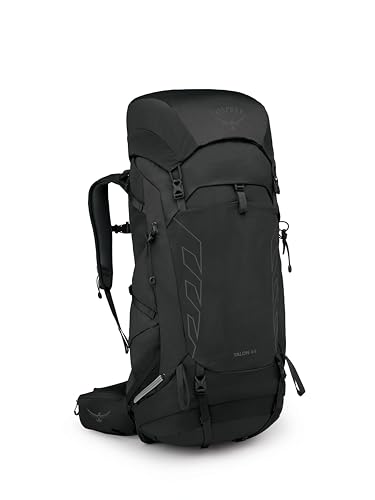
The current Osprey Talon 44 weighs 3.46 lb in S/M and provides 44 L of capacity. The L/XL increases to 48 L and 3.57 lb. Osprey gives the pack a 15 to 35 lb load range.
Those numbers immediately separate the Talon from the Atmos and Baltoro.
This is not the backpack we would choose for carrying a bulky sleeping bag, large tent, heavy cookware and several days of generous camp meals. It is better suited to compact camping systems and people who already know how to keep their equipment under control.
Is 44 L Enough for Camping?
A 44 L backpack can be enough for camping when your shelter, sleeping system, clothing and cooking equipment pack down small.
Your equipment matters more than an arbitrary trip duration.
A camper carrying a compact backpacking tent, compressible sleeping bag, lightweight sleeping pad and minimal cooking kit can fit into a much smaller backpack than someone using bulky entry-level equipment.
The Talon uses Osprey’s AirScape back panel, a LightWire frame and BioStretch harness and hipbelt. The design keeps the pack close to the body, which makes sense for hiking over more technical or uneven terrain.
You still get a separate sleeping-bag compartment, hydration sleeve, hipbelt pockets and attachment points for trekking poles and ice axes.
The limitation is space. Forty-four liters gives you less room to make bad packing decisions.
That can be useful once you know what you need. For a beginner still carrying bulky equipment, it can become frustrating.
Pros:
- 3.46 to 3.57 lb depending on size
- 44 to 48 L capacity
- 15 to 35 lb load range
- AirScape back panel
- Adjustable harness
- Separate sleeping-bag compartment
- Good choice for compact equipment
Cons:
- Too small for many bulky camping setups
- Less suitable for large multi-day loads
- Requires more disciplined packing
Best for: Lightweight campers, shorter multi-day trips and experienced backpackers with compact equipment.
Check Price on Amazon
5. TETON Sports Explorer 4000: Best Budget Option
The TETON Sports Explorer 4000 makes sense for campers who want around 65 L of storage and an internal-frame design without moving straight into the more expensive technical packs.
For Hiking, Camping, Backpacking, Rain Cover Included. Multi position torso adjustment fits medium and tall adventurers; Durable open-cell foam lumbar pad and molded channels provide maximum comfort and airflow; For beginners or experienced Backpackers

The Explorer 4000 has a stated 4,000 cubic-inch, or approximately 65 L, capacity. Available specifications also list an adjustable torso system, aluminum stays, a sleeping-bag compartment, hydration compatibility and an integrated rainfly.
It gives you plenty of space.
The issue is weight.
Is the TETON Sports Explorer 4000 Good for Beginners?
The Explorer 4000 can make sense for a beginner who prioritizes capacity and value over low pack weight.
At around 5 lb empty, the Explorer starts heavier than the Deuter Aircontact Lite and Talon 44. That matters if your goal is to reduce the total load on your back.
Its 65 L capacity is useful for bulkier sleeping bags, extra clothing and larger camping equipment. Beginners often own gear that does not compress as efficiently as expensive backpacking equipment, so that extra room can genuinely help.
There is another side to large capacity.
Empty space has a habit of attracting equipment.
I used to pack for unlikely situations and ended up carrying duplicate clothing, oversized tools, heavy food and equipment I rarely touched. A large backpack makes that easy. The better approach is to choose your equipment first, then choose a pack that fits the load.
The Explorer therefore works best when you need the space and have a firm packing list.
Pros:
- Approximately 65 L capacity
- Internal-frame design
- Adjustable torso fit
- Sleeping-bag compartment
- Hydration compatible
- Integrated rainfly
- Accessible option for beginners
Cons:
- Approximately 5 lb empty
- Considerably heavier than the Talon 44 and Deuter
- Large capacity can encourage over-packing
- Less attractive for weight-conscious backpacking
Best for: Budget-conscious campers who need substantial capacity and are less concerned about minimizing empty pack weight.
Check Price on Amazon
Which Is the Best Backpack for Camping?
For most multi-day campers, we would choose the Osprey Atmos AG 65.
Its 65 to 68 L capacity gives you enough space for a conventional multi-day setup, while the AntiGravity suspension, adjustable harness and hipbelt provide plenty of scope for dialing in the fit. Osprey’s recommended 30 to 40 lb load range also covers the loads many recreational backpackers are likely to carry.
The Atmos is not our recommendation for everyone.
Choose the Gregory Baltoro 65 if carrying heavier loads matters more than pack weight.
Choose the Deuter Aircontact Lite 50+10 if you want to reduce empty pack weight without moving to a small minimalist pack.
Choose the Osprey Talon 44 if your camping equipment is already compact and you want a smaller pack.
Choose the TETON Sports Explorer 4000 if capacity and affordability matter more than keeping the backpack itself light.
The right choice depends on the equipment going inside.
How Much Backpack Capacity Do You Need for Camping?
For multi-day camping, a backpack somewhere around 50 to 65 L is a useful starting point, but your actual equipment should determine the capacity.
A bulky synthetic sleeping bag can consume a large percentage of a smaller pack. A compact sleeping bag, inflatable pad and backpacking tent leave considerably more space.
Trip length matters too. Food is consumable weight, so extending a trip from two nights to five can make a noticeable difference to both volume and total load.
Do not automatically buy the biggest backpack available.
Lay out your camping equipment before choosing your pack. Look at the actual packed size of your shelter, sleeping system, clothing, food and cooking equipment.
Your backpack should fit your equipment. Your equipment list should not expand because your backpack has spare space.
How Important Is Backpack Fit?
Fit is more important than choosing between two packs with similar specifications.
Torso length, hipbelt position and shoulder-harness adjustment affect where the load sits on your body. Two people of the same height can need different torso settings.
The hipbelt should transfer a substantial portion of the load onto your hips. Shoulder straps stabilize the pack and keep it close to your body. They should not leave your shoulders carrying the entire load.
Adjustable torso systems, such as Deuter’s VariQuick system or the adjustment used on the Atmos, help accommodate different body proportions.
Try to assess fit with weight inside the pack. An empty backpack can feel comfortable for almost anyone.
Does Backpack Weight Really Matter?
Yes, because backpack weight forms part of your total carried load.
A 5 lb backpack carrying 30 lb of equipment gives you a 35 lb load before considering anything you might add later. Switching to a 3.5 lb pack removes around 1.5 lb without changing the contents.
That does not automatically make the lighter backpack better.
Suspension, structure and padding add weight too. If a heavier pack transfers a 40 lb load much more effectively than a minimalist design, saving a pound on the backpack can be a poor trade.
Look at pack weight and load capability together.
My own rule is simple. Equipment needs to justify its weight. That applies to cookware, spare clothing, tools and the backpack carrying everything.
How Should You Pack a Camping Backpack?
Keep dense, heavy equipment reasonably close to your back and avoid putting unnecessary weight far away from your center of gravity.
Your exact packing arrangement will depend on the backpack, but sleeping equipment often works well toward the bottom, with heavier items positioned around the middle of the pack and close to your back. Frequently needed equipment should stay accessible.
Balance matters too. Loading one side with heavy equipment can make the pack feel awkward even when the total weight is reasonable.
Use compression straps once packed. They help reduce movement inside the pack and keep the load closer to your body.
Keep essentials such as water, navigation equipment and appropriate safety gear accessible rather than burying them beneath your sleeping bag.
What Should You Look for in the Best Backpacks for Camping?
Start with fit and expected load rather than pockets, straps and accessories.
Fit
Check the manufacturer’s torso range and measure your torso rather than relying on height alone.
A properly positioned hipbelt and correctly adjusted shoulder harness can make more difference than an extra pocket or attachment loop.
Capacity
For these five packs, capacity ranges from 44 L to around 70 L depending on model and size.
Choose according to your actual equipment.
If you use compact shelter and sleeping gear, you may need much less volume than a camper carrying a bulky sleeping bag and larger tent.
Load Range
Check how much weight the manufacturer expects the suspension to handle.
The Talon 44 has a 15 to 35 lb load range. The Atmos AG 65 is rated for 30 to 40 lb. Gregory specifies up to 50 lb for the current Baltoro versions we researched.
Those differences tell you more about intended use than capacity alone.
Empty Weight
Every pound in the backpack itself is a pound you carry for the entire trip.
Do not chase low weight blindly. A heavier suspension system can make sense when carrying a substantial load.
The goal is an appropriate balance.
Access and Organization
Top-loading backpacks are simple, but front or U-shaped openings make reaching equipment easier.
Separate sleeping-bag compartments, hipbelt pockets, stretch front pockets and accessible water-bottle storage can all be useful.
More pockets are not automatically better. Every zipper, divider and compartment adds material and weight.
Durability
Look at fabric construction, reinforced high-wear areas and the overall design of the frame, straps and buckles.
Durability matters most where the pack repeatedly contacts the ground, rocks, vegetation or equipment attached externally.
A heavier fabric may resist abrasion better, but again there is a weight tradeoff.
What Mistakes Should You Avoid When Choosing a Camping Backpack?
The biggest mistake is buying the backpack before working out what you genuinely need to carry.
I made the opposite mistake for years. I packed around fears rather than realistic conditions. Extra clothing, heavy food, oversized tools and unnecessary equipment slowly turned into a brutally heavy load.
Now I review my gear after trips. If a non-essential item repeatedly comes home unused, it has to justify going back into the pack next time. Emergency and safety equipment is different. Its value does not depend on needing it every weekend.
Another common mistake is assuming a bigger backpack is automatically more versatile.
A 70 L pack gives you more room. It also gives you more opportunity to fill that room.
Fit is the other major problem. Do not buy a backpack because its specifications look right and assume the harness will suit your body. Measure your torso, check the manufacturer’s sizing and adjust the pack before heading into the backcountry.
Test important camping gear at home first. Finding a fit problem in your living room is considerably easier than finding it five miles into a hike.
Final Verdict
The Osprey Atmos AG 65 is our pick for the best backpack for camping overall. It combines useful multi-day capacity, a highly adjustable suspension, good ventilation and practical organization without moving into specialist heavy-load territory.
The Gregory Baltoro 65 is the stronger choice when you expect to carry heavier loads. Its 50 lb maximum carry rating gives it an advantage when the equipment list gets substantial.
For campers watching every pound, the Deuter Aircontact Lite 50+10 is the more interesting compromise. At roughly 3.62 lb, it saves meaningful empty weight while retaining an adjustable back system, X-frame and proper hip support.
The Osprey Talon 44 goes further toward compact, lighter camping. Just make sure 44 to 48 L genuinely accommodates your equipment before committing.
The TETON Sports Explorer 4000 fills the budget-focused position. It gives you plenty of capacity and conventional backpacking features, but its approximately 5 lb empty weight is difficult to ignore if you plan to cover serious mileage.
After years of carrying camping gear, my priorities have become fairly simple: get the fit right, keep the load balanced, carry what you genuinely need and pay attention to weight.
Your knees get a vote too.
CampEquipmentPlus relies on reader support. Purchases made via links on our website may earn us an affiliate commission at no extra cost to you, helping keep the site running.