
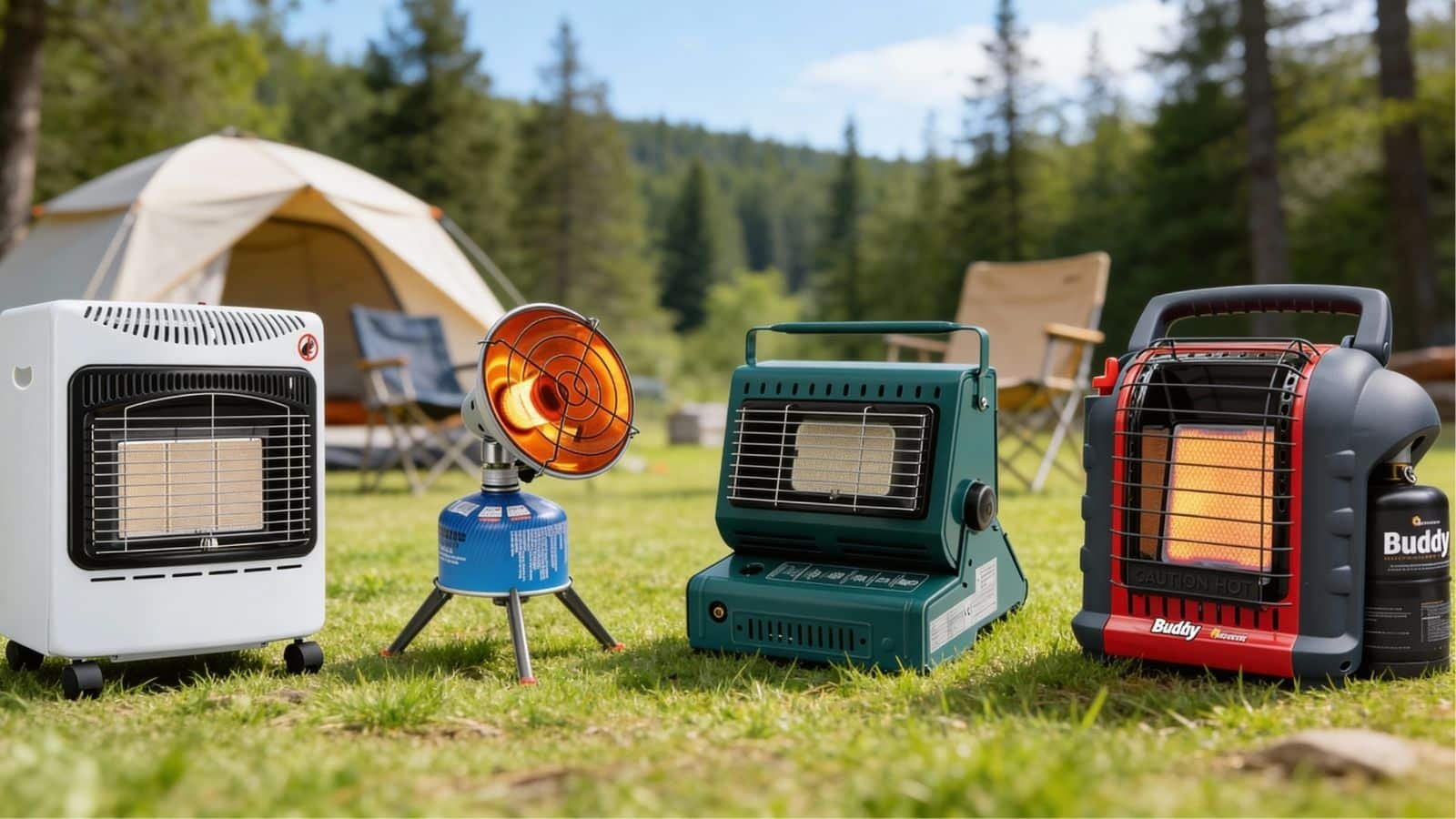
Cold-weather camping can be enjoyable with the right equipment, but staying warm requires more than a standard sleeping bag when temperatures fall.
The best camping heaters provide additional warmth for suitable outdoor spaces, open-sided shelters, and designated camping areas.
Choosing the right heater depends on your power supply, campsite rules, heating requirements, and safety considerations.
Safety first: Never operate a propane, butane, charcoal, or other fuel-burning heater inside a camping tent or enclosed sleeping space. Carbon monoxide poisoning and fire remain serious risks, even with built-in safety sensors. For enclosed tent heating, consider an appropriately rated electric heater with a safe power supply, subject to the tent manufacturer’s instructions.
The Best Camping Heaters: Our Top 5 Picks
| Camping heater | Best for | Heating output | Power source |
|---|---|---|---|
| Mr. Heater Portable Buddy MH9BX | Best overall propane heater | 4,000 to 9,000 BTU | Propane |
| Mr. Heater Little Buddy | Compact outdoor heating | 3,800 BTU | Propane |
| Mr. Heater Big Buddy MH18B | Higher heat output | Up to 18,000 BTU | Propane |
| DEWALT DXH12B | Portable worksite and outdoor use | Up to 12,000 BTU | Propane and battery for auxiliary functions |
| Lasko MyHeat Personal Heater | Campsites with electrical hookups | 200 watts | Electricity |
These models serve different heating needs. Propane models require particular attention to ventilation, location, and manufacturer restrictions. Electric models avoid combustion gases but introduce electrical and fire-safety considerations.
1. Mr. Heater Portable Buddy MH9BX
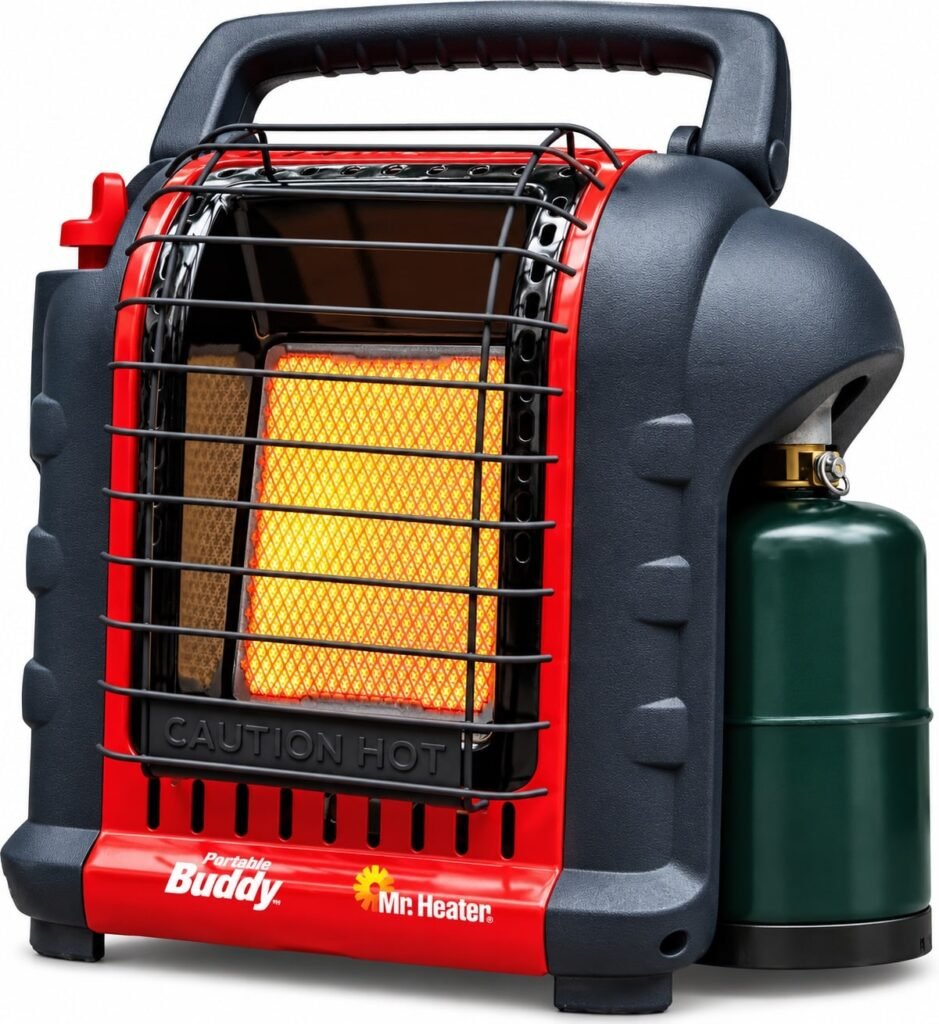
Best Overall Propane Camping Heater
The Mr. Heater Portable Buddy MH9BX is a practical option for campers who want portable radiant heat in a location where propane heating is permitted.

Its adjustable 4,000 and 9,000 BTU settings give users more control over heat output than a fixed-output heater. The unit connects to a 1-pound propane cylinder and features a fold-down carrying handle.
The heater also includes an oxygen depletion sensor and tip-over shutoff. These provide additional protection but do not eliminate carbon monoxide risks or make every enclosed location suitable.
Key Features
- Adjustable 4,000 and 9,000 BTU heat settings.
- Integrated piezo ignition.
- Oxygen depletion sensor.
- Automatic tip-over shutoff.
- Fold-down carrying handle.
- Compatible with a 1-pound propane cylinder.
- Optional connection to a larger propane tank using approved accessories.
The Portable Buddy weighs approximately 10.6 pounds without a fuel cylinder, so this is better suited to car camping than backpacking.
Advantages
- Two heating settings.
- Portable design with carrying handle.
- No electrical hookup required.
- Built-in safety shutoff systems.
Limitations
- Requires propane fuel.
- Not suitable for unattended overnight heating.
- Too bulky for most backpacking trips.
- Use in enclosed spaces depends on the exact regional model and manufacturer instructions.
Best For: Car campers and outdoor enthusiasts who need adjustable propane heating in an approved location.
The US and Canadian versions have different safety instructions. Check the manual supplied with your exact model before use.
2. Mr. Heater Little Buddy 3,800 BTU Heater
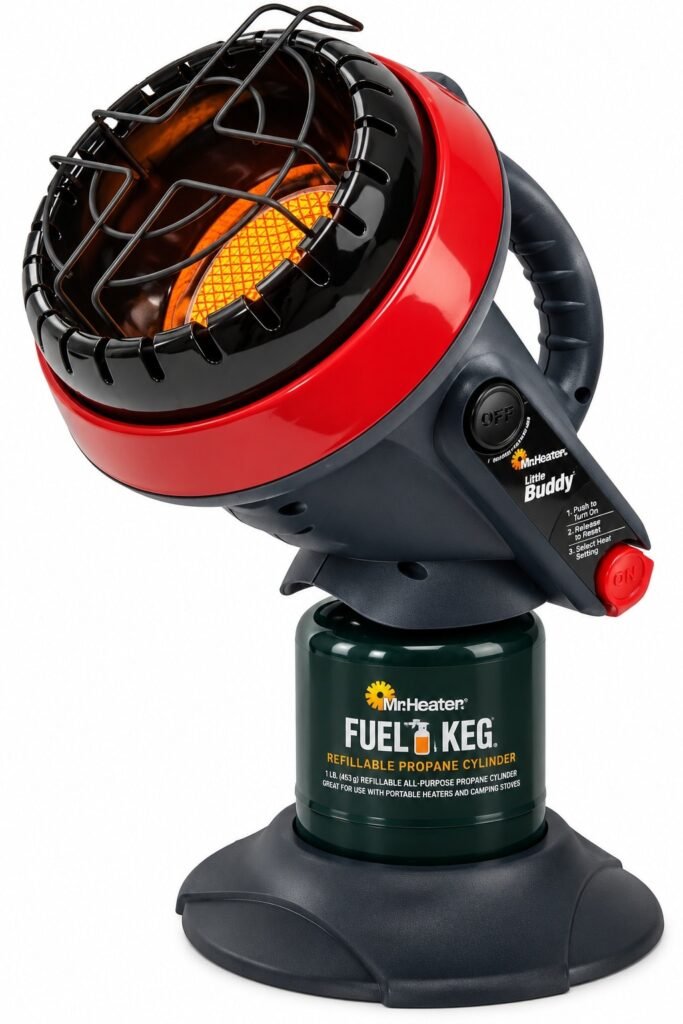
Best Compact Propane Camping Heater
The Mr. Heater Little Buddy offers a smaller alternative to the standard Portable Buddy. Its compact design makes carrying and storing the heater easier when vehicle space is limited.
One button ignition on function. 8in round stand; uses little floor space. Accidental tip-over safety shut-off. Automatic low oxygen shut-off system.

The Little Buddy provides a fixed 3,800 BTU heating output. Unlike the larger Portable Buddy, this model does not offer multiple heat settings.
It uses a 1-pound propane cylinder and a radiant heating element to provide localized warmth.
Key Features
- 3,800 BTU heating output.
- Compact portable design.
- Uses a 1-pound propane cylinder.
- Radiant heating system.
- Oxygen depletion safety sensor.
- Tip-over safety shutoff.
The Little Buddy is intended for users who need modest heating capacity rather than maximum output.
Advantages
- Smaller than full-size propane heaters.
- Simple operation.
- No electrical connection needed.
- Suitable for localized heating where permitted.
Limitations
- Fixed heat output.
- Limited heating capacity compared with larger models.
- Requires propane cylinders.
- Not suitable for heating enclosed sleeping tents.
Best For: Campers who prioritize compact equipment and need modest heat in a permitted, appropriately ventilated location.
3. Mr. Heater Big Buddy MH18B

Best High-Output Portable Camping Heater
For outdoor enthusiasts needing greater heating capacity, the Mr. Heater Big Buddy MH18B offers a step up from compact propane models.
The heater provides three heat settings, reaching a maximum output of 18,000 BTU per hour.
Its larger radiant heating surface makes the Big Buddy more appropriate for higher-demand heating applications than the Little Buddy or Portable Buddy.
The trade-off is size, weight, and fuel consumption.
Key Features
- 4,000, 9,000, and 18,000 BTU settings.
- Portable radiant heating design.
- Propane-powered operation.
- Integrated carrying handle.
- Oxygen depletion sensor.
- Tip-over safety shutoff.
- Compatibility with approved external propane connections.
The Big Buddy is best considered for appropriately ventilated locations that permit its use. A larger heating output does not make the heater suitable for a closed tent.
Advantages
- Three heating settings.
- Greater maximum output than smaller Buddy models.
- Portable design for vehicle-based trips.
- No electrical hookup required for heating.
Limitations
- Heavier and bulkier than compact heaters.
- Higher fuel consumption at maximum output.
- Requires substantial clearance from combustible materials.
- Unsuitable for unattended overnight operation.
Best For: Vehicle-based camping trips, approved outdoor work areas, and recreational applications where higher heat output is required.
4. DEWALT DXH12B Portable Propane Heater

Best Portable Heater for Outdoor Work and Camping
The DEWALT DXH12B is a portable propane heater designed around a worksite-style format.
Its combination of propane heating and battery-assisted auxiliary features makes the model worth considering for campers who already own compatible DEWALT batteries.
The battery powers auxiliary functions rather than serving as the primary heating source.
With heating output up to 12,000 BTU, the DXH12B offers more capacity than small personal propane heaters.
Key Features
- Propane radiant heating.
- Up to 12,000 BTU output.
- Portable carrying design.
- Battery-powered auxiliary functions.
- Integrated safety systems.
- Designed for recreational and worksite heating applications.
Check the exact product version for battery compatibility and included accessories. Batteries and chargers may be sold separately.
Advantages
- Useful for campers who already own compatible batteries.
- Portable design.
- Propane heating does not require mains electricity.
- Auxiliary battery-powered features add convenience.
Limitations
- More expensive equipment requirements if you need batteries.
- Bulkier than small personal heaters.
- Propane consumption adds ongoing costs.
- Not suitable for use in closed sleeping tents.
Best For: Car campers, outdoor workers, and users who want propane heat with battery-assisted convenience.
5. Lasko MyHeat 200-Watt Personal Heater

Best Compact Electric Heater for Campsite Hookups
The Lasko MyHeat offers a different approach to portable heating. Rather than burning propane, this compact personal heater runs on electricity.
Its 200-watt output makes the heater suitable for providing localized warmth rather than heating an entire family tent.
The small size makes the MyHeat easier to transport than many conventional space heaters.
For campers staying at powered campsites, a low-wattage heater can be attractive because electrical demand is considerably lower than a standard 1,500-watt space heater.
Key Features
- 200-watt electric heating.
- Compact personal heater design.
- Ceramic heating element.
- Simple controls.
- No propane cylinders required.
- Suitable for localized personal heating.
This is a household personal heater, not a weatherproof camping appliance. Only consider use in a camping shelter if the heater and shelter manufacturers explicitly permit the arrangement, the area stays dry, and the electrical supply is suitable.
Advantages
- No combustion gases.
- Compact and lightweight.
- Low electrical demand.
- No fuel cylinders to transport.
Limitations
- Requires an electrical connection.
- Limited heating output.
- Not designed for exposed outdoor conditions.
- Must be protected from moisture and combustible materials.
Best For: Campers with suitable electrical facilities who want localized warmth in an approved, dry location.
What Makes the Best Camping Heaters Safe and Effective?
Choosing a portable camping heater involves more than comparing heating output.
The most important considerations include the manufacturer’s approved operating locations, fuel type, ventilation requirements, and available safety features.
Essential Safety Features
Oxygen Depletion Sensor
An oxygen depletion sensor shuts down a compatible gas heater when oxygen levels fall below its operating threshold.
This is a useful safety feature, but an oxygen depletion sensor is not a carbon monoxide detector. Dangerous carbon monoxide exposure can occur without triggering the sensor.
Tip-Over Protection
Tip-over protection automatically shuts down compatible heaters if they are knocked over.
This reduces some fire risks but does not eliminate the danger posed by hot surfaces.
Flame Failure Protection
Some gas heaters include a system that stops the fuel supply if the flame goes out.
Check the specific model’s documentation rather than assuming every propane heater includes this feature.
Overheat Protection
Electric heaters may include automatic overheat shutoff systems.
Choose an electric model with appropriate safety certification and follow all clearance and operating requirements.
How Much Heat Do You Need?
Heat output is usually measured in BTU per hour for propane heaters and watts for electric heaters.
For comparison:
| Heater output | Equivalent power |
|---|---|
| 3,800 BTU/hr | Approximately 1,114 watts |
| 4,000 BTU/hr | Approximately 1,172 watts |
| 9,000 BTU/hr | Approximately 2,638 watts |
| 12,000 BTU/hr | Approximately 3,517 watts |
| 18,000 BTU/hr | Approximately 5,275 watts |
These figures describe heating output, not safe tent sizes.
An 18,000 BTU propane heater may provide considerable warmth in an approved location, but the greater output also increases fuel consumption and clearance requirements.
For camping tents, insulation, sleeping equipment, shelter design, and approved heating methods matter more than selecting a heater solely by BTU rating.
Buying Guide: How to Choose the Best Camping Heater
1. Propane vs Electric Camping Heaters
Propane Camping Heaters
Propane heaters are useful when electrical power is unavailable.
They provide radiant warmth and are available in several heating capacities.
Their main disadvantages include carbon monoxide risks, fuel handling, hot surfaces, and restrictions on enclosed-space use.
Electric Camping Heaters
Electric heaters avoid the combustion gases produced by propane heaters.
They require a reliable electrical supply and appropriate protection from moisture.
For campsites with electrical hookups, an electric heater approved for the intended location may be more practical than propane.
2. Portability and Weight
Backpackers generally benefit more from insulation and suitable sleeping systems than from carrying a fuel-burning heater.
Car campers have more flexibility because equipment weight is less restrictive.
A compact propane heater may fit easily in a vehicle, while a larger model offers additional heating capacity at the expense of storage space.
3. Fuel Availability
Propane is widely used in US camping equipment.
Many portable heaters connect to 1-pound propane cylinders. Larger models may support external tanks using manufacturer-approved hoses and accessories.
Always check cylinder compatibility before purchasing.
Do not use improvised adapters or refill disposable cylinders unless the cylinder is specifically designed and approved for refilling.
4. Runtime and Fuel Consumption
A propane heater’s runtime depends on its heating output and fuel supply.
Higher heat settings consume more propane.
For example, the Portable Buddy MH9BX has manufacturer-listed runtimes of approximately three hours on high and six hours on low with a 1-pound cylinder, although operating conditions affect actual results.

Mr. Heater®
Consider how much fuel you will need during the trip and store cylinders according to manufacturer instructions.
5. Campsite Restrictions
Before purchasing a heater, check whether your campground permits propane heaters, electric space heaters, or both.
Some campgrounds prohibit combustion heaters inside tents or restrict electrical appliances.
Fire restrictions may also limit outdoor propane equipment.
Camping Heater Safety: What You Need to Know
Carbon monoxide is one of the most serious hazards associated with fuel-burning camping equipment.
The US Consumer Product Safety Commission warns that camping heaters and other fuel-burning equipment can cause fatal carbon monoxide poisoning when used in enclosed areas.
U.S. Consumer Product Safety Commission
Rules for Safe Heater Operation
- Never operate fuel-burning heaters inside closed camping tents or sleeping spaces.
- Never leave a running heater unattended.
- Turn off heaters before sleeping.
- Follow the manufacturer’s minimum clearance requirements.
- Keep sleeping bags, clothing, and other flammable materials away from heating equipment.
- Use only approved fuel cylinders, hoses, and connections.
- Inspect propane equipment for damage before use.
- Keep electric heaters away from water and wet ground.
- Never connect an electric heater to an overloaded extension cord or power strip.
- Follow all campsite and fire-safety restrictions.
A carbon monoxide alarm provides additional protection where combustion appliances are permitted, but an alarm does not make an unsafe installation acceptable.
Symptoms of Carbon Monoxide Poisoning
Common symptoms include headache, dizziness, nausea, weakness, confusion, and unusual sleepiness.
If carbon monoxide exposure is suspected, move everyone into fresh air immediately and seek emergency medical assistance.
Do not return to the affected location until emergency personnel confirm that the area is safe.
Alternative Ways to Stay Warm While Camping
A portable camping heater is not always the best solution for cold nights.
For many campers, improving their sleeping equipment offers a more practical and reliable way to stay comfortable.
Insulated Sleeping Pads
An insulated sleeping pad reduces heat loss to the ground.
Check the pad’s R-value when choosing equipment for cold-weather camping. Higher R-values indicate greater resistance to heat transfer.
Cold-Weather Sleeping Bags
Choose a sleeping bag with an appropriate ISO or EN temperature rating when available.
Pay attention to the comfort rating rather than relying only on the lowest advertised temperature.
Hot Water Bottles
A properly designed hot water bottle can provide additional warmth before bedtime.
Follow the bottle manufacturer’s filling and temperature instructions. Avoid boiling water unless explicitly permitted.
Wrap the bottle to prevent direct skin contact and inspect for leaks or deterioration.
Electric Heated Blankets
Some heated blankets run from suitable portable power stations or campsite electrical supplies.
Check whether the blanket is approved for the intended camping environment, whether its power demand matches your supply, and whether the manufacturer permits use while sleeping.
[INTERNAL LINK: Best Cold Weather Sleeping Bags for Camping]
[INTERNAL LINK: Best Insulated Sleeping Pads for Winter Camping]
[INTERNAL LINK: Best Portable Power Stations for Camping]
Frequently Asked Questions
What is the best camping heater for cold weather?
The Mr. Heater Portable Buddy MH9BX offers a useful balance of adjustable heat output and portability for approved propane-heating applications.
For campers with an electrical hookup, an appropriately rated electric heater may be preferable because no propane combustion occurs.
Neither choice automatically makes heating a sleeping tent safe.
Can you use a propane heater inside a tent?
Do not assume a propane heater is safe inside a tent.
Some US heater models permit use in specified ventilated recreational enclosures, while other versions explicitly prohibit tent use. Fire hazards and carbon monoxide exposure remain serious concerns.
Follow the instructions for the exact heater and shelter. Never operate a fuel-burning heater while sleeping.
Are electric camping heaters safer than propane heaters?
Electric heaters do not generate carbon monoxide through combustion, which eliminates one major propane-related hazard.
They still present fire, burn, and electrical hazards.
Only use electric heaters in dry, approved locations with a suitable power supply.
How long does a 1-pound propane cylinder last?
Runtime depends on the heater’s fuel consumption and selected heat setting.
A small heater running at modest output generally lasts longer than a larger heater operating at maximum capacity.
Use the manufacturer’s published runtime figures to estimate your fuel requirements.
What is the best heater for winter tent camping?
For sleeping inside a conventional tent, prioritize a properly rated sleeping bag, insulated sleeping pad, suitable clothing, and weather protection.
Do not rely on a portable combustion heater to maintain a safe sleeping temperature overnight.
Can I use a camping heater during a power outage?
Some propane heaters are designed for specific emergency heating applications.
Check the exact model’s instructions for approved indoor use, ventilation requirements, and local restrictions.
Never use outdoor-only heaters inside a home, vehicle, or enclosed shelter.
[INTERNAL LINK: Best Emergency Camping Stoves for Power Outages]
Final Verdict: Which Camping Heater Should You Buy?
The best camping heater depends on where you plan to use the equipment and whether you have access to electricity.
For general portable propane heating, the Mr. Heater Portable Buddy MH9BX offers a practical combination of adjustable output, portability, and built-in shutoff systems.
For compact heating, the Little Buddy is worth considering when a smaller, fixed-output unit meets your needs.
For higher heating requirements, the Big Buddy MH18B provides additional capacity, although the extra fuel consumption and larger size make the model less convenient for lightweight camping.
The DEWALT DXH12B suits campers who want a worksite-style heater with battery-powered auxiliary features.
For campsites with electrical hookups, the Lasko MyHeat provides modest personal heating without burning propane, provided the location and electrical installation are approved for use.
Whichever heater you choose, check the manufacturer’s instructions and prioritize a safe sleeping system over overnight heater operation.
Amazon.com Product Links:
- Mr. Heater Portable Buddy MH9BX
- Mr. Heater Little Buddy
- Mr. Heater Big Buddy MH18B
- DEWALT DXH12B
- Lasko MyHeat 200-Watt Heater
These are Amazon.com product search links rather than verified direct product listings.
Safety References:
Mr. Heater Portable Buddy Product Specifications
US Consumer Product Safety Commission: Portable Heaters and Camping Equipment
Mr. Heater Portable Buddy Operating Instructions
CampEquipmentPlus relies on reader support. Purchases made via links on our website may earn us an affiliate commission at no extra cost to you, helping keep the site running.