
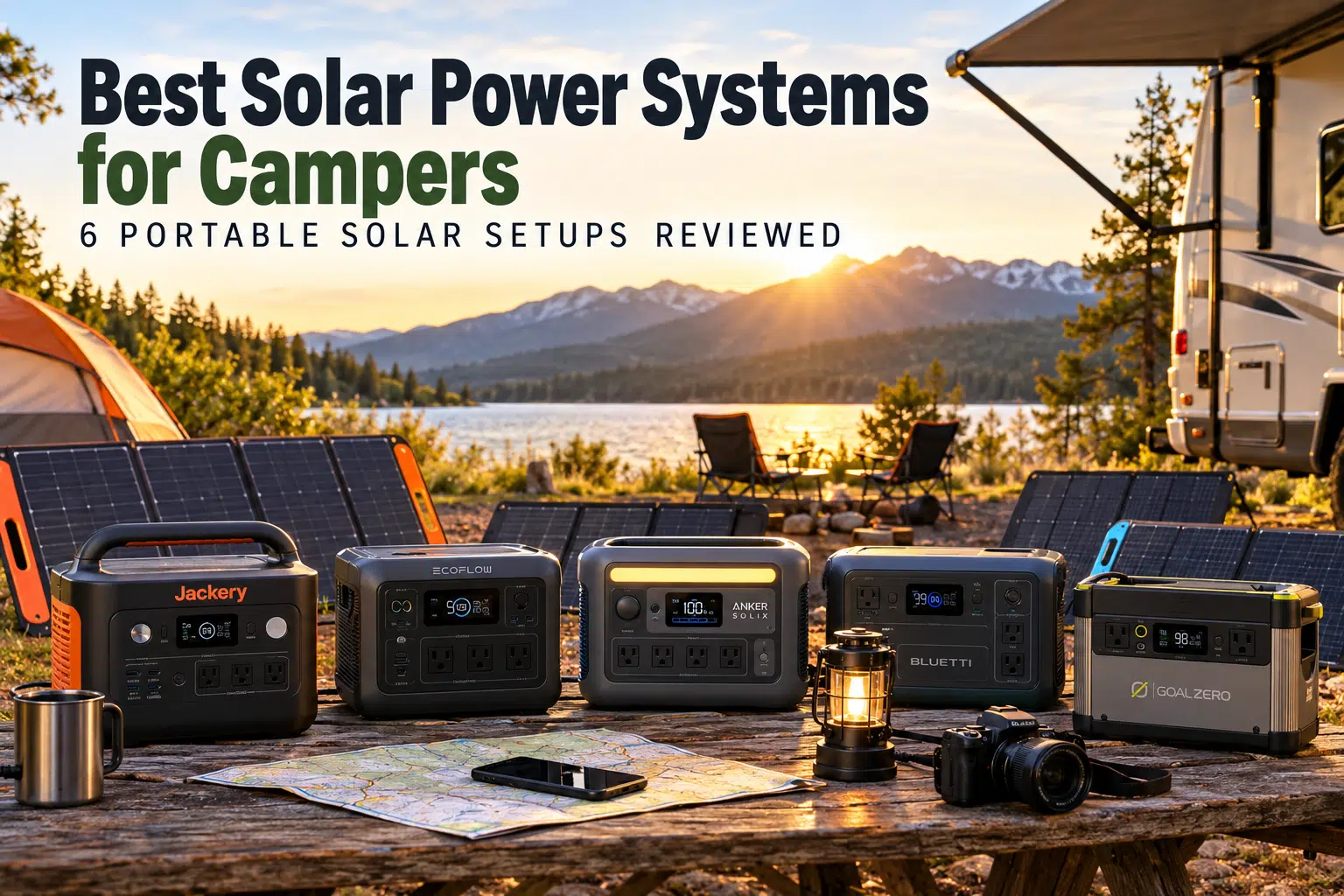
The best solar power systems for campers combine enough battery capacity for your equipment with portable solar panels capable of replacing a useful amount of the energy you consume.
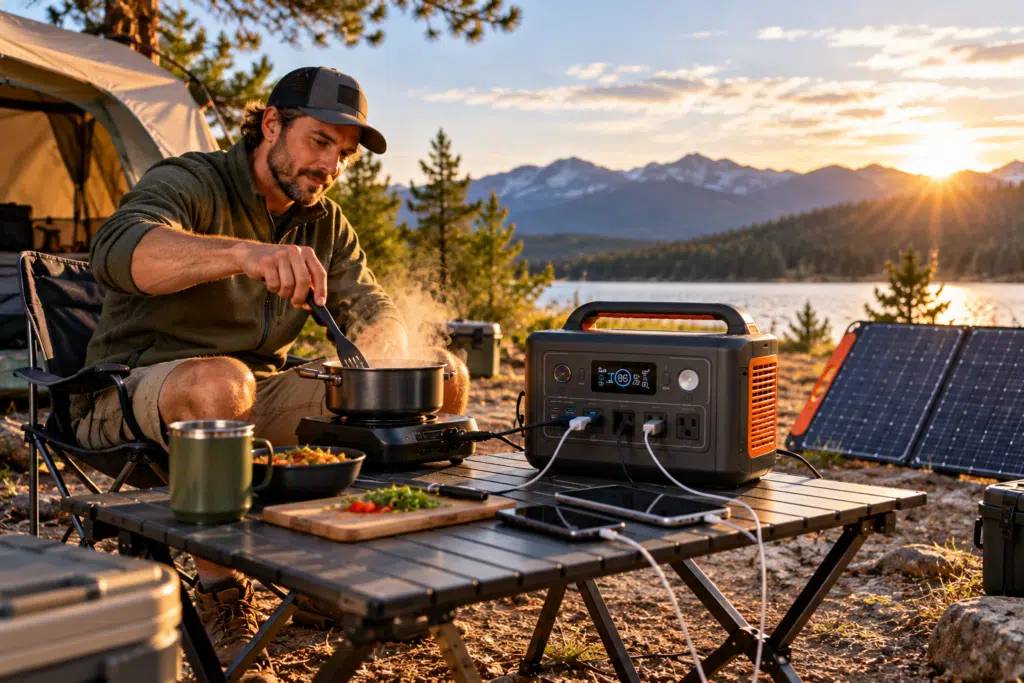
I learned the limitations of small batteries on one camping trip when I took two power banks to keep my phone and rechargeable lantern running.
Both were completely drained after two days. For longer trips, I now use a larger portable power station with portable solar panels.
That experience changed how I look at solar electric for camping. Battery capacity matters, but so does your ability to replace the energy you use.
For most car campers, a system around 1,000Wh provides a practical balance between capacity and portability. Tent campers with modest charging requirements can go much smaller.
RV campers running refrigerators, laptops and other electrical equipment should pay closer attention to inverter output and maximum solar input.
Best Solar Power Systems for Campers
| Solar Setup | AC Output | Max Solar Input | Best For |
|---|---|---|---|
| Jackery Explorer 1000 v2 + SolarSaga 200W | 1,500W | 400W | Best Overall |
| EcoFlow DELTA 3 Plus + Portable Solar Panel | 1,800W | 1,000W | RV Camping |
| EcoFlow RIVER 3 Plus + Portable Solar Panel | 600W | 220W | Tent Camping |
| Anker SOLIX C1000 Gen 2 + PS200 | 2,000W | 600W | High-Output Equipment |
| BLUETTI AC180 + 200W Solar Panel | 1,800W | 500W | High-Capacity Camping |
| Goal Zero Yeti 1500 + Nomad 200 Solar Generator | 2,000W | 900W | Vehicle Base Camps |
Quick picks: The Jackery Explorer 1000 v2 offers the best balance for general camping. The EcoFlow DELTA 3 Plus is better suited to RV campers who want greater solar-input capacity. The EcoFlow RIVER 3 Plus makes more sense when low weight matters. The Anker SOLIX C1000 Gen 2 provides the highest continuous AC output of the six.
What Are the Best Solar Power Systems for Campers?
The best solar power systems for campers match battery capacity, AC output and solar charging capability to the equipment you actually expect to run.
Do not start by looking for the largest battery.
A tent camper charging two phones, a camera and LED lights has little reason to haul a 35 lb power station into camp. An RV camper running a refrigerator, laptops, lights and other electrical equipment has a very different requirement.
For this guide, I compared battery capacity, continuous output, maximum solar input, battery chemistry, weight, panel compatibility and practical camping suitability.
The specifications matter, but only when they solve a problem you actually have.
#1 – Jackery Explorer 1000 v2 + SolarSaga 200W: Best Overall
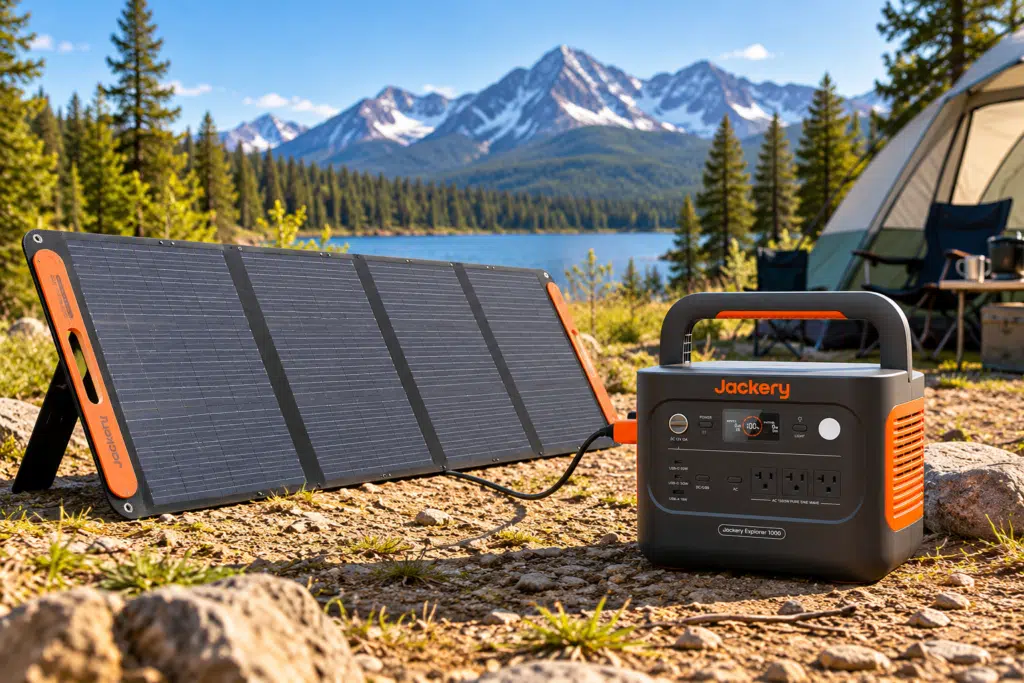
The Jackery Explorer 1000 v2 paired with a SolarSaga 200W is the setup I would choose for most car campers who want useful capacity without moving into a much larger power station.
1 Hr Fast Charge, LiFePO4 Battery, 100W USB-C Output, for Outdoor, Off-Grid Living, RV, Emergency

Key Specifications
- Battery capacity: 1,070Wh
- Battery chemistry: LiFePO4
- Continuous AC output: 1,500W
- Surge output: 3,000W
- Maximum solar input: 400W
- Power station weight: 23.8 lb
- Suggested panel: SolarSaga 200W
Jackery specifies a 1,070Wh LiFePO4 battery, 1,500W continuous output, 3,000W surge output and maximum 400W solar input for the Explorer 1000 v2.
That combination puts the Jackery in a useful middle ground.
The 1,070Wh battery moves well beyond simply charging phones. There is enough capacity for campsite lighting, cameras, laptops, rechargeable equipment and suitable 12V devices while keeping the station reasonably portable.
Weight is one of its advantages.
At 23.8 lb, the station is considerably easier to move than some 1 kWh alternatives.
The solar side deserves more thought.
Pairing the station with one 200W SolarSaga uses only half of its 400W maximum solar-input capability. One panel makes sense when packed size matters, while additional compatible panel capacity becomes more useful on longer trips.
Jackery publishes manufacturer recharge estimates for its solar generator combinations, but I would not plan a camping trip around a best-case charging figure. Shade, cloud, panel angle, temperature and available sunlight all affect output.
Pros
- Useful 1,070Wh capacity
- 1,500W continuous output
- LiFePO4 battery
- 23.8 lb station weight
- Up to 400W solar input
- Good balance for car camping and RV use
Cons
- One 200W panel does not use the full solar-input capacity
- Larger than necessary for basic phone and light charging
- Solar charging performance depends heavily on conditions
Who Should Buy It?
Choose the Jackery if you want one system capable of covering normal car camping, longer campground stays and occasional RV use without moving into a particularly heavy power station.
For many campers, this is around the point where portable power starts feeling genuinely useful without becoming cumbersome.
#2 – EcoFlow DELTA 3 Plus
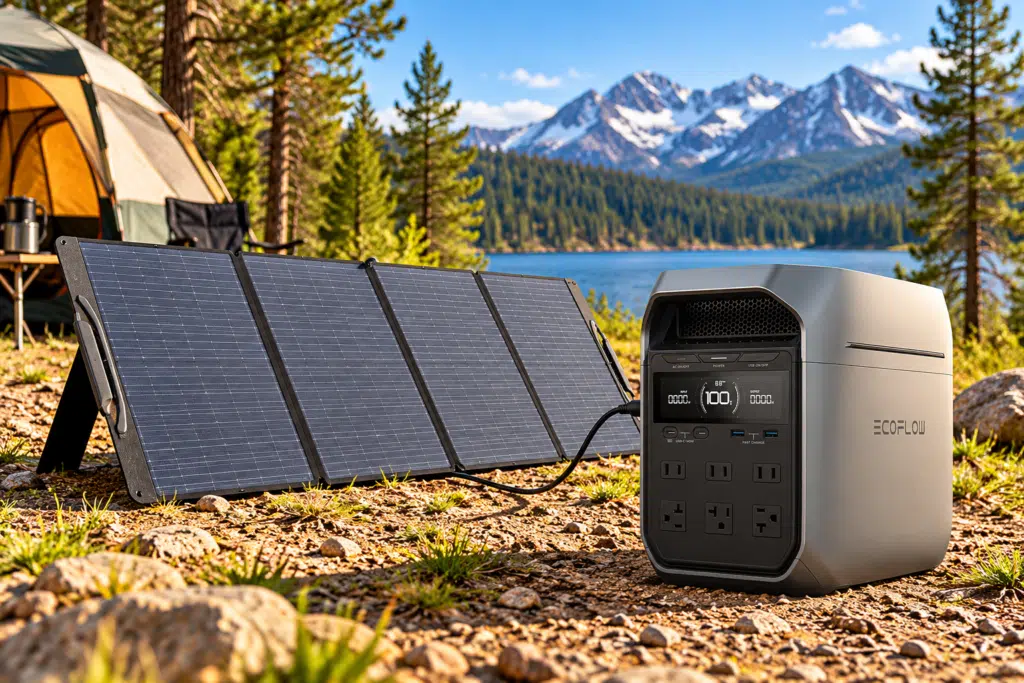
The EcoFlow DELTA 3 Plus is particularly well suited to RV and vehicle camping because its 1,000W maximum solar input provides considerably more charging headroom than most systems in this roundup.
Full Charge in 56 Min, 1800W AC/140W USB-C Output, Solar Generator (Solar Panel Optional) for Home Backup, Camping&RV

Key Specifications
- Battery capacity: 1,024Wh
- Battery chemistry: LFP
- Continuous AC output: 1,800W
- Surge output: 3,600W
- Maximum solar input: 1,000W
- Power station weight: approximately 27.6 lb
- Expandable capacity: up to 5kWh with compatible batteries
EcoFlow lists a 1,024Wh capacity, 1,800W AC output and up to 1,000W photovoltaic input for the DELTA 3 Plus.
That solar specification is the interesting part.
Several power stations sit around the 1 kWh mark. Far fewer accept this much portable solar input.
For campers spending several days away from hookups, greater solar-input capacity provides more opportunity to replace the previous day’s energy use during a useful period of sunshine.
This makes particular sense when looking at solar panels for RV campers.
The 1,800W inverter also gives you more AC output than the Jackery, although output and battery capacity should not be confused.
A 1,800W inverter tells you how much load the power station can support. The 1,024Wh capacity tells you how much energy the battery stores.
Running a high-wattage appliance can still empty a 1 kWh battery surprisingly quickly.
The main compromise comes when you start adding large panels.
A substantial portable solar array needs storage space, adds weight and requires enough clear ground at camp to position properly.
Pros
- 1,024Wh capacity
- 1,800W continuous output
- 3,600W surge output
- Up to 1,000W solar input
- Expandable battery capacity
- Strong option for RV and vehicle camping
Cons
- Large solar arrays add considerable weight and bulk
- More system than many weekend campers need
- High-output appliances can still drain 1,024Wh quickly
Who Should Buy It?
Choose the DELTA 3 Plus if you camp from an RV, campervan or vehicle and expect solar replenishment to form a meaningful part of your power setup.
If portability matters more than daily energy production, a smaller station makes more sense.
#3 – EcoFlow RIVER 3 Plus + Portable Solar Panel: Best for Tent Camping
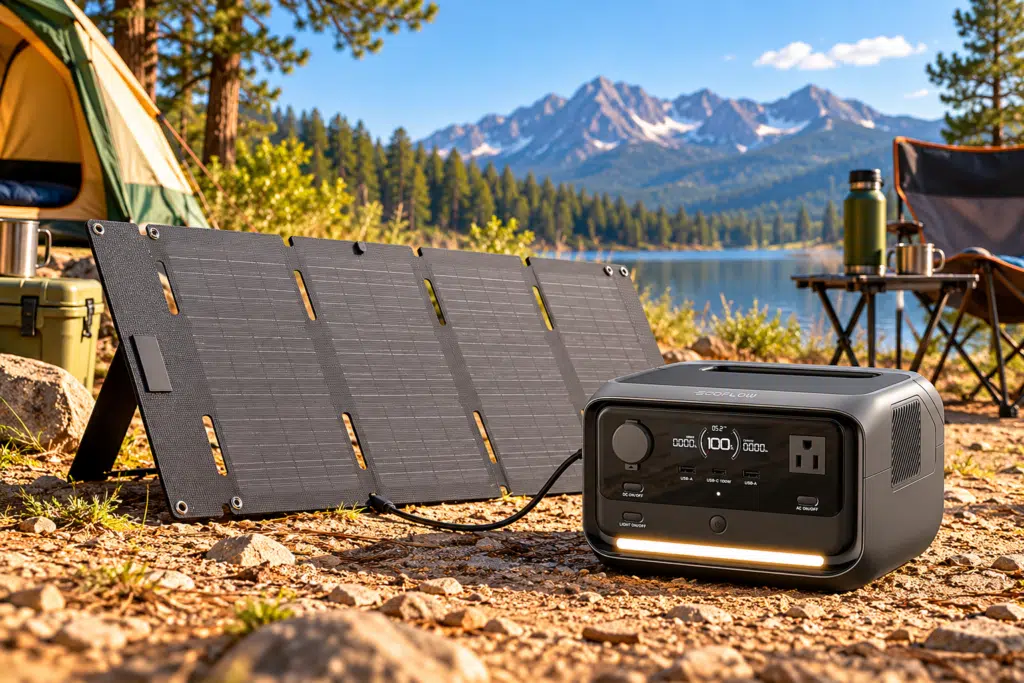
The EcoFlow RIVER 3 Plus is a better fit for tent campers who mainly need to charge electronics and run modest electrical equipment.
1 Hr Fast Charge, LiFePO4 Battery, 100W USB-C Output, for Outdoor, Off-Grid Living, RV, Emergency
Key Specifications
- Battery capacity: 286Wh
- Battery chemistry: LiFePO4
- Continuous AC output: 600W
- Surge output: 1,200W
- Maximum solar input: 220W
- Power station weight: approximately 10.4 lb
EcoFlow specifies a 286Wh battery, 600W rated output and up to 220W solar input for the RIVER 3 Plus. The LiFePO4 battery is rated by EcoFlow for 3,000 cycles before reaching 80% capacity.
This is a very different proposition from carrying a 1 kWh power station.
At roughly 10.4 lb, the RIVER 3 Plus is much easier to move around camp. Its 286Wh capacity makes sense for phones, cameras, rechargeable lights and other small electronics.
The compromise is obvious.
A 286Wh battery has less than one-third of the nominal stored energy of the 1 kWh systems in this guide.
For a simple example, equipment drawing 100W continuously would theoretically consume 200Wh in two hours. Actual runtime will also be affected by conversion losses and operating conditions.
For tent camping, that limitation may be perfectly acceptable.
If your electrical kit consists mainly of phones, LED lighting, camera batteries and USB devices, carrying another 15 or 20 lb of unused battery capacity makes little sense.
Pair the RIVER 3 Plus with a suitable solar panel for camping and you have a compact setup that can replenish energy without occupying a large section of your vehicle.
Pros
- Approximately 10.4 lb
- 286Wh capacity suits lighter electrical requirements
- 600W continuous output
- Up to 220W solar input
- LiFePO4 battery
- Easier to pack than 1 kWh systems
Cons
- Limited 286Wh capacity
- Poor choice for sustained high-demand equipment
- Smaller reserve during poor solar conditions
Who Should Buy It?
Choose the RIVER 3 Plus if you are a tent or car camper who wants more capability than a conventional power bank without carrying a large solar generator.
This is also a good example of why bigger is not automatically better.
#4 Is the Anker SOLIX C1000 Gen 2 Best for High-Output Equipment?
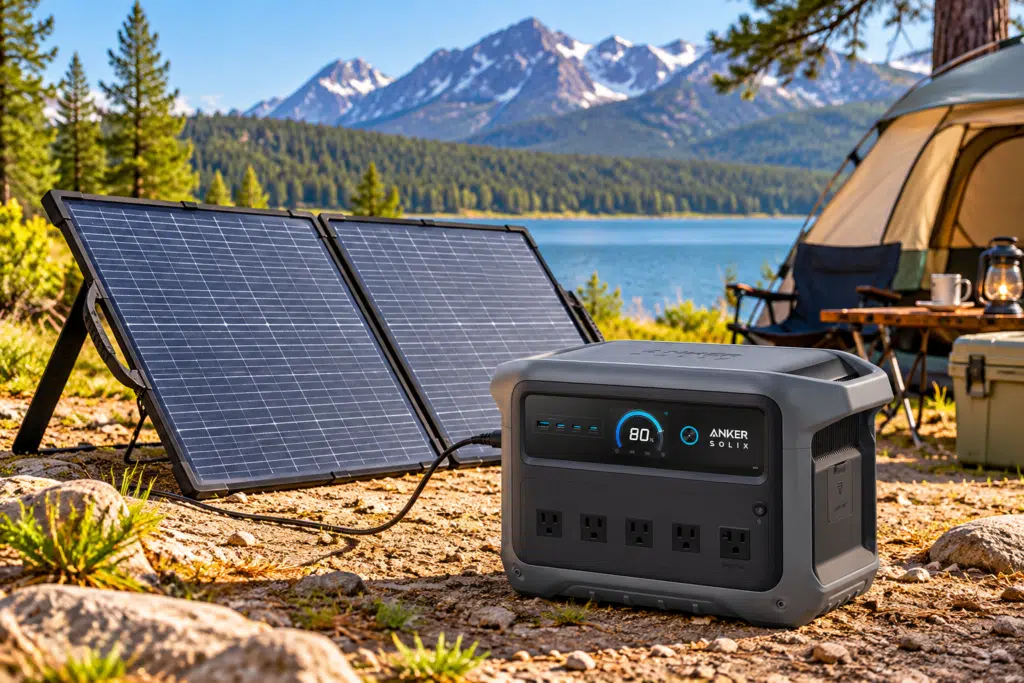
The Anker SOLIX C1000 Gen 2 is the strongest choice here when high continuous AC output matters but you still want a power station around the 1 kWh mark.
2,000W Solar Generator with 1,024Wh LiFePO4 Battery, Up to 3,000W Output, Full Charge in 49 Min, for UPS, Home, Outdoor

Key Specifications
- Battery capacity: 1,024Wh
- Battery chemistry: LFP
- Continuous AC output: 2,000W
- Peak output: 3,000W
- Maximum solar input: 600W
- Power station weight: 24.9 lb
- Suggested panel: Anker PS200
Anker specifies a 1,024Wh battery, 2,000W continuous output, 3,000W peak output and up to 600W solar input for the C1000 Gen 2.
The 2,000W continuous output is the specification that separates this model from most similarly sized batteries.
Watts and watt-hours are easy to confuse.
Watts tell you how much power equipment draws at a given moment. Watt-hours describe stored energy.
A 2,000W inverter does not give the Anker twice the runtime of a 1,000W system. The battery still stores 1,024Wh.
Instead, the higher inverter rating allows the station to support equipment with greater power requirements, provided the connected equipment remains within Anker’s operating limits.
Anker also sells the C1000 Gen 2 with its PS200 panel, while the station itself supports up to 600W solar input.
That gives you room to expand beyond a single 200W panel when longer trips justify carrying more solar capacity.
Pros
- 2,000W continuous AC output
- 3,000W peak output
- 1,024Wh LFP battery
- Up to 600W solar input
- 24.9 lb station weight
- Strong output for its capacity class
Cons
- High inverter output does not increase runtime
- 1,024Wh can disappear quickly under heavy loads
- More capability than basic campsite charging requires
Who Should Buy It?
Consider the Anker if your equipment has higher startup or operating wattage and smaller camping power stations cannot support the load.
Check the actual wattage requirements of your equipment before buying. Extra inverter capacity has little value if you never use it.
#5 – BLUETTI AC180 + 200W Solar Panel: Best Higher-Capacity Alternative
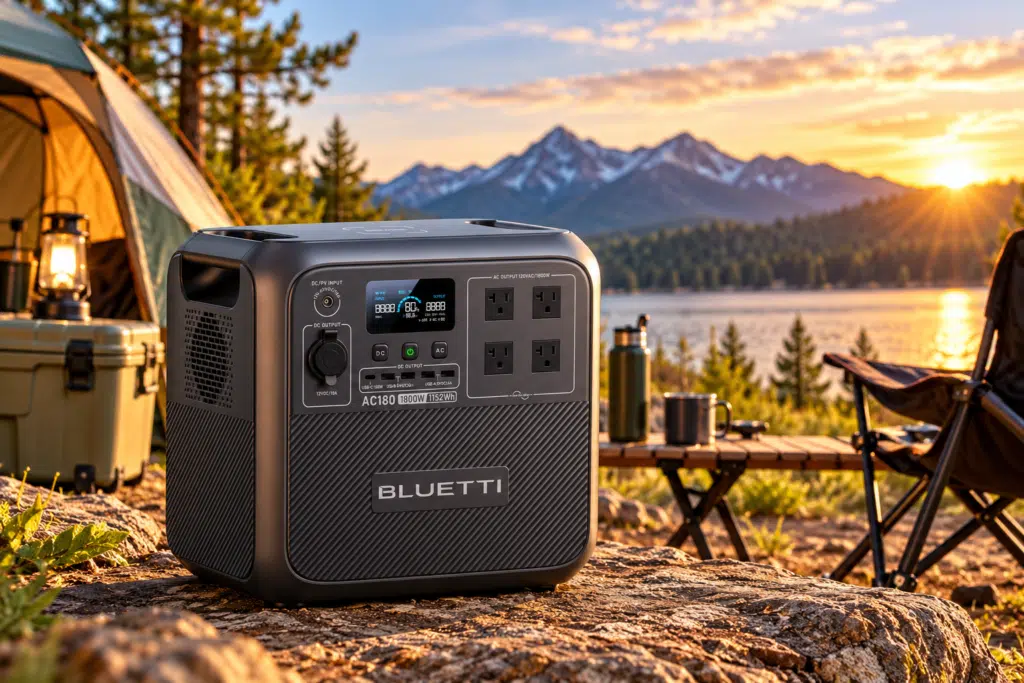
The BLUETTI AC180 offers slightly more battery capacity than most of the 1 kWh systems here, but its 35.3 lb weight makes the tradeoff easy to spot.
The AC180 packs a 1152Wh LiFePO4 battery, which can be fully charged in just 1 hour at 1440W AC input - always ready to go when you need it.

Key Specifications
- Battery capacity: 1,152Wh
- Battery chemistry: LiFePO4
- Continuous AC output: 1,800W
- Surge output: 2,700W
- Maximum solar input: 500W
- Power station weight: 35.3 lb
BLUETTI specifies a 1,152Wh LiFePO4 battery, 1,800W AC output and maximum 500W solar input for the AC180.
The manufacturer rates the battery for more than 3,500 cycles before reaching 80% of original capacity.
The extra capacity gives you a little more energy reserve than the 1,024Wh systems.
Do not overstate that advantage.
An extra 128Wh is useful, but I would not choose the AC180 purely because 1,152 is a bigger number than 1,024.
Weight deserves equal attention.
At 35.3 lb, the AC180 is more than 11 lb heavier than the Jackery Explorer 1000 v2. Once you add a portable panel and cables, the difference becomes noticeable.
For an RV or vehicle campsite, that may barely matter.
If you regularly carry the station from a parking area to your pitch, you may feel differently.
BLUETTI also offers the AC180 as a solar generator with several panel configurations, including 200W and 400W options. Its 500W maximum solar input leaves useful headroom for longer off-grid stays.
Pros
- 1,152Wh LiFePO4 battery
- 1,800W continuous output
- 2,700W surge output
- Up to 500W solar input
- Useful capacity for longer camps
Cons
- 35.3 lb station weight
- Noticeably heavier than several alternatives
- Additional capacity is relatively modest compared with the weight increase
Who Should Buy It?
The AC180 suits vehicle-based campers who place greater value on stored energy than low carrying weight.
For short weekend trips with modest electrical use, I would choose something lighter.
#6 – Goal Zero Yeti 1500: Best for High-Capacity Camping
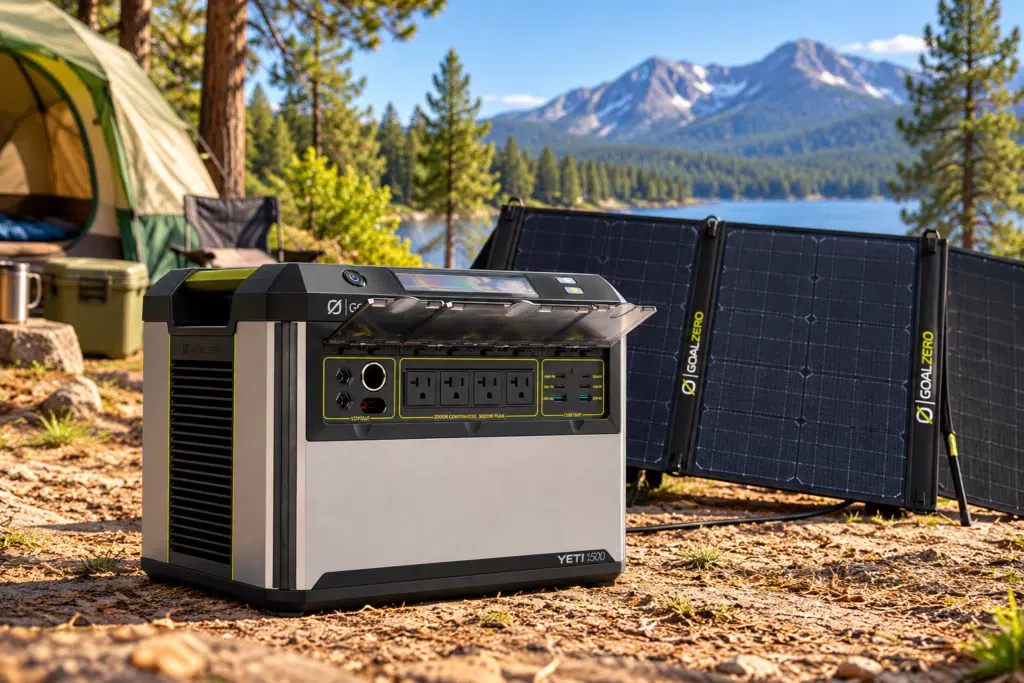
The Goal Zero Yeti 1500 is the largest-capacity system in this roundup, combining a 1,505Wh LiFePO4 battery with 2,000W continuous output and up to 900W of solar input.
1,505Wh LiFePO4 Battery, 2,000W Inverter with 3,600W Surge, 0-80% Recharge Under 1 Hour, IPX4 Weatherproof Aluminum Casing

Key Specifications
- Battery capacity: 1,505Wh
- Battery chemistry: LiFePO4
- Continuous AC output: 2,000W
- Surge output: 3,600W
- Maximum combined solar input: 900W
- Power station weight: 52.75 lb
- Cycle rating: 4,000 cycles to 80% capacity
- Water resistance: IPX4
The new Yeti 1500 is a significant upgrade over older Goal Zero power stations. Goal Zero specifies a 1,505Wh LiFePO4 battery rated for 4,000 cycles to 80% of original capacity, along with a 2,000W pure sine wave inverter and 3,600W surge output.
The larger battery gives the Yeti considerably more stored energy than the roughly 1,000Wh systems elsewhere in this guide. That extra capacity makes more sense for RV camping, extended vehicle-supported trips and campers running several electrical devices.
Solar charging is another strong point.
The Yeti 1500 accepts up to 900W of combined solar input. Goal Zero lists approximately 8.6 hours with 200W solar input, 4.3 hours at 400W and around three hours at 600W under its specified conditions.
Those figures should still be treated as manufacturer estimates. Available sunlight, shade, temperature and panel positioning will affect real charging performance.
The main drawback is weight.
At 52.75 lb, the Yeti 1500 is considerably heavier than the Jackery Explorer 1000 v2, EcoFlow DELTA 3 Plus and Anker SOLIX C1000 Gen 2. This is a power station I would want to move from the vehicle to a nearby campsite, not carry any meaningful distance.
Pros
- Large 1,505Wh LiFePO4 battery
- 2,000W continuous AC output
- 3,600W surge output
- Up to 900W combined solar input
- 4,000-cycle manufacturer rating
- IPX4 water-resistance rating
- Strong fit for longer vehicle-supported trips
Cons
- Heavy at 52.75 lb
- Excessive for basic phone, camera and light charging
- Larger solar arrays add further weight and storage requirements
Who Should Buy It?
Choose the Goal Zero Yeti 1500 if battery capacity and solar replenishment matter more than portability.
Its combination of 1,505Wh capacity, 2,000W output and 900W maximum solar input makes more sense for RV campers, overlanders and longer vehicle-supported trips than lightweight tent camping.
If your electrical requirements are modest, one of the smaller systems in this guide will be considerably easier to transport.
How Much Solar Power Do You Actually Need for Camping?
You need enough stored energy to cover your expected consumption, plus enough solar capacity to replace a useful proportion of that energy during longer trips.
Start with watt-hours.
The basic calculation is:
Device wattage × hours used = watt-hours consumed
For example:
| Device | Example Power | Daily Use | Energy Required |
|---|---|---|---|
| LED light | 10W | 5 hours | 50Wh |
| Laptop | 60W | 2 hours | 120Wh |
| Small fan | 30W | 5 hours | 150Wh |
| Example refrigerator load | 40W | 10 hours | 400Wh |
These numbers demonstrate the calculation rather than representing every appliance.
Check your own equipment.
If your campsite uses roughly 700Wh per day, a 300Wh power station is clearly undersized unless you are generating substantial energy while using the battery.
A 1,000Wh-class system starts making more sense.
You should also allow for conversion losses. A battery labelled 1,024Wh should not be treated as delivering exactly 1,024Wh from an AC outlet.
You can find more portable charging equipment in the Camp Equipment Plus Lighting & Power section.
Is a 100W or 200W Solar Panel Better for Camping?
A 100W panel makes more sense when portability matters most, while a 200W panel is generally more useful for replenishing medium and larger portable power stations.
A solar power panel for camping does not constantly produce its advertised wattage.
A 200W panel carries a 200W rating under specified test conditions. Real campsite output changes throughout the day.
Shade matters. Panel angle matters. Cloud matters.
When 100W Makes Sense
A 100W panel suits campers with modest daily consumption who prioritize lower weight and smaller packed dimensions.
Pairing one with a 250Wh to 500Wh station can make sense for phones, lights, cameras and similar electronics.
When 200W Makes Sense
A 200W panel becomes more useful when you have a 500Wh to 1,000Wh power station and expect to stay away from hookups for several days.
More panel capacity gives you the potential to collect more energy during the same period of useful sunlight.
The compromise is more weight, more packed volume and more ground area required at camp.
What About 400W?
A 400W portable solar setup makes more sense for RV camping, overlanding and longer vehicle-supported trips.
Check your power station before buying one.
A station accepting only 200W of solar input cannot make full use of a 400W array under conditions where the panels could otherwise exceed that input limit.
Voltage and current limits matter too.
Compatibility is more important than the headline wattage.
How Much Solar Do RV Campers Need?
RV campers should calculate daily energy consumption before deciding how many watts of solar panels they need.
This is particularly important when comparing solar panels for RV campers.
List the equipment your portable system needs to power.
That could include:
- 12V refrigerator
- Phones and tablets
- Laptops
- Campsite lighting
- Fans
- Camera equipment
- TV
- CPAP equipment
- Rechargeable tools
- Other USB and 12V devices
Then estimate how long each device operates each day.
A refrigerator demonstrates why simple calculations have limitations.
A compressor refrigerator does not necessarily draw its rated running power continuously for 24 hours. Ambient temperature, thermostat setting, insulation, food temperature and how often you open the door can change consumption.
Measure actual consumption when practical.
Once you know approximately how many watt-hours you use each day, choosing battery and solar capacity becomes much easier.
For other RV equipment guides, browse the Camp Equipment Plus camping equipment section.
What Should You Look for in Solar Power Systems for Campers?
You should prioritize battery capacity, continuous inverter output, maximum solar input, battery chemistry, portability and panel compatibility.
Battery Capacity
Battery capacity is normally expressed in watt-hours.
A 1,000Wh battery stores roughly four times the nominal energy of a 250Wh battery.
That does not mean you receive exactly the labelled capacity from an AC outlet. Conversion losses and operating conditions reduce usable energy.
Wh is still the first specification I would compare when estimating runtime.
Continuous AC Output
Continuous output tells you how much AC load the inverter is designed to support.
Capacity and output answer different questions.
Battery capacity tells you how much energy you have.
Inverter output tells you what equipment you can run at a given moment.
Solar Input
Solar input gets overlooked surprisingly often.
Suppose you buy a 1,000Wh battery because you expect to consume 700Wh per day.
If the station accepts only a modest amount of solar input, replacing that energy may take a long time.
For weekend camping, that may not matter.
For a week away from hookups, solar input can become one of the most important specifications.
Battery Chemistry
Most newer systems in this guide use LiFePO4 batteries.
Manufacturers including Jackery, EcoFlow, Anker and BLUETTI publish cycle-life figures running into thousands of cycles for the models covered here.
Do not assume every published cycle figure is directly comparable. Manufacturers can use different testing conditions and capacity thresholds.
Power Station Weight
Weight sounds uninteresting until you carry the battery.
The EcoFlow RIVER 3 Plus weighs around 10.4 lb.
The BLUETTI AC180 weighs around 35.3 lb.
Those products solve different problems.
For an RV where the battery moves a few feet, 35 lb may be perfectly manageable. For a tent pitch some distance from the parking area, the difference becomes more important.
Solar Panel Weight and Packed Size
Do not size the battery and forget the panel.
Large sun panels for camping require storage space in your vehicle and clear space at the campsite.
The Goal Zero Boulder 200 is a particularly good example. The panel alone weighs 42 lb.
Check folded dimensions as well as weight.
Connections and Compatibility
Never assume every portable panel works with every power station.
Check:
- Connector type
- Input voltage range
- Maximum input current
- Maximum solar wattage
- Manufacturer compatibility requirements
Third-party panels may work with some stations, but electrical compatibility must be verified.
Follow the manufacturer’s connection and operating instructions.
How Long Does Solar Charging Take?
Solar charging can take several hours to most of a day or longer depending on battery capacity, panel wattage, available sunlight, panel positioning and the station’s input limit.
A simple theoretical calculation starts with:
Battery capacity ÷ panel output
A 1,000Wh battery divided by 200W gives five hours.
Do not plan around that figure.
The calculation assumes the panel continuously delivers its rated 200W and ignores conversion losses.
Real production varies with:
- Sun intensity
- Cloud cover
- Panel angle
- Shade
- Temperature
- Season
- Time of day
- Charging losses
- Power station limits
The Goal Zero example demonstrates the difference. Its 983Wh Yeti 1000 Core paired with a 200W Boulder panel has a manufacturer recharge estimate of 6 to 12 hours, rather than the roughly five hours suggested by simple division.
Solar is variable.
Leave yourself some margin.
Are Portable or Fixed Solar Panels Better for RV Camping?
Portable solar panels offer more positioning flexibility, while fixed RV panels remove the need to unpack and set up panels every day.
Neither approach is automatically better.
Portable Solar Panels
A portable solar panel for camping can be positioned independently of your vehicle.
You can park the RV or campervan in shade while placing the panel somewhere sunnier, subject to cable length and campsite restrictions.
You can also reposition portable panels as the sun moves.
The disadvantages are setup, storage and having more equipment outside the vehicle.
Fixed RV Solar Panels
Fixed panels stay on the roof.
There is nothing to unpack each morning.
The compromise is that your vehicle determines where the panels sit.
Park under trees to keep the RV cooler and you may also shade your solar array.
Permanent RV solar installations also involve different electrical and installation considerations from the portable systems covered here.
Are Solar Panels Worth Taking Camping?
Solar panels are worth taking when your trip is long enough that replenishing your battery matters.
They are less useful when your power station already stores enough energy for the whole trip.
Suppose you arrive on Friday with a charged 1,070Wh power station and expect to consume only 300Wh before leaving Sunday.
Dragging a large 400W panel along achieves very little.
For a seven-day trip consuming several hundred watt-hours every day, the calculation changes.
This is why I prefer looking at solar products for camping as a complete system rather than shopping for the battery and panel independently.
Ask three questions:
- How much energy will I use?
- How much energy can my battery store?
- How much can my solar setup realistically replace?
Those answers tell you far more than choosing the largest numbers on a specification sheet.
My Experience Switching From Power Banks to Camping Solar
My move toward a larger camping power setup started with a fairly simple mistake.
I thought two small power banks would be enough.
I was only charging a phone and rechargeable lantern, so the setup seemed reasonable. After two days, both power banks were completely drained.
The problem was not simply battery capacity. Once the power banks were empty, I had no practical way to replenish them at camp.
I now use a larger portable power station with portable solar panels on longer trips.
That gives me more stored energy and, more importantly, a way to put energy back into the battery while I am away.
I still would not automatically take a large solar setup.
For a short trip with low electrical consumption, a charged power station may already contain everything you need. For longer trips, being able to replenish the battery changes the usefulness of the setup considerably.
You can read more about how Camp Equipment Plus approaches gear recommendations on the About page.
What Mistakes Should You Avoid When Buying Camping Solar?
The biggest mistake is buying equipment based on headline specifications without calculating how much electricity you actually need.
Buying Too Much Battery and Too Little Solar
A large battery can keep you going for several days.
Eventually, you still have an empty battery.
For longer off-grid trips, compare your daily consumption with the amount of energy your solar setup can realistically replace.
Looking Only at Inverter Wattage
A 2,000W inverter sounds better than a 1,500W inverter.
That does not mean the battery lasts longer.
Compare watts and watt-hours separately.
Assuming a 200W Panel Always Produces 200W
A solar panel’s rated output is not a promise of constant campsite production.
Cloud, shade, temperature, orientation and changing sun conditions affect output.
Ignoring Maximum Solar Input
Check the station’s solar-input specifications before buying additional panels.
More theoretical panel output does not help much when the charge controller cannot accept the extra power.
Forgetting Panel Size
Check folded dimensions before buying.
Then check your vehicle.
A panel can be electrically suitable and still be thoroughly inconvenient to transport.
Buying Incompatible Equipment
Panel voltage, current, connectors and power-station input limits need to work together.
Do not assume compatibility because both products mention solar charging.
Ignoring Your Actual Consumption
Start with the equipment, not the power station.
Write down what you plan to run, its wattage and approximate daily runtime.
Then choose your battery and panels.
Which Solar Power System Should You Choose?
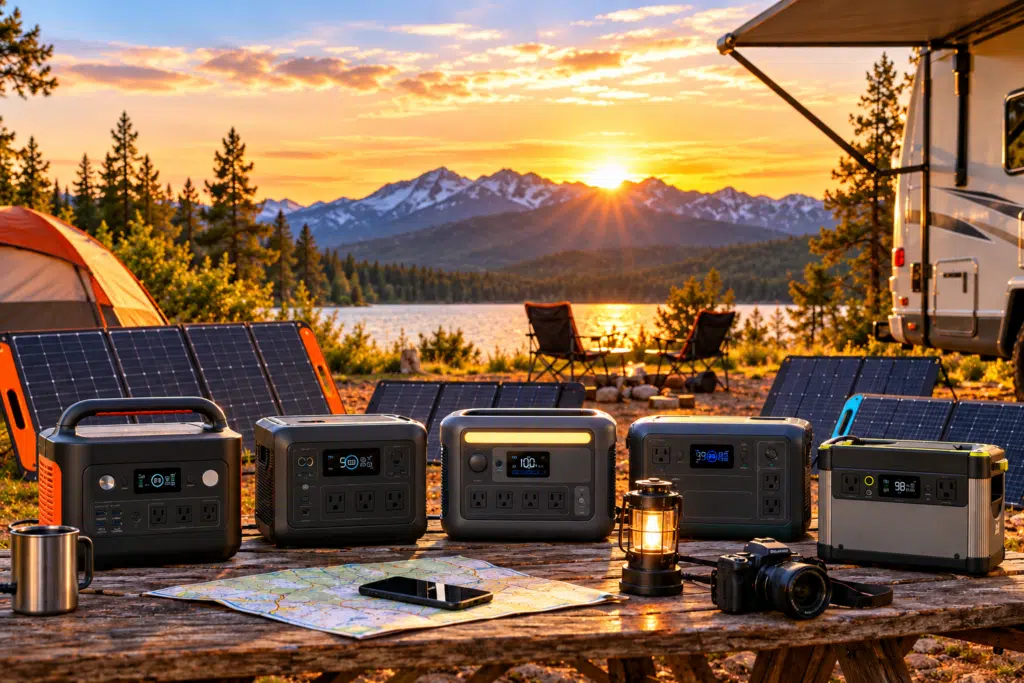
For most car campers, the Jackery Explorer 1000 v2 with a SolarSaga 200W offers the most balanced combination here. Its 1,070Wh battery, 1,500W inverter and 23.8 lb station weight cover a useful range of camping requirements without becoming excessively heavy.
The EcoFlow DELTA 3 Plus makes more sense for RV campers and longer off-grid stays where solar replenishment is a priority. Its maximum 1,000W solar input is the standout specification.
For tent camping and lighter electrical requirements, I would look closely at the EcoFlow RIVER 3 Plus. The 286Wh battery has obvious limitations, but carrying battery capacity you never use has drawbacks too.
The Anker SOLIX C1000 Gen 2 makes sense when higher AC output matters. Its 2,000W continuous inverter is impressive for a station weighing about 24.9 lb.
The BLUETTI AC180 provides slightly greater battery capacity and 500W solar input, although its 35.3 lb weight makes this a better fit for vehicle-supported camping.
The Goal Zero Yeti 1000 Core + Boulder 200 is harder to recommend against newer LiFePO4 systems. Its 983Wh NMC battery, 500-cycle manufacturer rating, 31.68 lb station and 42 lb panel create significant compromises. Existing Goal Zero users may still find the combination useful, but new buyers have stronger alternatives to compare.
The main rule is simple.
Work out how much electricity you actually use before deciding how much solar equipment to buy.
A good camping solar system does not need the largest battery, inverter or solar panel.
It needs enough stored energy for your equipment, enough output to run that equipment, and enough solar capacity to support the way you actually camp.
CampEquipmentPlus relies on reader support. Purchases made via links on our website may earn us an affiliate commission at no extra cost to you, helping keep the site running.