
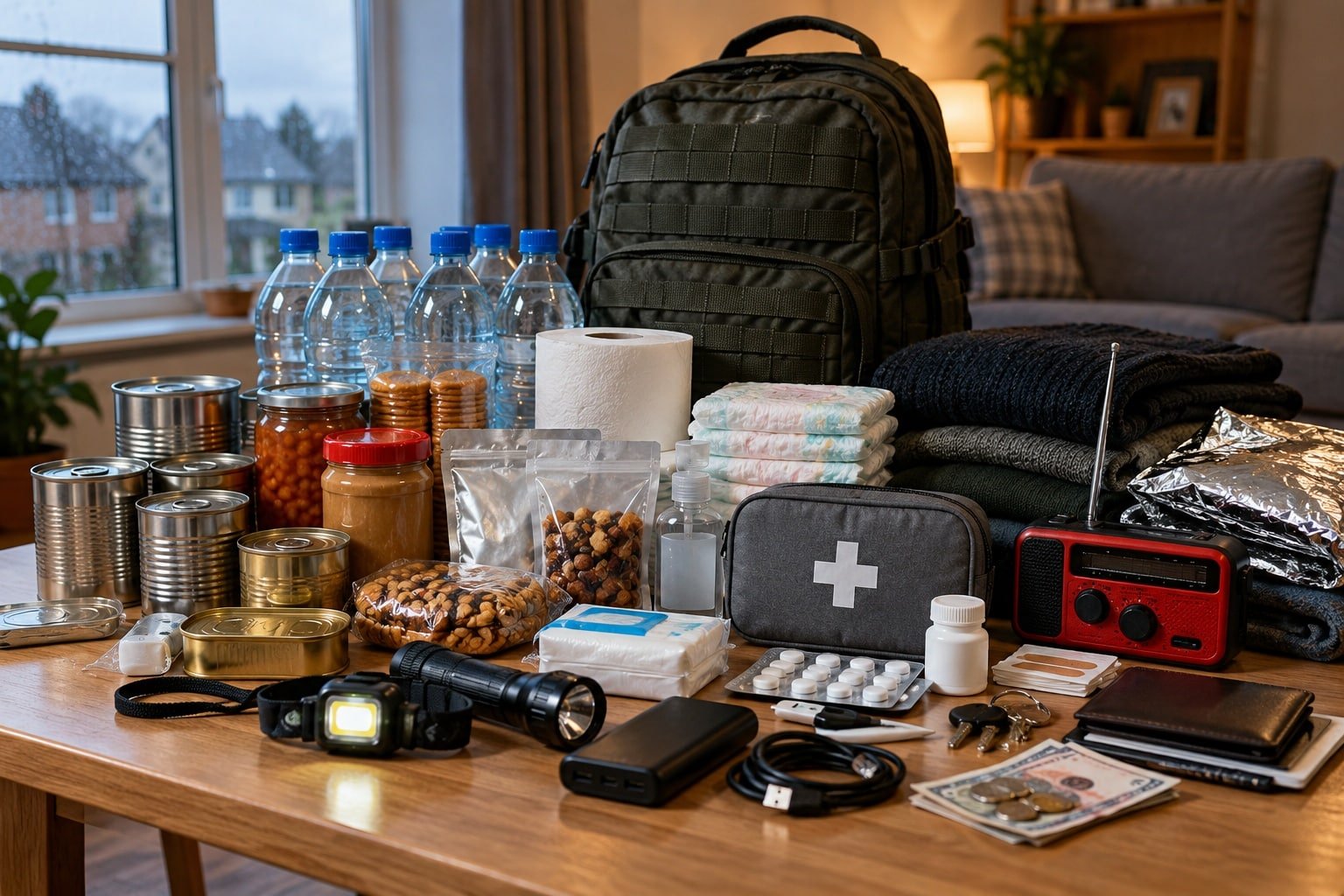
A 3 day emergency kit UK households can keep at home helps you manage the first 72 hours of a power cut, water supply interruption, severe storm or other emergency.
The UK Government recommends keeping essential supplies at home so you can meet your household’s basic needs if everyday services become unavailable.
You don’t need expensive survival equipment or a cupboard full of specialist rations. Most of the essentials are ordinary household items, including bottled water, non-perishable food, a torch, a radio, basic first aid supplies and essential medication.
This guide explains what to include, how much food and water to store, and how to prepare a practical emergency kit for your household.
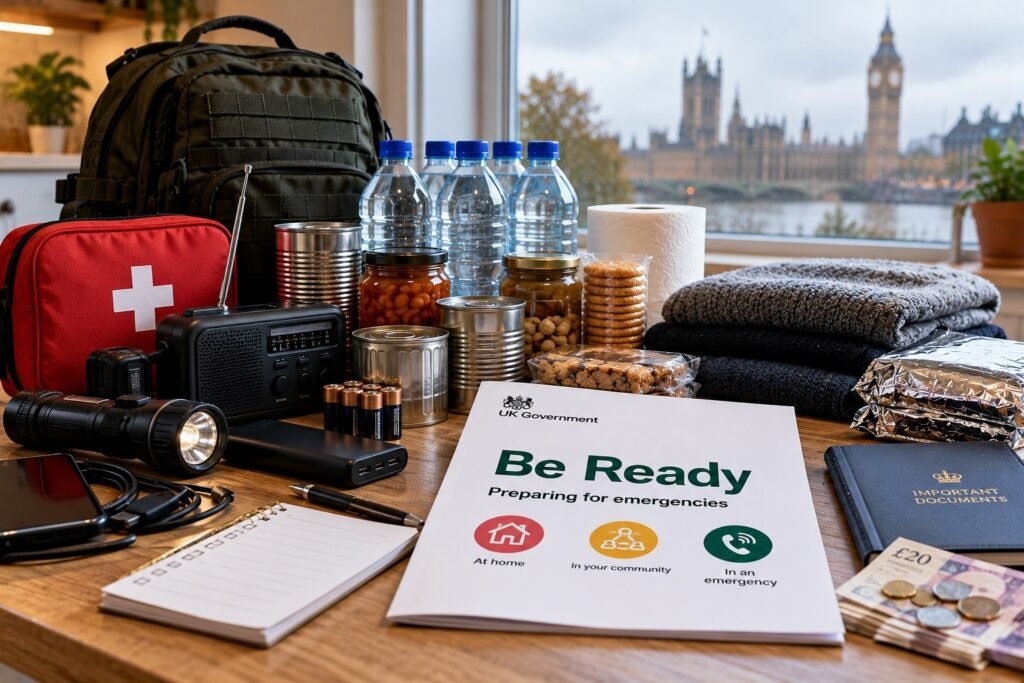
It follows the UK Government’s Be Ready emergency preparedness guidance, with additional advice on choosing and organising your supplies.
What Is a 3-Day Emergency Kit?
A three-day emergency kit is a collection of essential supplies that helps your household cope for up to 72 hours when normal services are disrupted.
You might also see the same supplies described as a 72 hour emergency kit, household survival kit or emergency preparedness kit.
The purpose is straightforward. If the electricity stops working, drinking water becomes unavailable or severe weather prevents you from leaving home, you should have enough basic supplies to manage safely while services are restored or further assistance becomes available.
A typical household emergency kit includes:
- Drinking water for everyone in your household.
- Non-perishable food that requires little or no preparation.
- Battery-powered or rechargeable lighting.
- A battery-powered or wind-up radio.
- A charged power bank and suitable charging cables.
- First aid supplies and essential medication.
- Hygiene products and sanitation supplies.
- Warm clothing and blankets.
- Emergency contact information and important documents.
- A small amount of cash in suitable denominations.
- Additional supplies for children, older adults, pets and anyone with specific needs.
Some of these items will already be in your home. Preparing an emergency kit often involves gathering them together, checking their condition and filling any gaps.
Why the UK Government Recommends Three Days
The UK Government’s Be Ready campaign encourages households to prepare for emergencies that might interrupt essential services.
Keeping supplies for three days gives you a practical starting point for dealing with temporary disruption.
For example, a major power cut might affect lighting, internet access, mobile phone charging and electronic payment systems. A water supply interruption might leave your taps without safe drinking water.
Severe weather can also make travelling to shops difficult or unsafe.
Having supplies available means you are less dependent on making last-minute purchases during an emergency.
The three-day recommendation is a preparedness baseline, not a guarantee that every emergency will end within 72 hours. Some households, particularly those with medical or mobility needs, may need additional arrangements.
The official guidance is available at Be Ready: Preparing for Emergencies.
What Emergencies Should UK Households Prepare For?
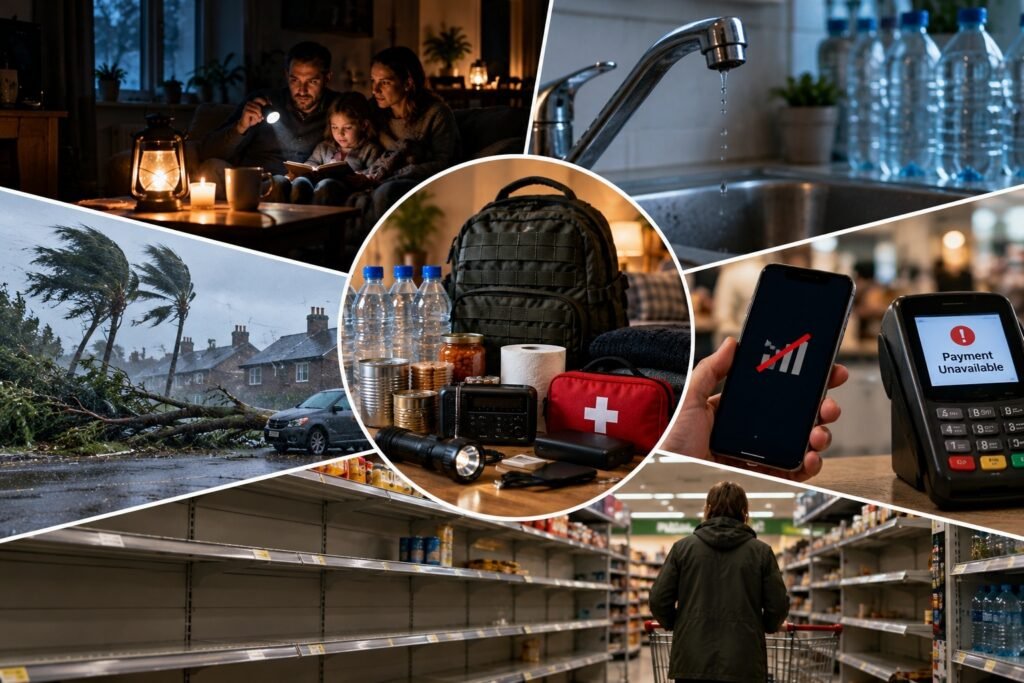
You don’t need a different survival kit for every possible emergency. Many of the same supplies are useful across several situations.
Power cuts
A prolonged electricity outage can affect lighting, refrigeration, heating controls, communication devices and the ability to charge phones.
Water supply interruptions
Burst water mains, infrastructure failures and contamination incidents can interrupt access to drinking water.
Severe weather
Storms, flooding, snow and high winds can disrupt transport, damage infrastructure and interrupt deliveries.
Communication and payment disruptions
Technical failures or cyber incidents can affect online services, card payments, mobile networks and access to information.
Temporary disruption to essential supplies
Local transport problems, road closures or other incidents can make obtaining food, medication and everyday essentials more difficult.
Your household emergency kit should help you manage the immediate practical effects of these situations.
It should also support an emergency plan. If authorities advise you to evacuate, follow their instructions rather than remaining at home because you have supplies.
Complete 3 Day Emergency Kit UK Checklist
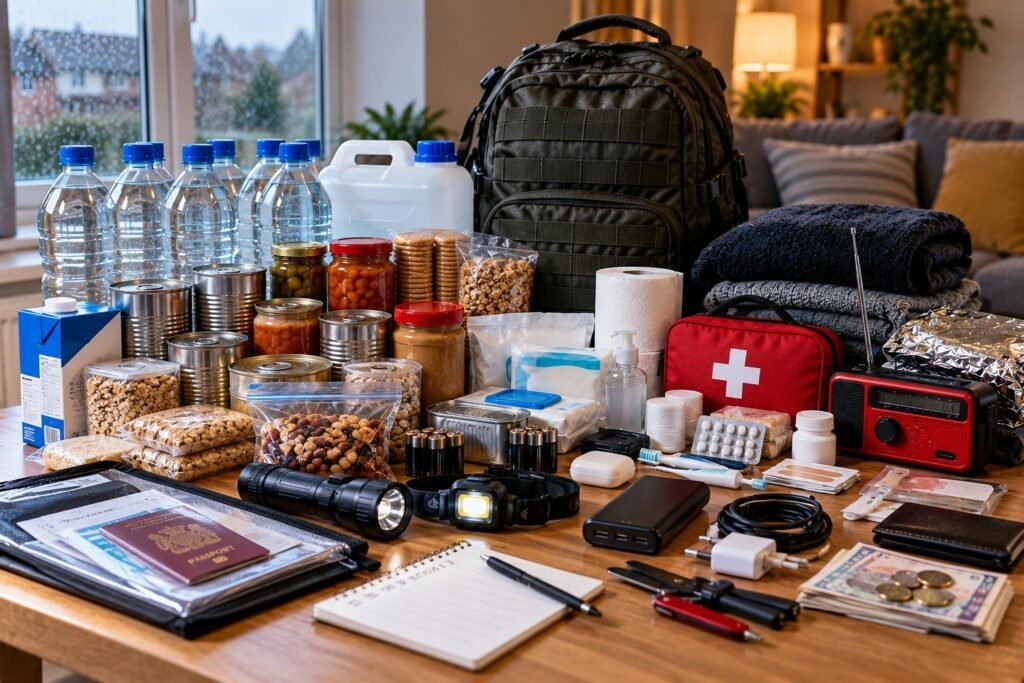
The following household emergency kit checklist covers the main supplies recommended in official UK guidance, alongside practical extras that may be useful.
You don’t need to buy everything at once. Start with drinking water, food, medication, lighting and a reliable way to receive information.
Drinking Water
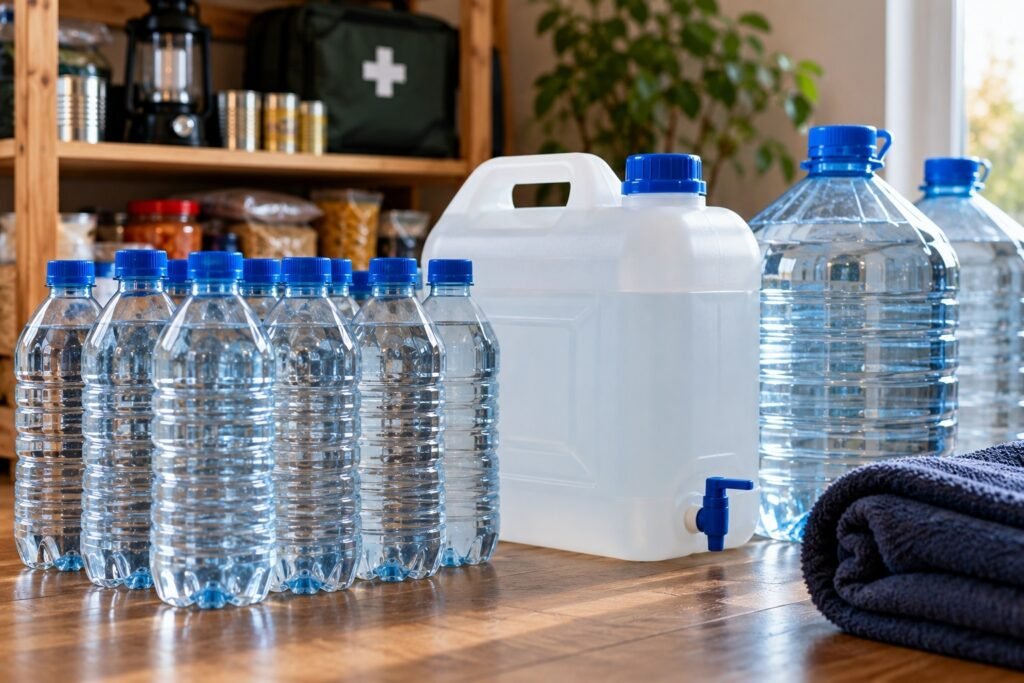
Drinking water should be one of your first priorities.
The UK Government recommends storing at least 3 litres of drinking water per person per day for three days.
That means one person needs 9 litres of drinking water for the recommended period.
For a family of four, the minimum drinking water supply is 36 litres.
| Household size | Water per day | Water for 3 days |
|---|---|---|
| 1 person | 3 litres | 9 litres |
| 2 people | 6 litres | 18 litres |
| 3 people | 9 litres | 27 litres |
| 4 people | 12 litres | 36 litres |
| 5 people | 15 litres | 45 litres |
| 6 people | 18 litres | 54 litres |
These quantities cover the recommended drinking water allowance. You may need additional water for cooking, washing, medical requirements and pets.
Bottled water is a convenient option because it is already sealed and easy to store.
Food-grade water containers can also be useful, provided they are suitable for drinking water and you follow appropriate cleaning and storage instructions.
Keep drinking water away from direct sunlight, chemicals and excessive heat. Check the packaging and replace supplies when necessary.
If you live in a flat or have limited storage, smaller bottles may be easier to organise than large containers.
For more detailed calculations and storage advice, see our Emergency Water Supply UK Guide.
Emergency Food
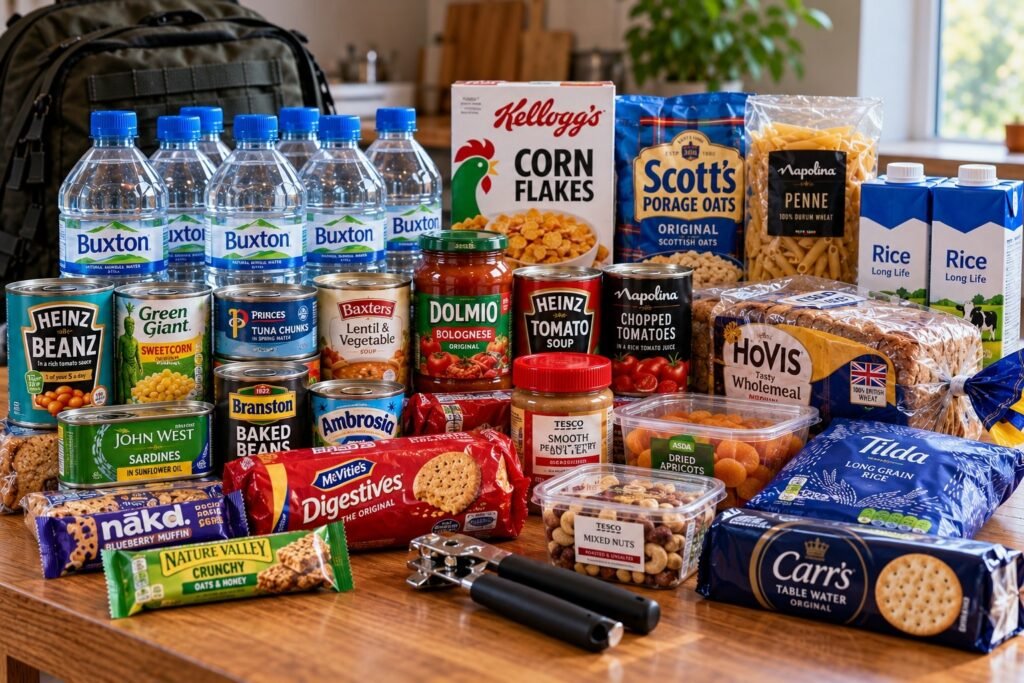
Your emergency food supply should provide enough suitable food for everyone in your household for three days.
Choose familiar foods that are easy to store, require little preparation and can be eaten without electricity.
Useful options include:
- Tinned beans, vegetables and pulses.
- Tinned fish or other ready-to-eat protein sources.
- Crackers, oatcakes and crispbreads.
- Breakfast cereals and cereal bars.
- Dried fruit, nuts and seeds.
- Peanut butter or other suitable spreads.
- Ready-to-eat meals that do not require refrigeration.
- Long-life milk or suitable alternatives.
- Baby food and specialist dietary products where required.
Include a manual tin opener if any of your food is packaged in tins without ring pulls.
Choose foods that your household already enjoys. Emergency supplies are more useful when everyone can eat them comfortably.
Consider allergies, dietary restrictions and the needs of anyone who requires a particular type of food.
Avoid relying entirely on products that need boiling water, refrigeration or a working cooker.
During a power cut, an electric hob or microwave may be unavailable. Gas appliances may also depend on electricity for ignition or controls.
Never use a barbecue, camping stove or fuel-burning heater indoors unless the appliance is specifically designed and approved for that indoor use. Carbon monoxide poisoning can be fatal.
For shopping lists and meal suggestions, read our 3-Day Emergency Food Supply Guide.
Lighting and Warmth
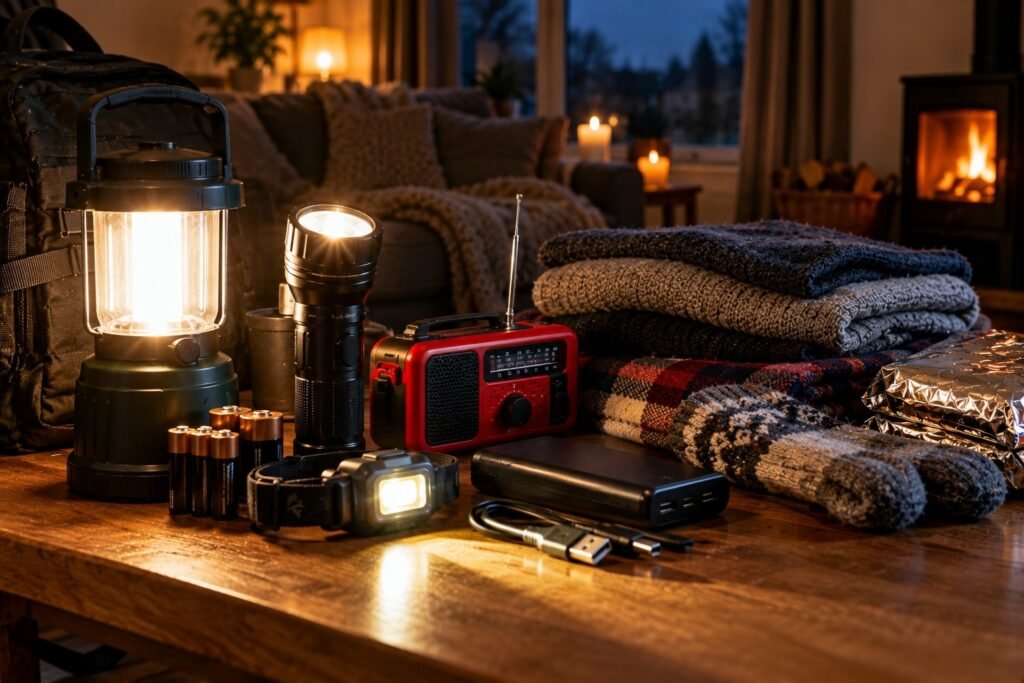
A power cut can leave your home without lighting, particularly during winter evenings.
Keep at least one reliable torch available, with enough lighting for household members to move around safely.
Useful supplies include:
- Battery-powered LED torches.
- Spare batteries in the correct sizes.
- Rechargeable torches that are kept charged.
- Battery-powered lanterns.
- Warm clothing and additional socks.
- Blankets and sleeping bags.
- Thermal emergency blankets.
LED torches are generally a practical choice because they are efficient and widely available.
A battery-powered lantern can be useful for lighting a room without needing to hold a torch.
For households with several people, consider keeping additional torches in bedrooms and other accessible locations.
If your heating stops during a winter power cut, close curtains, wear warm layers and concentrate on keeping occupied rooms comfortable.
Emergency foil blankets are compact and inexpensive, but they should not replace proper warm clothing and household blankets.
Avoid using candles where possible because unattended flames increase fire risk.
Useful equipment: A compact LED torch, spare batteries and a battery-powered lantern are practical additions to most emergency kits. You can compare suitable equipment in our Best Emergency Kit Supplies UK Guide.
Communication and Backup Power
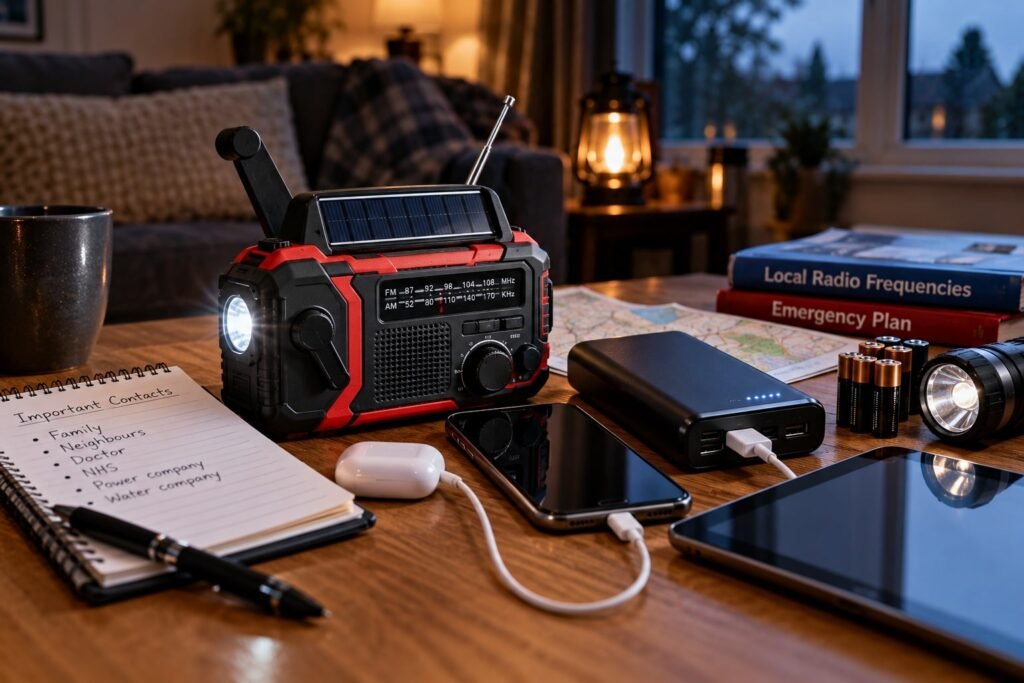
During a widespread emergency, your usual sources of information might become unreliable.
A mobile phone is useful, but its battery will eventually run out. Internet access and mobile networks may also be affected.
The UK Government recommends keeping a battery-powered or wind-up radio so you can receive information when other services are unavailable.
Useful communication and power supplies include:
- Battery-powered or wind-up FM radio.
- Spare batteries where required.
- Fully charged portable power bank.
- USB charging cables for household devices.
- Written emergency contact numbers.
- A list of useful local radio frequencies.
- A car charging adapter, where suitable.
A wind-up emergency radio is particularly useful because it offers a way to operate the radio without depending entirely on replaceable batteries.
Some models also include a solar charging panel, torch or USB output.
These extra features vary considerably between products. A small solar panel or hand crank may provide only limited charging power, particularly for a smartphone.
A separate power bank is usually a more practical way to keep a phone charged.
For buying advice, see our Best Wind-Up Emergency Radios UK and Best Power Banks for Power Cuts.
The UK Government also provides specific guidance on preparing for power cuts.
First Aid and Medication
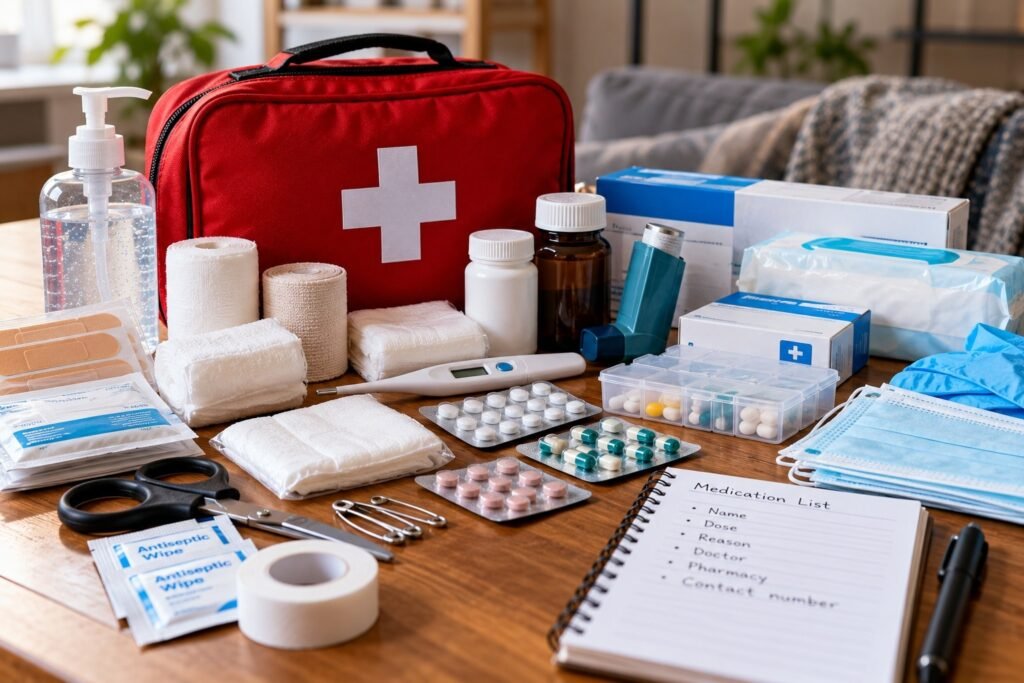
A household emergency kit should include basic first aid supplies and any essential medication required by members of your household.
A basic first aid kit might contain:
- Sterile dressings and plasters.
- Bandages and medical tape.
- Disposable gloves.
- Antiseptic wipes.
- A digital thermometer.
- Suitable pain relief.
- Any other first aid items recommended for your household.
Check expiry dates and replace used supplies.
If someone takes prescription medication, consider how they would manage if pharmacies became temporarily inaccessible.
Keep an up-to-date medication list, including dosages and relevant contact details.
Speak to a pharmacist or healthcare professional about appropriate arrangements for essential medication. Do not alter prescribed doses or stockpile medicines without professional advice.
Some medication needs refrigeration or other specific storage conditions. If your household depends on temperature-sensitive medication, prepare a separate plan for power cuts.
People who rely on electrically powered medical equipment should also have a suitable backup plan agreed with their healthcare provider.
A general-purpose power bank is not a substitute for an approved medical power supply.
Hygiene and Sanitation
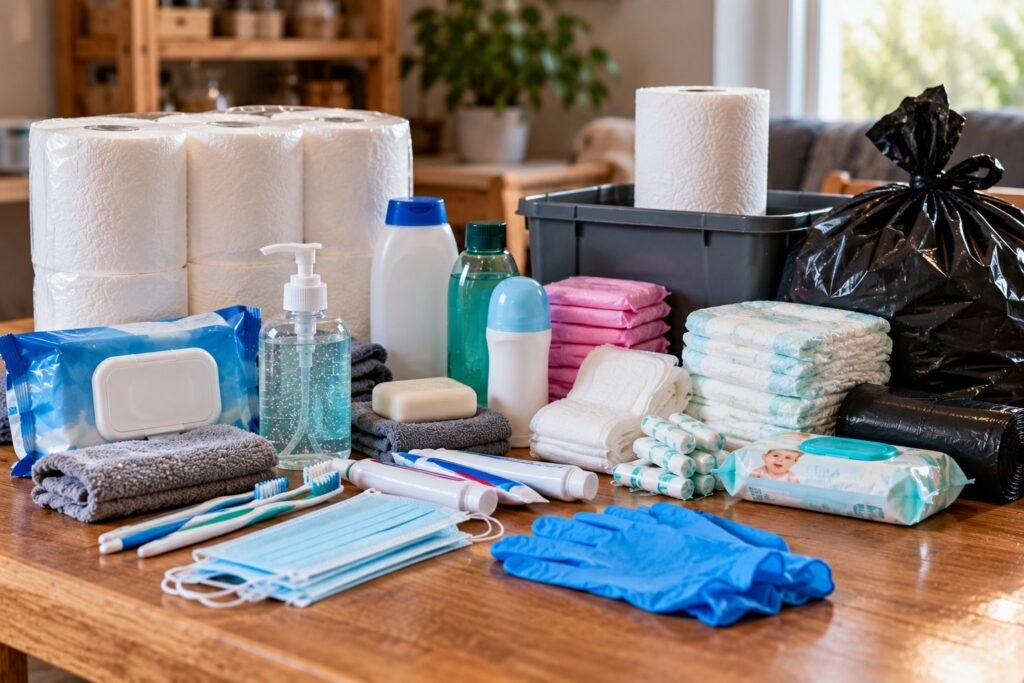
Hygiene supplies can become particularly important if your household loses access to running water.
Keep enough basic products to maintain personal cleanliness and manage waste during a short disruption.
Useful items include:
- Toilet paper.
- Wet wipes.
- Hand sanitiser.
- Soap.
- Toothbrushes and toothpaste.
- Sanitary products.
- Nappies and baby wipes where required.
- Heavy-duty rubbish bags.
- Disposable gloves.
- Kitchen roll or cleaning cloths.
Hand sanitiser can be useful when washing facilities are unavailable, but it does not replace proper handwashing in every situation.
If the water supply stops, you may also need to adjust how you use the toilet.
Do not assume your toilet can be flushed normally throughout a water interruption. Follow instructions from your water supplier or local authorities.
Store hygiene supplies in a sealed container or bag to protect them from damp and contamination.
Cash, Documents and Contact Numbers
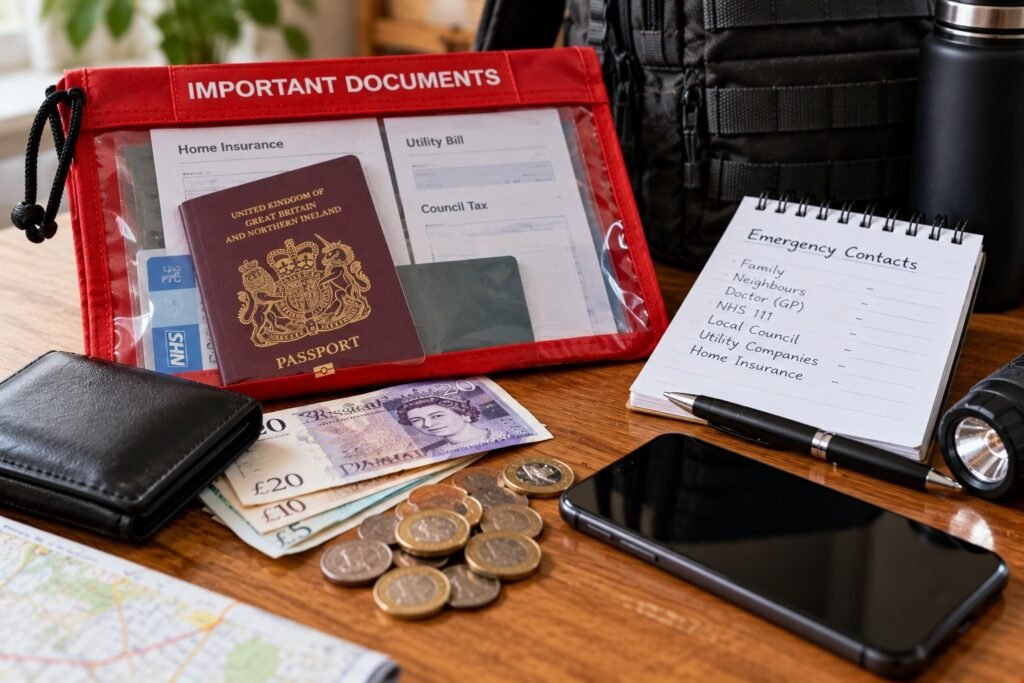
Many households rely on mobile phones and online accounts to access important information.
During a prolonged power cut or communications failure, digital access may be limited.
Keep a small emergency folder containing:
- Emergency contact numbers.
- NHS and relevant medical contact information.
- Home insurance details.
- Contact details for utility suppliers.
- Copies of important documents where appropriate.
- Information about essential medication.
- Local emergency arrangements.
- Details of family members or neighbours who may need assistance.
Protect sensitive documents from unauthorised access. A waterproof document pouch can help protect papers from moisture, but secure storage is equally important.
The government also recommends keeping some cash available in case electronic payments become unavailable.
You do not need to withdraw large amounts. Consider a modest amount appropriate to your household’s circumstances, including smaller notes and coins.
Keep emergency cash in a secure place.
How Much Water and Food Does Your Household Need?
Water requirements are relatively straightforward to calculate using the government’s minimum drinking water recommendation.
Multiply the number of people in your household by 3 litres, then multiply by three days.
For example:
4 people × 3 litres × 3 days = 36 litres.
Food requirements need a more individual approach.
The amount and type of food required depend on age, appetite, activity, health and dietary needs.
Rather than relying on a single calorie target for everyone, plan three days of suitable meals and snacks for each household member.
A simple emergency food plan might look like this:
| Day | Breakfast | Lunch | Evening meal |
|---|---|---|---|
| Day 1 | Cereal with long-life milk | Crackers and tinned fish | Ready-to-eat beans and bread |
| Day 2 | Oatcakes and peanut butter | Tinned pulses and crackers | Ready-to-eat tinned meal |
| Day 3 | Cereal bars and dried fruit | Crackers and a suitable protein source | Ready-to-eat beans or lentils |
This is an example of food types rather than a complete nutritional plan. Adjust portions and add snacks, fruit and other foods to meet each person’s needs.
Check that packaged foods can be eaten safely without heating. Some shelf-stable meals require cooking before consumption.
The easiest approach is often to keep a small reserve of foods you regularly eat and replace them as part of your normal shopping routine.
This reduces waste and helps keep supplies within their use-by or best-before dates.
Building an Emergency Kit for Different Household Sizes
A one-person household needs fewer consumable supplies than a family of five, but some equipment can be shared.
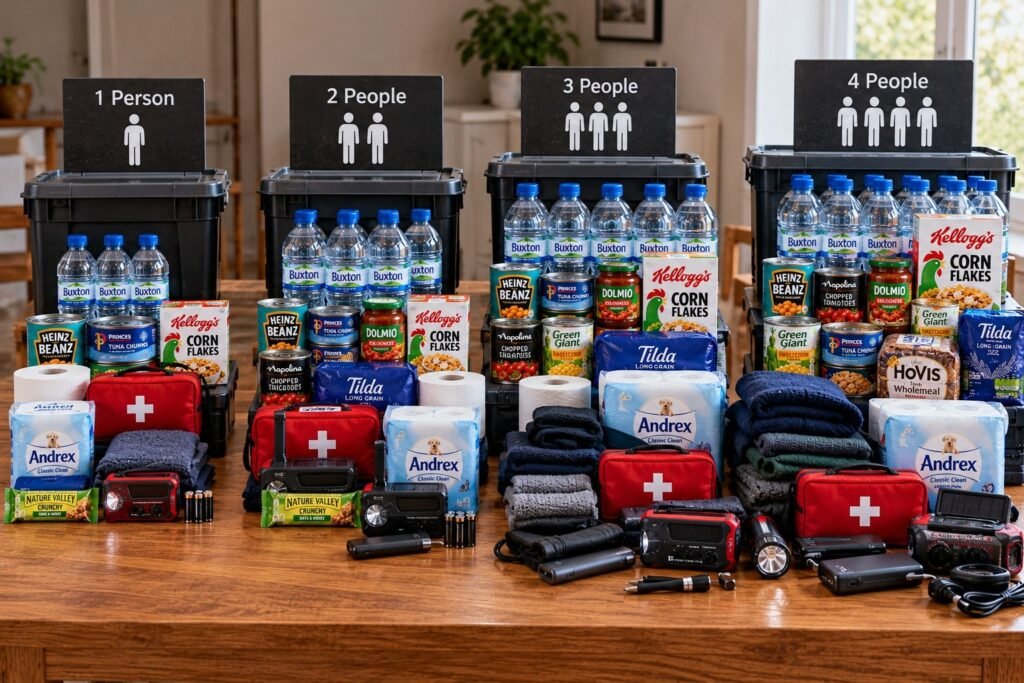
For example, one suitable emergency radio may serve an entire household, while drinking water and food requirements increase with each person.
| Supply | 1 person | 2 people | 4 people |
|---|---|---|---|
| Drinking water | 9 litres | 18 litres | 36 litres |
| Emergency food | 3 days | 6 person-days | 12 person-days |
| Radio | 1 | 1 | 1 |
| Torches | At least 1 | Preferably 2 | Preferably 4 |
| Power bank | 1 | 1–2 | 2 or more |
| First aid kit | 1 | 1 | 1 suitable family kit |
| Blankets | 1 or more | 2 or more | 4 or more |
The equipment quantities are practical planning suggestions, not fixed government requirements.
Consider your home’s layout, the number of phones and other devices, and whether anyone needs individual lighting or specialist equipment.
A household with young children may need more accessible lighting and additional comfort items.
A person living alone may benefit from arranging regular contact with a neighbour or relative during an emergency.
The aim is to prepare for the people who actually live in your home rather than purchasing a generic survival kit that may not meet their needs.
Emergency Supplies for Children, Older Adults and Pets
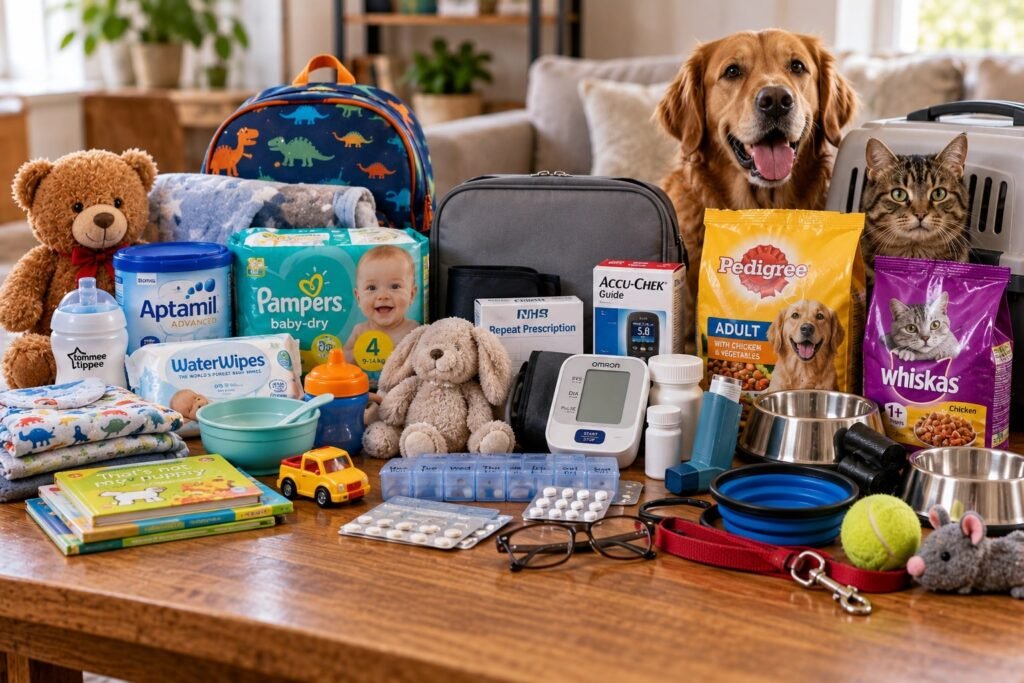
Not every household can rely on a standard emergency kit.
Some people need additional supplies, assistance or specific arrangements.
Babies and Young Children
If you have a baby or young child, consider including:
- Formula or suitable baby food.
- Safe drinking water and feeding equipment.
- Nappies and wipes.
- Spare clothing.
- Blankets.
- Any essential medication.
- Familiar comfort items.
If you use powdered infant formula, follow NHS and product safety guidance for preparation and storage. A loss of safe water or electricity may require a different feeding plan.
Older Adults and People With Limited Mobility
Older adults and people with disabilities may require additional planning.
Useful considerations include:
- Essential medication and an up-to-date medication list.
- Spare batteries for hearing aids.
- Glasses and other everyday aids.
- Walking aids kept within easy reach.
- Accessible lighting.
- Suitable food and drinking water.
- Emergency contact information.
- Backup arrangements for essential powered equipment.
If someone needs assistance to leave the home, include this in your household emergency plan.
Consider contacting your utility providers about their Priority Services Register if someone in your household is eligible for additional support during supply interruptions.
Registration can provide additional assistance and communication, but does not guarantee uninterrupted electricity or water.
Pets
Pets also need suitable emergency supplies.
Keep enough food and drinking water for at least three days, along with:
- Bowls.
- Essential medication.
- Leads or carriers.
- Waste bags or litter.
- Veterinary contact information.
- Identification details.
Pet water requirements vary according to species, size, diet and environmental conditions.
Ask your vet if you are unsure how much to store.
If evacuation becomes necessary, check which temporary accommodation options accept pets and prepare a suitable carrier.
Where Should You Store Your Emergency Supplies?
An emergency kit is most useful when everyone in your household knows where to find it.
Choose a dry, accessible location that is protected from excessive heat, moisture and pests.
A hallway cupboard, utility room or suitable storage cupboard may work well.
Avoid keeping all supplies in a loft or an area that becomes difficult to access during a power cut.
Use Clearly Labelled Storage Containers
A sturdy plastic storage box can help keep equipment organised.
Consider dividing supplies into categories:
- Food and drinking water.
- Lighting and batteries.
- Communication equipment.
- First aid and hygiene.
- Important documents.
You can keep heavy water supplies separately to make the main equipment box easier to move.
Keep Frequently Used Emergency Items Accessible
Some supplies should be immediately available.
For example, keep a torch near your bed and another in an accessible downstairs location.
Your emergency radio should be easy to locate, with batteries or charging equipment available.
Keep essential medication in its appropriate storage location rather than moving it into a kit where the storage conditions may be unsuitable.
Check Your Emergency Kit Every Six Months
Set a reminder to inspect your supplies twice a year.
During each check:
- Inspect food packaging and dates.
- Check stored drinking water.
- Test torches and radios.
- Replace discharged or damaged batteries.
- Recharge power banks.
- Check first aid supplies and medication arrangements.
- Update emergency contacts.
- Replace outgrown children’s clothing and other unsuitable items.
- Review changes to your household’s needs.
You should also check supplies after using them.
A well-organised emergency kit is easier to maintain than a box of forgotten equipment.
How Much Does a 3-Day Emergency Kit Cost?
The cost of building a three-day emergency kit depends on what you already own and how much specialist equipment you decide to purchase.
Many households already have blankets, basic first aid supplies, tinned food, a torch and charging cables.
If these items are suitable and in good condition, you may not need to replace them.
Start by checking your existing supplies against the government checklist.
Then divide missing items into three groups.
Essential consumables
Drinking water, food, hygiene supplies and other items that must be available in sufficient quantities for your household.
Essential equipment
Reliable lighting, a way to receive emergency information, appropriate first aid supplies and suitable backup arrangements.
Optional upgrades
Additional lanterns, higher-capacity power banks, specialist storage containers and other equipment that makes an emergency easier to manage.
You don’t need to purchase the most expensive products.
For example, a reliable battery-powered radio may be a sensible choice if you already keep spare batteries at home.
Similarly, a basic LED torch with replaceable batteries may be more practical for occasional emergency use than a complicated rechargeable model.
Buying supplies gradually can also make preparation more affordable.
Consider adding a few items to your regular shopping list until your household has the essentials covered.
For an itemised comparison, see our How Much Does a 3-Day Emergency Kit Cost in the UK?.
For equipment recommendations, visit our Best Emergency Kit Supplies for UK Households.
Download Your Free Emergency Kit Checklist
A written checklist makes it easier to see what you already own and what you still need.
Use the following checklist to organise your supplies.
3-Day Emergency Kit Checklist
For a checklist you can print or complete online, visit our Free Printable 72-Hour Emergency Kit Checklist UK.
Frequently Asked Questions
Does the UK Government Recommend a 3-Day Emergency Kit?
Yes. The UK Government’s Be Ready guidance recommends keeping essential supplies to help your household manage for at least three days during an emergency.
The guidance covers drinking water, non-perishable food, lighting, communication equipment, hygiene products and other household essentials.
How Much Drinking Water Do I Need for 72 Hours?
The recommended drinking water allowance is 3 litres per person per day.
For three days, that means 9 litres per person.
A family of four would need at least 36 litres of drinking water, plus any additional water required for cooking, hygiene, pets or specific medical needs.
Do I Need to Buy a Ready-Made Survival Kit?
No. You can assemble a household emergency kit using suitable items you already own.
Buying individual supplies often gives you more control over food choices, water quantities and equipment quality.
A ready-made kit may provide useful equipment, but you should check its contents carefully rather than assuming it covers every household need.
Should I Keep Cash in My Emergency Kit?
Keeping some cash available is sensible because card payment systems and cash machines may become unavailable during electricity or communications disruptions.
Choose an amount appropriate to your household and store it securely.
Is a Wind-Up Radio Necessary for an Emergency?
The government recommends a battery-powered or wind-up radio as a way to receive information during disruption.
A wind-up model provides an additional charging method, although the amount of energy generated by the hand crank varies between products.
A reliable battery-powered FM radio with suitable spare batteries can also be useful.
Where Is the Best Place to Keep an Emergency Kit?
Store supplies in a dry, accessible location that everyone in your household knows.
Keep heavy drinking water containers securely stored and make sure torches, essential medication and important contact information remain easy to access.
How Often Should I Replace Emergency Supplies?
Check your emergency supplies at least every six months.
Replace food and water according to packaging instructions, inspect first aid supplies and test electrical equipment.
Recharge power banks periodically and review your emergency arrangements whenever household needs change.
Is a 72-Hour Emergency Kit Enough for Every Emergency?
No. Three days is a practical starting point, but some emergencies may last longer.
Households with medical needs, limited mobility or other dependencies may require additional supplies and a more detailed plan.
Always follow official instructions during an emergency, including any advice to evacuate.
Start With the Essentials
Building a 3-day emergency kit does not need to be expensive or complicated.
Begin by checking how much drinking water and suitable food you already have. Make sure you can find a working torch, receive emergency information and access essential medication.
Then add any missing supplies over time.
The most useful emergency kit is one that matches your household’s needs, stays accessible and gets checked regularly.
For the latest official recommendations, refer to the UK Government’s Be Ready emergency guidance.
CampEquipmentPlus relies on reader support. Purchases made via links on our website may earn us an affiliate commission at no extra cost to you, helping keep the site running.