
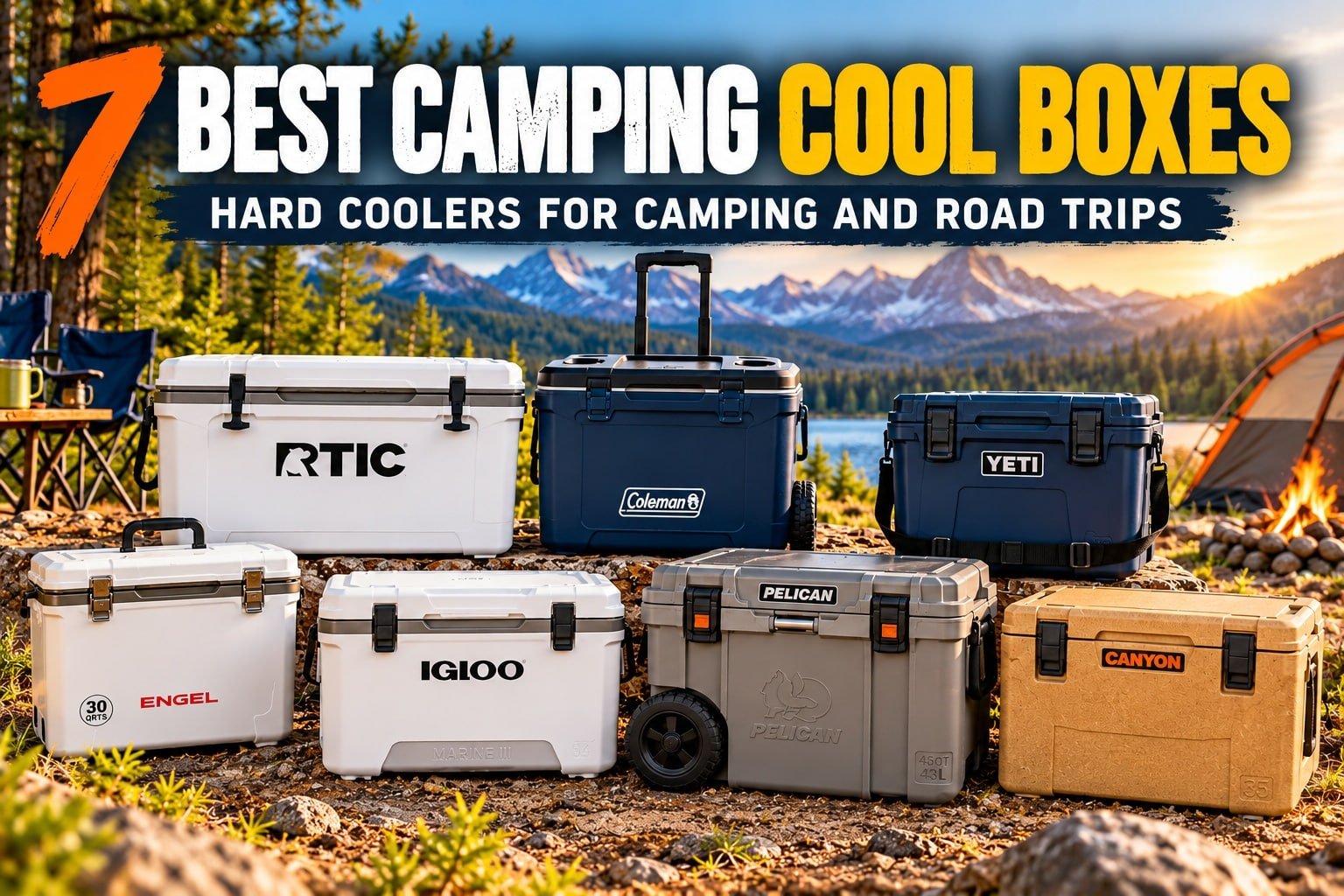
A good camping cooler has one main job: keep your food and drinks cold for long enough to matter.
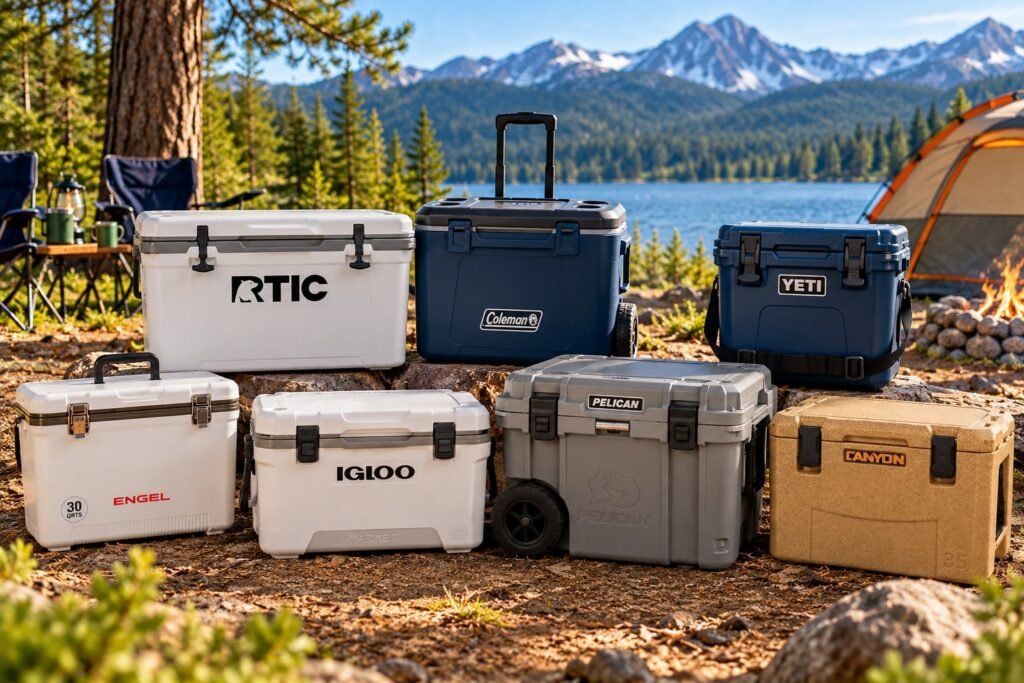
The difficulty is finding one that does this without taking over your trunk or becoming unpleasant to carry once loaded with food, drinks and ice.
For this guide to the Best Camping Cool Boxes, we compared seven hard-sided coolers covering everything from compact 24 and 30-quart models to larger 50-plus-quart options for family and car camping.
Our research considered insulation, usable capacity, empty weight, dimensions, portability, construction, drainage, manufacturer documentation and owner feedback. We also looked closely at what you give up when choosing a lighter cooler over a heavier, more heavily insulated design.
If you are searching for the best camping coolers for a weekend at a campground, a multi-day road trip or longer car-camping trips, these are the seven models we would put on the shortlist.
The Best Camping Cool Boxes
- Best Overall: RTIC 52 QT Ultra-Light Cooler. A useful balance of 52-quart capacity, substantial insulation and a manageable 21 lb empty weight.
- Best Wheeled Cooler: Coleman 50-Quart Xtreme 5-Day Hard Cooler with Wheels. Large capacity and wheels without the considerable empty weight of many heavy-duty coolers.
- Best Small Cooler: YETI Roadie 24 Hard Cooler. Compact enough for vehicle use while retaining the rugged construction associated with larger hard coolers.
- Best Lightweight Small Cooler: Engel 30 Quart Drybox/Cooler. It weighs only 7 lb while providing 30 quarts of storage.
- Best Lightweight Large Cooler: Igloo Marine Ultra 54 Qt Cooler. A 54-quart cooler weighing only 10.6 lb.
- Best Heavy-Duty Wheeled Cooler: Pelican 45QW Elite Wheeled Cooler. A heavily insulated wheeled option where rugged construction matters more than low weight.
- Best Rugged Mid-Size Cooler: Canyon Outfitter 35qt V2 Hard Cooler. A 35-quart hard cooler with pressure-injected insulation and IGBC-certified construction.
Best Camping Coolers Compared
| Cooler | Capacity | Empty Weight | Best For |
|---|---|---|---|
| RTIC 52 QT Ultra-Light | 52 qt | 21 lb | Best overall |
| Coleman 50-Quart Xtreme | 50 qt | 12.7 lb | Wheeled value |
| YETI Roadie 24 | 24 qt | 13.1 lb | Small cooler |
| Engel 30 Quart Drybox | 30 qt | 7 lb | Lightweight camping |
| Igloo Marine Ultra 54 | 54 qt | 10.6 lb | Lightweight large capacity |
| Pelican 45QW Elite | 45 qt | 43.7 lb | Heavy-duty camping |
| Canyon Outfitter 35qt V2 | 35 qt | 21 lb | Rugged mid-size use |
Capacity figures do not tell the whole story. Thick insulation reduces internal space relative to external dimensions, and the amount of ice you carry further reduces usable food and drink capacity.
Check the dimensions as carefully as the quart rating, especially if the cooler needs to fit behind a seat or alongside other camping equipment in an already crowded vehicle.
#1 – RTIC 52 QT Ultra-Light Cooler: Best Overall
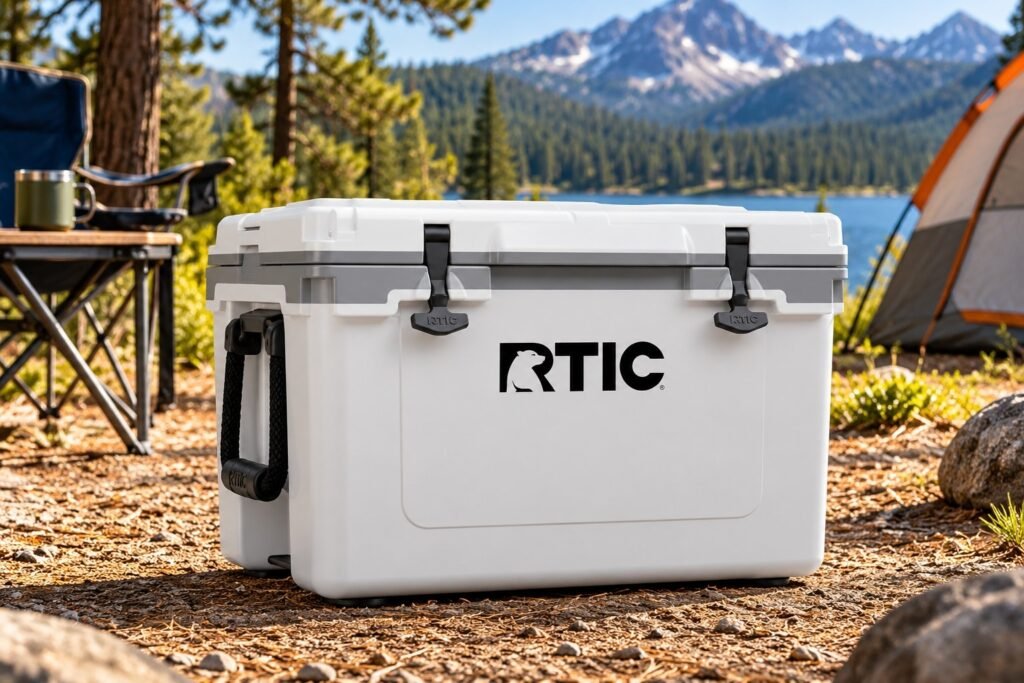
The RTIC 52 QT Ultra-Light is our Best Overall choice because it combines the capacity needed for car camping with substantial insulation without reaching the weight of many comparable heavy-duty coolers.
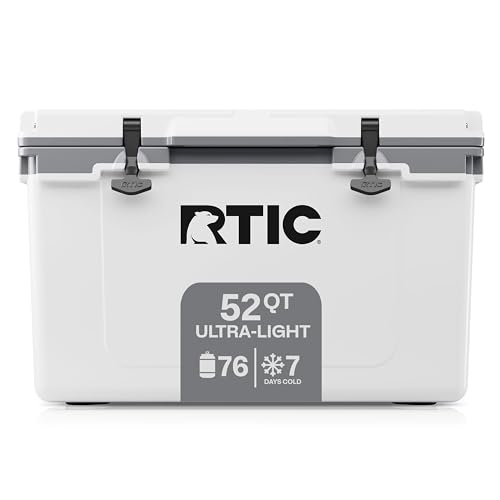
RTIC lists a 52-quart capacity, 21 lb empty weight and exterior dimensions of 27.17 x 17.49 x 17.33 inches. It holds up to 76 cans without ice and uses up to 3 inches of foam insulation with a freezer-style gasket.
RTIC claims up to seven days of cold retention when its cooling instructions are followed. Treat that as a manufacturer claim rather than a promise of how many days your ice will survive. Ambient temperature, how often you open the lid, pre-chilling, direct sunlight and the amount of ice all affect the result.
The important specification for us is the weight. RTIC says the Ultra-Light is more than 30% lighter than comparable rotomolded coolers. At 21 lb, it is still substantial, but there is a meaningful difference between lifting a 21 lb empty cooler and something weighing more than 40 lb before you have added a single drink.
The exterior is still fairly large. This is primarily a car-camping cooler rather than something you will want to carry any significant distance.
For weekend camping and longer vehicle-based trips, that compromise makes sense. You get a useful amount of storage and thick insulation without automatically moving into heavyweight cooler territory.
Pros:
- 52-quart capacity suits multi-day and family camping
- Up to 3 inches of foam insulation
- 21 lb empty weight
- Freezer-style gasket
- 76-can stated capacity without ice
- Non-skid feet
- Useful middle ground between basic and heavyweight hard coolers
Cons:
- Still bulky when fully loaded
- No wheels
- Basket and divider are sold separately
- Seven-day cold-retention figure depends on following RTIC’s cooling procedure and favorable conditions
Who should buy it?
The RTIC makes the most sense for campers wanting one hard cooler for weekends, road trips and general car camping without accepting the weight of the heaviest rotomolded alternatives.
The RTIC specifications confirm the 76-can capacity, 21 lb empty weight and up to 3 inches of foam insulation.
#2 – Coleman 50-Quart Xtreme 5-Day Hard Cooler With Wheels: Best Wheeled Cooler
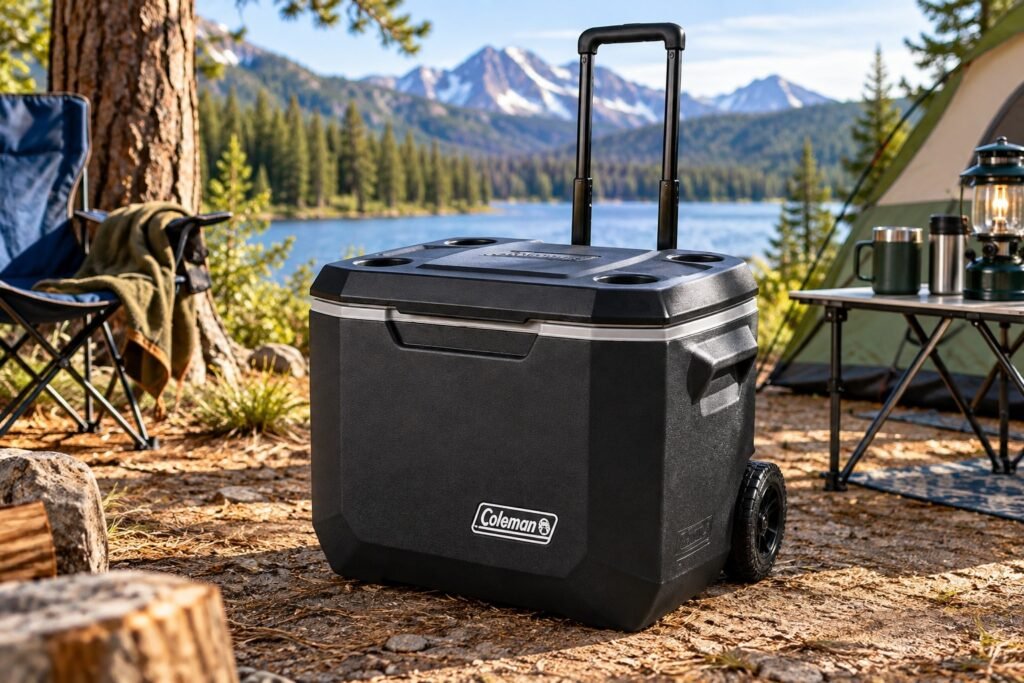
The Coleman 50-Quart Xtreme is the practical choice if you want plenty of space, wheels and a much lower empty weight than heavy-duty wheeled coolers.

Coleman lists an empty weight of 12.7 lb and capacity for up to 84 cans. The cooler also has a telescoping handle, molded side handles, cup holders and a drain.
Those specifications make the Coleman particularly interesting among the best car camping coolers. A large cooler often spends most of the journey in the vehicle, but you still have to get it from the trunk to the campsite. Wheels become useful very quickly when 50 quarts of space is filled with drinks, food and ice.
Coleman states that the insulated lid and additional wall insulation can retain ice for up to five days at temperatures as high as 90°F. Again, that is a manufacturer test claim rather than a result you should expect under every camping condition.
There are also reasons this model does not take our top position.
Owner feedback published on Coleman’s own website includes complaints concerning the telescoping handle and ice retention. That does not mean every cooler develops those problems, but it is enough to stop us treating the low weight and five-day manufacturer claim as the whole story.
The Coleman still has a clear role. It gives campers a lot of capacity, easy rolling and low empty weight without requiring the jump to a much heavier premium hard cooler.
Pros:
- 50-quart capacity
- 12.7 lb empty weight
- Heavy-duty wheels
- Telescoping pulling handle
- Drain simplifies emptying melted ice
- Holds up to 84 cans according to Coleman
- Lid includes molded cup holders
Cons:
- Published owner feedback raises concerns about handle durability
- Manufacturer ice-retention figures may not reflect every camping environment
- Less rugged construction than heavyweight alternatives such as the Pelican
Who should buy it?
Choose the Coleman if you want a large wheeled cooler for campsites, road trips, sporting events and family trips, but do not want a 40-plus-pound cooler before adding ice.
Coleman’s product specifications confirm its 12.7 lb weight, 84-can capacity and five-day manufacturer ice-retention claim.
#3 – YETI Roadie 24 Hard Cooler: Best Small Cooler for Camping
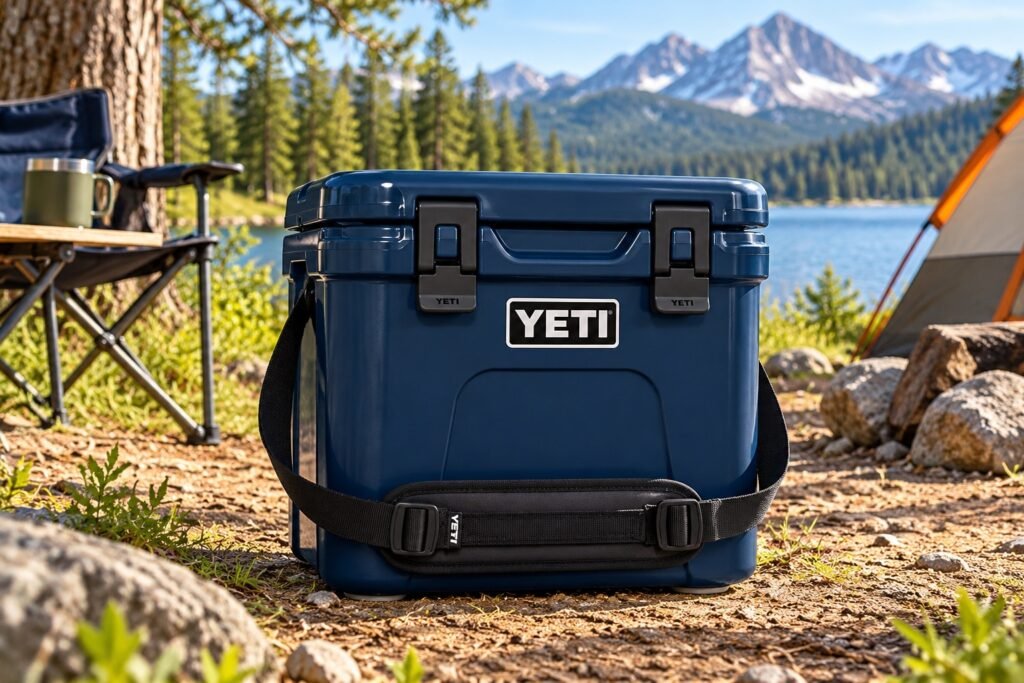
The YETI Roadie 24 is our pick for campers who want a compact hard cooler that fits more easily into a vehicle than a typical 50-quart model.

YETI lists capacity for 33 cans without ice or 26 lb of ice without cans. The cooler measures approximately 16.6 x 14 x 17.4 inches externally and weighs about 13.1 lb.
That relatively narrow footprint is important.
YETI designed the Roadie 24 with vehicle travel in mind. Its tall format can accommodate bottles while taking up less floor area than many wider hard coolers.
For one or two people on shorter trips, this can make more sense than buying a 50-quart box and filling half of it with ice. Smaller coolers are also easier to position behind seats and among tents, sleeping gear, chairs and camping tables.
The compromise is capacity. Twenty-four quarts disappears quickly once you start packing meals and drinks for several people.
It is also heavier than the 30-quart Engel despite having a smaller nominal capacity. The YETI is therefore better suited to campers prioritizing hard-cooler construction over minimum weight.
Pros:
- Compact 24-quart format
- 33-can stated capacity without ice
- Tall internal shape accommodates bottles
- Vehicle-friendly dimensions
- Shoulder carrying system
- Rotomolded construction
- Useful for one or two campers
Cons:
- Limited capacity for groups
- 13.1 lb is not particularly light for a 24-quart cooler
- Larger coolers make more sense for several days of food
Who should buy it?
The Roadie 24 is one of the best small coolers for camping if you are traveling solo or as a couple and want a rugged cooler that does not consume a large section of your trunk.
YETI’s Roadie specifications list its 33-can and 26 lb ice capacities.
#4 – Engel 30 Quart Drybox/Cooler: Best Lightweight Small Cooler
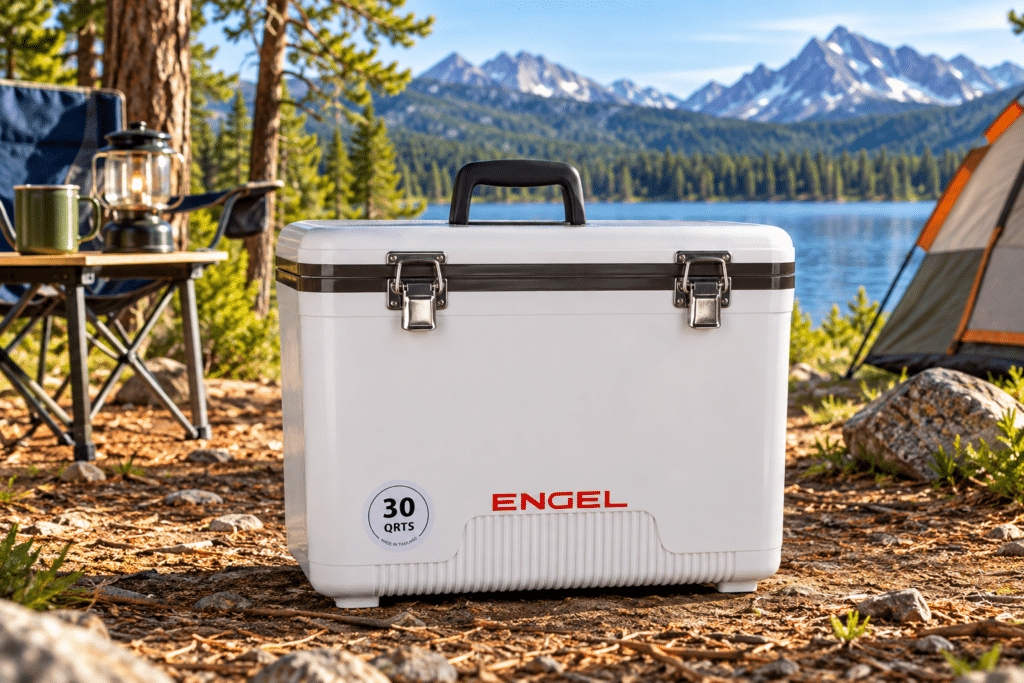
The Engel 30 Quart Drybox/Cooler is the standout choice when low empty weight matters more than maximum insulation thickness.

It weighs just 7 lb.
That immediately separates the Engel from many heavy-duty hard coolers. Engel still provides 30 quarts of capacity, with exterior dimensions of 19 x 12.5 x 14.25 inches.
Construction is injection-molded polypropylene with molded polystyrene foam insulation. An EVA gasket helps seal the lid, while stainless-steel screws secure the fittings.
Engel also includes an integrated shoulder strap and accessory tray.
The design is worth understanding before comparing it directly with something like the RTIC or Pelican. This is a lightweight insulated drybox and cooler. It is not trying to pack several inches of insulation into a heavy rotomolded body.
That makes the Engel appealing for day trips, overnight camping, fishing and short weekends where you value portability.
Seven pounds before loading is genuinely manageable. Add food, drinks and ice and the total weight still climbs quickly, but at least the cooler itself is not responsible for 20 or 40 lb of the load.
Pros:
- Only 7 lb empty
- 30-quart capacity
- Compact exterior dimensions
- EVA gasket
- Integrated shoulder strap
- Stainless-steel fittings
- Five-year manufacturer warranty
- Can double as a dry storage box
Cons:
- Less insulation than larger heavy-duty coolers
- Not our first choice for extended trips where maximum ice retention is the priority
- Narrower use case than a 50-plus-quart family cooler
Who should buy it?
The Engel makes sense for solo campers, couples, anglers and anyone who considers a 20-plus-pound empty cooler excessive for a short trip.
Engel’s official specifications confirm its 30-quart capacity, 7 lb weight, polystyrene insulation and five-year warranty.
#5 – Igloo Marine Ultra 54 Qt Cooler: Best Lightweight Large Cooler
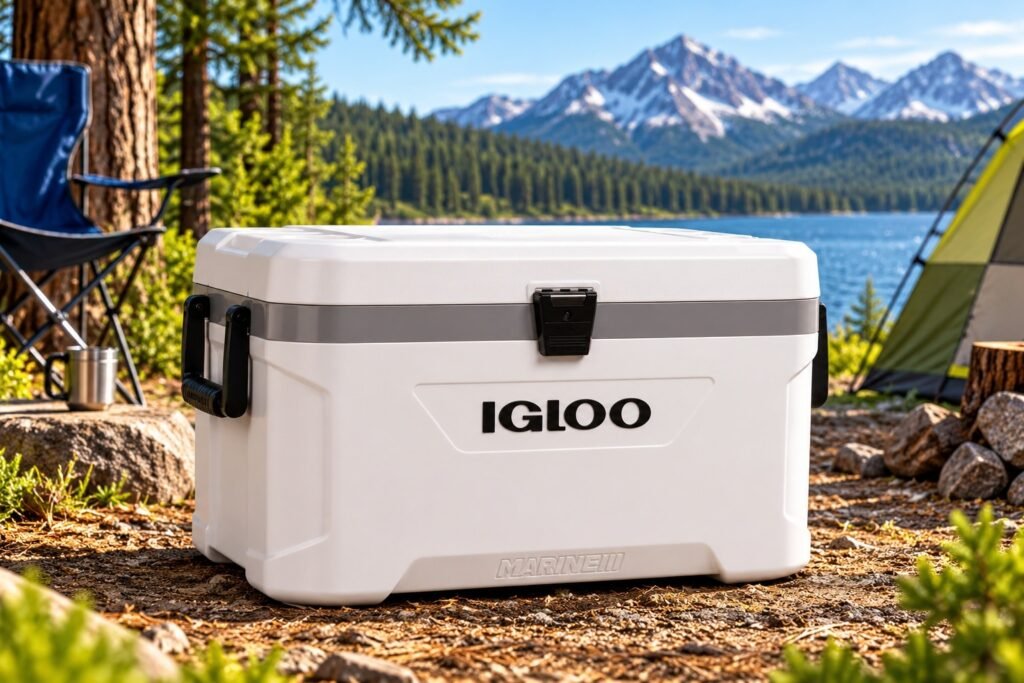
The Igloo Marine Ultra 54 gives you 54 quarts of nominal capacity while keeping empty weight down to about 10.6 lb.

That combination makes it worth considering if you need a larger ice chest but dislike the weight associated with rotomolded designs.
Igloo lists capacity for up to 76 cans. The Marine Ultra range was developed primarily for boating and outdoor use, so features such as corrosion-resistant hardware, insulation and drainage translate well to camping.
The 54-quart size gives you considerably more packing flexibility than a compact 24 or 30-quart cooler. There is room for food and drinks for several campers without moving straight into an oversized 70 or 100-quart box.
Its 10.6 lb empty weight is the interesting number.
Compare that with the 43.7 lb Pelican later in this guide. They are built around different priorities, but the difference shows why you should never shop by capacity alone.
The Igloo prioritizes low weight and straightforward construction. The Pelican prioritizes thick insulation and ruggedness.
Choose according to the trip.
Pros:
- 54-quart capacity
- Approximately 10.6 lb empty
- Holds up to 76 cans according to Igloo
- Suitable capacity for family and car camping
- Drain plug
- Corrosion-resistant hardware
- Easier to lift empty than heavyweight hard coolers
Cons:
- Conventional construction rather than heavy-duty rotomolding
- Large dimensions still require substantial vehicle space
- Loaded weight can become considerable despite the light shell
Who should buy it?
The Igloo is a good candidate if you need one of the larger best cool boxes for camping but care more about low empty weight than maximum-duty construction.
It also pairs naturally with larger campsite setups where you are carrying camping cookware and several days of food.
See the Igloo specifications for the manufacturer’s current capacity, dimensions and construction information.
#6 – Pelican 45QT Elite Wheeled Cooler: Best Heavy-Duty Wheeled Cooler
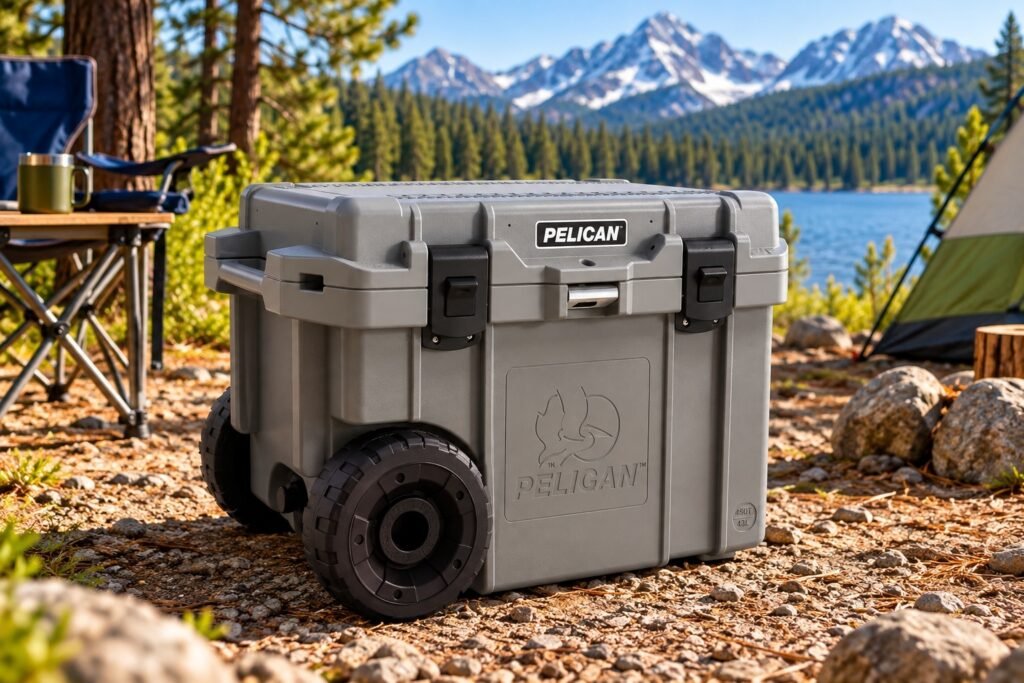
The Pelican 45QT Elite is built for campers who put rugged construction and insulation ahead of low weight.

Pelican uses 2 inches of polyurethane insulation with a freezer-grade gasket. The cooler also includes heavy-duty wheels, a built-in trolley handle, molded tie-down points, stainless-steel hardware and a sloped drain.
There is a reason for the wheels.
Pelican currently lists the cooler at 43.7 lb empty. Add several pounds of ice, drinks and food and you have a cooler that you will not want to casually carry across a large campground.
The wheels and trolley handle therefore form an important part of the design rather than being a small convenience.
The Pelican also has an IGBC-certified bear-resistant design when used according to the applicable certification requirements. That certification does not replace campsite, campground or land-management food-storage rules. Always follow the requirements for the area where you are camping.
For ordinary weekend camping, the Pelican may simply be more cooler than you need. A Coleman weighing 12.7 lb or an Igloo at 10.6 lb is much easier to move.
For repeated vehicle-based trips where construction and insulation take priority over weight, the equation changes.
Pros:
- 2 inches of polyurethane insulation
- Freezer-grade gasket
- Heavy-duty wheels
- Built-in trolley handle
- Stainless-steel hardware
- Tie-down points
- Sloped drain
- IGBC-certified bear-resistant construction
Cons:
- 43.7 lb empty weight
- Considerably heavier than the other coolers in this guide
- Overkill for many short camping trips
- Wheels help on suitable surfaces but do not solve every transport problem
Who should buy it?
Choose the Pelican if you want a rugged wheeled cooler for repeated car camping, overlanding or longer outdoor trips and you accept the weight that comes with that construction.
Pelican’s 45QT specifications detail its 2-inch polyurethane insulation, wheels, trolley handle and stainless-steel hardware.
#7 – Canyon Outfitter 35qt V2 Hard Cooler: Best Rugged Mid-Size Cooler
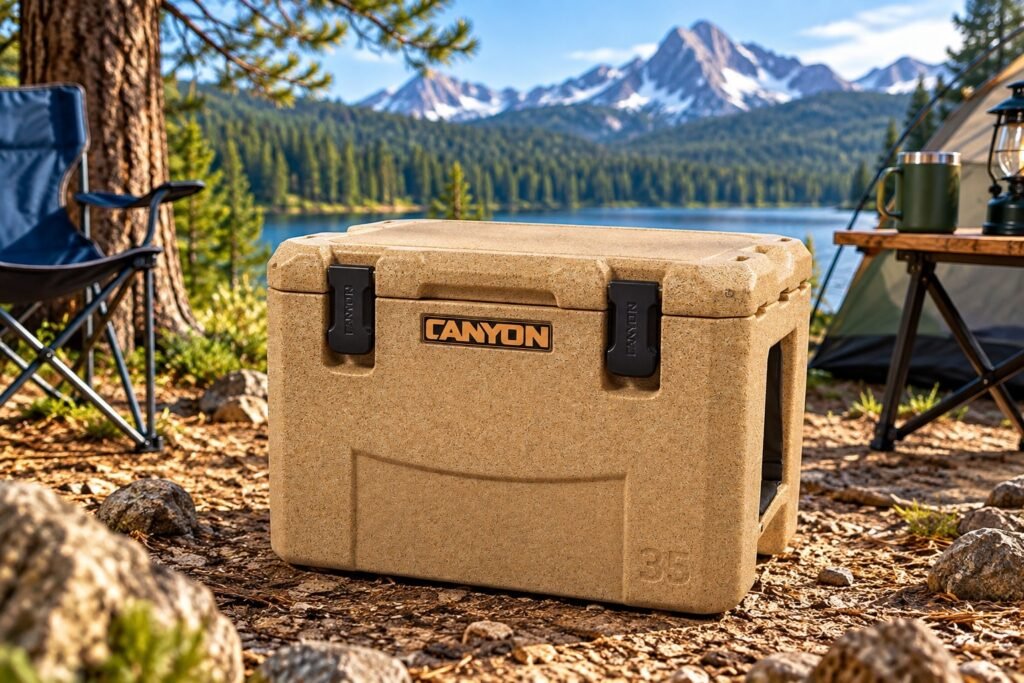
The Canyon Outfitter 35qt V2 fills the gap between compact personal coolers and large 50-plus-quart camping boxes.

Canyon lists exterior dimensions of 22 x 15.5 x 16.5 inches and an empty weight of 21 lb.
Its insulation system uses pressure-injected foam, an insulated seal and a substantial latching system. You also get 2-inch tie-down slots and a garden-hose-compatible drain plug.
Like the Pelican, the Outfitter has IGBC-certified bear-resistant construction. Local food-storage regulations still take priority.
The 35-quart capacity makes this an interesting option for two people who need more space than the YETI Roadie 24 provides but do not need a 50-plus-quart box.
The tradeoff appears on the scale.
At 21 lb empty, the Canyon weighs the same as our 52-quart RTIC pick while providing considerably less nominal capacity. The comparison is not entirely about capacity because construction and dimensions differ, but the weight-to-volume difference is difficult to ignore.
Buy the Canyon because you want its rugged mid-size format, not because 35 quarts happens to sound about right.
Pros:
- Manageable 35-quart size
- Pressure-injected insulation
- Insulated lid seal
- Robust latching system
- Tie-down slots
- Garden-hose-compatible drain
- IGBC-certified construction
Cons:
- 21 lb empty is heavy for a 35-quart cooler
- No wheels
- Less storage capacity than the similarly weighted RTIC 52 QT Ultra-Light
Who should buy it?
The Canyon suits campers who prioritize rugged construction but find larger 50-quart coolers unnecessarily bulky.
The Canyon specifications confirm its 21 lb empty weight, dimensions, pressure-injected foam and IGBC-certified construction.
What Size Camping Cooler Do You Need?
For most campers, cooler size should be based on the number of people, trip duration and how often you can replenish ice or food.
A 24 to 30-quart cooler makes sense for one or two people on shorter trips. It is easier to fit inside a vehicle and easier to move when full.
Around 35 to 55 quarts gives you considerably more flexibility for weekend car camping, couples carrying several days of food and smaller families.
Go larger and capacity increases, but so do the external dimensions and loaded weight.
Remember that a 50-quart cooler does not give you 50 quarts of food storage once you add ice.
This is where buying the biggest cooler you can afford starts to look less sensible. A huge half-empty cooler occupies vehicle space on every trip.
Which Camping Cooler Is Best for Car Camping?
The RTIC 52 QT Ultra-Light is our preferred option for general car camping because its 52-quart capacity provides useful storage without pushing empty weight beyond 21 lb.
The Coleman 50-Quart Xtreme makes more sense when wheels and lower weight matter. At 12.7 lb empty, it is considerably easier to lift into a vehicle.
For one or two campers, the YETI Roadie 24 is easier to fit behind a seat or among other equipment.
The best car camping coolers are therefore not necessarily the largest. Measure the available space in your vehicle before buying.
Your cooler still needs to share the trunk with a tent, sleeping equipment, food, chairs and everything else that seemed small when you packed it individually.
How Much Does Cooler Weight Matter?
Cooler weight matters much more after you add ice.
Suppose the empty cooler already weighs more than 40 lb. Add ice, drinks and food and moving it becomes a two-person job surprisingly quickly.
That is why the differences in this guide matter.
The Engel weighs 7 lb. The Igloo weighs about 10.6 lb. The Coleman weighs 12.7 lb. The RTIC and Canyon weigh 21 lb. The Pelican reaches 43.7 lb before loading.
A heavier cooler may give you thicker insulation and more substantial construction. That can be worthwhile.
Do not pay the weight penalty unless your camping actually benefits from it.
How Important Is Ice Retention?
Ice retention matters, but manufacturer “days of ice” claims need context.
The amount of ice, outside temperature, direct sunlight, how often you open the cooler and whether food and drinks were chilled beforehand all influence how quickly ice melts.
A cooler opened every 20 minutes on a hot campsite has a different job from one sitting unopened in the shade.
For that reason, we would not rank the best camping coolers purely by advertised ice-retention days.
Look at insulation, gasket design, construction and your actual trip length alongside the manufacturer’s claims.
Should You Choose a Cooler With Wheels?
Choose wheels when you expect to move a large loaded cooler regularly.
They make particular sense on 45 to 60-quart coolers where drinks, food and ice can push the loaded weight well beyond what is pleasant to carry.
The Coleman shows why wheels do not require a massively heavy cooler. Its 12.7 lb empty weight keeps the starting load low.
The Pelican takes the opposite approach. Its wheels help manage a cooler that already weighs more than 40 lb empty.
Wheels are less useful on rough trails, steps, deep sand and badly broken ground. Check where you actually camp rather than assuming wheels solve every carrying problem.
Hard Cooler vs Soft Cooler: Which Is Better for Camping?
Hard coolers make more sense when you want structure, better protection for the contents and the potential for thicker insulation.
They also stack more predictably in a vehicle and are easier to clean when food packaging leaks.
Soft coolers win on portability. They are usually lighter and easier to carry, particularly for day trips.
For multi-day car camping, we generally prefer a hard cooler. For lunch, short outings and carrying food away from the vehicle, a smaller soft cooler can be more convenient.
This guide concentrates on hard coolers because they are better suited to the longer campsite and vehicle-based use behind searches for the best ice chest for camping.
How Should You Pack a Camping Cooler?
Start with cold food and drinks rather than asking the cooler to chill warm items.
Pre-chilling the cooler where practical also reduces the amount of ice initially spent cooling the walls and interior.
Pack food in a way that reduces unnecessary searching. Every long session with the lid open replaces cold internal air with warmer outside air.
Keep frequently used drinks accessible rather than burying them underneath dinner.
For longer trips, separating drinks and perishable food into different coolers can also reduce how often the food cooler gets opened.
Your wider cooking setup matters too. Planning meals before the trip makes it easier to pack only what you need rather than filling valuable cooler space with food that returns home untouched.
Which Features Actually Matter on a Camping Cooler?
Insulation
Thicker insulation generally helps slow heat transfer, but it also consumes space and adds bulk.
Do not judge insulation by thickness alone. Gasket design, lid fit, construction and how you use the cooler also matter.
Empty Weight
Check this before buying.
A cooler that seems manageable on a product page feels very different once loaded with 30 lb of ice and several days of food.
External Dimensions
Quart capacity tells you very little about whether the cooler fits your vehicle.
Measure the intended storage location.
Drain Plug
A drain is particularly useful on larger coolers. Tipping a fully loaded 50-quart cooler to remove meltwater gets old quickly.
Handles
Look at how you will actually carry the cooler.
Side handles work well for two-person carrying. A shoulder strap makes more sense on smaller models. Large wheeled coolers benefit from a proper pulling handle.
Tie-Down Points
These become useful for truck beds, trailers, boats and overlanding setups.
For ordinary campground use, they may matter very little.
Buy for your trip, not the feature list.
Best Small Coolers for Camping
For compact camping setups, our two strongest options are the YETI Roadie 24 and Engel 30 Quart Drybox/Cooler.
Choose the YETI if rugged hard-cooler construction is the priority.
Choose the Engel if low weight matters more. Its 7 lb empty weight makes it considerably easier to carry than most hard coolers in this guide.
The Engel also gives you 30 quarts of nominal capacity compared with the Roadie’s 24 quarts, although quart ratings should never replace checking the actual internal dimensions.
For solo camping and short weekends, either makes more sense than hauling a large family cooler you barely fill.
What Are the Best Cool Boxes for Camping?
For most car campers, we would start with the RTIC 52 QT Ultra-Light.
Its combination of 52-quart capacity, 21 lb empty weight and up to 3 inches of insulation gives it the broadest appeal in this group.
The Coleman Xtreme is easier to justify if budget, wheels and low weight take priority. The YETI Roadie 24 and Engel 30 Quart Drybox are better fits for campers who do not need 50 quarts of storage.
The Igloo Marine Ultra 54 stands out when you want plenty of capacity without a heavy empty cooler.
At the rugged end, the Pelican 45QW and Canyon Outfitter 35 trade additional weight for heavier construction and insulation.
There is no reason to carry a 40 lb empty ice chest for a one-night trip if a smaller cooler handles the job. Equally, saving a few pounds on the cooler itself matters less when you are keeping several days of perishable food cold at a vehicle-based base camp.
Match the cooler to the trip.
For most campers, that decision matters more than the logo on the lid.
CampEquipmentPlus relies on reader support. Purchases made via links on our website may earn us an affiliate commission at no extra cost to you, helping keep the site running.