
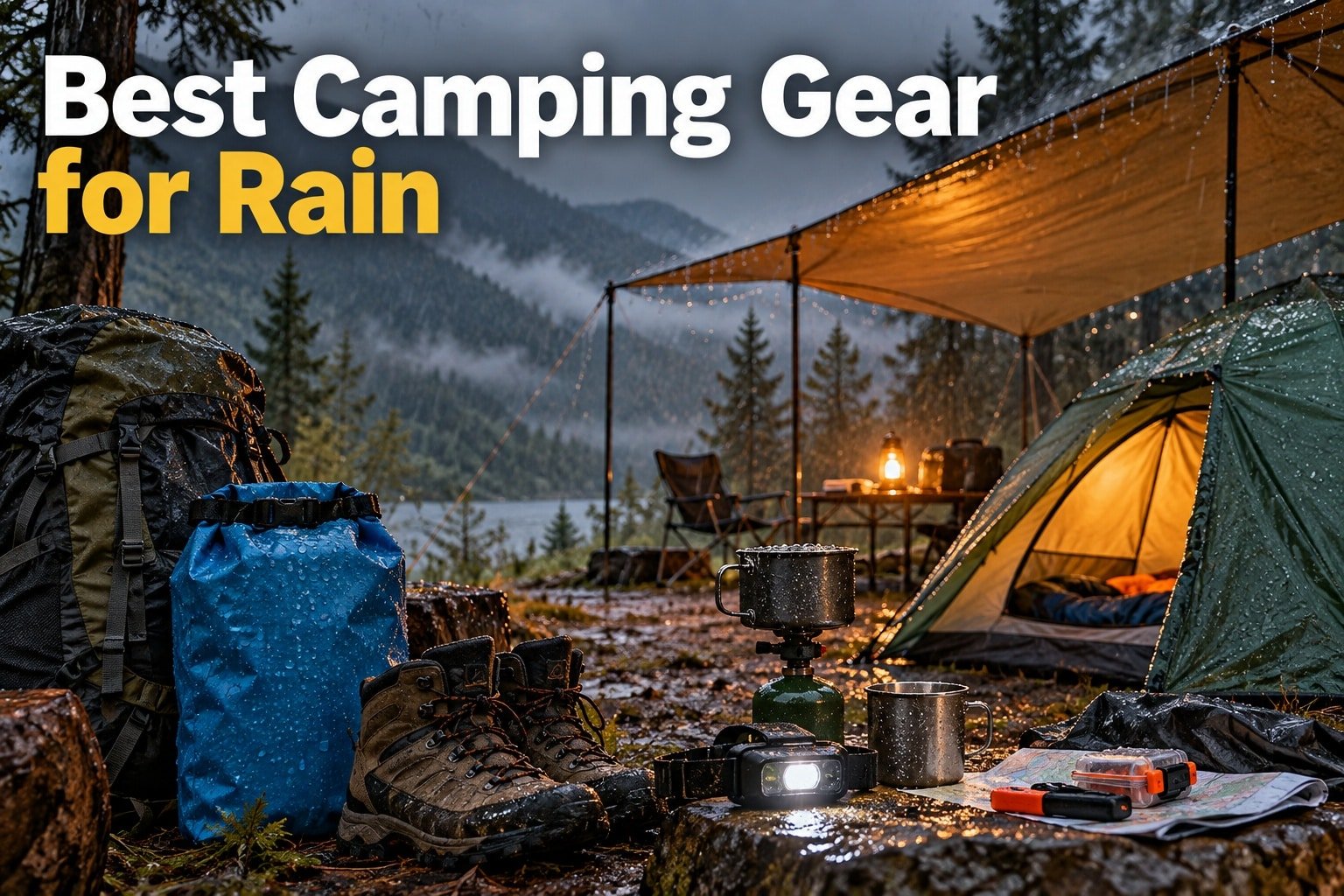
Camping in the rain can go from mildly annoying to miserable surprisingly quickly. The best camping gear for rain deals with several problems at once: water falling from above, saturated ground underneath you, wet clothing, damp sleeping gear, poor visibility, and a campsite where everything seems determined to collect water.
I learned that lesson during a storm on an exposed ridge. Heavy rain arrived with wind gusts of around 40 mph, and I had pitched the tent broadside to the wind. The ground became saturated, a peg pulled out of the mud, and at around 2:00 AM I woke in a puddle with the tent fabric pressing against my shins.
I spent the rest of the night supporting a tent pole with my backpack.
That trip changed how I prepare for wet weather. I pay far more attention to drainage, wind direction, ground conditions, guylines, footprint placement, fly tension, and ventilation before the rain starts.
Good equipment matters. How you use it matters too.
Best Camping Gear for Rain
- Start with shelter. A suitable tent, correctly positioned footprint, and properly tensioned rainfly protect your sleeping area.
- Add a separate tarp for car camping. Having somewhere sheltered outside the tent makes prolonged rain considerably easier to live with.
- Protect your sleeping bag and spare clothing separately. A dry bag is more useful when you prioritize the equipment that really needs to stay dry.
- Wear a proper rain system. A waterproof shell works better when paired with rain pants and suitable footwear.
- Prepare before the forecast arrives. Check seams, DWR, batteries, guylines, pegs, and waterproof storage at home.
What Is the Best Camping Gear for Rain?
The best camping gear for rain protects your shelter, clothing, sleeping system, essential equipment, and campsite rather than relying on one supposedly waterproof product.
For most campers, I would prioritize gear in this order:
- Weather-appropriate tent
- Groundsheet or footprint
- Rain jacket
- Rain pants
- Waterproof or weather-resistant footwear
- Dry bags
- Campsite tarp
- Weather-resistant headlamp
- Repair equipment
- Backup ignition equipment where fires are permitted
You do not necessarily need all 10.
A backpacker may leave the large campsite tarp at home because of its weight. A family camping beside the car may consider that same tarp one of the most useful pieces of equipment they packed.
Buy for the trip you are actually taking.
Best Camping Gear for Rain at a Glance
| Gear | Recommended Product | Best For | Key Advantage | Main Limitation |
|---|---|---|---|---|
| Tent | Weather-appropriate full-rainfly tent | Sleeping shelter | Protects the main sleeping area | Performance depends heavily on setup and conditions |
| Groundsheet | Tent-specific footprint | Wet ground | Separates tent floor from wet and abrasive ground | Must fit beneath tent floor correctly |
| Campsite tarp | Kelty Noah’s Tarp 12 | Car camping | 144 sq ft of flat coverage | 2 lb 9 oz and poles sold separately |
| Rain jacket | Outdoor Research Foray 3L | Sustained rain | Three-layer shell with large vents | More shell than occasional campers need |
| Rain pants | Outdoor Research Foray 3L Rain Pants | Hiking and camp setup | Seam-taped construction and long side zips | Extra clothing to carry |
| Dry bag | Sea to Summit Big River Dry Bag | Critical gear | 10,000 mm hydrostatic-head fabric | Not designed for submersion |
| Sleeping bag storage | Sea to Summit Evac Compression Dry Bag | Compressible insulation | Compression plus water-resistant storage | More specialized than a standard dry bag |
| Headlamp | Black Diamond Storm 500-R | Wet-weather lighting | IP67 construction and 500-lumen maximum output | Rechargeable battery requires power planning |
| DWR treatment | Nikwax TX.Direct Spray-On | Rainwear maintenance | Restores water repellency | Does not repair damaged waterproof membranes |
| Ignition | Weather-resistant backup ignition kit | Emergency preparedness | Gives you more than one ignition option | Fire restrictions and manufacturer instructions still apply |
1. Start With a Weather-Appropriate Tent
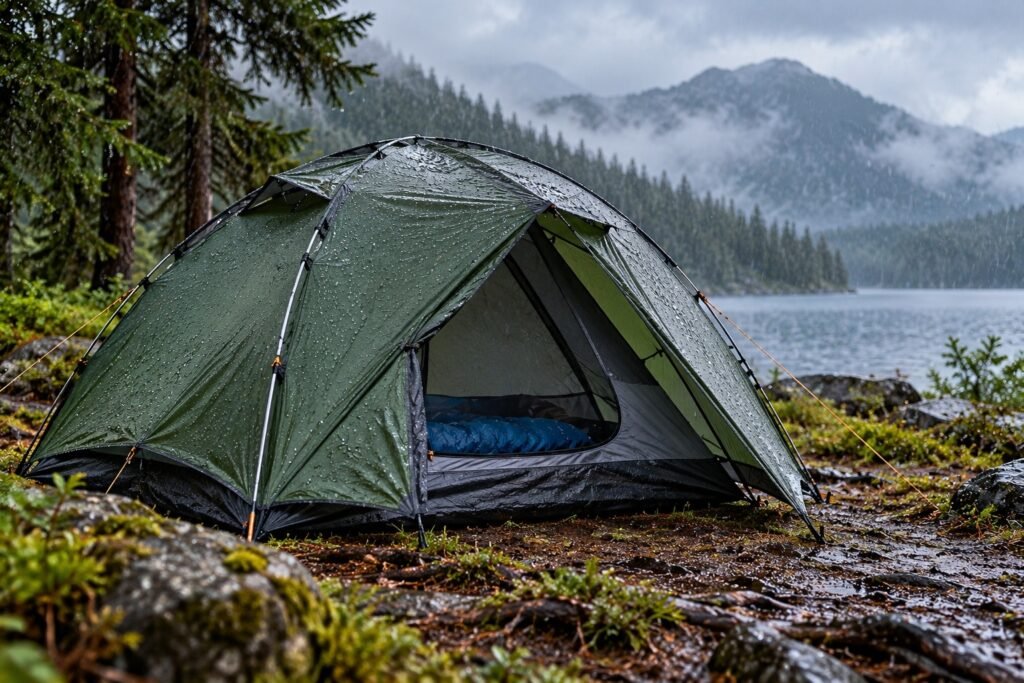
Your tent is the most important piece of rain camping gear because almost everything else depends on maintaining a usable sleeping area.
Do not judge a tent solely by a large waterproof rating printed on a product listing.
Look at the whole shelter.
A good wet-weather tent needs appropriate rainfly coverage, protected seams, a suitable floor, ventilation, reliable attachment points, and enough structural stability for the conditions you expect.
Ventilation deserves particular attention. A tent can prevent rain from entering while condensation creates moisture inside. Keeping the fly properly tensioned and separated from the inner tent helps airflow and reduces contact between wet outer fabric and the inner shelter.
Your pitching location matters too.
Avoid obvious depressions where water can collect. Check drainage before unpacking. Consider the direction of the weather and use the tent’s appropriate guylines when conditions require them.
Our guide to waterproof tents covers suitable options in more detail.
2. Use a Proper Tent Footprint or Groundsheet
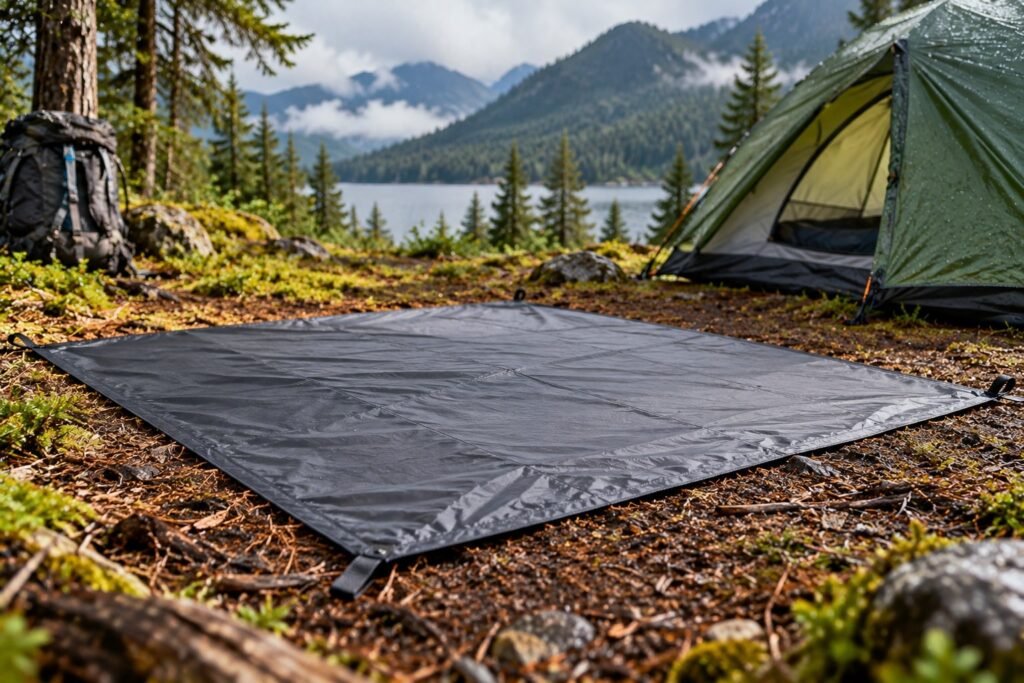
A footprint protects the tent floor from wet, abrasive, and dirty ground, but bigger is not better.
The footprint should sit beneath the tent floor rather than sticking out around the edges. Exposed material can catch rain running from the fly and direct that water underneath your tent.
That is one lesson I took from my night on the exposed ridge.
I now make sure the footprint is tucked completely beneath the tent floor before bad weather arrives. I also look at the ground itself rather than assuming a footprint can compensate for pitching in a poor location.
A footprint also protects the tent floor from stones, sticks, grit, and repeated abrasion.
If your tent manufacturer offers a correctly sized footprint, that is usually the simplest option. Universal groundsheets work too, but check their dimensions carefully.
See our guide to the best camping groundsheets for more options.
3. Kelty Noah’s Tarp 12: Best Rain Tarp for Car Camping
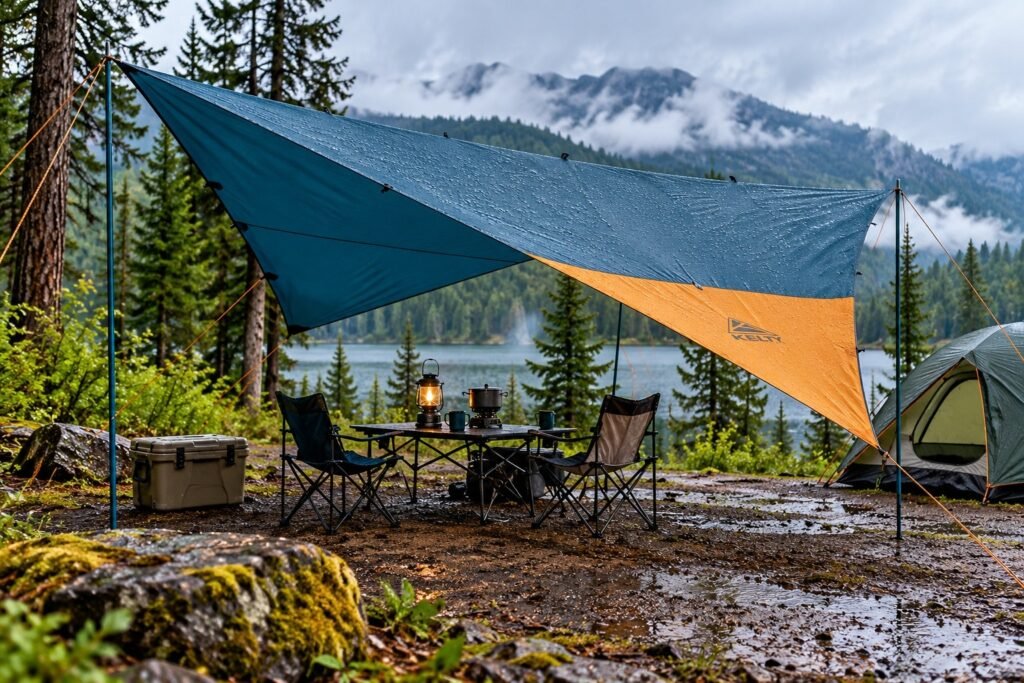
A separate tarp gives you something a tent cannot: sheltered living space outside your sleeping area.
Portable Camping Canopy + Rain Shelter, Durable 68D Polyester, Adjustable Guy Lines, Multiple Pitch Options, 9, 12 or 16f

The Kelty Noah’s Tarp 12 provides 144 sq ft of flat coverage from a 12 x 12 ft design. Kelty specifies 68D polyester fabric with an 800 mm rating, fully taped seams, reinforced guyout points, and attached corner guylines. Kelty specifications
That makes sense over a campsite seating or food-preparation area, subject to safe stove placement and manufacturer instructions.
The advantage becomes obvious after several hours of rain. Without additional shelter, your tent can become the bedroom, changing room, storage cupboard, and only dry place to sit.
The compromise is weight.
At 2 lb 9 oz, this is much easier to justify for car camping than lightweight backpacking. Kelty also sells the support poles separately.
Pros:
- 144 sq ft of flat coverage
- Fully taped seams
- Multiple reinforced guyout points
- Packs into its own carry bag
- Useful for creating a separate sheltered camp area
Cons:
- 2 lb 9 oz is substantial for backpacking
- Support poles are separate
- Requires enough campsite space and suitable anchor points
- An 800 mm fabric specification should not be confused with higher-rated waterproof storage fabrics
4. Outdoor Research Foray 3L: Best Rain Jacket
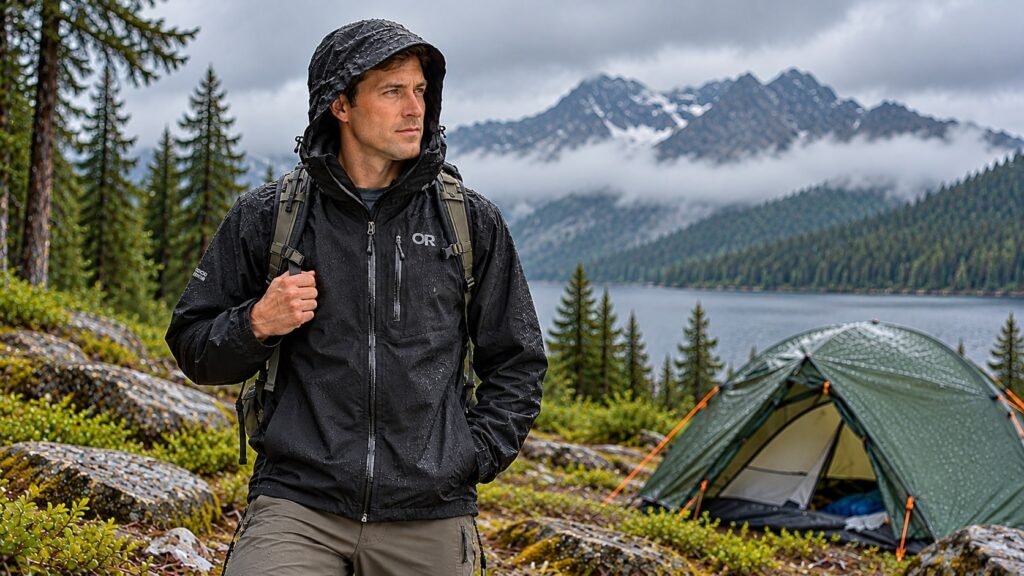
A rain jacket needs to prevent external water getting through while allowing you to manage the moisture your own body produces.
Foray 3L Rain Jacket features recycled AscentShell Dry waterproof stretch fabric, a single-separating center front zipper, hook/loop cuff closures and an elastic drawcord hem for optimal performance at any level.

That second part gets overlooked.
The Outdoor Research Men’s Foray 3L (Aspire 3L is the women’s version) uses a fully seam-taped, three-layer AscentShell Dry construction made from 40D recycled nylon. Outdoor Research also gives it TorsoFlo vents running from the hem toward the bicep.
Those vents are one of the main reasons this jacket makes sense for wet-weather camping.
Pitching a tent, carrying equipment, hiking, and repeatedly walking between the car and campsite can generate plenty of heat. Opening large mechanical vents gives that heat somewhere to go.
The Foray also has an adjustable hood, AquaGuard zippers, an internal storm flap, adjustable cuffs, and an elastic drawcord hem. Outdoor Research currently lists its weight at 15.34 oz.
Pros:
- Three-layer construction
- Fully seam taped
- Large TorsoFlo ventilation openings
- Adjustable hood, cuffs, and hem
- Better suited to prolonged wet conditions than a basic emergency shell
Cons:
- Heavier than minimalist rain shells
- Overkill for campers who only want emergency rain protection
- An uninsulated shell still requires appropriate layers in cold weather
5. Outdoor Research Foray 3L Rain Pants: Best Rain Pants
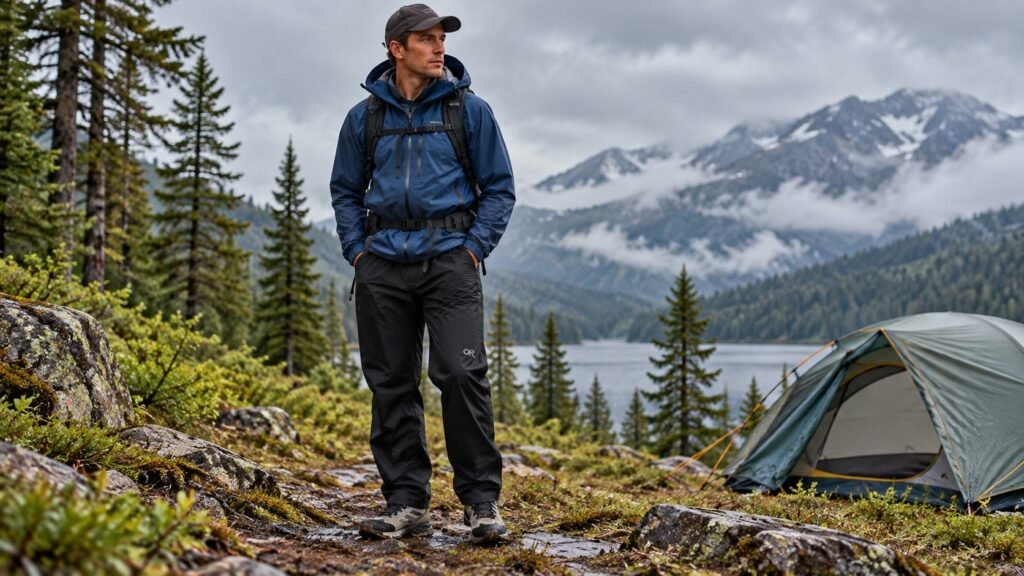
A waterproof jacket protects only half of you.
For a brief shower around a campground, that may be enough. For sustained rain, setting up camp or walking through wet vegetation, rain pants become much easier to justify.
Premium three-layer waterproof trousers designed specifically for rugged trail use and wet-weather adventures.

The Outdoor Research Foray 3L Rain Pants use waterproof, breathable, fully seam-taped three-layer construction. Their 3/4-length side zippers are particularly useful because rain pants often need to go on after you are already wearing hiking footwear.
That sounds like a small detail until the rain starts.
A suitable rain-pant system also prevents water running from a jacket straight into ordinary trousers, which can leave your lower layers wet long after the shower passes.
The disadvantage is another piece of clothing to carry.
For fair-weather summer car camping, they may spend the entire trip packed away. If sustained rain appears in the forecast, that unused weight starts looking far more sensible.
Pros:
- Three-layer waterproof construction
- Fully seam taped
- Long side zippers simplify dressing
- Articulated design helps movement
- Useful for sustained rain and wet vegetation
Cons:
- Unnecessary for many dry-weather trips
- Adds weight and packed bulk
- Requires correct layering to manage heat and moisture
Check Price on Amazon.com
6. What Footwear Works Best for Camping in Rain?
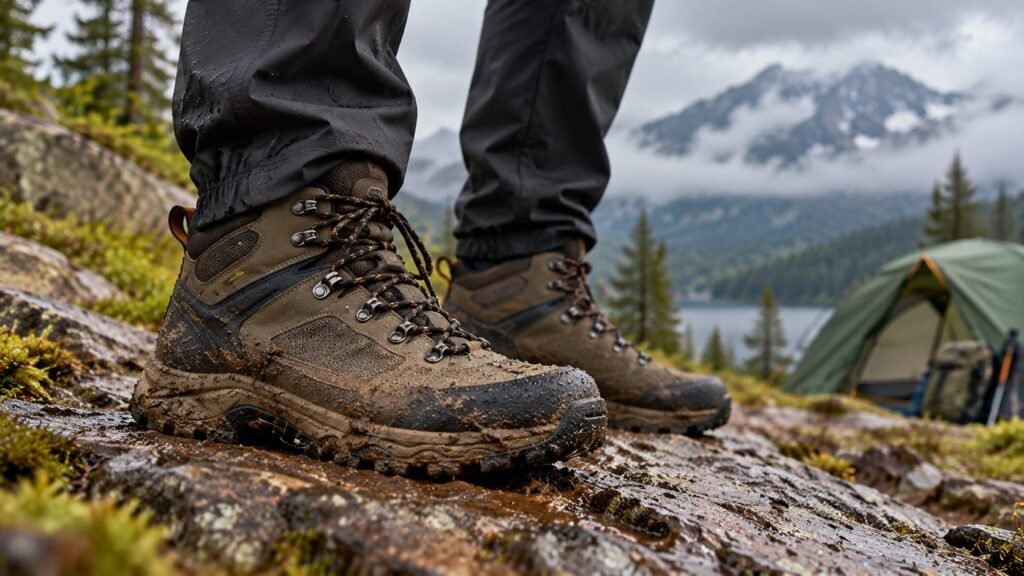
Waterproof hiking shoes or boots make sense when you expect prolonged rain, muddy campsites, wet trails, or repeated exposure to saturated vegetation.
Do not assume the word “waterproof” solves everything.
Water can still enter through the opening at the top. Wet trousers can funnel water toward your socks. Deep water can exceed the height of the boot. Feet also produce moisture internally, particularly during strenuous hiking.
This is where rain pants and footwear need to work together.
For campsite use, prioritize grip as well as water protection. Wet grass, mud, timber, roots, and rocks can become slippery.
For backpacking, weight and drying time deserve more consideration. A heavy waterproof boot that becomes saturated can take considerably longer to dry than lightweight trail footwear.
There is no universal winner here.
Choose footwear according to your terrain, expected temperature, trip length, and whether you are mainly standing around a campground or covering miles on foot.
7. Sea to Summit Big River Dry Bag: Best for Protecting Important Gear
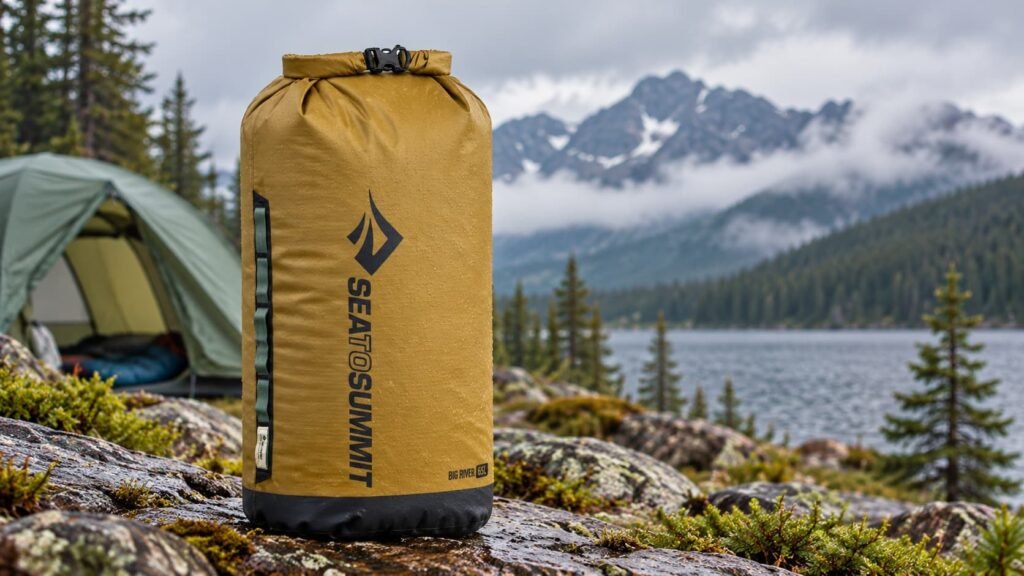
You do not need to put every item you own into a heavy dry bag.
Protect the things that matter first.
Ultradurable, abrasion-resistant TPU-coated dry bag delivers rugged dry storage for kayaking, rafting, and touring

The Sea to Summit Big River Dry Bag uses 420D nylon and has a stated 10,000 mm hydrostatic head. It comes in multiple capacities and has external attachment points that make it more versatile around camp than a basic lightweight stuff sack.
Sea to Summit also makes an important distinction: roll-top dry bags should not be treated as submersible storage.
That limitation is worth remembering. “Dry bag” does not mean “throw it underwater and forget about it.”
I would prioritize spare clothing, electronics, essential documents, vulnerable equipment, and other items that become difficult or useless when soaked.
Pros:
- 10,000 mm hydrostatic-head fabric
- Tougher 420D construction
- Multiple sizes available
- External attachment points
- Suitable for organizing moisture-sensitive gear
Cons:
- Heavier than ultralight dry sacks
- Roll-top closure is not intended for submersion
- Using heavy dry bags for every item adds unnecessary weight
Check Price on Amazon.com
8. Sea to Summit Evac Compression Dry Bag: Best for Sleeping Bags
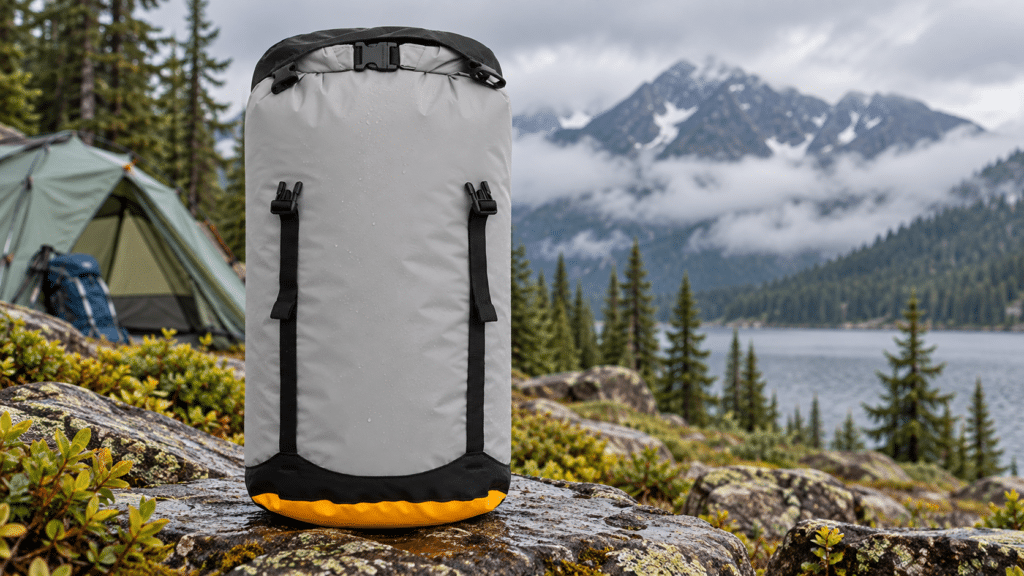
Your sleeping bag deserves special treatment in sustained rain.
Once insulation becomes wet, the consequences are more serious than having a damp camp chair or wet cookware.
Air-permeable roll-top compression dry bag with four straps compresses gear for backpacking, camping, and water sports

The Sea to Summit Evac Compression Dry Bag combines compression straps with waterproof fabric rated at a 10,000 mm hydrostatic head. The design allows air to escape while compressing bulky items such as sleeping bags and insulated clothing.
That solves two problems.
You reduce packed volume while giving important insulation another layer of protection inside your pack or luggage.
Do not forget the sleeping pad, though.
A cold-weather sleep system depends on insulation beneath you as well as around you. I learned that on a different trip when an inadequately insulated air pad became the weak point despite having a sleeping bag rated for much colder conditions.
Treat your sleeping bag, sleeping pad, clothing, and shelter as one system.
Pros:
- Designed for compressible equipment
- 10,000 mm hydrostatic-head fabric
- Reduces sleeping-bag packed volume
- Useful for separating critical insulation from wet equipment
Cons:
- More specialized than a normal dry bag
- Compression can make organization less convenient
- Roll-top dry storage should still be used within manufacturer limits
Check Price on Amazon.com
9. Black Diamond Storm 500-R: Best Headlamp for Rain
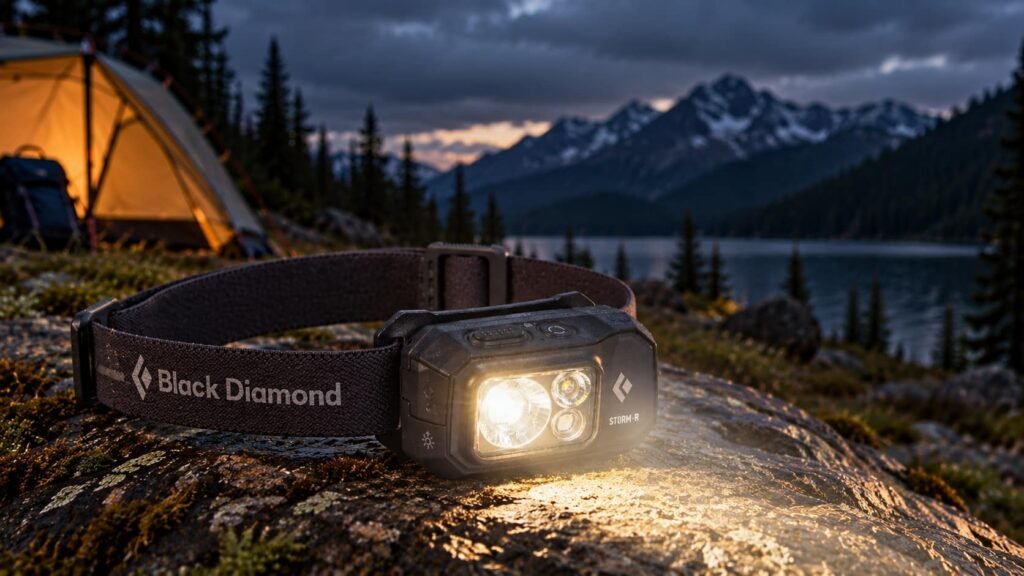
Rain creates enough jobs without asking one hand to hold a flashlight.
The Black Diamond Storm 500-R produces up to 500 lumens and carries an IP67 rating. Black Diamond states that its sealed housing is tested to operate at a depth of 1 meter for 30 minutes. Storm 500-R specifications
500 lumens, red night vision, RGB night vision for route finding, camp tasks, and low-light navigation, Brightness Memory

That IP rating is the important specification here.
The headlamp also uses a rechargeable 2400 mAh lithium-ion battery and weighs 120 g. Available modes include proximity and distance lighting, dimming, strobe, colored night-vision settings, and a lock mode.
Hands-free lighting becomes particularly useful when tightening guylines, finding a loose peg, checking a tent, changing wet clothing, or setting up after dark.
The rechargeable battery is both an advantage and a consideration.
Charge it before leaving and think about how you will replenish it during longer trips.
Pros:
- IP67 rated
- Maximum 500-lumen output
- Hands-free operation
- Rechargeable battery
- Multiple brightness and night-vision modes
- Lock function helps prevent accidental activation inside your pack
Cons:
- Requires charging
- More lighting modes than some campers need
- Currently shown as out of stock directly from Black Diamond, so retailer availability may vary
10. Nikwax TX.Direct Spray-On: Best for Maintaining Rain Gear
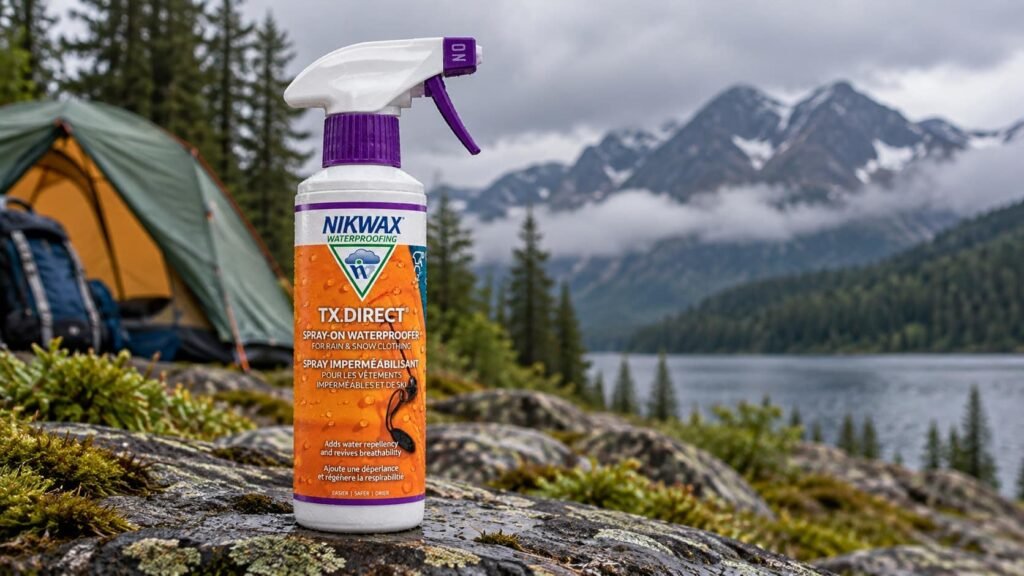
Sometimes you do not need another jacket.
You need to look after the one you already own.
Aater-based, PFAS-free waterproofing spray designed to restore the Durable Water Repellency (DWR) and breathability of technical outdoor clothing.

The outer face of waterproof clothing normally uses a durable water-repellent treatment, commonly called DWR. Its job is to encourage water to bead and run from the fabric rather than saturating the outer surface.
As that treatment wears or becomes contaminated, the face fabric can start “wetting out.”
That does not automatically mean the waterproof membrane has failed.
GORE-TEX explains that dirt, sunscreen, insect repellent, smoke, detergent residue, and ordinary use can reduce DWR performance. Cleaning, drying, and restoring the treatment according to the garment manufacturer’s instructions can help maintain performance. GORE-TEX care guidance
Nikwax TX.Direct Spray-On is designed to restore water repellency to waterproof breathable clothing and lets you target areas that receive heavy wear.
Follow the garment manufacturer’s care instructions first.
A treatment cannot repair torn fabric, damaged seam tape, or a failed waterproof membrane.
Pros:
- Extends the usefulness of existing rainwear
- Spray application allows targeted treatment
- Useful for high-wear areas
- Avoids replacing functional clothing simply because the DWR needs maintenance
Cons:
- Not a repair for structural damage
- Cannot restore a failed waterproof membrane
- Application instructions vary according to garment construction
What Camping Gear Should You Keep Dry First?
Prioritize your sleeping insulation, dry clothing, electronics, ignition equipment, and other moisture-sensitive essentials.
Not everything needs the same protection.
A wet cooking pot is annoying. A soaked sleeping bag shortly before temperatures drop is a much bigger problem.
I like separating wet and dry equipment rather than repeatedly opening one large bag containing everything. Keep a genuinely dry set of clothing protected for camp and sleeping rather than wearing every available layer during the day.
Your sleeping bag deserves particularly careful storage.
If several days of rain are forecast, redundancy also starts to make sense. A pack liner combined with individual dry storage for critical equipment gives you another barrier if one layer leaks or is accidentally left open.
Does Waterproof Camping Gear Really Stay Waterproof?
Waterproof performance has limits, and different products use different test methods, materials, seams, closures, and construction.
A hydrostatic-head figure measures how much water pressure a fabric can resist under a defined test. That number is useful, but it does not describe the entire finished product.
Seams matter.
Zippers matter.
Openings matter.
Wear matters.
How the product is used matters.
This is why the Sea to Summit Big River and Lightweight dry bags can use fabric with a 10,000 mm hydrostatic-head rating while the manufacturer still warns that roll-top dry bags are not intended for submersion.
Rainwear introduces another issue: condensation.
A waterproof shell can prevent rain from passing inward while sweat and water vapor accumulate inside. Mechanical ventilation, breathable membranes, suitable layering, and maintaining the outer DWR all help manage that moisture.
Do not diagnose every clammy jacket as a waterproofing failure.
How Should You Prepare Your Gear Before Camping in Rain?
Prepare your wet-weather equipment at home before relying on it at a campsite.
Pitch your tent and inspect the fly, poles, pegs, guylines, floor, and seams. Make sure you understand how everything fits together.
Wear your rain jacket and pants. Check the zippers, hood adjustment, cuffs, and vents.
Charge your headlamp.
Inspect your footprint.
Check dry bags and closures.
Look at your footwear.
Pack repair supplies suitable for the equipment you actually own.
I strongly prefer doing this before leaving. A missing tent component is simple to deal with at home. Finding out during heavy rain after dark is considerably less entertaining.
How Do You Pitch a Tent When Heavy Rain Is Expected?
Choose the site carefully, consider drainage and wind exposure, position the footprint correctly, use the appropriate guylines, and tension the rainfly according to the tent manufacturer’s instructions.
My worst wet-weather camping experience changed how I approach this.
During that exposed-ridge storm, I had pitched broadside to strong wind. Saturated ground contributed to a peg pulling loose, and the shelter deteriorated quickly from there.
Since then, I consider the prevailing wind before pitching and, where the tent design permits, orient the lower-profile end toward it. I keep the footprint fully beneath the floor, use the appropriate guylines, reinforce anchoring where soft ground requires it, and pay much closer attention to fly tension and ventilation.
Site selection still comes first.
Do not pitch in an obvious drainage channel or depression and expect a better groundsheet to solve the problem.
Our weather protection guide covers more equipment for rain, wind, and damp ground.
What Should Be in a Wet-Weather Repair Kit?
A wet-weather repair kit should match your tent, clothing, sleeping equipment, and other gear rather than being a collection of random tools.
Useful items may include manufacturer-compatible fabric patches, repair tape, spare cord, appropriate seam repair material, and replacement parts suitable for your equipment.
Check compatibility first.
Some repair products work well on particular fabrics or coatings and poorly on others. A patch that refuses to bond to wet fabric at 11:00 PM is mostly extra luggage.
Keep repair materials somewhere accessible and protected from water.
Our camp maintenance hub covers more equipment for campsite repairs and maintenance.
Should You Carry Backup Fire-Starting Equipment in Rain?
If fires are permitted where you are camping, carrying more than one suitable ignition method can provide useful redundancy.
I learned this after heavy rain soaked the forest during a cold trip. My wet lighter failed and ordinary matches repeatedly blew out. Available wood was damp, and I could not establish a reliable fire.
I changed my fire kit after that trip.
I now favor carrying multiple suitable ignition options rather than trusting one lighter. Stormproof matches and purpose-made fire-starting materials can form part of that setup.
Personal experience does not override local fire restrictions, campground rules, wildfire bans, or manufacturer instructions. Check the rules for your location before lighting any fire or stove.
The wider lesson applies beyond fires.
Wet-weather camping exposes single points of failure quickly.
What Are the Most Common Rain Camping Mistakes?
Most wet-weather camping problems come from small decisions accumulating rather than one spectacular equipment failure.
A few mistakes are particularly easy to avoid.
Leaving the footprint sticking out from beneath the tent can collect runoff.
Waiting until rain starts before attaching guylines means doing a simple job in considerably worse conditions.
Mixing wet clothing with dry sleeping layers spreads moisture through equipment that was previously protected.
Closing every vent because rain is falling can increase condensation.
Assuming expensive equipment removes the need for good campsite selection is another mistake.
And relying on one ignition source, one light, or one unprotected set of dry clothes leaves little room for equipment failure.
Rain makes organization matter.
Is Expensive Rain Gear Worth Buying?
Expensive rain gear makes more sense when you regularly camp or hike in prolonged wet conditions, while occasional campground users can often manage with simpler equipment.
Frequency matters.
Conditions matter more.
A backpacker covering 15 miles in sustained rain has different requirements from someone walking 50 yards between a car and a tent.
Spend where failure creates the biggest problem.
Shelter deserves attention. So does rain clothing if you hike away from camp. Protecting your sleeping system costs relatively little compared with dealing with soaked insulation.
You can save money elsewhere.
You do not need the heaviest dry bag for your spoon.
Your spoon does not care.
Do You Need a Tarp If Your Tent Is Waterproof?
A tarp is not essential, but it becomes useful when you expect to spend significant time at camp during rain.
Your tent protects the sleeping area.
A tarp creates somewhere else to exist.
For car camping, that can mean a sheltered place for chairs, equipment, footwear, and food preparation where permitted and safely arranged.
For backpacking, the decision changes because weight matters more. Carrying another 2 lb 9 oz shelter makes little sense if you are trying to keep your pack light.
A smaller lightweight tarp may make more sense there.
What Should You Wear for Camping in Heavy Rain?
Use a layered system that manages rain from outside and moisture from inside.
A waterproof breathable shell forms the outer layer. Rain pants protect your lower body. Suitable footwear handles wet ground.
Underneath, choose layers appropriate for the temperature and activity level.
Avoid overdressing simply because it is raining. If you become excessively hot inside waterproof clothing, perspiration can leave your base layers damp.
Use ventilation.
That is one reason I like large mechanical vents on a rain shell. Sometimes opening a zipper does more for comfort than chasing another impressive fabric specification.
Keep a separate dry layer protected for later.
How Do You Keep a Sleeping Bag Dry When Camping?
Pack your sleeping bag inside protected storage and keep it away from wet clothing, tent walls, and equipment.
A compression dry bag such as the Sea to Summit Evac provides one option.
You can also use a waterproof pack liner combined with a suitable stuff sack. The important part is creating a reliable barrier between your insulation and the wet environment.
Once inside the tent, avoid pressing the sleeping bag against condensation-covered walls.
Ventilate the shelter according to its design.
And do not forget what is underneath you. Your shelter and sleeping gear should work as a complete system.
Best Camping Gear for Rain: Final Picks
If I were building a wet-weather camping setup from scratch, I would spend money according to consequences rather than trying to waterproof everything I own.
Start with the tent and ground protection.
For car camping, add a separate tarp. The Kelty Noah’s Tarp 12 provides a large sheltered area without pretending to be a lightweight backpacking solution.
For clothing, the Outdoor Research Foray 3L jacket and matching rain pants provide a more substantial setup for campers expecting prolonged wet weather.
Protect your sleeping insulation and spare clothing separately. The Sea to Summit Big River makes sense for general equipment, while the Evac Compression Dry Bag is better suited to bulky insulation.
For lighting, the Black Diamond Storm 500-R stands out because its IP67 construction addresses the actual problem we care about here: operating around a wet campsite.
Then maintain what you already own.
Clean rainwear correctly, restore its DWR when appropriate, inspect your tent before leaving, charge your lights, and test unfamiliar equipment at home.
After more than 16 years of camping, my biggest lesson from bad weather is fairly simple.
Rain exposes weak systems.
A good tent helps. Good clothing helps. Dry storage helps.
Getting all of them working together is what makes the difference.
CampEquipmentPlus relies on reader support. Purchases made via links on our website may earn us an affiliate commission at no extra cost to you, helping keep the site running.