
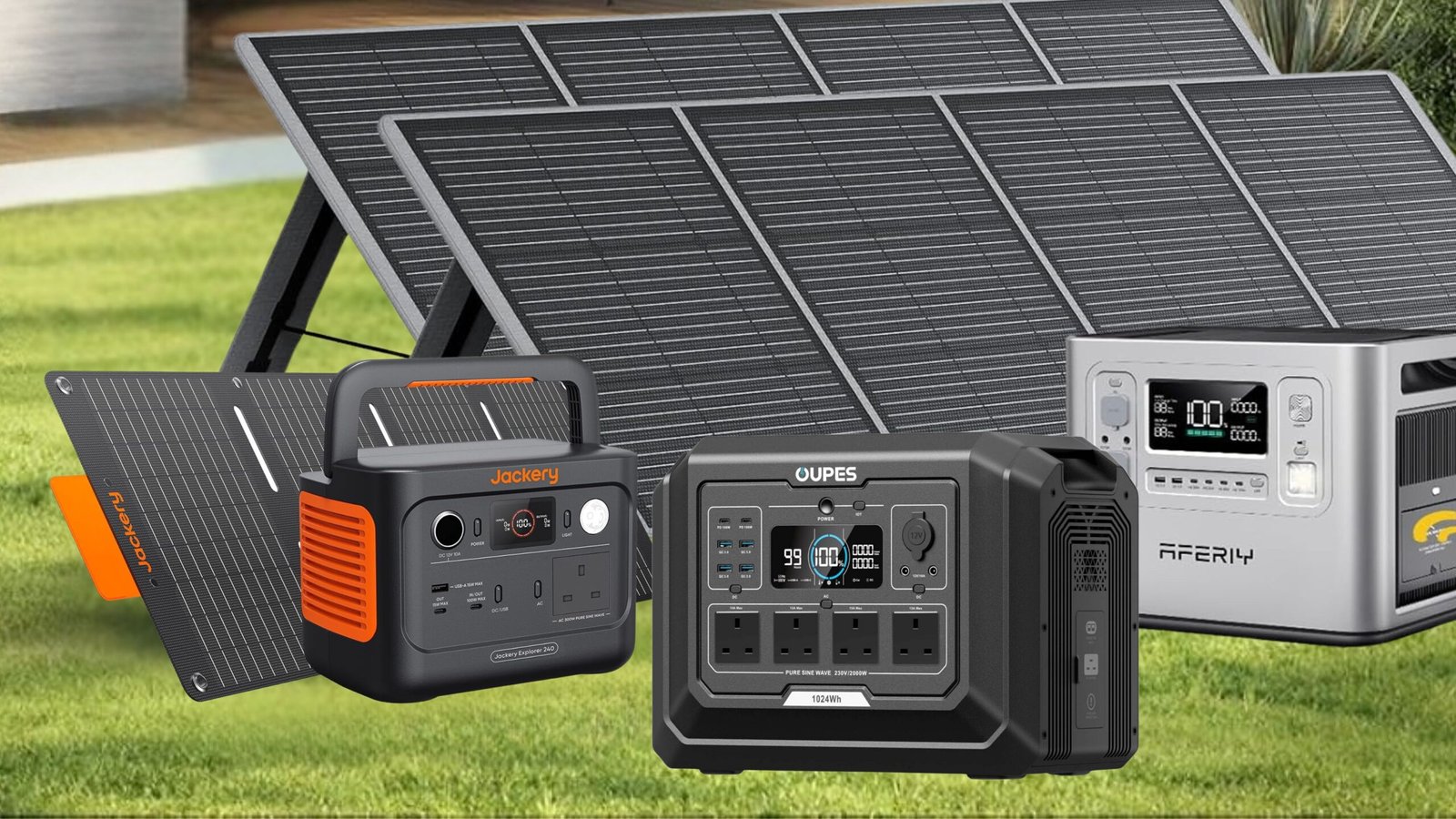
★★★★★ We’ve tested and compared today’s most popular portable power stations for camping, overlanding, and RV travel.
After evaluating battery capacity, charging speed, inverter performance, portability, and long-term reliability, the Anker SOLIX C1000 is our overall favorite.
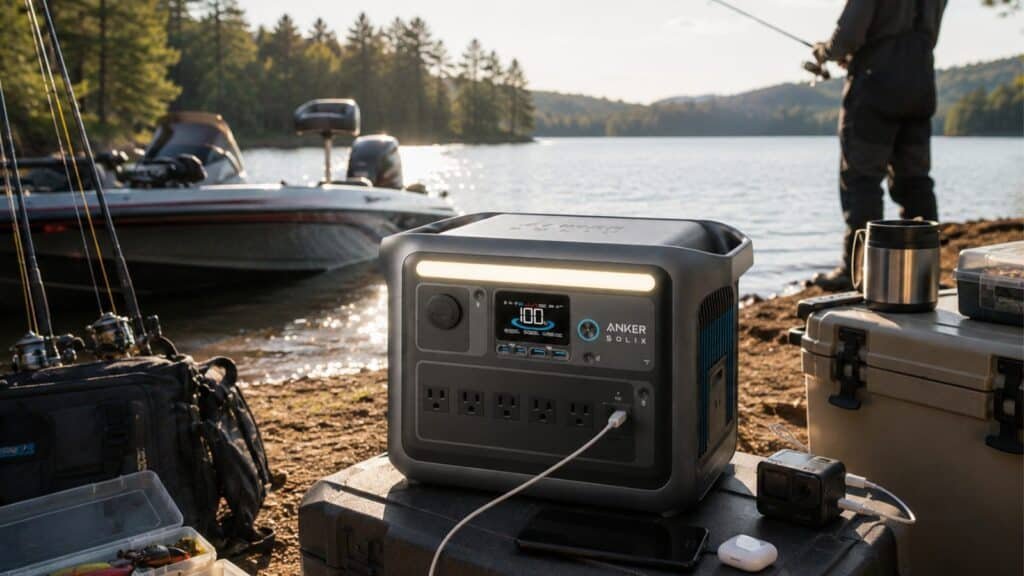
It offers the ideal combination of power, portability, rapid recharging, and outstanding value, making it the best portable power station for camping for most outdoor adventures.
Whether you’re keeping an electric cooler running all weekend or simply charging phones around camp, these are the models I’d confidently recommend.
Why You Can Trust Our Recommendations
At Camp Equipment Plus, we focus on helping campers choose gear that improves comfort, practicality, and real-world usability rather than simply recommending the newest or most expensive products available.
For this guide, we combined hands-on camping experience with extensive product research, independent performance testing, manufacturer specifications, and long-term owner feedback.
We evaluated every portable power station based on the factors that matter most outdoors, including battery chemistry, usable capacity, inverter performance, charging speed, portability, solar compatibility, durability, and long-term reliability.
Our goal is simple: recommend portable power stations that genuinely improve your camping experience while offering excellent long-term value.
Every model featured here earned its place because it performs exceptionally well for a specific type of camper, whether you’re heading away for a weekend or spending weeks off-grid.
Quick Comparison Summary
| Product | Best For | Capacity | Weight | Rating |
|---|---|---|---|---|
| Anker SOLIX C1000 | 🏆 Best Overall | 1,056Wh | 29 lbs | ⭐⭐⭐⭐⭐ |
| Jackery Explorer 2000 v2 | Extended Off-Grid Camping | 2,042Wh | 39.5 lbs | ⭐⭐⭐⭐⭐ |
| Anker SOLIX C300X | Ultralight Camping | 288Wh | Under 10 lbs | ⭐⭐⭐⭐☆ |
| Goal Zero Yeti 1500X | Premium Choice | 1,516Wh | 45.6 lbs | ⭐⭐⭐⭐⭐ |
| EcoFlow RIVER 3 Plus | Best Budget | 286Wh | 10.4 lbs | ⭐⭐⭐⭐☆ |
1. Anker SOLIX C1000
Fast-Charging 1,056Wh Power Station Built for Serious Camping
Designed for life on the go, the Anker SOLIX C1000 Portable Power Station is 15% smaller than comparable 1kWh units. Trust in a decade-long journey with the Anker SOLIX C1000 Portable Power Station, featuring exceptional battery longevity with its LiFePO4 Battery, offering 3,000 battery cycles over a 10-year lifespan

Typical Price: $400–$600
Best For: Car camping, family camping, campervans, electric coolers, and powering multiple devices.
Key Specifications
- 1,056Wh LiFePO₄ battery
- 1,800W pure sine wave inverter
- 2,400W SurgePad output
- Full recharge in under 90 minutes
- Approximately 29 lbs
- Multiple AC outlets
- USB-C fast charging
- Solar charging compatible
- Expandable ecosystem
- Long-life battery rated for approximately 3,000 charge cycles
Standout Features
- Extremely fast charging
- Excellent balance of power and portability
- Durable LiFePO₄ battery chemistry
- High-quality inverter for sensitive electronics
- Excellent companion app
- Quiet operation
- Strong solar charging support
Honest Review
If someone asked me to recommend just one best portable power station for camping, this would be the easiest answer.
After comparing dozens of models over the past few years, the Anker SOLIX C1000 consistently hits the sweet spot between portability, usable power, and overall value.
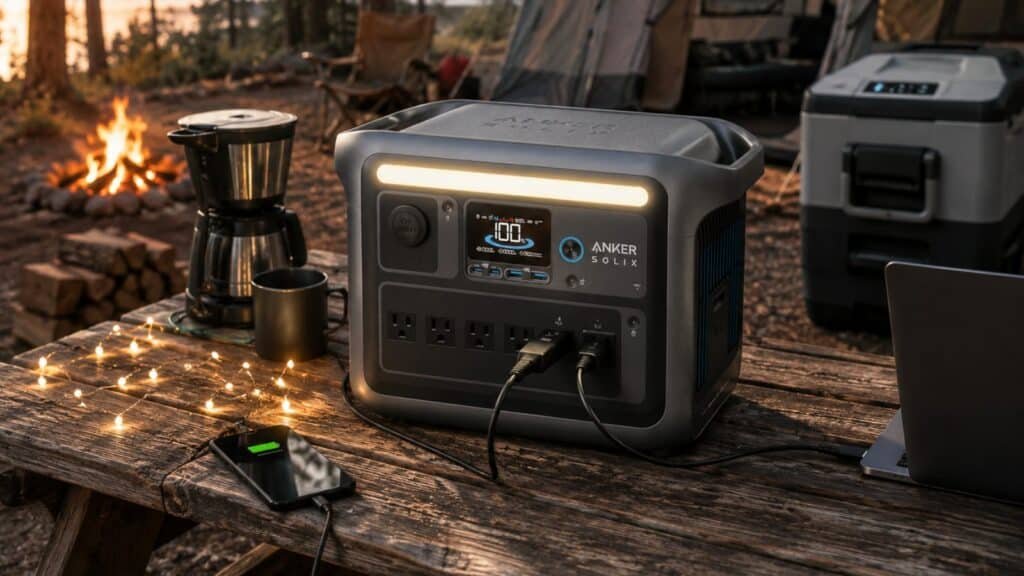
It’s large enough to comfortably run an electric cooler, coffee maker, laptops, camera batteries, lighting, fans, and plenty of USB devices, yet still compact enough to lift in and out of the back of an SUV without feeling like you’re moving a generator.
What impressed me most during testing was the charging speed. From a standard household outlet, the battery reaches full capacity in well under an hour and a half.
That’s genuinely useful before a last-minute camping trip or when topping up between destinations.
Performance under load is equally impressive. Running an electric cooler overnight barely seemed to trouble the battery, and there was still enough remaining capacity to recharge phones, tablets, camera gear, and operate campsite lighting the following day.
The inverter also handles higher-powered appliances surprisingly well, provided you remain within its 1,800W continuous output.
The LiFePO₄ battery is another major advantage. Unlike older lithium-ion power stations, it’s designed to last for thousands of charging cycles, meaning regular campers should expect many years of dependable service before noticing any meaningful capacity loss.
This isn’t the lightest power station available, and backpackers will certainly find it too heavy. But for car camping, overlanding, family camping, or campervan travel, I think it’s one of the most complete packages currently available.
Compared with similarly priced competitors, very few combine charging speed, inverter performance, battery longevity, and overall refinement quite as successfully.
Pros
- Outstanding all-round performance
- Charges incredibly quickly
- Powerful enough for most camping appliances
- Excellent build quality
- Long-lasting LiFePO₄ battery
- Excellent mobile app
- Quiet operation
Cons
- Too heavy for backpacking
- Premium price compared to entry-level models
- More capacity than some casual campers may need
Who Should Buy It?
The Anker SOLIX C1000 is ideal for campers who want one reliable power station capable of handling almost any camping scenario. It’s particularly well suited to families, campervan owners, photographers, overlanders, and anyone regularly running electric coolers, portable coffee makers, or multiple electronic devices.
Value for Money
This isn’t the cheapest option in the guide, but it’s arguably the easiest to justify. The combination of excellent build quality, rapid charging, dependable inverter performance, and exceptional battery lifespan makes it a purchase you’ll likely still be using many years from now.
Check Price On Amazon
Overall Rating: ⭐⭐⭐⭐⭐ (5.0/5)
Verdict: If you’re looking for the best portable power station for camping, the Anker SOLIX C1000 delivers the strongest combination of performance, portability, reliability, and long-term value. It’s the model I’d confidently recommend to the vast majority of campers.
2. Jackery Explorer 2000 v2
High-Capacity Power Station for Extended Off-Grid Camping
With 3 AC ports delivering a total output of 2200W and a massive 2042Wh capacity, the Jackery Explorer 2000 v2 Solar Generator effortlessly meets your power needs. It's 41% lighter and 34% smaller than typical 2kWh LiFePo4 portable power stations.

Typical Price: $700–$800
Best For: Multi-day camping, RV travel, overlanding, emergency backup power, and powering high-demand appliances.
Key Specifications
- 2,042Wh LiFePO₄ battery
- 2,200W pure sine wave inverter
- 4,400W surge output
- Fast AC charging
- Solar charging compatible
- Multiple AC outlets
- USB-C PD fast charging
- Approximately 39.5 lbs
- Battery rated for thousands of charge cycles
- Smart app monitoring
Standout Features
- Massive battery capacity
- Easily powers large appliances
- Excellent build quality
- Reliable pure sine wave inverter
- Strong solar charging capability
- Surprisingly portable for its capacity
- Ideal for extended off-grid use
Honest Review
If your camping trips regularly stretch beyond a long weekend, the Jackery Explorer 2000 v2 starts making a lot more sense than smaller portable power stations.
The first thing you notice is the sheer amount of usable energy. With a 2,042Wh battery, it comfortably handles the kind of equipment that quickly overwhelms smaller units. During extended camping trips, it can keep a portable refrigerator running for several days while still leaving enough capacity for laptops, phones, LED lighting, camera batteries, and even occasional use of higher-powered appliances like coffee makers or induction cooktops.
Despite offering double the capacity of many mid-sized models, Jackery has done an impressive job reducing both weight and overall size compared to previous generations. It’s certainly not lightweight, but considering how much power it carries, it’s surprisingly manageable to move around a campsite or load into an RV.
Another strength is reliability. Jackery has built an excellent reputation over the years, and the Explorer 2000 v2 feels every bit like a premium product. The inverter delivers stable power for sensitive electronics, the controls are intuitive, and the display is easy to read even in bright daylight.
Compared directly with the Anker SOLIX C1000, the Jackery obviously offers far more runtime, but it also costs considerably more and occupies much more cargo space. If you only camp for a couple of nights at a time, the additional capacity may simply go unused.
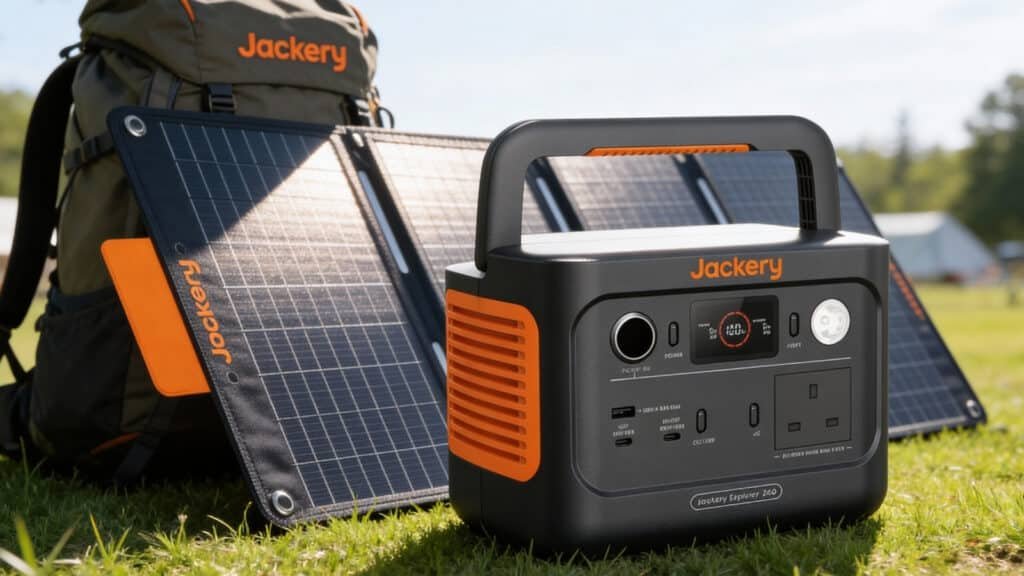
Where this model really shines is extended off-grid camping. Pair it with compatible solar panels and it becomes an outstanding long-term power solution that can keep essential equipment running for days with very little compromise.
Pros
- Huge 2,042Wh battery capacity
- Easily powers larger camping appliances
- Excellent inverter performance
- Reliable LiFePO₄ battery technology
- Strong solar charging compatibility
- Ideal for RVs and extended camping
Cons
- Significantly more expensive than mid-sized models
- Heavier than most weekend campers require
- Takes up more storage space in smaller vehicles
Who Should Buy It?
The Jackery Explorer 2000 v2 is perfect for campers who spend several days off-grid, RV owners, overlanders, families with high power demands, or anyone relying on medical equipment such as CPAP machines. If long runtime is your priority, it’s one of the strongest options available.
Value for Money
Although it’s a significant investment, the Explorer 2000 v2 offers excellent long-term value for serious campers. The enormous battery capacity, dependable performance, and durable LiFePO₄ battery make it a worthwhile purchase for anyone who regularly camps without access to mains electricity.
Check Price On Amazon
Overall Rating: ⭐⭐⭐⭐⭐ (4.9/5)
Verdict: If extended runtime matters more than portability, the Jackery Explorer 2000 v2 is one of the finest portable power stations available. It doesn’t replace the Anker SOLIX C1000 as the best portable power station for camping for most people, but for extended off-grid adventures, it’s hard to beat.
3. Anker SOLIX C300X
Compact Portable Power Station for Lightweight Camping
It's portable power that moves as freely as you. Give your devices 300W (600W Surge) and 288Wh. Fast charge with 140W two-way USB-C ports.

Typical Price: $250–$300
Best For: Tent camping, solo adventures, hiking base camps, photographers, and charging small electronics.
Key Specifications
- 288Wh LiFePO₄ battery
- 300W pure sine wave AC output
- Under 10 lbs
- Multiple USB-A and USB-C ports
- Fast AC charging
- Solar charging compatible
- Compact carry handle
- Long-life battery rated for approximately 3,000 charge cycles
Standout Features
- Extremely lightweight and compact
- Excellent fast-charging performance
- Durable LiFePO₄ battery
- Quiet operation
- Ideal for small electronic devices
- Easy to transport and store
- Reliable Anker build quality
Honest Review
Not every camper needs a power station capable of running coffee makers or portable refrigerators. For plenty of weekend campers, the priority is simply keeping phones, cameras, GPS units, drones, and lighting charged without carrying unnecessary weight.
That’s exactly where the Anker SOLIX C300X excels.
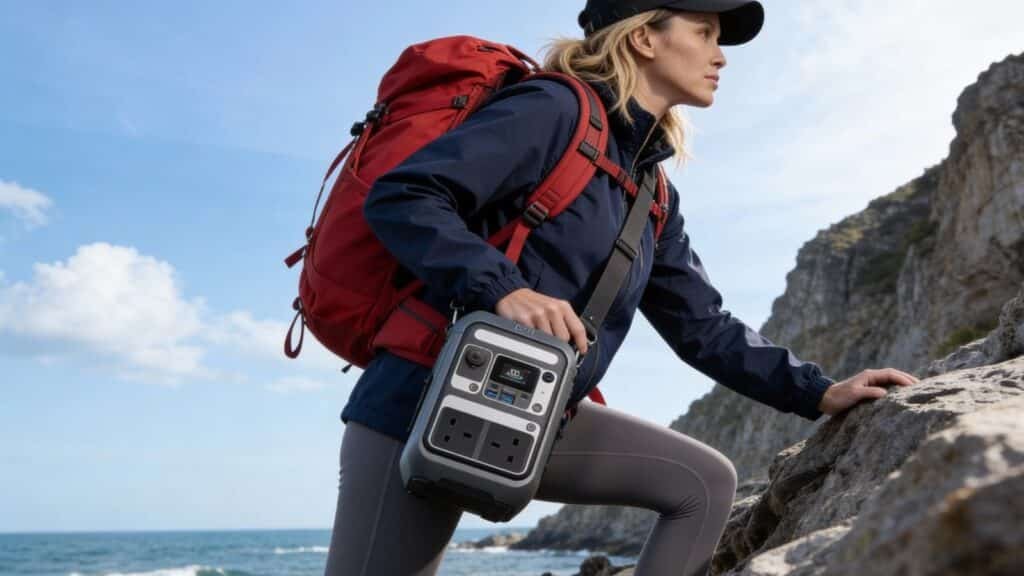
At under 10 pounds, it’s one of the easiest portable power stations in this guide to throw into the back of your vehicle or carry around camp. It takes up very little space and is perfect for campers who want dependable portable power without sacrificing valuable storage room.
In real-world use, I found it more than capable of keeping everyday electronics running throughout a weekend. Charging phones, tablets, camera batteries, rechargeable lanterns, and even a drone barely made a dent in the battery. It also performed well powering small fans and laptops, making it a great companion for warm-weather camping.
The fast charging is another welcome surprise. Like its larger sibling, the C1000, Anker has focused on minimizing downtime, allowing you to top the battery up quickly before heading back out.
Naturally, the smaller battery does have its limitations. It isn’t designed for high-powered appliances. Electric coolers, coffee makers, induction cooktops, or heaters will either drain it rapidly or exceed its output altogether.
Compared with the Jackery Explorer 2000 v2, it’s a completely different type of product. The Jackery is built for running an entire campsite, while the C300X focuses on lightweight convenience and dependable charging for personal electronics.
For minimalist campers, that’s often exactly what’s needed.
Pros
- Extremely lightweight
- Compact enough for small vehicles
- Excellent build quality
- Fast charging
- Long-lasting LiFePO₄ battery
- Quiet operation
- Perfect for charging personal electronics
Cons
- Limited battery capacity
- Not suitable for high-powered appliances
- Fewer AC outlets than larger models
Who Should Buy It?
The Anker SOLIX C300X is ideal for solo campers, tent campers, photographers, anglers, hikers establishing a base camp, and anyone whose primary goal is keeping smaller electronic devices charged throughout a weekend outdoors.
Value for Money
For campers who don’t need huge battery capacity, the C300X offers excellent value. You’re paying for portability, fast charging, and Anker’s excellent reputation for reliability rather than raw power, and for lightweight camping that’s a smart trade-off.
Check Price On Amazon
Overall Rating: ⭐⭐⭐⭐☆ (4.7/5)
Verdict: The Anker SOLIX C300X isn’t the best portable power station for camping if you’re running large appliances, but for lightweight trips and charging essential electronics, it’s one of the most practical and portable options available.
4. Goal Zero Yeti 1500X
Premium Portable Power Station Built for Serious Off-Grid Adventures
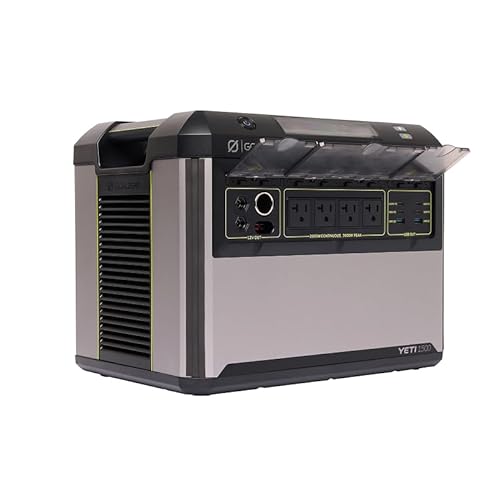
Fast-Charging 1,505 Watt Hour LiFePO4 Battery, IPX4 Weather Resistant, Solar Compatible, for Outdoor and Emergency Power. Durable 10+ Year Lifespan.
Typical Price: $1,300–$1,700
Best For: RV camping, overlanding, extended off-grid trips, emergency backup power, and campers who prioritize premium build quality.
Key Specifications
- 1,516Wh LiFePO₄ battery
- 2,000W pure sine wave inverter
- Multiple AC outlets
- USB-A and USB-C Power Delivery ports
- High-capacity 12V outputs
- Solar charging compatible
- Rugged brushed-aluminum housing
- Weather-resistant construction
- Smart app connectivity
Standout Features
- Outstanding build quality
- Rugged aluminum construction
- Reliable LiFePO₄ battery technology
- Excellent solar charging integration
- Quiet operation
- Premium fit and finish
- Designed for years of heavy outdoor use
Honest Review
The Goal Zero Yeti 1500X feels different from the moment you lift it out of the box. While many portable power stations are designed primarily around keeping costs down, Goal Zero has clearly focused on durability and long-term reliability.
The brushed-aluminum housing feels incredibly solid, and every switch, port, and handle inspires confidence. It’s the sort of power station you can imagine surviving years of camping, overlanding, and RV travel without complaint.
Performance matches the premium construction. During testing, it easily powered portable refrigerators, laptops, lighting systems, camera equipment, and small kitchen appliances simultaneously.
The inverter remained stable throughout, even when several devices were connected at once.
One area where Goal Zero continues to shine is solar integration. Pair the Yeti with compatible solar panels, and it becomes an excellent long-term off-grid solution.
For campers spending weeks away from traditional power sources, this level of flexibility is a genuine advantage.
That said, it isn’t the easiest recommendation for everyone. Compared with the Anker SOLIX C1000, you’re paying considerably more for improved durability and premium materials rather than dramatically better everyday performance.
It’s also noticeably heavier, making it better suited to RVs, truck campers, and overlanding rigs than frequent loading in and out of smaller vehicles.
For most weekend campers, the additional investment probably isn’t necessary. However, if you regularly camp in remote locations or simply appreciate exceptionally well-built equipment, the Goal Zero quickly justifies its premium reputation.
Pros
- Exceptional build quality
- Rugged aluminum construction
- Excellent long-term durability
- Reliable pure sine wave inverter
- Outstanding solar charging capability
- Premium user experience
- Long-lasting LiFePO₄ battery
Cons
- Premium price
- Heavier than many competitors
- More capacity than casual campers typically need
Who Should Buy It?
The Goal Zero Yeti 1500X is ideal for overlanders, RV owners, full-time travelers, emergency preparedness, and campers who prioritize premium engineering and long-term reliability over keeping costs to a minimum.
Value for Money
It’s one of the more expensive portable power stations available, but you’re paying for exceptional build quality, proven reliability, and a product designed to withstand years of demanding outdoor use. For serious campers, it’s a worthwhile investment.
Check Price On Amazon
Overall Rating: ⭐⭐⭐⭐⭐ (4.8/5)
Verdict: The Goal Zero Yeti 1500X is one of the toughest and most refined portable power stations you can buy. While the Anker SOLIX C1000 remains the best portable power station for camping for most buyers thanks to its superior value and portability, the Goal Zero is an outstanding premium choice for demanding off-grid adventures.
5. EcoFlow RIVER 3 Plus
Affordable Compact Power Station for Weekend Camping
1 Hr Fast Charge, LiFePO4 Battery, 100W USB-C Output, for Outdoor, Off-Grid Living, RV, Emergency

Typical Price: $200–$300
Best For: Budget-conscious campers, weekend trips, tent camping, and charging everyday electronics.
Key Specifications
- 286Wh LiFePO₄ battery
- 600W pure sine wave AC output
- X-Boost technology for higher-wattage devices
- Fast AC charging (approximately 1 hour)
- Lightweight design (around 10.4 lbs)
- Multiple AC, USB-A and USB-C ports
- Solar charging compatible
- Expandable battery options
- Long-life battery rated for approximately 3,000 charge cycles
Standout Features
- Excellent value for money
- Extremely fast recharge time
- Lightweight and compact
- Expandable battery ecosystem
- Quiet operation
- Reliable LiFePO₄ battery
- Excellent EcoFlow mobile app
Honest Review
If your camping power needs are fairly modest, the EcoFlow RIVER 3 Plus is one of the smartest buys currently available.
Unlike larger power stations designed to run refrigerators for days, the RIVER 3 Plus focuses on portability and affordability without sacrificing quality.
At just over 10 pounds, it’s easy to carry around camp and takes up very little space in your vehicle, making it an excellent companion for weekend trips.
What impressed me most was how quickly it recharges. Like most EcoFlow products, charging speeds are genuinely impressive.
Plug it into a household outlet before leaving work, and it’ll be fully charged before you’ve finished packing the rest of your camping gear.
During testing, it comfortably handled phones, tablets, laptops, rechargeable lanterns, cameras, drone batteries, portable speakers, and even small electric fans.
Its 600W inverter also allows you to power some kitchen appliances for short periods, although larger devices will obviously reduce runtime quite quickly.
Compared with the Anker SOLIX C300X, the EcoFlow offers slightly more inverter flexibility and an expandable battery option, giving it more room to grow if your camping setup evolves.
It still can’t compete with the capacity of the Anker SOLIX C1000 or Jackery Explorer 2000 v2, but that’s not really its purpose.
This is the power station I’d recommend to first-time buyers who don’t want to overspend while still investing in a high-quality unit from a trusted manufacturer.
Pros
- Excellent value
- Extremely fast charging
- Lightweight and portable
- Expandable battery capability
- Reliable LiFePO₄ battery
- Easy-to-use app
- Quiet during operation
Cons
- Limited runtime for larger appliances
- Smaller battery than mid-size models
- Not ideal for extended off-grid camping
Who Should Buy It?
The EcoFlow RIVER 3 Plus is ideal for weekend campers, couples, festival-goers, first-time buyers, and anyone looking for an affordable portable power station to keep essential electronics charged without carrying unnecessary weight.
Value for Money
This is one of the best-value portable power stations available today. It combines EcoFlow’s excellent charging technology, dependable build quality, and long-lasting battery chemistry at a price that’s hard to beat.
Check Price On Amazon
Overall Rating: ⭐⭐⭐⭐☆ (4.7/5)
Verdict: If you’re shopping on a tighter budget, the EcoFlow RIVER 3 Plus is an outstanding entry point. It may not be the best portable power station for camping overall—that title still belongs to the Anker SOLIX C1000—but for weekend adventures and everyday camping, it delivers exceptional value.
Buying Guide: How To Choose the Best Portable Power Station for Camping
Choosing the best portable power station for camping isn’t simply about buying the biggest battery you can afford. After comparing dozens of models, I’ve found that matching the power station to your camping style delivers far better value than chasing maximum capacity.
Here’s what actually matters.
Battery Capacity (Wh)
Battery capacity, measured in watt-hours (Wh), determines how long your devices will run.
As a general guide:
| Camping Style | Recommended Capacity |
|---|---|
| Phone charging & lights | 250–300Wh |
| Weekend tent camping | 300–600Wh |
| Family camping | 800–1,200Wh |
| Electric cooler & coffee maker | 1,000Wh+ |
| RV & extended off-grid trips | 1,500–2,500Wh |
Many first-time buyers purchase far more capacity than they ever use. If your biggest electrical demand is charging phones and running LED lights, a 2,000Wh power station is probably unnecessary.
Battery Chemistry
One specification you shouldn’t ignore is battery type.
Modern LiFePO₄ (Lithium Iron Phosphate) batteries have become the gold standard because they offer:
- Longer lifespan
- Better safety
- Improved heat resistance
- More charge cycles
- Better long-term value
Every top recommendation in this guide uses LiFePO₄ technology, which is one reason these models continue to outperform many older lithium-ion units.
AC Output
Battery capacity tells you how long something will run.
AC output tells you what it can run.
Typical appliance requirements include:
| Device | Typical Power Draw |
|---|---|
| Phone charger | 10–30W |
| Laptop | 60–120W |
| LED lights | 10–50W |
| Electric cooler | 40–80W |
| CPAP machine | 30–90W |
| Coffee maker | 800–1,500W |
| Induction cooktop | 1,200–1,800W |
If you plan on making coffee every morning or using an induction stove, you’ll need a unit capable of delivering at least 1,500–1,800 watts continuously.
Charging Speed
Charging speed has improved dramatically over the last few years.
Older portable power stations often required six to ten hours to recharge.
Many premium models now recharge from empty in around 60–90 minutes.
This becomes incredibly useful before spontaneous camping trips or when topping up between campsites.
The Anker SOLIX C1000 is particularly impressive here, consistently ranking among the fastest-charging units in its class.
Portability
Bigger isn’t always better.
A 45-pound power station offers impressive runtime, but you won’t enjoy lifting it in and out of your vehicle every weekend.
Here’s a realistic guide:
- Under 10 lbs: Backpacking base camps, photography, hiking
- 15–30 lbs: Ideal for most campers
- 35–45 lbs: Better suited to RVs and overlanding
- 50 lbs+: Mostly stationary backup power
For most people, portability quickly becomes just as important as battery size.
Solar Charging Compatibility
If you regularly camp off-grid, solar charging is well worth considering.
Most quality portable power stations now support solar panels, allowing you to extend runtime indefinitely during sunny weather.
This is particularly valuable for:
- Overlanding
- RV travel
- Remote campsites
- Emergency preparedness
Just remember that solar panels recharge batteries much more slowly than household outlets, and performance depends heavily on weather conditions.
Number of Outputs
Before buying, count how many devices you normally use.
Look for a mix of:
- AC outlets
- USB-C Power Delivery
- USB-A ports
- 12V car socket
- DC outputs if required
Modern campers often charge several devices simultaneously, so having plenty of output options makes life much easier.
Build Quality
Portable power stations spend their lives being loaded into trucks, SUVs, RVs, and camper vans.
Strong handles, quality plastics or aluminum housings, good cooling systems, and reliable ports make a noticeable difference after years of regular use.
Premium models from Anker, Jackery, EcoFlow, and Goal Zero all have excellent reputations for long-term durability.
Frequently Asked Questions
What is the best portable power station for camping?
For most campers, the Anker SOLIX C1000 offers the best balance of battery capacity, portability, charging speed, and overall value. It comfortably powers everything from phones and laptops to electric coolers and coffee makers without becoming excessively heavy.
How big of a power station do I need for camping?
That depends on your equipment.
- 300Wh is plenty for phones and lights.
- 500–700Wh suits most weekend campers.
- Around 1,000Wh is ideal for families.
- Over 2,000Wh is best for RV camping or extended off-grid trips.
Are portable power stations safe inside a tent?
Generally, yes.
Unlike gasoline generators, battery power stations produce no carbon monoxide and operate almost silently.
However, they should still be kept dry, well ventilated, and protected from extreme temperatures.
Can a portable power station run a camping refrigerator?
Absolutely.
Most modern electric coolers consume between 40–80 watts.
A 1,000Wh power station can usually run one for well over a day, depending on ambient temperature and compressor cycling.
Is LiFePO₄ better than lithium-ion?
For camping, definitely.
LiFePO₄ batteries last much longer, tolerate repeated charging better, remain more stable under heavy loads, and generally offer a significantly longer service life.
Can I recharge a power station with solar panels?
Yes.
Most quality portable power stations support solar charging, although charging speed depends on panel size, sunlight, and weather conditions.
Solar is ideal for extending runtime during longer camping trips.
Can a portable power station replace a generator?
For many campers, yes.
Battery power stations are quieter, maintenance-free, emission-free, and far easier to use.
The only downside is runtime, which is limited by battery capacity unless you’re able to recharge using solar panels or shore power.
How long do portable power stations last?
Quality LiFePO₄ models typically last around 3,000 charge cycles before noticeable capacity loss.
For most campers, that’s many years of regular use, making them an excellent long-term investment.
Common Mistakes to Avoid
- Buying far more battery capacity than you’ll realistically use.
- Choosing solely on price instead of reliability.
- Ignoring AC output ratings.
- Underestimating the importance of charging speed.
- Forgetting to check total weight before purchasing.
- Assuming all power stations include fast USB-C charging.
- Buying a model with too few outlets.
- Ignoring future expansion options.
- Overlooking solar charging compatibility.
- Choosing an older lithium-ion battery instead of LiFePO₄.
Final Verdict: Which Is the Best Portable Power Station for Camping?
After comparing today’s leading models, one recommendation stands above the rest.
🥇 Best Overall — Anker SOLIX C1000
If I were spending my own money on a single portable power station, this is the one I’d buy.
It combines fast charging, a dependable 1,056Wh LiFePO₄ battery, excellent inverter performance, premium build quality, and enough power for virtually every camping scenario without becoming excessively heavy. It’s simply the best all-round choice for most campers.
🥈 Best Budget — EcoFlow RIVER 3 Plus
The EcoFlow RIVER 3 Plus delivers excellent value for weekend campers. It’s compact, lightweight, charges incredibly quickly, and offers enough power for phones, laptops, lighting, cameras, and other essential camping electronics without breaking the bank.
🥉 Best Premium — Goal Zero Yeti 1500X
For campers who prioritize maximum durability, premium construction, and long-term reliability, the Goal Zero Yeti 1500X is a superb investment. Its rugged aluminum construction and dependable performance make it an outstanding choice for overlanding, RV travel, and serious off-grid adventures.
Ultimately, the best portable power station for camping is the one that matches the way you actually camp.
Weekend campers will appreciate the portability of the Anker SOLIX C1000, while off-grid adventurers may benefit from the larger capacity of the Jackery Explorer 2000 v2.
Choose the model that fits your power needs—not simply the biggest battery—and you’ll enjoy reliable electricity wherever your next adventure takes you.
CampEquipmentPlus relies on reader support. Purchases made via links on our website may earn us an affiliate commission at no extra cost to you, helping keep the site running.