
The best rear view mirror cameras should give you a clear view behind your vehicle without making recording, installation, or everyday driving more complicated than it needs to be.
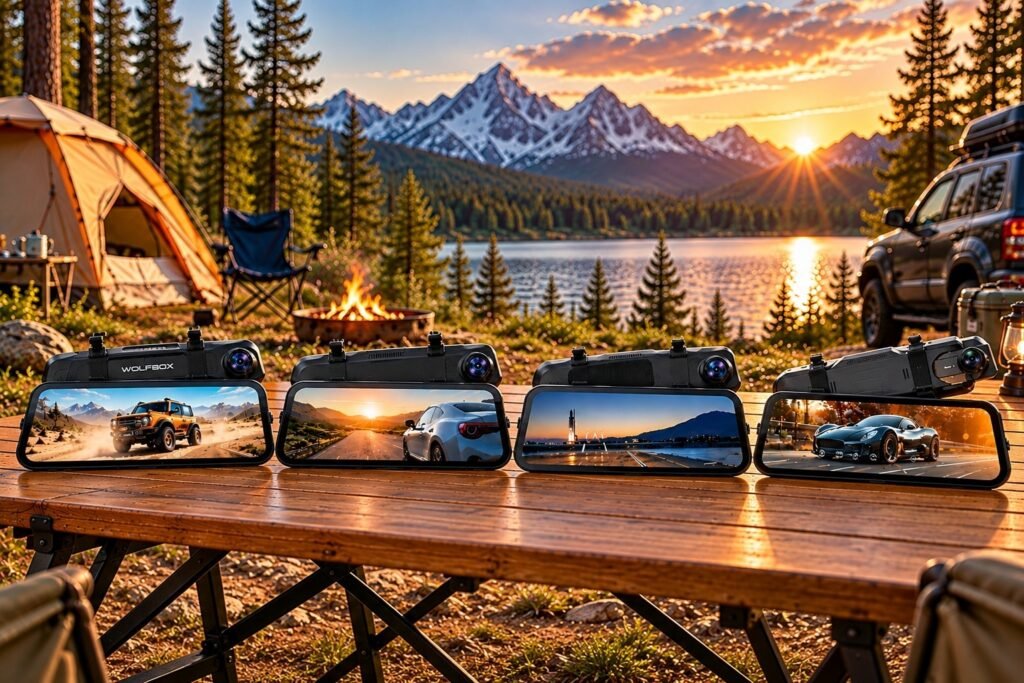
The better models combine a digital rear-view display with front and rear recording, reversing assistance, GPS, and useful parking features.
They can be particularly useful for camping. Load an SUV or car with tents, sleeping bags, camp chairs, coolers, storage boxes, and other gear, and the view through your conventional rearview mirror can disappear surprisingly quickly. A rear-mounted camera does not depend on being able to see through the passenger compartment.
For this guide, we compared four camera rear view mirrors based on documented specifications, available independent evidence, recording resolution, rear-camera quality, display size, installation requirements, and useful features. This is a research-based comparison. Camp Equipment Plus has not personally tested these cameras.
TL;DR: Best Rear View Mirror Camera Picks
- Best Overall: WOLFBOX G900Pro for its 4K front and 2.5K rear recording, strong sensor, 12-inch display, and independent evidence supporting its video quality.
- Best for Driver Assistance: Pelsee S12 Pro for its combination of ADAS, blind-spot detection, voice control, GPS, and 5.8GHz Wi-Fi.
- Best for ADAS & Wi-Fi: WOLFBOX G850Pro if you want WOLFBOX’s 12-inch format with ADAS and app connectivity but can accept lower rear-camera resolution than the G900Pro.
- Best Budget Option: Veement VT10 for buyers who want the basic advantages of a large rear view camera mirror without as many premium features.
| Product | Front / Rear | Screen | Wi-Fi | GPS | Best For |
|---|---|---|---|---|---|
| WOLFBOX G900Pro | 4K / 2.5K | 12 in | Yes | Yes | Best Overall |
| Pelsee S12 Pro | 4K / 1080p | 12 in | Yes | Yes | Driver Assistance |
| WOLFBOX G850Pro | 4K / 1080p | 12 in | Yes | Yes | ADAS & Wi-Fi |
| Veement VT10 | 4K / 1080p | 10 in | No | No | Budget Buyers |
What Is the Best Rear View Mirror Camera?
The WOLFBOX G900Pro is our best rear view mirror camera overall because it combines strong front and rear recording specifications with a large display, Wi-Fi, GPS, and encouraging independent video-quality results.
WOLFBOX specifies a Sony STARVIS IMX678 front sensor with native 8MP capture, a 12-inch touchscreen, 5MP rear camera, Wi-Fi/app connectivity, voice control, GPS playback, loop recording, and support for memory cards up to 512GB. WOLFBOX specs confirm that parking monitoring is also available when used with the appropriate hardwire kit.
There is useful independent evidence behind those specifications. In its G900Pro review, TechRadar found both front and rear footage impressive and praised the touchscreen interface.
There is a catch. The same review found the large unit could cause fitment problems in some smaller vehicles, while the separate GPS module adds another cable to manage.
So while the G900Pro gets our overall recommendation, check your existing mirror and surrounding windshield area before ordering.
1. WOLFBOX G900Pro: Best Overall
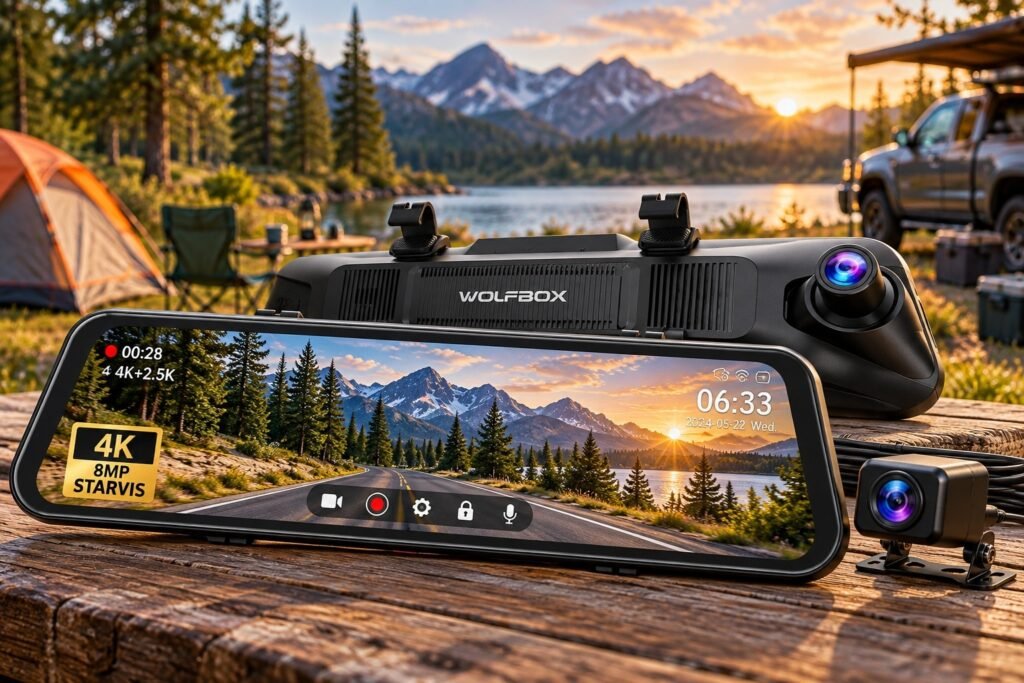
The WOLFBOX G900Pro makes the strongest case if you want your rear view mirror camera to work equally well as a digital mirror and a serious dual-channel dash cam.
With 8MP STARVIS IMX678, Front 4K Rear 2.5K 128GB Card Included,12 inches Rear View Mirror Camera with Voice Control, 5.8GHz WiFi, Loop Recording, G-Sensor & GPS

The 12-inch display sits over the existing mirror and can display the rear-camera feed while driving. This becomes useful when passengers, headrests, cargo, or camping equipment restrict the view through the rear window.
Image Quality
The front camera uses Sony’s STARVIS IMX678 sensor. WOLFBOX specifies native 8MP front capture and a 5MP rear camera.
The G900Pro is generally described as recording 4K at the front and 2.5K at the rear.
That rear specification is important.
A surprising number of car camera mirrors shout about 4K on the front camera while quietly pairing it with a much lower-resolution rear unit. If the rear camera is providing the digital image you regularly look at while driving, its quality deserves more attention.
Independent testing strengthens the case. TechRadar found the G900Pro’s 4K footage highly detailed and also rated the rear footage positively.
Wi-Fi, GPS and Storage
The G900Pro supports Wi-Fi transfers through the WOLFBOX app, making it easier to retrieve footage without repeatedly removing the memory card.
GPS provides additional journey information, while maximum storage capacity is 512GB according to the manufacturer specifications.
That larger storage capacity could be useful for road trips and camping holidays where you are driving for several hours each day.
Installation Is Its Main Weakness
The large screen will not suit every vehicle.
Independent testing identified potential interference between the camera and the existing mirror mounting arrangement. The separate GPS module and rear-camera wiring also mean installation is more involved than simply attaching a basic dash cam.
Measure first.
Best for: Drivers wanting high-resolution front and rear recording combined with a large digital rear-view display.
Pros
- 4K front recording
- 2.5K rear recording
- Sony STARVIS IMX678 front sensor
- 12-inch touchscreen
- Wi-Fi
- GPS
- Voice control
- Up to 512GB storage
- Useful as a reversing camera
- Strong independent video-quality findings
Cons
- Large display may not fit every vehicle cleanly
- Installation involves several cables
- Separate GPS module adds clutter
- Parking monitoring requires appropriate permanent power
2. Pelsee S12 Pro: Best for Driver Assistance
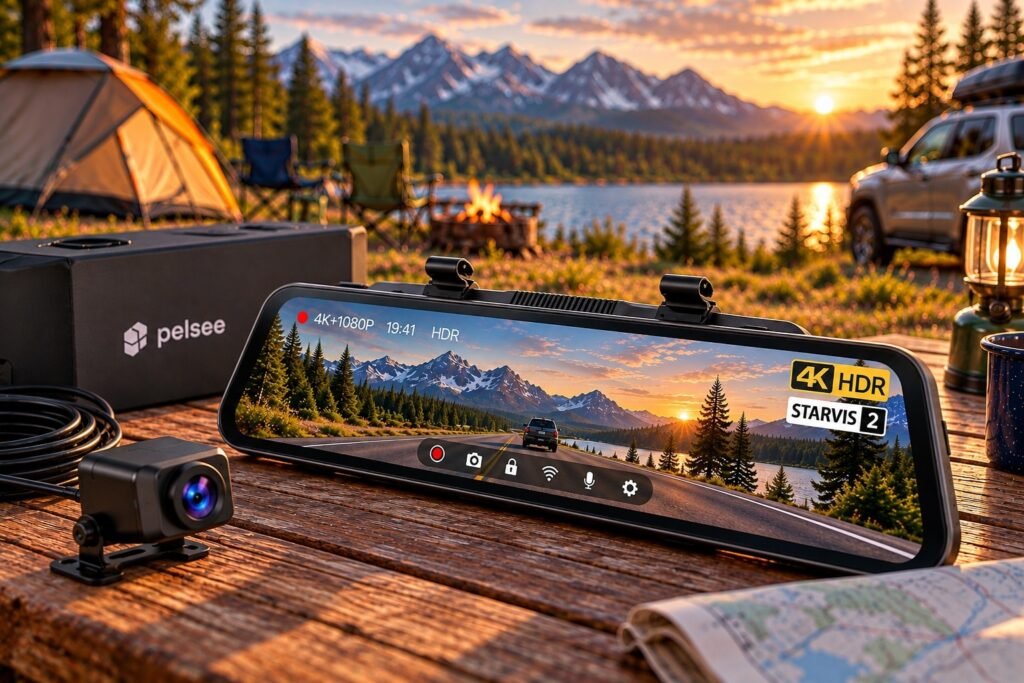
The Pelsee S12 Pro is the more interesting choice if you want a rear view mirror camera with driver-assistance functions as well as front and rear recording.
5.8GHz WiFi, GPS, Rear View Mirror Camera w/ Voice Control, ADAS & BSD, Color Night Vision, Backup Assist for Cars

Pelsee specifies 4K front and 1080p rear recording, a 12-inch mirror display, STARVIS 2 sensor technology, 5.8GHz Wi-Fi, GPS, voice control, ADAS, blind-spot detection, loop recording, and parking monitoring.
A 64GB memory card is also included.
What Do the ADAS Features Do?
According to the Pelsee specifications, its ADAS system can provide alerts for lane departure, forward collision, pedestrians, vehicle movement, and other situations.
Blind-spot detection adds another layer of alerts.
We would treat both as supplementary assistance rather than reasons to stop checking your surroundings properly.
ADAS performance depends on factors such as installation, camera position, road markings, visibility, and the system itself. The manufacturer’s feature list establishes what the camera is designed to do, not that every warning will be correct.
Good Features for a Loaded Camping Vehicle
For camping, the S12 Pro’s basic rear-camera function may be more useful than the cleverer driver-assistance technology.
If your SUV is packed with sleeping systems, chairs, cooking equipment, and storage boxes, an external camera gives you a view behind the vehicle that does not depend on being able to see through the cargo area.
The rear camera cable is 19.6 ft. Pelsee specifically warns that full-size SUVs, vans, and trucks may need an extension.
That is exactly the sort of small specification worth checking before buying.
Parking Mode Needs Extra Hardware
The S12 Pro supports parking surveillance, but Pelsee states that the hardwire kit required for 24-hour parking monitoring is sold separately.
Do not assume every function printed on the feature list works from the standard 12V power connection.
Best for: Drivers who want ADAS and blind-spot alerts alongside a digital rear-view display.
Pros
- 4K front recording
- STARVIS 2 sensor
- 12-inch display
- ADAS
- Blind-spot detection
- 5.8GHz Wi-Fi
- GPS
- Voice control
- 64GB card included
Cons
- Rear camera is 1080p
- Larger vehicles may need a cable extension
- Parking monitoring requires additional hardware
- Driver-assistance features should remain supplementary
3. WOLFBOX G850Pro: Best for ADAS & Wi-Fi
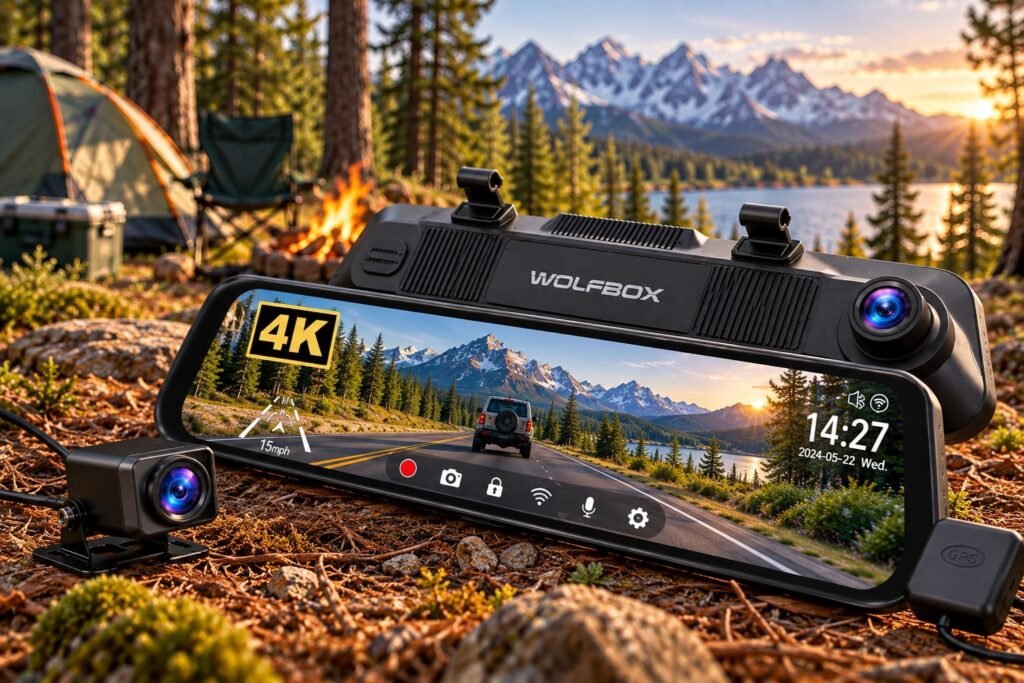
The WOLFBOX G850Pro is a better choice than the G900Pro if ADAS matters more to you than having the higher-resolution rear camera.
4K Mirror Dash Cam with ADAS and BSD,64GB Card,5.8GHz WiFi

Both use large 12-inch displays and support Wi-Fi, app control, voice commands, and GPS functions.
The differences become more interesting when you look past the headline 4K specification.
G850Pro vs G900Pro
WOLFBOX’s model comparison lists the G850Pro with a custom 4K front CMOS and 1080p rear sensor.
The G900Pro uses the larger Sony STARVIS IMX678 front sensor and a higher-resolution rear camera.
The G850Pro, however, supports WOLFBOX’s ADAS technology, while the current G900Pro specification table does not list ADAS support.
That creates a useful split.
Choose the G900Pro if image quality, particularly rear-camera resolution, is the priority.
Consider the G850Pro if you specifically want lane and driver-assistance functions alongside Wi-Fi and the large mirror display.
Rear Resolution Matters
The 1080p rear camera is the biggest compromise.
For an ordinary dash cam, you may care mostly about the front footage.
With camera rear view mirrors, you are potentially looking at the rear-camera image every time you drive. That makes rear resolution much more important.
The G850Pro is therefore not simply a cheaper G900Pro. Its feature balance is different.
Best for: Drivers who prioritize ADAS and Wi-Fi over maximum rear-camera resolution.
Pros
- 4K front recording
- 12-inch display
- Wi-Fi and app support
- Voice control
- GPS
- ADAS
- Digital rear-view display
Cons
- 1080p rear recording
- Lower-spec camera hardware than G900Pro
- Large mirror needs compatibility checking
- ADAS adds setup considerations
4. Veement VT10: Best Budget Rear View Mirror Camera
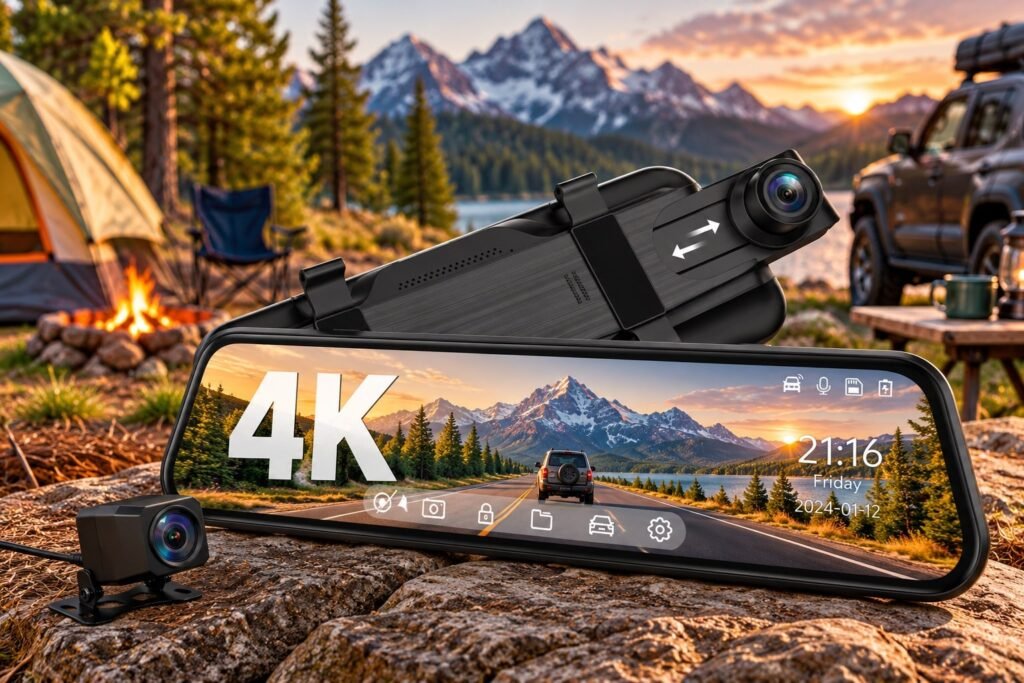
The Veement VT10 takes a simpler approach and is worth considering if you mainly want the core functions of a rear view camera mirror without paying for every smart feature.
1080P Backup Camera, Voice Control, Night Vision, Reverse Assist, 32GB Card Included, G-Sensor, Loop Recording, 256GB Max

The VT10 uses a 10-inch display rather than the 12-inch screens found on the other three recommendations.
It combines 4K front recording with a 1080p rear camera and a 170-degree viewing angle. Available product documentation also lists loop recording, G-sensor recording, parking monitoring, reversing assistance, an included 32GB card, and support for cards up to 256GB.
Why Choose the Smaller Display?
A 10-inch display is still substantial.
More importantly, smaller can sometimes be better.
One of the weaknesses of oversized rear view camera mirrors is physical fit. They can interfere with sun visors, existing mirror mounts, sensors, or simply take up more windshield space than you expected.
The VT10 gives up some screen area but may make more sense in a smaller vehicle.
Less Independent Evidence
The biggest weakness is not hidden somewhere in the specifications.
There is less high-quality independent testing available for the Veement VT10 than for the WOLFBOX G900Pro.
That makes us more cautious about judging real-world nighttime image quality, long-term reliability, and how well the claimed specifications translate into everyday use.
Its feature set is appealing for the money, but buyers wanting the strongest evidence behind their purchase should look toward the G900Pro.
Best for: Buyers wanting the basic mirror-camera functions without paying for premium connectivity and driver-assistance features.
Pros
- 4K front recording
- 1080p rear recording
- 10-inch display
- Wide field of view
- Memory card included
- Reversing assistance
- Simpler feature set
Cons
- No Wi-Fi
- No GPS
- Smaller display
- Less independent testing available
- Rear camera limited to 1080p
How Do Camera Rear View Mirrors Work?
Camera rear view mirrors use a rear-mounted camera to send a live image to a screen positioned where you would normally look at the interior rearview mirror.
Many systems retain reflective mirror functionality when the display is switched off.
The rear camera is normally mounted inside the rear window or externally near the back of the vehicle. Its cable runs forward to the mirror display.
Most of the products reviewed here also have a front camera built into the mirror unit. That means the system can simultaneously work as a dual-channel dash cam.
Some reversing camera mirrors can connect to the vehicle’s reverse-light circuit. Select reverse and the screen automatically changes to the appropriate rear view, often adding parking guidelines.
This makes modern rear view camera mirrors different from basic backup cameras that only activate while reversing.
Is a Rear View Mirror Camera Useful for Camping?
A rear view mirror camera can be particularly useful for car camping because an external rear camera is not obstructed by equipment packed inside the vehicle.
Anyone who camps from a car or SUV knows how quickly an apparently large cargo area disappears.
A tent goes in. Then sleeping bags. Camp chairs. Cooking gear. Food. Storage boxes. Maybe a portable power station.
Suddenly the rear window is doing a convincing impression of a wall.
A conventional interior mirror can only show what it can physically see through the vehicle. An externally mounted rear camera bypasses that problem.
That can make car mirrors with camera systems useful for:
- Car camping
- SUV camping
- Camper vans
- Long road trips
- Vehicles carrying bulky outdoor equipment
There is an important caveat.
A rear view mirror camera should not be used as an excuse to pack a vehicle poorly. Heavy equipment still needs to be positioned and secured appropriately.
For more gear for vehicle-based trips, browse the Camp Equipment Plus equipment guides.
Are Mirrors or Camera More Accurate?
Neither a conventional mirror nor a camera is universally more accurate because field of view and distance perception are different problems.
A conventional flat mirror gives you a direct optical reflection. It does not rely on a camera sensor, electronic processing, or a display.
A camera can provide a wider view and position that view somewhere a conventional interior mirror cannot.
Research published by SAE International found that distance perception through camera-based displays is more complicated than simply matching image magnification to a conventional mirror.
Later SAE research found that with sufficiently rich, wide fields of view, drivers may use additional visual cues when judging distance rather than relying purely on image size.
NHTSA has also conducted rear-visibility research comparing camera-monitor systems with conventional mirrors, including how drivers focus on and extract information from electronic displays.
So, are mirrors or camera more accurate?
For natural optical distance perception, conventional mirrors have clear advantages.
For seeing around passengers, cargo, headrests, and other physical obstructions, a well-positioned camera can show information the interior mirror simply cannot see.
That is why we would not describe either technology as universally superior.
What Should You Look for in the Best Rear View Mirror Camera?
Look beyond the front-camera resolution and compare rear image quality, screen size, field of view, low-light performance, installation, cable length, storage, and parking requirements.
Front and Rear Resolution
A giant “4K” on the box does not tell you everything.
Check whether 4K applies to the front camera, rear camera, or both.
The WOLFBOX G900Pro is interesting partly because its rear camera has a higher resolution than the 1080p rear units commonly paired with 4K front cameras.
That matters when the rear feed doubles as your digital mirror.
Camera Sensor
A good image sensor can help with difficult lighting, but do not buy from the sensor name alone.
Sensor size, lens, exposure, image processing, bitrate, compression, and firmware all contribute to the final footage.
The G900Pro uses Sony’s IMX678 sensor, while Pelsee specifies STARVIS 2 technology for the S12 Pro.
Screen Size
Twelve inches looks impressive on a specification table.
It also has to fit inside your vehicle.
Large displays provide plenty of room for a rear view and touchscreen controls, but can create problems around sun visors, windshield sensors, and unusually shaped factory mirrors.
A 10-inch unit such as the Veement VT10 could make more sense in a compact car.
Field of View
A wider field of view lets the camera capture more of the area around the vehicle.
Too wide can introduce distortion.
That becomes especially important when judging the position and distance of another vehicle through a digital display.
Night Performance
Do not treat “night vision” as a guarantee of excellent nighttime footage.
The sensor, lens, exposure processing, HDR/WDR implementation, headlights, street lighting, weather, and cleanliness of the rear lens all affect the result.
Wi-Fi
Wi-Fi is useful if you regularly retrieve footage.
Instead of removing the memory card, compatible models let you connect through an app and transfer clips to your phone.
If you only look at recorded footage after an incident, Wi-Fi may matter considerably less.
GPS
GPS can add location and journey information to recorded footage.
It is useful for drivers who want additional context around a recording but is not essential to the core rear-view function.
Parking Mode
Read the small print.
A camera may advertise parking monitoring but require a separate hardwire kit before it can receive power with the ignition switched off.
The Pelsee S12 Pro is one example.
Cable Length
Cable length becomes increasingly important as the vehicle gets bigger.
A setup that fits comfortably in a sedan may need an extension in a full-size pickup, van, or camper.
Measure the actual cable route, not just the distance from the dashboard to the rear bumper.
Memory Capacity
Loop recording automatically overwrites older unprotected footage when storage becomes full.
Higher supported capacities give you more recording time before footage cycles.
That can be useful during longer camping trips and road journeys.
Are Camera Mirrors for Cars Better Than Regular Mirrors?
Camera mirrors for cars can provide a wider and less obstructed rear view, but conventional mirrors remain simpler and provide a direct optical image.
The biggest advantage of car camera mirrors is where the camera sits.
Passengers cannot block an externally mounted rear camera. Neither can a pile of camping equipment inside the cargo area.
Camera systems can also add recording, reversing assistance, GPS, parking monitoring, and other functions that an ordinary mirror cannot provide.
But conventional mirrors have advantages too.
They do not need power. They do not suffer from electronic latency. There is no rear lens to get covered with road grime, rain, or condensation.
The sensible choice depends on what problem you are trying to solve.
If rear visibility is regularly obstructed, camera mirrors for cars become much more compelling.
What Are Camera Side View Mirrors?
Camera side view mirrors use cameras to supplement or replace the view normally provided by exterior side mirrors, which makes them different from the central rear view mirror cameras reviewed above.
This distinction matters when shopping.
A camera for side mirrors may be designed to show a blind spot when you activate a turn signal.
Other camera side view mirrors are part of complete camera-monitor systems intended to provide the visual information normally obtained through exterior mirrors.
You will also see products described as side mirrors with camera, side mirrors camera systems, or simply camera side mirrors.
Those terms do not necessarily describe the same thing.
A camera side mirrors car setup might consist of cameras added underneath existing mirrors, while another vehicle may use factory-integrated cameras linked to displays inside the cabin.
None of the four products reviewed above is intended to replace your exterior side mirrors.
Can Camera Side Mirrors Replace Regular Side Mirrors?
Camera side mirrors can technically provide rearward side views, but that does not mean an aftermarket camera can legally replace the mirrors required on your vehicle.
NHTSA has researched camera-monitor systems specifically because replacing conventional mirrors raises questions about field of view, driver visual behavior, focusing, and information retrieval.
SAE also maintains guidance covering the visual and perceptual considerations involved in rear-viewing systems.
For an aftermarket installation, adding cameras while retaining the required mirrors is the more straightforward approach.
Do not remove required exterior mirrors simply because you have installed a side camera.
Rear View Mirror Camera vs Backup Camera
A rear view mirror camera can provide continuous rear visibility while driving, whereas a basic backup camera is primarily intended to help while reversing.
| Feature | Rear View Mirror Camera | Backup Camera |
|---|---|---|
| Continuous rear display | Usually | Usually no |
| Front recording | Often | No |
| Rear recording | Often | Not always |
| Reversing view | Yes | Yes |
| Parking guidelines | Often | Usually |
| GPS | Some models | Rare |
| Dash-cam function | Common | No |
| Typical screen | Mirror display | Head unit/separate screen |
There is plenty of overlap.
Many modern reversing camera mirrors provide a continuous rear view during normal driving, then automatically switch display mode when reverse gear is selected.
Rear View Mirror Camera vs Dash Cam
Most of the products in this guide are effectively dual-channel dash cams built around a large mirror-shaped display.
A conventional dash cam normally uses a small screen because you rarely need to look at it while driving.
A mirror camera is different. The display itself is one of the main features.
If you already have excellent rear visibility and mainly want video evidence, a conventional front-and-rear dash cam may be smaller and simpler.
If you want recording and a continuous digital rear view, the mirror format makes more sense.
Are Rear View Mirror Cameras Good for Trucks, RVs and Camping?
Rear view mirror cameras can work well in trucks, camper vans, and some RVs, but vehicle length and rear-camera position need more attention.
A pickup with camping equipment stacked behind the cab can benefit from a rear camera for the same reason as a loaded SUV: the camera does not rely on an unobstructed view through the interior.
Camper vans are another logical application, particularly conversions with limited rear-window visibility.
Large RVs introduce different problems.
Cable length becomes important, and the best camera mounting position may be much farther from the dashboard than the manufacturer expected.
Towing creates another limitation. Put a rear camera on the tow vehicle and a large travel trailer can still block everything behind it.
For that situation, a dedicated camera mounted at the back of the trailer may be more useful. Our RV backup camera guide covers systems specifically designed around larger recreational vehicles.
Frequently Asked Questions
Is a Rear View Mirror Camera Worth It?
A rear view mirror camera is worth considering if passengers, cargo, vehicle design, or camping equipment regularly restricts your conventional rear view.
It becomes less compelling if your existing rear visibility is excellent and you only want dash-cam recording.
Can You Use a Rear View Mirror Camera While Driving?
Yes. Many digital mirror cameras are specifically designed to display the rear-camera feed continuously while the vehicle is moving.
That is one of the main differences between a digital rear view mirror and a basic reversing camera.
Can a Rear View Mirror Camera Replace the Normal Mirror?
Some products mount over the existing mirror, while others can use replacement brackets.
Replacing the interior mirror physically does not automatically mean cameras can replace every mirror legally required on the vehicle.
Do Rear View Mirror Cameras Record Continuously?
Most mirror dash cams use loop recording while powered.
When the card fills, older unprotected recordings are overwritten with new footage.
Parking recording may work differently and can require a hardwire kit.
Do Rear View Mirror Cameras Work at Night?
Yes, but image quality varies considerably.
Sensor performance, HDR or WDR processing, available lighting, weather, headlights, and camera position all affect how useful the image remains after dark.
Can You Install a Rear View Mirror Camera Yourself?
Many systems are designed for DIY installation.
Attaching the display is usually straightforward. Neatly routing the rear-camera cable, connecting the reverse trigger, positioning the rear camera, and installing a hardwire kit require more effort.
Can You Add a Camera to Side Mirrors?
Yes. Aftermarket cameras can supplement the view around exterior mirrors and blind spots.
These are different from the central digital mirror systems reviewed in this guide.
Do Camera Mirrors Have Blind Spots?
Yes.
A wider field of view can reduce some areas you cannot see, but no camera should automatically be assumed to eliminate every blind spot.
Camera position matters.
Are Camera Mirrors Useful for Camping?
Yes, particularly for car camping, SUVs, and camper vans where equipment can obstruct the rear window.
An external rear camera can continue showing the area behind the vehicle even when the cargo area is heavily loaded.
What Is the Difference Between a Reversing Camera and Rear View Camera?
A reversing camera is primarily designed to help while backing up.
A rear view camera can provide a continuous image while driving forward.
Modern mirror systems often combine both functions.
Which Rear View Mirror Camera Should You Buy?
The WOLFBOX G900Pro is our first choice for most buyers because it combines a strong Sony front sensor, 4K front and 2.5K rear recording, a 12-inch touchscreen, Wi-Fi, GPS, and useful independent evidence supporting its video quality.
Choose the Pelsee S12 Pro if ADAS and blind-spot alerts are higher priorities. The WOLFBOX G850Pro provides another ADAS-focused option, although its 1080p rear camera is a meaningful step down from the G900Pro’s rear recording specification.
The Veement VT10 is the simpler choice if you want the basic benefits of a digital mirror without paying for GPS, Wi-Fi, and additional driver-assistance functions.
For camping, pay particular attention to the rear camera rather than the 4K number printed beside the front camera. Cable length, camera position, screen fit, low-light performance, and the view around a fully loaded vehicle can matter more once you actually hit the road.
You can find more practical outdoor, camping, RV, and vehicle gear advice throughout Camp Equipment Plus.
CampEquipmentPlus relies on reader support. Purchases made via links on our website may earn us an affiliate commission at no extra cost to you, helping keep the site running.