
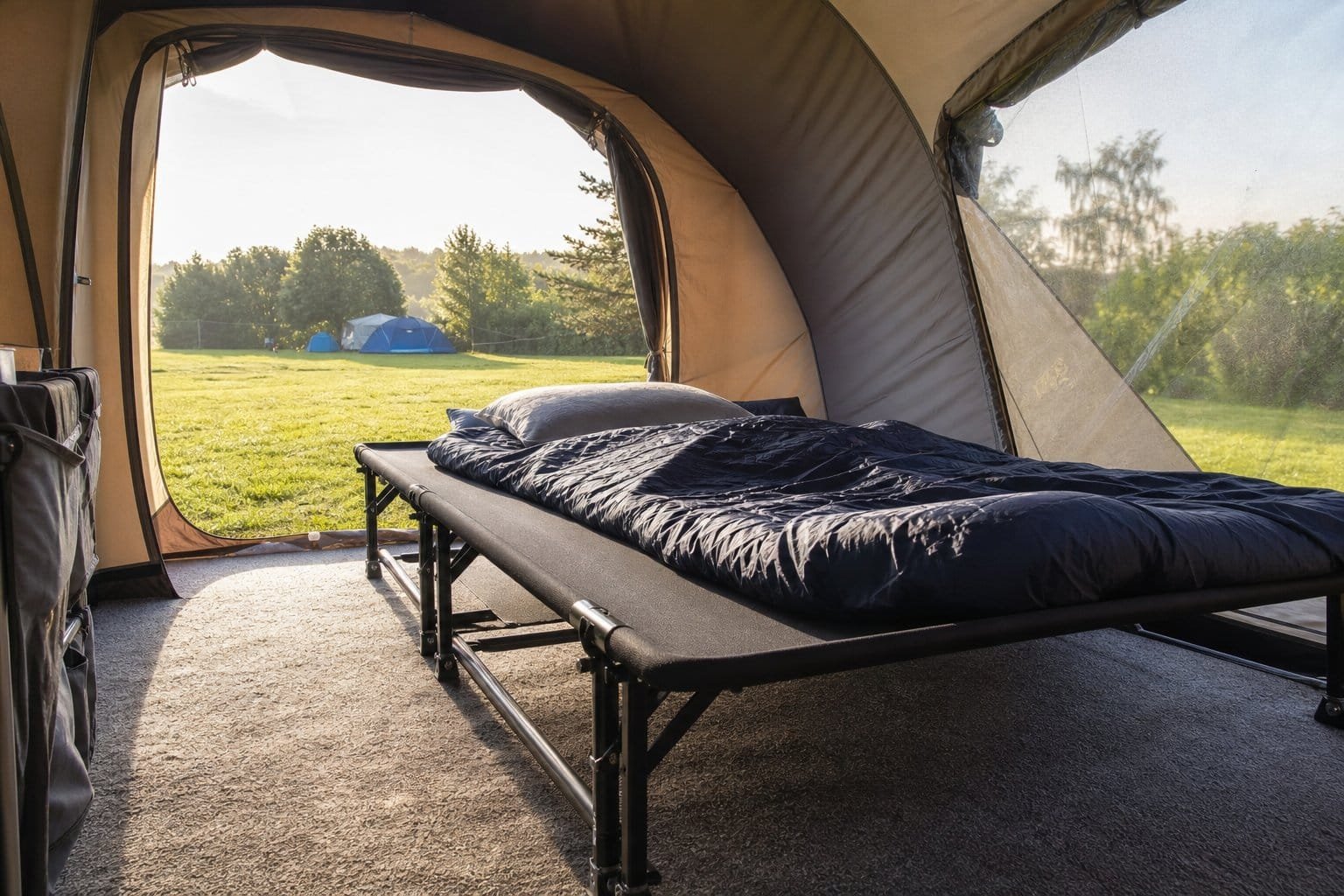
Best Camping Beds for Heavy Adults UK
The best camping beds for heavy adults in the UK carry well over your body weight, stay rigid without sagging onto a cross bar, are wide enough to roll over on, and sit high enough to get up from easily.
Most standard camp beds are rated for only 100 to 120 kg, and heavier campers report the same problems again and again: fabric that sinks until a bar digs into your back, frames that creak or splay, beds too narrow for broad shoulders, low beds that are hard to climb out of, and the nagging worry that the whole thing will give way at 2am. We have picked five heavy-duty camping beds rated from 227 kg to 272 kg and beyond, covering the strongest all-rounder, a cot with no centre bar, a padded budget fold-out, the widest bed we found and a 4 kg aluminium cot.
- Choose a bed rated at least 20 kg above your weight, more is better
- Steel frames, more legs and cross bracing add stability
- Width of 80 cm or more and a seat height near 45 cm make life easier
- Weight rating Standard beds are rated 100 to 120 kg. Every bed here is rated 227 kg or more, giving a large safety margin.
- Frame and legs Steel frames with X-bracing and extra legs resist splaying. Aluminium saves weight if it is a strong 7075 alloy.
- Width and length Look for 80 cm or wider if you are broad, and a bed about 10 cm longer than your height.
- Height Beds around 45 to 48 cm high are far easier to stand up from than 15 to 30 cm cots.
The camping beds for heavy adults UK campers trust share a few qualities: a load rating well above your body weight, a rigid frame that does not splay, fabric that stays taut over the bars and a height that makes getting up easy. Width, packed size and tent fit then decide which heavy-duty camp bed is right for you. This guide explains the thinking behind our five picks so you can choose with confidence.


Best overall Teton XXL | Best no centre bar Disc-O-Bed L | Best value Suteck XXL | Widest bed Timber Ridge | Best lightweight KingCamp | |
|---|---|---|---|---|---|
|
|
|
|
|
| |
| Max load | 272 kg | 227 kg | 408 kg (maker claim) | 272 kg | 250 kg |
| Bed size | Not quoted | 201 x 71 cm (deck) | 201 x 81 cm | 216 x 113 cm | 200 x 70 cm |
| Bed height | Not quoted | Not quoted | 48 cm | Not quoted | 30 cm |
| Frame | Steel, S-legs | Steel modules | Steel, 10 legs | Steel X-frame | 7075 aluminium |
| Weight | 11.8 kg | Not quoted | Not quoted | 12.7 kg | 4 kg |
| Packed | Carry bag | Canvas bag | 114 x 25 cm | 121 x 26 x 22 cm | 64 x 17 x 17 cm |
| Padding | None | None | 10 cm mattress | None | None |
| Warranty | Lifetime | Not quoted | 2 years | Not quoted | 1 year |
| Check price | Check price | Check price | Check price | Check price |
Best camping beds for heavy adults: our detailed reviews
Each review covers the load rating, frame, bed size, height, weight and packed size, plus the complaints heavier campers raise most. For lighter everyday options see our guide to the best camping beds for adults, and for compact designs our best folding camping beds.
Oversized steel cot rated to 272 kg, with a pivot-arm lever and lifetime warranty
The Outfitter XXL is built for exactly the people this guide is about. Teton rates it to 600 lb (272 kg) and describes the bed as larger than a twin (US single) bed, and retailers list it at about 85 x 40 x 19 inches (roughly 216 x 102 x 48 cm). That height matters if you are heavier: you sit down onto it like a chair rather than lowering yourself to the floor, and getting up in the morning is far easier on knees and hips.
The usual struggle with big cots is the last corner. Teton’s patented pivot arm is a built-in lever that pulls the bed fabric tight without wrestling, and reinforced steel S-shaped legs keep the frame steady when you roll over or sit on the edge. Independent testers at OutdoorGearLab scored it highly for comfort and durability but low for portability: the listing gives a pack weight of 26 lb (11.8 kg), it is bulky folded, and they warn the legs can pinch fingers during setup. It is a car-camping bed, backed by Teton’s lifetime warranty against defects.
- Rated to 272 kg
- Very roomy bed, wider than a single
- High seat height, easy to get up from
- Pivot-arm lever tightens the fabric
- Lifetime warranty
- 11.8 kg and bulky folded
- Legs can pinch fingers in setup
- Needs a large tent bedroom
227 kg-rated steel cot with a 201 x 71 cm deck, no centre bar, and bunk-bed option
A common complaint from heavier campers is feeling a cross bar dig in as the fabric sinks. Disc-O-Bed’s design has no middle bar at all: the frame is a series of rigid steel modules joined by disc-shaped hinges, and the 79 x 28 inch (about 201 x 71 cm) polyester deck is shaped to give contoured support without a mattress. It holds 500 lb (227 kg).
It assembles without tools, comes with removable leg extensions, and packs into a zipped canvas bag. Buy a second Single L and the stacking kit and the pair becomes a bunk bed, handy in family tents. US retailer Kodiak Canvas lists the cot at 29 lb (about 13.2 kg) in a bag of roughly 84 x 36 x 15 cm, so it is a car-camping bed. At 71 cm the deck is not the widest here, and one owner notes the sleeping area is narrower than the end frames suggest; broad-shouldered sleepers should look at the Timber Ridge or Teton instead.
- 227 kg rating
- No centre bar under your back
- No-tool assembly
- Leg extensions for a higher bed
- Can be stacked into bunks
- About 13 kg (retailer figure)
- 71 cm deck is narrower than some
- Dearer than steel fold-outs
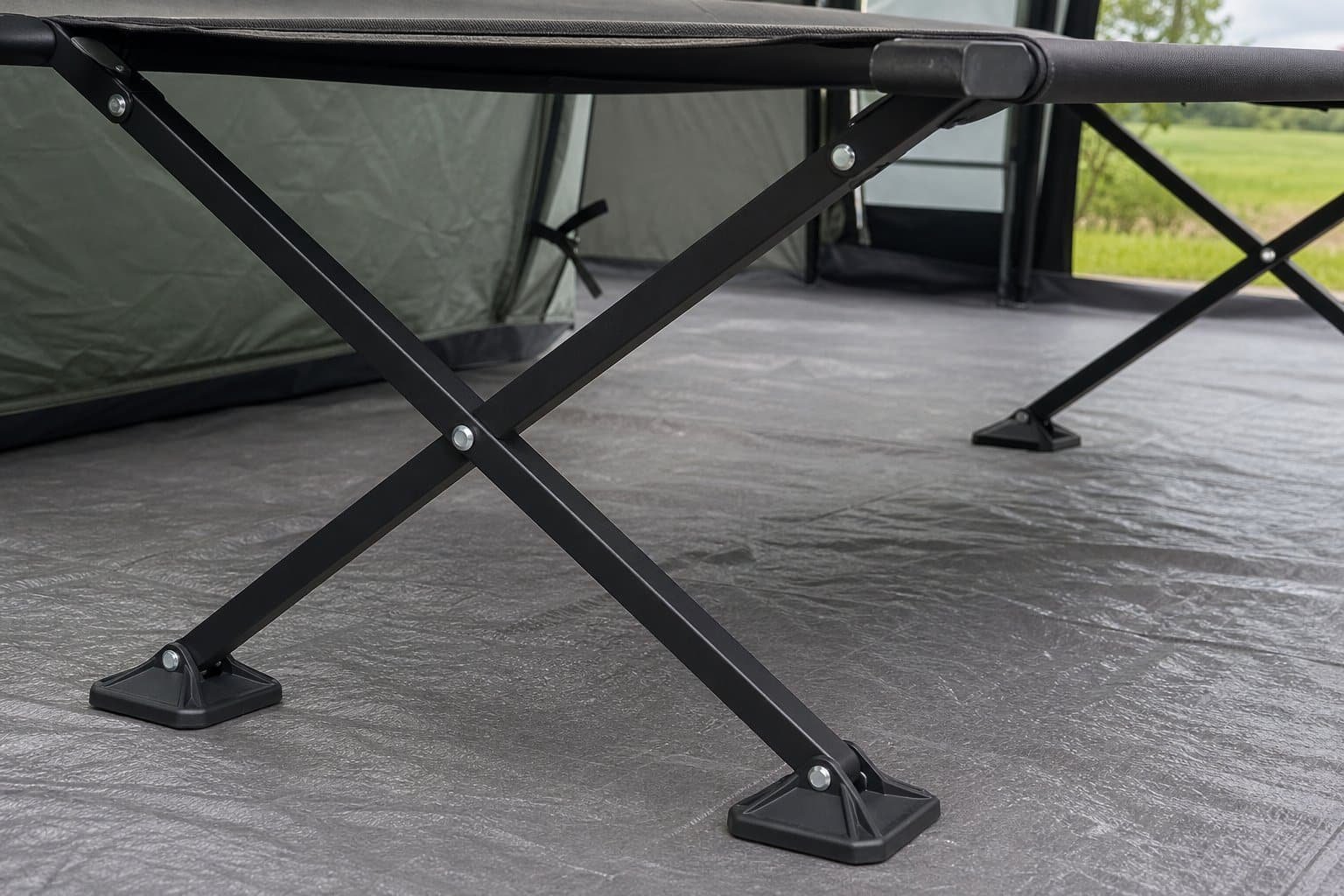
Fold-out steel cot with a 10 cm mattress, 81 cm wide, 48 cm high and a 408 kg maker rating
If you want bed-like comfort without buying a separate mattress, the Suteck XXL is the best value here. It is a fold-out design, so there are no poles or end bars to force in: you unfold it, the frame locks, and it folds back into its carry bag in seconds. Open, it measures 79 x 32 x 19 inches (about 201 x 81 x 48 cm), so it is wide and high enough to sit on, and the removable mattress is 79 x 31.5 x 4 inches, a full 10 cm thick, with a gently angled built-in pillow at the head.
The frame uses 25 mm square steel tubing with a 1 mm wall, double-layer 1200D Oxford fabric and ten legs with non-slip feet, which spread the load across the groundsheet. Suteck claims a 900 lb (408 kg) capacity; we would treat that as a marketing figure and still allow a healthy margin, but the build is clearly heavier than budget cots. It folds to about 45 x 10 inches (114 x 25 cm) and carries a two-year warranty. The listing does not quote the cot’s weight, and the mattress ships vacuum-packed, so give it a few hours to fluff up.
- Fold-out, no assembly
- Thick 10 cm removable mattress
- 81 cm wide, 48 cm high
- Ten legs spread the load
- Two-year warranty
- 408 kg claim is optimistic
- Weight not quoted
- 114 cm long folded
113 cm wide, 216 cm long steel X-frame cot rated to 272 kg
Most camp beds are 60 to 70 cm wide, which is where broad-shouldered or heavier sleepers feel squeezed and worry about rolling off. The Timber Ridge XXL is 44.5 inches (about 113 cm) wide and 85 inches (216 cm) long, close to a small double, so you can sleep on your side or turn over without hanging off the edge, and taller campers have room to stretch out.
A reinforced steel frame with an X-shaped cross-leg design holds up to 600 lb (272 kg) and stays steady as you climb in or sit up. The bed is 600D Oxford fabric, and a built-in side pocket keeps your phone, glasses and torch within reach. The trade-off for all that space is size and weight: it weighs 27.94 lb (12.7 kg) and folds to 47.6 x 10.2 x 8.7 inches (about 121 x 26 x 22 cm), so measure your boot and your tent bedroom before buying. The listing does not quote the bed height, and the 600D fabric is lighter than the 1200D used by some rivals.
- 113 cm wide, close to a small double
- 216 cm long for tall sleepers
- 272 kg rating
- X-frame stability
- Side pocket and carry bag
- 12.7 kg, folds to 121 cm long
- Height not quoted
- Needs a big tent bedroom

4 kg aluminium cot rated to 250 kg, 200 x 70 cm, packs to 64 cm
Heavy-duty usually means heavy, but this KingCamp cot proves it does not have to. Its frame is aircraft-grade 7075 aluminium with flat rather than round tubes, which KingCamp says improves strength, and it is rated to 551 lb (250 kg). Yet it weighs only 8.8 lb (4 kg), about a third of the steel cots here, and packs into a 25.1 x 6.6 x 6.6 inch (about 64 x 17 x 17 cm) bag that fits almost any boot or a motorbike pannier.
The bed is 78.7 x 27.5 inches (200 x 70 cm), 10 cm longer and a little wider than standard cots, and the surface combines 1200D Oxford with 420D ripstop to resist sagging. A lever-locking system takes the strain out of the final tensioning, which KingCamp says takes under a minute, and split non-slip feet help on grass and sand. The downsides: at 30 cm high it is lower than the steel fold-outs, so it is harder to get up from if your knees complain, it is not as wide as the XXL models, and it carries a one-year warranty.
- 250 kg rating at only 4 kg
- Packs to 64 x 17 x 17 cm
- 200 cm long
- Lever lock eases tensioning
- 1200D fabric resists sag
- 30 cm high, lower to get up from
- 70 cm wide
- One-year warranty
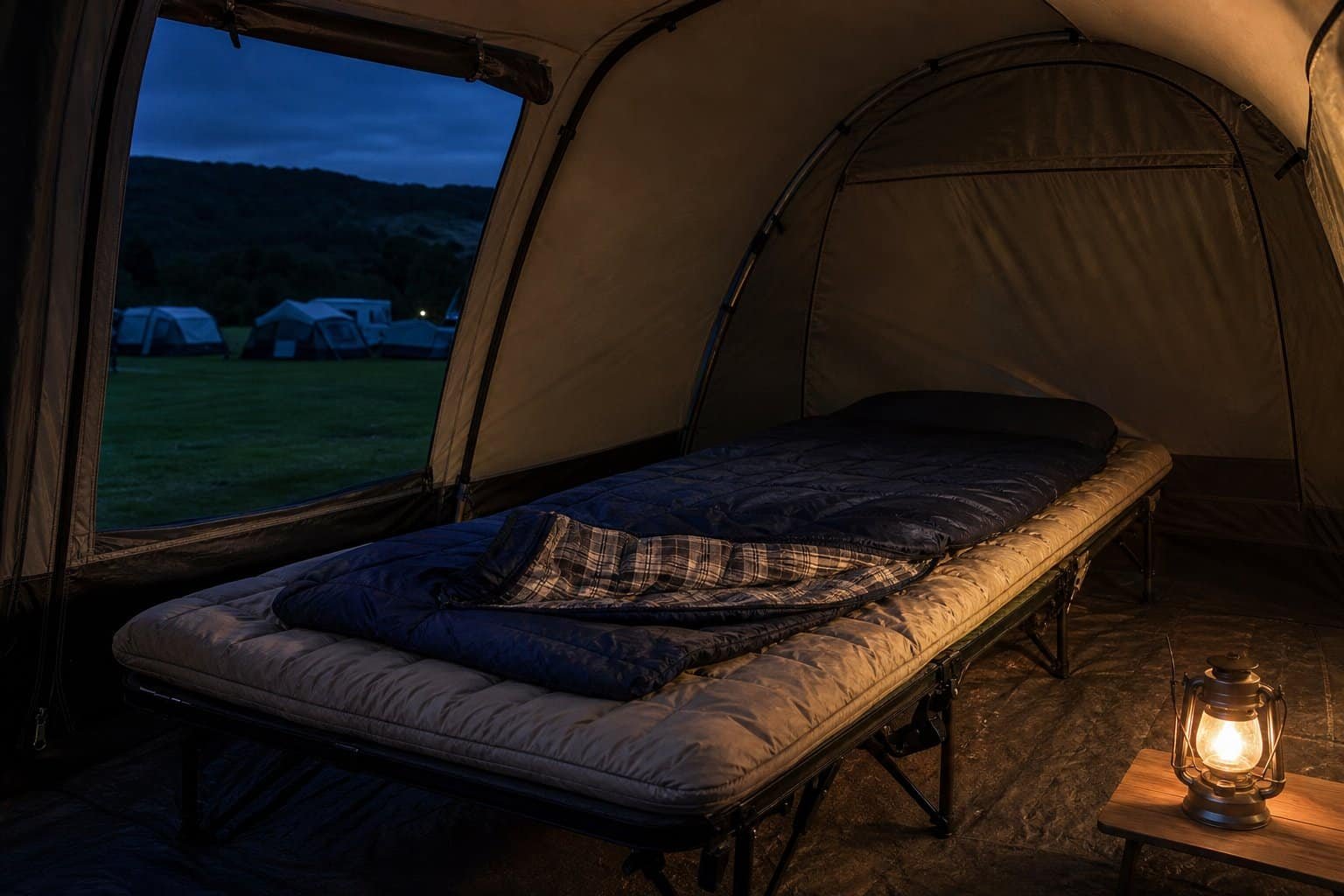
Camping beds for heavy adults: how much weight can a camp bed hold?
Weight ratings vary far more than most people expect. UK retailer UK Camping and Leisure says budget and standard camp beds are usually rated at 100 to 120 kg, mid-range models at 120 to 150 kg and heavy-duty steel beds at 150 to 200 kg or more, and recommends buying a bed rated at least 20 kg above your body weight; a bed used near its limit flexes more and sags sooner. Their camp bed weight limits guide also points out that the fabric attachment points are often the weakest link, and lists the warning signs of overloading: obvious sagging, legs bowing outwards, creaking and joints that no longer fold smoothly. Remember that sitting down hard on the edge puts far more force through one side than lying still, which is why extra legs and cross-bracing help. If you would rather sleep on air, our air beds for bad backs guide covers raised options.
Camping beds for heavy adults UK campers can choose: the main types
Heavy-duty camp beds solve the same problem in several different ways, and each design suits a different kind of trip. The five beds in this guide cover the main approaches, so they make a useful benchmark when you compare other models with similar weight ratings.
High steel cots
The TETON Sports Outfitter XXL and Timber Ridge XXL are classic oversized steel cots. A tensioned fabric bed sits on a reinforced steel frame with sturdy legs, giving a high, roomy surface that is easy to sit on. They are the strongest and steadiest designs here, but they are heavy and long when folded, so they belong in the car.
Bar-free modular beds
The Disc-O-Bed Large takes a different route. Instead of a fabric bed stretched over end bars, it uses rigid steel modules joined by disc-shaped hinges, so there is no cross bar under your back. That design also lets two beds stack into bunks, which can save floor space in a family tent.
Fold-out beds with mattresses
The Suteck XXL is a fold-out frame with a thick removable mattress. There are no poles or end bars to fit, so setup takes seconds, and the mattress adds cushioning straight out of the bag. It is a strong choice for heavier campers who want comfort without buying a separate topper.
Lightweight aluminium cots
The KingCamp aluminium cot shows that heavy-duty does not always mean heavy. Its 7075 aluminium frame carries a high load at a fraction of the weight of steel and packs into a short bag. It sits lower than the steel cots, which suits smaller tents but asks more of your knees each morning.
Reading weight ratings sensibly
The weight rating is the first figure most heavier campers check, but it needs reading with care. It is the maker’s own claim, and it is usually based on a load spread evenly across the bed. Real life is less tidy: you sit down on the edge, kneel on one corner to reach the tent door and roll over in the night, all of which concentrate force on one part of the frame.
That is why a generous margin matters. A bed working close to its limit flexes more, sags sooner and wears its joints faster. A bed with plenty of spare capacity stays flatter and quieter for longer. When you compare camping beds for heavy adults UK listings can quote very different figures, so treat unusually high claims, such as the Suteck’s, as a guide rather than a guarantee.
Look beyond the headline number to how the bed is built. Steel tubes, cross-bracing, extra legs and thick fabric all spread the load, while wide or multiple feet stop the bed sinking into soft ground. A well-built bed with a slightly lower rating can feel steadier than a flimsy one with a bigger claim.
It also pays to think about what else goes on the bed. A sleeping bag, mat and pillow add a little to the load, and so does a child who climbs on for a morning cuddle. Choose a weight rating that covers your body weight plus that extra with room to spare, and the bed will feel firmer and more dependable on every trip.
Height, width and getting in and out
Getting up from a low bed is one of the biggest frustrations for heavier campers. A bed that sits near chair height lets you sit on the edge, plant your feet and stand without a struggle, which is why the high Teton and Suteck frames appeal. A lower camping cot such as the KingCamp fits more tents but needs more effort to rise from.
Width matters for comfort and confidence. On a narrow bed, broad shoulders hang over the edges and turning over can feel risky. A wider surface, such as the Suteck at 81 cm or the Timber Ridge at 113 cm, lets you lie on your side, change position and settle without worrying about the edge. Taller campers should check the length as well.
Think about how you climb in. Sit on the middle of the long side, then swing your legs up, rather than kneeling on one end. In the morning, roll onto your side, drop your legs over the edge and push up with your arms. These habits are easier on the frame and on your joints, and they help any heavy-duty camp bed last longer.
Fitting a heavy-duty camp bed into your tent and car
Big beds need big spaces. Oversized steel cots can be well over two metres long and a metre wide, which fills a typical bedroom pod. High beds also need near-vertical walls, because sloping fabric reduces the usable width at bed height. Measure your bedroom at the height the bed will sit before you buy.
Family tents with tall bedroom walls are usually the best match for high, wide beds. If you are choosing a tent around your bed, our guide to the best family camping tents UK covers models with roomy bedrooms. For couples, two beds side by side need more space again, so check the full width of the pod.
Then check your car. Steel cots in this guide fold to over a metre long and weigh well over 10 kg, so measure the boot and think about lifting the bed in and out. The KingCamp’s short packed size makes it the easy option for small cars. Among camping beds for heavy adults UK drivers with hatchbacks will find it the least awkward to carry.
Storage at home deserves a thought too. Keep a folded camping cot somewhere dry and avoid stacking heavy boxes on top of it in the garage or loft, where steady pressure can bend tubes or crush feet. Steel beds over 10 kg are easier and safer to move with two people, especially up stairs.
Comfort and warmth on UK campsites
All camp beds are cold underneath because air circulates freely below the fabric. On cool British nights, even in summer, a mat on top makes a real difference. A self-inflating mat or thick foam pad adds insulation and also softens the feel of tight fabric, which many heavier campers appreciate on a cot without padding.
If you prefer to sleep on air rather than a frame, or you share a bed with a partner, our guide to the best double camping mattresses covers sturdy two-person options. Many campers combine a strong frame with a mat, which gives the support of a bed and the warmth of insulation.
Wet ground is common on UK sites, and heavy beds can sink into soft turf. Place wide boards or plastic lids under the feet on boggy pitches, and check the bed is level before you get in. A level bed feels steadier, shares the load across all the legs and is far less likely to creak or tilt overnight. These small steps make the camping beds for heavy adults UK campers buy feel more secure from the first night.
Final thoughts on choosing a heavy-duty camp bed
For most heavier car campers, the TETON Sports Outfitter XXL is the best all-rounder, with a high rating, a roomy bed and a lifetime warranty. The Disc-O-Bed Large removes the centre bar, the Suteck XXL adds a thick mattress at a good price, the Timber Ridge is the widest and longest, and the KingCamp aluminium cot carries a lot of weight for very little.
Whichever of the camping beds for heavy adults UK campers choose, choose a weight rating with a healthy margin over your body weight, measure the tent and boot, and add a mat for warmth. Get those basics right and you can stop worrying about the bed and start enjoying a proper night’s sleep under canvas.
What to look for in a camping bed for heavy adults
Pick a bed rated at least 20 kg over your weight; a bigger margin means less sag and a longer life.
Steel is strongest for the money. X-frames, S-legs and extra legs stop the frame splaying when you sit on the edge.
Taut 1200D fabric, or a bar-free design like Disc-O-Bed, stops a cross bar digging in as the fabric sinks.
70 cm is snug for broad shoulders. 80 cm or more lets you sleep on your side and roll over safely.
Beds around 45 to 48 cm high are easier on knees and hips than low cots, but need upright tent walls.
Heavy-duty steel cots weigh 11 to 13 kg and fold to over a metre. Measure your boot first.
Wide or multiple feet spread a heavy load and are kinder to sewn-in groundsheets.
How to make a camp bed last when you are heavier
- Pitch on level ground
Set the bed on flat ground so the load is shared evenly between all the legs.
- Sit in the middle
Lower yourself onto the centre of the bed rather than dropping onto one edge or corner, where the frame is weakest.
- Spread the feet
Put squares of carpet or plastic lids under narrow feet to stop them sinking into soft ground or wearing the groundsheet.
- Check the joints
Before each trip look for bent tubes, cracked feet and fraying stitching where the fabric meets the frame.
- Add insulation on top
All cots are cold underneath, so lay a foam or self-inflating mat on the bed below about 10C.
- Store dry and unloaded
Dry the fabric before packing and never store heavy kit on the bed, which stretches it.
How we chose these camping beds for heavy adults
We have not slept on every bed in this list ourselves. Our picks are based on manufacturer specifications, UK camping retailer guides, independent cot tests and recurring themes in feedback from heavier campers about sag, stability, width and getting up.
-
Load rating
We only included beds rated at 227 kg (500 lb) or more.
-
Frame and stability
We compared frame material, leg design and bracing.
-
Size and height
We compared bed width, length and seat height where given.
-
Practicality
We noted weight, packed size and warranty for UK car camping.
Load ratings are the makers’ own claims and are not independently verified. Not every Amazon listing quotes weight, height or packed size; where a figure is missing we say “Not quoted” rather than guess.
What is the best camping bed for a heavy person?
For most heavier car campers, the TETON Sports Outfitter XXL: it is rated to 272 kg, has a roomy bed, a high seat height and a lifetime warranty. If you need to save weight, the 4 kg KingCamp aluminium cot carries 250 kg.
How much weight can a camp bed hold?
Standard camp beds are usually rated at 100 to 120 kg. Heavy-duty models range from about 150 kg to 272 kg, and some makers claim more. Choose a bed rated at least 20 kg above your weight.
Are steel or aluminium camp beds stronger?
At the same tube size, steel is stronger and cheaper but heavier. High-grade 7075 aluminium, as used by KingCamp, can still carry 250 kg at around 4 kg.
How do I stop feeling the bar on a camp bed?
Choose a bed with very taut, thick fabric, a bar-free design such as the Disc-O-Bed, or add a thick mat or mattress topper. The Suteck XXL includes a 10 cm mattress.
What width camp bed do I need if I am broad?
Standard cots are 60 to 70 cm wide. Broad-shouldered or side sleepers will be more comfortable on 80 cm or wider, such as the Suteck XXL (81 cm) or Timber Ridge (113 cm).
Will a heavy-duty camp bed fit in my tent?
Check the bedroom size and wall slope. High, wide beds need upright walls; our tents with standing room guide is a good place to start.
Which camping bed for heavy adults should you buy?
- Best overall: TETON Sports Outfitter XXL Heavy-Duty Camping Cot
- Best no centre bar: Disc-O-Bed Large Single Portable Camping Cot
- Best value: Suteck 32 inch XXL Folding Camping Cot with Mattress
- Widest bed: TIMBER RIDGE 44.5 inch Extra Wide Camping Cot, 600 lb
- Best lightweight: KingCamp 551 lb Aluminium Heavy Duty Camping Cot
For most heavier UK campers, the TETON Sports Outfitter XXL is the best camping bed for heavy adults: it is rated to 272 kg, roomy, high enough to get up from easily and backed by a lifetime warranty. The Disc-O-Bed Large removes the centre bar entirely, the Suteck XXL is the best value with its 10 cm mattress, the Timber Ridge is the widest bed we found at 113 cm, and the KingCamp aluminium cot carries 250 kg at only 4 kg. Add a mat on cold nights; our self-inflating mat picks and R-value guide will help.
CampEquipmentPlus relies on reader support. Purchases made via links on our website may earn us an affiliate commission at no extra cost to you, helping keep the site running.