

Best Camping Cot Mattresses
The best camping cot mattress is wide enough to cover your cot, thick enough to hide the frame and insulated enough to block the cold air underneath. Our top pick, the TETON Universal XL, is an 80 x 30 in foam pad made for cots, while the Exped MegaMat gives the closest thing to a real-bed feel.
Cots get you off the cold, lumpy ground, but on their own they’re a sheet of fabric stretched over a frame. Owners complain about the same things: feeling the side bars, a hammock-like sag, and a cold back on any night below about 50°F because air circulates under the cot. A good pad fixes all three.
Below we compare six pads, from a cheap quilted topper to a 4 in self-inflating mattress, and explain how to match width, thickness and R-value to your cot.
- Match the pad width to your cot
- 2 in for back sleepers, 3–4 in for side sleepers
- R 5+ for cool nights on a cot
- Cots are cold underneath Moving air under a cot steals heat. Use an insulated pad, ideally R 5–6 or more, in cool weather.
- Best overall: TETON Universal XL An 80 x 30 x 2 in foam pad built for cots, R 5.5 per Teton, with a lifetime warranty.
- Best real-bed feel: Exped MegaMat 4 in of self-inflating foam with vertical sidewalls and R 8.1.
- Measure your cot first Cots range from about 24 to 40 in wide. A pad that’s too narrow leaves bare bars; too wide and it hangs over.
A camping cot mattress is the cheapest way to turn a cot from a stiff stretcher into something that feels like a real bed. The right camping cot mattress does three jobs at once: it pads over the frame and side rails, it smooths out sag in the fabric, and it insulates you from the cold air moving underneath the cot. This guide compares six cot pads on Amazon, from foam and memory foam to self-inflating mattresses, and shows how to choose one for your cot, your sleeping position and the temperatures you camp in.


Top pick Teton XL | Real-bed feel MegaMat LXW | Cold nights BaseCamp L | Memory foam CYMULA 2in | |
|---|---|---|---|---|
|
|
|
|
| |
| Type | Open-cell foam | Self-inflating | Self-inflating | Memory foam |
| Size | 80 x 30 in | 77.6 x 30.3 in** | 77 x 25 in | 75 x 30 in |
| Thickness | 2 in | 4 in | 2 in | 2 in |
| R-value | 5.5* | 8.1** | 6 | Not quoted |
| Weight | 5.3 lb* | 5 lb 12 oz** | 3 lb 6 oz | Not quoted |
| Warranty | Lifetime | Not quoted | Ltd lifetime | Not quoted |
| Check price | Check price | Check price | Check price |
The best camping cot mattresses: our reviews
Each review covers size, thickness, insulation, weight, packed size and warranty, plus the complaints owners raise most often. The first three pads suit most adults on standard cots; the last three are lighter, softer or cheaper options for specific needs.
Open-cell foam, 80 x 30 x 2 in, removable poly-canvas cover, R 5.5 (Teton), 5.3 lb, rolls to 31.5 x 10.25 x 10.25 in, lifetime warranty
The Teton Universal XL is the pad most cot owners should start with, because it is built for the job. At 80 x 30 in it covers the full sleeping surface of most standard and XL cots, so you aren’t sliding off a narrow mat onto the side rails at 2 a.m. The 2 in open-cell foam is soft enough to take the edge off taut cot fabric, and Teton lists an R-value of 5.5 for the XL, which is enough insulation to stop the cold air under a cot from chilling your back on spring and fall nights. The poly-canvas shell zips off for washing, and the pad rolls up with built-in compression straps.
The trade-off is bulk. Teton’s site gives a weight of 5.3 lb and a rolled size of 31.5 x 10.25 x 10.25 in, which is fine in a car but too big for anything else. Two inches of foam is comfortable for back sleepers, but heavier side sleepers may feel the cot underneath at the hip. If that is you, look at the 82 x 38 x 2.5 in Teton Outfitter XXL (R 6.2, 7.7 lb) or a 4 in pad. Teton backs both with a lifetime warranty.
- Sized for full-width cots
- Washable canvas cover
- R 5.5 insulation per Teton
- Compression straps built in
- Lifetime warranty
- Bulky when rolled
- Heavy at 5.3 lb
- 2 in can bottom out for side sleepers
Self-inflating 4 in open-cell foam, 77.6 x 30.3 in, R 8.1, 5 lb 11.7 oz, packs to 9.8 x 31.1 in, vertical sidewalls, stretch tricot top, top-up pump included (specs from REI)
If the goal is a real-bed feel, the Exped MegaMat is the benchmark. It combines 4 in of self-inflating open-cell foam with straight vertical sidewalls, so the whole surface is usable and you don’t roll toward a rounded edge. Exped says the sidewalls stop you bottoming out in any sleeping position, and the included top-up pump lets you set it plush or firm. The top is a soft four-way stretch tricot rather than slippery nylon, which matters on a cot because you’re lying on it directly.
The Amazon listing doesn’t give dimensions or weight, so we used REI’s spec page for the Long X-Wide: 77.6 x 30.3 x 4 in, 5 lb 11.7 oz, R-value 8.1 and a packed size of 9.8 x 31.1 in. That R-value is more than enough for a cot in freezing weather. The downsides are price, at well over $200 when we checked, and weight. A few REI reviewers reported slow leaks, so keep it away from sharp cot hardware and carry the repair kit. At 30 in wide it suits wide cots; on a narrow 25 in cot the edges will hang over.
- 4 in foam with vertical sidewalls
- R 8.1 for cold-weather cots
- Soft stretch fabric top
- Adjustable firmness with pump
- Expensive
- Heavy at nearly 6 lb
- Occasional slow-leak reports
- Too wide for narrow cots
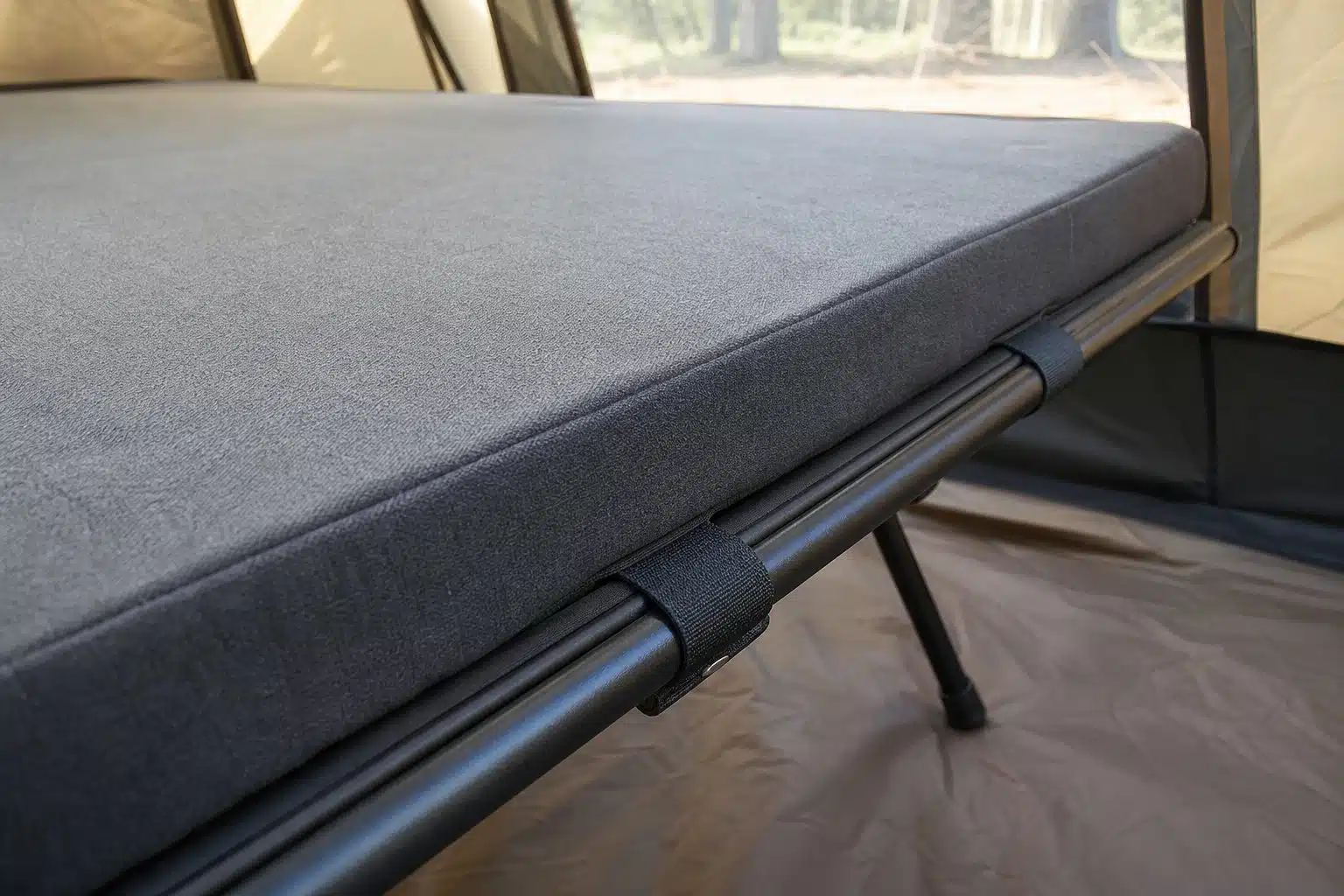
Self-inflating foam, 77 x 25 x 2 in, R 6, 3 lb 6 oz, rolls to 26 x 7.5 in, WingLock valve, made in USA, limited lifetime warranty
The Therm-a-Rest BaseCamp is the pick for anyone who uses a cot into fall and winter. Therm-a-Rest rates it at R 6, which is exactly the level winter campers recommend for cots, since the air under a cot provides almost no insulation. The Large measures 77 x 25 x 2 in, weighs 3 lb 6 oz and rolls to 26 x 7.5 in, much smaller than a foam cot pad of similar warmth. The WingLock valve inflates and deflates faster than a classic twist valve, and the pad is made in the USA with a limited lifetime warranty.
REI reviewers praise its durability and warmth, with several describing BaseCamps that have lasted many years. The complaints are that 2 in can feel thin for side sleepers, deflating takes some effort, and a few owners reported air loss after several nights. It is also 25 in wide, so on a 30 in cot you’ll have a few inches of bare cot on each side. Use the cot’s straps or a sheet to stop it shifting.
- R 6 for cold cots
- Rolls smaller than foam pads
- Proven durability
- Made in USA, limited lifetime warranty
- Only 25 in wide
- 2 in can feel thin side-on
- Slow to roll up
Self-inflating, 73 x 25.6 in, 1.2 in (3 cm) foam, R 4.1 (maker claim), 2.6 lb, packs to 14.6 x 6.3 in, elastic cot straps, TPU non-slip base
The OneTigris NIGHTFALL is designed specifically for cots rather than adapted from a ground pad. At 73 x 25.6 in, OneTigris sizes it to regular cots of about 74.5 x 27.5 in, and it has elastic straps to hold it on the frame plus a TPU-coated base that resists sliding. The 1.2 in foam core self-inflates, and you top it up with a few breaths to set the firmness. OneTigris quotes an R-value of 4.1, which is good for three-season use if you also block drafts under the cot.
It weighs 2.6 lb and packs to 14.6 x 6.3 in, so it’s the only pad here that makes sense for a lightweight cot like a Helinox. The catch is thickness: 1.2 in won’t give a real-bed feel, and heavier sleepers will feel the cot rails. The listing doesn’t quote a warranty, and the product is new, so there’s little owner history yet.
- Light and compact
- Straps keep it on the cot
- Non-slip base
- Quiet stretch fabric
- Only 1.2 in foam
- R-value is a maker claim
- Warranty not quoted

Memory foam, 75 x 30 x 2 in, removable breathable cover, water-resistant non-slip bottom with rubber dots, securing straps, also sold in 3 and 4 in
The CYMULA cot pad brings memory foam to a cot-sized footprint. The 75 x 30 x 2 in pad matches the width of most standard cots, the cover comes off for washing, and the base is water-resistant with rubberized anti-slip dots and straps to hold it in place. CYMULA also sells 3 in and 4 in versions, and its own listing says heavier sleepers may prefer the thicker ones because the foam compresses more under weight.
Memory foam gives the most bed-like, contouring feel of any pad here, but it has quirks outdoors. It gets firmer in the cold, so it feels stiff until your body warms it, and CYMULA gives no R-value, weight or warranty. Use it for mild-weather car camping and guest beds, and add an insulated pad underneath on chilly nights.
- Bed-like contouring feel
- Cot-width 30 in
- Washable cover
- Non-slip, water-resistant base
- No R-value quoted
- Firms up in the cold
- Weight and warranty not quoted
Quilted polyester-fibre pad, 75 x 30 x 2 in, corner ties to secure it, rolls up with end ties, no warranty
The Tuphen pad is a quilted topper rather than a foam mattress. It’s filled with polyester fibre, measures 75 x 30 x 2 in, and has ties at the four corners to fix it to the cot so it doesn’t slide. It rolls up and ties at both ends, it’s light, and it was one of the cheapest cot-specific pads we found. It also fits cots with raised head ends and lounge chairs.
Think of it as a comforter for your cot. It softens the fabric and the bars, but polyester fibre flattens under your hips and shoulders, so it won’t fix a sore back the way thick foam does. There’s no insulation rating and no warranty (the listing says “No”). It’s best for summer, kids’ cots and guest beds, or as a soft layer on top of an insulated pad.
- Very low price
- Light and quick to roll
- Corner ties prevent sliding
- Fits head-raised cots
- Fibre fill flattens
- No insulation rating
- No warranty
Do you need a camping cot mattress?
If you only camp on warm summer nights and sleep on your back, a bare cot can be fine. For everyone else, a camping cot mattress makes a big difference. A cot keeps you off rocks, roots and wet ground, but its surface is just tensioned fabric. Your hips and shoulders press into it, you can feel the side rails if you roll toward the edge, and some cots have cross bars you can feel through the fabric. A pad spreads your weight and covers those hard spots.
The bigger reason is warmth. On the ground, at least the earth underneath you is still. On a cot, air moves freely underneath you and carries heat away from your back. Campers quoted in Explore’s round-up of advice from seasoned winter campers describe a bare cot as basically R-0, and recommend an insulated pad of R 6 or more when temperatures drop. That is why so many people are surprised to be colder on a cot than they were on the tent floor.
How to choose a camping cot mattress
Width and length: measure your cot
Start with your cot’s sleeping surface, not its overall frame size. Standard cots are roughly 72–76 in long and 25–30 in wide, XL and oversized cots run to 80–85 in long and 30–40 in wide, and ultralight cots can be as narrow as 23–24 in. GearJunkie’s tested list of camping cots lists cots from about 23.5 in wide up to 40 in, which shows how much they vary. Choose a pad that matches the cot’s width within an inch or two. Too narrow and you’ll feel bare fabric and rails at the edges; too wide and it drapes over the sides and slides off.
Length matters for taller campers. A 72 in pad leaves your feet or head on bare fabric if you’re over about 6 ft. The TETON Universal XL (80 in) and Exped MegaMat Long X-Wide (77.6 in) are the longest pads here. If you’re still choosing a cot, our guides to the best camping beds for adults and camping beds for heavy adults list sleeping-surface sizes.
Thickness and sleeping position
Back sleepers spread their weight over a large area, so a 2 in foam or self-inflating pad is usually enough on a cot. Side sleepers put most of their weight on the hip and shoulder, and they are the ones who complain of feeling the cot through a thin pad. For side sleeping, look at 3–4 in of foam, like the Exped MegaMat, or the thicker 3 in and 4 in CYMULA versions. Heavier campers of any position should also go thicker, because foam compresses more under more weight.
A camping cot mattress doesn’t need to be as thick as a ground pad, because the cot already keeps you off rocks. That’s the advantage of the pairing: a cot plus a 2–4 in pad usually feels more like a bed than either one on its own.
Insulation: R-value on a cot
R-value measures how well a pad resists heat loss. On the ground, R 2–3 is enough for summer and R 4–5 for three seasons. On a cot, aim higher, because cold air circulates underneath. As a rough guide, use R 3–4 in summer, R 5–6 for spring and fall, and R 6–8 for nights near freezing. The Therm-a-Rest BaseCamp (R 6) and Exped MegaMat (R 8.1) are the best choices for cold nights. Our guide to what R-value you need for winter explains the numbers in more detail, and you can stack two pads for extra warmth if your favourite pad isn’t warm enough alone.
Foam vs self-inflating vs memory foam cot pads
Open-cell foam pads like the TETON Universal XL can’t puncture, need no inflating and are usually the widest, so they suit cots well. Their downside is size: they roll into a big, heavy cylinder. The canvas or fabric cover often comes off for washing.
Self-inflating pads like the Exped MegaMat, Therm-a-Rest BaseCamp and OneTigris NIGHTFALL have a foam core inside an airtight shell. Open the valve and the foam draws in air, then you add a few breaths to set the firmness. They pack smaller for the same warmth and let you adjust the feel, but they can leak, so keep them away from sharp cot hardware and carry a repair kit.
Memory foam pads like the CYMULA give the most bed-like, contouring feel, but they’re heavy for their thickness, rarely quote an R-value and firm up noticeably in the cold. They’re best for mild weather, RVs and guest beds. Our guide to the best foam sleeping pads compares closed-cell and memory foam in more detail.
Quilted toppers like the Tuphen are the cheapest option. They soften the fabric, but polyester fibre packs down under your hips and adds little insulation, so treat them as a comfort layer rather than a mattress.
Air mattresses are the one type we would avoid on a cot. Uninsulated air chambers let cold air circulate inside the mattress as well as under the cot, so you end up colder, and most are too thick and bouncy to stay put on a narrow frame.

How to keep a cot warm on cold nights
Even the best camping cot mattress works better with a few extra habits. First, put the insulation where it counts: under you. A sleeping bag’s fill is crushed flat under your body, so it does very little on the bottom. An insulated pad does that job instead.
Second, block the airflow under the cot. Drape a blanket, tarp or spare sleeping bag over the sides of the cot so it hangs to the floor, or pack bags and gear underneath to fill the space. Winter campers often add a closed-cell foam pad on the tent floor under the cot as well.
Third, layer on top. A fleece blanket between the pad and your sleeping bag adds warmth and stops a slippery pad surface from sliding. Wear a hat and dry socks to bed. If you still sleep cold, pair your cot with one of our {a(‘best-cold-weather-sleeping-bags’,’best cold weather sleeping bags’)}.
Keeping your cot pad in place
A pad that slides off a cot in the night is one of the most common complaints. Look for straps or ties: the OneTigris NIGHTFALL has elastic straps, the CYMULA has a non-slip base with rubber dots and straps, and the Tuphen has corner ties. For pads without them, a fitted twin sheet pulled over both the pad and the cot works well, as do a couple of luggage straps around the cot frame. Some cots have built-in pad straps, so check yours before buying.
Matching the pad’s width to the cot also helps. A 25 in pad on a 30 in cot will shift sideways every time you roll over, while a pad that’s an inch or so narrower than the cot sits snugly between the rails.
Camping cot mattress size and packing in the car
Cot pads are mostly car-camping gear, so packed size matters more than weight. Foam pads are the bulkiest: the TETON Universal XL rolls to about 31.5 x 10.25 x 10.25 in according to Teton, roughly the size of a sleeping bag stuffed into a large duffel. Self-inflating pads pack smaller for the same warmth; the Therm-a-Rest BaseCamp Large rolls to 26 x 7.5 in. The OneTigris NIGHTFALL is the most compact at 14.6 x 6.3 in.
Store self-inflating pads unrolled with the valve open, under a bed or behind a sofa, so the foam keeps its spring. Foam and memory foam pads should be stored flat or loosely rolled, and always dry, to avoid mildew.
Common camping cot mattress problems and fixes
I’m cold even with a pad. Check the pad’s R-value, block the airflow under the cot with a blanket or gear, and add a foam pad on top or underneath.
I can feel the side bars. Your pad is too narrow or too thin. Choose a pad the full width of the cot, or go up to 3–4 in of foam if you sleep on your side.
My self-inflating pad is flat by morning. Some air loss is normal as the air inside cools at night. Top it up before bed. If it’s much softer by morning, check the valve and look for a puncture by submerging sections in water or brushing on soapy water.
The memory foam is rock hard. Memory foam stiffens in the cold. Unroll it early in the tent, lie on it for a few minutes, or keep it in the car until bedtime on cold nights.
The pad squeaks or rustles. Brushed or stretch fabric tops are quieter than slick nylon. A fleece blanket or sheet over the pad also muffles noise.
Matching a camping cot mattress to your cot type
Standard steel cots such as the Coleman Trailhead II have a sleeping surface around 73–75 in long and 30–35 in wide, with side rails you can feel at the edges. A full-width foam pad like the TETON Universal XL or the 30 in CYMULA covers the rails best. Two inches of foam is usually enough because these cots are wide and fairly taut.
Oversized and XL cots are 80 in or longer and up to about 40 in wide. They need the longest, widest pads you can find. The 82 x 38 in TETON Outfitter XXL is designed for Teton’s oversized cots, and the 80 x 30 in Universal XL works on many others. A narrow pad on a very wide cot will slide around, so use straps or a fitted sheet.
Lightweight and low cots, often 23–25 in wide, sit just a few inches off the floor. They’re closer to the cold ground and more tippy, so a thin, light self-inflating pad with straps, like the OneTigris NIGHTFALL or the 25 in Therm-a-Rest BaseCamp, is the better fit. GearJunkie’s testers found stacking a thick pad on a minimal cot can feel wobbly.
Cots with built-in pads or raised head ends already have some padding, but it is usually thin. A soft topper such as the Tuphen, which fits head-raised cots and lounge chairs, adds comfort without fighting the shape of the frame.
Who should buy which cot pad?
Choose the TETON Universal XL if you have a standard or XL cot and want one durable pad for most of the year. Choose the Exped MegaMat if you sleep on your side, want a real-bed feel and camp into the cold months. The Therm-a-Rest BaseCamp suits campers who need warmth and a smaller packed size, but have a cot around 25 in wide. Go for the OneTigris NIGHTFALL for a lightweight cot, the CYMULA for mild-weather comfort and RV bunks, and the Tuphen if you just want to soften a cot for kids or guests on a tight budget.
If you’re still deciding between a cot and a pad on the ground, our guides to the best folding camping beds and best self-inflating camping mats cover both options.
Camping cot myths
Not without a pad. Air moving under a cot steals heat, so a bare cot is often colder than the tent floor.
Width matters. A narrow ground pad leaves bare rails and slides around; cot-width pads fit better.
Uninsulated air mattresses get cold and bouncy on a cot. Foam or self-inflating pads are warmer and more stable.
What to look for in a camping cot mattress
Choose a pad within an inch or two of your cot’s sleeping-surface width.
R 3–4 for summer, R 5–6 for spring and fall, R 6+ near freezing.
2 in for back sleepers; 3–4 in for side sleepers and heavier campers.
Straps, ties or rubberized bottoms keep the pad on the cot.
Foam pads roll big; self-inflating pads pack smaller for the same warmth.
A removable, washable cover and a long warranty add real value.
How to set up a warm cot bed
- Set up the cot first
Tension the fabric fully so it doesn’t sag under the pad.
- Add the pad and strap it
Center the pad and secure it with straps, ties or a fitted sheet.
- Block the airflow underneath
Drape a blanket or tarp to the floor, or fill the space with gear.
- Layer a blanket on top
A fleece blanket adds warmth and stops the bag sliding.
- Top up self-inflating pads
Add a few breaths before bed for the firmness you like.
How we chose these cot mattresses
We have not tested every pad in this list ourselves. Our picks are based on Amazon listings, manufacturer specifications from Teton, spec pages and owner reviews at REI, cot testing from GearJunkie, and advice from experienced cold-weather campers. Where a listing didn’t state a spec, we used the maker’s or REI’s figure and said so, or marked it “Not quoted”.
-
Cot fit
We favoured pads sized to cover a cot’s sleeping surface.
-
Insulation
We compared stated R-values for cold air under the cot.
-
Comfort
We weighed thickness, foam type and sidewalls by sleeping position.
-
Honest specs
We marked missing specs and warranties clearly.
What is the best camping cot mattress?
For most people, the TETON Universal XL: it’s 80 x 30 x 2 in, sized for cots, R 5.5 per Teton and backed by a lifetime warranty. For the most bed-like feel, choose the Exped MegaMat.
Why am I cold on a camping cot?
Air circulates under the cot and draws heat from your back. Use an insulated pad of about R 5 or more and block the airflow under the cot with a blanket or gear.
How thick should a cot pad be?
About 2 in is enough for most back sleepers. Side sleepers and heavier campers usually prefer 3–4 in.
Can I use a regular sleeping pad on a cot?
Yes, but check the width. Many ground pads are 20 in wide and leave bare rails on a 25–30 in cot. A wide or long-wide pad fits better.
Should I put an air mattress on a cot?
We don’t recommend it. Uninsulated air mattresses get cold and bouncy on a cot; foam or self-inflating pads are warmer and more stable.
How do I stop my pad sliding off the cot?
Use a pad with straps or a non-slip base, pull a fitted sheet over the pad and cot, or strap them together with luggage straps.
Final thoughts on choosing a camping cot mattress
A cot gets you off the ground, but the pad decides whether you sleep well on it. Match the pad to your cot’s width, choose the thickness for your sleeping position, and pick an R-value for the coldest night you expect. The TETON Universal XL is the best all-rounder for standard and XL cots, the Exped MegaMat gives the most bed-like comfort, and the Therm-a-Rest BaseCamp is the warmest for its size. Add a blanket under the cot on cold nights and you’ll wake up warm and rested.
Which camping cot mattress should you buy?
- Best overall: TETON Universal XL Camp Pad
- Best real-bed feel: Exped MegaMat Long X-Wide
- Best for cold nights: Therm-a-Rest BaseCamp Large
- Best lightweight cot pad: OneTigris NIGHTFALL Cot Mattress
- Best memory foam: CYMULA 2 in Memory Foam Cot Pad
- Best budget topper: Tuphen Quilted Cot Mattress Pad
For most campers, the TETON Universal XL is the best camping cot mattress: it covers a full-size cot, insulates against cold air underneath and has a lifetime warranty. Side sleepers and cold-weather campers should choose the Exped MegaMat or Therm-a-Rest BaseCamp, while the OneTigris NIGHTFALL suits light cots. The CYMULA and Tuphen pads are comfortable, cheaper choices for mild weather.
CampEquipmentPlus relies on reader support. Purchases made via links on our website may earn us an affiliate commission at no extra cost to you, helping keep the site running.