
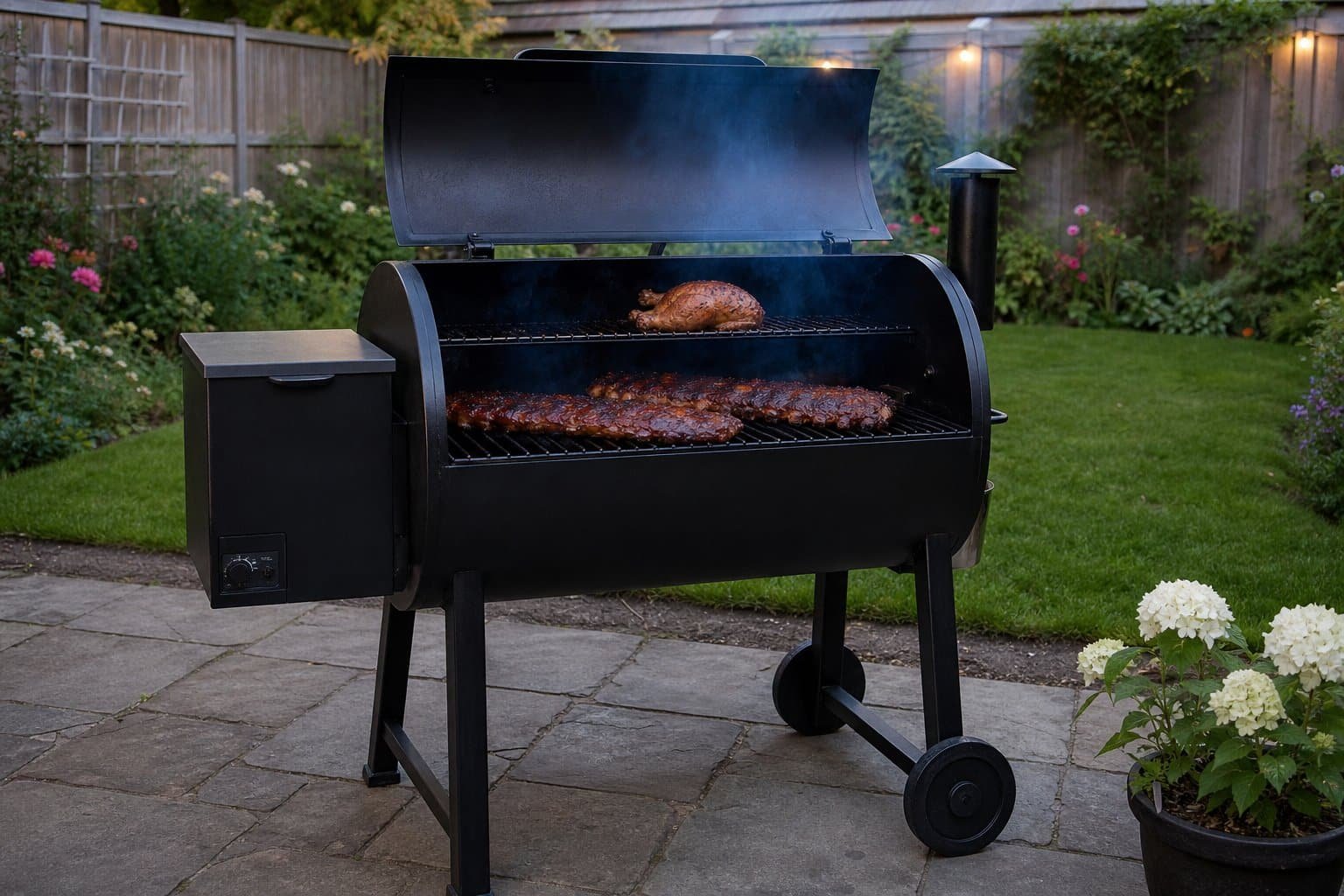
Best Pellet Grill and Smoker
The best pellet grill and smoker for most backyards is the Weber Searwood XL 600, which smokes low and slow and sears hot on the same grates. The Traeger Woodridge is the best Wi-Fi value, and the Pit Boss 700 Carbon Series is the best pellet smoker on a budget.
A pellet grill burns food-grade hardwood pellets and uses a fan and a digital controller to hold the temperature you set, a bit like an outdoor oven. That makes long smokes of brisket, ribs and pork butt far easier than on charcoal or an offset.
We compare six models sold on Amazon, from full-size backyard grills to portable tailgaters and a battery-powered camp grill, then explain how to choose, run and look after one.
- Full-size grills for the backyard, portables for tailgating and camping
- Direct-flame features matter if you want a real sear
- Plan on roughly 1 lb of pellets an hour for low and slow cooks
- Best overall: Weber Searwood XL 600 180 to 600°F range, DirectFlame searing and Wi-Fi control.
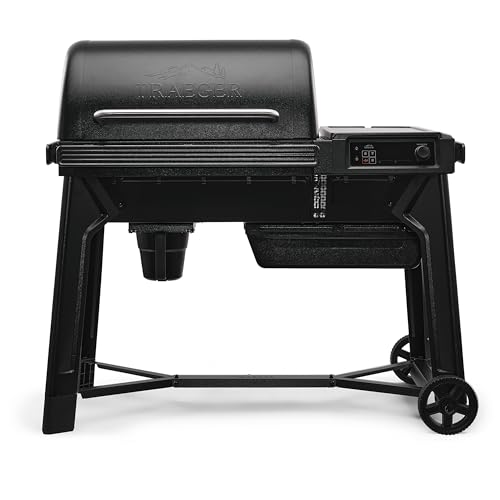
- Best Wi-Fi value: Traeger Woodridge 860 sq in, WiFIRE app control and a 10-year warranty.
- Best budget: Pit Boss 700 Carbon Series 718 sq in and a 13.5 lb hopper for about $325 when checked.
- Best for camping: Pit Boss 150 Battery Powered Cordless pellet grilling with a 1,000°F Flame Broiler.
Choosing the best pellet grill and smoker comes down to three things: how many people you cook for, whether you want to sear as well as smoke, and where you’ll plug it in. A pellet smoker gives you real wood flavor with the push-button control of an oven, so it suits beginners and seasoned pitmasters alike. Below are our six picks, from backyard workhorses to grills you can take tailgating and camping.
To find the best pellet grill and smoker for different budgets, we looked for grills from established brands whose listings state the specs that matter: temperature range, cooking area, hopper size and warranty. We also favored grills sold and shipped by Amazon, and we checked independent reviews for the weak spots listings don’t mention.




Best overall Searwood XL | Best Wi-Fi value Woodridge | Best budget 700 Carbon | Best for camping Pit Boss 150 | |
|---|---|---|---|---|
|
|
|
|
| |
| Type | Full-size | Full-size | Full-size | Battery tabletop |
| Temp range | 180–600°F | 180–500°F | 180–500°F | 180–500°F |
| Cooking area | 972 sq in | 860 sq in | 718 sq in | 256 sq in |
| Hopper | Not quoted | Not quoted | 13.5 lb | 7 lb |
| Searing | DirectFlame | Not quoted | Not quoted | Flame Broiler, 1,000°F |
| App control | Wi-Fi + Bluetooth | Wi-Fi | No | No |
| Warranty | 5-yr limited | 10-yr limited | 3 years | 5-yr limited |
| Check price | Check price | Check price | Check price |
Our best pellet grill and smoker reviews
Each review covers capacity, temperature control, searing, build and the small print on the listing. Where a listing didn’t give a figure, we say so rather than guess, so you can pick the best pellet grill and smoker for your backyard with confidence.
36-inch wood pellet smoker grill: 180 to 600°F range, DirectFlame cooking with a full-grate Sear Zone, Rapid React PID that heats to temperature in 15 minutes or less (Weber lab conditions), SmokeBoost setting at 180°F, Wi-Fi and Bluetooth with the Weber Connect app, 1 food probe, 972 sq in cooking area (Weber figure), 5-year limited warranty.
The Weber Searwood XL 600 is the best pellet grill and smoker here if you want one cooker for everything. Its 180 to 600°F range covers SmokeBoost smoking right up to steak-searing heat, and DirectFlame cooking skips the big sheet diffuser most pellet grills use, so the fire reaches the food across a full-grate Sear Zone. Most pellet grills struggle to brown food well, which makes this its biggest selling point.
Weber’s Rapid React PID controller is quoted to reach temperature in 15 minutes or less and recover quickly after you open the lid, and the Weber Connect app works over Wi-Fi and Bluetooth with the included food probe. Weber lists 972 sq in of cooking area for the XL, and the warranty is 5 years limited. A griddle insert and rotisserie are sold separately.
- Sears properly across the whole grate
- Wide 180 to 600°F range
- Fast-heating PID with Wi-Fi and Bluetooth
- Big 36-inch cook chamber
- Expensive
- Very heavy and large
- Only one probe included
Wi-Fi wood pellet grill and smoker: 180 to 500°F, Traeger App (WiFIRE) control, 860 sq in total cooking area (6 chickens, 8 rib racks or 6 pork butts), EZ-Clean Grease & Ash Keg, P.A.L. Pop-And-Lock accessory rail, ModiFIRE compatible, 10-year limited warranty.
The Traeger Woodridge is the best Wi-Fi pellet smoker for the money. It holds 180 to 500°F and you can set and watch it from anywhere in the Traeger App, which is ideal for overnight brisket. Traeger lists 860 sq in of space, enough for six chickens, eight rib racks or six pork butts, and the EZ-Clean keg catches ash and grease in one place.
Reviewers like it as a set-and-forget cooker but note its limits. Smoked BBQ Source counted weak smoke flavor and poor high-heat searing among the base model’s cons, so add a cast iron pan if you want crusty steaks. The 10-year limited warranty is the longest here, and it was discounted from $899.99 for Black Friday when we checked.
- Wi-Fi control from anywhere
- 860 sq in of space
- Ash and grease in one keg
- 10-year limited warranty
- Weak at high-heat searing
- Lighter smoke flavor than some
- Long assembly
Wood pellet grill and smoker: 718 sq in total cooking surface, 180 to 500°F with LCD digital controller, 13.5 lb hopper with cleanout, porcelain-coated steel grates, automatic start-up and cool-down, meat probe, bucket grease management, 3-year warranty.
The Pit Boss 700 Carbon Series is the best pellet grill and smoker on a budget. For about $325 when we checked, down from $449.99, you get 718 sq in of porcelain-coated grates, a 180 to 500°F LCD controller and a 13.5 lb hopper that Pit Boss says holds enough for a day-long cook. A cleanout lets you swap pellet flavors.
It starts and shuts down automatically, comes with a meat probe and catches drippings in a bucket. There’s no Wi-Fi and the listing doesn’t mention a Flame Broiler, so it’s a smoker and roaster first. The warranty is 3 years, shorter than the 5 years Pit Boss gives some other models.
- Lots of space for the price
- Big 13.5 lb hopper
- Automatic start-up and cool-down
- Meat probe included
- No Wi-Fi
- No direct-flame searing quoted
- 3-year warranty
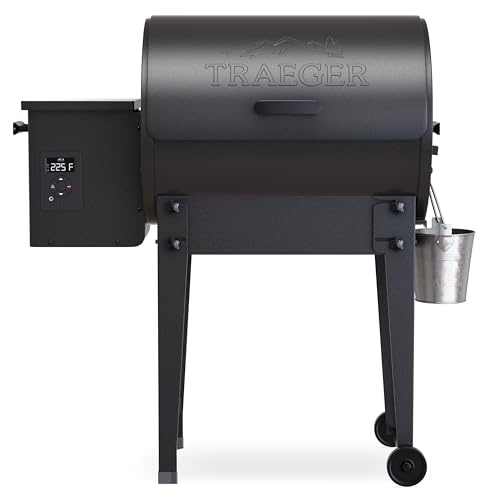
Portable wood pellet grill and smoker: Digital Arc Controller from 180 to 450°F (within 15°F of set point), 300 sq in cooking space (12 burgers, 3 rib racks or 2 chickens), folding legs, 8 lb hopper, porcelain-coated grates, 120V AC power, 3-year warranty.
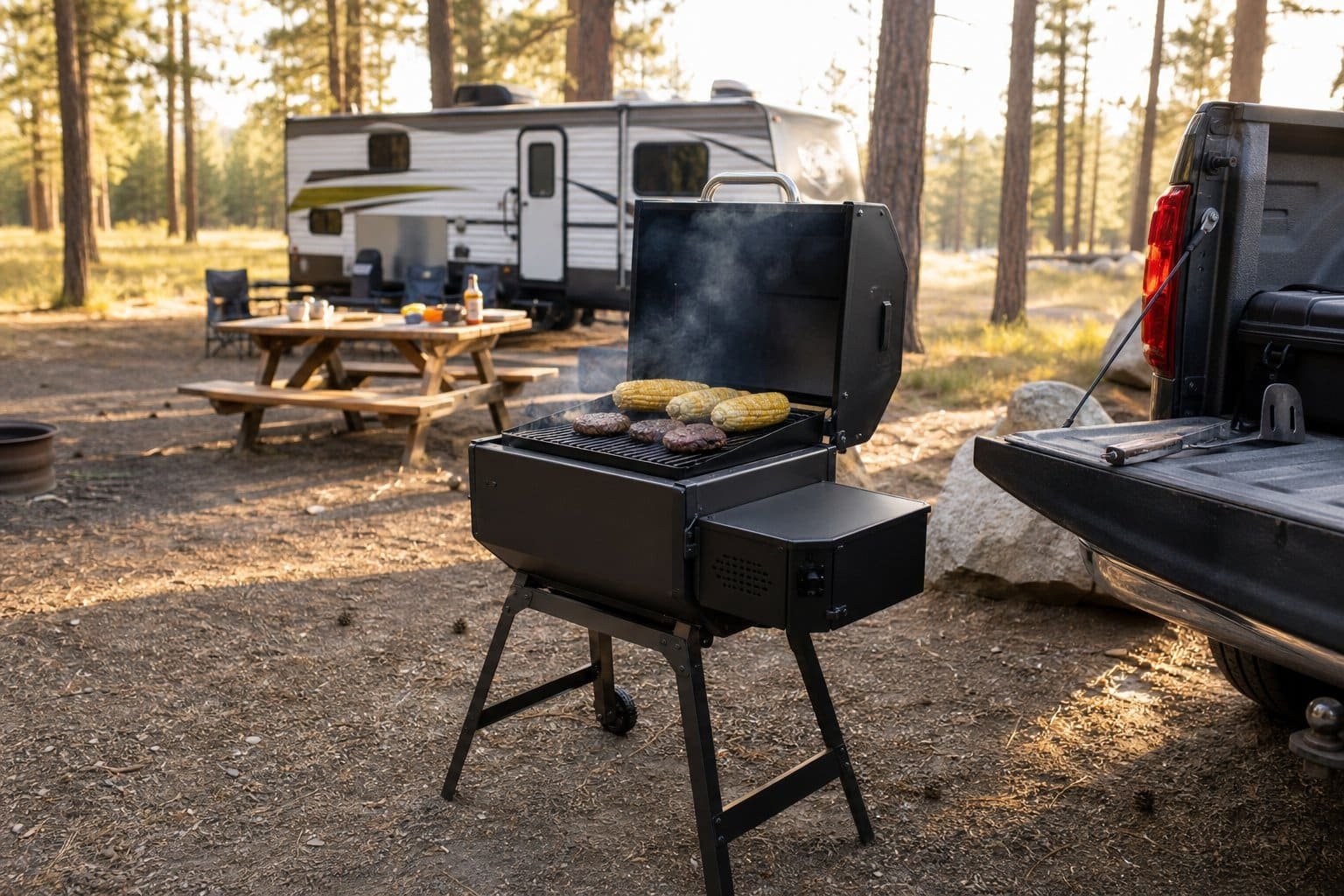
The Traeger Tailgater is the classic portable pellet smoker for tailgates, campgrounds and small patios. Its legs fold so it slides into a truck bed or SUV, and 300 sq in of grate fits 12 burgers, three racks of ribs or two whole chickens. The Digital Arc Controller runs from 180 to 450°F and Traeger says it holds within 15°F of your setting.
The 8 lb hopper is enough for a long afternoon, and the porcelain grates are easy to clean. It needs a 120V outlet, so plan on campground hookups, a generator or a suitable power station. There’s no Wi-Fi, and the top temperature limits searing, but it’s simple and proven. The warranty is 3 years.
- Folding legs for transport
- Holds temperature well
- Fits ribs and whole chickens
- Simple controller
- Needs 120V power
- No Wi-Fi
- 450°F top end limits searing
Battery-powered tabletop wood pellet grill and smoker: 256 sq in on 2 porcelain-coated grates (about 13 burgers), 180 to 500°F digital control, Flame Broiler for direct-flame searing up to 1,000°F, 7 lb hopper, DC12V 71W with 110–120V adapter, carry handles and latches, cover included, 26.3 x 18.1 x 15 in, 46.7 lb, 5-year limited warranty.
The Pit Boss 150 is the pellet smoker we’d take camping. It runs on a 12V battery, so it works at primitive sites and trailheads with no outlet, and an adapter lets you plug into 110 to 120V power when it’s available. Retailers including Camping World quote up to 15 hours of run time on one charge, and Pit Boss’s warranty covers the battery for up to a year.
The listing gives 256 sq in across two grates, a 180 to 500°F range and a Flame Broiler for direct-flame searing up to 1,000°F, which is rare on a portable. It weighs 46.7 lb and has side handles, latches and an included cover. The 7 lb hopper suits a day of cooking.
- Runs without an outlet
- Flame Broiler for searing
- Handles, latches and cover
- 5-year limited warranty
- 46.7 lb is heavy to carry far
- Small cooking area
- Battery warranty is shorter
Electric outdoor grill and smoker: 1,760W electric heat with real wood pellet smoke, grill, bake, roast and smoke functions, 141 sq in nonstick grate (6 steaks, 30 hot dogs or a 9 lb brisket), uses about 1/2 cup of pellets, weather resistant, no open flame or flammable fuel, 1-year warranty.
The Ninja Woodfire OG301 isn’t a classic auger-fed pellet grill: electric elements do the cooking and a small amount of wood pellets burns for smoke flavor. Ninja says half a cup is enough for a cook. Because there’s no open flame or flammable fuel, it suits apartment balconies and small patios where a full pellet smoker won’t fit or isn’t allowed.
The listing quotes 1,760W, a 141 sq in nonstick grate and room for six steaks, 30 hot dogs or a 9 lb brisket. It grills, bakes, roasts and smokes, and it’s built for outdoor use year-round, though Ninja recommends its cover. The warranty is 1 year, and the smoke flavor is lighter than from a full-size pellet grill.
- No open flame or propane
- Small footprint
- Uses very few pellets
- Good value on sale
- Not a true pellet grill
- Small cooking area
- 1-year warranty
What is a pellet grill and smoker?
A pellet grill and smoker is an outdoor cooker that burns small pellets of compressed hardwood. You pour the pellets into a hopper on the side, set a temperature, and the grill does the rest. An electric auger, a screw inside a tube, carries pellets into a small fire pot under the cooking chamber.
When you switch on, a hot rod glows red for a few minutes to light the first pellets, and a fan blows air across the fire pot to get them burning. Once the fire is going the hot rod turns off. The fan then pushes heat and smoke around the cook chamber, so the food cooks by convection, much like in a convection oven.
On the best pellet grill and smoker models, a temperature probe inside the grill reports back to the controller. If the grill is too cool, the controller feeds more pellets; if it’s too hot, it slows the auger and the fan. Better grills use a PID controller, which learns how fast to feed pellets and holds the set temperature more tightly. That steady heat is why a pellet smoker is so good at long, slow cooks.
Pellet grill vs pellet smoker: is there a difference?
In practice, no. Most brands sell the same machine as a pellet grill, a pellet smoker or a wood-fired grill, and the best pellet grill and smoker does both jobs well. The real difference is in the design: how hot it can get and how well it puts flame on the food.
The best pellet grill and smoker models are all excellent at low temperatures, from about 180 to 250°F, where the pellets smolder and produce the most smoke. Grilling and searing are harder, because the fire sits under a heat deflector. That’s why Weber’s DirectFlame system and the Pit Boss Flame Broiler matter: both let flames reach the grate, so a steak gets a crust instead of a gray finish.
Types of pellet grill and smoker
Full-size backyard grills
These are the classic shape: a steel cook chamber on legs or a cart, a hopper on the side and a chimney or vents at the back. The Weber Searwood XL, Traeger Woodridge and Pit Boss 700 Carbon are full-size. They have the most cooking space, the biggest hoppers and the widest temperature range, so they’re the best pellet grill and smoker choice for a permanent spot on the deck or patio. They’re heavy and stay put.
Portable and tabletop pellet grills
Portables such as the Traeger Tailgater and Pit Boss 150 work the same way, with a smaller hopper, auger and controller, but they fold or sit on a table. They’re ideal for tailgating, RV trips, campgrounds and small patios. The trade-offs are a smaller cooking area, a hopper that needs topping up on long cooks and less stable temperatures in wind.
Electric grills that burn pellets for smoke
The Ninja Woodfire is a different idea. Electric elements do the cooking, and a little wood pellet fuel burns purely for smoke flavor. You don’t get the deep bark of a 12-hour brisket on a big smoker, but you do get genuine wood smoke with almost no learning curve, and there’s no open flame or propane tank, which matters on many apartment balconies.
How to choose the best pellet grill and smoker
Once you know which type suits your space, compare these features to find the best pellet grill and smoker for you. They make far more difference to how you’ll get on with a pellet smoker than the number of cooking modes on the box.
Cooking area and capacity
Brands give cooking area in square inches, often including upper racks, plus a burger or rib-rack count. For a couple or small family, 450 to 600 sq in is plenty, and the best pellet grill and smoker for you may well be a mid-size one. For regular parties, look at 700 sq in or more, like the Pit Boss 700 Carbon at 718 sq in or the Traeger Woodridge at 860 sq in. Upper racks run cooler, so the main grate is what counts for brisket.
Temperature range and searing
Nearly every pellet smoker runs from 180 to 450 or 500°F, which covers smoking, roasting and baking. If you want steaks and burgers with real char, the best pellet grill and smoker for you needs a top end near 600°F or a direct-flame feature. The Searwood XL reaches 600°F across the whole grate, and the Pit Boss 150’s Flame Broiler claims up to 1,000°F over the fire pot. A cast iron skillet for camping on the grate is a cheap way to sear on any model.
Controller, probes and app control
A PID controller is worth having on any pellet smoker, because it holds temperature more tightly in wind and cold. Meat probes plugged into the controller show the food temperature on the display, so you don’t need to lift the lid. Wi-Fi control, as on the Searwood XL and Woodridge, lets you watch an overnight cook from bed and get an alert when it’s done.
Hopper size and pellet use
According to Broil King, a pellet grill burns about 1 lb of pellets an hour when smoking low and slow and roughly 3.4 to 4 lb an hour on high. A 13.5 lb hopper like the Pit Boss 700’s can run a long smoke without a refill, while a portable’s 7 or 8 lb hopper may need topping up on an all-day cook. A hopper cleanout lets you empty pellets to change flavors or store the grill dry.
Build, weight and warranty
The best pellet grill and smoker for cold winters has thick steel, which holds heat better, and a good powder coat or porcelain finish to resist rust. Check the weight against your deck and steps, and whether there are wheels. Warranties vary a lot: Weber gives the Searwood XL 5 years limited, Traeger quotes 10 years on the Woodridge, and the Pit Boss 700 Carbon and Tailgater get 3 years.
Power and outlets
Even the best pellet grill and smoker needs power: every auger-fed pellet grill needs electricity for the hot rod, auger, fan and controller. Full-size and Tailgater models plug into a standard 120V outlet, so place the grill near a weatherproof GFCI outlet and use a heavy-duty outdoor extension cord rated for the load if you need one. The hot rod draws the most power during start-up. The Pit Boss 150 is the exception here, because it runs on its own 12V battery.
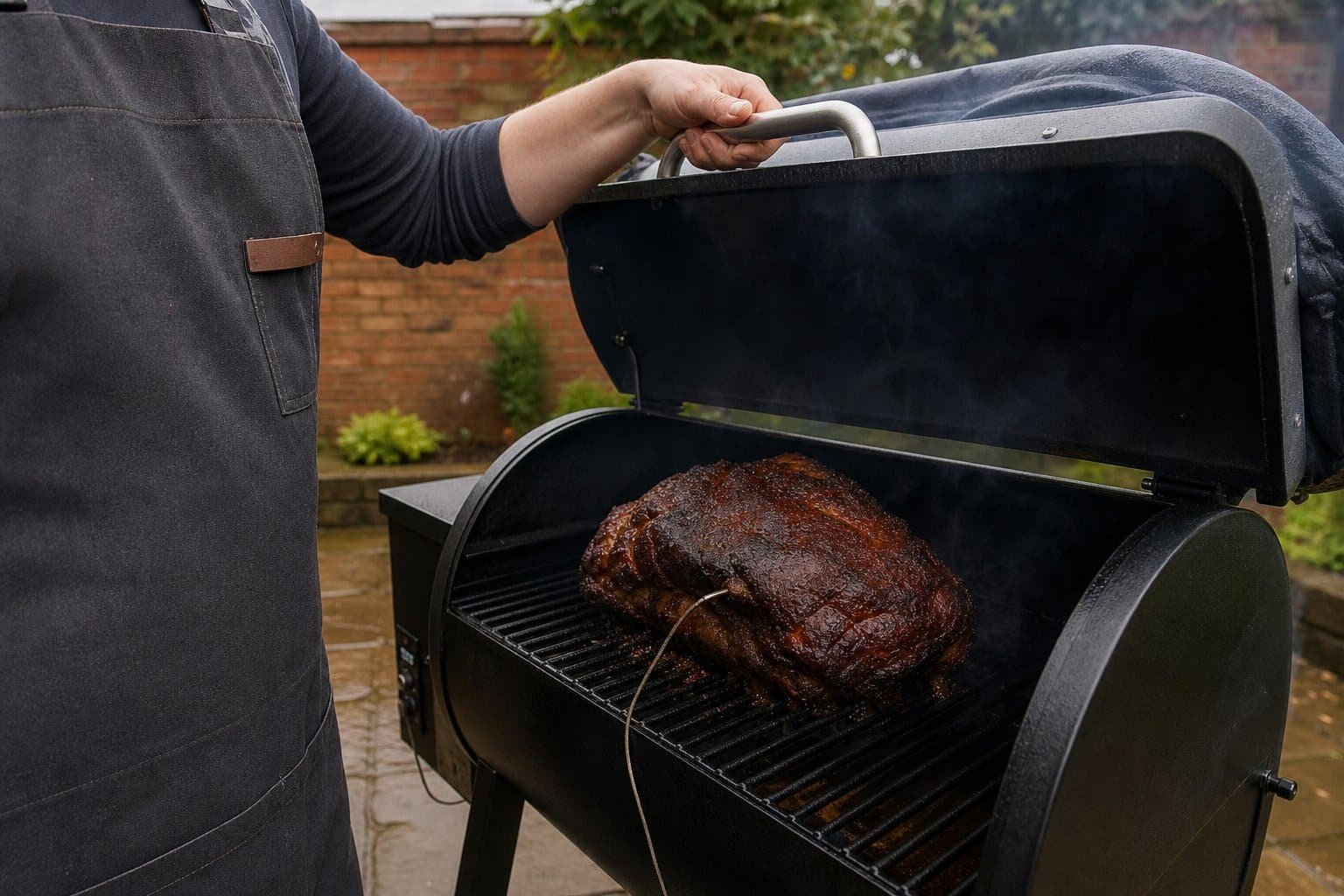
Using a pellet smoker for tailgating, RV trips and camping
For tailgating and camping, the best pellet grill and smoker is a portable one, as full-size grills are too heavy to move. At a campground with electric hookups, plug the Tailgater into the pedestal or your RV’s outdoor outlet. At a primitive site, you’ll need a generator, a suitable power station or a battery grill like the Pit Boss 150. Our guide on how to power devices while camping explains generators and power stations in more detail.
Camping World reviewed the Pit Boss 150 from the road and highlights its battery and plug-in adapter, which make it handy in an RV: run it on hookup power when you have it and on the battery when you don’t. Keep any grill well away from tents, awnings and RV slide-outs, and never cook inside a camper or tent.
Check campground and stadium rules before you go. Many campgrounds allow pellet grills on a fire ring pad or picnic table, but fire restrictions can apply in dry seasons. If you want a cheaper camping option without power, look at our portable barbecue buying guide and our guide to the best camping fire pits.
Running costs: pellets and power
Pellets are the main running cost of any pellet smoker. When we checked Amazon, an 18 lb bag of Traeger Signature Blend was $19.99 and a 40 lb bag of Pit Boss Competition Blend was $25.50, so pellets cost roughly $0.65 to $1.10 a pound. At about 1 lb an hour, a 12-hour brisket uses around 12 lb, or roughly $8 to $13 of pellets. A hot grilling session burns more per hour but runs for far less time.
The Ninja Woodfire uses only about half a cup of pellets per cook but relies on 1,760W of electricity for all the heat. Whichever pellet smoker you choose, buy pellets in larger bags and keep them dry, because damp pellets swell, crumble and jam the auger.
Choosing pellets for your pellet smoker
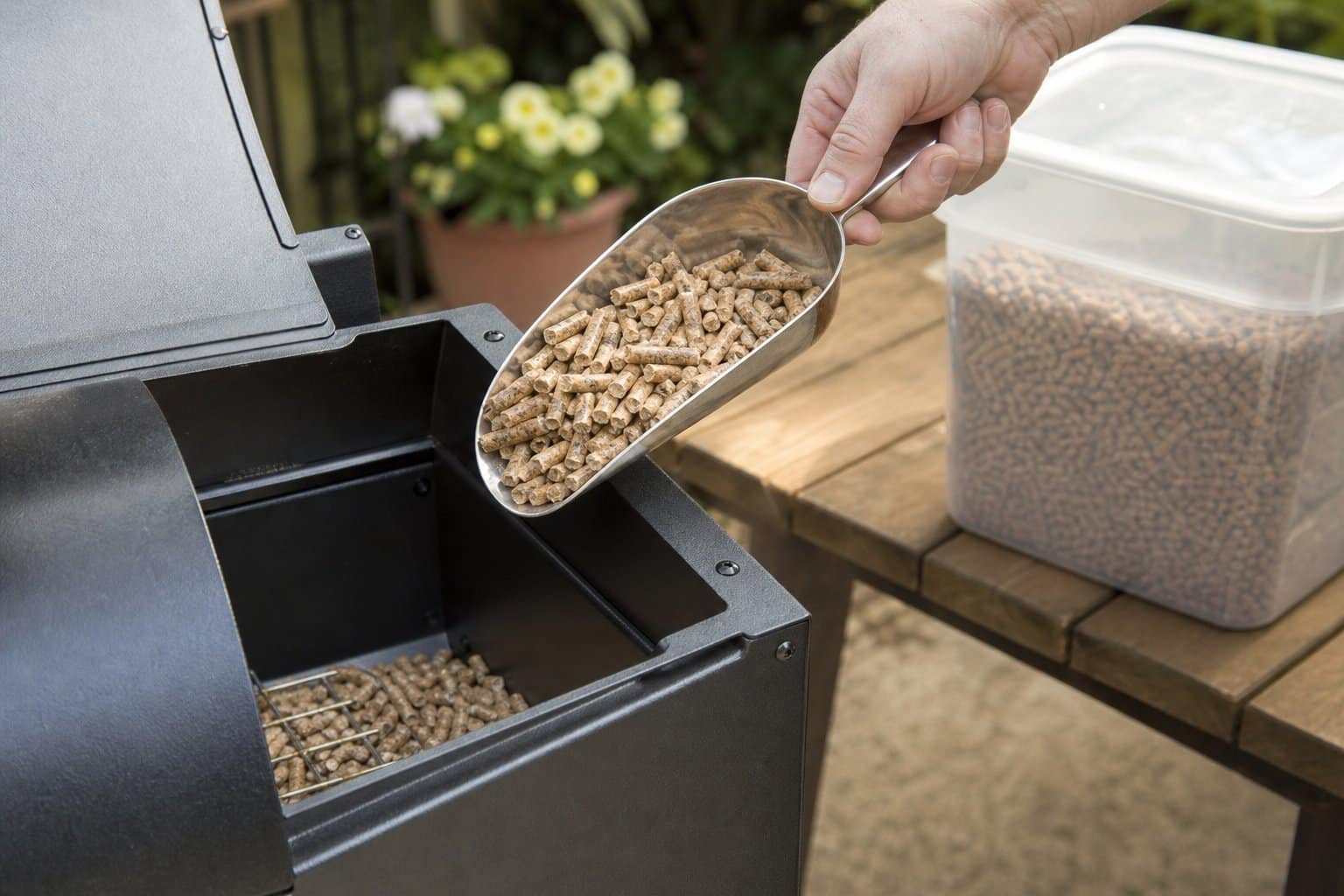
The best pellet grill and smoker only tastes as good as its fuel, so only use pellets made for cooking. Heating pellets for stoves aren’t made for food. Most cooking pellets use a hardwood base flavored with oak, hickory, cherry, apple, pecan or mesquite. Fruitwoods such as apple and cherry suit pork, chicken and fish, while hickory and mesquite are stronger and suit beef. Blends are a good place to start.
Ninja Woodfire grills are designed around Ninja’s own Woodfire pellets. Standard pellet grills burn any good food-grade pellet, though some brands recommend their own, so check the manual. Store pellets in a sealed bucket in a dry garage or shed, and don’t leave them in the hopper through a humid summer or wet winter.
Your first cook: burn-in and seasoning
Even the best pellet grill and smoker needs a burn-in before its first cook. Fill the hopper, follow the manual to prime the auger, and run the grill hot for the time the manufacturer says, usually around 30 to 45 minutes. This burns off oils and residue from the factory and lets you check that the hot rod, auger and fan all work.
For your first real cook on a pellet smoker, choose something forgiving such as a whole chicken, pork butt or sausages. Keep the lid shut as much as possible, because every peek lets heat and smoke escape and makes the controller work harder. Once you’re confident, move on to ribs and brisket. Our easy camping meals have simple ideas that work on a pellet smoker too.
Pellet smoker safety and food safety
Place the grill on a flat, stable surface well away from siding, fences, deck railings and overhanging branches. Keep kids and pets clear of the cook chamber and chimney, which get very hot. Let ash cool completely before you empty it into a metal container, and never use a pellet grill in a garage or enclosed porch.
Low and slow cooking on a pellet smoker still has to cook food safely. The USDA safe minimum internal temperature chart lists 145°F with a 3-minute rest for beef, pork, veal and lamb steaks, chops and roasts, 160°F for ground meats and 165°F for all poultry. A meat probe takes the guesswork out. Keep raw and cooked meat apart, chill leftovers within two hours, and see how to store food while camping for tips on keeping food cold outdoors.
Cleaning and care through the seasons
Looking after the best pellet grill and smoker is simple. Ash builds up in the fire pot after every few cooks, and too much of it can stop the pellets lighting or smother the fire. Vacuum the fire pot and cook chamber with a shop vac once everything is cold, scrape the grates, and replace drip tray liners regularly. A grease fire is the most common pellet grill accident, so empty the grease bucket often.
Rain and humidity are the biggest enemy of a pellet smoker. Water in the hopper turns pellets to mush and can jam the auger, so use a fitted cover and empty the hopper if the grill will sit unused for weeks. Before winter, run the grill hot for half an hour to dry it out, clean out the ash and grease, then store it covered. Check the hot rod and fan each spring.
Common pellet smoker problems and fixes
The grill won’t light. Even the best pellet grill and smoker can fail to light. The fire pot may be full of ash or the auger empty. Clean the fire pot, prime the auger as the manual describes and try again. If the hot rod doesn’t glow, it may need replacing.
Temperature swings. Wind, cold and lifting the lid all cause swings of a few degrees. Shelter the grill from wind, keep the lid closed and consider an insulated blanket in winter. Large, constant swings can mean damp pellets or a dirty temperature probe.
Not enough smoke flavor. A pellet smoker makes most smoke below about 250°F. Start the cook low, use a stronger wood such as hickory or mesquite, add a smoke tube, or use a smoke setting such as Weber’s SmokeBoost.
Auger jams. Damp or crumbly pellets are the usual cause. Empty the hopper, clear the auger following the manual and use fresh, dry pellets. Store pellets indoors in a sealed tub.
Black, bitter smoke. This usually means too much ash, a grease build-up or poor-quality pellets. Clean the grill thoroughly and switch to a better brand.
Which best pellet grill and smoker suits you?
If you want one grill to smoke, roast and sear with app control, the Weber Searwood XL 600 is the best pellet grill and smoker we found. If you want Wi-Fi for less, the Traeger Woodridge has the space and the longest warranty here. On a budget, the Pit Boss 700 Carbon Series gives you a full-size pellet smoker and a big hopper for a low price.
For tailgating and hookup camping, the Traeger Tailgater is the proven portable. For camping without power, the Pit Boss 150 Battery Powered grill is the one to buy. If you live in an apartment or have a tiny patio, the Ninja Woodfire OG301 is the easiest way to get real wood smoke without a full pellet grill.
Final thoughts on the best pellet grill and smoker
The best pellet grill and smoker is the one that fits your space, your power supply and the way you like to cook. Check the warranty, the hopper size and how hot it really gets, and budget for a cover and a few bags of food-grade pellets. Get those right and a pellet smoker will give you smoky ribs, juicy chicken and tender brisket with very little effort. For more outdoor cooking ideas, see our portable barbecue buying guide and our list of camping kitchen essentials.
Pellet grill myths
Many can’t sear well, but direct-flame designs such as Weber DirectFlame and the Pit Boss Flame Broiler put flames on the food.
Use pellets sold for cooking. Heating pellets for stoves aren’t made for food.
The auger, fan and controller all need power: an outlet, a generator, a power station or a built-in battery like the Pit Boss 150’s.
What to look for in a pellet grill and smoker
450 to 600 sq in for families; 700+ for parties.
Look for direct-flame access or a top end near 600°F.
PID control and meat probes; Wi-Fi is a bonus.
13 lb or more for overnight cooks without refills.
120V outlet for most; battery models for off-grid camping.
Ranges from 1 year to Traeger’s 10 years here.
How to start a new pellet grill
- Pick a safe spot
Flat, stable ground away from siding, fences and branches, near a GFCI outdoor outlet.
- Fill and prime
Fill the hopper with food-grade pellets and prime the auger as the manual says.
- Burn it in
Run the grill hot for the time the maker states, often 30 to 45 minutes, with the lid closed.
- Set the temperature
Choose a low setting for smoke or high heat for grilling and let it stabilize.
- Cook with a probe
Insert the meat probe, keep the lid shut and cook to a safe internal temperature.
How we chose these pellet grills
We have not tested every grill in this list ourselves. Our picks are based on the Amazon listings, manufacturer information from Weber, Traeger, Pit Boss and Ninja, and published reviews from Smoked BBQ Source, Engadget, GearJunkie and Camping World. Where a listing didn’t state a spec, we said so rather than guessing. Prices change often, so check the current price.
-
Clear specs
We favored listings that state temperature range, cooking area and warranty.
-
Real-world feedback
We weighed independent reviews for searing, smoke flavor and reliability.
-
A mix of types
Full-size, portable, battery and electric models across a range of budgets.
What is the best pellet grill and smoker?
For most backyards, the Weber Searwood XL 600. The Traeger Woodridge is the best Wi-Fi value and the Pit Boss 700 Carbon Series is the best budget pick.
Is a pellet smoker worth it?
If you like slow-cooked, smoky food and don’t want to babysit charcoal, yes. It holds temperature on its own, so long cooks are much easier.
Can pellet grills sear steaks?
Some can. Look for direct-flame features like Weber DirectFlame or the Pit Boss Flame Broiler, or use a cast iron pan on the grate.
Do pellet grills need electricity?
Yes. Most plug into a 120V outlet. The Pit Boss 150 runs on its own rechargeable battery for camping.
How many pellets does a pellet smoker use?
About 1 lb an hour for low and slow smoking and roughly 3 to 4 lb an hour on high, depending on the weather.
Can I take a pellet smoker camping?
Yes. The Traeger Tailgater works with hookups or a generator, and the Pit Boss 150 runs on battery at sites with no power.
More outdoor cooking guides
Cooking away from home? Read our portable barbecue buying guide, learn how to power devices while camping and check our guide to solar power systems for campers. Planning meals for the trip? Our easy camping meals and camping kitchen essentials help you pack the right gear.
Which pellet grill and smoker should you buy?
- Best overall: Weber Searwood XL 600 Pellet Smoker Grill
- Best Wi-Fi value: Traeger Woodridge Wood Pellet Grill & Smoker
- Best budget: Pit Boss 700 Carbon Series Wood Pellet Grill
- Best portable: Traeger Tailgater Portable Wood Pellet Grill & Smoker
- Best for camping: Pit Boss 150 Battery Powered Wood Pellet Grill
- Best for small spaces: Ninja Woodfire Outdoor Grill & Smoker OG301
Choose the Weber Searwood XL 600 if you want the most versatile pellet grill and smoker, and the Traeger Woodridge for Wi-Fi control at a lower price. The Pit Boss 700 Carbon Series is the best budget pick, the Traeger Tailgater is the best portable, the Pit Boss 150 is the best for off-grid camping, and the Ninja Woodfire OG301 suits small spaces.
CampEquipmentPlus relies on reader support. Purchases made via links on our website may earn us an affiliate commission at no extra cost to you, helping keep the site running.