
Best Double Burner Camping Stoves UK
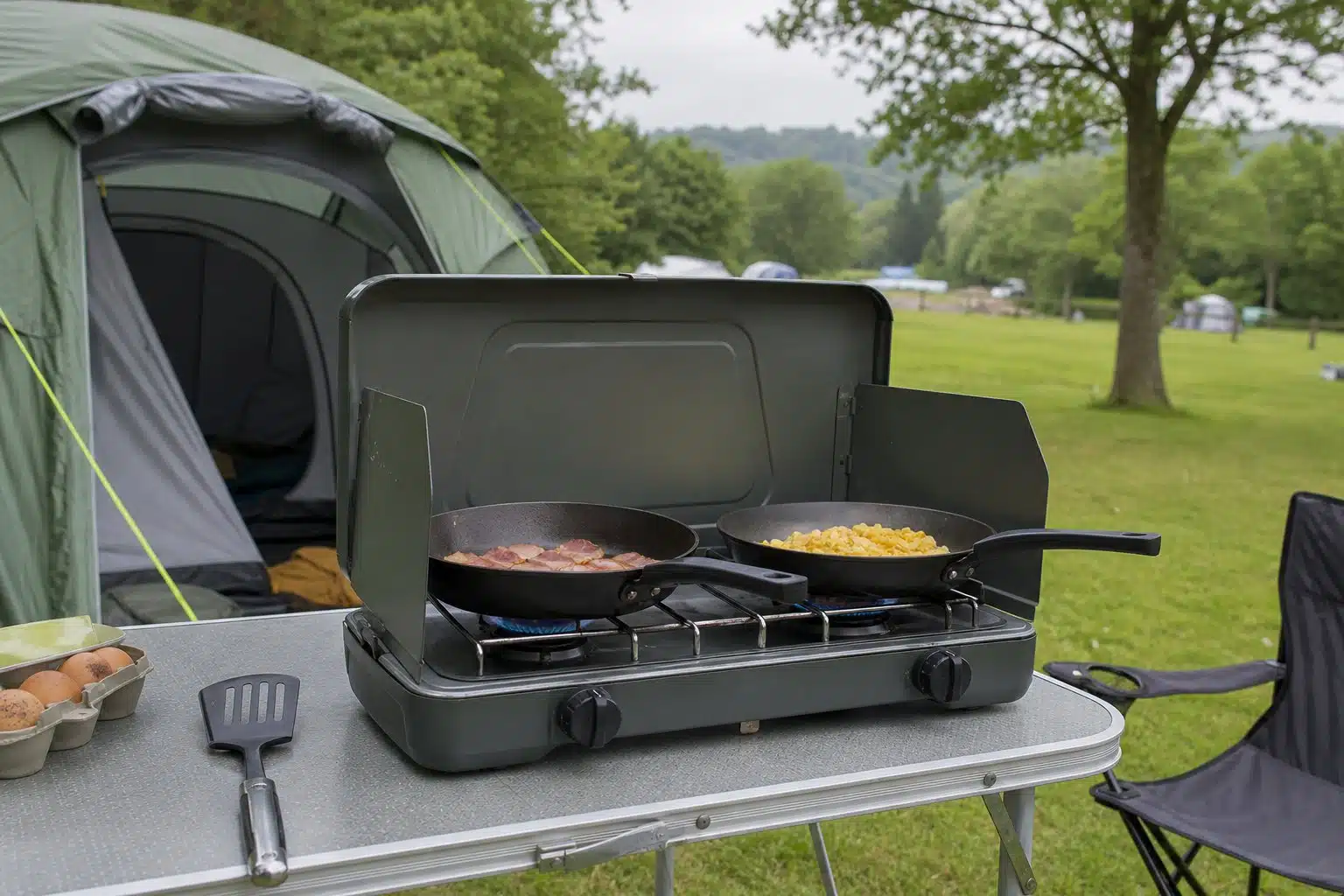
The best double burner camping stoves in the UK let you boil the kettle and fry breakfast at the same time, hold a steady flame when the wind picks up, simmer without scorching, and fit two full-size pans without wobbling.
A single-burner stove is fine for a brew, but family camping means pasta and sauce, eggs and beans, or tea while the bacon cooks. Campers’ most common complaints about twin-burner stoves are flames blown out or weakened by wind, burners that will not turn down low, wobbly pan supports, pans that are too big to sit side by side and gas that runs out sooner than expected. We have chosen five two-burner stoves that tackle those problems in different ways: a powerful all-rounder, a precise simmerer, an easy beginner’s stove, an ultra-compact folding model and a budget pick. We also explain the gas fittings UK campers need to know about, because these stoves are designed for propane.
- Look for at least two independent burners with good low-flame control
- A tall windscreen matters more than headline BTU
- Check the gas type and fittings work with the cylinders you can buy in the UK
- Power 10,000 BTU per burner (about 2.9 kW) is plenty for most families. 20,000 BTU burners boil big pans much faster.
- Wind protection Wind is the number one stove complaint. Tall three-sided windscreens beat low side guards.
- Simmer control Good knobs let you cook eggs and sauces gently, which matters more than raw power for many campers.
- Gas and fittings All five run on propane. Propane works below about 4C, where butane struggles, but check the fittings for UK cylinders.
Shopping for double burner camping stoves UK campers can rely on starts with a simple question: what will you actually cook? A two-burner stove lets you boil the kettle while breakfast fries, but the right one depends on wind protection, simmer control, pan space, the gas you can buy near home and how much room is left in the car. This guide explains those trade-offs before you compare the five picks below.


Best overall Everest 2X | Best simmer control Cascade 222 | Best for beginners Triton+ | Most compact Genesis | Best budget Kodiak | |
|---|---|---|---|---|---|
|
|
|
|
|
| |
| Total output | 40,000 BTU | 22,000 BTU | 22,000 BTU | 10,000 BTU | 20,000 BTU |
| Per burner | 20,000 BTU | Not quoted | Not quoted | Not quoted | 10,000 BTU |
| Ignition | Matchless | Rotary, matchless | Push-button | Not quoted | Matchless |
| Pan space | 215 sq in | 12 in + 10 in | 12 in + 10 in | Jetboil pans | Not quoted |
| Wind shield | 3-sided screen | Side guards | Side guards | Clip-on screen | Lid screen |
| Weight | 5.4–6.3 kg (tests) | Not quoted | Not quoted | 2.8 kg | Not quoted |
| Size closed | 64 x 32 x 14 cm | Not quoted | 57 x 35 x 14.5 cm | Folds in half | Not quoted |
| Fuel (as sold) | Propane | Propane | Propane | Propane | Propane |
| Warranty | 1 year | 3 years | 3 years | 1 year | Not quoted |
| Check price | Check price | Check price | Check price | Check price |
Best double burner camping stoves: our detailed reviews
Each review covers burner power, simmer control, wind protection, pan space, size and warranty, plus the complaints campers raise most. If you are still deciding between stove types, start with our guide to choosing a camping stove.
Two 20,000 BTU burners, a 215 sq in cooktop and a tall three-sided windscreen
The Everest 2X is the stove we would pick if you regularly cook proper meals for a family. Its two cast-aluminium burners are rated at 20,000 BTU each (around 5.9 kW per burner, so roughly double a typical UK butane twin), and the 215 sq in cooking area takes two full-size pans side by side. Camp Chef lists the overall size as 25.2 x 12.7 x 5.6 inches (about 64 x 32 x 14 cm).
Power is only half the story. In OutdoorGearLab’s testing it boiled a litre of water in about 3 minutes 25 seconds in still air and only 20 seconds slower with a fan blowing at it, thanks to its tall, nearly seamless three-sided windscreen and recessed burners. Reviewers at OutdoorGearLab and Switchback Travel also praised its low-end control for eggs and pancakes. The trade-offs are bulk and weight (reviewers weighed it at 12 to 14 lb, about 5.4 to 6.3 kg), a price at the top of this list, and some reports of loose knobs and a regulator that rattles in transit. Note that an older Everest model (MSHP) was recalled in 2020 over its regulator; the MSHPX version listed here is the current model.
- Most powerful stove in this guide
- Excellent wind protection
- Simmers well despite the power
- Large cooktop fits two big pans
- Drip tray and carry handle
- Heavy and bulky, about 5.4 to 6.3 kg
- Dearest propane stove here
- Knobs and latches feel less robust
22,000 BTU twin burners with improved simmer knobs and a three-year warranty
The most common complaint about camping stoves is not lack of power but the opposite: burners that go from roaring to off with nothing in between, scorching porridge and sauces. Coleman says the Cascade 222 has improved knob rotation specifically for precise temperature and simmer control, and the two burners share 22,000 BTU (about 6.4 kW in total), which is plenty for a family breakfast.
The cooktop takes a 12-inch and a 10-inch pan at the same time, the chrome-plated pan support lifts out for cleaning and rotary ignition lights it without matches. There is a recessed carry handle and a space to store the regulator inside, plus a heavy-duty latch. Coleman also sells a cast-iron grill and griddle accessory that drops onto the burners, which turns it into a breakfast plancha. The weak points are the low side wind guards, which give only moderate protection compared with the Everest’s tall windscreen, and burn time: Coleman quotes up to an hour on high from one 16 oz propane cylinder. Coleman backs it with a three-year limited warranty; the listing does not quote its weight or folded size.
- Precise simmer control
- Takes 12 in and 10 in pans together
- Optional cast-iron grill and griddle
- Regulator stores inside
- Three-year warranty
- Wind guards are fairly low
- Weight and size not quoted
- One hour on high per 1 lb cylinder
Simple, push-button 22,000 BTU stove with PerfectHeat burners and a three-year warranty
If you are new to camp cooking and want something that just works, the Triton+ is the stove we would point you to. Coleman’s push-button InstaStart ignition means no matches or lighters, and the two independently adjustable burners use its PerfectFlow and PerfectHeat technology, designed to keep the flame steady as the cylinder empties and the weather cools.
It shares the Cascade’s 22,000 BTU total output and fits a 12-inch and a 10-inch pan side by side, and the chrome-plated grate lifts out so you can wipe the aluminised steel cooktop clean. Coleman lists the size as 13.7 x 5.7 x 22.6 inches, which is roughly 57 x 35 x 14.5 cm closed, and a heavy-duty latch keeps it shut in the car. As with most stoves of this type the side wind guards help but do not replace a windbreak, and the listing quotes burn time of about an hour on high from one 16 oz cylinder. The three-year limited warranty is longer than most rivals here.
- Push-button ignition
- Steady flame as the gas cools
- Fits two family-size pans
- Easy-clean removable grate
- Three-year warranty
- Weight not quoted
- Wind guards only moderate
- Less precise simmer than Cascade 222
Folding 2.8 kg twin-burner stove that links to other Jetboil burners
Most two-burner stoves are suitcase-sized slabs. The Genesis folds in half on a hinge and, according to the listing, weighs 6.2 lb (about 2.8 kg), less than half of the Everest 2X. It comes with a carry bag that has a pocket for the regulator and an attachable windscreen, and it can be linked to other JetLink-compatible Jetboil stoves or a Luna satellite burner if you want a bigger outdoor range.
Jetboil quotes 10,000 BTU in total and says it boils water in just over three minutes with its own pans; UKClimbing’s reviewer found the flame could be turned down to low levels and called the stove extremely well made. The catches are cost and cookware. It is designed around Jetboil’s own frypan and FluxRing pots, total output is the lowest here, and the full Basecamp cooking system with pans costs a lot more than this stove on its own. If space is tight, though, nothing else here packs as small.
- Very compact folding design
- Only about 2.8 kg
- Fine flame control
- Windscreen and carry bag included
- Can link to extra Jetboil burners
- Lowest output, 10,000 BTU total
- Expensive
- Best with Jetboil’s own pans

Two 10,000 BTU stainless burners, lid windscreen and drip tray at a lower price
The Kodiak is a newer, simpler member of Camp Chef’s Mountain Series. Its two stainless-steel burners are rated at 10,000 BTU each (about 2.9 kW per burner), which Camp Chef says is more than a standard home hob, and that is plenty for boiling pasta water and frying sausages for a small family.
It keeps the features that matter most outdoors: a folding lid with a built-in windscreen, matchless ignition, an integrated carry handle and a stainless-steel drip tray that lifts out for cleaning, one of the details UK retailers suggest checking because fat and spills are hard to clean off a cooktop on site. The listing does not quote its weight, size, pan capacity or warranty, so check those on the product page before you buy, and with half the Everest’s output it will be slower to boil big pans.
- Lower price than most here
- Lid doubles as a windscreen
- Stainless burners and drip tray
- Matchless ignition
- Grab-and-go carry handle
- Half the Everest’s power
- Weight and size not quoted
- Warranty not stated on listing
Double burner camping stoves and UK gas: what you need to know
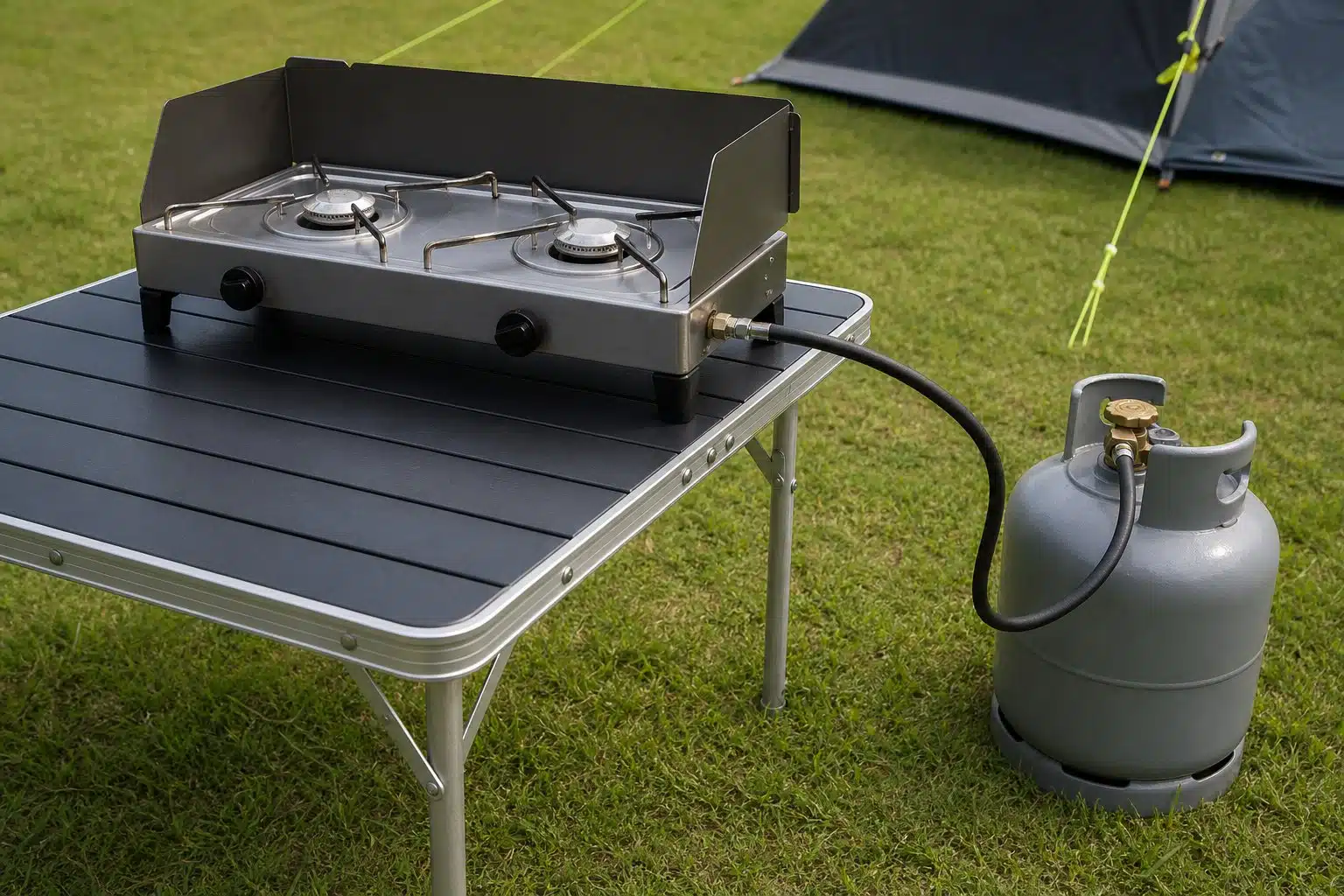
All five stoves in this guide are designed for propane, and are supplied with a regulator for the small 1 lb (16.4 oz) disposable propane cylinders that are common in North America but much harder to find in UK camping shops. In the UK most twin-burner camping cookers run on butane cartridges or Campingaz cylinders, and larger refillable propane bottles are sold for patio heaters and barbecues. The Camping and Caravanning Club’s gas guide for tent campers explains why propane is worth having: it can be used all year round, whereas liquid butane struggles to turn to gas below about 4C, which is common on spring and autumn mornings in the UK. It also notes that butane appliances usually need a 28 mbar regulator and propane 30 or 37 mbar, that large propane cylinders use a left-hand thread, and that hoses should be replaced at least every five years.
In practice that means checking, before you buy, which cylinder you will use and whether a suitable adaptor hose is made by the stove manufacturer or a reputable gas supplier for that combination. Do not improvise fittings or mix regulators, always follow the appliance instructions, and if you are unsure ask a gas specialist. Never cook inside a tent or use a stove in an enclosed awning; the Club advises against it because of the fire and carbon monoxide risks. For fuel planning, see how long camping stove fuel lasts on a weekend trip.
Do you really need a two-burner stove?
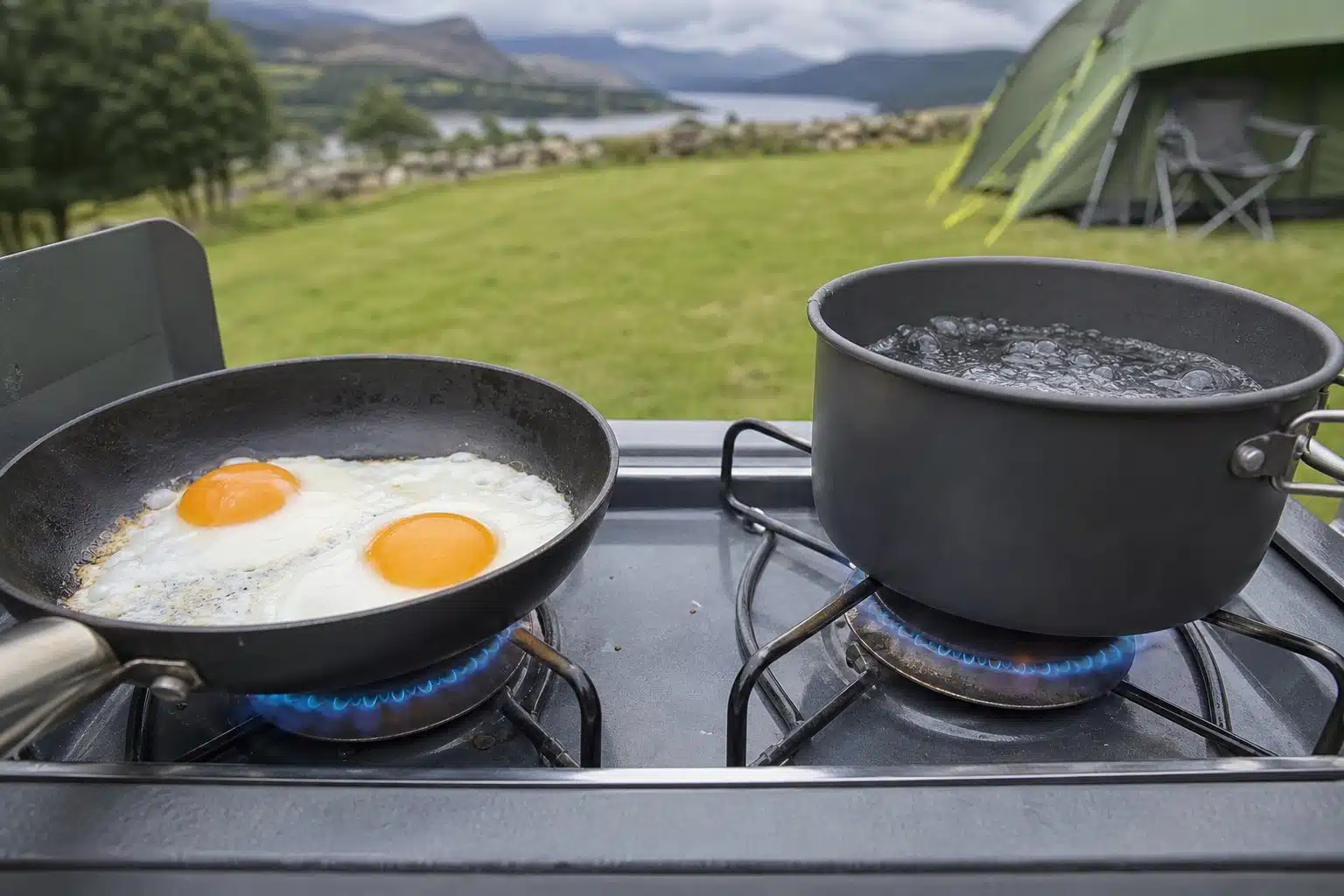
A single-burner stove is light and cheap, and for a couple who mostly make tea and one-pot meals it can be all you need. The moment you want to cook two things at once, though, a two-burner stove changes how you eat on site. Pasta can boil while the sauce simmers, the kettle can go on while the eggs fry, and nobody has to wait for the first pan to finish before the second one starts.
Twin-burner stoves suit car campers, small families, campervan owners who prefer to cook outside and anyone on a longer trip who is tired of instant noodles. If you regularly cook for a bigger group, a three-burner model or a stove with a grill plate may suit you better; our guide to the best camping stoves for family holidays covers those larger cookers. For most households, two good burners hit the sweet spot between capacity and packed size.
It is also worth thinking about the length of your trips. On a one-night stopover almost any stove will do, but over a long weekend or a full week the small frustrations add up: a flame that blows out every few minutes, a burner that will not turn down, or a case that takes up half the boot. A little time spent on the choice now saves a lot of cold dinners later.
How to compare double burner camping stoves UK shops stock
When you line up double burner camping stoves UK shops stock side by side, the spec sheets tend to shout about power. Power matters, but it is only one of five things that decide whether a stove is pleasant to cook on. The others are how well it copes with wind, how low the flame will go, how much pan space it offers and which gas it runs on. Weigh all five against how and where you usually camp.
Power and boil speed
Burner output is usually quoted in BTU. As a rough guide, around 10,000 BTU per burner handles everyday family cooking, while 20,000 BTU burners like those on the Camp Chef Everest 2X bring big pans to the boil faster, especially in a breeze. More power also means more gas used per minute on full, so a very powerful stove only saves fuel if you remember to turn it down once things are boiling.
Wind protection and simmer control
On an open pitch, wind steals heat from the pan faster than almost anything else. A tall three-sided windscreen keeps the flame where it belongs, while low side guards help but usually need a windbreak as well. Simmer control is the other half of good cooking: a knob that turns smoothly from high to a gentle low lets you make porridge, scrambled eggs and sauces without welding them to the pan. That is exactly why the Coleman Cascade 222 earned its place here.
Pan space and stability
Check that the pans you already own fit side by side without their handles clashing or hanging over the edge. A stove that takes a 12-inch and a 10-inch pan together, like the Cascade 222 and the Triton+, covers most family frying pans and saucepans. Stability matters as much as width: a full pan of boiling water on a wobbly support is a genuine burn risk, particularly with children moving around the camp kitchen.
Which twin-burner stove suits your style of camping?
Of the double burner camping stoves UK buyers will find in this guide, each one tackles the same job in a different way, so start from how you camp rather than from the scores. Families who cook proper meals on exposed pitches will get the most from the Camp Chef Everest 2X, the most powerful stove here and the best at shrugging off wind. Keen cooks who make sauces, porridge and pancakes will appreciate the finer simmer control of the Coleman Cascade 222.
If you are new to camp cooking, the Coleman Triton+ keeps things simple with push-button ignition and a familiar fold-shut case. Campervan owners and anyone short of boot space should look at the Jetboil Genesis, which folds in half and weighs about 2.8 kg. On a tighter budget, the Camp Chef Kodiak keeps a folding-lid windscreen and a drip tray while costing noticeably less than the Everest 2X.
Think about cookware at the same time. The Genesis works best with Jetboil’s own pans, while the larger suitcase-style stoves take the ordinary pans you probably already have. If weekend fry-ups are a big part of your trips, remember that Coleman sells a cast-iron grill and griddle that drops onto the Cascade 222, which can save you packing a second cooking appliance.
Setting up a safe and tidy camp kitchen
Even the best double burner camping stoves UK retailers sell only work well on a good base. Use a sturdy camping table at a comfortable working height, level it on the pitch and set the stove so the knobs face you and the hose runs away from where people walk. Keep the cylinder beside the table rather than under the burners, and leave space either side to put a hot pan down without reaching across a flame.
Place the kitchen downwind of the tent and well clear of guy lines, awnings and anything flammable. A windbreak on the windward side helps any stove, even one with a tall screen, and it also keeps curious children at a safe distance. Never cook inside a tent or an enclosed porch; a tarp pitched high over the table and open at the sides keeps off the rain while letting fumes escape.
Organise the rest of the kitchen around the burners: a washing-up bowl, a water carrier, a heat-proof mat for hot pans and one box that keeps utensils, a spare lighter and a tea towel together. Our camping kitchen essentials list covers the rest. Small habits help too: a lid for every pan means faster boils and less gas, so your cylinders last the whole trip.
Care, storage and simple fixes
Most stove problems are easy to prevent. After each meal, let the stove cool, then wipe the cooktop and empty the drip tray if it has one, because baked-on fat is far harder to shift later and attracts wasps on summer evenings. Lift out removable grates to clean underneath, and make sure everything is dry before you close the lid, so the case does not rust or smell when you next open it.
When the flame is weak or uneven
A weak, uneven or yellow-tipped flame usually points to wind, a cold or nearly empty cylinder, or burner ports partly blocked by food and grease. Shield the stove first, then try a fresh cylinder. If the flame is still poor once the stove has cooled, clean the ports following the maker’s instructions. If you ever smell gas, turn everything off, move away from the tent and check the joints with soapy water, never a flame.
Storing it between trips
At home, disconnect the regulator, look over the hose for cracks or stiffness and store the stove somewhere dry. Keep gas cylinders upright in a cool, ventilated place outside the house, such as a shed, rather than in the car boot or a kitchen cupboard. Before the first trip of the season, connect everything outdoors and run a quick test burn, so any fault shows up at home and not at the campsite.
Packing it for the journey
Close the latches, keep the regulator in its storage space or a padded bag so the thread is not knocked, and pack the stove flat where heavier kit cannot slide onto it. Carry cylinders upright and secure, disconnected from the stove, and unload them first when you arrive so they are not left baking in a hot car.
Final thoughts on choosing a twin-burner stove
Comparing double burner camping stoves UK campers can buy comes down to honest answers about your own trips. How many people do you cook for, how exposed are your usual pitches, how much space is left in the car and which gas can you buy near home? Answer those and the choice narrows quickly, whether that means the power of the Everest 2X, the gentle simmer of the Cascade 222 or the small folded size of the Genesis.
Sort out your gas, hose and fittings before you set off, pack a windbreak and a backup lighter, and practise lighting the stove in the garden first. Do that, and a good two-burner stove will make camp meals quicker, calmer and far more varied than cooking on a single ring.
What to look for in a double burner camping stove
Tall, three-sided windscreens and recessed burners keep heat on the pan. Low side guards still need a windbreak on exposed pitches.
Knobs that turn down smoothly let you cook eggs, porridge and sauces without burning them. UK retailers rate this above raw power.
Around 10,000 BTU (2.9 kW) per burner suits most families; 20,000 BTU burners boil large pans much faster but use gas quicker.
Check two full-size pans fit side by side, and that the pan supports are stable; wobbly pans are a real burn risk.
Propane works in cold weather; butane is cheaper but weak below about 4C. Make sure you can buy compatible cylinders and the right hose.
Push-button or rotary ignition saves hunting for matches; a removable grate and drip tray make cleaning on site easier.
Traditional twin stoves are suitcase-sized and weigh 5 kg or more. Folding designs suit vans and small cars.
How to get the best from a two-burner camping stove
- Set up outside, on a stable table
Use the stove on a level, heat-resistant surface well away from the tent and anything flammable.
- Check the hose and seals
Before each trip, look for cracks, kinks and an out-of-date hose, and test joints with soapy water, never a flame.
- Block the wind
Raise the windscreen and add a windbreak on the windward side; you will cook faster and use less gas.
- Start high, then turn down
Bring pans to the boil on high, then drop to a simmer; lids on pans save a surprising amount of fuel.
- Keep gas warm in cold weather
On frosty mornings, store cylinders somewhere sheltered (not in the tent) so they vaporise properly.
- Clean and store dry
Wipe the drip tray and grate once cool, disconnect the gas and store cylinders upright and outside.
First time cooking outdoors? Our step-by-step guide on how to use a camping stove on your first trip and our camping kitchen essentials checklist will help you set up a safe, efficient camp kitchen. For a UK retailer’s view of twin-burner cookers, see UK Camping and Leisure’s double burner stoves for family cooking guide.
How we chose these double burner camping stoves
We have not cooked on every stove in this list ourselves. Our picks are based on manufacturer specifications, independent stove tests (including boil-time and wind testing by OutdoorGearLab and long-term reviews by Switchback Travel and UKClimbing), UK retailer and camping club guidance, and recurring themes in campers’ feedback about wind, simmering, stability and fuel.
-
Cooking performance
We compared burner output, simmer control and boil times where tested.
-
Wind resistance
We looked at windscreen design and independent wind testing.
-
Practicality
We compared pan space, ignition, cleaning, size and weight.
-
UK suitability
We checked fuel type and flagged the gas fittings UK campers need to consider.
BTU ratings are the makers’ own claims. Not every Amazon listing quotes weight, size or warranty; where a figure is missing we say “Not quoted” rather than guess.
What is the best double burner camping stove?
For most family car campers, the Camp Chef Everest 2X: it has two 20,000 BTU burners, excellent wind protection and good simmer control. If space is tight, the folding Jetboil Genesis weighs only about 2.8 kg.
Is propane or butane better for camping in the UK?
Propane keeps working in cold weather, while butane struggles to vaporise below about 4C. Butane cartridges are cheap and easy to buy, so many campers use butane in summer and propane for spring, autumn and winter trips.
Can I use an American propane camping stove in the UK?
Yes, but the small 1 lb cylinders these stoves are designed for are hard to find in UK shops. You will need compatible cylinders or a suitable adaptor hose from the manufacturer or a reputable gas supplier. Never improvise fittings, and follow the appliance instructions.
How many BTU do I need for a camping stove?
Around 10,000 BTU (about 2.9 kW) per burner is enough for most family cooking. More power boils large pans faster in wind, but simmer control and a good windscreen matter just as much.
How long does a gas cylinder last on a double burner stove?
Coleman quotes about an hour on high from one 1 lb propane cylinder for its 22,000 BTU stoves. Cooking at medium with lids on pans makes gas last much longer; see our fuel guide.
Can I use a camping stove inside my tent?
No. The Camping and Caravanning Club advises against cooking in a tent because of fire and carbon monoxide risks. Cook outside on a stable table, sheltered by a windbreak.
Which double burner camping stove should you buy?
- Best overall: Camp Chef Everest 2X Two-Burner Camping Stove
- Best simmer control: Coleman Cascade 222 Two-Burner Camping Stove
- Best for beginners: Coleman Triton+ Two-Burner Propane Camping Stove
- Most compact: Jetboil Genesis Basecamp Two-Burner Stove
- Best budget: Camp Chef Mountain Series Kodiak Two-Burner Stove
For most UK families, the Camp Chef Everest 2X is the best double burner camping stove: it is the most powerful here, shrugs off wind and still simmers gently. The Coleman Cascade 222 is the one for precise, gentle cooking, the Coleman Triton+ is the easiest to get started with, the Jetboil Genesis folds smallest for vans and small cars, and the Camp Chef Kodiak brings a lid windscreen and drip tray at a lower price. Whichever you choose, sort out your gas and fittings before your trip; our stove types guide explains the options.
CampEquipmentPlus relies on reader support. Purchases made via links on our website may earn us an affiliate commission at no extra cost to you, helping keep the site running.