
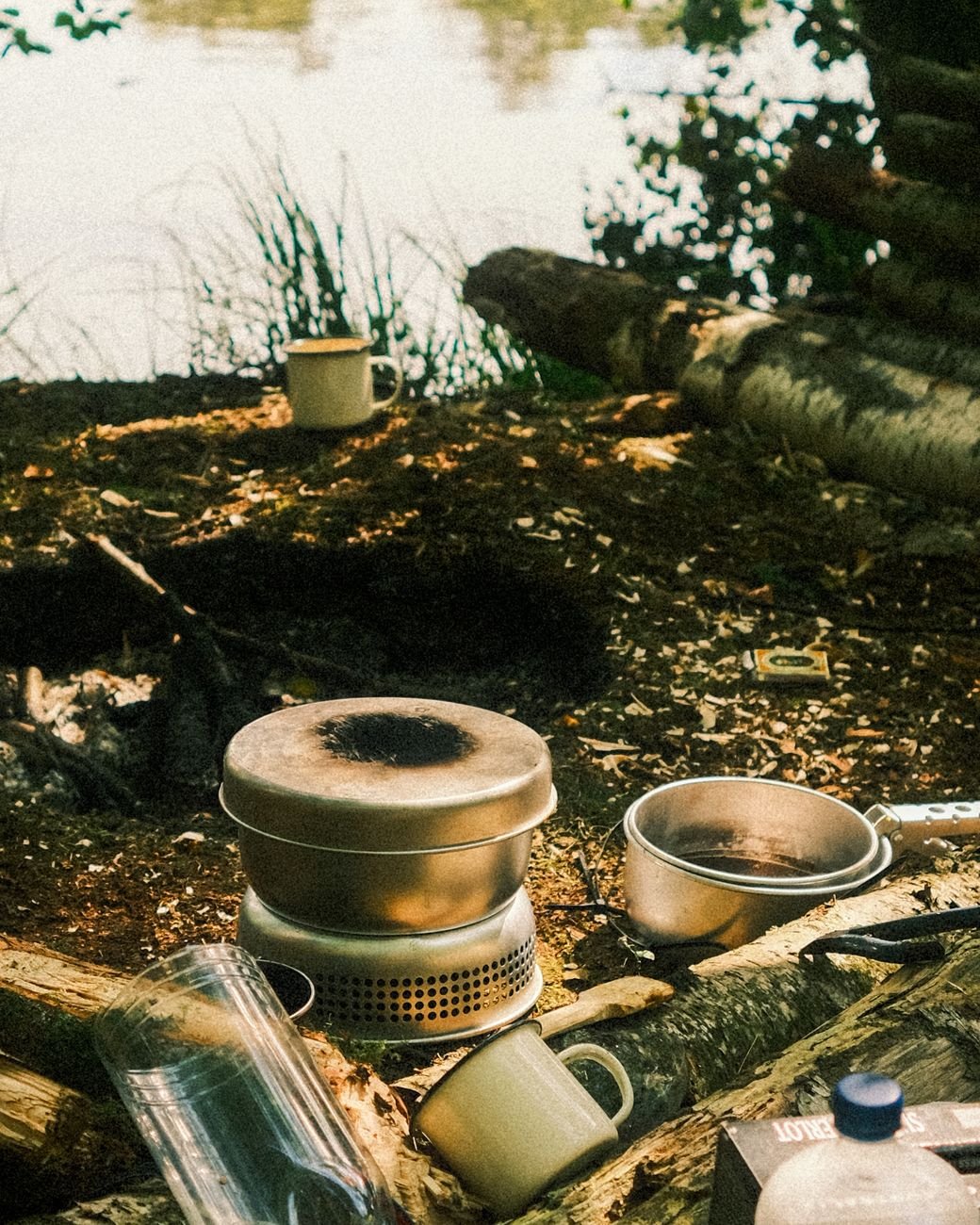
The right camp kitchen is sized for the meal, not the gear shelf.
A family-sized saucepan can swallow a backpacking stove’s tiny flame, while a nesting pot may struggle to hold pasta for four. Before packing, campers can list the meals they’ll actually cook and count how many people will eat at once. Boil-in-bag meals and coffee need little more than one pot; pancakes or fresh vegetables call for a skillet.
Match the pan to the heat source. A compact burner heats a narrow patch, so a wide household pan can scorch food in the center. A two-burner car-camping stove offers more room and stability. That distinction often matters more than whether the cookware is sold as a “camping set.”
The smallest workable cookware kit
A lidded pot, one heat-safe spoon, and an eating vessel for each person cover a surprising number of camp meals. The pot heats water, cooks food, and can hold leftovers while portions are served. Its lid speeds boiling, reduces fuel use, and keeps ash or insects out when cooking outdoors. A long spoon can stir and serve, avoiding a separate spatula or ladle unless the menu needs one.
There is no need to buy a camping pot before the first trip. An ordinary kitchen pot works if its base sits securely on the stove supports and its handles can be kept away from the flame. Check packed size and weight, but do not mistake a heavier pot for a cooking problem: it may be perfectly sensible for a short walk from car to campsite.
A titanium mug used to boil water can replace the pot for one person eating meals rehydrated in their packets or making instant oats. It is a poor substitute when cooking a full portion of pasta, rice, or sauce: limited volume invites boilovers, and the narrow base makes stirring difficult. For those meals, carry the pot rather than trying to make a mug do two jobs badly.
Choose a pot that fits the meal
A pot’s stated capacity is usually measured to the rim. Food needs space to expand, and a bubbling meal needs room to stir without spilling. For soups, rice, and one-pot dinners, plan to use no more than about two-thirds of the stated capacity; boiling plain water can use more.
- Solo: A 750 mL–1 L pot often handles water for one dehydrated meal, a hot drink, or a modest one-pot serving. A mug-sized vessel is less practical when noodles or vegetables must be stirred.
- Two people: A 1.5–2 L pot suits many shared meals. If both eat from separate dehydrated pouches, only the combined rehydration water must fit—not the finished food.
- Four people: A 3–5 L pot gives a family room for pasta, chili, or a shared stew. Four 500 mL servings already occupy 2 L before ingredients and bubbling space are considered.
Check the recipe, not just the head count. Measure the water and ingredients for the largest planned meal, then allow headroom. A tall, narrow pot may hold enough but heat unevenly on a small burner or make stirring awkward; a very wide pot may extend beyond the stove’s stable support.
One generous pot beats two undersized ones when the entire meal cooks together. A second vessel earns its space when rice and sauce need separate cooking, or when a small pan would otherwise force eggs or pancakes into several batches. On a single burner, two vessels still cook in sequence, so the time saved depends on the menu.
Match cookware to the heat source
A camp stove concentrates heat beneath the pot and offers a controllable flame. A campfire is less predictable: flames can climb the sides, hot spots shift as logs burn, and soot coats exposed surfaces. Cookware that works on a stove is not automatically safe over a fire.
For stove cooking, check that the pot sits securely on the supports rather than balancing on a narrow rim. A wide pan may overhang a compact burner, leaving its edges cool while the center scorches. Handles should stay clear of the flame, and a well-fitting lid should remain seated when the pot is moved or water is poured.
For fire cooking, choose a stable grate over coals rather than resting a pot directly on logs. An uncoated stainless steel pot with all-metal handles and lid hardware is a practical example; stainless steel pots over a campfire still need gradual heating and a secure support. Plastic knobs, silicone grips, and many nonstick coatings can be damaged by flames reaching beyond the pot base. Even stainless steel can discolor or warp under intense, uneven heat, so use a cloth or gloves for hot handles and expect soot to need cleaning afterward.
Check the lid knob and handle attachments as carefully as the pot body; small heat-sensitive parts are easy to miss.
Choose a material for the meals
A pot that only boils water has a different job from a pan that cooks eggs. Aluminum spreads heat quickly and weighs less than stainless steel, making it a useful choice for simmering pasta or cooking breakfast on a stove. It can dent, though; hard-anodized aluminum has a tougher surface but is not necessarily nonstick.
Titanium pots are often exceptionally light because they can be made with thin walls. They are excellent for boiling water, but heat concentrates over the burner, so thick oatmeal or sauce needs frequent stirring. Stainless steel is heavier and tougher, tolerates metal utensils and vigorous scrubbing, and suits harder use. Thin stainless pans can also develop hot spots; a heat-spreading base helps, at a weight cost.
A nonstick pan makes eggs easier to cook and cleanup quicker when water is scarce. Its coating calls for gentle utensils, a soft sponge, and controlled heat. For boiling, one-pot meals, or cooking over a fire, bare metal usually earns its space better than a coating that needs protection.
Add a frying pan only if the menu needs one
A frying pan earns its space when the menu includes eggs, pancakes, or sautéed vegetables. For pasta, soup, or meals reheated in water, the pot already does the job. Breakfast plans matter more than the appeal of a matching cookware set: a single suitable pan is more useful than several pieces that never leave the bag.
Choose diameter for the food and the burner. An 18–22 cm pan is often enough for one or two people; a crowded pan, however, steams vegetables instead of browning them. Going much wider than a small stove’s flame creates a hot center and cool edges. Those uneven temperatures are particularly noticeable with eggs, so a pan chosen for delicate breakfasts should fit both the portion and the stove.
Control the heat before adding more cookware. Camp burners can deliver intense heat to a small spot. A moderate flame and a short preheat help pancakes cook through without burning underneath; nonstick coatings should never be heated empty on high. A thin film of oil or butter helps food release, but butter can brown quickly over a strong flame. If eggs still tear or vegetables cling, the cause of sticking may be heat, timing, or too little fat—not a missing specialty pan.
Pack tools for the meals
A tool earns its place by doing a job the menu requires. A sturdy spoon can stir, serve, and eat porridge or soup; a fork is useful for meals a spoon handles poorly. One bowl per person can serve hot dinners and cold breakfasts, while a mug adds value when drinks need a separate vessel.
A knife is necessary if ingredients need cutting at camp, but pre-cut food may eliminate the need for a kitchen knife. A pot gripper is essential for a handleless pot. Over a fire, even fixed handles may need a heat-resistant glove; wet cloth transmits heat quickly.
Keep conveniences conditional:
- Kettle: Useful when drinks and cooking water need heating separately; otherwise the pot can do both.
- Colander: A lid held ajar can drain small portions, provided the pot can be gripped securely.
- Utensil roll: Most useful for organizing a larger shared kitchen.
Nest bowls or mugs inside the pot without forcing them. Put a soft cloth between metal pieces and nonstick surfaces, and keep loose cutlery out of coated pans to prevent scratches.
Clean up before packing
A one-pot dinner leaves fewer dishes, but the pot still needs cleaning. Scrape food scraps into the trash, then add a little warm water to loosen stuck-on food. Washing without a sink calls for a small wash container and a way to collect used water; strain out food particles, pack them out, and dispose of the water according to campsite rules. Keep soap and wash water out of lakes and streams.
Different marks need different treatment:
- Soot collects on the outside of pots used over a fire. Wipe off loose residue before it rubs onto the rest of the kit; stubborn soot can wait until a suitable cleaning spot is available.
- Scratched nonstick is a coating problem, not a stain to scour away. Use soft utensils and a nonabrasive sponge, and replace a pan whose coating is peeling or flaking.
- Rusty cast iron needs the rust removed, followed by thorough drying and a thin coat of oil. Leaving it damp inside a packed kit invites the rust back.
Dry every pot, lid, and handle joint before nesting. A quick wipe may leave water trapped under a lid or around a folding handle.
Run each meal through the kit
-
List every meal and its cooking order
Include breakfast and drinks. Note whether food only needs hot water, must simmer, or needs a separate cooking surface.
-
Start with one lidded pot and a stirring tool
Boil-water meals need no pan. Check that the pot holds the largest batch with room to stir.
-
Add a pan only for a planned frying job
Eggs or pancakes may justify it; a second vessel also helps when one pot must stay occupied while another food cooks.
-
Check group size and heat source
For a group, test whether the largest batch fits or whether cooking in rounds is acceptable. For campfire meals, use fire-suitable cookware and a safe way to lift it rather than packing a second stove kit.
-
Remove anything without a distinct job
If two pieces handle the same meals at the same time, leave one behind.
The final kit should follow the cooking sequence, not the number of meals. An extra piece earns its space only when it enables a cooking step the smaller kit cannot handle conveniently.
CampEquipmentPlus relies on reader support. Purchases made via links on our website may earn us an affiliate commission at no extra cost to you, helping keep the site running.