
The best camping heaters for tents need to do more than pump out heat.
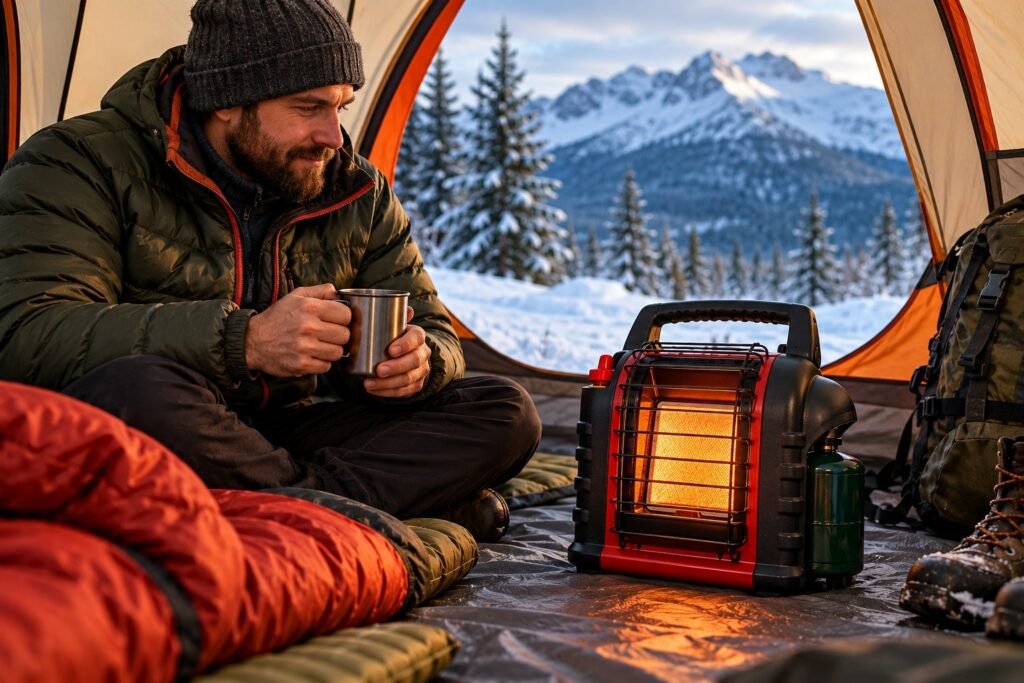
When you are putting a heater close to tent fabric, sleeping bags, clothing and other combustible gear, the manufacturer’s intended use and safety instructions matter more than an impressive BTU figure.
That narrowed our shortlist considerably.
We researched camping heaters for tents using manufacturer specifications, operating guidance and US Consumer Product Safety Commission recommendations.
Rather than fill this guide with generic propane heaters and household space heaters, we settled on three models with clear manufacturer support for tent use in the US.
All three are propane heaters from the Mr. Heater Buddy range. We have not included an electric model in the rankings because the electric heaters we researched did not provide equally clear manufacturer documentation supporting recreational tent use.
There is another point to get out of the way early. The CPSC says never to use portable fuel-burning heaters while sleeping in enclosed areas such as tents, campers and vehicles. CPSC guidance also warns that carbon monoxide risk increases at high altitude.
Use a heater to warm your shelter while you are awake. Your sleeping bag and insulated pad need to handle the night.
The Best Camping Heaters for Tents
- Best Overall: Mr. Heater Portable Buddy MH9BX. Its 4,000 and 9,000 BTU settings offer a useful middle ground for car camping.
- Best for Small Tents: Mr. Heater Little Buddy MH4B. A smaller 3,800 BTU heater weighing 5.85 lb.
- Best for Large Tents: Mr. Heater Big Buddy MH18B. Up to 18,000 BTU and three heat settings, but substantially larger and heavier.
- All three US models include an oxygen-depletion sensor and tip-over shutoff.
- Never operate a fuel-burning camping heater while sleeping. Ventilation and the manufacturer’s required clearances still apply even when a heater has an ODS.
Camping Heater Comparison
| Heater | Best For | Heat Output | Coverage | Weight | Heat Settings |
|---|---|---|---|---|---|
| Mr. Heater Portable Buddy MH9BX | Best Overall | 4,000/9,000 BTU | Up to 225 sq. ft. | 10.6 lb | Two |
| Mr. Heater Little Buddy MH4B | Small Tents | 3,800 BTU | Up to 95 sq. ft. | 5.85 lb | One |
| Mr. Heater Big Buddy MH18B | Large Tents/Shelters | 4,000/9,000/18,000 BTU | Up to 450 sq. ft. | 17.1 lb | Three |
The coverage figures above are manufacturer ratings rather than guarantees of how warm your tent will become. Tent volume, insulation, outside temperature, wind, ventilation and heater positioning all affect real-world performance.
1. Mr. Heater Portable Buddy MH9BX: Best Overall
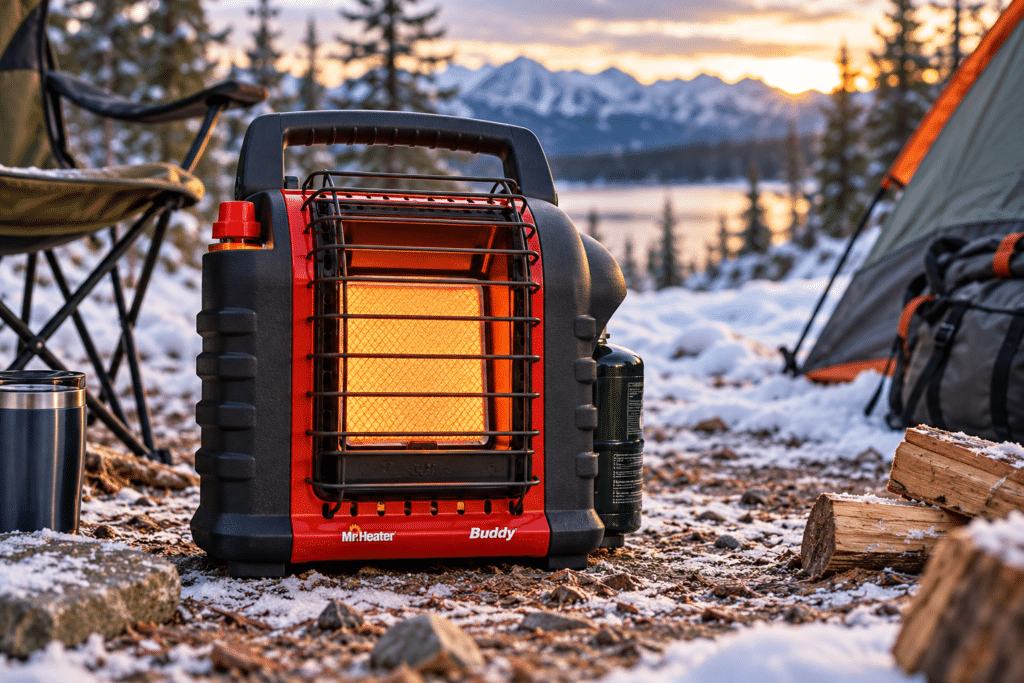
The Mr. Heater Portable Buddy MH9BX offers the best balance of heat output, portability and adjustment for most US car campers who have a suitable tent and can meet the manufacturer’s operating requirements.
Runs 5.4 hours on low and 2.4 hours on high with 1 lb propane cylinder. Constructed with self-extinguishing materials
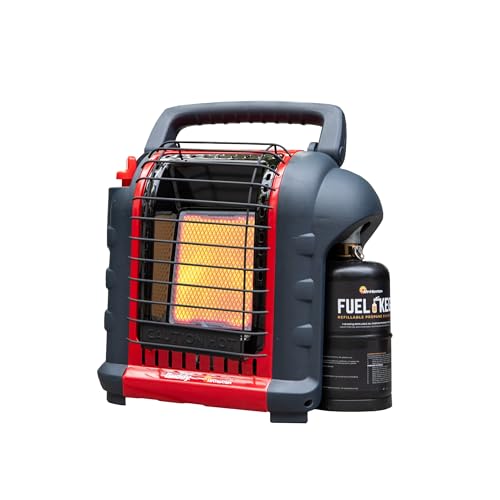
Key Specifications
| Specification | Portable Buddy MH9BX |
|---|---|
| Fuel | Propane |
| Output | 4,000/9,000 BTU |
| Manufacturer coverage | Up to 225 sq. ft. |
| Fuel cylinder | 1 lb propane cylinder |
| Weight | 10.6 lb |
| Settings | Low/High |
| Oxygen-depletion sensor | Yes |
| Tip-over shutoff | Yes |
| Ignition | Piezo |
| Maximum listed elevation | 7,000 ft |
Mr. Heater’s MH9BX specifications list tents among the US model’s intended uses. The heater produces either 4,000 or 9,000 BTU and is rated by the manufacturer for spaces up to 225 sq. ft.
Those two settings are a major reason it takes our top position.
The Little Buddy gives you one 3,800 BTU setting. The Big Buddy goes all the way to 18,000 BTU. The Portable Buddy sits between them and gives you enough adjustment to make sense in a wider range of recreational shelters.
The heater connects directly to a 1 lb propane cylinder. Mr. Heater lists approximately six hours of runtime at 4,000 BTU and three hours at 9,000 BTU.
That difference matters on a cold weekend. Maximum output consumes roughly twice as much fuel as the low setting.
The MH9BX also has an oxygen-depletion sensor and accidental tip-over shutoff. These are important safety systems, but neither removes the need for ventilation, adequate clearance or supervision.
The CPSC specifically says users of ODS-equipped camping heaters still need to follow the manufacturer’s ventilation instructions.
Pros
- Two useful heat settings
- Manufacturer specifically lists tents among US applications
- Oxygen-depletion sensor
- Accidental tip-over shutoff
- Direct connection to a 1 lb propane cylinder
- More portable than the Big Buddy
- Optional connection to larger propane supplies using specified accessories
Cons
- 10.6 lb is heavy for anything beyond car camping
- Requires ventilation
- Cannot be operated while sleeping
- No thermostat
- Regional versions have different restrictions
Who Should Buy the Portable Buddy MH9BX?
The Portable Buddy makes the most sense for car campers who want more output than a small personal heater without carrying the much larger Big Buddy.
It is our most versatile choice of the three.
Do not assume every MH9BX sold in North America has identical permitted uses. Mr. Heater’s Massachusetts and Canadian version is specifically listed as outdoor-safe rather than indoor-safe. Check the exact model, local requirements and current manual before use.
2. Mr. Heater Little Buddy MH4B: Best for Small Tents
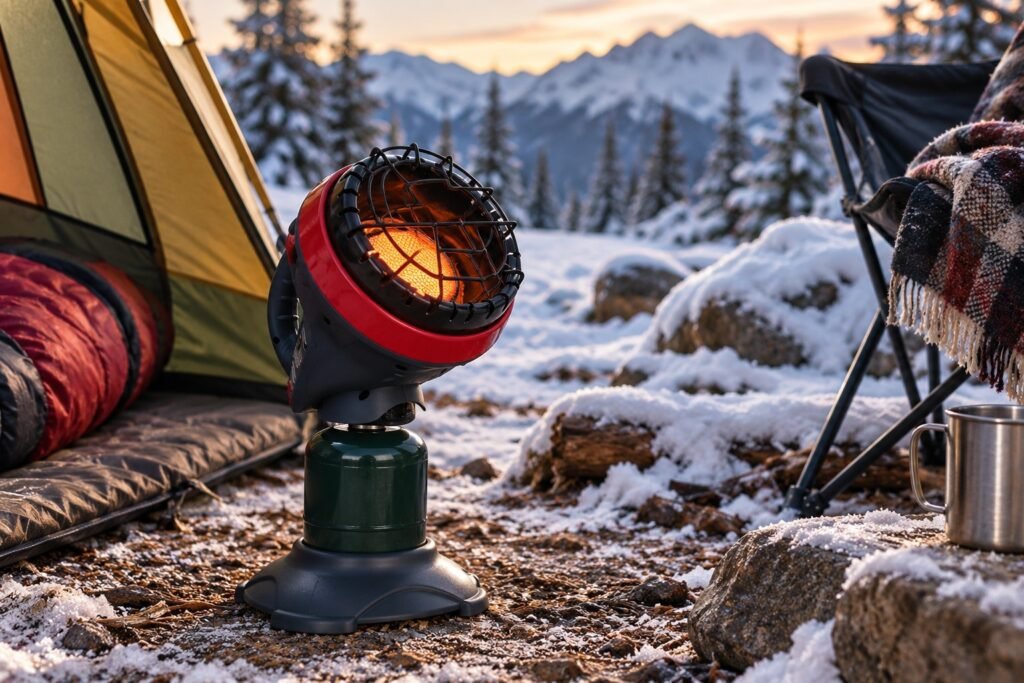
The Mr. Heater Little Buddy MH4B makes more sense when space and portability matter more than maximum heat output.
One button ignition on function. 8in round stand; uses little floor space. Accidental tip-over safety shut-off. Automatic low oxygen shut-off system.

Key Specifications
| Specification | Little Buddy MH4B |
|---|---|
| Fuel | Propane |
| Output | 3,800 BTU |
| Manufacturer coverage | Up to 95 sq. ft. |
| Fuel cylinder | 1 lb propane cylinder |
| Weight | 5.85 lb |
| Settings | One |
| Oxygen-depletion sensor | Yes |
| Tip-over shutoff | Yes |
| Ignition | Piezo |
| Maximum listed elevation | 7,000 ft |
The Little Buddy produces 3,800 BTU and carries a manufacturer coverage rating of up to 95 sq. ft. Mr. Heater’s product specifications specifically list tents among its intended US uses.
At 5.85 lb, it weighs almost 5 lb less than the Portable Buddy and more than 11 lb less than the Big Buddy.
Its round base also takes up relatively little floor space.
That matters inside a tent.
A heater does not occupy the floor by itself. You also need to account for people, sleeping bags, pads, backpacks, clothing and the clearances required between the heater and combustible materials.
A smaller heater can therefore make more sense than chasing the highest possible BTU figure.
There is a tradeoff. The Little Buddy has one heat setting. You cannot reduce its output when you only want to take the edge off a chilly evening.
It is also still too heavy for most backpacking trips once you add a propane cylinder.
Pros
- 5.85 lb heater weight
- Smaller footprint than the other Buddy models
- Manufacturer lists tents among US uses
- 3,800 BTU output is better matched to smaller spaces
- Oxygen-depletion sensor
- Tip-over shutoff
- Approximately 5.6-hour manufacturer runtime rating
Cons
- Only one heat setting
- Limited output for large family tents
- Still heavy for backpacking
- Requires adequate ventilation
- Must be turned off before sleeping
Who Should Buy the Little Buddy MH4B?
Choose the Little Buddy if you are car camping in a smaller shelter and its dimensions, output and required clearances suit your setup.
Do not automatically choose the Big Buddy because 18,000 BTU looks better on paper.
More heat is useful only when you need it.
For overnight warmth, your shelter and sleeping gear still does the important work. An insulated sleeping pad is particularly easy to overlook when campers focus on sleeping-bag temperature ratings.
3. Mr. Heater Big Buddy MH18B: Best for Large Tents and Camping Shelters
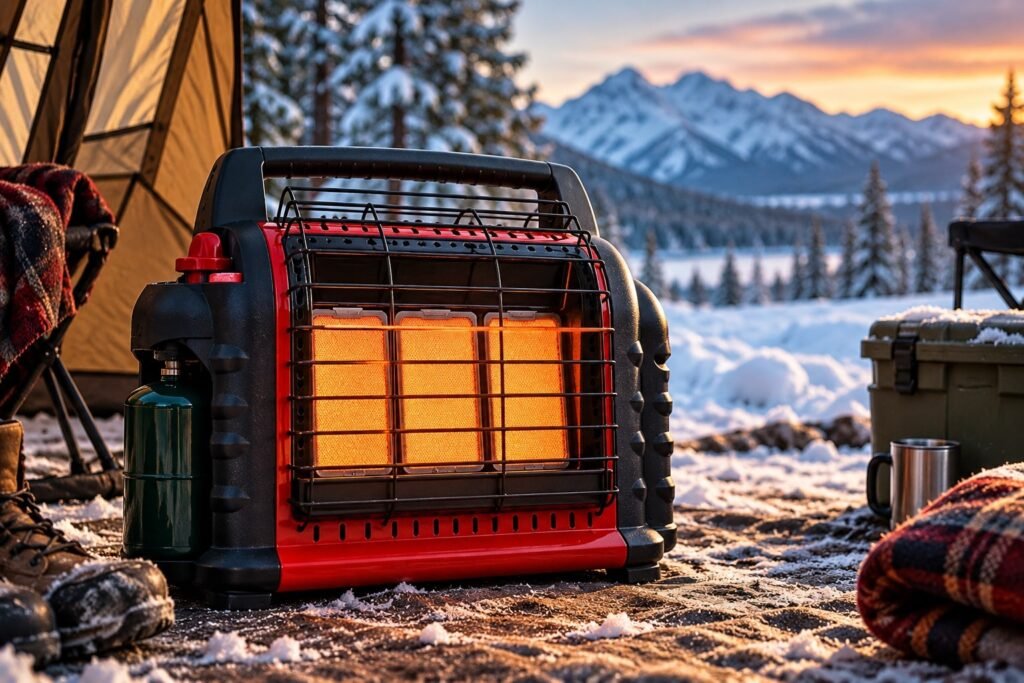
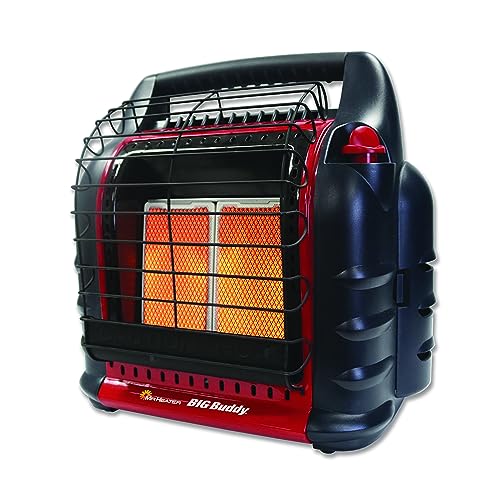
The Mr. Heater Big Buddy MH18B is the high-output option for large recreational shelters where the smaller Buddy heaters do not provide enough heating capacity.
Low, Medium, and High heat settings: 4,000 / 9,000 / 18,000 BTU. Heats up to 216 hrs. on two 20lb Propane tanks with optional hose (low setting). Big Buddy dual heating system combines radiant heat comfort with convection heat air flow. Built-in high powered fan
Key Specifications
| Specification | Big Buddy MH18B |
|---|---|
| Fuel | Propane |
| Output | 4,000/9,000/18,000 BTU |
| Manufacturer coverage | Up to 450 sq. ft. |
| Fuel cylinders | Up to two 1 lb cylinders |
| Weight | 17.1 lb |
| Settings | Low/Medium/High |
| Oxygen-depletion sensor | Yes |
| Tip-over shutoff | Yes |
| Ignition | Piezo |
| Maximum listed elevation | 7,000 ft |
The current US Big Buddy specifications provide three settings: 4,000, 9,000 and 18,000 BTU. Mr. Heater rates the unit for up to 450 sq. ft. and lists tents among its intended uses.
The three settings make the Big Buddy more flexible than its maximum output suggests. You do not have to run it at 18,000 BTU whenever it is switched on.
Size is the problem.
The heater weighs 17.1 lb and measures 19 inches long by 12 inches wide. It also accepts two 1 lb propane cylinders.
That is a lot of heater to place inside a conventional camping tent while maintaining the required space around hot surfaces.
For a two-person tent, we would look elsewhere. For a large family shelter, hunting tent or similarly spacious recreational enclosure, the Big Buddy becomes easier to justify.
Mr. Heater gives the MH18B a 7,000 ft maximum elevation specification. Its product documentation also includes an oxygen-depletion sensor and accidental tip-over shutoff.
Pros
- Three heat settings
- Maximum 18,000 BTU output
- Up to 450 sq. ft. manufacturer coverage
- Manufacturer lists tents among US uses
- Oxygen-depletion sensor
- Tip-over shutoff
- Can run from two 1 lb propane cylinders
- Larger remote propane supply supported with specified accessories
Cons
- Heavy at 17.1 lb
- Large footprint
- Excessive for many small tents
- Higher fuel consumption at maximum output
- Requires careful clearance and ventilation
- Must not operate while you sleep
Who Should Buy the Big Buddy MH18B?
The Big Buddy suits campers with large recreational shelters who genuinely need more heating capacity.
Measure first.
The manufacturer’s coverage figure tells you what the heater is designed to heat. It does not tell you whether your tent has enough usable floor space to position a hot appliance safely among sleeping bags and camping equipment.
That practical distinction matters.
Are Propane Camping Heaters Safe for Tents?
Some propane heaters are specifically designed for use in recreational enclosures such as tents, but no fuel-burning heater should be treated as risk-free.
The CPSC states that portable fuel-burning camping equipment should never be used inside a tent unless it is specifically designed for enclosed-space use and includes instructions for that use.
That rule shaped this entire shortlist.
A product being described as “portable,” “camping” or “outdoor” is not enough.
Check the manufacturer’s instructions for your exact model.
What Makes a Camping Heater Suitable for Tent Use?
A camping heater should have explicit manufacturer support for the intended enclosure, appropriate safety systems and operating instructions you can realistically follow inside your shelter.
For propane models, we looked particularly closely at:
- Manufacturer approval for tents or recreational enclosures
- Oxygen-depletion sensor
- Tip-over shutoff
- Required ventilation
- Required clearances
- Fuel connection
- Altitude limitations
- Regional restrictions
The first item is the most important filter.
A propane heater designed exclusively for outdoor use does not become a tent heater because it has a convenient handle.
What Does an Oxygen-Depletion Sensor Do?
An oxygen-depletion sensor monitors conditions around the heater and shuts down the gas supply when oxygen drops below its designed operating threshold.
CPSC describes ODS technology as an important development in portable camping heater safety. Its guidance says these heaters still require adequate ventilation and must be operated according to manufacturer instructions.
An ODS is therefore a backup safety system.
It is not a replacement for fresh air.
That distinction is important because terms such as “indoor safe” can easily give the wrong impression. Combustion still consumes oxygen and produces exhaust gases.
Can You Sleep With a Propane Camping Heater Running?
No. Turn a portable fuel-burning camping heater off before going to sleep.
The CPSC camping warning specifically says not to use portable heaters or lanterns while sleeping in enclosed spaces including tents, campers and vehicles.
This recommendation still applies when the heater has an ODS and tip-over shutoff.
Use the heater while you are awake and supervising it. Turn it off before sleeping.
Your cold-weather sleeping system then takes over.
This is one reason we put so much emphasis on insulated sleeping pads. A warm sleeping bag cannot fully compensate for substantial heat loss into cold ground.
Why Is Carbon Monoxide Dangerous in a Tent?
Carbon monoxide is particularly dangerous because you cannot see or smell it.
CPSC lists headache, dizziness, weakness, nausea, vomiting, sleepiness and confusion among the symptoms of carbon monoxide poisoning.
Some of those symptoms can look like illness or ordinary fatigue, which makes CO particularly concerning during a camping trip.
Poorly ventilated enclosed spaces increase the risk when fuel-burning equipment is operating.
The CPSC also warns against using camping stoves, charcoal grills, lanterns and similar combustion equipment as alternative sources of tent heat.
Your stove has a job. Heating your bedroom is not it.
How Much Ventilation Does a Propane Tent Heater Need?
Follow the ventilation requirements in the operating manual for your exact heater.
There is no useful universal answer because requirements vary between heaters and output levels.
Do not assume cracking a tent door by an arbitrary amount is enough. Read the manufacturer’s current manual before taking the heater camping and make sure your shelter can meet its requirements.
CPSC specifically tells users of ODS-equipped camping heaters to follow manufacturer ventilation instructions.
Ventilation is part of operating the heater correctly, not an optional precaution added afterwards.
What Clearances Do Camping Heaters Need?
The required clearance depends on the heater, so check the current manual rather than applying one generic distance to every product.
Hot radiant surfaces and tent fabric are a poor combination.
Your layout needs to account for sleeping bags, clothing, camp furniture and anything else that can move closer to the heater during use.
Place the heater on a stable surface where accidental contact is unlikely.
Current CPSC portable-heater guidance also stresses keeping heaters away from combustible materials and never leaving a portable heater running unattended in a confined space. CPSC heater guidance recommends a stable, level surface and substantial separation from combustible items.
If your tent is too small to maintain the heater manufacturer’s required clearances, the heater is too large for that setup.
Are Electric Camping Heaters for Tents Safer Than Propane?
Electric heaters remove the carbon monoxide risk associated with combustion, but that does not automatically make a household electric heater suitable for use inside a camping tent.
This is where we found the evidence less convincing.
Plenty of compact electric heaters are sold for indoor household or office use. Their small dimensions make them look attractive for powered campsites, but we do not think “small enough to fit inside a tent” is a sufficient selection standard.
Manufacturer intended use still matters.
Electric heaters also create their own practical problems. High-output models commonly demand substantial electrical power, while hot heating elements and combustible tent materials still require careful separation.
CPSC recommends plugging portable electric heaters directly into a wall outlet rather than a power strip and keeping portable heaters away from combustible materials.
Those requirements deserve particular attention when campsite electricity involves extension leads, hookup posts and equipment exposed to outdoor conditions.
For those reasons, we have not named a Best Electric Tent Heater without stronger manufacturer evidence supporting that specific use.
Can You Run an Electric Heater From a Portable Power Station?
Technically, some portable power stations can operate electric heaters, but heating is one of the fastest ways to consume stored battery energy.
A 1,500 W electric heater running continuously consumes 1.5 kWh every hour.
A power station with 1 kWh of usable energy therefore cannot theoretically sustain a constant 1,500 W load for even one full hour. Real-world conversion losses reduce runtime further.
A lower-powered heater lasts longer, but also produces considerably less heat.
Portable power stations make excellent sense for phones, lighting, electronics and numerous campsite appliances. Resistive electric heating asks far more from the battery.
Our lighting and power section covers campsite power equipment in more detail.
Propane vs Electric Camping Heaters for Tents
| Feature | Propane | Electric |
|---|---|---|
| Shore power required | No | Usually |
| Combustion | Yes | No |
| Carbon monoxide from heater | Possible | No combustion CO |
| Off-grid practicality | Good | Depends heavily on battery capacity |
| Typical output | High | Depends on wattage |
| Fuel/power | Propane | Electricity |
| Manufacturer tent approval | Must verify | Must verify |
| Main concern | Combustion, CO, fire, ventilation | Electrical supply, heat, fire, intended use |
Propane has the practical advantage away from electrical hookups. That convenience comes with combustion-related risks that need to be managed according to the manufacturer’s instructions.
Electric heating avoids those combustion gases. It still needs a suitable power supply and a heater whose manufacturer permits your intended use.
Neither category gets a free pass.
How Do You Choose the Best Camping Heaters for Tents?
Start with intended use and safety documentation. Heat output comes afterwards.
Is the Heater Actually Approved for Your Intended Use?
Check the manufacturer rather than relying on an Amazon title or seller description.
For propane heaters, look for explicit reference to tents, recreational enclosures or your specific type of shelter.
Also check regional variations.
Mr. Heater’s US and Canadian/Massachusetts Buddy products illustrate why this matters. Similar-looking products can carry different indoor-use classifications.
How Much Heat Do You Need?
BTU measures heat output. A larger number means greater potential heat production, but more is not automatically better.
Our three selections range from 3,800 to 18,000 BTU.
The Little Buddy suits smaller spaces. The Portable Buddy gives you two output levels and more flexibility. The Big Buddy is aimed at substantially larger areas.
Your tent still needs enough room to position the heater correctly.
How Much Weight Are You Willing to Carry?
Portable camping heaters for tents are primarily car-camping equipment.
The lightest heater in our shortlist weighs 5.85 lb before adding fuel. The Big Buddy weighs 17.1 lb.
That is difficult to justify in a backpack.
Backpackers should normally put their weight allowance into a suitable sleeping bag, insulated pad, shelter and clothing rather than a propane heater.
Camp Equipment Plus has more equipment guidance in our main camping equipment section.
What Safety Features Should You Look For?
For a propane heater intended for a recreational enclosure, an ODS and tip-over shutoff are two features we prioritize.
All three Buddy heaters selected here include both.
We would still reject a heater for tent use if the manufacturer specifies outdoor use only.
Safety features support correct operation. They do not rewrite the operating manual.
What Fuel Does the Heater Use?
All three recommendations can use disposable 1 lb propane cylinders.
The Portable Buddy and Big Buddy can also connect to larger propane supplies using appropriate manufacturer-specified accessories.
Do not improvise propane connections.
Use the hose, filter, regulator and cylinder arrangements specified for your exact model.
You can find related fuel equipment in our camp fuel and fire section.
Can You Use Camping Heaters for Tents at High Altitude?
Check the heater’s altitude specification before use.
Mr. Heater gives the three Buddy models in this guide a maximum listed elevation of 7,000 ft.
CPSC also identifies high altitude as a particular concern for carbon monoxide poisoning when portable heaters are used in enclosed camping spaces.
Do not assume an ODS overrides the manufacturer’s elevation limit.
If your campsite exceeds the specified altitude, use another method of staying warm.
Can You Use a Camping Stove as a Tent Heater?
No. Do not repurpose a camping stove as a tent heater.
CPSC warns campers against using alternative combustion equipment to heat enclosed camping areas because of carbon monoxide hazards.
That includes equipment designed for cooking rather than space heating.
If you need a stove, choose one for cooking and operate it according to its instructions. Our camping stove guide covers that job.
Do not ask the stove to do two jobs simply because you already packed it.
How Can You Stay Warm After Turning the Heater Off?
Build your sleeping system around the expected overnight temperature rather than depending on a heater.
This lesson matters because ground insulation is easy to underestimate. Camp Equipment Plus has 16+ years of camping experience, and one cold-weather trip reinforced just how much warmth can disappear through an inadequate sleeping pad.
For colder trips, we place particular importance on the sleeping bag and pad working as a system.
Check:
- Sleeping-bag temperature rating
- Sleeping-pad R-value
- Expected overnight low
- Appropriate dry clothing layers
- Tent ventilation and condensation management
- Exposure to wind
- Your own cold tolerance
A heater can make changing clothes, reading or getting ready for bed more comfortable.
It should not be the thing keeping you warm enough to survive the night.
Frequently Asked Questions
What Is the Best Camping Heater for a Tent?
For most US car campers, our research points to the Mr. Heater Portable Buddy MH9BX as the most versatile option of the models we evaluated. It offers 4,000 and 9,000 BTU settings, an ODS, tip-over shutoff and explicit manufacturer support for tents on the US model.
Smaller tents may be better suited to the Little Buddy. Large recreational shelters may justify the Big Buddy.
What Is the Best Small Heater for a Camping Tent?
The Mr. Heater Little Buddy MH4B is our small-tent pick. It produces 3,800 BTU, weighs 5.85 lb and has a relatively compact base.
You still need enough room to meet every clearance and ventilation requirement in its operating instructions.
Are There Camping Heaters Safe for Tents?
There are heaters specifically designed for use in recreational enclosures including tents, subject to manufacturer instructions.
“Safe” should not be interpreted as risk-free.
CPSC recommends choosing fuel-burning equipment specifically designed for enclosed-space use, maintaining required ventilation and switching portable heaters off before sleeping.
Can I Leave a Tent Heater Running All Night?
Do not leave a fuel-burning camping heater running while you sleep.
CPSC specifically warns against using portable heaters while sleeping in tents, campers and other enclosed vehicles or shelters.
Do Propane Camping Heaters Need Ventilation?
Yes. Follow the ventilation instructions supplied with your exact heater.
An oxygen-depletion sensor does not remove the requirement for combustion air and ventilation.
Can I Put a Carbon Monoxide Detector in My Tent?
A suitable battery-operated carbon monoxide alarm can provide an additional warning layer, but an alarm does not make incorrect heater operation acceptable.
Never use an alarm as a substitute for following heater instructions, providing required ventilation or turning a fuel-burning heater off before sleeping.
Are Portable Camping Heaters Worth Carrying?
For car camping in cold conditions, a properly selected heater can make evenings and mornings considerably more comfortable.
For backpacking, the weight is difficult to justify. Even the 5.85 lb Little Buddy requires propane in addition to the heater itself.
We would put that weight into the sleeping system first.
Final Verdict
The Mr. Heater Portable Buddy MH9BX is our Best Overall camping heater for tents because its two heat settings, 10.6 lb weight and manufacturer-supported tent use give it the broadest appeal of the three models researched.
Choose the Little Buddy MH4B when space matters and 3,800 BTU is enough.
Choose the Big Buddy MH18B only when you have a substantially larger recreational shelter and enough room to meet its operating requirements.
All three include useful safety systems. None removes the need to read the manual, provide the required ventilation, maintain clearances and supervise the heater.
Most importantly, turn fuel-burning heaters off before sleeping.
Warm the tent while you are awake. Build your sleeping system for the temperature you expect after the heater goes off.
CampEquipmentPlus relies on reader support. Purchases made via links on our website may earn us an affiliate commission at no extra cost to you, helping keep the site running.