
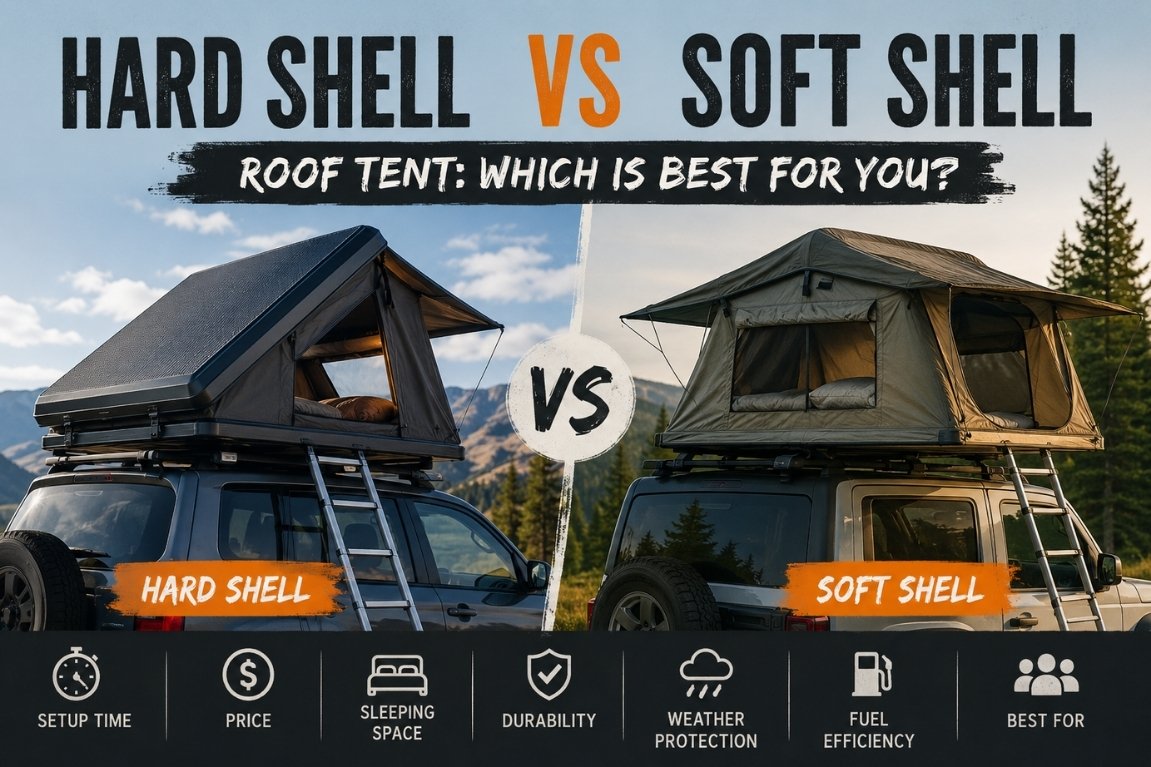
Choosing between a hard shell vs soft shell roof tent is one of the biggest decisions you’ll make when building a rooftop camping setup.
Both styles get you off the ground, provide a comfortable place to sleep, and can transform almost any suitable vehicle into a capable camping base.
However, the way they perform on the road and at the campsite can be surprisingly different.
Hard shell roof tents are typically faster to set up, more aerodynamic, quieter on the road, and better suited to frequent camping and overlanding.
Soft shell tents generally cost less, can provide considerably more sleeping space, and are often a better choice for families or campers working with a tighter budget.
So, which one should you buy?
For most frequent campers, I’d choose a hard shell rooftop tent because of its convenience, durability, and quick setup. But that doesn’t automatically make it the best option for everyone.
In this guide, I’ll compare hard shell vs soft shell rooftop tents across price, comfort, setup time, durability, weather protection, vehicle compatibility, fuel economy, and more.
Hard Shell vs Soft Shell Roof Tent: Quick Comparison
If you’re trying to make a quick decision, here’s how the two designs generally compare.
| Feature | Hard Shell Roof Tent | Soft Shell Roof Tent |
|---|---|---|
| Setup speed | Excellent | Good |
| Pack-down speed | Excellent | Average |
| Aerodynamics | Excellent | Average |
| Sleeping space | Good | Excellent |
| Weather protection | Excellent | Good |
| Durability | Excellent | Good |
| Wind resistance | Excellent | Good |
| Vehicle roof space | Compact | Larger when folded |
| Family camping | Good | Excellent |
| Frequent overlanding | Excellent | Good |
| Entry price | Higher | Lower |
| Best for | Frequent campers | Budget/family campers |
Quick verdict: Choose a hard shell roof tent if you value convenience, quick setup and durability. Choose a soft shell roof tent if sleeping space and affordability are more important.
What Is a Hard Shell Roof Tent?
A hard shell roof tent uses a rigid outer case, normally manufactured from materials such as aluminum, ABS plastic or fiberglass.
When the tent is closed, the upper and lower shells protect the fabric, mattress and much of the internal tent structure.
At camp, the shell opens upward to create the sleeping compartment. Depending on the design, this may use gas struts, hinges or a pop-up mechanism.
Some models can be ready to use in around a minute or two, which is one of the biggest attractions of this design.
Instead of spending time unfolding fabric, installing support poles and securing a cover, you can park, release the latches, open the tent and climb inside.
Hard Shell Roof Tent Advantages
The main benefits include:
- Very fast setup and pack-down
- Aerodynamic profile when closed
- Excellent protection while driving
- Good resistance to wind and bad weather
- Durable construction
- Less loose fabric when packing away
- Ideal for frequent camping
- Excellent for road trips and overlanding
- Often feels more substantial than a soft shell tent
If you’re planning to change campsites regularly, these advantages become particularly noticeable.
What Is a Soft Shell Roof Tent?
A soft shell rooftop tent uses a folding base combined with a fabric tent body and protective travel cover.
When you reach camp, the tent normally folds outward from the vehicle. The ladder frequently supports the extended portion of the sleeping platform.
This design allows manufacturers to create a sleeping area substantially larger than the tent’s packed footprint.
That’s one reason soft shell tents remain extremely popular.
You can potentially get a spacious rooftop sleeping area without requiring an enormous vehicle roof.
Soft Shell Roof Tent Advantages
Soft shell tents typically offer:
- Lower purchase prices
- Large sleeping platforms
- Good value for money
- Plenty of headroom
- Roomier interiors
- Good ventilation
- More options for families
- Annex compatibility on some models
- A traditional tent-like camping experience
For first-time buyers primarily interested in getting maximum sleeping space for their money, a soft shell design can make a lot of sense.
Hard Shell vs Soft Shell Rooftop Tent: 10 Key Differences
Let’s look more closely at the differences that actually matter when you’re camping.
1. Setup Time
Winner: Hard Shell
Setup speed is probably the most obvious difference between the two designs.
A well-designed hard shell tent can be remarkably quick.
Park the vehicle, release the latches and allow the tent to open. Depending on the design, you may only need to extend the ladder and make a few minor adjustments before climbing inside.
Soft shell tents require a little more work.
You’ll generally need to remove or loosen the travel cover, unfold the sleeping platform, position the ladder and possibly install window or rainfly supports.
It’s hardly difficult, but the additional steps matter if you’re camping frequently.
Imagine arriving at camp after driving for eight hours.
It’s dark.
It’s raining.
You just want somewhere dry to sleep.
That’s when the convenience of a hard shell tent really starts earning its keep.
My pick: Hard shell for road trips and frequent camping.
2. Price
Winner: Soft Shell
Price is where soft shell rooftop tents fight back.
A good soft shell tent can provide an impressive amount of sleeping space without the sophisticated shell mechanisms and materials found in premium hard shell models.
Hard shell tents generally command higher prices because you’re paying for features such as:
- Rigid exterior construction
- Gas struts
- Aluminum or reinforced shells
- More complex opening mechanisms
- Low-profile designs
- Additional structural components
If you’re testing rooftop camping for the first time and aren’t sure how often you’ll use your tent, spending significantly more on a hard shell model may not make sense.
A quality soft shell tent can provide the rooftop camping experience at a considerably lower entry price.
My pick: Soft shell for budget-conscious beginners.
3. Sleeping Space
Winner: Soft Shell
Here’s another area where soft shell tents perform particularly well.
Because the base unfolds away from the vehicle, the sleeping platform can become much larger than its packed dimensions.
That’s particularly useful for couples wanting extra space or parents camping with children.
Hard shell tents are usually restricted more closely by the dimensions of the shell mounted to your roof.
There are larger hard shell tents available, but increased dimensions normally mean increased weight and cost.
For two adults, either design can work extremely well.
For three or four campers, I’d start by looking at larger soft shell models.
My pick: Soft shell for families and maximum sleeping space.
4. Comfort
Winner: Tie
Comfort depends more on the individual tent than whether it has a hard or soft shell.
Mattress thickness, internal dimensions, ventilation, insulation and headroom can all make a bigger difference.
A good rooftop tent should provide enough room to sit up comfortably and a supportive mattress that isolates you from the vehicle roof beneath.
Hard shell tents can feel slightly more enclosed and secure, particularly during poor weather.
Soft shell tents often feel airier because they can have larger windows and more fabric panels.
For warm summer camping, that ventilation can be a major advantage.
5. Aerodynamics and Fuel Economy
Winner: Hard Shell
Mounting anything large to your roof increases aerodynamic drag.
That’s worth remembering because your rooftop tent stays on the vehicle while you’re driving between campsites.
Hard shell tents usually have a relatively smooth, low-profile exterior when closed.
Soft shell tents tend to be taller and boxier when packed, particularly once the protective cover is fitted.
Neither option is invisible to the airflow.
You should expect some effect on fuel economy from carrying a rooftop tent, with the exact change depending on the tent, vehicle, speed, driving conditions and installation.
If you plan on covering thousands of highway miles, I’d pay close attention to the tent’s packed dimensions and profile.
My pick: Low-profile hard shell.
6. Wind and Weather Protection
Winner: Hard Shell
Both designs can handle poor weather when they’re properly designed, installed and secured.
However, hard shell models have a few natural advantages.
There’s generally less exposed fabric, and the rigid shell can provide additional structural protection.
That’s particularly noticeable in strong wind.
A large soft shell tent with extended fabric panels and a rainfly can catch more wind, potentially creating additional movement and noise.
If your adventures regularly take you into exposed mountain, desert or coastal locations, a quality hard shell model is particularly appealing.
That doesn’t mean a soft shell rooftop tent can’t handle bad weather.
Quality models certainly can.
Just make sure you pay close attention to the manufacturer’s wind and weather guidance.
7. Durability
Winner: Hard Shell
Rooftop tents have a difficult life.
They’re exposed to:
- Highway speeds
- Rain
- UV radiation
- Dirt
- Dust
- Tree branches
- Temperature changes
- Repeated folding
- Campsite abuse
A rigid exterior gives hard shell tents excellent protection when they’re closed.
That’s especially useful if the tent stays permanently mounted to your vehicle.
With a soft shell tent, the travel cover becomes an important line of defense.
A damaged cover doesn’t necessarily mean a damaged tent, but it’s another component you’ll need to inspect and maintain.
For occasional weekend camping, this difference may not matter much.
For serious overlanding, I’d favor hard shell construction.
8. Packing Up in the Rain
Winner: Hard Shell
Packing away a wet tent isn’t fun.
It’s even less enjoyable when you’re standing beside your vehicle in heavy rain trying to fold fabric back underneath a travel cover.
Hard shell tents generally make this process easier.
There’s less material to organize, and closing the shell can take only a few minutes.
However, there’s an important rule regardless of which design you own:
Don’t leave your rooftop tent packed away wet for extended periods.
Once conditions improve, reopen it and allow the fabric, mattress and interior to dry thoroughly.
This helps prevent mildew, odors and deterioration.
9. Vehicle Compatibility
Winner: Depends on Your Vehicle
Don’t buy a rooftop tent until you’ve checked whether your vehicle and roof-rack system can safely support it.
You need to consider more than the tent’s weight.
Check:
- Vehicle manufacturer’s roof-load specifications
- Roof-rack capacity
- Tent mounting requirements
- Tent weight
- Dynamic roof-load limits
- Installation instructions
- Crossbar spacing requirements
Your vehicle’s dynamic roof-load rating is particularly important because it relates to carrying loads while driving.
Don’t simply assume that because you’ve seen the same model of vehicle carrying a rooftop tent online, your vehicle is suitable.
Different roof configurations and rack systems can have different limitations.
When in doubt, check directly with your vehicle, rack and tent manufacturers.
10. Everyday Convenience
Winner: Hard Shell
This is ultimately why I’d recommend hard shell tents to many frequent campers.
It’s not necessarily one spectacular feature.
It’s the accumulation of small conveniences.
You arrive at camp and open it quickly.
You leave the following morning and close it quickly.
There’s less fabric to fight with.
The packed profile is cleaner.
And changing campsite every day doesn’t feel like such a chore.
If you’re camping twice a year, those advantages may not justify the additional expense.
If you’re camping or overlanding regularly, they absolutely can.
Hard Shell vs Soft Shell Roof Tent: Pros and Cons
Hard Shell:
Hard Shell Roof Tent – Pros
- Very fast setup
- Quick pack-down
- Streamlined profile
- Excellent highway protection
- Durable exterior
- Good wind performance
- Great for frequent camping
- Ideal for overlanding
- Premium appearance
Hard Shell Roof Tent – Cons
- More expensive
- Can be heavy
- Sleeping footprint may be smaller
- Larger models become expensive
- May offer fewer family-size options
Soft Shell Roof
Soft Shell Roof Tent – Pros
- More affordable
- Excellent sleeping space
- Great value for beginners
- Good ventilation
- Large windows
- Family-friendly options
- Traditional tent experience
- Annex options available
Soft Shell Roof Tent – Cons
- Slower setup
- Slower pack-down
- More fabric exposed at camp
- Travel cover requires maintenance
- Can be noisier in wind
- Packing wet fabric can be frustrating
Which Roof Tent Is Best for Beginners?
If you’re buying your first rooftop tent, don’t automatically assume the more expensive option is better.
Think about how you’ll actually camp.
Choose a Soft Shell Roof Tent If…
A soft shell tent probably makes more sense if:
- You’re working with a limited budget.
- You’ll mainly take occasional weekend trips.
- You want maximum sleeping space.
- You’re camping with children.
- You don’t mind spending a few extra minutes setting up.
- You want to try rooftop camping without investing heavily.
For recreational campers, a good soft shell tent can offer exceptional value.
Choose a Hard Shell Roof Tent If…
I’d seriously consider spending more on a hard shell model if:
- You’ll camp regularly.
- You’re planning long road trips.
- You’ll change campsites frequently.
- You’re building an overlanding vehicle.
- Quick setup is important.
- You regularly encounter poor weather.
- You want a streamlined design.
- You expect the tent to remain mounted for long periods.
The more frequently you camp, the easier it becomes to justify the additional cost.
Hard Shell vs Soft Shell for Overlanding
For serious overlanding, hard shell is my preferred option.
Overlanding often involves moving regularly rather than establishing one campsite for several days.
That changes what matters.
If you’re packing and unpacking the tent 15 times during a long trip, a few minutes saved every morning and evening becomes significant.
A rugged hard shell also protects the tent while driving through dust, rain and vegetation.
Some hard shell models additionally provide mounting points for carrying compatible accessories.
Just remember that every additional item adds weight.
Always stay within the manufacturer’s specified limits.
Hard Shell vs Soft Shell for Family Camping
This is where I’d lean toward soft shell.
Families need space.
A soft shell design can unfold into a surprisingly large sleeping platform without occupying the same amount of roof space while packed.
Some larger models can accommodate several sleepers, while compatible annexes can provide additional sheltered space beneath the tent.
If you’re establishing camp for several days rather than moving every morning, the slightly longer setup process becomes much less important.
Set it up once and enjoy the extra room.
Hard Shell vs Soft Shell for Weekend Camping
For occasional weekend camping, either design works.
I’d make the decision primarily based on your budget.
If you’re only going camping five or six weekends each year, paying a substantial premium simply to save a few minutes during setup may not be worthwhile.
Put the money toward a quality soft shell tent, sleeping bags, camping furniture or other equipment.
However, if convenience determines whether you’ll actually use the tent, the hard shell upgrade can still make sense.
What Should You Look for Before Buying a Roof Tent?
Whether you choose hard or soft shell, don’t buy based purely on photographs.
Pay attention to the specifications.
Weight
Check the complete tent weight and compare it with your vehicle and rack specifications.
Lighter isn’t automatically better, but unnecessary roof weight isn’t desirable either.
Mattress
You’re buying a tent partly because you want a comfortable night’s sleep.
Check:
- Mattress thickness
- Mattress dimensions
- Foam construction
- Removable covers
- Condensation mat availability
A poor mattress can turn an otherwise excellent rooftop tent into an uncomfortable place to sleep.
Ventilation
Look for multiple windows or vents that allow air to circulate.
Ventilation becomes especially important when two or more people are sleeping inside.
Ladder
Check the ladder’s:
- Maximum length
- Weight capacity
- Adjustment system
- Rung design
- Storage position
The ladder is something you’ll use every time you enter the tent, so don’t treat it as an afterthought.
Tent Fabric
Look for durable weather-resistant materials appropriate for your camping environment.
Fabric quality affects waterproofing, ventilation, longevity and resistance to UV exposure.
Packed Dimensions
Don’t just look at the open dimensions.
Measure the packed tent against your vehicle.
Consider whether you’ll still have room for other compatible roof-mounted equipment if required.
Warranty and Replacement Parts
Rooftop tents contain components that can eventually wear out.
Check whether replacement parts such as:
- Gas struts
- Ladders
- Covers
- Mounting hardware
- Mattresses
- Tent fabric
are available.
That’s particularly important if you’re spending thousands of dollars on a premium tent.
Are Hard Shell Roof Tents Worth the Extra Money?
For frequent campers, yes — they often are.
You’re primarily paying for convenience, durability and a more streamlined design.
A hard shell tent doesn’t necessarily give you a better night’s sleep.
What it can do is make rooftop camping easier.
That’s an important distinction.
If you’re camping every few months, saving several minutes during setup probably isn’t worth spending considerably more money.
But if you’re touring the country and changing campsite almost every night, quick setup becomes one of the most valuable features you can have.
Are Soft Shell Roof Tents Worth Buying?
Absolutely.
The arrival of increasingly sophisticated hard shell tents hasn’t made soft shell models obsolete.
Far from it.
They remain one of the best ways to maximize rooftop sleeping space while controlling your budget.
For first-time buyers, couples, families and recreational campers, a good soft shell tent can be all you need.
I’d rather buy a well-made soft shell roof tent than a poorly made hard shell tent simply because the latter looks more premium.
Build quality matters more than the label.
Hard Shell vs Soft Shell Roof Tent FAQs
Is a hard shell or soft shell roof tent better?
Neither design is universally better. Hard shell rooftop tents are generally better for quick setup, frequent travel, aerodynamics and durability, while soft shell tents tend to offer more sleeping space for the money.
Frequent campers may prefer hard shells, while budget-conscious and family campers may prefer soft shells.
Are hard shell rooftop tents warmer?
Not necessarily. Thermal performance depends on the tent’s materials, construction, insulation, ventilation and weather conditions.
Some hard shell designs can provide a more enclosed sleeping environment, but you shouldn’t assume a tent is warmer simply because it has a rigid shell.
Are hard shell roof tents more waterproof?
Both quality hard and soft shell rooftop tents can provide excellent rain protection.
Hard shell tents benefit from rigid roof sections and often have less exposed fabric, but waterproof performance ultimately depends on the individual tent’s design, fabric, seams and weatherproofing.
Do hard shell roof tents use less fuel?
A rooftop tent can increase aerodynamic drag and potentially reduce fuel economy. Hard shell tents generally have smoother, lower-profile packed designs than bulky soft shell models, which can make them more aerodynamic.
Actual fuel consumption varies considerably depending on the vehicle, tent, speed and driving conditions.
Are soft shell rooftop tents noisy?
They can become noisy during windy conditions because larger areas of exposed fabric and rainfly material can flap.
Properly tensioning the tent can help. Hard shell tents often have less exposed fabric and may therefore be quieter in strong winds.
Can you leave a rooftop tent on your vehicle permanently?
Many rooftop tents can remain mounted for extended periods, provided the installation complies with the tent, rack and vehicle manufacturers’ requirements.
However, prolonged exposure to UV, rain, dirt and weather can accelerate wear. Regularly inspect the tent, mounting hardware and roof-rack system.
Which rooftop tent is best for families?
A large soft shell rooftop tent is often the better option for families because its folding platform can create a larger sleeping area.
Always check the manufacturer’s stated sleeping capacity and weight limits before buying.
Which is better for overlanding?
Hard shell roof tents are particularly well suited to overlanding because they combine fast setup, fast pack-down, a streamlined profile and excellent protection while traveling.
These benefits become increasingly valuable when moving between campsites frequently.
Hard Shell vs Soft Shell Roof Tent: Final Verdict
So, hard shell vs soft shell roof tent — which should you buy?
For most frequent campers and overlanders, I’d choose a hard shell roof tent.
The fast setup alone can transform the camping experience, particularly on long road trips where you’re moving almost every day. Add better aerodynamics, excellent durability and easier pack-down, and it’s easy to understand why hard shell tents have become so popular.
But don’t dismiss soft shell tents.
If you’re a first-time buyer looking for maximum sleeping space at a more affordable price, a quality soft shell rooftop tent may actually be the smarter purchase.
The decision comes down to how you camp:
Choose hard shell for convenience, durability and frequent travel.
Choose soft shell for affordability, space and family camping.
Before purchasing either type, check your vehicle’s roof-load specifications, roof-rack capacity and the rooftop tent manufacturer’s installation requirements.
Once you’ve established that your vehicle is suitable, you can concentrate on finding the tent that offers the right combination of sleeping space, weight, setup speed, weather protection and price for your adventures.
CampEquipmentPlus relies on reader support. Purchases made via links on our website may earn us an affiliate commission at no extra cost to you, helping keep the site running.