
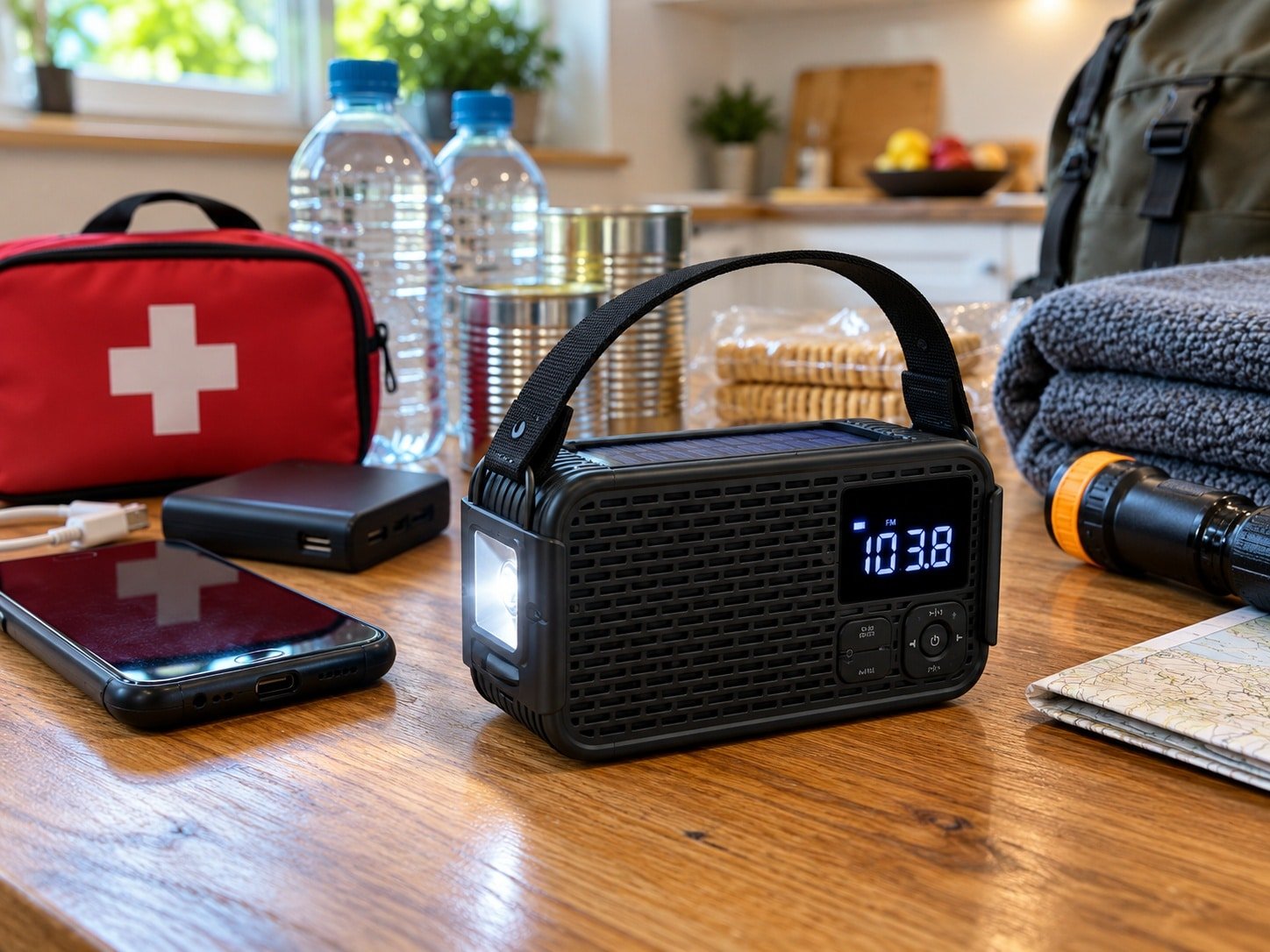




The Philips TAR3500 emergency radio is designed for situations where keeping informed matters more than having the latest technology.
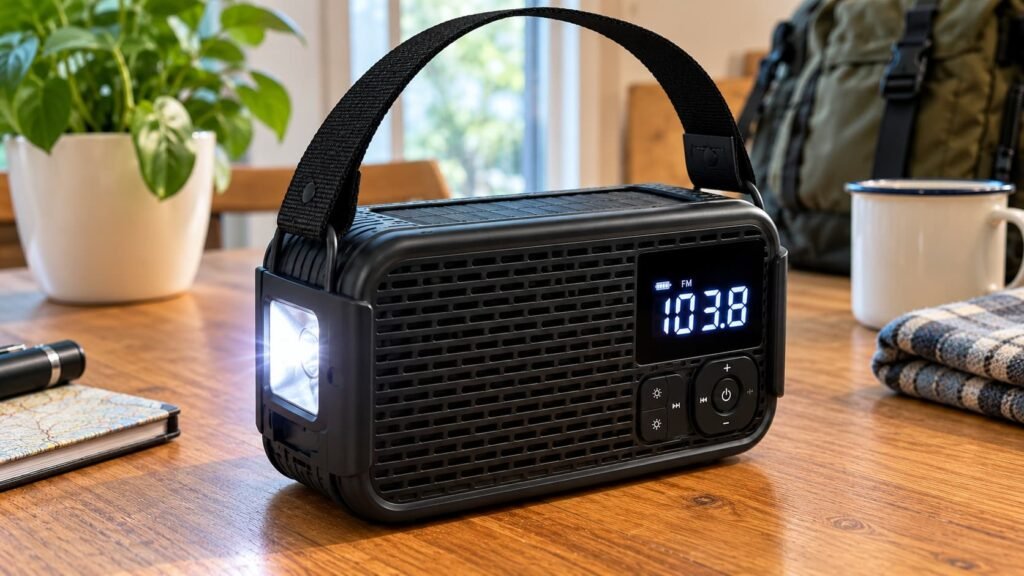
Whether you’re preparing for a power outage, putting together an emergency kit, or heading off on a camping trip, having a reliable radio that doesn’t depend entirely on mains electricity makes sense.
For this Philips TAR3500 review, I’ve looked at the manufacturer’s specifications, operating instructions, charging options, and practical features to see whether this multi-powered radio deserves a place in your emergency supplies.
What caught my attention was the combination of hand crank charging, solar power, replaceable batteries, an integrated flashlight, and a built-in phone charging function.
On paper, the Philips TAR3500 offers a useful selection of emergency features in one portable device. But does that make it a sensible purchase?
At a Glance: Philips TAR3500 Emergency Radio
With AM/FM, SOS Siren & Power Bank

Best for: Household emergency kits, power outages, camping, and backup communications.
A portable radio with multiple charging methods, AM/FM reception, emergency lighting, and an SOS alarm.
| Specification | Philips TAR3500 |
|---|---|
| Radio reception | Digital AM/FM, weather band on North American model |
| Charging methods | USB-C, hand crank, solar, 4 AAA batteries |
| Rechargeable battery | Replaceable lithium-ion battery |
| Speaker | 3W mono |
| Flashlight | Built-in adjustable light |
| Reading light | Integrated |
| Emergency alarm | SOS siren and flashing light |
| Phone charging | USB-A output |
| Water resistance | IP55 |
| Weight | Approximately 1.48 lb |
| Dimensions | 7.32 × 4.06 × 3.03 inches |
| Bluetooth | No |
These details come from Philips’ published product specifications and operating manual. The manufacturer’s documentation lists a 5,200 mAh lithium-ion battery, although one marketing description refers to a 2,600 mAh power bank. Buyers should confirm the battery specification for the exact US version before ordering.
What Makes the Philips TAR3500 Different?
There are plenty of inexpensive emergency radios available, many offering a similar combination of solar panels, hand cranks, and flashlights.
The Philips TAR3500 stands out because it brings several practical features together with digital tuning, a rechargeable battery, and alternative power sources.
The four main attractions are straightforward.
- Multiple charging options reduce dependence on a single power source.
- AM/FM reception provides access to broadcasts when internet services are unavailable.
- Built-in lighting provides an alternative to searching for a separate flashlight.
- USB phone charging offers limited backup power for small devices.
I particularly like the idea of keeping one device in an emergency kit that covers several everyday needs.
Of course, combining features doesn’t automatically mean every feature performs as well as a dedicated product. A separate power bank, for example, will often make more sense for regular phone charging.
Philips TAR3500 Charging Options: How Practical Are They?
One of the strongest selling points of this Philips emergency radio is its ability to operate using several power sources.
USB-C Charging
USB-C is the most convenient way to charge the built-in battery.
Philips specifies a charging time of approximately 3.5 hours under the recommended charging conditions.
For normal use, I’d charge the radio from a wall adapter before storing it with emergency supplies.
USB-C also makes charging convenient when you’re preparing for a camping trip or checking your equipment before storm season.
Hand Crank Charging
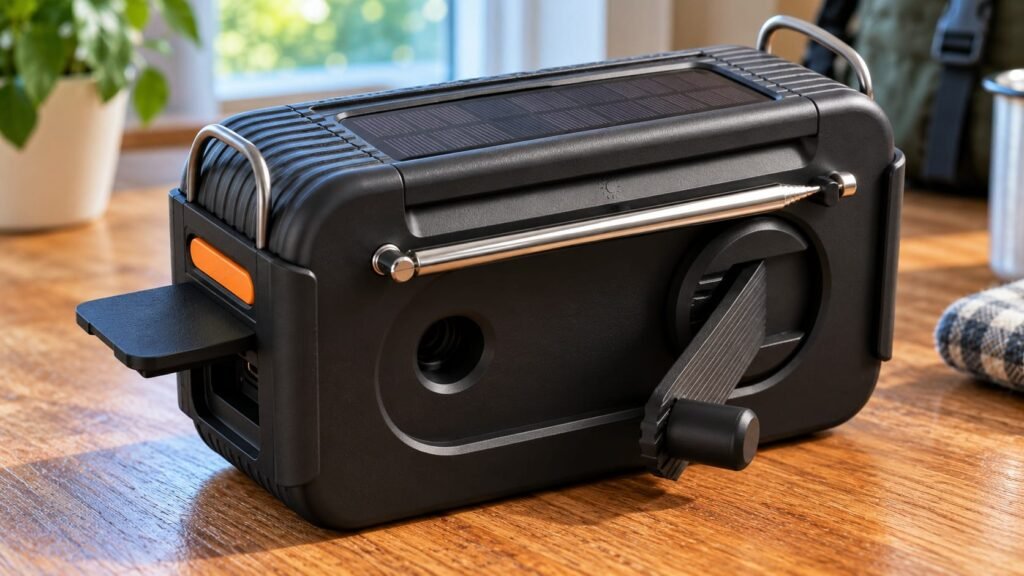
The hand crank is arguably the most important backup feature.
If the electricity fails and the internal battery becomes depleted, you can turn the crank to generate additional power.
This is particularly useful during extended outages when conventional charging options aren’t available.
There is one limitation worth understanding.
Hand crank charging is an emergency measure, rather than a practical replacement for fully charging the battery. You should expect to spend time turning the handle to obtain a relatively small amount of usable power.
I would treat this feature as a way to keep the radio functioning when other options fail, rather than something I’d rely on for charging my phone.
Solar Charging
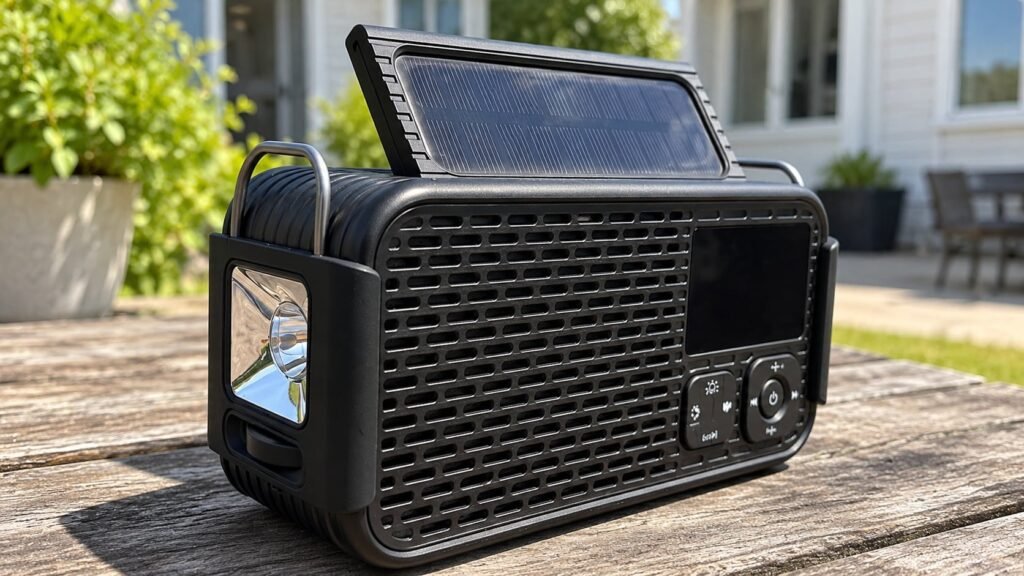
The integrated solar panel provides another way to replenish the battery.
For camping trips, this offers some extra flexibility, particularly when you’re spending several days away from electrical outlets.
The downside is the small size of the panel.
Small solar panels generally produce limited charging power, especially in cloudy conditions or when sunlight doesn’t strike the panel directly.
Philips recommends treating solar and hand crank charging as emergency charging methods.
AAA Battery Backup
Another useful feature is the option to run the radio using four AAA batteries.
This gives you a separate source of power when the rechargeable battery is depleted.
For an emergency kit, I’d keep a sealed pack of suitable AAA batteries alongside the radio and check their expiration dates periodically.
The batteries are not included, so remember to purchase them separately.
Radio Reception and Sound Quality
A radio’s most important job during an emergency is to receive information clearly.
The Philips TAR3500 features digital AM/FM tuning, automatic station scanning, and station presets.
The manufacturer’s specifications list a 3W mono speaker and support for storing 20 FM and 20 AM stations.
That should be sufficient for listening to news bulletins, weather information, and local radio broadcasts in ordinary conditions.
The telescopic antenna also provides a way to adjust reception when you’re indoors or camping in an area with weaker signals.
One feature I appreciate is the digital tuning. Instead of turning an analog dial and trying to find the clearest frequency, you can search for available stations electronically.
The radio also includes a headphone connection, which is useful when listening privately.
I haven’t independently measured the TAR3500’s reception range, speaker volume, or audio clarity. Actual reception will depend on your location, surrounding buildings, terrain, and available broadcasts.
Does the Philips TAR3500 Receive NOAA Weather Radio?
The North American operating manual identifies a weather-band setting for receiving compatible weather broadcasts.
This is particularly relevant for US buyers who want access to NOAA Weather Radio information during severe weather.
Before buying, confirm that the Amazon listing supplies the North American version with weather-band reception.
A weather-band receiver should not automatically be treated as a radio that activates itself for every NOAA warning. The documentation reviewed does not establish automatic weather-alert activation.
For severe weather preparedness, I’d still recommend enabling Wireless Emergency Alerts on your phone and maintaining other ways to receive official warnings.
Built-In Flashlight and Reading Light
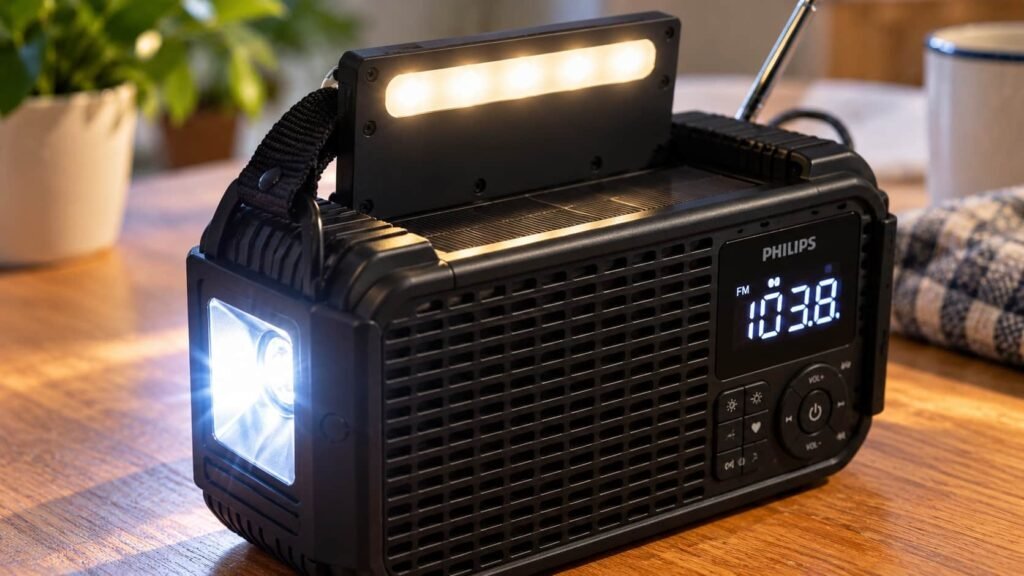
The Philips TAR3500 includes two lighting functions.
The first is a built-in flashlight with adjustable brightness. This is useful when moving around a dark room during a power outage or finding equipment inside a tent.
The second is a reading light, which provides a more convenient option for illuminating a small area.
Having both functions makes sense.
A flashlight works better when you need to direct light toward something, while a reading light is more practical for stationary tasks.
For example, during a power outage, you might use the flashlight to locate your emergency supplies and then switch to the reading light while checking instructions or a printed contact list.
I wouldn’t expect this radio to replace a dedicated camping lantern or a high-output flashlight.
For occasional emergency lighting, though, the combination is practical.
SOS Alarm and Emergency Signaling
The Philips TAR3500 includes a dedicated SOS function.
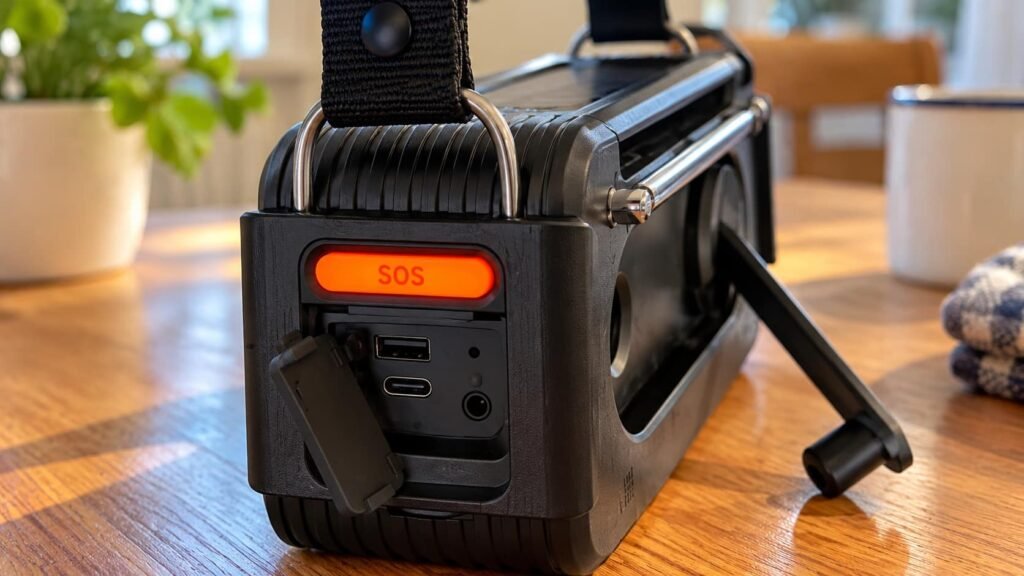
According to Philips, activating the SOS button triggers an audible siren and flashing light. The device also includes an ultrasonic dog-whistle function.
These features are intended to attract attention when assistance is needed.
For campers, hikers, and people preparing household emergency supplies, having an additional signaling option may be useful.
There are limitations.
An SOS siren does not contact emergency services, transmit your location, or replace a satellite communicator.
Similarly, an ultrasonic whistle should not be treated as a guaranteed method of attracting rescuers.
I would regard these features as additional emergency tools rather than the main reason to buy the radio.
Can the Philips TAR3500 Charge Your Phone?
Yes. The Philips TAR3500 has a USB-A output for charging compatible mobile devices.

This feature is particularly appealing when you’re preparing for an electricity outage.
If your phone battery is running low, having another source of power available can help you maintain communication.
But there is an important trade-off.
The radio’s rechargeable battery also powers its receiver, lighting, and other functions. Charging a phone reduces the energy available for those features.
The actual amount of phone charging you obtain will depend on the battery capacity, its remaining charge, your phone, and conversion losses.
For this reason, I would use the phone charging feature sparingly during a prolonged emergency.
A dedicated USB power bank is a better choice if you need to charge several devices or keep a smartphone operating over multiple days.
Build Quality, Portability, and Water Resistance
The Philips TAR3500 weighs approximately 1.48 lb and measures around 7.3 inches wide.
That makes it portable enough for a household emergency kit, car emergency supplies, or a camping equipment bag.
It’s not an ultralight backpacking radio, but its size is reasonable given the built-in battery, lighting, and charging features.
One specification worth highlighting is the IP55 rating.
This means the housing offers protection against limited dust ingress and low-pressure water jets.
That’s useful when you’re camping or using the radio outdoors in unsettled weather.
It does not mean the radio is waterproof or suitable for submersion.
I would still keep it sheltered during heavy rain and avoid leaving it exposed unnecessarily.
The carrying strap also provides a convenient way to transport or hang the radio.
For household emergency use, portability matters because you may need to move between rooms or take your emergency supplies with you.
Philips TAR3500 Pros and Cons
After reviewing the specifications and available documentation, there are several reasons to consider the Philips TAR3500, along with a few limitations worth understanding.
Pros
- Four power options provide flexibility during outages.
- Digital AM/FM tuning makes finding stations straightforward.
- North American version supports weather-band reception.
- Built-in flashlight and reading light are useful during blackouts.
- USB-A output provides emergency phone charging.
- IP55 housing offers dust and water resistance.
- SOS siren and flashing light provide additional signaling options.
- AAA batteries offer an alternative to the rechargeable battery.
Cons
- Solar charging is limited by the small integrated panel.
- Hand crank charging requires manual effort and is best reserved for emergencies.
- Phone charging reduces the battery power available for radio operation.
- Not a replacement for a dedicated power bank or camping lantern.
- Automatic NOAA weather-alert activation is not confirmed.
- Four AAA backup batteries must be purchased separately.
- No Bluetooth connectivity.
Is the Philips TAR3500 Good for an Emergency Kit?
I think the Philips TAR3500 makes sense as part of a well-prepared household emergency kit.
When electricity fails, mobile networks become congested, or internet services stop working, access to broadcast information can be useful.
A battery-powered emergency radio gives you another way to receive updates without relying entirely on your smartphone.
The TAR3500 also reduces the number of separate items you need to carry by including lighting, a siren, and limited phone charging.
For a typical household, I’d include the following alongside the radio:
- Spare AAA batteries.
- A fully charged dedicated power bank.
- USB charging cables.
- A separate LED flashlight.
- Bottled drinking water.
- Nonperishable food.
- A first aid kit.
- Essential medication arrangements.
- A printed emergency contact list.
If you’re building an emergency kit from scratch, our 3-Day Emergency Kit Checklist covers the main supplies worth considering.
Although that checklist focuses on UK households, many of the same basic preparedness principles apply in the United States.
For US-specific emergency preparedness advice, Ready.gov also provides official recommendations.
Philips TAR3500 vs Other Emergency Radios
The Philips TAR3500 isn’t the only option worth considering.
There are simpler hand crank radios, compact battery-powered models, and larger emergency radios with higher-capacity batteries.
Which type makes the most sense depends on how you intend to use it.
| Radio type | Main advantage | Main limitation |
|---|---|---|
| Philips TAR3500 | Multiple power sources and integrated emergency features | Limited backup phone charging |
| Basic hand crank radio | Simple, compact emergency listening | Fewer additional features |
| Large-capacity emergency radio | More stored energy for compatible devices | Often larger and heavier |
| Standard battery-powered radio | Straightforward operation | Depends on replacement batteries |
For household preparedness, I prefer the flexibility offered by multiple charging methods.
For someone who only needs occasional radio reception during short outages, a basic battery-powered radio may be sufficient.
If you’re interested in other hand crank models, take a look at our Best Wind-Up Emergency Radios Guide.
That guide focuses on UK models, so US buyers should check regional radio-band compatibility before choosing an alternative.
Who Should Buy the Philips TAR3500?
The Philips TAR3500 is worth considering if you want a portable radio that serves several emergency purposes.
I would particularly recommend researching this model if you’re:
- Preparing a household emergency kit for storms or power outages.
- Looking for a camping radio with backup charging options.
- Putting together emergency supplies for your vehicle.
- Seeking an AM/FM radio with integrated lighting.
- Looking for an emergency radio that can provide limited phone charging.
- Preparing for situations where internet access may become unavailable.
Who Should Look Elsewhere?
This radio may not be the best choice for everyone.
If your main priority is charging smartphones and tablets, a dedicated high-capacity power bank will generally be more practical.
If you need a compact radio for ultralight backpacking, the TAR3500’s weight may be more than you want to carry.
And if receiving automatic severe weather alerts is your primary requirement, choose a model with clearly documented NOAA alert functionality.
Frequently Asked Questions
Is the Philips TAR3500 a good emergency radio?
Based on its published specifications, the Philips TAR3500 is a well-equipped option for emergency preparedness. Multiple power sources, digital radio reception, integrated lighting, and a USB charging output make it suitable for household emergency kits. Long-term reliability has not been independently verified for this review.
Does the Philips TAR3500 work without electricity?
Yes. The radio can operate using its rechargeable battery or four AAA batteries. It also supports hand crank and solar charging, providing alternatives when mains electricity is unavailable.
How long does the Philips TAR3500 battery last?
Philips lists an operating time of up to 60 hours in its published specifications. Actual runtime depends on operating conditions and which features you use. This figure should not be interpreted as a guarantee of 60 hours of continuous operation with lighting or phone charging enabled.
Can you charge a smartphone using the Philips TAR3500?
Yes. The USB-A output supports charging compatible devices. The amount of charge available depends on the radio’s remaining battery capacity and the connected device. It’s best used as a backup rather than your primary phone charger.
Is the Philips TAR3500 waterproof?
No. The radio has an IP55 rating, which provides protection against limited dust ingress and low-pressure water jets. It should not be submerged in water.
Is the Philips TAR3500 suitable for camping?
Yes. Its portable design, AM/FM radio, flashlight, reading light, and alternative charging methods make it a practical option for camping trips. The carrying strap and water-resistant housing are also useful outdoor features.
Philips TAR3500 Review: Final Verdict
The Philips TAR3500 is a sensible option for anyone looking to add a multi-powered radio to their emergency supplies.
What appeals to me most is the flexibility.
Having USB-C charging, a hand crank, solar charging, and AAA battery backup means you’re less dependent on one source of electricity.
The digital radio, built-in lighting, and emergency signaling functions add further practical value.
There are compromises. The small solar panel and hand crank are backup charging methods, and the USB phone charging function shouldn’t replace a dedicated power bank.
For home emergency preparedness and occasional camping trips, though, the TAR3500 has a useful combination of features.
My recommendation is to consider it as a backup communication and lighting device, alongside spare batteries, a dedicated power bank, and the other essentials in your emergency kit.
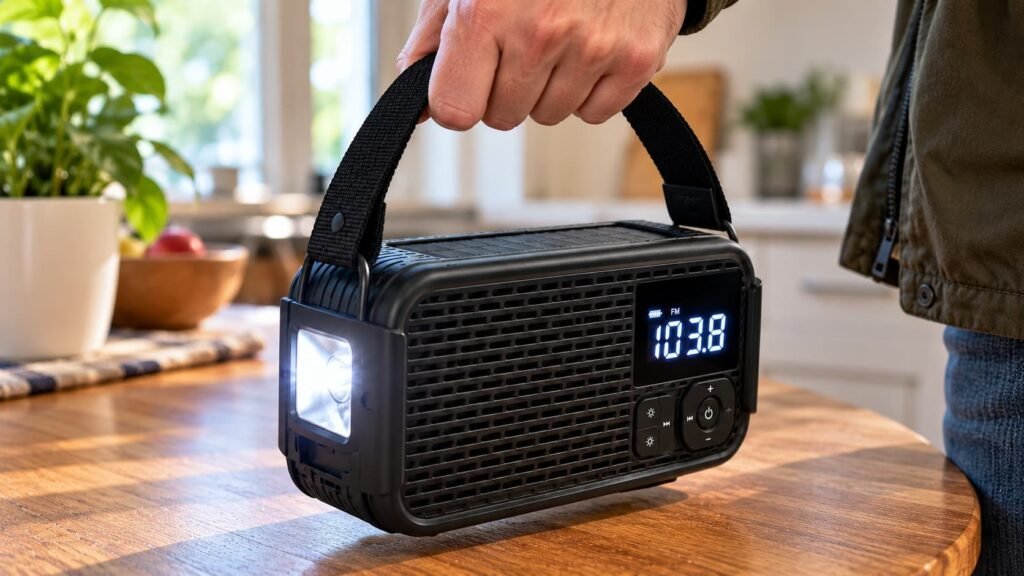
Philips TAR3500 Multi-Powered Emergency Radio
Best for: Home emergency preparedness, power outages, and camping.
Check the Philips TAR3500 on Amazon.com
Research sources: Philips official product information and Philips TAR3500 operating manual.
CampEquipmentPlus relies on reader support. Purchases made via links on our website may earn us an affiliate commission at no extra cost to you, helping keep the site running.