
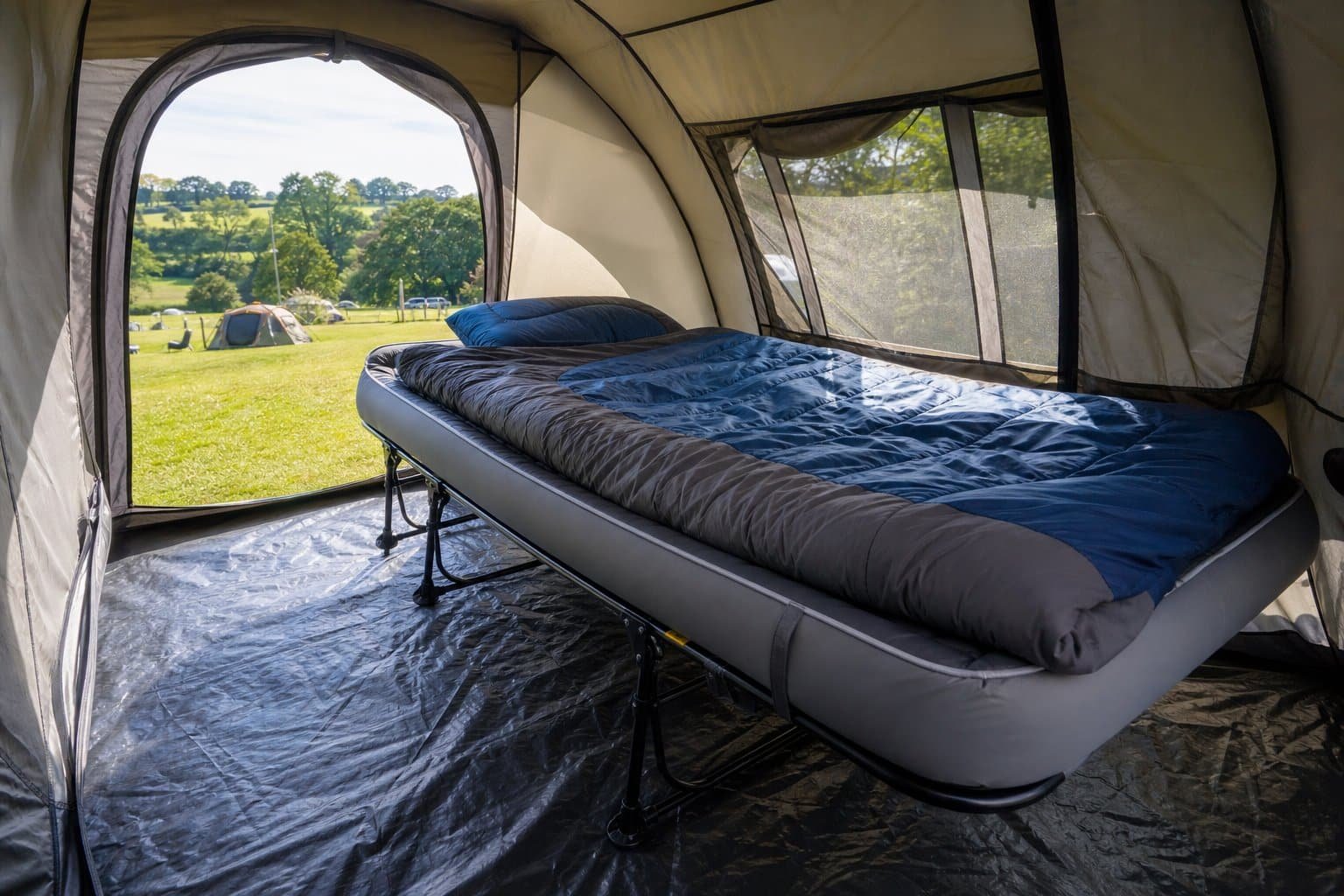
Best Camping Air Beds for Bad Backs UK
The best camping air beds for bad backs in the UK do two things a cheap air bed cannot: they stay firm all night instead of sagging into a hammock, and they lift you high enough to get up in the morning without a struggle.
Ask campers with back pain what goes wrong and the same complaints come up again and again: the middle sags and the hips sink, the bed seems to deflate by 3am, a partner rolling over bounces you awake, cold creeps up from the ground and stiffens everything, and getting up off a low mattress on the tent floor is the hardest part of the day. We have chosen five beds that tackle those problems in different ways, from a 56 cm Coleman airbed cot to a 46 cm raised air bed, a firm-holding TPU queen and a foam-and-air mattress for colder nights, with an honest look at height, support, insulation and pumps for each.
- Choose 40 cm or higher if getting up is the hard part
- Beams, coils or foam stop the middle sagging
- Air beds need insulation underneath on cold nights
- Height helps most Raised air beds and airbed cots let you sit and stand like a normal bed, avoiding the strain of getting up from the floor.
- Support beats softness I-beams, coils, tension-band frames and foam cores stop the mid-bed sag that causes most air-bed backache.
- Firm, not rock hard Inflate firmly, then let a little air out until your hips and shoulders are supported without sinking.
- Check the pump US air beds with built-in 120 V pumps will not work on UK mains; choose battery, rechargeable or self-inflating.
Choosing between camping air beds for bad backs UK campers can buy is mostly about three things: how high the bed sits, how well it resists sagging and how easy it is to set up and carry. Get those right and mornings in a tent feel far less of a struggle. This guide explains bed height, internal structure, materials and tent layout, so you can match one of the five beds above to your needs and your tent.


Best overall Coleman Cot | Best raised air bed Commouds | Best adjustable firmness Sierra Queen | Best foam and air Option3 | Quickest to set up Naturehike Cot | |
|---|---|---|---|---|---|
|
|
|
|
|
| |
| Bed height | 56 cm | 46 cm | Up to 25 cm | 11.4 cm | 35 cm |
| Support | Coil construction | 8 I-beams | TPU, adjustable | Foam + air | Tension-band frame |
| Size | Queen (not quoted) | Queen (not quoted) | 198 x 142 cm | Single (not quoted) | 197 x 138 cm |
| Max load | 272 kg | 295 kg | 181 kg | 100 kg | 300 kg |
| Insulation | Raised off ground | None | None | R13 (maker claim) | Raised off ground |
| Weight | Not quoted | Not quoted | 2.7 kg | Not quoted | 16.4 kg |
| Pump | Battery, included | Rechargeable, included | Battery, included | Self-inflating | Not included |
| Check price | Check price | Check price | Check price | Check price |
Best camping air beds for bad backs: our detailed reviews
Each review covers height, support, firmness, warmth and the complaints owners raise most often. If you are deciding between bed types, our guide to choosing a sleeping pad for camping explains the options, and couples should also see our pick of the best double camping mattresses.
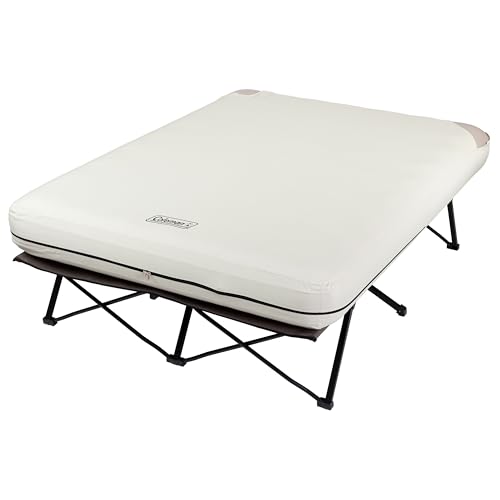
Coil-construction queen air bed on a folding steel cot, 56 cm off the ground
If getting up off a tent floor is the worst part of camping for your back, the Coleman Queen Airbed Cot is the answer. It pairs a queen air mattress with a folding steel frame, and Coleman quotes a 22 inch (about 56 cm) bed height, which is above the 40 to 50 cm range UK camping retailers recommend for people with bad backs and dodgy knees. You sit on the edge, put your feet flat on the floor and stand up, with no kneeling, rolling or pushing yourself up from ground level. The mattress uses Coleman’s coil construction, which is what stops the hammock-like sag in the middle that causes most air-bed backache, and a battery pump is included for inflation and deflation, so it works on any pitch without hook-up. A clip-on side table with cup holders keeps your torch, glasses and painkillers within reach. The trade-offs are size and weight: it needs a tent with a tall, roomy bedroom, Coleman says it is designed for people up to 6 ft (183 cm) tall, and the listing does not quote the length, width, weight or the type of batteries the pump takes. It supports up to 600 lb (about 272 kg), so two adults are fine.
- 56 cm height, easy to sit down and stand up
- Coil construction resists sagging
- Steel frame keeps you off cold ground
- Battery pump works without hook-up
- Side table with cup holders
- Needs a tall, roomy tent bedroom
- Designed for people up to 183 cm
- Weight and dimensions not quoted
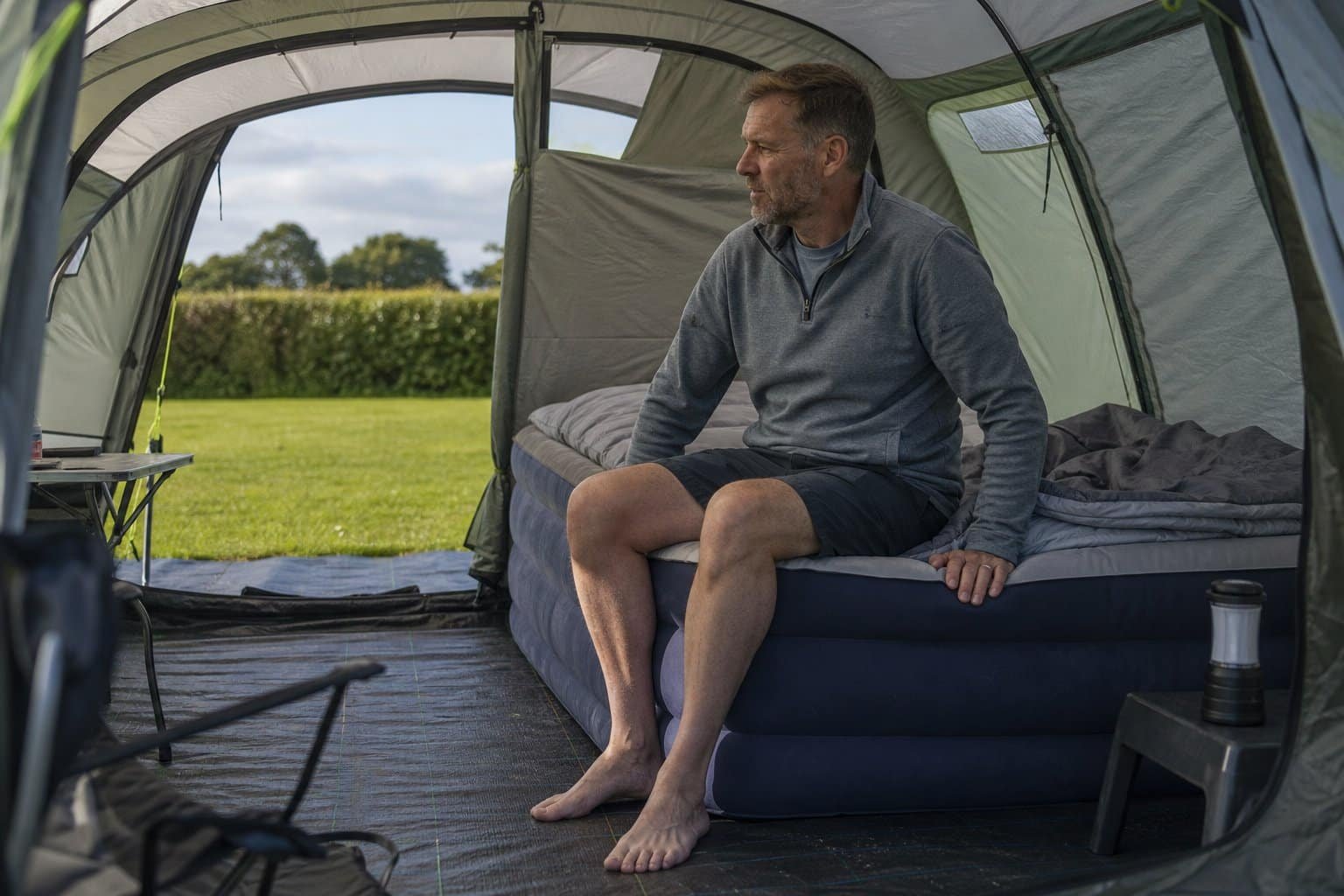
46 cm raised queen air bed with eight I-beams and a cordless pump
Not every tent has room for an airbed cot, and a tall raised air bed gets you most of the way there for far less money. The COMMOUDS Queen stands 18 inches (about 46 cm) high, inside the 30 to 46 cm range of raised camping air beds and roughly twice the height of a standard 20 cm air bed, so getting in and out puts much less strain on your lower back. Inside are eight reinforced I-beams, which COMMOUDS says spread your weight evenly; beam construction is what stops the hips sinking and the middle sagging, the two biggest air-bed complaints from people with back pain. The removable pump has a 2000 mAh rechargeable battery, so there is no 120 V mains plug to worry about on a UK campsite: the maker says it fills the bed in about four minutes, runs for up to 25 minutes per charge, and has a button to adjust firmness, which matters because most people with bad backs prefer a firmer bed than they expect. The top is flocked and the PVC is 30% thicker than before, with repair patches included, and it holds up to 650 lb (about 295 kg). The listing does not say how the pump charges or quote the length, width or weight, and like every uninsulated air bed it gets cold on chilly nights, so put a blanket or foam mat underneath.
- 46 cm raised height without a frame
- Eight I-beams resist sagging
- Rechargeable pump with firmness button
- Repair patches included
- Low price for a raised bed
- No insulation, cold on chilly nights
- Pump charging method not stated
- Size and weight not quoted
198 x 142 cm TPU air bed, up to 25 cm thick, with a built-in pillow
The Sierra Designs Queen Campaign is a car-camping air bed built from TPU rather than the PVC used by most cheap air beds. That matters for bad backs in two ways: TPU stretches far less than PVC, so the bed holds its firmness better through the night instead of slowly softening into a dip, and it is lighter, at about 6 lb (2.7 kg) according to the listing, so lifting and carrying it is easier on your back too. It measures 78 x 56 inches (about 198 x 142 cm) and inflates to an adjustable thickness of up to 10 inches (about 25 cm), so you can run it firm for back support or softer for side sleeping. An integrated pillow along the top edge gives a slight incline for reading, the soft top fabric is quiet when you turn over, and a battery-operated pump and oversized stuff sack are included. The limitations: 25 cm is still low compared with a raised bed or a cot, so getting up from it takes more effort if your back is bad in the mornings, and it has a conservative 400 lb (about 181 kg) weight limit. Like any air bed it has no insulation.
- TPU stretches less and holds firmness
- Light at about 2.7 kg
- Adjustable thickness up to 25 cm
- Quiet top fabric and built-in pillow
- Battery pump included
- Only 25 cm high, harder to get up from
- No insulation
- 181 kg weight limit
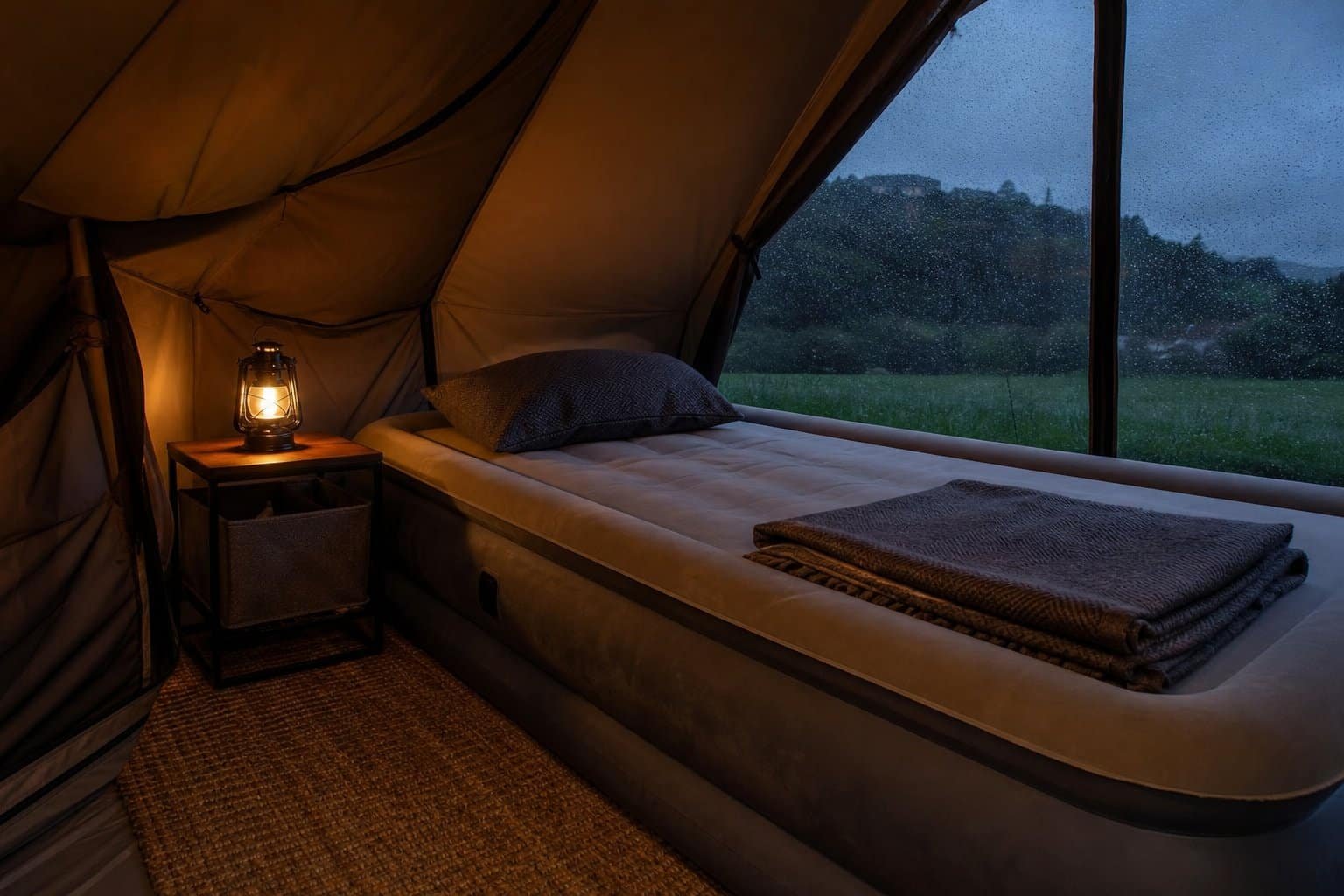
11.4 cm foam-and-air single mattress with adjustable firmness
Spinal-alignment experts point out that pure air beds tend to be either soft enough to sink into or rock hard, and that foam-core designs support the body better. The Lost Horizon Option3 is that kind of mattress: 4.5 inches (about 11.4 cm) of foam combined with air, so you twist the valve, let it self-inflate, then add or release air to set the firmness your back likes. Lost Horizon says the internal structure distributes air and foam evenly to reduce pressure points, and the foam makes it quiet and stable, so it does not bounce or squeak when you move. Because it is foam, it also insulates: the maker claims an R-value of 13, far more than any air bed here, which is useful because cold stiffens backs and joints. Treat that figure as the maker’s own claim rather than an independent test. The catches: it is a single, rated for sleepers up to 220 lb (about 100 kg); it sits low on the ground like any mat; and the maker admits deflating and packing it takes patience, with an electric pump sold separately. The listing does not quote the length, width or packed size. A one-year warranty is included.
- Foam and air together, no bounce
- Adjustable firmness
- Warm, R13 maker claim
- Quiet and stable
- One-year warranty
- Low to the ground
- Single only, 100 kg rating
- Slow to deflate and pack
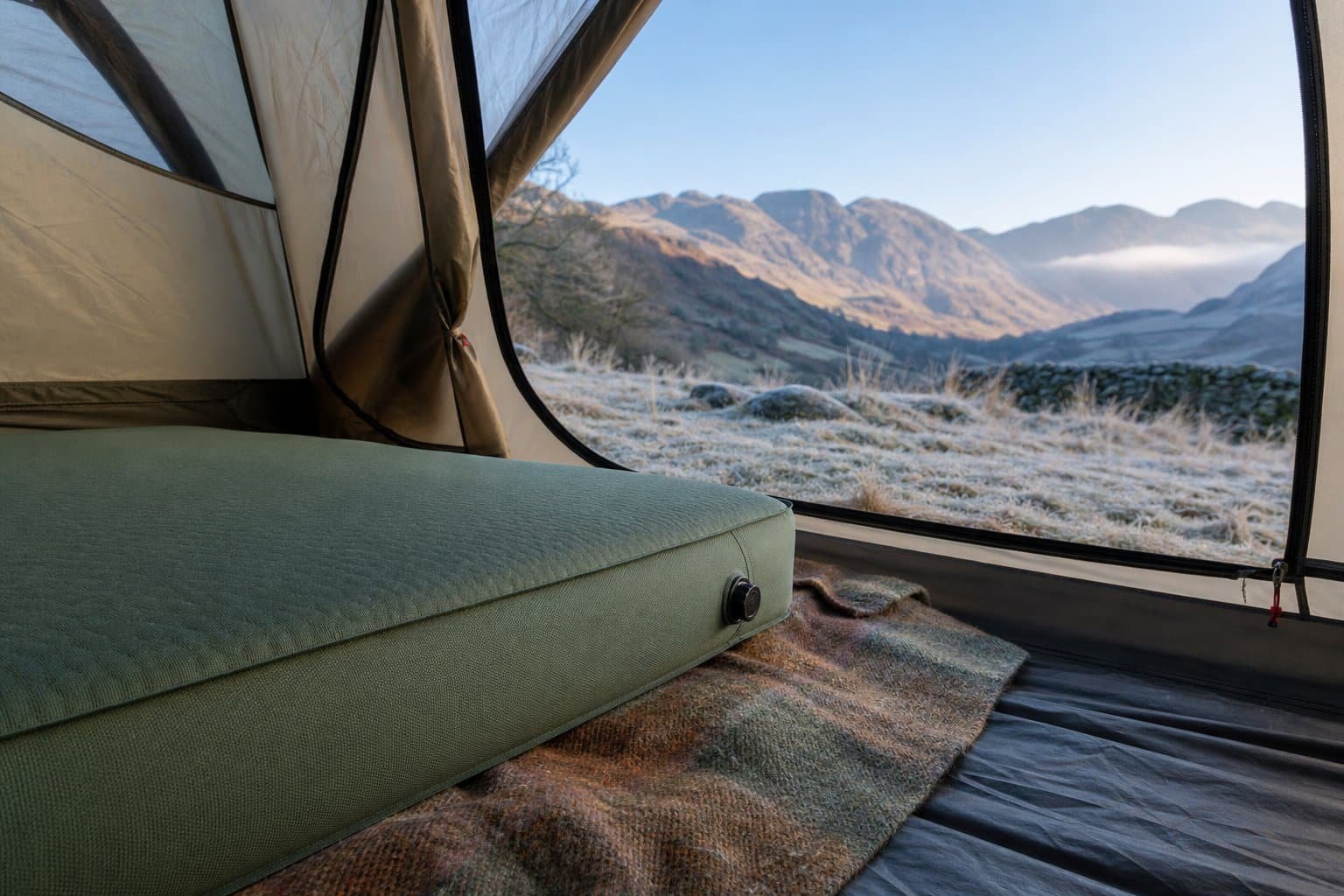
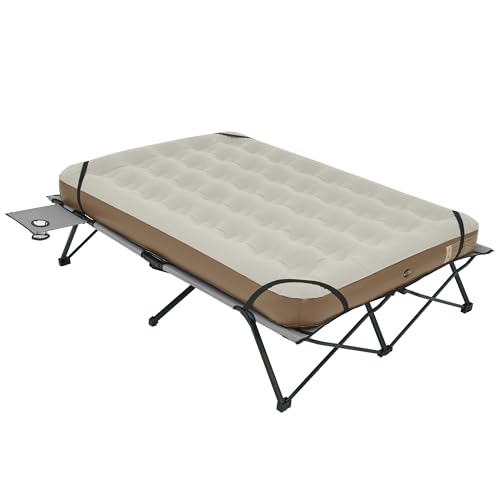
197 x 138 cm double airbed cot, 35 cm high, with a one-step X-frame
Assembling a cot can be as hard on your back as sleeping on the floor, which is why the Naturehike Airbed Cot’s X-frame is its best feature: Naturehike says it unfolds in about a second with no assembly. The frame uses what Naturehike calls a honeycomb system of high-elasticity tension bands to spread your weight across multiple points rather than letting the middle sag, which UK camping retailers identify as the biggest cause of backache on a camp bed. Together with the 7.9 inch (about 20 cm) air mattress it measures 77.6 x 54.3 x 13.8 inches, roughly 197 x 138 x 35 cm, so it is a full double with a bed height inside the raised-bed range, and it holds up to 662 lb (about 300 kg). A detachable side table and phone pocket are included, and the cot and mattress can be used separately. At 36.2 lb (about 16.4 kg) it is heavy, though it folds to about 98 x 24 x 14 cm and comes in a wheeled bag, so you can roll it rather than carry it. Note that the air pump is not included, so budget for a battery or rechargeable pump, and it is lower than the Coleman cot.
- Unfolds in seconds, no assembly
- Tension-band frame spreads weight
- 35 cm bed height
- 300 kg capacity
- Wheeled carry bag
- Pump not included
- Heavy at about 16.4 kg
- Lower than the Coleman cot
Raised air bed, airbed cot or foam mat: which is best for a bad back?
If your back is worst first thing in the morning, height matters more than anything else. A standard air bed sits around 15 to 22 cm off the floor, a raised air bed 30 to 46 cm, and an airbed cot can reach 56 cm, about the height of a bed at home. Pitchup’s camping beds guide also notes that elevated beds are easier to get in and out of, but warns that air beds can lose air overnight, so look for good valves and check reviews for sagging. Support comes next: beams, coils, tension bands or foam keep your spine level instead of letting your hips sink. Warmth is the third factor, because cold stiffens backs: an air bed has no insulation, so add a foam mat or blanket underneath, or choose a self-inflating foam mattress. Our guides to what R-value a sleeping pad needs and the best self inflating camping mats cover the foam route in more detail.
How to choose camping air beds for bad backs UK campers can trust
A cheap, low air bed is a common reason people say camping hurts. It sags in the middle, softens overnight and leaves you climbing up from floor level each morning. The beds in this guide tackle those problems in different ways. This is buying advice rather than medical advice, so if your back pain is severe, persistent or getting worse, speak to your GP or a physiotherapist before choosing a bed for a long trip.
Height comes first
If getting up is the hardest part of the day, start with height. A standard air bed sits roughly 15 to 22 cm off the floor. A raised air bed like the COMMOUDS Queen reaches about 46 cm, and an airbed cot such as the Coleman Queen Airbed Cot reaches about 56 cm. The Naturehike Airbed Cot sits at about 35 cm. Higher beds let you sit on the edge with your feet flat, more like a bed at home.
Support and structure
Next, look inside the bed. The Coleman uses coil construction, the COMMOUDS has eight I-beams, the Naturehike frame uses tension bands, and the Lost Horizon Option3 combines foam with air. Each is designed to spread your weight and stop your hips sinking lower than your shoulders. Simple tube-chamber air beds, by contrast, are the ones most likely to form a hammock-like dip in the middle.
Raised air bed vs airbed cot: which suits you?
A raised air bed is a single unit with no frame. It is cheaper, lighter to carry and quicker to pack away than a cot, and it fits tents where a frame would be awkward. The downsides are that the edges are softer when you sit on them, and like every air bed it can feel softer by morning as the air inside cools overnight. A quick top-up before bed usually solves that.
An airbed cot puts the mattress on a folding frame. The frame gives a firmer edge to sit on, lifts you clear of cold ground and usually adds a side table for essentials. The trade-off is weight and bulk: the Naturehike cot weighs about 16.4 kg, although it comes in a wheeled bag. If lifting is difficult for you, check how a cot is packed and carried before you buy.
As a rule of thumb among camping air beds for bad backs UK campers choose, a raised air bed suits medium-sized family tents and tighter budgets, while an airbed cot suits large tents with tall bedrooms and campers who want the highest, most bed-like option. If you would rather skip air altogether, our guide to the best camping beds for adults covers folding cots with fabric beds.
PVC, TPU and foam: why materials matter
Most budget air beds are made from PVC, which stretches during the first few nights of use. That stretch is why new beds can feel as though they are leaking when they are not. The Sierra Designs Queen Campaign uses TPU instead, which stretches far less, so it holds its firmness more consistently. TPU is also lighter, which makes the Sierra Designs bed easier to lift and carry at around 2.7 kg.
Flocked tops, like the one on the COMMOUDS, are soft to the touch and help sheets stay in place, while quieter fabric tops reduce the squeaks that can wake you or a partner. Foam-and-air mattresses such as the Lost Horizon Option3 behave differently again: the foam adds stability and insulation, so the surface does not bounce, though it sits low to the ground and is a single rather than a double.
Whatever the material, check the weight limit for two people. Among the doubles in this roundup the Sierra Designs has the lowest stated limit, while the Coleman cot, COMMOUDS and Naturehike are rated higher; the single Lost Horizon is rated for one sleeper up to about 100 kg. Choosing camping air beds for bad backs UK couples will share with a comfortable margin under the limit helps the bed keep its shape over time.
Setting up a tent bedroom around a bad back
The tent matters as much as the bed. A tall family tent with near-vertical walls lets you stand up straight to dress and get into bed, rather than stooping. Before you go, check the bedroom’s length and width at bed height, because a cot or raised air bed takes up more usable space under sloping walls than a low mat does.
Think about layout. Position the bed so you can get out on the side with the most floor space, and keep a torch, water and anything else you need within reach, ideally on a side table like those supplied with the Coleman and Naturehike cots. Inflate the bed where it will sleep rather than carrying it inflated through a narrow tent door, and leave a clear path to the tent door so night-time trips outside do not involve stepping over bags.
Lifting and packing can be harder on your back than sleeping. Split heavy loads into smaller bags, use wheeled bags where you can, and let a battery or rechargeable pump do the deflating. Your pillow matters too: a supportive one can make a raised air bed feel far more like home. Our roundup of the best camping pillows for neck support has options that pack small.
Staying warm on cold mornings
Cold can make a stiff back feel worse first thing, and air beds cool to the temperature of the ground or the air beneath them. When comparing camping air beds for bad backs UK spring and autumn trips will test, look at how each one handles cold. An airbed cot lifts you clear of the ground, but air still circulates underneath, so a foam mat or folded blanket under your bedding helps on chilly nights.
The Lost Horizon Option3 is the warmest option in this list, because its foam core insulates; the maker claims an R-value of 13, though that is not an independent test. For any of the other camping air beds for bad backs UK campers buy, a fleece blanket, a warm sleeping bag and dry layers for the night make a noticeable difference, and getting dressed inside a warm sleeping bag avoids a chilly start to the day.
Common mistakes to avoid
Running the bed too soft. A soft air bed can feel lovely when you first lie down, but you may sink further as the night goes on. Start firm and release a little air at a time. Skipping insulation. Air beds have no insulation, and cold air under a raised air bed chills you from below, so add a blanket or foam mat on chilly nights.
Buying for the bed rather than the tent. A queen-size cot will not help if it barely fits your bedroom pod. Forgetting the pump. US beds with built-in 120 V pumps will not work on UK mains, and the Naturehike cot does not include a pump at all, so check what you need, and pack spare batteries for a battery pump.
Final thoughts
The best camping air beds for bad backs UK campers can choose combine height, firm internal support and a setup that does not strain you before bedtime. Pick an airbed cot if you have a large tent and want the most bed-like height, a raised air bed for value and simplicity, a TPU bed if weight and firmness matter, or a foam-and-air mat for colder nights. And if your back pain is severe or persistent, please talk to your GP or a physiotherapist before your trip.
What to look for in a camping air bed for a bad back
40 to 50 cm lets you sit on the edge with your feet flat and stand up without twisting. Raised air beds reach about 46 cm; airbed cots go higher.
I-beams, coils or foam cores stop the hammock sag in the middle that is the biggest cause of backache on cheap air beds.
A pump with deflate, or a foam-and-air mat, lets you set the bed firm enough to support your hips without feeling like a board.
Air beds cool to ground temperature. On cold nights add a foam mat or blanket underneath, or choose foam with a stated R-value.
Built-in 120 V pumps on US air beds will not work on UK mains. Battery, rechargeable or self-inflating designs work on any pitch.
Cots can weigh 15 kg or more. Look for wheeled bags, no-assembly frames and light TPU beds if lifting is a problem.
Check length if you are over 180 cm and the maximum load for two sleepers, and measure your tent bedroom, especially for cots.
How to sleep better on an air bed with a bad back
- Pitch on level ground
Even a slight slope makes you roll to one side and twist your spine. Clear stones and pick the flattest spot.
- Inflate firm, then fine-tune
Fill it fully, lie on your back and let air out until your hips sink slightly but you cannot feel the floor or frame.
- Top it up for the first nights
New air beds stretch and air cools at night, so they feel softer by morning. A quick top-up before bed keeps your support even.
- Insulate underneath
Lay a foam mat, blanket or tent carpet under an air bed. Staying warm helps stop muscles stiffening overnight.
- Get up the easy way
Roll onto your side, push up with your arms and swing your legs down together rather than sitting straight up.
- Bring your usual pillow
A pillow that keeps your neck in line, or one between your knees if you sleep on your side, takes pressure off your lower back.
How we chose these camping air beds for bad backs
We have not slept on every bed in this list ourselves. Our picks are based on manufacturer specifications, UK camping retailer and buying guides, spinal-alignment advice and recurring themes in owner feedback. This is buying advice, not medical advice: if your back pain is severe or persistent, speak to your GP or a physiotherapist.
-
Height
We favoured raised beds and cots because getting up from the floor was the most common complaint.
-
Support and firmness
We compared beams, coils, frames and foam cores, and looked for adjustable firmness.
-
Warmth
We noted which beds insulate and where an R-value is the maker’s own claim.
-
UK practicality
We chose pumps that work without 120 V mains and noted weight, setup and load ratings.
Not every Amazon listing quotes dimensions, weight or pump details. Where a figure is missing we say “Not quoted” rather than guess.
Are air beds bad for your back?
A cheap, soft air bed that sags in the middle can leave your spine out of line and make back pain worse. A firm air bed with beams, coils or a foam core, inflated properly, supports most people well.
What is the best camping bed for a bad back?
For most people, a raised bed or airbed cot such as the Coleman Queen Airbed Cot, because it is firm and high enough to get in and out of easily. If you prefer a mat, a thick foam-and-air mattress is more supportive than a pure air bed.
How high should a camping bed be for a bad back?
Around 40 to 50 cm, so you can sit on the edge with your feet flat on the floor. Raised air beds reach about 46 cm and airbed cots can be higher.
How firm should an air bed be for back pain?
Firm enough that your hips do not sink below your shoulders, but not so hard that your shoulders and hips take all the pressure. Inflate fully, then release a little air until it feels supportive.
Why does my air bed go soft overnight?
New air beds stretch for the first few uses and cold night air contracts, so they lose firmness by morning. Top up for the first nights; if it keeps going flat, check for a puncture or a faulty valve.
Will a US air bed pump work in the UK?
Built-in pumps designed for 120 V US mains will not work on UK sockets without a converter. Battery, rechargeable and self-inflating designs avoid the problem.
Which camping air bed is best for a bad back?
- Best overall: Coleman Queen-Size Airbed Cot with Steel Frame and Battery Pump
- Best raised air bed: COMMOUDS Queen 18" Raised Air Mattress with Rechargeable Pump
- Best adjustable firmness: Sierra Designs Queen Campaign TPU Air Mattress with Battery Pump
- Best foam and air: Lost Horizon Option3 Self-Inflating Foam Camping Mattress, Single 4.5"
- Quickest to set up: Naturehike Queen Airbed Cot Combo with Side Table
For most UK campers with a bad back, the Coleman Queen Airbed Cot is the best camping air bed: a firm coil-built mattress on a steel frame at 56 cm, so you get in and out as you would at home. The COMMOUDS 18″ Queen gives you raised height and I-beam support for much less, the Sierra Designs Queen Campaign holds its firmness and is light to carry, the Lost Horizon Option3 adds foam support and warmth, and the Naturehike Airbed Cot is a raised double that sets up in seconds.
CampEquipmentPlus relies on reader support. Purchases made via links on our website may earn us an affiliate commission at no extra cost to you, helping keep the site running.