
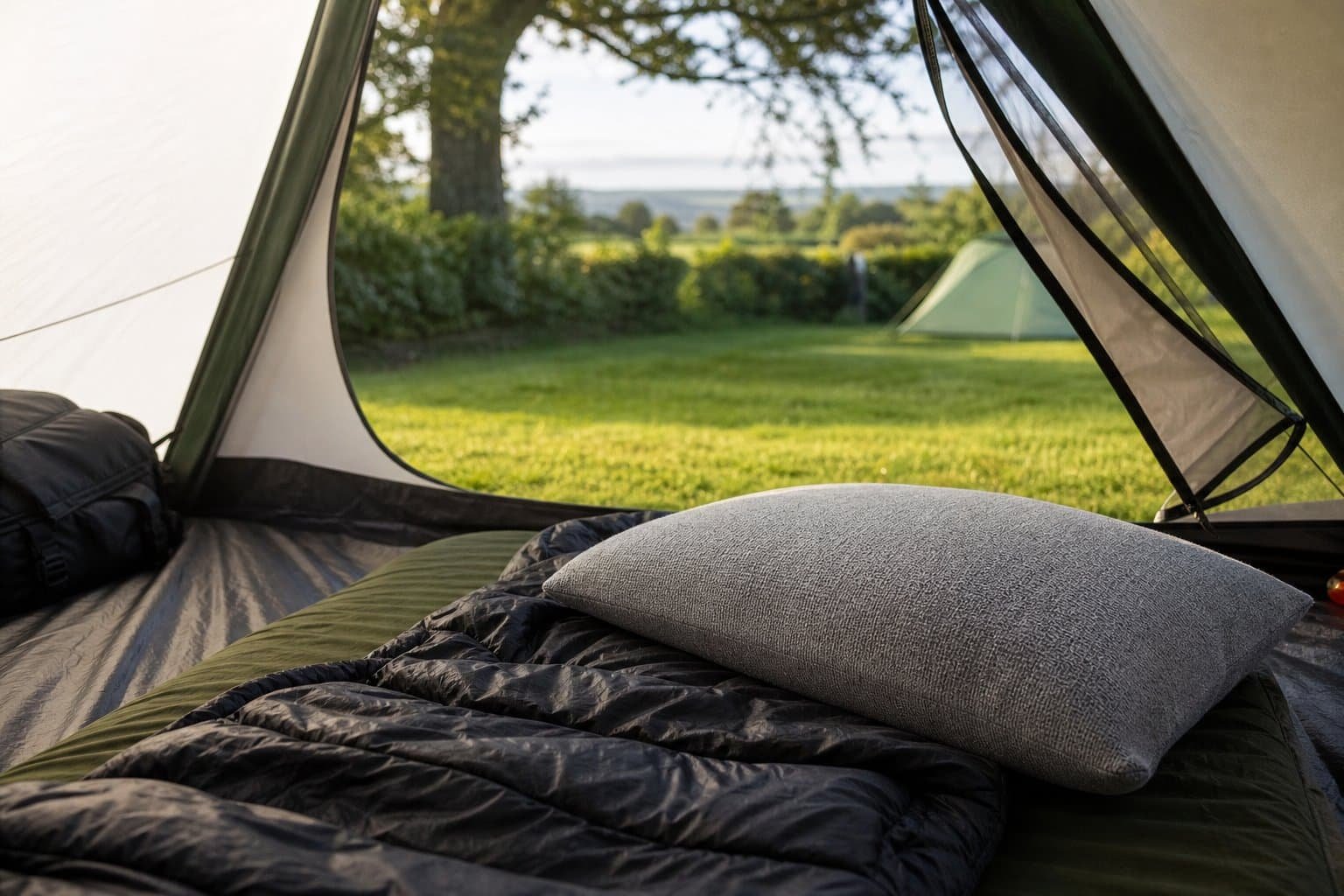
Best Camping Pillows for Neck Support UK
The best camping pillows for neck support in the UK hold your head at the right height for how you sleep, stay put on your mat, feel quiet and soft rather than like a balloon, and pack small enough for your kit.
Campers raise the same complaints about pillows again and again: inflatable pillows are bouncy, crinkly and slide off the mat, cheap ones slowly go flat overnight, foam pillows take up half a rucksack, and a pillow that is too thin or too high leaves you with a sore neck by morning. We compared hybrid, inflatable and foam pillows on height adjustment, shape, grip, noise, packed size and warranty to find the best options for UK camping.
- Hybrids combine air support with a foam top
- Side sleepers need more height than back sleepers
- Adjustable valves or cinch cords let you set the height
- Straps, curved shapes and hood fit stop slipping
- Pillow type Hybrids (air plus foam) give the best mix of support and comfort. Pure air is lightest; foam is quietest but bulky.
- Height for your sleep position Side sleepers need a higher pillow to fill the shoulder gap, around 10 to 12 cm. Back sleepers usually want it lower.
- Adjustability A fine-tune valve or cinch cord lets you set exact height and firmness, the key to neck support.
- Staying put Look for a mat strap, a curved shape that fits your sleeping bag hood or a mat-locking system.
The best camping pillows for neck support UK campers can buy all do one job well: they keep your head level with your spine for the way you sleep, all night long. That depends on height you can adjust, a shape that cradles your neck, a surface that stays put on the mat and a pack size that suits your trip. This guide adds the background behind our five picks so you can choose a camping pillow with confidence.


Best overall NEMO Fillo | Best lightweight Aeros Prem | Best adjustable foam Cinch Reg | Best contoured Bespilow | Best budget Hikenture | |
|---|---|---|---|---|---|
|
|
|
|
|
| |
| Type | Air + foam hybrid | Air + memory foam layer | Foam | Memory foam | Air |
| Size | 43 x 27 x 10 cm | 34 x 24 x 11 cm | 36 x 46 cm | Not quoted | Not quoted |
| Weight | 260 g | 99 g | Not quoted | Not quoted | Not quoted |
| Packed | 15 x 10 cm | 11 x 8 cm | Compresses | About 1/3 size | Drinks-can size |
| Height control | Fine-tune valve | Fine-tune valve | Cinch cord | Fixed contour | Valve |
| Stays put | Not quoted | Hood fit, PillowLock | Not quoted | Not quoted | Mat strap |
| Washable cover | Yes | Not quoted | Yes | Yes | Yes |
| Warranty | Lifetime | Lifetime | 3 years | 1-year service | 365-day guarantee |
| Check price | Check price | Check price | Check price | Check price |
Best camping pillows for neck support: our detailed reviews
Each review covers the pillow’s build, how you set its height, how well it stays in place, packed size and the complaints owners raise most. A pillow only works as well as what is under it, so see our guide to choosing a sleeping pad for camping and our best self-inflating camping mats too.
Air and foam hybrid, 43 x 27 x 10 cm, 260 g, with a built-in stuff sack and lifetime warranty
The most common complaint about camping pillows is that air pillows feel like a balloon: bouncy, slippery and hard to settle into. The NEMO Fillo solves that with a hybrid build. A 3 inch baffled I-beam air cell gives the structure that holds your neck at the right height, while a thick layer of luxury foam on top gives a soft, home-pillow feel instead of a tight plastic surface.
NEMO lists it at 43 x 27 x 10 cm inflated and 260 g, and it packs into its own integrated stuff sack to about 15 x 10 cm, so the bag cannot get lost. A micro-adjustable valve lets you let out tiny amounts of air to fine-tune firmness, which matters for neck support: side sleepers can run it fuller, back sleepers a little softer. The recycled cover is removable and machine-washable, and NEMO backs it with a lifetime warranty against defects.
It is heavier and bulkier than pure air pillows and costs more than budget options, and the Amazon listing itself does not quote size or weight (our figures are from NEMO). For car campers and anyone who has woken up stiff after a night on a basic inflatable, it is the best all-round choice here.
- Air cell for support plus foam for comfort
- No balloon feel or crinkly noise
- Fine-tune valve for exact firmness
- Integrated stuff sack, washable cover
- Lifetime warranty
- 260 g, heavier than pure air pillows
- Pricier than budget pillows
- Specs not on the Amazon listing
Curved inflatable with a memory foam top layer, up to 12 cm thick, 99 g, packs to 11 x 8 cm
If you carry your kit, every gram counts, but a flat, unsupportive pillow ruins sleep. The Aeros Premium weighs just 3.5 oz (about 99 g) and packs to 4.3 x 3.1 inches (about 11 x 8 cm), yet adds a thin memory foam layer under a soft stretch-knit cover, so it feels far less plasticky than most ultralight air pillows.
The Regular measures 13.4 x 9.4 x 4.3 inches (about 34 x 24 x 11 cm), and Sea to Summit quotes up to 12 cm thickness, enough height for most side sleepers. Its ergonomic scalloped, curved shape cradles the head and fits inside a mummy sleeping bag hood, which helps stop the pillow drifting away in the night. The Mini XPRESS valve inflates in a few breaths, deflates fast and lets you fine-tune pressure. If you use a Sea to Summit mat, PillowLock patches lock the two together.
It is smaller than a home pillow, and broad-shouldered side sleepers may prefer the larger sizes. Sea to Summit guarantees it against defects for the life of the product.
- Only 99 g, packs to 11 x 8 cm
- Memory foam layer and knit cover
- Up to 12 cm of adjustable height
- Curved shape fits a sleeping bag hood
- Lifetime guarantee
- Small 34 x 24 cm surface
- Still an air pillow, some bounce
- PillowLock only works with Sea to Summit mats
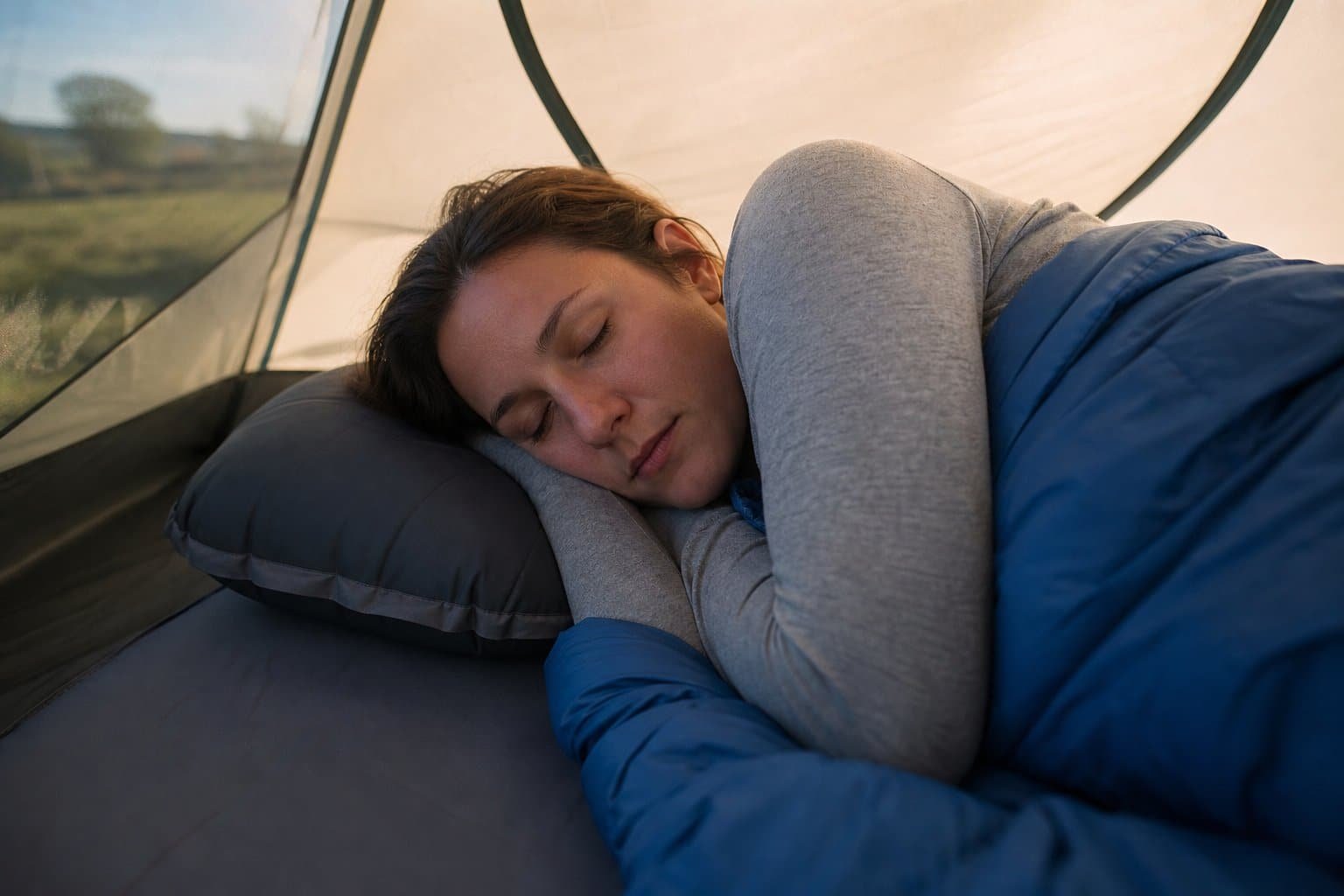
Upcycled foam fill with a cinch cord to set loft and firmness, 36 x 46 cm, machine-washable
Many campers simply dislike inflatables: they are noisy, slippery and cold to the touch. Therm-a-Rest’s Compressible pillows have long been a favourite alternative because they feel like a pillow from home, and the new Cinch version adds a way to set your own neck support.
It is filled with upcycled urethane foam under a soft stretch-knit cover. An integrated cinch cord lets you pull the pillow tighter to raise its loft and firmness, which suits side sleepers, or leave it loose for a lower, softer pillow for back sleepers. The Regular size is 14 x 18 inches (about 36 x 46 cm), larger than the air pillows here, so there is more room to move your head in the night. The compression system shrinks it for packing, it is machine-washable and it carries a three-year warranty.
Foam pillows are bulkier and heavier than air ones, and the listing does not give weight or packed size. Therm-a-Rest advises letting it sit open for 24 hours when new, and storing it uncompressed so it keeps its loft.
- Home-pillow feel, quiet and warm to touch
- Cinch cord adjusts loft for side or back sleeping
- Large 36 x 46 cm surface
- Machine-washable
- Three-year warranty
- Weight and packed size not quoted
- Bulkier than air pillows
- Needs time to regain loft after packing
Contoured cervical memory foam pillow with a cooling cover, rolls to a third of its size, spare pillowcase included
Flat camping pillows leave a gap under the neck, and that is a common reason people wake up stiff in a tent. The Bespilow takes the approach of a home orthopaedic pillow: a contoured shape that follows the curve of your neck, made from high-density slow-rebound memory foam rather than air.
Bespilow says it suits side, back and stomach sleepers and that its foam is not temperature sensitive, so it should stay soft on cold UK nights, a real issue with some memory foams that stiffen in the cold. It compresses to about a third of its size into the included storage bag, and the removable, machine-washable cover uses a cooling, moisture-wicking fabric. A second pillowcase is included, handy on longer trips.
It is a less established brand than NEMO or Therm-a-Rest, the listing does not quote dimensions or weight, and memory foam is bulkier than air, so this is one for car camping rather than backpacking. Contoured pillows also take a few nights to get used to.
- Contoured cervical shape fills the neck gap
- Quiet memory foam, no bounce
- Cold-tolerant foam claim
- Cooling washable cover plus spare case
- Rolls to about a third of its size
- Size and weight not quoted
- Bulkier than air pillows
- Contour shape takes getting used to
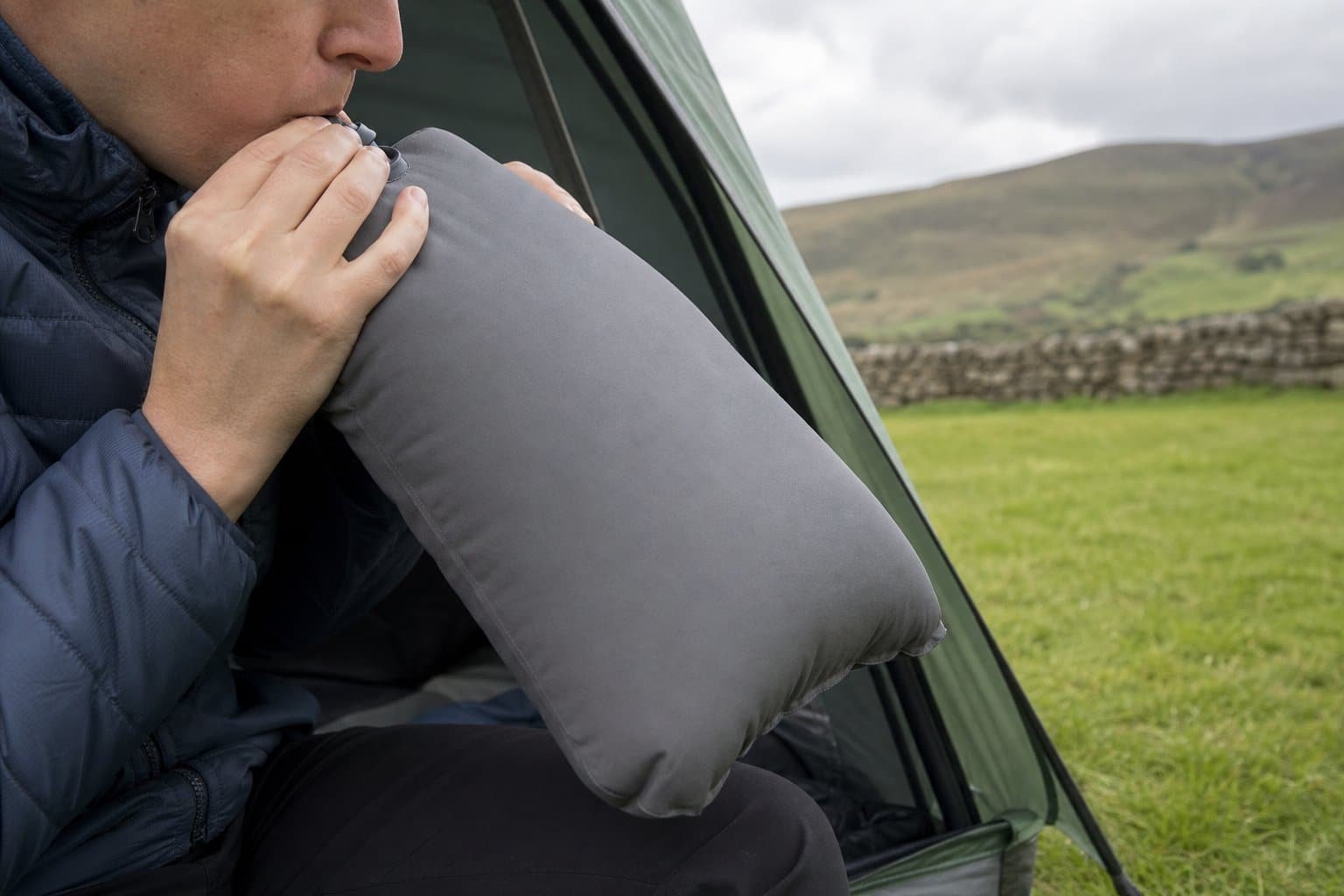
Ergonomic inflatable with a separate thick TPU bladder, cotton cover, one-click valve and a strap to fix it to your mat
Cheap inflatable pillows tend to fail in the same ways: they slowly leak, slide off the mat and squeak on every turn. Hikenture’s pillow targets all three while keeping the price low. Instead of a thin TPU coating under the fabric, it has a separate, thicker TPU air bladder to resist leaks, and the brand says it checks every pillow before shipping.
The ergonomic shape has a raised edge to fill the gap under your neck, and you set firmness through the one-click valve: press to let air in without losing it between breaths, press again to deflate in seconds. A detachable elastic strap on the back holds it to your sleeping mat, and the breathable cotton cover cuts noise and can be removed for washing. It packs to about the size of a drinks can.
The listing does not quote weight or dimensions, and the satisfaction guarantee is 365 days rather than a long warranty. Still, it gives much of the function of pricier air pillows for a fraction of the cost.
- Low price
- Separate thick bladder to resist leaks
- Strap stops it sliding off the mat
- Quiet, washable cotton cover
- Packs to drinks-can size
- Weight and size not quoted
- 365-day guarantee only
- Pure air feel, less cushioned than hybrids
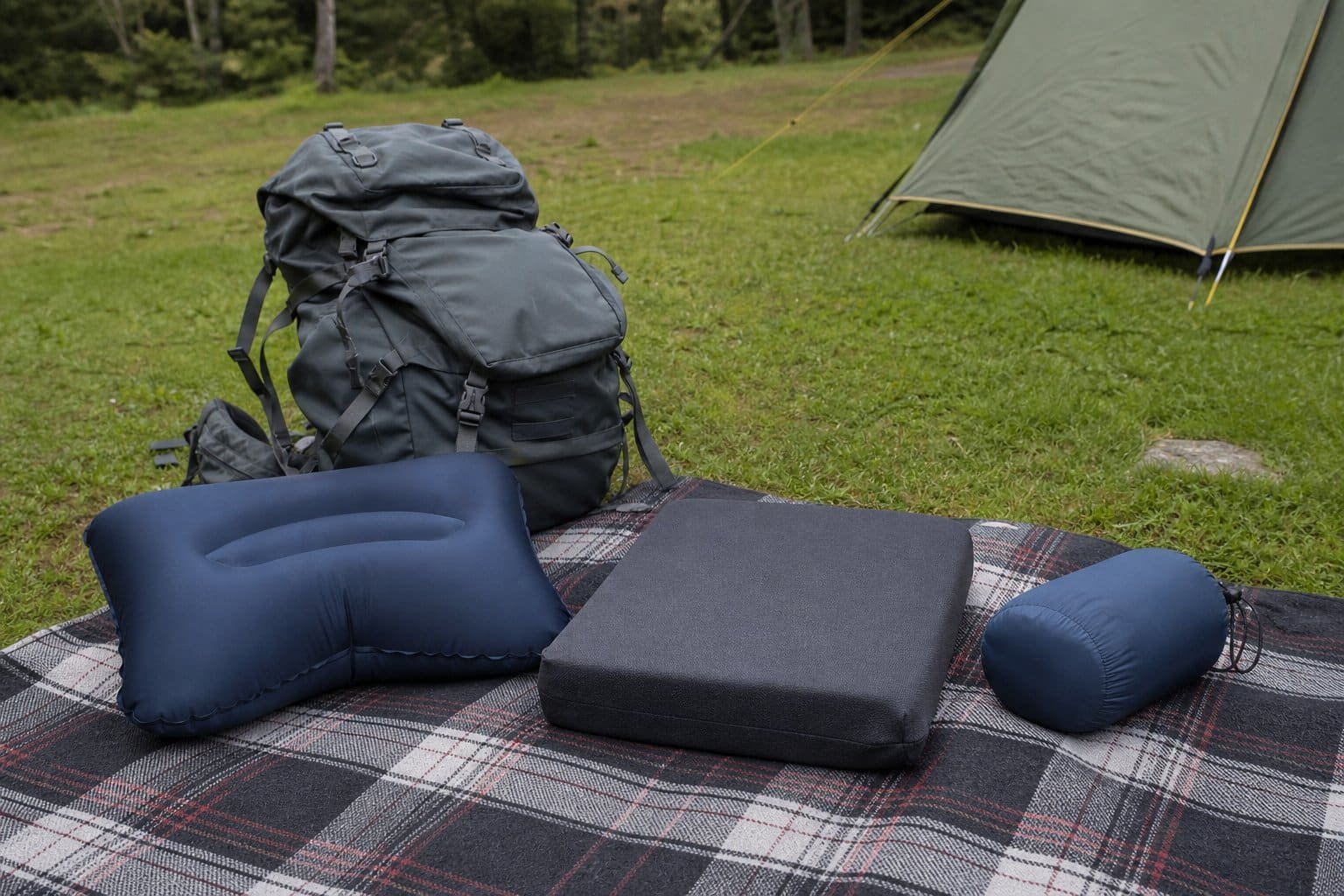
Camping pillows for neck support: hybrid, air or foam?
Camping pillows come in three main types. Inflatable pillows such as the Hikenture and Sea to Summit Aeros are the lightest and smallest, and a valve lets you set the height, but cheaper ones can feel bouncy, crinkle when you move and slide around. Foam pillows such as the Therm-a-Rest Compressible Cinch and the Bespilow feel most like a home pillow and are quiet, but they are bulkier and heavier. Hybrids like the NEMO Fillo put a foam layer over an air chamber, so you get adjustable support without the balloon feel.
For neck support, height matters more than type. Side sleepers need a pillow tall enough to fill the space between the shoulder and the head so the neck stays straight, while back sleepers usually need less height. As Countryfile's camping pillow guide points out, it also comes down to balancing a light, packable pillow against one that gives better rest, so think about whether you will carry it or keep it in the car. If you sleep on your side, our best sleeping bags for side sleepers pair well with a higher pillow.
Camping pillows for neck support UK campers can choose: the main types
Pillows for camping come in four broad styles, and the right one depends as much on how you travel as on how you sleep. The five pillows in this guide cover each style, from the NEMO Fillo hybrid to the contoured Bespilow, so they are a useful benchmark when you compare other models in shops or online.
Inflatable pillows
Pure air pillows such as the Hikenture are light, cheap and pack to the size of a drinks can. Because you control the air inside, you can set the height to suit your neck in seconds. The downside is feel: a basic inflatable pillow can be bouncy and slippery, and it may crinkle each time you turn. A cotton or brushed cover makes a big difference to comfort.
Hybrid air and foam pillows
Hybrids such as the NEMO Fillo and the Sea to Summit Aeros Premium put a foam layer over an air chamber. The air gives adjustable support, while the foam takes away the balloon feel and makes the surface quieter. They weigh a little more than pure air pillows but still pack small, which is why many campers see them as the best all-round compromise for neck support.
Foam and memory foam pillows
Foam pillows such as the Therm-a-Rest Compressible Cinch and the Bespilow feel closest to the pillow on your bed at home. They are quiet, warm to the touch and less likely to slide away, and a contoured shape can fill the gap under your neck. They are bulkier, so they suit car camping, campervans and festivals better than long walks with a full rucksack.
How to set the right pillow height for your neck
Height is the single biggest factor in neck support, and it is personal. The aim is simple: when you lie down, your head should be neither tipped up towards the tent roof nor dropped down towards the mat. A friend can help here. Ask them to look at you from behind while you lie on your side, and adjust the pillow until your neck and spine form a straight line.
Side sleepers need the most height, because the pillow has to fill the space between the shoulder and the ear. Broad shoulders need more again. Back sleepers usually want less height and a little extra support under the curve of the neck, which is where contoured and scalloped shapes help. Stomach sleepers tend to prefer a very low, soft pillow, or sometimes none at all.
Your mat changes the maths. On a thick, soft mat your shoulder sinks in further, so you may need less pillow height than on a thin, firm foam pad. If you switch between a thin mat for backpacking and a deep mattress for car camping, an adjustable pillow saves you buying two. It is one reason the camping pillows for neck support UK campers rate most highly nearly all let you change the height.
Fine-tune in small steps. With an inflatable pillow, inflate it firmly, lie down and let out air a little at a time; with a cinch pillow, tighten or loosen the cord a notch at a time. Give each setting a few minutes before you judge it. What feels right while you are sitting up reading often feels different after you have settled down to sleep.
Your pillow, mat and sleeping bag as one system
A camping pillow never works in isolation. It sits on a mat, inside or next to a sleeping bag hood, in a tent that may slope slightly, and all of those affect how well it supports your neck. Thinking of the three together helps explain why a pillow that felt perfect in the shop can let you down on the first night.
Start with the mat. If the mat is too thin or under-inflated, your shoulder presses towards the ground and your neck bends, however good the pillow is. Side sleepers in particular benefit from a deeper, wider mat, and our guide to the best camping sleeping mats for side sleepers explains what to look for. Once the base is right, the pillow has far less work to do.
Next, the sleeping bag. Mummy bags have a shaped hood that can hold a small pillow in place, which is why curved designs like the Aeros Premium fit so neatly. Rectangular bags leave the pillow loose on the mat, so a strap or a grippy cover matters more. If your bag hood pushes your head forward, try placing the pillow inside the hood rather than under it.
Finally, the pitch. A slight slope can make your pillow creep downhill all night, taking your neck support with it. Sleep with your head at the higher end, and clear any lumps under the groundsheet where your head and shoulders will lie. These small checks often make more difference to a stiff neck in the morning than swapping one pillow for another.
Air or foam: what suits UK camping conditions?
British weather has a real effect on camping pillows. Cool nights are common even in summer, and air inside an inflatable pillow cools and contracts as the temperature falls, so a pillow that felt firm at bedtime can feel softer by the early hours. A quick top-up before you settle down helps, and a pillow with a fine-tune valve makes that easy to do in the dark.
Air pillows can also feel cold against your cheek on chilly nights, while foam pillows stay warmer to the touch. Some memory foams stiffen in the cold, which is why Bespilow highlights that its foam is not temperature sensitive. A fleece or cotton cover softens the feel of any pillow and adds a little warmth, which is welcome in a damp autumn tent.
Condensation is the other UK factor. Pillows close to the inner tent wall can pick up moisture overnight, and foam takes longer to dry than a wipe-clean air bladder. Keep your pillow away from the tent fabric, and on damp trips pack a spare pillowcase so you always have a dry surface. Removable, washable covers, like those on most of our picks, make this far easier.
Pack size settles many decisions when you compare camping pillows for neck support UK shops stock. If you carry everything, the light, small air and hybrid pillows make sense, and the Aeros Premium is the standout. If the car is parked a few metres away, the extra bulk of foam costs you nothing, and many car campers find the quieter, steadier feel worth the space.
Caring for your camping pillow
Look after any of the camping pillows for neck support UK campers rely on and it will hold its shape and air for years. Wash removable covers regularly, following the maker’s label, because sweat and sun cream build up quickly on a campsite. Let covers dry fully before refitting them, and never put an air bladder through a washing machine unless the maker says it is safe; a damp cloth is usually enough.
Store foam pillows uncompressed between trips so the foam can recover its loft, and leave inflatable pillows loosely rolled with the valve open, which lets any moisture escape. If an air pillow keeps going soft, inflate it at home and check it overnight before assuming it has a leak, since cool air alone can make it feel flatter by morning.
If you do find a slow leak, a little soapy water brushed over the seams and valve will show bubbles where air is escaping. Many brands offer repairs or replacements under warranty, and the NEMO Fillo, Aeros Premium and Compressible Cinch all carry long cover, so keep your receipt. A well-made pillow that lasts several seasons is better value than a cheap one replaced every year.
Final thoughts on neck support when camping
A good night’s sleep in a tent starts with a level neck. For most campers the NEMO Fillo is the easiest way to get there, the Aeros Premium is the one to carry, the Compressible Cinch and Bespilow suit people who prefer foam, and the Hikenture is a sensible budget choice. Whatever you choose, pair it with a decent mat and take time to set the height properly.
When you compare camping pillows for neck support UK listings can make every model sound the same, so focus on adjustability, shape and grip rather than marketing claims. This is general buying advice rather than medical guidance: if you wake with neck pain that lasts beyond the trip, see a GP or physio. For warmth to match, our guide to sleeping bags for UK camping completes the set.
What to look for in a camping pillow for neck support
Side sleepers need roughly 10 to 12 cm of loft; back sleepers usually less. Stomach sleepers want a low, soft pillow.
A fine-tune valve or cinch cord lets you set height and firmness precisely, rather than all or nothing.
Curved, scalloped or contoured shapes cradle the head and fill the neck gap better than flat rectangles.
Straps, mat-locking patches or a shape that fits a sleeping bag hood stop the pillow escaping in the night.
Foam tops and fabric covers reduce the bounce and crinkle of bare TPU air pillows.
Air pillows weigh about 100 to 260 g and pack to fist size. Foam pillows are much bulkier, fine for car camping.
A removable cover keeps things hygienic; long warranties signal valves and seams built to last.
How to get better neck support from a camping pillow
- Inflate fully, then let air out
Blow the pillow up firm, then lie down and release small bursts of air until your neck feels level with your spine.
- Match height to how you sleep
Run the pillow fuller if you sleep on your side, softer if you sleep on your back.
- Stop it sliding
Use the mat strap, tuck the pillow inside your sleeping bag hood, or put it inside a fleece or pillowcase for grip.
- Add a layer for height
A folded fleece under a thin pillow adds height and warmth on cold nights.
- Level your pitch
Sleep with your head uphill on a slope; a level, padded base matters as much as the pillow.
- Store foam pillows open
Keep foam pillows uncompressed at home so they recover their loft for the next trip.
How we chose these camping pillows
We have not slept on every pillow in this list ourselves. Our picks are based on manufacturer specifications, UK camping buying guides and recurring themes in owner feedback about neck support, slipping, noise, leaks and packed size. This is general buying advice, not medical advice: if you have ongoing neck pain, speak to your GP or a physiotherapist.
-
Support and adjustability
We favoured pillows with a way to set height and firmness, and shapes that support the neck.
-
Comfort and noise
We looked at foam layers, covers and owner reports of bounce and crinkle.
-
Staying in place
We noted straps, mat-locking systems and hood-friendly shapes.
-
Packability and build
We compared weight, packed size, leak resistance and warranty, and flagged missing specs.
What is the best camping pillow for neck support?
For most campers, the NEMO Fillo: its air cell holds your neck at the right height, the foam top stops the balloon feel and the valve lets you fine-tune firmness. If you carry your kit, the 99 g Sea to Summit Aeros Premium is the best lightweight choice.
Are inflatable or foam camping pillows better for your neck?
Either can work if the height is right. Inflatables are easier to adjust and pack smaller; foam feels more natural and quieter. Hybrids combine both and suit most people.
What height of camping pillow do side sleepers need?
Enough to fill the gap between shoulder and head so your neck stays straight, often around 10 to 12 cm. Broad-shouldered side sleepers may need more, so an adjustable pillow helps.
How do I stop my camping pillow sliding off my mat?
Choose a pillow with a mat strap or a locking system, tuck it into your sleeping bag hood, or slip it into a fleece or cotton pillowcase for extra grip.
Why does my inflatable pillow go flat overnight?
Usually a slow valve or seam leak, or simply air cooling and contracting on a cold night. Top it up before bed, check the valve is closed and choose pillows with thick bladders or strong warranties.
Can I use a travel neck pillow for camping?
U-shaped travel pillows are designed for sitting upright, so they give poor support lying down. A proper camping pillow works far better in a tent.
Which camping pillow for neck support should you buy?
- Best overall: NEMO Fillo Camping Pillow
- Best lightweight: Sea to Summit Aeros Premium Inflatable Pillow, Regular
- Best adjustable foam: Therm-a-Rest Compressible Cinch Pillow, Regular
- Best contoured: Bespilow Memory Foam Cervical Neck Support Camping Pillow
- Best budget: Hikenture Inflatable Camping Pillow with Removable Cover
For most UK campers, the NEMO Fillo is the best camping pillow for neck support: its air cell gives adjustable support, its foam top feels like a real pillow and it comes with a lifetime warranty. The Sea to Summit Aeros Premium is the one to carry at just 99 g, the Therm-a-Rest Compressible Cinch is the best foam pillow with adjustable loft, the Bespilow brings a contoured, orthopaedic-style shape to the campsite and the Hikenture is the best budget buy. Pair your pillow with a good base; our camping air beds for bad backs and self-inflating mat picks will help.
CampEquipmentPlus relies on reader support. Purchases made via links on our website may earn us an affiliate commission at no extra cost to you, helping keep the site running.