
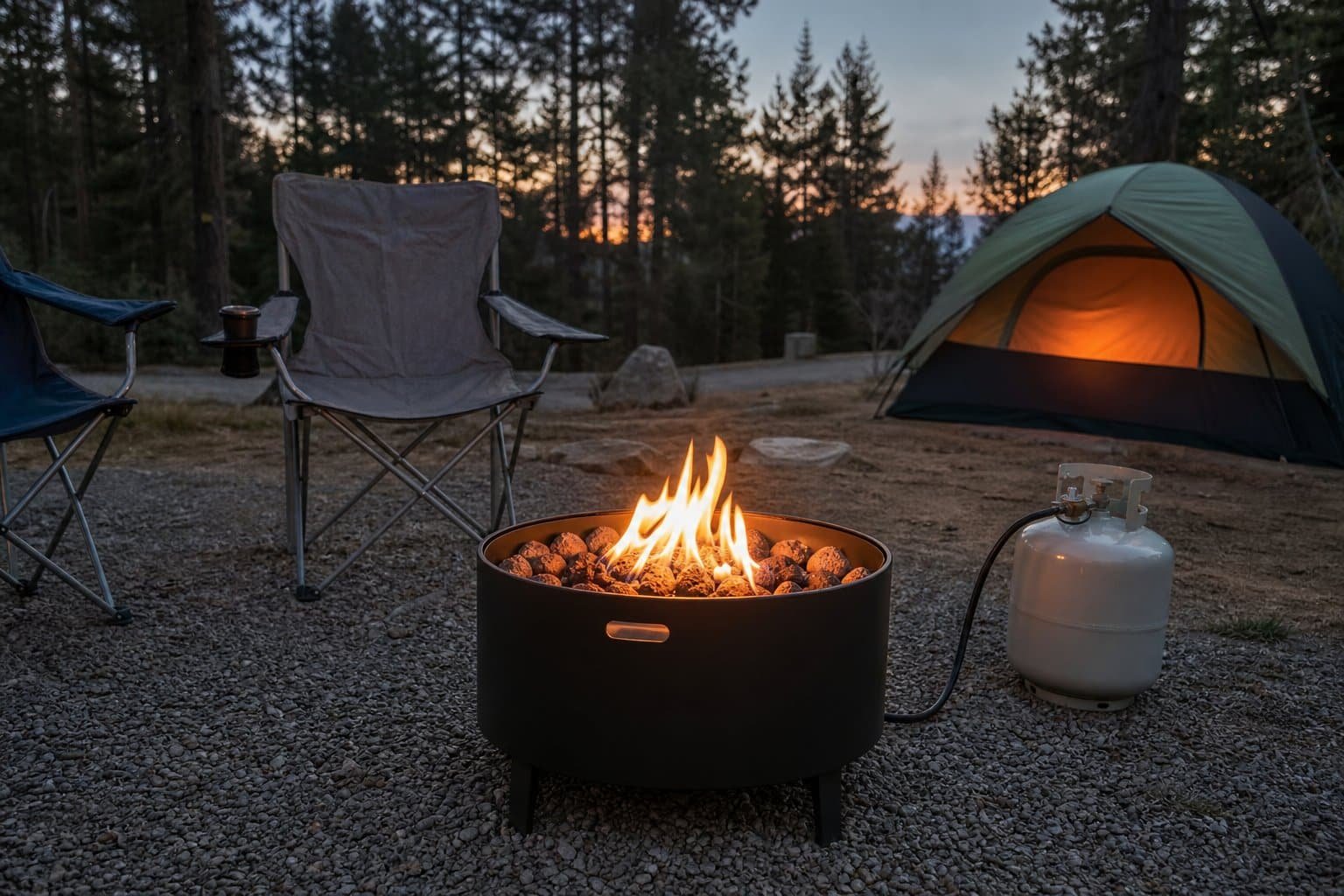
Best Propane Fire Pits for Camping
The best propane fire pit for camping lights in seconds, shuts off instantly and leaves no ash, so you can keep a campfire going at sites where wood fires are banned or smoke bothers your neighbors. Our top pick is the Outland Living Firebowl 893 Deluxe, while the Ignik FireCan packs the smallest.
Campers who switch to propane usually do it for three reasons: fire restrictions, no firewood to buy or haul, and no smoke in their eyes or clothes. The common complaints are just as consistent: propane pits give less heat than a wood fire, wind can push the flame around, and a 20 lb tank is one more thing to carry.
Below we compare six portable propane fire pits, from an ammo-can design to a 24 in bowl, and explain BTU ratings, tank runtimes, burn-ban rules and safe setup.
- Low smoke, no ash, instant off
- Check local burn-ban rules every trip
- Outdoors only, never in a tent
- Best overall: Outland 893 Deluxe A 19 in steel bowl rated at 58,000 BTU/hr, with a 10 ft hose, lava rocks and a cover.
- Most packable: Ignik FireCan An ammo-can design that packs to 12 x 6.25 x 8.5 in and weighs 11.5 lb.
- Low smoke, not more heat Propane fire pits are clean and convenient, but testers agree they give less radiant heat than wood.
- Burn bans vary Many Stage 1 orders allow pressurized-gas devices, but rules are local. Check before you light.
A propane fire pit for camping gives you the glow of a campfire without the smoke, sparks or ash, and you can turn it off with a knob. That makes a propane fire pit for camping the easiest way to keep an evening fire going on dry summer nights, at campgrounds with fire restrictions and on RV pads where a wood fire isn’t welcome. This guide compares six portable models on Amazon and explains BTU ratings, tank runtimes, burn-ban rules and safety, so you can choose the right one. If you need warmth inside a shelter instead, see our guide to propane heaters for camping.


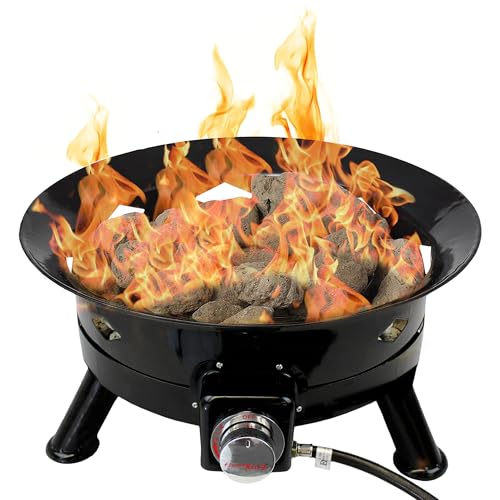
Top pick Outland 893 | Packable Ignik FireCan | Compact Firecube 805 | RV pick Camco 58047 | |
|---|---|---|---|---|
|
|
|
|
| |
| Style | 19 in bowl | Ammo can | 14 in square | 14.5 in tray |
| Max output | 58,000 BTU | Not quoted | 58,000 BTU | 65,000 BTU |
| Size | 19 x 19 x 11 in | 15.5 x 6.5 x 10.75 in | 14 x 14 x 9 in | Not quoted |
| Weight | 24 lb* | 11.5 lb | Not quoted | Not quoted |
| Hose | 10 ft | 5 ft | 10 ft | 8 ft |
| Ignition | Manual | Pilot hole | Manual | Not quoted |
| Warranty | 1 year | Not quoted | 1 year | Ltd 1 year |
| Check price | Check price | Check price | Check price |
The best propane fire pits for camping: our reviews
Each review covers size, BTU rating, weight, hose length, ignition and warranty, plus the trade-offs owners and testers mention most. Specs come from the Amazon listings unless we say otherwise.
Steel firebowl, 19 x 19 x 11 in, 58,000 BTU/hr, manual ignition, 24 lb (Outland), 10 ft hose and regulator, 4.4 lb lava rocks, cover and carry kit, CSA approved, 1-year warranty
The Outland Living Firebowl 893 Deluxe is the propane fire pit most campground regulars end up with, and it’s our pick for most people. The 19 in steel bowl is big enough for four to six chairs, the burner is rated at 58,000 BTU/hr on high, and the kit includes everything except the tank: a pre-attached 10 ft hose with an adjustable regulator, 4.4 lb of natural lava rock, and a cover with carry straps. The long hose matters more than it sounds, because it lets you park a 20 lb tank behind a chair instead of next to the flame.
Outland’s support page lists the 893 at 24 lb, and it asks for a non-combustible surface underneath, 36 in of clearance to the sides and 80 in overhead. That weight is fine from car to campsite but not for carrying far. Ignition is manual (a long lighter through the burner), and like every propane pit it gives less radiant heat than a wood fire: think gathering point and glow rather than drying wet boots. Outland quotes a one-year limited warranty, and a natural gas conversion kit is sold separately for home use.
- 58,000 BTU on high
- 10 ft hose keeps the tank out of the way
- Cover, carry kit and lava rocks included
- CSA approved for most campfire bans
- 24 lb is heavy to carry far
- Manual ignition
- Less radiant heat than a wood fire
Ammo-can design with steel mesh sides, 15.5 x 6.5 x 10.75 in, packs to 12 x 6.25 x 8.5 in, 11.5 lb, folding legs, 5 ft quick-release hose and adjustable regulator for 5, 10 and 20 lb tanks
The Ignik FireCan solves the biggest complaint about bowl-style pits: they take up half the trunk. This one is built like an ammo can, measures 15.5 x 6.5 x 10.75 in set up and packs down to 12 x 6.25 x 8.5 in, and weighs 11.5 lb according to the listing. Folding legs lift it off the ground, the lid has a carry handle, and silicone side handles help when you need to move it. Steel mesh sides let you see the flame from all around and throw a little more heat sideways than a solid bowl.
Ignik includes a tool-free, quick-release 5 ft hose and adjustable regulator for refillable 5, 10 and 20 lb cylinders. The listing doesn’t quote a BTU rating or a warranty, so we’ve marked both “Not quoted”. You light it through a pilot hole with a long lighter. The fire is narrow rather than round, so it suits two to four people sitting close better than a big circle. It’s also the priciest pit here for its size: you’re paying for packability and build quality.
- Packs smaller than any bowl here
- 11.5 lb with folding legs
- Mesh sides show the flame all round
- Works with 5, 10 and 20 lb tanks
- BTU and warranty not quoted
- Narrow fire suits small groups
- Pricey for its size

Square steel firecube, 14 x 14 x 9 in, 58,000 BTU/hr, stainless burner and fasteners, 10 ft hose and regulator, 4.4 lb lava rocks, cover and carry kit, CSA approved, 1-year warranty
The Firecube 805 is Outland’s smallest and lightest propane fire pit, and it keeps the same headline 58,000 BTU/hr rating as the 19 in bowls. At 14 x 14 x 9 in it fits on a picnic table end, a small RV patio mat or a campervan floor between trips. The kit mirrors the 893: a pre-attached 10 ft hose with an adjustable regulator, 4.4 lb of lava rock, and a cover and carry kit. Outland uses a stainless-steel burner and fasteners with an enamel-coated steel body.
The listing doesn’t quote a weight, so we’ve left it as “Not quoted”. In practice the smaller footprint means a smaller flame area, so it works best for two to four people. Like the 893, it is CSA approved and Outland says it can be used during most campfire bans, but always check the current order where you camp. Outland quotes a one-year warranty.
- Compact 14 in square
- Same 58,000 BTU rating as bigger bowls
- Stainless burner and fasteners
- Hose, rocks and cover included
- Weight not quoted
- Smaller flame area
- Manual ignition
14.5 in fire tray, up to 65,000 BTU/hr, 8 ft hose and adjustable regulator, lava rocks, storage bag, legs fold under, listed to ANSI Z21.97/CSA 2.41-2017, limited 1-year warranty
Camco makes RV gear, and its Portable Propane Campfire (model 58047) is designed to live in an RV’s storage bay. The fire tray measures 14.5 in across, the legs fold completely underneath, and it comes with a storage bag, lava rocks, an 8 ft propane hose and an adjustable regulator for standard LP cylinders. Camco rates it at up to 65,000 BTU/hr, the highest figure in this list, and it is listed to the ANSI Z21.97/CSA 2.41 outdoor gas appliance standard.
Camco’s listing says it is approved for campgrounds with fire restrictions, but rules are set locally, so check before you light it. The listing doesn’t quote a weight. Reviews of Camco’s propane campfires praise how quickly they set up and shut off, but one Camping World reviewer of the smaller Little Red model found it didn’t put out much heat on cold, windy nights and had to sit within a couple of feet. That’s true of most propane pits, so treat it as a social fire rather than a heater. Camco gives a limited one-year warranty.
- 65,000 BTU maximum rating
- Legs fold flat for storage bays
- Storage bag included
- Listed to ANSI Z21.97/CSA 2.41
- 8 ft hose is shorter than Outland’s 10 ft
- Weight not quoted
- Modest heat in cold wind

Steel firebowl, 19 x 19 x 11 in, 58,000 BTU/hr, matchless auto-ignition, 10 ft hose and regulator, 4.4 lb lava rocks, cover and carry kit, CSA approved, no assembly, 1-year warranty
The Firebowl 870 Premium is essentially the 893 Deluxe with a matchless auto-ignition. You turn the knob and press the igniter instead of reaching in with a long lighter, which is handy in wind and for anyone nervous about lighting gas. Everything else matches the 893 on the listing: a 19 x 19 x 11 in steel bowl, 58,000 BTU/hr, a pre-attached 10 ft hose with an adjustable regulator, 4.4 lb of lava rock and a cover and carry kit. It needs no assembly and is CSA approved.
Expect to pay a little more than for the 893. Igniters are also one more part that can fail over the years; if it does, you can still light the burner by hand. The listing doesn’t quote a weight; Outland’s figure for the near-identical 893 is 24 lb. Outland quotes a one-year limited warranty.
- Push-button ignition
- No assembly
- Same proven 19 in bowl as the 893
- Costs more than the 893
- Igniter is an extra part to fail
- Weight not quoted
24 x 24 x 12 in steel firebowl, 58,000 BTU/hr, piezo self-igniter, 10 ft hose and regulator with QCC connector, lava rocks, cover, carry strap, tank stabilizer ring
If your group fills more than six chairs, the Flame King FKG6502D gives you a 24 x 24 x 12 in bowl, the biggest here. It keeps the common 58,000 BTU/hr rating but spreads the flame over a wider area so more people can see it. A built-in piezo igniter means no lighter, and the kit includes a 10 ft pre-attached hose with regulator and QCC connector, lava rocks, a UV- and weather-resistant cover, a carry strap and a stabilizer ring to hold the tank steady.
Bigger means bulkier: this is a pit for RV pads and drive-up sites, not small cars. The listing doesn’t quote a weight. Its warranty details also contradict each other: one bullet promises a one-year defect warranty, while the spec field says 30 days and only via Flame King or Amazon Retail. Buy from Amazon itself if the warranty matters to you.
- Largest 24 in bowl here
- Piezo self-igniter
- Tank stabilizer ring included
- Bulky to transport
- Weight not quoted
- Warranty details contradict
Why choose a propane fire pit for camping?
A wood campfire is part of camping for most people, but it comes with smoke in your eyes, sparks on your jacket, firewood to buy or haul, and a pile of ash to drown before bed. A propane fire pit for camping trades some of that romance for convenience: you open the tank, light the burner and have a steady flame in under a minute. When you’re done, you turn a knob and the fire is out. There are no embers to watch and nothing to clean up the next morning.
The other big reason is fire restrictions. Across the western US, summer restrictions often ban wood and charcoal fires outside developed fire rings, but many Stage 1 orders still allow devices fueled by pressurized gas that can be turned off. That means a portable propane fire pit can be the only way to have an evening fire on a dry August trip. It’s also popular with RV campers and anyone who camps at busy sites where smoke drifts straight into a neighbor’s awning.
Propane fire pits do have honest downsides. They give noticeably less radiant heat than a good wood fire, which OutdoorGearLab and Camping World reviewers both point out. Wind can flatten or blow out the flame. And you have to bring, refill and store a propane tank. If you understand those trade-offs before you buy, a propane fire pit is one of the most useful upgrades for car and RV camping.
Types of portable propane fire pit
Round firebowls such as the Outland 893, Outland 870 and Flame King 24 in are the most common design. A steel bowl holds a ring burner covered in lava rock, and the hose runs out to a tank on the ground. Bowls of 19 in suit four to six people, while 24 in bowls suit bigger circles. They’re stable and simple but bulky, and the 19 in Outland weighs around 24 lb.
Compact square pits like the Outland Firecube 805 shrink the footprint to about 14 in. They usually keep the same burner rating as larger models but spread the flame over a smaller area, so they suit couples and small families who are short on trunk space.
Tray-style campfires like the Camco 58047 sit low on folding legs with a shallow tray of lava rocks. They are designed to fold flat and slide into an RV storage bay with their bag.
Can and box designs like the Ignik FireCan pack the burner into a rugged, lidded container. They’re the most packable propane fire pits and the easiest to throw in an overland rig, but the long, narrow flame suits a small group sitting close.
How to choose a propane fire pit for camping
Size, weight and how you camp
When choosing a propane fire pit for camping, start with your vehicle and your group size. If you drive to a campsite and carry the pit a few yards, a 19–24 in bowl is fine. If you camp from a small car or a van, or you walk a little way to walk-in sites, a 14 in cube or a can design makes more sense. Check the packed size as well as the weight: a bowl may be light enough to lift but still fill most of a small trunk.
BTU ratings: what the numbers mean
Most portable propane fire pits are rated around 58,000–65,000 BTU per hour, and that number is the maximum gas flow on the highest setting, not how warm you’ll feel. A wider bowl spreads the same output across a bigger flame, which looks better but doesn’t warm you more. The BTU rating matters most for fuel use, because it tells you how quickly the pit can drain a tank.
Hose length and tank options
A long hose is more useful than it sounds. Outland and Flame King include 10 ft hoses, Camco 8 ft and Ignik 5 ft. Longer hoses let you set the tank behind a chair, upwind and out of the walkway, so nobody trips on it in the dark. Check which tank sizes the regulator suits: most use a standard 20 lb barbecue cylinder, and the Ignik is also designed for refillable 5 and 10 lb tanks.
Ignition and controls
Manual propane fire pits are lit with a long lighter or match while the gas is low. Auto-ignition models like the Outland 870 and Flame King use a piezo igniter, which is easier in a breeze and keeps your hand away from the burner. An adjustable regulator or valve knob is standard and lets you turn the flame down to save fuel or when the wind picks up.
Certification and burn-ban wording
On any portable propane fire pit, look for a CSA or ANSI Z21.97 listing, which means the pit has been tested to an outdoor gas appliance standard. Some fire orders specifically mention approved or listed devices, and campground hosts sometimes ask. Be careful with marketing phrases like “safe during most campfire bans”: that depends on the order in force where and when you camp, not on the product.
Propane fire pits and fire restrictions
Fire restrictions in the US usually come in stages. According to a Western Fire Chiefs Association explainer on fire restriction stages, Stage 1 orders typically ban wood and charcoal fires outside designated fire structures but still allow stoves or grills powered by propane or other pressurized gas. Stage 2 and higher orders add more limits, and individual forests, parks and counties can add or change exemptions.
In practice, that means a propane fire pit for camping is often allowed when wood fires aren’t, but you should never assume. Before each trip, check the current order on the land manager’s website or call the ranger station, and ask the campground host on arrival. Some orders allow gas devices only with an on/off valve, only in cleared areas or only within developed sites. Under the strictest orders, every open flame is banned, including propane.
How long does a propane tank last?
A full 20 lb propane cylinder holds roughly 430,000 BTU of fuel. A pit running flat out at 58,000 BTU/hr would empty it in about 7 hours, and a 65,000 BTU pit in about 6.5 hours. Most people run a fire pit on medium for the evening, so a 20 lb tank often lasts two or three nights. OutdoorGearLab reported more than 6 hours on high from a 5-gallon tank on the larger Outland Mega, which fits that estimate.
Small 1 lb camping cylinders are a different story. Each holds only about 21,600 BTU, which is roughly 20 minutes at 58,000 BTU/hr on high. Even on low you will burn through several in an evening, and cold weather makes small cylinders lose pressure faster. If your pit can use them with an adapter, keep them for short sessions and bring a larger refillable tank for anything longer. Our guide to how long camping stove fuel lasts explains the same math for stoves.
Placement and safety around a propane fire pit
Every propane fire pit for camping is an outdoor appliance. Never use one inside a tent, camper, screen room or under an awning: it consumes oxygen, produces carbon monoxide and can ignite fabric overhead. The Camco listing says it is for outdoor use only, and Outland’s support page asks for 36 in of clear space around the bowl and 80 in above it.
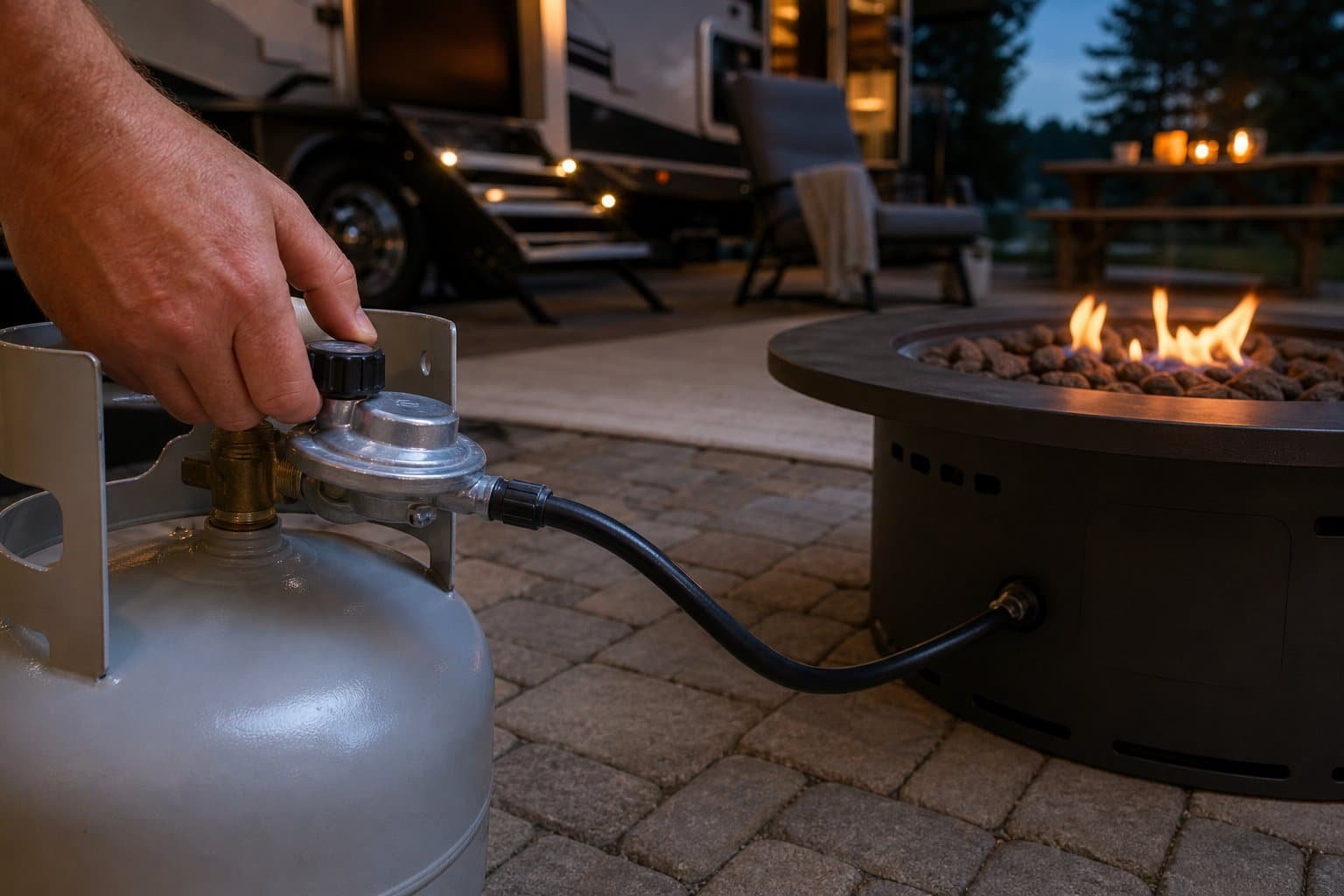
Set the pit on bare ground, gravel, a concrete pad or a fire ring, not on dry grass, a wooden deck or a plastic outdoor rug. Keep chairs at a comfortable distance and children and pets back from the bowl. Put the tank upwind of the pit, standing upright, and run the hose so it doesn’t cross the main walkway. After you finish, close the tank valve first, let the flame burn off the gas in the hose, then turn the pit’s knob off.
Check the connections on your portable propane fire pit for leaks every trip with soapy water: if bubbles grow when the tank is open, shut it off and tighten or replace the fitting. Keep the cover on between uses so rain doesn’t soak the lava rock and spiders don’t nest in the burner ports, a common cause of a weak or uneven flame.
Common propane fire pit problems and fixes
The flame is tiny even on high. Many regulators have a safety device that restricts flow if the tank is opened too quickly or the knob is already on. Close the tank and the pit’s knob, disconnect the hose, wait a minute, reconnect, then open the tank slowly before you turn the knob on.
The wind keeps blowing the flame out. Turn the flame down a little, sit the pit in the lee of your vehicle or a windbreak, and consider an aftermarket wind guard made for your model. On very gusty nights, it’s safer to shut it off.
The lava rocks crack or pop. Rocks that have soaked up rain can crack as trapped water turns to steam. Store the pit covered, let wet rock dry out, and start on a low flame after rain.
It smells of gas. Turn off the tank immediately and leak-test the hose and fittings. A faint smell on lighting is normal; a persistent smell is not.
It doesn’t feel warm enough. That’s the nature of propane fire pits. Move chairs closer, use the lowest flame that stays lit in wind, and dress warmly. For real warmth on cold nights, combine the pit with insulated layers and a proper sleep system, or a heater designed for the job.
Propane fire pit vs wood fire pit
A wood fire gives more heat, more crackle and a cooking fire for marshmallows and foil packets. A propane fire pit gives cleaner air, instant on and off, and no ash or embers to manage. Propane fire pits are usually the better choice in dry regions, at crowded campgrounds and for RV trips, while wood suits remote sites with established fire rings and plenty of legal firewood. If you prefer a wood-burning pit, see our guides to the best portable fire pits and the best camping fire pits.
Cooking is the other key difference. Most makers of propane fire pits say not to cook directly over the lava rock, because drips and grease can foul the burner. Some brands sell grill grates, and the Ignik FireCan Deluxe version adds a grill, but for real camp cooking a propane stove is still the better tool.
Which propane fire pit for camping should you buy?
Choose the Outland 893 Deluxe if you want one proven 19 in pit for campgrounds, RV sites and the backyard. Pick the Outland 870 if push-button ignition is worth a few extra dollars. The Ignik FireCan is the pick for overlanders and small cars, while the Outland Firecube 805 suits couples who want a bowl-style fire in less space. RVers should look at the Camco 58047, which folds flat into a storage bay, and big groups will appreciate the 24 in Flame King bowl.
Propane fire pit myths
Not always. Many Stage 1 orders allow pressurized-gas devices, but stricter stages and local orders can ban them. Check each trip.
Testers consistently find propane pits give less radiant heat than wood. They’re great for ambiance and close-range warmth.
They produce far less smoke than wood and no ash, but they still burn fuel and need fresh air. Use them outdoors only.
What to look for in a propane fire pit
14 in pits suit two to four people; 19–24 in bowls suit bigger circles.
Check the trunk or storage bay; bowls weigh about 20–25 lb.
A 10 ft hose keeps the tank well away from the flame and out of the way.
Look for CSA or ANSI Z21.97 listing; some fire orders ask for approved devices.
Auto-ignition is easier, especially in wind; manual is simpler to maintain.
A cover keeps rain off lava rocks and the burner between uses.
How to set up a propane fire pit safely
- Pick a safe spot
Use a level, non-combustible surface outdoors, away from tents, awnings and overhanging branches.
- Place the tank upwind
Run the hose to its full length and keep the tank upright and away from the flame.
- Check for leaks
Brush soapy water on the connections and open the tank. Bubbles mean a leak: tighten or replace parts.
- Light at low
Open the tank slowly, light the burner on low, then raise the flame.
- Shut down properly
Close the tank valve first, let the burner flame go out, then turn off the knob and let the pit cool before covering.
How we chose these propane fire pits
We have not tested every fire pit in this list ourselves. Our picks are based on Amazon listings, Outland Living’s published specifications, independent reviews from OutdoorGearLab, Camping World and Field & Stream, and US fire-restriction guidance. Where a listing didn’t state a spec, we used the maker’s figure and said so, or marked it “Not quoted”.
-
Portability
We compared size, weight and packed shape for camping use.
-
Complete kit
We favored pits with a long hose, regulator, rocks and cover included.
-
Certification
We checked for CSA or ANSI outdoor gas appliance listings.
-
Honest specs
We flagged missing specs and contradictory warranty claims.
What is the best propane fire pit for camping?
For most campers, the Outland Living Firebowl 893 Deluxe: a 19 in bowl rated at 58,000 BTU/hr with a 10 ft hose, lava rocks and a cover. If space is tight, choose the Ignik FireCan.
Can I use a propane fire pit during a fire ban?
Often, but not always. Many Stage 1 restrictions allow devices fueled by pressurized gas, but stricter stages and local orders can ban them. Check with the campground or land manager before every trip.
How long does a 20 lb propane tank last in a fire pit?
A full 20 lb tank holds roughly 430,000 BTU, so a 58,000 BTU pit on high uses it in about 7 hours. On a medium flame it can last two or three evenings.
Can I run a propane fire pit on 1 lb cylinders?
Some pits can with an adapter, but a 1 lb cylinder holds only about 21,600 BTU, so it lasts well under an hour at high flame. A 5–20 lb refillable tank is far more practical.
Can I use a propane fire pit in a tent or screen room?
No. Propane fire pits are outdoor appliances. Burning them in a tent, screen room or under an awning risks fire and carbon monoxide poisoning.
Do propane fire pits give off much heat?
Less than wood. You’ll feel warmth within a few feet, but testers say propane pits don’t match a wood fire’s radiant heat, especially in wind.
Final thoughts on choosing a propane fire pit for camping
A propane fire pit for camping won’t replace a crackling wood fire for heat, but it beats it for convenience, cleanliness and the chance of having any fire at all during dry summers. Start with the Outland 893 if you want a proven all-rounder, the Ignik FireCan if vehicle space is tight, the Firecube for small groups, and the Camco if it will live in an RV bay. Whatever you choose, bring a 20 lb tank, a wind plan and warm layers. For cold nights, pair it with a good cold weather sleeping bag so the evening doesn’t end the moment the flame goes out.
Which propane fire pit should you buy?
- Best overall: Outland Living Firebowl 893 Deluxe 19 in
- Most packable: Ignik FireCan Portable Propane Fire Pit
- Best compact bowl: Outland Living Firebowl 805 Firecube 14 in
- Best for RVers: Camco Portable Propane Campfire 58047
- Best push-button start: Outland Living Firebowl 870 Premium Auto-Ignition
- Best for big groups: Flame King 24 in Propane Fire Pit FKG6502D
For most campers, the Outland Living Firebowl 893 Deluxe is the best propane fire pit for camping: a full kit, a 10 ft hose and a bowl big enough for a group. Pick the Ignik FireCan for the smallest pack size, the Firecube 805 for small groups, the Camco 58047 for RV bays, the Outland 870 for push-button lighting and the Flame King 24 in for big circles.
CampEquipmentPlus relies on reader support. Purchases made via links on our website may earn us an affiliate commission at no extra cost to you, helping keep the site running.