

Best Non Stick Camping Frying Pans UK
A good non stick camping frying pan turns a bacon-and-egg breakfast from a scrape-and-scrub job into a two-minute wipe. Our top pick is the GSI Bugaboo Ceramic 10 in for families, while the MSR Ceramic Skillet is the best light pan for backpacking.
Campers judge these pans on a short list: how well eggs release, how evenly the pan heats on a small gas burner, how securely the handle locks and how well the coating survives a season of packing, washing up in cold water and cooking outdoors. The common complaints are just as consistent: hot spots that scorch food, coatings that wear after a few trips and handles that wobble or don’t fit the stove.
Below we compare six pans from 19 cm to 25 cm and explain ceramic vs PTFE coatings, sizing, gas-stove technique and how to make a non-stick pan last.
- Ceramic coatings are PTFE-free; PTFE coatings release food longer
- Match the pan size to your group and your burner
- Medium heat and wooden utensils make any coating last longer
- Best overall: GSI Bugaboo Ceramic 10 in 25 cm ceramic pan with a locking folding handle, ideal for families.
- Best lightweight: MSR Ceramic Skillet 20 cm, 190 g with handle and a 3-year warranty.
- Best classic design: Trangia 24 cm Detachable braced handle and a mid-size pan for two or three.
- Best for groups: Jetboil 10 in 25 cm with 2 in walls at just 380 g.
Picking a non stick camping frying pan is mostly about three things: the coating, the size and the handle. A ceramic or PTFE coating lets you cook eggs, pancakes and fish with a little oil and clean up without a scourer, which matters when you’re washing up in a bowl of cold water. Size decides how many people you can feed at once, and the handle decides whether the pan packs into your kit and feels safe on a wobbly burner. If you are still building your kit, our guide to what cookware campers really need explains what to pack and what to leave at home.


Best overall Bugaboo 10in | Lightweight MSR Ceramic | Classic Trangia 24cm | Lifetime Frontier 8in | |
|---|---|---|---|---|
|
|
|
|
| |
| Diameter | 10 in / 25 cm | 8 in / 20 cm | 9.4 in / 24 cm | 8.1 in / 21 cm |
| Weight | 17.7 oz / 502 g | 6.7 oz / 190 g | 14 oz / 400 g | Not quoted |
| Coating | Ceramic | Fusion ceramic | Not stated (Trangia: PTFE) | Ceramic |
| Handle | SureLock folding | Removable Talon | Detachable, braced | Removable Click-Safe |
| Packed size | 11.1 x 10.6 x 2.8 in | 9 x 2.5 in | Not quoted | Nests in 3 L Frontier pot |
| Warranty | Not quoted | 3-year limited | Not quoted | Lifetime guarantee |
| Check price | Check price | Check price | Check price |
Our non stick camping frying pan reviews
Each review covers the size, weight, coating, handle and the trade-offs owners and testers report. We have ranked them for typical UK car camping first, then lighter trips.
10 in (25 cm) ceramic-coated heavy-gauge aluminium frying pan, SureLock folding handle with silicone grip, spiral-pattern base, 17.7 oz (502 g), 11.1 x 10.6 x 2.8 in.
The GSI Bugaboo Ceramic 10 in is the non stick camping frying pan we would pick for most tent campers and families. At 25 cm across it takes three or four eggs, a full fry-up for two or a stack of pancakes, yet the SureLock handle folds over the pan so it packs into a crate or a cookware bag. The handle locks open and has a silicone grip, and GSI’s spiral-pattern base is designed to grip pan supports, which helps on small, wobbly camping stove arms.
The ceramic coating is bonded onto thick-gauge aluminium, so it heats evenly and wipes clean. OutdoorGearLab found the Bugaboo coating “super easy to clean”, and REI owners praise the release and the folding handle. The complaints are small: there is no lid, one owner says the handle rattles a little, and at 17.7 oz (502 g) it is a car-camping pan rather than one for a rucksack. GSI does not quote a warranty on the Amazon listing.
- Big enough for a family breakfast
- Folding handle locks open and packs flat
- Spiral base grips stove supports
- Ceramic coating is PTFE-free
- No lid included
- Heaviest pan here at 17.7 oz
- Warranty not quoted on the listing
8 in (20 cm) hard-anodised aluminium skillet with MSR Fusion ceramic coating (PTFE- and PFOA-free), removable Talon handle, 6.7 oz (190 g), packs to 9 x 2.5 in, 3-year limited warranty.
The MSR Ceramic Skillet is the lightest pan here at 6.7 oz (190 g) including the removable Talon handle, and it packs to 9 x 2.5 in. That makes it the best non stick camping frying pan for backpackers, cyclists and anyone cooking for one or two on a small canister stove. The hard-anodised aluminium body spreads heat well for its weight, and OutdoorGearLab testers found it “easily scrambles or fries eggs with minimal cleanup”.
MSR says its Fusion ceramic coating is scratch resistant even with metal utensils and safe at high temperatures, and it is PTFE- and PFOA-free. We would still use a wooden or silicone spatula to make it last. The trade-offs: 20 cm is small for a family, the clip-on handle has to be fitted before you cook, and it is one of the dearer pans for its size. It is the only pan here with a 3-year limited warranty stated on the listing.
- Lightest pan here at 6.7 oz
- Tough Fusion ceramic coating
- Removable handle packs flat
- 3-year limited warranty
- Small for more than two people
- Handle must be clipped on to cook
- Pricey for an 8 in pan

9.4 in (24 cm) Swedish-made non-stick frying pan with a detachable handle and locking brace, 14 oz (400 g).
Trangia is a familiar name on British campsites, and its 24 cm non-stick frypan is a simple, proven design. It weighs 14 oz (400 g), and the handle detaches completely, with a locking brace for a secure fit while you cook. At 9.4 in it sits between the small backpacking pans and the 25 cm family pans, so it suits couples and small families who cook on a single or double burner.
The Amazon listing doesn’t name the coating, but Trangia’s material guide says its nonstick is a type of PTFE (PFOA-free) that won’t break down unless the pan is left dry and empty on very high heat above 260°C. Trangia asks for wooden or plastic utensils only and says the coating is thin, so the pan “may need to be replaced from time to time”. Check that the handle suits your setup before you buy; the listing doesn’t quote a warranty or packed size.
- Mid-size 24 cm pan suits two to three people
- Detachable handle with a locking brace
- Simple, proven Swedish design
- Moderate 14 oz weight
- PTFE coating: no metal utensils
- Thin coating wears with heavy use
- Warranty not quoted on the listing
8.1 in (21 cm) hard-anodised aluminium pan with ceramic non-stick coating, removable reversible Click-Safe handle, nests with the 3 L Frontier pot, lifetime guarantee.
The Sea to Summit Frontier UL 8 in pan is built to be part of a compact cook kit. It nests with the 3 L Frontier pot, and the removable Click-Safe handle can be reversed for storage, so the whole kitchen packs into one bundle. The hard-anodised aluminium base moves heat well, and the ceramic coating releases eggs and cleans up easily.
Two details make it stand out. First, the curved join between base and wall makes it easy to get a spatula under food. Second, Sea to Summit offers its guarantee for the lifetime of the product, the longest cover in this list. The listing doesn’t quote a weight, and at 21 cm it is a pan for one or two people rather than a family.
- Lifetime guarantee
- Nests with the 3 L Frontier pot
- Reversible removable handle
- Curved sides make flipping easy
- Weight not quoted on the listing
- Small for groups
- Best value only if you use the Frontier pot
10 in (25 cm) ceramic-coated aluminium fry pan with high 2 in walls, insulated folding handles, 13.4 oz (380 g), made for Jetboil Genesis and HalfGen stoves, 1-year limited warranty.
The Jetboil 10-Inch Fry Pan gives you the same 25 cm cooking surface as the GSI Bugaboo but weighs 13.4 oz (380 g), about 120 g less. Its 2 in walls are higher than most camping pans, so it works as a sauté pan for stir-fries, fajita fillings and one-pan pasta without food spilling over the sides. The ceramic coating releases eggs and pancakes easily.
Instead of one long handle it has two insulated folding handles, which pack neatly but mean you lift the pan with both hands. Jetboil designed it for its Genesis and HalfGen stoves, but it suits any stable two-burner stove. The coating type is ceramic, so keep the heat at medium. Jetboil gives a 1-year limited warranty.
- Large 25 cm surface at only 13.4 oz
- High walls for sautéing
- Folding insulated handles pack flat
- 1-year limited warranty
- Two side handles, no long handle for flipping
- Wide base needs a stable stove
- Shortest warranty of the branded pans
7.6 in (19 cm) hard-anodised aluminium frying pan with nonstick coating, thicker base, self-locking heat-resistant handle, 9.2 oz (261 g), folds to 7.8 x 7.6 x 2.2 in.
The Fire-Maple Feast pan is the budget option and usually the cheapest pan in this guide. It is a 19 cm hard-anodised aluminium pan with a thicker-than-usual base, which Fire-Maple says spreads heat more evenly than standard camping pans. At 9.2 oz (261 g) and 7.8 x 7.6 x 2.2 in folded, it fits a backpacking kit as well as a car-camping box.
The self-locking handle folds away and is described as heat resistant, but Fire-Maple warns that on a campfire the flames must stay under the base, not wrap up the sides, or the handle can be damaged. The listing doesn’t say what the nonstick coating is made of or quote a warranty, so treat it gently: medium heat, wooden utensils and soft sponges.
- Usually the cheapest pan here
- Thicker base for even heat
- Compact and light at 9.2 oz
- Self-locking folding handle
- Small 19 cm surface
- Coating type not stated
- Warranty not quoted
Ceramic vs PTFE: which non stick camping frying pan coating?
Every pan in this guide is a non stick camping frying pan, but the coatings are not all the same. Four use ceramic coatings (GSI, MSR, Sea to Summit and Jetboil), Trangia uses a type of PTFE, and Fire-Maple doesn’t say. The coating decides how hot you can cook, which utensils you can use and how long the slick surface lasts.
Ceramic coatings
Ceramic coatings are made from a silica-based (sand-derived) finish and contain no PTFE. According to America’s Test Kitchen, ceramic has no fume risk at high heat, but it is more brittle than PTFE, can develop microscopic cracks and “will become gradually less nonstick with use”. It also heats quickly, which on a powerful camping stove means you need to watch it. Ceramic is the better choice if you want a PTFE-free camping frying pan, and MSR’s Fusion coating is sold as tougher than most.
PTFE coatings
PTFE is the classic slippery coating and usually releases food for longer when new. The catch is heat: PTFE can degrade and release fumes if it is overheated, which America’s Test Kitchen puts at above 500°F and Trangia’s material guide puts at above 260°C, when the pan is left dry and empty on very high heat. Trangia also asks for wooden or plastic utensils only and says its coating is thin, so a well-used pan will eventually need replacing. On a camping stove the simple rule is never to heat a PTFE pan empty on full power.
Hard-anodised and carbon steel alternatives
Hard anodising is a surface treatment, not a non-stick coating. It makes aluminium harder and easier to clean, and several of these pans use it under the coating. Carbon steel and cast iron have no coating to wear out and, once seasoned, become fairly non-stick, but they are heavier and need oiling. If you mostly cook over a campfire, a cast iron skillet for campfire cooking is a better fit than any coated pan.
How to choose a non stick camping frying pan
Size for your group
Match the pan diameter to the number of people you cook for at once. A 19–21 cm pan, like the Fire-Maple, MSR or Sea to Summit, cooks two eggs or one person’s breakfast at a time. A 24 cm pan such as the Trangia suits two or three people, and a 25 cm camping frying pan like the GSI Bugaboo or Jetboil 10 in is the minimum for a family fry-up. Bigger is not always better, though: a wide pan on a small burner heats only in the centre.
Weight and packability
Weight ranges from 190 g (MSR) to 502 g (GSI) in this list. For car camping it hardly matters, but for backpacking every 100 g counts, and packed shape matters too. Folding or removable handles let a pan lie flat in a crate or nest with a pot, which is why the Sea to Summit Frontier pan pairs so well with its matching 3 L pot.
Handle design
Handles are where camping pans differ most from kitchen pans. Fixed folding handles (GSI, Fire-Maple) are always there when you need them and lock open. Removable handles (MSR, Trangia, Sea to Summit) pack smaller and let you use one handle across several pots, but you can lose them, and they must be clipped on firmly before you lift a hot pan. Two side handles (Jetboil) are stable for carrying but make flipping and tossing harder. Whatever the design, check that the handle locks without play.
Base thickness and hot spots
Most camping stoves have a small, concentrated flame. OutdoorGearLab warns that any hot spots on a pan “can quickly scorch the eggs”, and thin pans are the worst offenders. Thicker aluminium bases spread heat better, which is why the GSI’s heavy-gauge body and the Fire-Maple’s thicker base are worth having. A heat diffuser or simply turning the flame down helps any non stick camping frying pan cook more evenly.
Stove compatibility
Check that the pan sits securely on your stove. Small canister stoves with three narrow arms suit 20 cm pans; wide 25 cm pans need a stable double burner camping stoves or a sturdy single burner. Our guide to single burner camp stoves covers butane and propane options that suit pans of every size, and a portable camping kitchen gives you a flat, heat-resistant surface to cook on.
Lids
None of these frying pans comes with a lid on its Amazon listing. A lid helps eggs set on top, keeps out midges and dust and saves gas. If you want one, use a pot lid of the right size from your kit or buy a pan from a set that includes one.
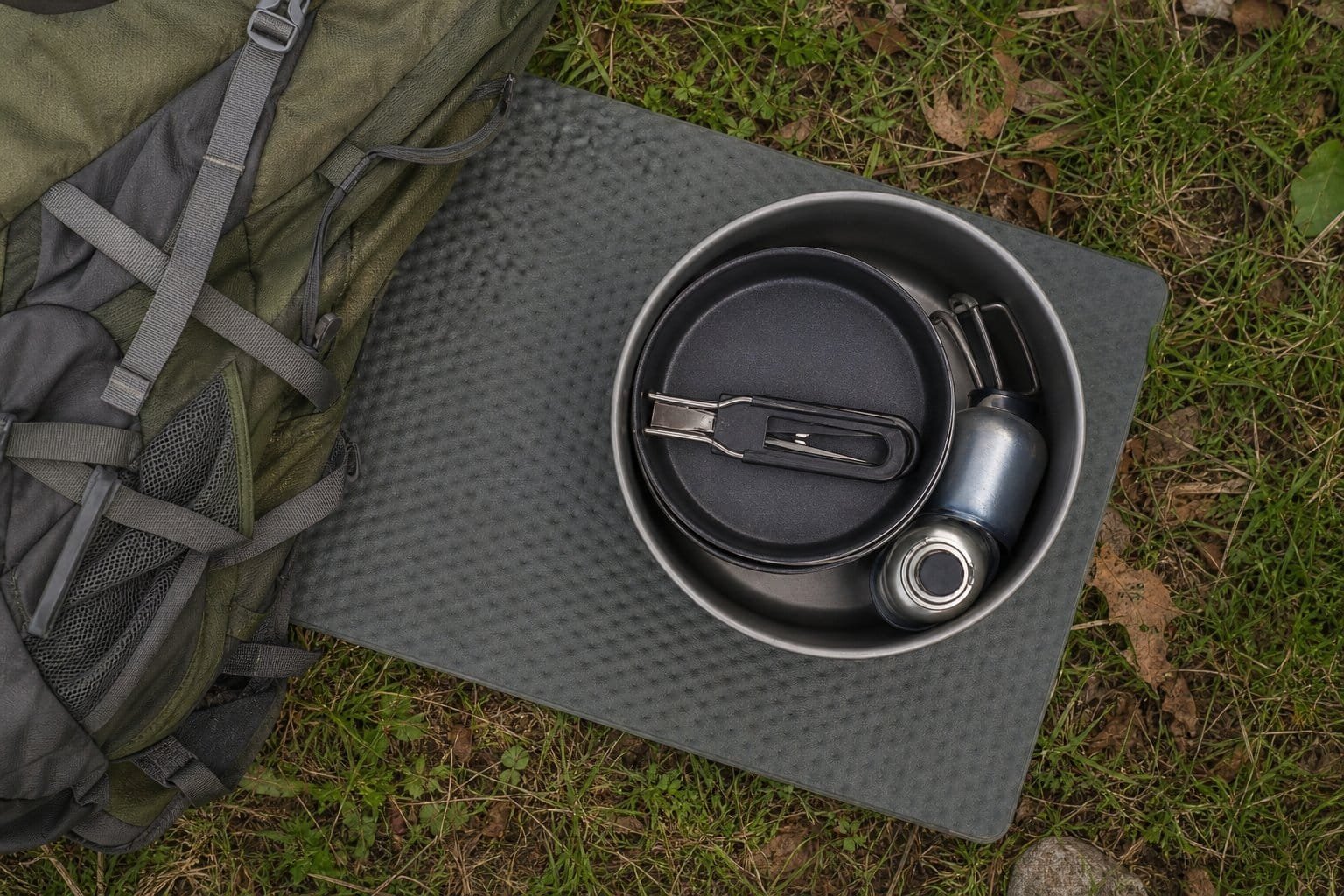
Using a camping frying pan on a gas stove
Preheat a non-stick pan on low to medium with a little oil or butter already in it, rather than heating it empty on full power. This protects both ceramic and PTFE coatings and gives you more even cooking, because the small flame of a camping stove has time to spread across the base. Once food is in, adjust the flame rather than lifting and tilting the pan.
Centre the pan over the burner and shield the flame from wind with your body, the car or a windbreak, but never enclose a gas canister with a windscreen, which can overheat it. Butane cartridges lose pressure in cold weather, so on cold UK mornings a propane or butane-propane mix keeps the pan hotter. If you are planning gas for a weekend, see how long camping stove fuel lasts.
Always cook outside the tent or in a well-ventilated porch area designed for cooking. Gas stoves produce carbon monoxide, and a sliding pan of hot fat in a tent is a serious fire risk.
Can you use a non-stick pan on a campfire?
You can, but it is the quickest way to ruin a non stick camping frying pan. Campfire flames are uneven and hard to control, and they often wrap up the sides of the pan, damaging the coating and any silicone or plastic on the handle. Fire-Maple specifically warns users to keep flames low and under the base. If you do cook on a fire, wait for embers, use a grill grate to hold the pan above them and keep the heat moderate.
For regular fire cooking, a cast iron or carbon steel pan is the better tool, and our camping stoves with a grill roundup covers gas grills if you want a barbecue flavour without a fire.
Why non-stick camping pans stop working
The most common complaint about any non stick camping frying pan is that it sticks after a season or two. Usually the cause is how the pan is used and packed rather than a faulty coating.
Overheating
High heat breaks down every non-stick coating over time. Ceramic loses its slickness faster when it is run hot, and PTFE can degrade when overheated. Cooking on full power to save time is the habit that wears most camping pans out.
Metal utensils and scouring
Metal spatulas, forks and steel wool scratch coatings. Even MSR, which says its ceramic resists metal utensils, is easier on itself with wood or silicone. Pack a wooden spatula with your pan so you are never tempted to use a fork.
Packing scratches
Rattling around in a crate with a stove, cutlery and tent pegs scratches a pan quickly. Store it with a cloth, paper towel or soft bag inside, and don’t nest sharp items in the pan.
Thermal shock
Plunging a hot pan into cold water can warp thin aluminium and stress the coating. Let it cool for a few minutes before you wash it.
Cleaning and care at the campsite
Wipe the pan with a paper towel while it is still warm to remove most of the fat, then wash it with warm water, a drop of washing-up liquid and a soft sponge in a collapsible washing-up bowl. Avoid scouring pads and steel wool. Dispose of grey water and food scraps as the campsite asks, never straight into a stream.
Dry the pan fully before packing to stop water marks and corrosion around rivets and handle fittings. At home, give it a proper wash and check that folding or removable handles still lock firmly. If a ceramic coating starts to feel sticky, a thorough clean to remove baked-on oil often brings some of the release back.

Non-stick vs stainless steel vs cast iron for camping
A non stick camping frying pan is the easiest choice for eggs, pancakes and fish, and it is light and quick to clean. Its weakness is lifespan: the coating eventually wears out and can’t be replaced.
Stainless steel pans last almost indefinitely and can be scrubbed hard, but food sticks unless you use more oil and control the heat carefully. Cast iron is heavy and slow to heat but excellent over a fire and for searing. Many campers carry a non-stick pan for breakfast and a pot for everything else; our camping cookware sets guide covers full kits, and our camping kitchen essentials list covers the rest of the kitchen.
What to cook in a non stick camping frying pan
Breakfast is where a non stick camping frying pan earns its place. Eggs, pancakes, drop scones, halloumi and fish all release cleanly with a teaspoon of oil, so you save gas, water and washing-up. Cook sausages and bacon first on medium, then push them to the side to keep warm while the eggs go in the fat.
For dinners, a deeper pan like the Jetboil 10 in handles stir-fries, fajitas, gnocchi and one-pan pasta. Cut ingredients small so they cook quickly on a modest flame, add sauces near the end and keep the heat moderate so nothing catches. Quesadillas and toasted wraps are another easy win: a dry, medium-hot non-stick pan crisps them in a couple of minutes a side.
Plan meals around your pan size. Two people can share a 20 cm pan if you cook in batches, but a family of four will spend half the morning waiting unless the camping frying pan is 24–25 cm or you run two pans on a double burner.
Buying a camping frying pan in the UK
The pans in this guide link to Amazon listings. Availability, delivery times and prices for UK buyers vary by seller, so check the listing before you order. All six pans work on standard UK camping gas stoves, whether they run on butane cartridges, screw-thread canisters or propane cylinders with a regulator.
Inch sizes on listings refer to the pan’s diameter. As a guide, 8 in is about 20 cm, 9.4 in is 24 cm and 10 in is 25 cm.
Final thoughts on choosing a non stick camping frying pan
For most UK campers, the GSI Bugaboo Ceramic 10 in is the best non stick camping frying pan: big enough for a family breakfast, easy to clean and simple to pack thanks to its locking folding handle. Backpackers should choose the MSR Ceramic Skillet, which weighs 190 g and comes with a 3-year warranty. The Trangia 24 cm is a dependable mid-size pan, the Sea to Summit Frontier has the best guarantee, the Jetboil 10 in is a light group pan, and the Fire-Maple is a sensible budget buy. Whichever you choose, cook on medium heat with a wooden spatula and your pan will last many more breakfasts.
Non-stick pan myths
Ceramic coatings gradually lose their non-stick release with use, especially when run on high heat.
Medium heat on a well-preheated pan gives more even results and protects the coating.
Flames that wrap up the sides damage coatings and handles. Use embers and a grill grate, or a cast iron pan.
What to look for in a non stick camping frying pan
19–21 cm for one or two people; 24–25 cm for families.
Ceramic is PTFE-free; PTFE releases longer but must not be overheated.
Must lock firmly; folding or removable for packing.
Thicker bases reduce hot spots on small burners.
Under 300 g for backpacking; less important for car camping.
MSR offers 3 years and Sea to Summit a lifetime guarantee.
How to make a non-stick camping pan last
- Wash before first use
Wash, dry and wipe with a little cooking oil.
- Preheat gently with oil in the pan
Never heat it empty on full power.
- Use wooden or silicone utensils
Keep forks and metal spatulas away from the coating.
- Cool before washing
Avoid plunging a hot pan into cold water.
- Wash with a soft sponge
No scouring pads or steel wool.
- Pack it protected
Put a cloth or paper towel inside before storing.
How we chose these frying pans
We have not tested every pan in this list ourselves. Our picks are based on the Amazon listings, maker information and published testing and advice from OutdoorGearLab, REI owner reviews, Backpacker, Trangia and America’s Test Kitchen. Where a listing didn’t state a spec we marked it “Not quoted” rather than guessing.
-
Coating and release
We included only pans with a non-stick coating and compared ceramic and PTFE types.
-
Size and weight
We covered pans from 19 cm to 25 cm for solo trips to family camping.
-
Handles and durability
We looked at handle locking, packability, warranties and common owner complaints.
What is the best non stick camping frying pan?
For most campers, the GSI Bugaboo Ceramic 10 in: a 25 cm ceramic pan with a locking folding handle. Backpackers should choose the 190 g MSR Ceramic Skillet.
What size camping frying pan do I need?
About 20 cm for one or two people, 24 cm for two or three and 25 cm or more for a family.
Is ceramic or PTFE better for camping?
Ceramic is PTFE-free and has no fume risk at high heat, but slowly loses release. PTFE usually releases food longer but must never be overheated empty.
Can I use a non-stick frying pan on a campfire?
Only gently, over embers and with flames kept under the base. Cast iron is better for regular campfire cooking.
How do I clean a non-stick pan at a campsite?
Wipe out the fat with paper towel, then wash with warm water, a little washing-up liquid and a soft sponge. Avoid scourers.
Do these pans work on UK camping stoves?
Yes. They suit butane, butane-propane and propane stoves; just match the pan’s width to the burner and pan supports.
More camp kitchen guides
Still planning your kitchen? See our guides to single burner camp stoves, double burner camping stoves, the best portable camping kitchen tables and camping cookware sets.
Which non stick camping frying pan should you buy?
- Best overall: GSI Outdoors Bugaboo Ceramic Frypan 10 in
- Best lightweight: MSR Ceramic Nonstick Camping Skillet
- Best classic design: Trangia Non-Stick Frypan with Handle 9.4 in
- Best lifetime guarantee: Sea to Summit Frontier Ultralight 8 in Pan
- Best for groups: Jetboil 10-Inch Ceramic Fry Pan
- Best budget: Fire-Maple Feast 7.6 in Nonstick Frying Pan
For most campers, the GSI Bugaboo Ceramic 10 in is the best non stick camping frying pan. Choose the MSR Ceramic Skillet for backpacking, the Trangia 24 cm for a classic mid-size pan, the Sea to Summit Frontier for its lifetime guarantee, the Jetboil 10 in for group cooking and the Fire-Maple Feast on a budget.
CampEquipmentPlus relies on reader support. Purchases made via links on our website may earn us an affiliate commission at no extra cost to you, helping keep the site running.