

Best Camping Chairs with Footrests UK
A good camping chair with footrest lets you raise your legs without wobbling, is easy to get in and out of, and still folds small enough for the car. Our top pick is the VEVOR 2-in-1, while the HOPERAN suits heavier campers.
Campers who buy a footrest chair want to put their feet up after a day’s walking. The common complaints are footrests that work loose or feel short, chairs that are awkward to climb into, heavy frames and padding that soaks up rain.
We compare six options: two light recliners with clip-on footrests, a six-legged 500 lb lounger, a padded zip-off design, a chair with a separate ottoman and a clip-on footrest for a chair you already own.
- Pick the footrest type first: clip-on, built-in or separate ottoman
- Check the capacity and how you'll get in and out
- Most weigh 4–5 kg, so they suit car camping
- Best overall: VEVOR 2-in-1 Four positions, detachable footrest and only 4.2 kg.
- Best for heavier campers: HOPERAN Six feet, built-in footrest and a 500 lb rating.
- Best padded: OUTSIDER 3 cm foam in the seat, back and footrest.
- Easiest to get out of: USKAU Separate 400 lb ottoman you pull in after sitting down.
A camping chair with footrest lets you sit up for tea, then lift your legs and stretch out after a long walk, without dragging a cool box over to rest your feet on. It’s one of the simplest comfort upgrades for a week on a campsite. If you mainly want to lie back, our reclining camping chair guide and zero gravity chair guide cover full recliners; this guide focuses on the footrest itself.
We compare six options with different footrest designs, explain how to choose between them and share tips for using a camp chair with footrest on soft, wet British pitches. Specs come from the Amazon listings, which quote pounds and inches, so we’ve converted them to kilograms and centimetres.
We chose chairs whose listings state the recline, capacity and weight, then checked them against published advice from REI, BestReviews and MyOpenCountry. Where a listing leaves something out, we say “Not quoted” rather than guess.



Best overall VEVOR 2-in-1 | Heavy users Hoperan 500lb | Padded Outsider Pad | Ottoman USKAU Ottoman | |
|---|---|---|---|---|
|
|
|
|
| |
| Footrest | Clip-on, detachable | Built-in, 6 feet | Zip-off, padded | Separate ottoman |
| Recline | 4 (90–135°) | 4 (105–160°) | 4 (90–135°) | Not quoted |
| Capacity | 300 lb / 136 kg | 500 lb / 227 kg | 300 lb / 136 kg | 400 lb / 181 kg |
| Weight | 9.3 lb / 4.2 kg | 10.3 lb / 4.7 kg | 9.9 lb / 4.5 kg | Not quoted |
| Padding | Headrest only | Pillow | 3 cm foam | Thick padded |
| Warranty | Not quoted | Not quoted | Not quoted | Not quoted |
| Check price | Check price | Check price | Check price |
Our camping chair with footrest reviews
Each review covers the footrest design, recline, capacity, weight, folded size and warranty, plus who the chair suits and who should skip it.
Reclining chair with detachable footrest and headrest: 4 positions from 90° to 135°, iron X-frame rated to 300 lb (136 kg), Oxford fabric with mesh, cup holder and side pocket. Weighs 9.3 lb (4.2 kg); folds with the footrest still fitted to 22 x 19 x 90 cm (8.66 x 7.48 x 35.43 in); carry bag. Warranty not quoted on the listing.
The VEVOR 2-in-1 is the camping chair with footrest we would pick for most people. It is a proper recliner first: the back locks in four positions between 90° and 135°, so you can sit up for dinner and lie well back for a doze. The footrest clips on at the front, and the listing says the chair folds with it still attached, which saves fiddling at the end of a long day. A removable headrest pillow finishes it off.
At 9.3 lb (4.2 kg) it is one of the lighter footrest chairs we found, and it packs to about 90 cm long. The trade-offs are a modest 300 lb (136 kg) rating and an iron frame, which will rust if it goes into the car wet. The warranty isn’t stated on the listing, so keep your receipt.
- Four recline positions, 90–135°
- Footrest stays on when folded
- Light at 4.2 kg
- Removable headrest
- 300 lb (136 kg) rating only
- Iron frame needs drying
- Warranty not quoted
Recliner with a built-in footrest on a 6-point base: 4 lockable positions from 105° to 160°, steel frame and 600D Oxford fabric rated to 500 lb (227 kg), detachable padded pillow, cup holder, side mesh pocket. 114 x 85 x 90 cm open (44.9 x 33.5 x 35.4 in); 10.3 lb (4.7 kg); carry bag. Warranty not quoted on the listing.
Most footrest chairs stand on four legs and hang the leg rest off the front. The HOPERAN builds the footrest into the frame and adds two extra feet under it, so it stands on six points. The maker says this keeps it steadier and stops the footrest working loose, which is a common gripe with clip-on designs. The rating is a generous 500 lb (227 kg).
The back has four positions from 105° to 160°, the flattest recline in this list, so it is close to a lounger when fully back. It weighs 10.3 lb (4.7 kg). Because the footrest is fixed, you can’t turn it into a normal chair for meals, and getting in means stepping over the leg rest. The warranty isn’t quoted on the listing.
- 500 lb (227 kg) rating
- Six feet for stability
- Reclines to 160°
- Footrest can’t detach or slip
- Fixed footrest, no upright armchair mode
- You step over it to sit down
- Warranty not quoted
Padded 2-in-1 recliner: 4 positions at 90°, 105°, 120° and 135°, 3 cm (1.2 in) foam in the seat, back and footrest, double-layer 600D Oxford, zip-off footrest with removable support rods, side pocket. 167 x 67 x 72 cm open (65.7 x 26.4 x 28.3 in); rated to 300 lb (136 kg); 9.9 lb (4.5 kg); carry bag. Warranty not quoted on the listing.
If you feel the cold in the evenings, the OUTSIDER is the cosiest chair here. It has 3 cm of foam in the seat, the back and the footrest, so your legs are cushioned too, not just your backside. The four stated angles (90°, 105°, 120° and 135°) are set with a button, and the footrest unzips and its rods pull out when you want a normal chair.
It is wide at 67 cm and fairly light at 9.9 lb (4.5 kg). Padding has one big downside in Britain: it soaks up rain and takes a long time to dry, so bring it under the awning at night. The rating is 300 lb (136 kg), and the listing doesn’t quote a warranty.
- 3 cm foam in seat, back and footrest
- Four stated angles
- Footrest zips off for meals
- Wide 67 cm frame
- Padding is slow to dry
- 300 lb (136 kg) rating
- Warranty not quoted
Padded oversized chair with a separate folding ottoman: chair and ottoman each rated to 400 lb (181 kg), ottoman top 16 x 16 in (41 x 41 cm) and 21 in (53 cm) high, thick padded seat, high back, soft headrest, 2 cup holders and pockets. The ottoman doubles as a stool or side table. Recline, weight, folded size and warranty not quoted on the listing.
The USKAU takes a different approach. Instead of a leg rest fixed to the chair, it comes with a separate padded ottoman. You sit down in a normal upright chair and then pull the stool to wherever your legs are comfortable, so there is no climbing over a footrest to get in or out. The maker stresses this as its main selling point.
Both the chair and the 41 cm square ottoman are rated to 400 lb (181 kg), so the stool works as an extra seat for a visitor or a table for your brew. The listing doesn’t say the back reclines, and it doesn’t give a weight, folded size or warranty. Two folding items also take more room in the boot than one.
- Easy to sit down and stand up
- Ottoman works as a stool or table
- 400 lb (181 kg) chair and ottoman
- Thick padding and headrest
- No recline stated
- Two items to carry
- Weight and warranty not quoted
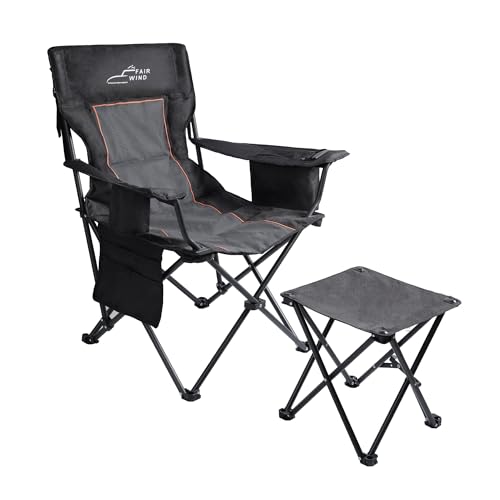
Quad-fold padded chair with matching footrest stool: high-tensile steel frame rated to 300 lb (136 kg), fully padded 4-layer 600D ripstop polyester with sponge cushion, padded neck rest, insulated drink holder, side organiser, cooler bag. Open size 38.2 x 21.3 x 21.3 in (97 x 54 x 54 cm); packs to 102 x 21 x 21 cm (40.16 x 8.2 x 8.2 in) in a tote with shoulder sling. Recline positions, weight and warranty not quoted on the listing.
The FAIR WIND set pairs a padded quad-fold chair with a matching footrest stool that can also be used as a side table. Quad chairs are the familiar umbrella-style folders, so it packs into a long tote and opens in seconds. Padding runs through the seat and back, and there’s a padded neck rest, an insulated drink holder and a cooler bag.
The product name mentions reclining, but the listing doesn’t describe any recline positions, so we’d treat it as an upright chair with a footstool. The 300 lb (136 kg) rating is fair. The listing doesn’t give the weight or a warranty, and padded quad chairs are slow to dry.
- Footstool doubles as a table
- Packs like a normal quad chair
- Padded seat and neck rest
- Cooler bag included
- No recline positions described
- Weight and warranty not quoted
- Padding holds water
Clip-on leg rest for an existing folding chair: extends from 45 cm to 70 cm, 7075 aluminium frame with 600D Oxford mesh, weighs 390 g (13.8 oz), folds into a storage bag. The listing doesn’t name compatible chairs, a weight limit or a warranty.
If you already have a chair you like, this add-on turns it into a camping chair with footrest for a fraction of the price of a new one. It is a small aluminium frame with a mesh panel that attaches to the front of a folding chair and extends from 45 cm to 70 cm, so you can set the length to suit your legs. At 390 g it barely adds weight.
The catch is that the listing calls it “universal” without naming compatible chairs or giving a weight limit for your legs. Measure your chair’s front bar and leg spacing before you buy, and don’t stand or sit on it. It’s best suited to lighter backpacking-style chairs on firm ground.
- Very cheap
- Only 390 g
- Adjusts from 45 to 70 cm
- Uses the chair you already own
- No compatible chairs listed
- No weight limit stated
- Not as steady as a built-in footrest
What is a camping chair with footrest?
A camping chair with footrest is a folding chair that supports your lower legs as well as your back and bottom. The simplest designs hang a fabric leg rest off the front of the seat. Others build the footrest into the frame, or sell the chair with a separate stool you can place where you like.
Most footrest chairs also recline, because raising your legs while sitting bolt upright isn’t very relaxing. The usual pairing is a back with three to five positions and a leg rest that sits roughly level with the seat. That makes them different from a zero gravity chair, which tilts your whole body back in one movement, and from a sun lounger, which lies almost flat.
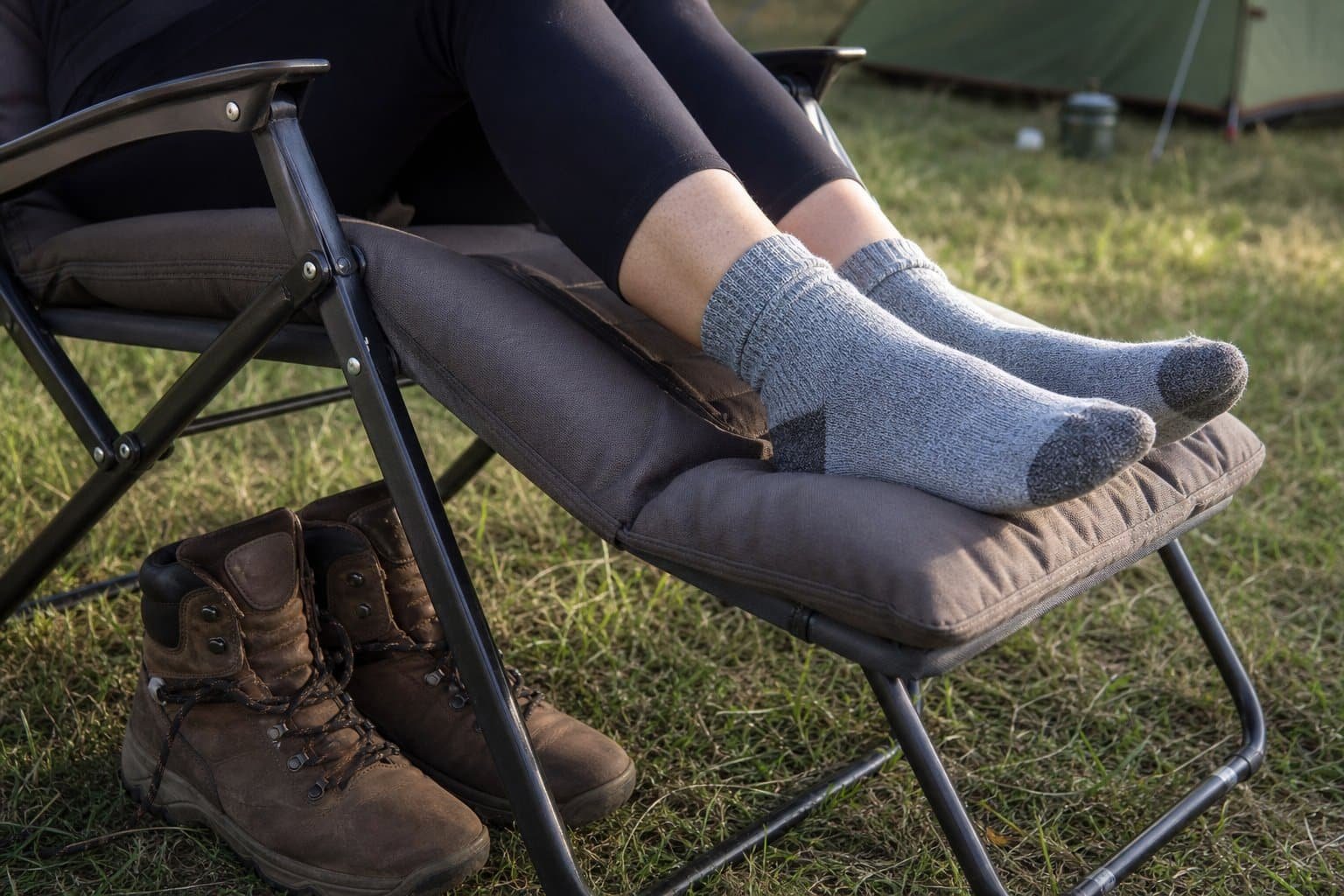
Types of footrest
Clip-on or detachable footrests
This is the most common type, used on the VEVOR. The leg rest clips or slots onto the front of the chair and comes off when you want a normal seat for meals. It’s versatile and keeps the price down. The weak point is the joint: if it’s loose, the leg rest can wobble or slide, and a few owners of clip-on chairs mention footrests that work free over time. Check the clips each trip.
Built-in footrests
On a built-in design like the HOPERAN, the footrest is part of the frame, often with extra feet underneath. It can’t come loose and tends to feel steadier, especially for heavier users. The trade-off is that you can’t remove it, so you step over the leg rest to sit down and the chair always takes up more ground.
Zip-off padded footrests
Padded recliners such as the OUTSIDER use a fabric footrest that zips onto the seat and is held out by removable rods. It’s comfortable because your calves sit on foam rather than bare fabric. Expect a few minutes of fiddling to fit or remove it, and keep the rods in the bag so they don’t get lost.
Separate ottomans and footstools
An ottoman is a small folding stool that comes with the chair, as on the USKAU and FAIR WIND sets. You sit in a normal upright chair and pull the stool into place, so getting up is as easy as with any camp chair. MyOpenCountry’s footrest chair round-up notes that a separate footrest is a plus for some campers and a drawback for others, mainly because it’s one more thing to pack. The bonus is a spare seat or a side table.
Add-on footrests
An add-on footrest attaches to a chair you already own. It’s cheap and light, but fit varies, so measure your chair first. It won’t be as steady as a footrest designed into the frame.
How to choose a camping chair with footrest
Footrest length and height
Short footrests are the most common complaint about loungers: your heels hang off the end and the edge digs into your calves. Few listings give the footrest length, so look at the open length instead. The OUTSIDER is 167 cm long when open, which suits most adults. Taller campers should favour a separate ottoman, because you can move it as far forward as you need.
Height matters too. A leg rest roughly level with the seat is comfortable for most people. If it’s much lower, your knees bend and you don’t get the feet-up feeling; much higher and it pulls on the backs of your legs.
Recline positions
A camping chair with footrest that has three or four back positions covers eating, reading and napping. Check the stated angles if the maker gives them. The VEVOR goes from 90° to 135°, while the HOPERAN reaches 160°, close to flat. More angles are only useful if each one locks firmly.
Weight capacity
Leaning back with your legs up puts more load on the rear legs and pivots than sitting upright. Allow some margin above the heaviest person who will use the chair. Our picks run from 300 lb (136 kg) to 500 lb (227 kg). Where a listing gives two different figures, plan around the lower one. Heavier campers can find more options in our heavy duty camping chair guide.
Getting in and out
This is where a camp chair with footrest differs most from a normal chair. With a fixed leg rest you have to step over it or swing your legs on from the side, which can be awkward for anyone with stiff knees or hips. REI’s camp chair buying advice points out that chairs with a standard seat height are easier to get in and out of. If that matters to you, choose a detachable footrest or a separate ottoman.
Stability on soft ground
Weight shifts backwards when you recline, so the rear feet can sink into wet grass and the chair can tip. Six-point designs like the HOPERAN spread the load. On any chair, small boards or wide pads under the rear feet help a lot on a soggy pitch.
Padding or mesh
Padding is warmer and kinder to your calves, which is welcome on chilly evenings. Mesh and plain fabric dry faster and are cooler on hot days. If you camp in showery weather without a big awning, a mesh or single-layer camping chair with footrest will be less hassle, and a padded camp chair with footrest is better kept for drier trips.
Weight and packed size
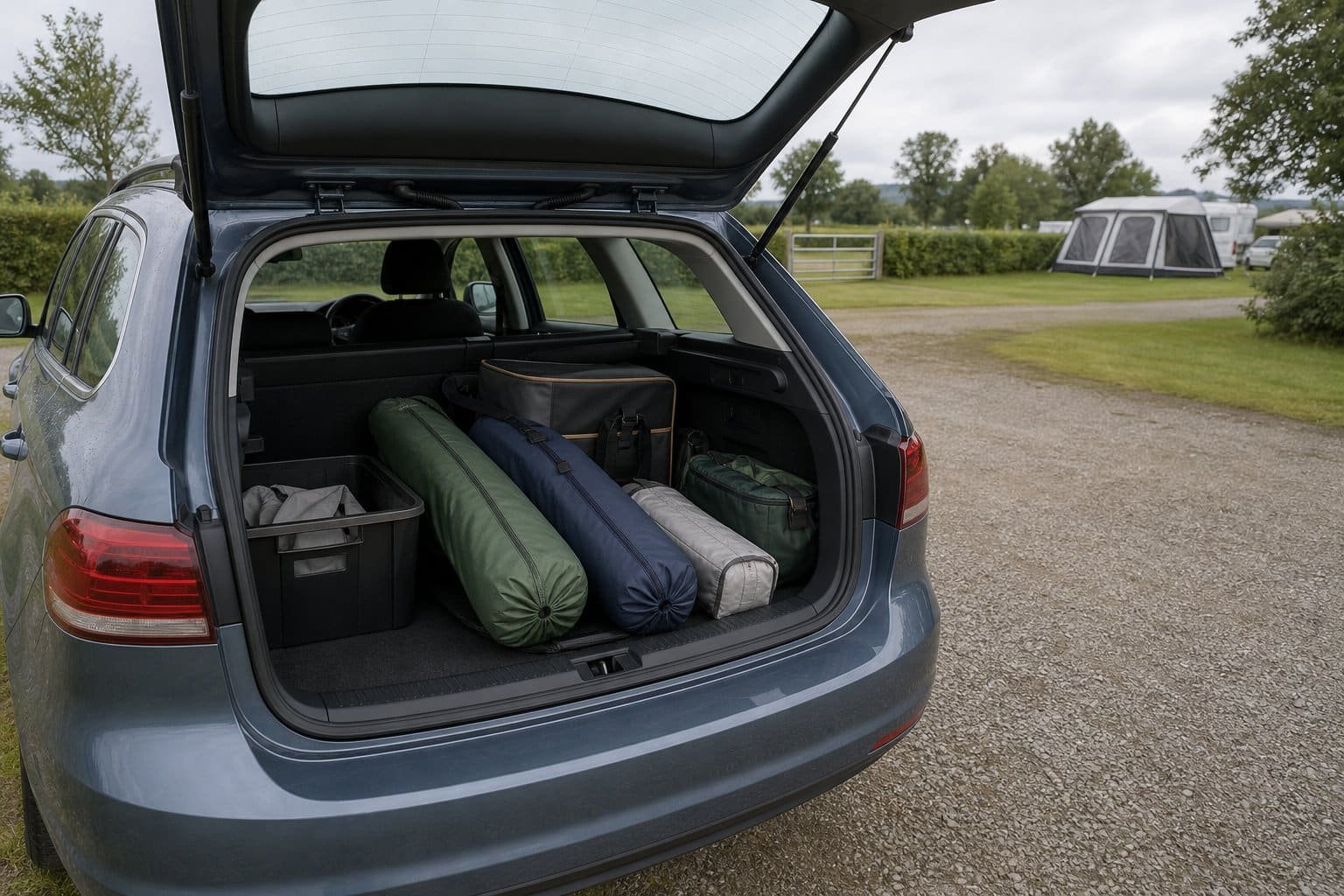
A camping chair with footrest built in or clipped on will usually weigh 4–5 kg and fold to about 90 cm long, similar to a quad chair. Sets with an ottoman add a second bag. Measure your boot if space is tight, especially if the whole family wants one.
Warranty
Few budget models of camping chair with footrest quote a warranty on their listings. If it’s important to you, buy from a seller with a clear returns policy and check the chair as soon as it arrives, including every lock and clip.
Who needs a camping chair with footrest?
A camping chair with footrest makes most sense for people who spend long stretches sitting on the pitch. If you walk or cycle all day and then sit by the tent for the evening, lifting your legs feels great. It’s also popular with anglers, festival-goers and anyone who camps for a week at a time, when the chairs stay set up outside.
It’s less useful if you mostly eat at a table, move around camp a lot or carry your kit any distance. A normal chair is lighter and easier to get in and out of, and a stool or cool box can do the footrest job in a pinch. If you only want one chair for everything, a camping chair with footrest that comes off, like the VEVOR or OUTSIDER, is the best compromise.
Footrest chairs for families
Children love footrest chairs, but they also love climbing on them. Most leg rests are designed to hold legs, not a standing child, so teach kids to sit properly and never to jump on the footrest. A separate ottoman can double as a child’s seat, as long as its rating is clear; the USKAU’s stool is rated to 400 lb (181 kg).
If you’re buying for the whole family, you don’t need a camping chair with footrest for everyone. Two for the adults plus lighter chairs for the children keeps weight and boot space down. Pick matching footrest types so the parts don’t get mixed up when packing.
Caravans, campervans and awnings
A camping chair with footrest works well under a caravan or campervan awning, where it stays dry and the ground is often firmer. Check the open length first, as some loungers reach about 1.7 m and can fill a small awning. Chairs whose footrests come off are easier to fit in tight spaces, and an ottoman can be tucked under a table when you need room.
For storage in a campervan, flat-folding designs are easier than quad chairs. The FAIR WIND set packs into a long tote, while the clip-on designs fold to about 90 cm long. A camp chair with footrest that folds without removing the leg rest, like the VEVOR, saves time when you move on.
Useful accessories
A few cheap extras make a camping chair with footrest more comfortable. A small plywood board or pair of wide pads under the rear feet stops sinking. A fleece blanket over the seat adds warmth on cool nights. A groundsheet under the footrest keeps wet grass off the fabric, and a small cushion at the end of a short leg rest stops the edge pressing into your calves.
Camping chair with footrest vs recliner vs zero gravity chair
A camping chair with footrest is the best all-rounder if you want to sit at a normal height for meals and then put your feet up. A recliner without a footrest is lighter and simpler but leaves your legs on the ground. A zero gravity chair is the most relaxing for lounging but is heavy, sits low and isn’t good for eating.
Many families end up with a mix: one or two footrest chairs for the adults who walk the most, lighter chairs for children, and a padded camping chair for anyone who feels the cold.
Using a footrest chair on British campsites
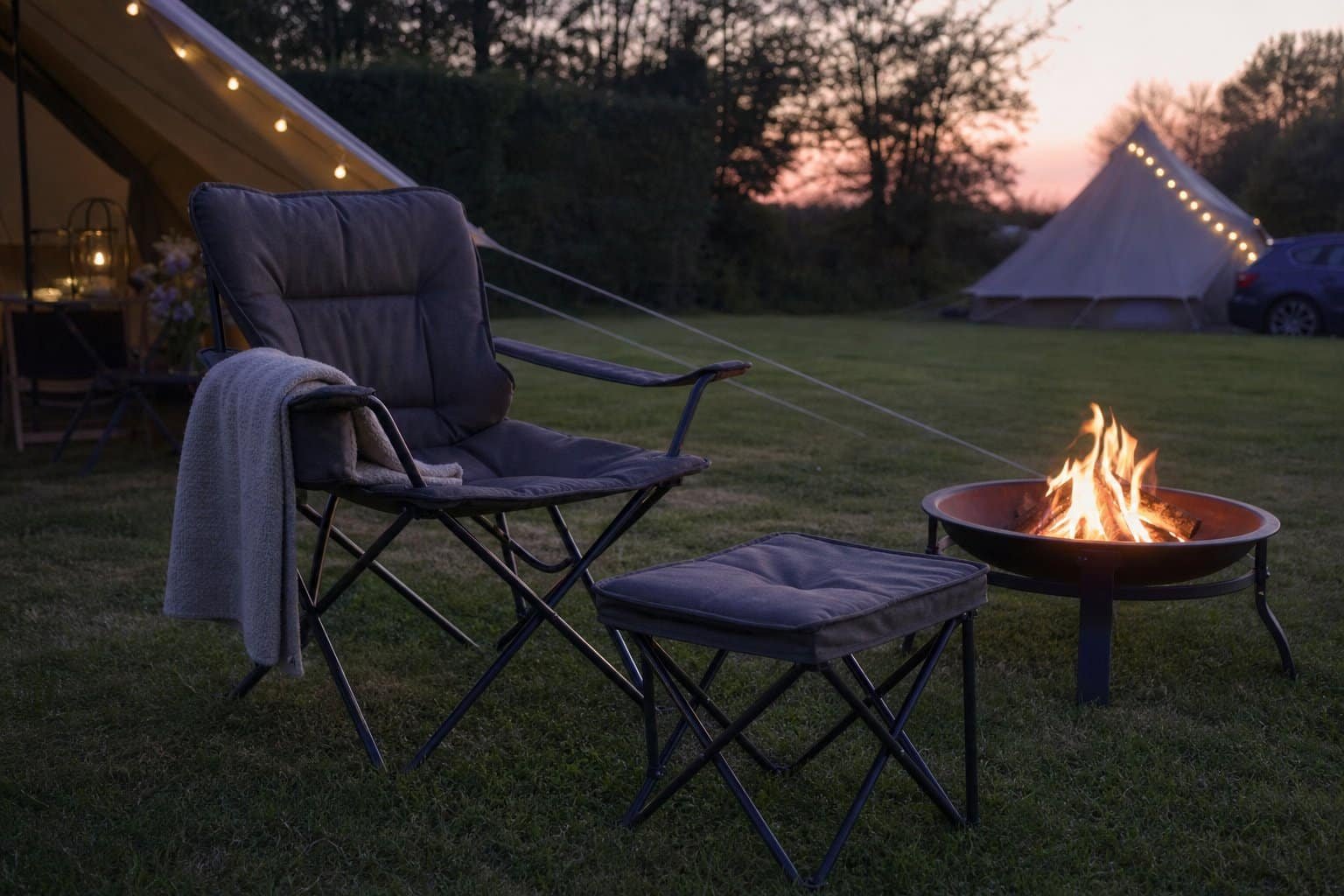
Wet grass is the main challenge for a camping chair with footrest. When you lean back with your legs up, your weight moves onto the rear feet, which can sink into soft ground. Put the chair on firm, level ground, or slide a small board under the back legs. On a slope, face uphill or across the slope, never with your back downhill.
Keep the chair away from the fire. Footrests bring your feet and the fabric closer to the flames than you might expect, and polyester melts. Leave a good gap from any fire bowl or propane fire pit.
Rain is the other issue. Bring padded chairs into the awning at night, and lay a groundsheet or mat under the footrest so wet grass doesn’t wick into it. Never fold a chair away wet if you can avoid it; dry it at home before storing it.
Setting up a camp chair with footrest
Open your camp chair with footrest fully and check every joint has locked before you sit. Fit a clip-on or zip-off footrest next, then press on it with your hand to make sure it’s seated. Sit down in the upright position first, then lift your legs onto the rest and recline the back.
To get up, lower your legs to one side, bring the back upright and then stand. Pushing up from the footrest itself can tip the chair forwards or bend the leg rest frame.
Caring for your chair
Look after a camping chair with footrest the same way as any folding chair, with extra attention to the leg rest. Brush sand and grit out of the recline locks and footrest clips before folding, because grit stops them seating properly. Wash the fabric with mild soapy water and let it dry fully before storage. Check rivets, screws and clips at the start of each season, and wipe steel frames dry to stop rust.
Common problems and fixes
The footrest wobbles or slips: the clips or joint are worn or not fully seated. Clean them, refit the leg rest and check for bent tubes. A strip of tape on a loose tube end can help in an emergency.
Your heels hang off the end: the footrest is too short for you. Add a rolled jacket at the end, or switch to a chair with a separate ottoman you can move forwards.
The chair tips back when you recline: the rear feet are sinking or you’re on a slope. Move to firmer ground and put a board under the rear legs.
The padding is still damp in the morning: padded seats are slow to dry. Store the chair under cover overnight and pack a towel to dry the surface.
Buying a camping chair with footrest in the UK
The chairs in this guide are listed on Amazon US, which quotes prices in dollars, capacities in pounds (lb) and sizes in inches. Divide pounds by 2.2 for kilograms and multiply inches by 2.54 for centimetres. Delivery times and import costs vary, so check them before you order.
If you’re buying a camping chair with footrest from a UK shop, look for the same details: footrest type, number of recline positions, capacity, weight and folded length. A clear returns policy is worth having, because it’s hard to judge footrest length from photos.
How much should you spend?
Converting the US prices we saw when we checked, around £30–£40 buys a capable clip-on footrest recliner such as the VEVOR or HOPERAN. Padded designs and chair-and-ottoman sets cost more, roughly £50–£70. An add-on footrest is the cheapest option at under £15, if it fits your existing chair.
Which footrest chair suits your trip?
For a family holiday where the chairs live on the pitch, the VEVOR 2-in-1 gives the best mix of comfort, weight and price. Heavier campers should choose the HOPERAN. If you feel the cold, the OUTSIDER’s padding is the cosiest. If getting up is hard work, the USKAU’s separate ottoman is the easiest to live with. For festivals and sports, the FAIR WIND set packs like a normal quad chair.
Final thoughts on choosing a camping chair with footrest
The best camping chair with footrest is the one that suits how you sit and move. Start with the footrest type, then check capacity, recline and weight. Keep it on firm ground, out of the rain and away from the fire, and it will make long evenings at camp far more comfortable. Building your camping kit? See our camping essentials list too.
Camping chair with footrest myths
Many footrests are short. Taller campers should check the open length or choose a separate ottoman they can move.
Fixed footrests on extra feet often feel steadier, but a well-fitted clip-on design on firm ground works fine too.
Several weigh about 4–5 kg, similar to a padded quad chair. They suit car camping rather than long walks.
What to look for in a camping chair with footrest
Clip-on, built-in, zip-off or separate ottoman: pick the one that suits how you get in and out.
Your heels should rest on it, not hang off; check the open length.
Allow extra above the heaviest user, as reclining loads the rear legs.
Three or four firm positions cover meals, reading and napping.
Wide or extra feet help on soft grass.
Most weigh 4–5 kg; sets with an ottoman add a second bag.
How to use a footrest chair safely
- Open it fully
Unfold the chair and check every joint has locked.
- Fit the footrest
Clip, slot or zip the footrest on and press it to check it’s secure.
- Pick firm, level ground
Put the rear feet on firm ground or a board; face uphill on slopes.
- Sit upright first
Sit down with the back upright before lifting your legs.
- Lift your legs and recline
Place your legs on the rest, then recline the back to your chosen position.
- Get up the safe way
Lower your legs to the side and bring the back upright before standing. Don’t push up from the footrest.
How we chose these camping chairs with footrests
We have not tested every chair in this list ourselves. Our picks are based on the Amazon listings and published buying advice from REI, BestReviews and MyOpenCountry. Where a listing didn’t state a spec, we said so rather than guessing. Nothing here is medical advice.
-
Footrest
Every pick supports your legs, either on the chair or with a matching stool.
-
Stated specs
We favoured listings that state capacity, recline and weight.
-
Real-world use
We weighed getting in and out, stability, padding, folded size and price.
What is the best camping chair with footrest?
For most campers, the VEVOR 2-in-1: four recline positions, a detachable footrest and a weight of only 4.2 kg. Heavier campers should look at the 500 lb HOPERAN.
Are camping chairs with footrests stable?
Yes, on firm, level ground. Reclining moves your weight to the rear feet, so use a board on soft grass. Six-point designs such as the HOPERAN are steadier.
Is a separate ottoman better than an attached footrest?
An ottoman makes it easier to sit down and stand up and doubles as a stool or table, but it’s one more item to carry. An attached footrest packs in one bag.
Can I add a footrest to my existing camping chair?
Yes. Add-on footrests like the universal attachment in this guide clip onto many folding chairs. Measure your chair first, as compatibility isn’t guaranteed.
How much weight can a camping chair with footrest hold?
Our picks are rated from 300 lb (136 kg) to 500 lb (227 kg). Allow a margin above the heaviest user.
Are footrest chairs good for bad backs or swollen legs?
Raising your legs can feel more comfortable, but this isn’t medical advice. Speak to your GP or physio if you have a back, circulation or joint condition.
More camping furniture guides
Furnishing your pitch? See our guides to reclining camping chairs, zero gravity chairs, lightweight camping chairs, camping chairs for bad backs and what camping furniture you need.
Which camping chair with footrest should you buy?
- Best overall: VEVOR 2-in-1 Reclining Camping Chair with Footrest
- Best for heavier campers: HOPERAN Camping Chair with Foot Rest, 500 lb
- Best padded: OUTSIDER Padded Reclining Camping Chair with Footrest
- Best with ottoman: USKAU Oversized Camping Chair with Foot Rest Ottoman
- Best quad-style set: FAIR WIND Oversized Padded Camping Chair with Footrest Stool Set
- Best add-on: Universal Camping Chair Foot Rest Attachment
For most campers, the VEVOR 2-in-1 is the best camping chair with footrest. Choose the HOPERAN for a 500 lb rating, the OUTSIDER for padding, the USKAU or FAIR WIND for a separate footstool, and the universal attachment to upgrade a chair you already own.
CampEquipmentPlus relies on reader support. Purchases made via links on our website may earn us an affiliate commission at no extra cost to you, helping keep the site running.