
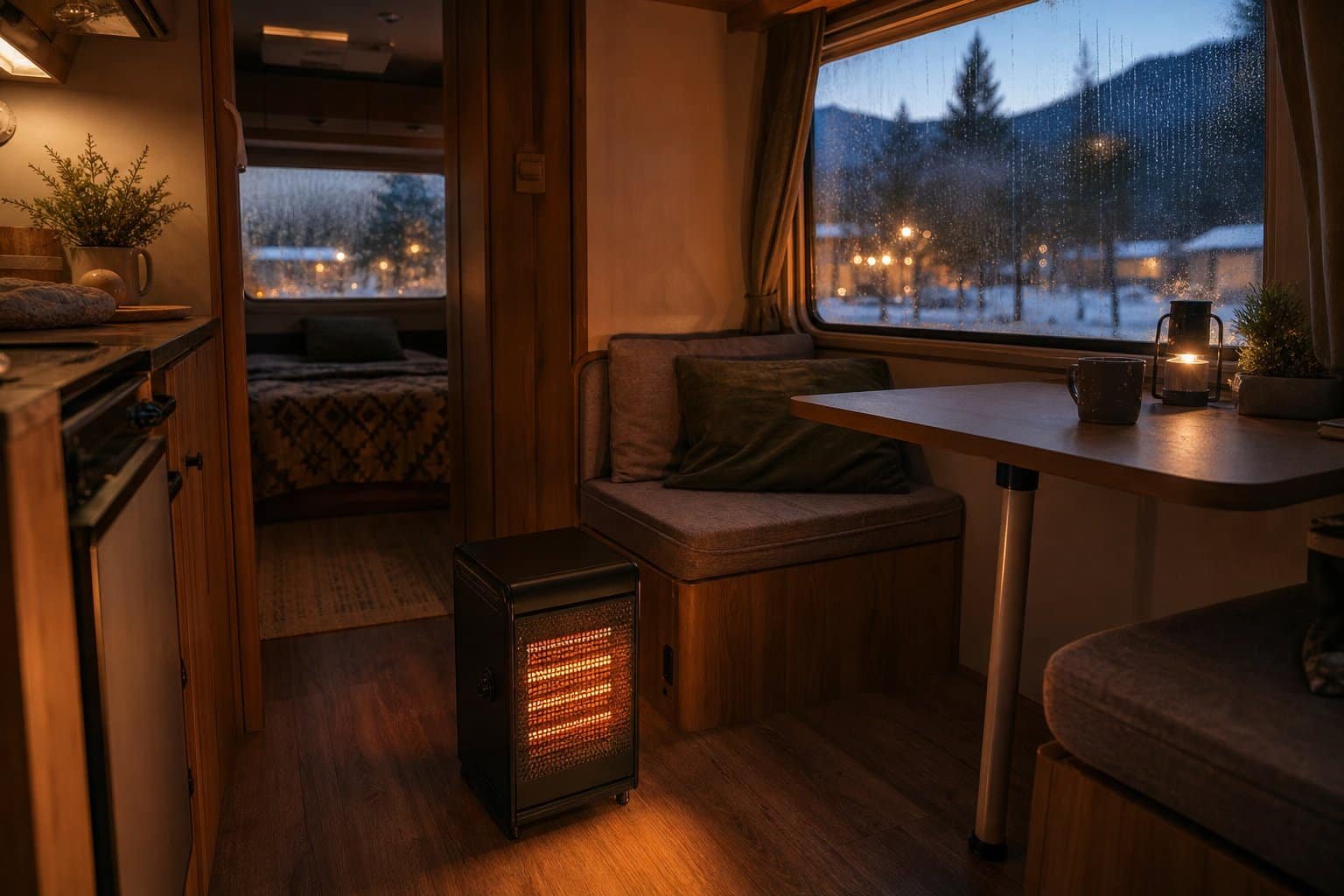
Best Electric Heaters for Campers and RVs
The best electric heater for campers is one with a genuine low setting of 600–900 W, a thermostat and a tip-over or overheat cut-off, because on a 30 amp campground hookup it is amps, not BTUs, that usually decide whether you stay warm.
RVers turn to electric heat to save propane, stop the furnace cycling and roaring all night, and keep condensation down. The usual problems are tripped breakers, warm or melted plugs and outlets, noisy fans and thermostats that cycle on and off. A 1500 W heater draws about 12.5 amps on 120 volts, which is a big share of a 30 amp hookup and close to the limit of a single RV outlet.
This guide focuses on low-amp heaters that suit campers, travel trailers and RVs on shore power. Below we compare six options, show the amp maths for 15, 20, 30 and 50 amp sites, and explain how to use an electric heater in a camper safely.
- Low settings of 500–900 W save outlets and breakers
- 1500 W = about 12.5 amps at 120 V
- Oil-filled radiators are silent; ceramic heaters warm fastest
- Run on low A 600 W setting draws about 5 amps; 1500 W draws 12.5 amps. Low is kinder to RV outlets and leaves room for other appliances.
- Count your amps On a 30 amp hookup, a heater on high plus a microwave or air conditioner can trip the main breaker.
- Plug straight into the wall Fire services advise no extension cords or power strips for space heaters, and to check plugs for heat damage.
- Pick the type for the job Radiators for silent nights, ceramic heaters for quick warm-ups, a 500 W mini heater for low-amp sites.
Choosing an electric heater for campers is mostly about matching the heater to your hookup. A camper heater that only runs at 1500 W will trip breakers and stress outlets on many campground pedestals, while a model with a 500–900 W low setting can run all evening alongside the fridge and lights. The six picks below are all plug-in electric heaters for RV and camper use on shore power, chosen for their low settings, thermostats and safety cut-offs.



Top pick Caframo | Quiet Basics Oil | Compact Lasko | Low draw Basics 500W | |
|---|---|---|---|---|
|
|
|
|
| |
| Type | Fan heater | Oil-filled radiator | Ceramic fan heater | Ceramic fan heater |
| Heat settings | 600/900/1500 W | 600/900/1500 W | 900/1500 W | 500 W |
| Draw on low (120 V) | About 5 A | About 5 A | About 7.5 A | About 4.2 A |
| Draw on high (120 V) | About 12.5 A | About 12.5 A | About 12.5 A | About 4.2 A |
| Thermostat | Adjustable | Adjustable | 11 settings | Not quoted |
| Tip-over shut-off | Not quoted (low-profile base) | Yes | Not quoted | Yes |
| Size | 11.25 x 8 x 5 in | Not quoted | 9.2 in tall | 5.9 x 3.2 x 6 in |
| Warranty | 5 years | Not quoted | 3 years | Not quoted |
| Check price | Check price | Check price | Check price |
The best electric heater for campers: our detailed reviews
Each review covers heat settings, the amps each setting draws, thermostat and safety features, size and warranty, plus the complaints owners raise most. Camping without hookup? See our battery powered heaters for camping instead, or our propane heaters for camping if you can manage the ventilation.
600, 900 or 1500 W, three heat and two fan settings, anti-freeze mode, steel housing, 5-year warranty
Caframo’s True North is built for boats and RVs rather than offices, and it shows. Retailers list three heat settings of 600, 900 and 1500 W plus two fan settings, so on low it draws only about 5 amps at 120 volts. That leaves plenty of headroom on a 30 amp hookup for the fridge, microwave or coffee maker, and it is the setting that saves the stab-style RV outlets that owners and electricians warn can overheat at a constant 12.5 amps. The adjustable thermostat holds a set temperature, and the anti-freeze setting switches the heater on when the air drops to about 38°F, which is handy if you leave the rig plugged in during winter storage.
The low, wide steel housing (11.25 x 8 x 5 in) sits flat on the floor and resists tipping, and Caframo backs it with a 5-year warranty. The listing doesn’t mention a separate tip-over switch, so keep it on a clear floor. Owners praise how quiet it is; the main complaint is the price, which is several times that of a basic ceramic heater.
- True 600 W low setting (about 5 A)
- Steel, low-profile housing
- Thermostat plus anti-freeze mode
- Very quiet fan
- 5-year warranty
- Expensive
- No tip-over switch quoted
- Fan-forced, so some air movement
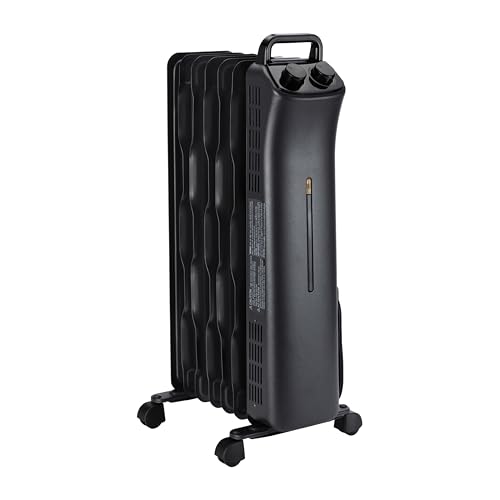
High 1500 W, medium 900 W, low 600 W, adjustable thermostat, tip-over and overheat protection, ETL listed
Oil-filled radiators are the quietest electric heaters you can put in a camper because they have no fan: the elements warm sealed oil, which radiates heat and keeps giving it off after the thermostat clicks off. This Amazon Basics model has three settings, 1500, 900 and 600 W, so the low setting draws about 5 amps on 120 volts, the same as the Caframo. It is ETL listed and adds tip-over and overheat protection, fully enclosed elements and caster wheels.
The trade-offs are typical of radiators: it takes longer to warm a cold rig than a fan heater, it is bulky in a small van, and casters can roll when you’re driving, so stow it before you move. No warranty term is quoted on the listing. If you sleep lightly and are fed up with your propane furnace cycling on and off all night, this is the cheapest way to get steady, silent warmth on hookup.
- Completely silent
- 600 W low setting
- Tip-over and overheat protection
- Keeps radiating after it cycles off
- Low price
- Slow to warm a cold rig
- Bulky for small vans
- Warranty not quoted

1500 W high, 900 W low or fan-only, 11 thermostat settings, 9.2 in tall, 6 ft cord, ETL listed
The Lasko 754200 is one of the best-known small ceramic heaters in the US, and its size suits campers well: it is 9.2 in tall with a footprint of about 6 x 7 in, so it fits on a table, step or nightstand. You get 1500 W high, 900 W low and fan-only, plus an 11-step thermostat with simple dials and no remote to lose. On low it draws about 7.5 amps, which is fine on a 30 amp hookup if you avoid running the microwave and air conditioner at the same time.
Safety features include a self-regulating ceramic element, automatic overheat protection, cool-touch housing and ETL listing, and Lasko gives a 3-year limited warranty. The listing doesn’t mention tip-over protection, so place it where it can’t be knocked over. Its 900 W low is higher than the Caframo’s or the radiator’s 600 W, so it is less suited to a 15 or 20 amp pedestal shared with other loads.
- Small enough for a table
- Fast ceramic heat
- Simple 11-step thermostat
- Fan-only mode for summer
- 3-year warranty
- 900 W minimum (7.5 A)
- No tip-over switch quoted
- Fan noise
500 W ceramic heater, about 4.2 A, tip-over protection, 48 dB, 1.4 lb, 5.9 x 3.2 x 6 in
This tiny Amazon Basics heater has one job: put 500 W of ceramic heat where you are sitting. At about 4.2 amps on 120 volts it is the gentlest load in this list, which makes it the one to use on a 15 or 20 amp campground outlet, alongside other appliances, or on a larger power station’s inverter for short spells. Amazon quotes 48 dB, tip-over protection, a weight of just 1.4 lb and a footprint of 5.87 x 3.15 x 5.95 in.
Be realistic about what 500 W can do: it is a personal heater for your feet under the dinette or your hands at the desk, not a way to heat a whole trailer on a freezing night. The listing doesn’t mention a thermostat or warranty term. It is also worth reading our guide to battery powered heaters for camping if you camp without hookup.
- Only about 4.2 A
- Tip-over protection
- Tiny and light
- Very cheap
- Quiet at 48 dB
- Personal heat only
- No thermostat quoted
- Warranty not quoted
1500 W oil-filled radiator, ComfortTemp auto mode, anti-freeze below 41°F, thermal cut-off, 3-year warranty
De’Longhi’s EW7707CM is a premium take on the oil-filled radiator. It is silent, the thermal-slot design keeps the surface temperature lower than a traditional finned radiator, and its ComfortTemp button automatically balances temperature and power, which De’Longhi says uses up to 20 percent less energy than running the thermostat at maximum. An anti-freeze setting switches it on below about 41°F, and it has a thermal cut-off and fully enclosed elements. It measures about 5.9 x 13.8 x 24.8 in, rolls on snap-in wheels and comes with a 3-year warranty.
The listing only says the power level is adjustable; De’Longhi’s own FAQ gives 700, 800 and 1500 W settings for its 1500 W radiators, so expect about 5.8 amps on low. Like any radiator, it heats slowly and takes floor space, and it costs about twice as much as the Amazon Basics radiator.
- Silent radiant heat
- ComfortTemp auto mode
- Anti-freeze setting
- Lower surface temperature
- 3-year warranty
- Costs twice the budget radiator
- Slow to heat
- Tall for small vans
Vortex whole-room circulation, low/medium/high heat, 7 thermostat settings, tip-over and auto shut-off, 5-year replacement
Vornado’s MVH uses the brand’s vortex circulation to push warm air across the room like a small forced-air furnace, which suits long trailers and fifth wheels where a ceramic heater only warms the area in front of it. You get low, medium and high heat, a 7-step thermostat, a cool-touch exterior, tip-over protection and an automatic safety shut-off. Vornado will replace it for up to 5 years and designs and supports its heaters in Kansas.
The Amazon listing doesn’t give the wattage of each setting, so check the label before you rely on low on a tight circuit, and assume the high setting draws close to the usual 12.5 amps. Air movement is more noticeable than with a radiator, which some people find draughty.
- Circulates heat around the room
- Three heat modes
- Tip-over and auto shut-off
- Cool-touch exterior
- 5-year replacement promise
- Wattages not quoted on listing
- Fan noise and air movement
- Mid-priced
How many amps does an electric heater for campers draw?
Divide the heater’s watts by 120 volts to get amps. A 1500 W heater draws about 12.5 A, 900 W about 7.5 A, 600 W about 5 A and 500 W about 4.2 A. As RV electrical writer Mike Sokol explains, the low setting matters because RV outlets are usually rated 15 A and the stab-style receptacles in many rigs can loosen and overheat under a long, heavy load. Check outlets and plugs for discolouration or melting, and replace them if you find any.
On a 30 amp hookup, one heater on low leaves roughly 24 amps for everything else, but a heater on high plus a microwave (often 10–13 A) or air conditioner can trip the main breaker. A 50 amp RV has two 50 A legs, so it can usually run two heaters on separate circuits. On a 15 or 20 amp pedestal or household outlet, stick to one heater on its lowest setting, or the 500 W mini heater.

Types of electric heater for campers
There are four main types of electric heater for campers, and each suits a different rig and sleeping style. None burns fuel, so none adds carbon monoxide or the moisture that an unvented propane heater puts into the air.
Ceramic fan heaters
Ceramic heaters such as the Lasko 754200 and the Amazon Basics 500W pass air over a heated ceramic element with a small fan. They warm a van or small trailer within minutes, are compact enough to sit on a table, and are usually the cheapest camper heater you can buy. The downsides are fan noise and the fact that the warmth stops almost as soon as the heater cycles off.
Oil-filled radiators
Oil-filled radiators such as the Amazon Basics 7-fin and the De’Longhi EW7707CM heat sealed oil, which then radiates warmth for a long time. They are silent, which makes them the best electric heater for campers who are woken by a furnace or fan cycling at night. They are slow to warm a cold rig, heavier and taller, and need to be secured or stowed before you drive.
Fan-forced and vortex heaters
Heaters such as the Caframo True North and Vornado MVH use a stronger fan to move warm air across the whole space. That suits long travel trailers and fifth wheels, where a small ceramic heater only warms the area in front of it. Expect more air movement and a little more noise than a radiator.
12V heaters
You will also see 12V plug-in heaters for cars and vans. A 150 W heater on 12 volts pulls about 12.5 amps from the battery and gives far less heat than a 120 V RV space heater, so they are best for defrosting a windshield or warming your hands. If you camp off-grid, a heated blanket is a better use of battery power; see our guide to battery powered heaters for camping.
What size electric heater for RV use do you need?
A common rule of thumb for home space heaters is about 10 watts per square foot of floor area, so a 1500 W heater is rated for about 150 sq ft. RVs and campers have thin walls, large windows and single-glazed vents, so in freezing weather one 1500 W heater rarely keeps a 30 ft trailer as warm as the furnace does. In practice, one electric heater for RV living areas plus the furnace set a few degrees lower works well, and in a small campervan a 500–900 W setting is often plenty.
If you have 50 amp service, two smaller heaters often beat one large one: put one in the living area and one in the bedroom, each on its lowest useful setting and on a separate circuit. You get more even warmth, each outlet carries less load, and you can switch off the heater in any room you aren’t using. On 30 amp service, stick to one heater and move it between rooms as you need it.
Insulation makes a big difference to how hard any camper heater has to work. Closing blinds at night, adding reflective insulation to skylights and vents, and blocking draughts around the door can let you run a heater on its low setting instead of high, which saves power and keeps outlets cooler.
Electric heater for campers vs propane furnace
Most RVs have a ducted propane furnace, so why add an electric heater for campers at all? The main reasons are saving propane, peace and quiet, and cost. If electricity is included in your site fee, every hour on electric heat is propane you don’t have to refill. Electric heaters are also much quieter than many RV furnaces, which roar when the blower starts and cycle on and off through the night.
The furnace still has a job, though. In many RVs its ducts also warm the tank bays and plumbing, so relying only on an RV space heater in sub-freezing weather can leave tanks and pipes at risk of freezing. A good approach is to set the furnace thermostat a few degrees below the electric heater’s setting, so the furnace only comes on when the electric heat can’t keep up. If you camp without hookup and want more heat than electric can give, our guide to propane heaters for camping covers portable models with low-oxygen shut-offs.
On metered sites it helps to do the sums. A 1500 W heater uses 1.5 kWh an hour, so at 15 cents per kWh it costs about 23 cents an hour on high and about 9 cents an hour at 600 W. It produces about 5,100 BTU an hour on high, while a gallon of propane holds about 91,500 BTU, so compare those figures with your local electricity and propane prices before deciding which to lean on. Many full-timers find electric heat cheaper when the site includes power and roughly similar when it doesn’t.
Can you run an RV space heater from a power station or generator?
You can, but only for short spells. Runtime is roughly the power station’s watt-hours multiplied by 0.85 (to allow for inverter losses) and divided by the heater’s watts. A 1,000 Wh power station runs a 1500 W heater for only about 35 minutes, a 600 W setting for about 1.4 hours and a 500 W mini heater for about 1.7 hours. The inverter also has to be rated above the heater’s wattage, or it will shut down.
A generator is more practical. A 2,000 W inverter generator can usually run one RV space heater on its low setting plus a few small loads, but not a heater on high plus a microwave. For overnight warmth off-grid, a 12V heated blanket or heated mattress pad uses a fraction of the energy of any electric heater for campers.
Where to put a camper heater
Place the heater on a flat, hard floor in the main living area, at least 3 ft from bedding, curtains, clothing and cushions, and where nobody will trip over it or the cord. Point fan heaters along the length of the rig rather than at a wall, and keep radiators away from the door so they can’t be knocked when you come in. Plug the heater straight into a wall outlet on its own circuit if you can, and avoid the outlet that also feeds the microwave or coffee maker. In a small campervan, a table-top camper heater placed low and away from the bed is safer than one on the floor among bags and shoes.
Electric RV heater myths
It draws about 12.5 A on its own. Add a microwave or air conditioner and you can exceed 30 A. Use low, or run big loads one at a time.
They produce no carbon monoxide, but space heaters still cause home fires every year. Keep them clear of bedding and curtains, plug them straight into the wall and never leave them on when you’re out.
The oil is permanently sealed and never needs topping up; it is only a heat store.
What to look for in an electric heater for campers
Look for a stated low of 600–900 W (or a 500 W heater). It keeps amps down, protects RV outlets and leaves room for other appliances.
A thermostat lets the heater cycle to hold a temperature instead of running flat out, saving power and stopping the rig overheating.
Campers are small and floors get busy. A tip-over switch and overheat cut-off add a layer of safety; look for UL or ETL listing.
Oil-filled radiators are silent but slow; ceramic heaters are fast but have a fan; vortex fan heaters circulate air through longer rigs.
Low, wide heaters resist tipping and fit small floors. Tall radiators need space and should be stowed before driving.
A freeze-guard setting helps during winter storage on hookup, and a 3–5 year warranty shows maker confidence.
How to use an electric heater in a camper safely
- Check your hookup
Know whether you have 15/20, 30 or 50 amps, and add up the heater plus anything else you will run at the same time.
- Plug straight into the wall
Follow Ready.gov and U.S. Fire Administration heater safety advice: no extension cords or power strips, and check cords and plugs for damage first.
- Start on low
Use the lowest setting with the thermostat and only switch to high for a short warm-up.
- Keep it clear
Keep at least 3 ft clear of bedding, curtains and clothing, and place the heater on a flat, hard floor where it can’t be knocked over.
- Feel the plug
After an hour, carefully check whether the plug or outlet feels hot. Warm plugs are a warning sign; stop using that outlet and have it checked.
- Never leave it running unattended
Switch the heater off when you leave the RV, and keep a working smoke alarm.
How we chose these electric heaters
We have not tested every heater in this list ourselves. Our picks are based on the Amazon listings, maker and retailer specifications (including Caframo dealers and De’Longhi’s own FAQ), RV electrical guidance from RVtravel’s Mike Sokol, fire-safety advice from Ready.gov and the U.S. Fire Administration, and recurring complaints from RV owners on forums such as Good Sam about tripped breakers, hot outlets and noisy heaters.
-
Amp draw
We favoured heaters with a stated low setting and calculated the amps at 120 V.
-
Safety features
We checked for thermostats, tip-over switches, overheat cut-offs and UL/ETL listings.
-
Fit for campers
We considered size, stability, noise and whether each heater suits a van, trailer or larger RV.
-
Value and warranty
We weighed price against build quality and stated warranty.
This guide is general information, not professional electrical or safety advice. Always follow the heater’s manual and your RV maker’s guidance.
What is the best electric heater for campers and RVs?
For most RVers, the Caframo True North 9206: a 600 W low setting (about 5 A), a thermostat, a steel low-profile body and a 5-year warranty. The Amazon Basics oil-filled radiator is the best quiet budget choice.
Will a space heater trip my 30 amp RV breaker?
It can. A 1500 W heater draws about 12.5 A, so with a microwave or air conditioner running you can exceed 30 A. Run the heater on low, or avoid using big loads at the same time.
How many electric heaters can I run on 50 amp?
A 50 amp RV has two 50 A legs, so two heaters on separate circuits are usually fine. Each RV outlet circuit is normally only 15 or 20 A, so don’t plug two heaters into the same circuit.
Can I use an extension cord with an RV space heater?
Fire-safety guidance from Ready.gov and the U.S. Fire Administration says to plug space heaters directly into a wall outlet, not an extension cord or power strip.
Is an oil-filled heater or a ceramic heater better in a camper?
Oil-filled radiators are silent and give steady heat, so they suit overnight use. Ceramic heaters warm a small space faster and are more compact but have a fan.
Is it cheaper to heat an RV with electric or propane?
If electricity is included in your site fee, an electric heater saves your propane. On metered sites it depends on local prices. Many RVers use electric heat for the living area and keep the furnace for very cold nights, because it also keeps the tank bays warm.
For more ways to stay warm, see our older roundup of electric heaters for RVs, our guide to camping heaters for tents and our tips on how to power devices while camping.
Electric heater safety features explained
Not every safety feature on a product listing means the same thing, so it helps to know what to look for before you buy an electric heater for campers.
Safety listing. UL, ETL or CSA marks mean an independent lab has tested the heater against a recognised safety standard. Look for the mark on the heater’s label, not just in the listing text, and avoid unbranded heaters that don’t name a testing lab.
Thermostat. A thermostat switches the heater on and off to hold a set temperature. It saves power and stops a small rig overheating, and on a fan heater it also means fewer hours of noise. Heaters with numbered dials rather than degrees still work well once you find the setting you like.
Tip-over switch. A tip-over switch cuts power if the heater is knocked over. It is especially useful in campers, where pets, children and bags share a small floor. Low, wide heaters such as the Caframo are harder to knock over in the first place, but a switch adds a second layer of protection.
Overheat protection. An overheat cut-off turns the heater off if its internal temperature gets too high, for example if a towel falls over the grille. Most reputable heaters have one; check the listing or manual.
Cool-touch housing and anti-freeze modes. Cool-touch casings reduce the risk of burns in tight spaces, and anti-freeze or frost-guard modes switch the heater on when the temperature drops near freezing, which can help protect a stored rig on hookup.
Common RV space heater problems and how to fix them
Most complaints about an RV space heater come down to power, placement or expectations. Here are the problems owners report most and what usually solves them.
The breaker keeps tripping. Add up what is running. A 1500 W heater (12.5 A) plus a microwave on the same 15 or 20 amp circuit will trip it, and a heater on high plus an air conditioner can overload a 30 amp hookup. Use the heater’s low setting, move it to an outlet on a different circuit, or switch it off while you cook.
The plug or outlet feels hot. This is a warning sign, often caused by a worn or loose outlet. Stop using that outlet, let it cool, and have it checked or replaced. Running the heater on low reduces the load on older outlets.
A burning smell on first use. New heaters often smell for a short time as dust and manufacturing residue burn off. Run a new heater on high for a short while with a window open, and stop using it if the smell persists or you see smoke.
It’s too noisy to sleep. Fan heaters hum and click as the thermostat cycles. An oil-filled radiator is silent; alternatively, warm the rig before bed and switch to a heated blanket overnight.
It can’t keep up when it’s freezing. One plug-in heater is a supplement, not a replacement for the furnace in sub-freezing weather. Insulate windows and vents and let the furnace cover the coldest hours.
Final thoughts on choosing an electric heater for campers
The right electric heater for campers is the one that fits your hookup as well as your rig. On a 30 amp site, a heater with a true 600 W low setting like the Caframo True North or the Amazon Basics radiator gives steady warmth without crowding out the fridge, microwave and lights. On 15 or 20 amp outlets, the Amazon Basics 500W keeps you warm at your seat for very little power, and for larger rigs on 50 amp service the De’Longhi and Vornado heaters add silence or better air circulation. Whichever RV space heater you choose, plug it straight into the wall, keep it clear of fabric and never leave it running when you’re out.
Which electric heater for campers should you buy?
- Best overall for RVs: Caframo True North 9206 Heater
- Best quiet budget pick: Amazon Basics 7-Fin Oil-Filled Radiator
- Best compact heater: Lasko 754200 Ceramic Heater
- Lowest power draw: Amazon Basics 500W Mini Ceramic Heater
- Best premium radiator: De'Longhi ComfortTemp Oil-Filled Radiator EW7707CM
- Best air circulation: Vornado MVH Vortex Heater
For most RVers on hookup, the Caframo True North 9206 is the best electric heater for campers: a genuine 600 W low setting, a thermostat, a sturdy low-profile body and a 5-year warranty. The Amazon Basics oil-filled radiator gives silent overnight heat for much less, the Lasko 754200 is the compact quick warm-up choice, and the Amazon Basics 500 W mini heater is the one for low-amp sites. The De’Longhi radiator and Vornado MVH suit larger rigs where silence or air circulation matters most.
CampEquipmentPlus relies on reader support. Purchases made via links on our website may earn us an affiliate commission at no extra cost to you, helping keep the site running.