

Best Running Headlamps
A good running headlamp lights the ground in front of you without bouncing, pinching or dying halfway through your run. Our top pick is the Petzl NAO LT, a balanced 600-lumen lamp with a rear red light, while the Nitecore UT27 MCT Pro is the best value for trails.
Runners ask the same things of a headlamp: a stable fit that doesn’t bounce, enough light to see roots and rocks, a battery that lasts the whole run and a way for cars to see them. The common complaints are just as consistent: front-heavy lamps that bob with every stride, tight bands that cause headaches, sweaty straps, and lights that dim or die early.
Below we compare six headlamps from 39 g to 145 g and from 325 to 1500 lumens, and explain how to choose the right brightness, fit and battery for road and trail.
- Rear-battery lamps bounce less than front-heavy ones
- 100–300 lumens for roads, 500+ for dark trails
- Pick a runtime about 25% longer than your longest run
- Best overall: Petzl NAO LT 600 lumens, rear battery for balance, rear red light and an AAA backup.
- Best value: Nitecore UT27 MCT Pro 800 lumens at 2.61 oz, with two rechargeable packs in the box.
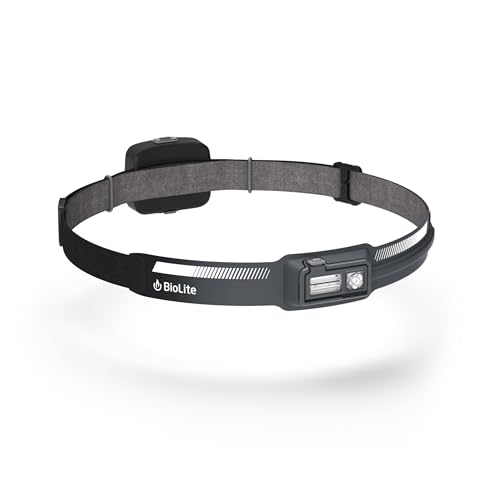
- Road running: BioLite Dash 450 Rear red light and reflective band for traffic, at 78 g.
- Ultras: Petzl NAO RL 1500 lumens and reactive lighting with a 3200 mAh rear battery.
A running headlamp has one job: to show you the ground ahead while you move fast, without bouncing or slipping. That sounds simple, but the best running headlamp for a 5K on lit streets is very different from the best trail running headlamp for a night in the mountains. In this guide we compare six lamps chosen from expert tests by iRunFar, Treeline Review and Running Warehouse, and explain how lumens, fit, battery position and runtime affect a headlamp for running. Camping as well? Our rechargeable head torch guide covers lamps for camp chores.




Top pick NAO LT | Value UT27 Pro | Road Dash 450 | Ultra NAO RL | |
|---|---|---|---|---|
|
|
|
|
| |
| Max output | 600 lm | 800 lm | 450 lm | 1500 lm |
| Weight | 88 g (iRunFar) | 2.61 oz (74 g) | 78 g | 145 g (Petzl) |
| Battery | Rechargeable or 3 AAA | 2 x HLB1500 or 3 AAA | Built-in, USB-C | 3200 mAh, USB-C |
| Runtime on high | 2 h at 600 lm | 2.5 h at 800 lm | 3 h | Varies by mode |
| Battery position | Rear | Front | Balanced front/rear | Rear |
| Rear red light | Yes | No | Yes | Yes |
| Water rating | Not quoted | IP66 | IPX4 | IPX4 |
| Warranty | 3 years | 18 months | Unclear on listing | 3 years |
| Check price | Check price | Check price | Check price |
The best running headlamps: our reviews
Each review covers brightness, weight and balance, battery and runtime, visibility from behind, water resistance and warranty, plus what testers and owners say about bounce and comfort.
Up to 600 lumens for 2 hours (Petzl’s listed burn time), rear-mounted battery for balance, rear red light, USB-C rechargeable, HYBRID CONCEPT also runs on 3 AAA batteries, breathable headband; 3-year warranty. iRunFar lists 3.1 oz (88 g) and 7 / 100 / 600 lumen levels.
The NAO LT is the headlamp we’d hand to most runners. It’s built specifically for running, and the design choices show it: the battery sits at the back of the head to balance the lamp at the front, the headband is a breathable elastic band, and there’s a red light on the rear pack so cars and other runners can see you from behind. iRunFar, which named it its overall pick in 2026, weighed it at 3.1 oz (88 g).
Petzl quotes up to 600 lumens for 2 hours. iRunFar lists three steps of 7, 100 and 600 lumens and says 100 lumens is enough for road running under streetlights, while 600 is ideal for trails. The catch is runtime at full power: you won’t get more than a couple of hours on max, so long trail runs mean dropping to the middle setting. Petzl’s HYBRID CONCEPT helps here, because the lamp also runs on three AAA batteries if the rechargeable pack dies. It charges by USB-C and carries a 3-year warranty.
- Rear battery balances the weight
- Rear red light for road safety
- Runs on 3 AAA as a backup
- 3-year warranty
- Only about 2 h at 600 lumens
- Pricier than Nitecore
- Not built for all-night ultras
Up to 800 lumens, 183-yard beam, three color temperatures (3000K high-CRI warm, 4500K neutral, 6500K cool) plus steady or flashing red, 2 x HLB1500 USB-C battery packs included, also takes 3 x AAA, 2.61 oz with band and battery, IP66, 1 m impact resistance; 18-month warranty.
The UT27 MCT Pro packs a lot into a 2.61 oz lamp. Nitecore rates it at up to 800 lumens with a 183-yard throw, and the Pro kit comes with two HLB1500 rechargeable packs, so you can swap mid-run instead of slowing down to save power. It also accepts three AAA batteries. iRunFar picked it as its best trail headlamp, and lists Nitecore’s runtimes as about 2.5 hours at 800 lumens, 3.5 hours at 500 and 14.5 hours at 100.
Its stand-out feature is light color. The 3000K warm, high-CRI mode cuts glare in fog, rain and snow and shows the texture of roots and rocks better than harsh cool light, and there are neutral and cool modes plus steady or flashing red. The lamp is rated IP66 and drop-tested to 1 m. On the downside, there’s no dedicated rear light, so add a clip-on blinker for road miles, and Treeline Review found the band dug in for some testers. The warranty is 18 months.
- 800 lumens for about $60
- Two rechargeable packs in the box
- Warm high-CRI mode for fog and rain
- IP66 and 1 m impact rated
- No rear red light
- Band can feel tight for some
- Shorter 18-month warranty

450 lumens, 90 m beam, rear red safety light and reflective band printing, 78 g, 10 mm thick front panel, 3 h on high / 60 h on low plus 1 h reserve mode, USB-C with 2-hour charge, IPX4. The listing quotes both 1-year and 3-year warranty terms.
The Dash 450 is made to be seen as much as to see. A rear red light and reflective printing on the band give you 360-degree visibility on dark roads, and Treeline Review chose it as its best headlamp for visibility to drivers. The front panel is only 10 mm thick and the whole lamp weighs 78 g, and testers report little to no bounce thanks to the balance between front and back.
BioLite rates it at 450 lumens with a 90 m beam, 3 hours on high and 60 hours on low, with a 1-hour reserve mode that kicks in before it dies. It charges by USB-C in about 2 hours. For road running and lit paths, 450 lumens is plenty. On technical trails it’s less punchy than the 800-lumen Nitecore, and its IPX4 rating means it’s fine in rain but not the most waterproof light here. The Amazon listing quotes both a 1-year and a 3-year warranty, so check with BioLite.
- Rear red light and reflective band
- Thin, balanced, low-bounce fit
- 60 h on low plus reserve mode
- Fast 2-hour USB-C charge
- 450 lumens is modest for technical trails
- Only IPX4
- Warranty terms unclear on listing
1500 lumens, beam up to 200 m, REACTIVE LIGHTING sensor adjusts brightness automatically, 3200 mAh R1 Li-ion battery at the back of the head (USB-C, can charge a phone or watch in an emergency), rear red light (continuous or strobe), thin flexible front plate; 3-year warranty. Petzl lists 145 g and IPX4.
If you run through the night, the NAO RL is the lamp built for it. It puts out up to 1500 lumens with a beam reaching 200 m, and Petzl’s REACTIVE LIGHTING uses a sensor to dim the light when you look at your feet and brighten it when you look down the trail. That saves battery and means less fiddling with buttons when you’re tired. The 3200 mAh battery sits at the back of the head with a rear red light, and in a pinch it can top up a phone or watch.
Runtime figures vary by mode: Running Warehouse cites a minimum of 5 hours in REACTIVE mode, and iRunFar’s testers got 8 to 11 hour nights on medium and low settings during 100-mile races. At 145 g it’s the heaviest headlamp here, and some runners find the constant dimming and brightening distracting, with a slight lag. iRunFar also notes it’s awkward with a ponytail. It’s expensive, but for ultras it’s the benchmark.
- 1500 lumens and 200 m beam
- Reactive lighting saves battery
- Big 3200 mAh rear battery
- Rear red light, 3-year warranty
- Heaviest here at 145 g
- Reactive changes can distract
- Expensive
1200 lumens, 92 g, REACTIVE LIGHTING sensor, red light in continuous or strobe modes, ultra-thin design and easy adjustment, USB-C rechargeable; 3-year warranty. Petzl rates the Swift RL IPX4.
The Swift RL is Petzl’s all-round performance lamp, and it makes sense for runners who want lots of light without the NAO RL’s weight. The current listing quotes 1200 lumens at 92 g, with the same REACTIVE LIGHTING sensor that adjusts brightness automatically. It’s an ultra-thin, single-unit design, and Petzl recommends the Swift RL alongside the NAO RL for long runs, cold weather and rugged terrain.
Running Warehouse cites a minimum of 7 hours in REACTIVE mode and says the red light is visible up to 150 m in strobe mode. The trade-off is balance: the battery is in the front unit rather than at the back, so it can feel more front-heavy on fast descents than a rear-battery lamp. A top strap isn’t included on this model, so fit it snugly. It’s USB-C rechargeable, rated IPX4 and comes with a 3-year warranty.
- 1200 lumens at 92 g
- Reactive lighting
- Red continuous and strobe modes
- 3-year warranty
- Front-mounted battery
- No dedicated rear tail light
- Expensive
Up to 325 lumens, compact contoured housing that sits close to the forehead, built-in USB-C lithium-ion battery, side switch with dimming and strobe, lockout mode, IPX4; 3-year warranty. Treeline Review lists 39 g and 2.5 h at 325 lumens / 4.3 h at 180.
The Deploy is for runners who want to forget they’re wearing a light. Treeline Review weighed it at 39 g, making it one of the lightest lamps we found, and Black Diamond’s low-profile housing sits close to the forehead to cut bounce. It runs on a built-in battery charged by USB-C, and a single side switch handles brightness, dimming and strobe, with a lockout so it doesn’t switch on in your pack.
The limits are output and runtime. At up to 325 lumens it’s best for lit roads, track sessions and moderate trails, and Treeline lists about 2.5 hours at 325 lumens or 4.3 hours at 180. The beam is fixed rather than adjustable, according to iRunFar, and there’s no rear red light. It’s a great light for 5K to half-marathon distances, or as a spare in an ultra vest. It’s IPX4 rated with a 3-year warranty.
- Only 39 g
- Low-profile, close-fitting design
- Lockout mode
- 3-year warranty
- 325 lumens max
- Short runtime on high
- No rear light
What makes a good running headlamp?
A camping headlamp and a running headlamp share LEDs and batteries, but they’re built for different jobs. At camp you move slowly and mostly look at things within arm’s reach. On a run your head moves up and down with every stride, you need to see several meters ahead at speed, and you might be sweating hard in the rain. That’s why a dedicated running headlamp puts so much effort into weight, balance and the headband.
Four things matter most. First, a stable fit, so the beam stays where you point it. Second, the right amount of light for where you run. Third, enough runtime for your longest session, with a margin. Fourth, visibility to others, especially if you share roads with cars. Water resistance, controls you can use with gloves and a decent warranty round out the list.
How to stop headlamp bounce
Bounce is the number one complaint about any headlamp for running. A lamp that bobs makes the beam jump around, which is tiring for your eyes and can make you misjudge the ground. According to iRunFar, minimalist straps hold the lamp less securely, which causes bounce and eye fatigue, while overtightening a band to compensate is a common cause of headaches.
Weight and balance
Lighter lamps bounce less, and how the weight is spread matters as much as the total. Treeline Review notes that lamps with the battery at the back of the head typically bounce less than front-heavy designs. That’s why our top running headlamp, the Petzl NAO LT, and the NAO RL both put the battery on the back of the head, and why the BioLite Dash 450 balances weight front and rear. A single-unit lamp like the Swift RL is light overall but carries its battery in front, so it needs a snugger fit on fast descents.
Headband and top straps
A wide, slightly stretchy band grips better than a thin cord. An over-the-head top strap spreads pressure and stops the lamp sliding down, which is useful with heavier lamps or for long runs. Some lamps have a removable top strap so you can choose. Testers also found that bands with silicone patterns can dig in, and that some designs catch long hair or are awkward with a ponytail, so check the shape of the rear pack if that matters to you.
The jumping test
Before you buy, or at least before your first dark run, try the lamp on and do a few jumping jacks or run on the spot. The beam should stay put. Test it over a hat or beanie too if you run in winter, because a band adjusted for bare skin may slip over fabric. Tighten just enough to stop movement, then stop: pressure on the forehead adds up over an hour.
How many lumens do you need for running?
Lumens measure total light output, and more isn’t always better because high settings drain batteries quickly. Experts don’t fully agree on numbers, but the ranges are similar. Running Warehouse suggests about 100 to 200 lumens for well-lit streets, 200 to 300 lumens in low ambient light and 500 or more for trails or fully dark routes. Treeline Review recommends at least 500 lumens for trail running in full darkness and 600 to 800 or more for technical trails, while iRunFar sees 200 to 300 lumens as a good starting point on trail, with the option to boost to 500 or 800.
In practice, a running headlamp with a medium setting of 200 to 300 lumens and a boost of 500 to 800 covers almost every runner. Use the medium mode for most of the run and save the high mode for fast descents, technical sections or spotting trail markers.
Spot vs flood beams
A spot beam is narrow and reaches far, which helps you see what’s coming at speed. A flood beam is wide and short, which helps with peripheral vision on twisty, technical ground. Many running lamps mix the two. Using both together gives the most complete view but drains the battery faster, so choose a lamp whose main mode suits your terrain.
Light color
Cool white light looks brightest, but warm or high-CRI light shows texture and depth better and reflects less off fog, rain and snow. The Nitecore UT27 MCT Pro’s 3000K warm mode is a good example. If you often run in mist or falling snow, a warm mode, or a second light held lower, makes a real difference.
Reactive vs constant lighting
Reactive lighting uses a sensor to measure the light bouncing back and adjust output automatically. Petzl says its REACTIVE LIGHTING adjusts brightness and beam shape to the ambient light, which saves battery. Look down at your feet and the lamp dims; look up the trail and it brightens.
The benefit is longer runtime and fewer button presses, which is why reactive lamps like the NAO RL and Swift RL are popular for ultras. The drawback is that some runners find the constant changes distracting, and iRunFar noticed a slight lag. Reflective road signs or a runner’s vest ahead can also make the light dim unexpectedly. A constant-output trail running headlamp is more predictable, but you’ll need to switch modes yourself to stretch the battery.
Running headlamp battery life and runtime
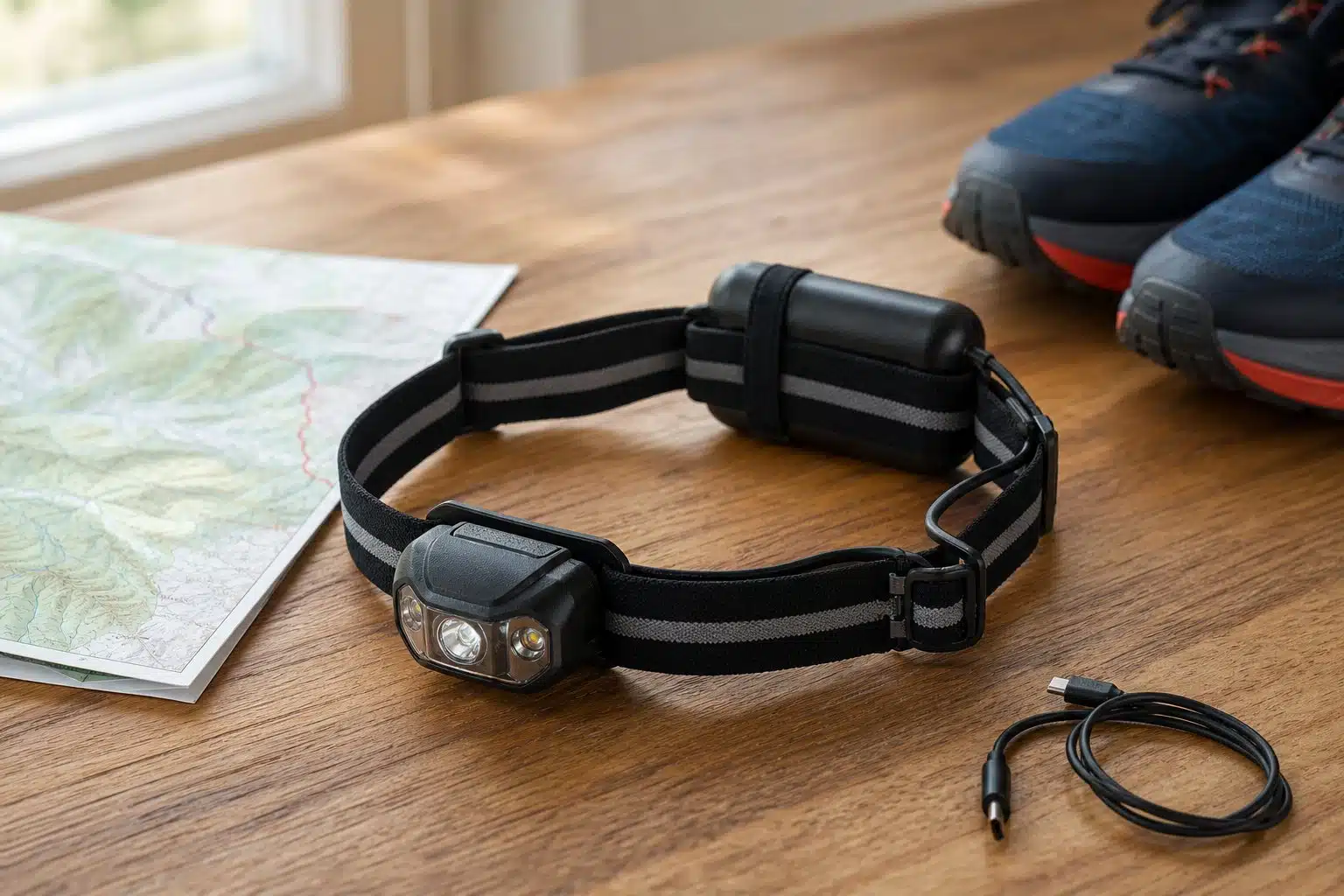
Runtime claims are measured in standard ways, but they assume a fresh, warm battery. Real runs vary. Treeline Review suggests choosing a lamp with about 25% more runtime than your longest run, and for ultras you’ll want 8 hours or more, or a spare battery you can swap.
Rechargeable, AAA or both
Most modern lamps use a rechargeable lithium-ion battery charged by USB-C. Hybrid designs like the Petzl NAO LT and Nitecore UT27 MCT Pro also accept three AAA batteries, which is a great backup when the rechargeable pack is flat or you’re away from power for several days. Treeline notes AAA backups are often lighter and more reliable than carrying a power bank.
Regulated output and reserve modes
A regulated running headlamp keeps brightness steady until the battery is nearly empty, then steps down. Cheaper lamps fade gradually. Either way, many lamps drop out of their highest mode after a few minutes or as the battery runs low. Look for a battery indicator and a reserve mode like the BioLite Dash 450’s extra hour, so a dying battery doesn’t leave you in the dark. iRunFar’s testers had one lamp suddenly switch off after about 6 hours, which is a good argument for carrying a backup light on long runs.
Cold weather
Lithium batteries lose capacity in the cold. Treeline Review reports a fully charged lamp left in a car overnight in winter was dead by morning. Store your lamp indoors, charge it the day before, and on winter runs keep spare batteries in an inside pocket where your body heat keeps them warm. Our guide to powering devices while camping has more tips for keeping batteries topped up away from home.
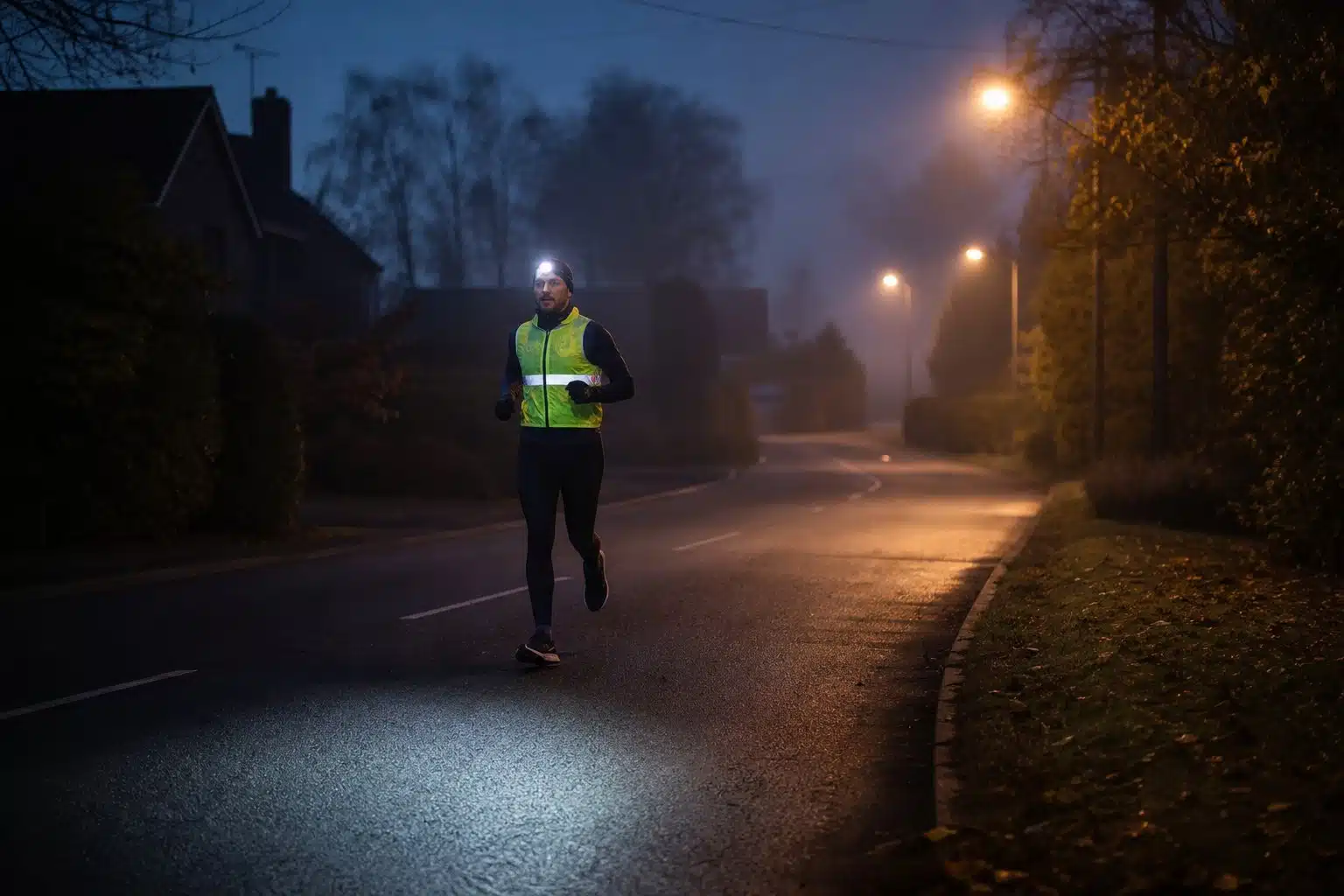
Road running headlamp: be seen as well as see
On roads, being seen matters as much as seeing. A headlamp for running in traffic should have a red light on the back of the head, like the NAO LT, NAO RL and Dash 450, or you should add a clip-on tail light. Blinking red is more noticeable to drivers and saves battery, while steady red is easier for runners behind you to follow.
Pair the light with reflective clothing on moving parts of your body, such as ankles and wrists, run against traffic where there’s no sidewalk, and dip your beam when facing oncoming cars or runners so you don’t dazzle them. Treeline Review gave the Dash 450 its visibility award for its rear light and reflective band.
Headlamp vs waist light
A waist light sits lower than your eyes, so it throws longer shadows that make rocks and roots easier to see. iRunFar calls waist lights very effective on technical trails, and they take weight off your head. The downsides are bulk and, for some runners, discomfort around the stomach on long nights.
Many trail runners use both: a running headlamp to light where they’re looking and a waist or handheld light to add depth. Lights held low also cut glare in fog, rain and snow. On roads with streetlights, a headlamp or a light belt alone is usually enough.
Water resistance and durability
Look at the IP rating. IPX4 means protection against rain and splashes, which is fine for most running. IP66 and IP67 lamps, like the Nitecore UT27 MCT Pro at IP66, handle heavier water and dust. Sweat is the other enemy: salt breaks down elastic bands over time, and Treeline Review found some bands hold sweat and need drying after runs. Rinse the band now and then and let it dry fully, and check whether the maker sells replacement bands.
Caring for your running headlamp
A little care keeps a running headlamp working for years. After sweaty or wet runs, take the band off if it’s removable, rinse it in cool water with a drop of mild soap and let it air dry away from direct heat. Wipe the lens with a soft cloth so mud and salt don’t dull the beam. Check that charging port covers are closed before every run, because an open flap lets water in even on a lamp with a good IP rating.
Lithium-ion batteries last longest when they’re not stored completely empty or completely full for months. If you put the lamp away for the summer, leave it around half charged and top it up every few months. If your lamp also takes AAA batteries, remove them before storage so they can’t leak. Finally, before the first dark run of the season, charge the lamp, try every mode and do the bounce test again, since elastic bands stretch over time.
Common running headlamp problems and fixes
The lamp bounces. Tighten the band slightly, move it a little higher on your forehead, add a top strap if your lamp has one, or choose a lighter lamp with a rear battery.
My forehead hurts or I get a headache. The band is too tight or the front unit is too heavy. Loosen it a notch, wear a thin headband or buff underneath, or switch to a rear-battery design that needs less tension.
The battery dies before the run ends. Use the medium setting for most of the run, charge fully the day before and keep the lamp warm. On long runs carry AAA batteries or a spare pack, or choose a lamp with more capacity.
The light keeps dimming by itself. On a reactive lamp, that’s the sensor working. Switch to a constant mode if it distracts you. On other lamps it can mean the battery is low or the lamp is stepping down to avoid overheating.
Fog or rain makes everything glare. Lower the brightness, use a warm-color mode if you have one, or hold a second light at waist height so the beam isn’t reflecting straight back into your eyes.
Which running headlamp should you buy?
Choose the Petzl NAO LT if you want one running headlamp for roads and trails, with a rear battery for balance and a rear red light. Pick the Nitecore UT27 MCT Pro for the most light per dollar and a spare battery, the BioLite Dash 450 if you mostly run on roads in traffic, and the Petzl NAO RL for ultras and all-night races. The Petzl Swift RL suits runners who also hike and climb, and the Black Diamond Deploy is the lightest choice for short runs or as a backup.
Running headlamp myths
Not always. High modes drain batteries fast and can cause glare in fog; 200–300 lumens covers most of a run.
It works, but camping lamps often bounce and lack a rear light. Running lamps are lighter and better balanced.
Only up to a point. Overtightening causes headaches; better balance and a wider band help more.
What to look for in a running headlamp
A rear battery or balanced design and a wide band to limit bounce.
100–300 lumens for roads; 500–800 for dark or technical trails.
About 25% longer than your longest run on the setting you’ll use.
Essential for road running near traffic.
USB-C rechargeable, ideally with an AAA backup.
IPX4 for rain; IP66–IP67 for heavy wet weather.
How to fit a running headlamp
- Charge and check
Fully charge the battery the day before and check the battery indicator.
- Position the lamp
Set the front unit centered and slightly high on the forehead.
- Adjust the band
Tighten until it doesn’t move, then stop; add the top strap if you have one.
- Angle the beam
Tilt the lamp so the brightest spot lands a few strides ahead.
- Do the bounce test
Jog on the spot or do jumping jacks; readjust if the beam moves.
How we chose these headlamps
We have not tested every headlamp in this list ourselves. Our picks are based on Amazon listings, published specifications from Petzl, Nitecore, BioLite and Black Diamond, and independent tests from iRunFar, Treeline Review and Running Warehouse. Where a listing didn’t state a spec, we marked it “Not quoted”.
-
Fit and bounce
We favored light, balanced lamps that testers found stable.
-
Light and runtime
We compared lumens and runtimes on realistic settings.
-
Visibility
We gave credit for rear red lights and reflective bands.
-
Honest specs
We flagged missing or conflicting specs rather than guessing.
What is the best running headlamp?
For most runners, the Petzl NAO LT: it offers up to 600 lumens, a rear battery for balance, a rear red light and an AAA backup.
How many lumens do I need for running?
About 100–200 lumens on lit streets, 200–300 in low light and 500 or more for dark trails, according to Running Warehouse.
How do I stop my headlamp from bouncing?
Choose a light, rear-battery lamp, wear it slightly high on the forehead, tighten the band just enough and use a top strap if available.
Are reactive headlamps worth it?
For long runs, often yes: they adjust brightness automatically and save battery. Some runners find the changing light distracting.
Is a waist light better than a headlamp for running?
A waist light shows terrain depth better on trails, but a headlamp lights where you look. Many trail runners use both.
Do I need a rear light on my running headlamp?
If you run on roads, yes. A rear red light, or a clip-on tail light, helps drivers see you from behind.
Final thoughts on choosing a running headlamp
The right running headlamp is the one you forget you’re wearing. Get the fit right first, then choose brightness and runtime for your longest, darkest route, and add a rear light for roads. Running as part of a camping trip? See what lights you need for camping, our camping lanterns guide and our rechargeable lanterns for the campsite. For independent test results, see iRunFar’s running headlamp tests.
Which running headlamp should you buy?
- Best overall: Petzl NAO LT
- Best value for trails: Nitecore UT27 MCT Pro
- Best for road running: BioLite Dash 450
- Best for ultras: Petzl NAO RL
- Best bright lightweight: Petzl Swift RL
- Lightest pick: Black Diamond Deploy Run Light
For most runners, the Petzl NAO LT is the best running headlamp because it’s balanced, bright enough for trails and visible from behind. Pick the Nitecore UT27 MCT Pro for value, the BioLite Dash 450 for road running, the Petzl NAO RL for ultras, the Petzl Swift RL as a bright all-rounder and the Black Diamond Deploy for the lightest fit.
CampEquipmentPlus relies on reader support. Purchases made via links on our website may earn us an affiliate commission at no extra cost to you, helping keep the site running.