
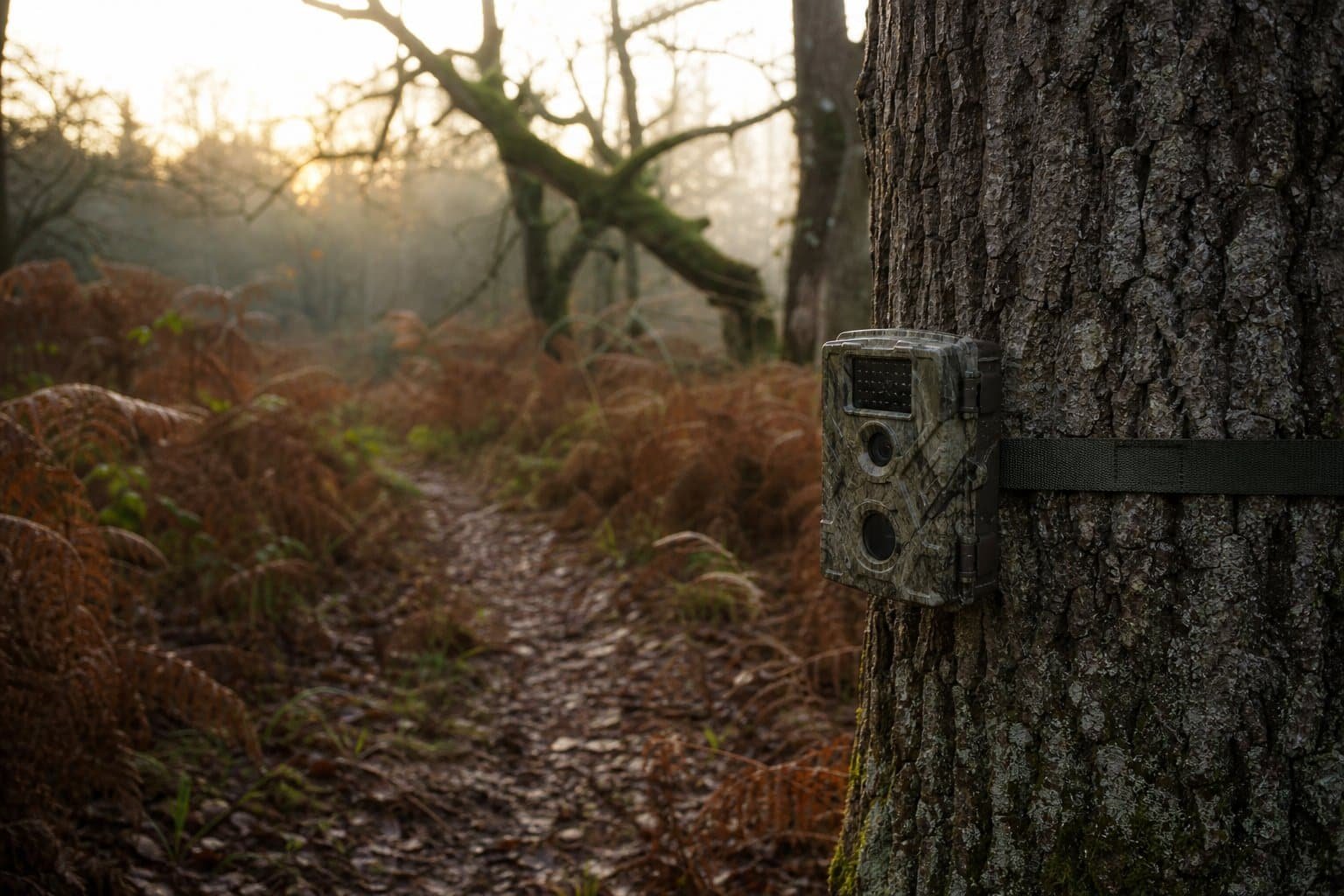
Best Game Trail Cameras
The best game trail camera depends on one question: do you want photos sent to your phone, or are you happy to collect an SD card? Our top cellular pick is the Tactacam Reveal X 3.0, and the Bushnell CORE S-4K No Glow is the best subscription-free camera.
Hunters and wildlife watchers judge trail cameras on a few things: how fast they trigger, whether the night flash spooks animals, how long the batteries last and how reliable they are in rain and cold. The usual complaints are blank frames, half-animals and dead batteries.
Below we compare six trail cameras, three cellular and three SD-card, and explain how to set one up so it actually catches something.
- Cellular cameras send photos to your phone but need a data plan
- No-glow flash is invisible; low-glow reaches a little further
- Trigger speed and placement matter more than megapixels
- Best cellular: Tactacam Reveal X 3.0 Auto multi-carrier LTE, GPS, no SD card needed.
- Best SD-card: Bushnell CORE S-4K No Glow 0.2 s trigger, 110 ft invisible flash, 4K video.
- Best value: GardePro E5S 0.1 s trigger and no-glow flash for under $50 when checked.
- Best solar: Moultrie Edge 4 Solar Built-in panel and lithium battery, IP67.
A game trail camera lets you see what walks past a spot when you aren’t there: deer using a woodland ride, a fox crossing the field edge or a badger heading for the hedge at 2 am. This guide compares six of the best trail cameras on Amazon, from subscription-free SD-card models to cellular cameras that send photos to your phone, and explains which features actually matter.
We chose established brands whose listings state the key specs: trigger speed, night range, flash type, power and warranty. We then checked them against published field tests from Outdoor Life, Field & Stream and Digital Camera World. Where a listing didn’t give a figure, we say so rather than guess.


Best cellular Reveal X 3.0 | Best SD-card CORE S-4K | Best value GardePro E5S | Two cameras Flex-M Twin | |
|---|---|---|---|---|
|
|
|
|
| |
| Type | Cellular (US LTE) | SD card | SD card | Cellular (US LTE), 2 cams |
| Trigger | Under 0.5 s | 0.2 s | 0.1 s | 0.4 s |
| Night flash | Low-glow, 96 ft | No-glow, 110 ft | No-glow, 100 ft | 90 ft (type not quoted) |
| Photo / video | 4K / 1080p | 30MP / 4K | 64MP* / 1296p | 28MP / 720p |
| Power | Not quoted (6+ months claimed) | 6 AA lithium | 8 AA | Not quoted |
| Storage | Built in | SD up to 512GB | SD card | microSD (not incl.) |
| Warranty | 1 year | 2-year limited | 1 year | Not quoted |
| Check price | Check price | Check price | Check price |
Our game trail camera reviews
Each review covers how the camera stores or sends photos, its trigger speed, night flash, power, warranty and the trade-offs testers and owners report. Cellular cameras need a data plan; SD-card cameras need you to walk out and swap the card.
Cellular trail camera: auto-connect multi-carrier LTE (AT&T and Verizon), 4K photos, 1080p video, 96 ft low-glow IR flash, sub-half-second trigger with 3-shot burst, built-in GPS and onboard storage (no SD card needed), IP66 waterproof, up to 6+ months battery life claimed, plans from $5 a month, 1-year warranty.
The Tactacam Reveal X 3.0 is the cellular game trail camera we would point most people towards first. Its built-in SIM automatically connects to whichever of AT&T or Verizon has the stronger signal where you hang it, so there is no SIM swapping, and the free Reveal app pushes new photos to your phone. You can request HD video on demand, change settings remotely and find the camera again with its built-in GPS.
The listing quotes 4K photos, 1080p video, a 96 ft low-glow infrared flash and a sub-half-second trigger with a 3-shot burst. Storage is onboard, so you don’t need an SD card, and data plans start at $5 a month with no contract. Field testers who used the newer Reveal Pro 4.0 found Tactacam’s connection the slowest in their group to send a first photo, so test the camera before you walk away. The warranty is 1 year, and this model is sold for US networks.
- Connects to the stronger of two US networks automatically
- No SD card to buy or swap
- GPS and remote settings in the app
- Plans from $5 a month, no contract
- Low-glow flash shows a faint red glow
- Needs a data plan for photos
- Sold for US networks only
Non-cellular trail camera: 4K video, up to 30MP photos, 110 ft no-glow night range, 0.2 s trigger, 1 s recovery, 1.5 in colour viewscreen, 6 AA lithium batteries and up to 512GB SD card (both sold separately), 2-year limited warranty.
If you don’t need photos on your phone, the Bushnell CORE S-4K No Glow is the game trail camera to beat. Bushnell lists a 0.2-second trigger, a 1-second recovery and a 110 ft no-glow night range, which means the infrared flash is invisible to people and far less likely to spook deer or foxes. It records 4K video and up to 30MP stills, and a 1.5 in colour screen helps you frame the shot before you leave.
Digital Camera World named it the best non-cellular trail camera for most people. Its testers praised the fast trigger, which kept animals centred in the frame, and the Hybrid mode that captures a photo and a video from each trigger. They also noted that 4K runs at only 20 frames per second, which can judder with fast animals, and that some daylight stills looked a little dull. It runs on 6 AA lithium batteries, takes SD cards up to 512GB and has a 2-year limited warranty.
- 0.2 s trigger catches animals mid-frame
- Invisible no-glow flash
- True 4K video plus Hybrid mode
- 2-year limited warranty
- 4K capped at 20 fps
- Batteries and SD card cost extra
- Small 1.5 in screen
Non-cellular trail camera: 64MP photos, 1296p HD video, 0.1 s trigger with 3 PIR sensors, 100 ft no-glow night vision, IP66 waterproof, 1/4-20 mounting thread, 8 AA batteries (not included), works with the GardePro SP350 solar panel, 1-year warranty.
The GardePro E5S is the best-value game trail camera here. For under $50 when we checked, the listing promises a 0.1-second trigger from three PIR motion sensors, a 100 ft no-glow night range, 1296p HD video and an IP66 waterproof rating. A standard 1/4-20 thread lets you fit it to a tripod, post or tree bracket as well as the usual strap.
Treat the 64MP figure as marketing: most trail cameras interpolate their headline megapixels, and real detail depends on the sensor and lens. What matters more is that the trigger is fast and the flash is invisible, which suits shy wildlife and busy deer trails. It runs on 8 AA batteries, which you buy separately, and it can run from GardePro’s SP350 solar panel. The warranty is 1 year.
- Very fast 0.1 s trigger
- Invisible no-glow flash
- IP66 weather sealing
- Solar panel option
- Headline 64MP is interpolated
- 1-year warranty
- Needs 8 AA batteries
Two cellular trail cameras: auto multi-network LTE, GPS, 28MP photos, 720p video with sound, 0.4 s trigger, 90 ft motion detection and flash, photo, video and time-lapse modes, free plan of 100 photos a month per camera, microSD card not included.
The SPYPOINT Flex-M Twin Pack gets you two cellular trail cameras for around the price of one premium model, which makes it a strong pick if you want to cover a feeder and a game trail at the same time. Each camera switches between networks automatically, has GPS, and works with SPYPOINT’s free plan of up to 100 photos a month. Paid plans start at $5 a month for 250 photos or $15 for unlimited.
The listing quotes 28MP photos, 720p video with sound, a 0.4-second trigger and a 90 ft detection and flash range. Time-lapse and Time-Lapse+ modes are handy over food plots, and BuckTracker AI filters photos by species in the app. Field & Stream found AA batteries a weak point on the newer Flex-M2, so budget for lithium cells or a solar panel. The microSD cards aren’t included, and the twin pack is sold for US networks.
- Two cameras in one box
- Free plan of 100 photos a month
- Time-lapse and species filtering
- GPS and auto network switching
- Only 720p video
- Battery life is modest on AAs
- microSD cards not included
Solar cellular trail camera: integrated pan/tilt solar panel, rechargeable lithium battery included, 40MP photos, 1080p video, 100 ft low-glow IR, multi-carrier auto connect, Live Aim, AI buck detection, GPS, IP67 waterproof, built-in 8GB memory (no SD card), 2-year warranty.
The Moultrie Edge 4 Solar is the game trail camera for anyone who hates battery runs. An adjustable solar panel charges the included lithium battery, so if the panel sees enough sun you may not touch it all season. Live Aim shows the camera’s view in the Moultrie app while you set it up, Auto Connect picks the strongest network, and GPS pins its location for you.
The listing quotes 40MP photos, 1080p video, a 100 ft low-glow flash, IP67 waterproofing, 8GB of built-in memory and a 2-year warranty. Its AI Buck Shot Detection switches to video when it spots a buck and sends a zoomed image. Field & Stream rated it the best solar cellular camera they had used and said its battery never dropped below 80 percent, though they disliked the door latch. Solar needs light, so it suits field edges better than dark woodland.
- Integrated solar panel plus lithium battery
- IP67 waterproofing
- Live Aim helps framing
- 2-year warranty
- Solar struggles under heavy canopy
- Low-glow flash is faintly visible
- Trigger speed not stated on listing
Non-cellular trail camera: 64MP photos, 1296p HD video, 0.1 s trigger with side sensors, 100 ft no-glow 940nm night vision, f/1.6 lens, 2.4 in colour display, H.264 video, solar-ready (Meidase SP350 panel sold separately), 8 AA batteries (sold separately), 1-year warranty.
The Meidase P70 is a budget game trail camera with one stand-out feature: a 2.4 in colour display, the largest here, so you can review clips and check your framing in the field without taking the SD card home. The listing quotes a 0.1-second trigger with side sensors, invisible 940nm no-glow night vision out to 100 ft and an f/1.6 lens for better low-light capture.
Videos are saved as compressed H.264 files, which keeps file sizes down and makes them quicker to copy to a phone or laptop. As with the GardePro, read the 64MP claim as interpolated. It runs on 8 AA batteries, works with Meidase’s SP350 solar panel and comes with a 1-year warranty. It is a good pick for a garden, an allotment or a first camera on a deer trail.
- Large 2.4 in review screen
- Fast 0.1 s trigger
- Invisible 940nm no-glow flash
- Solar-ready
- Headline 64MP is interpolated
- 1-year warranty
- Batteries and card extra
What is a game trail camera?
A game trail camera is a small, weatherproof camera that sits on a tree or post and takes photos or video whenever its motion sensor spots a warm animal moving in front of it. Hunters use them to learn when and where deer move, while wildlife watchers use the same kit to film foxes, badgers, hedgehogs and garden birds without disturbing them.
Most of them use a passive infrared (PIR) sensor that reacts to a change in heat and movement, a fixed-focus lens and an infrared flash for night shots. They run for weeks or months on AA batteries, a lithium pack or a solar panel, and save files either to an SD card or, on cellular models, send them over a mobile network.
Cellular vs SD-card trail cameras
The first choice is how you want to get your photos, because it decides the price, the running costs and how often you need to visit the camera.
SD-card (standard) trail cameras
A standard game camera saves everything to a memory card that you collect by hand. The Bushnell CORE S-4K, GardePro E5S and Meidase P70 all work this way. They are cheaper to buy, have no monthly fees and work anywhere, including deep valleys and woods with no phone signal.
The downside is the walk. Every visit leaves scent and noise near the spot you are trying to study, and you only learn what happened when you check the card. For a garden, an allotment or a wood you visit every week, that is rarely a problem.
Cellular trail cameras
A cellular game trail camera has a built-in SIM and sends each photo to an app on your phone. The Tactacam Reveal X 3.0, SPYPOINT Flex-M and Moultrie Edge 4 Solar all connect automatically to the strongest network they can find, and you can change settings or request a video without going near the camera.
You pay for that convenience. Outdoor Life puts most data plans at about $4 to $15 a month, with extra costs for full HD video or high-resolution photos. You also need a usable signal where the camera hangs, so check coverage on your own phone at the exact spot first.
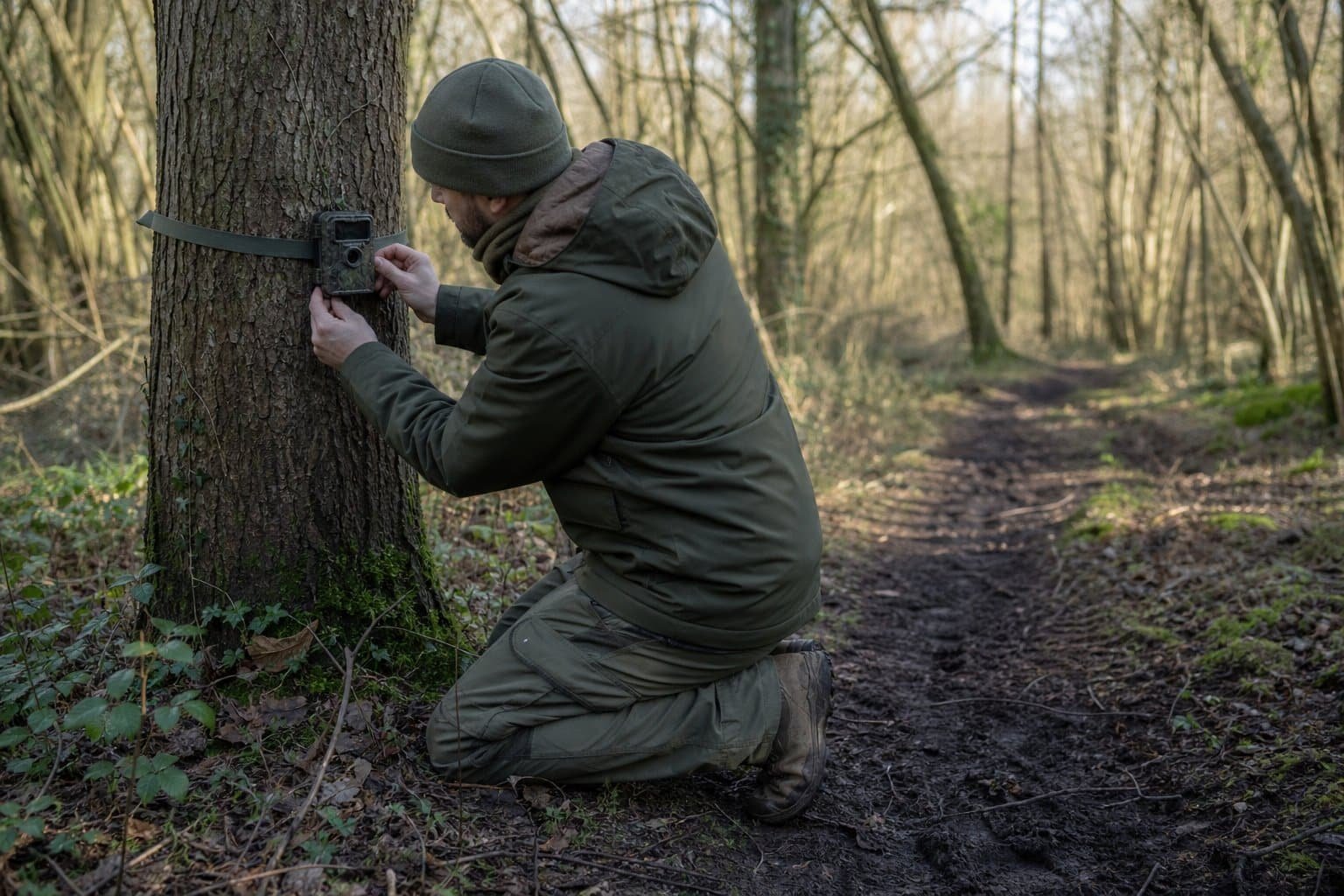
How to choose a game trail camera
Once you know whether you want cellular or SD card, compare these features. They make more difference to your results than the headline megapixel number on the box.
Trigger speed and recovery time
Trigger speed is the delay between the sensor spotting movement and the camera taking a picture. Digital Camera World warns that anything slower than about half a second risks empty frames or animals already leaving the shot. The GardePro E5S and Meidase P70 claim 0.1 seconds and the Bushnell 0.2 seconds, which is excellent for a busy game trail.
Recovery time is how quickly the camera is ready for the next shot. A fast recovery matters on trails where animals move in groups, such as a doe followed by a buck, or a family of badgers. Bushnell quotes a 1-second recovery for the CORE S-4K.
Detection range and angle
Detection range is how far away the sensor can notice movement. Long ranges of 90 to 110 ft help over open fields and food plots, while a woodland path where animals pass a few yards away needs far less. Be wary of a game camera whose detection angle is much wider than its lens angle, because it will trigger on animals that are outside the frame and leave you with blank shots.
Night flash: no-glow vs low-glow
No-glow cameras use 940nm infrared LEDs that you can’t see at all, which suits shy wildlife, security use and busy public woods. The Bushnell, GardePro and Meidase are no-glow. Low-glow cameras use 850nm LEDs with a faint red glow; they usually light the scene a little further and brighter, which is why the Tactacam and Moultrie use them. Pure white-flash cameras give colour night photos but tend to scare game, so they are now rare.
Photo and video resolution
Ignore most megapixel claims. Many budget trail cameras interpolate their images, so a 64MP label can come from a much smaller sensor. Judge image quality by test photos, especially at night, and look at video resolution and frame rate if you plan to film behaviour. The Bushnell records true 4K, but at 20 frames per second; 1080p or 1296p is plenty for most people.
Power and battery life
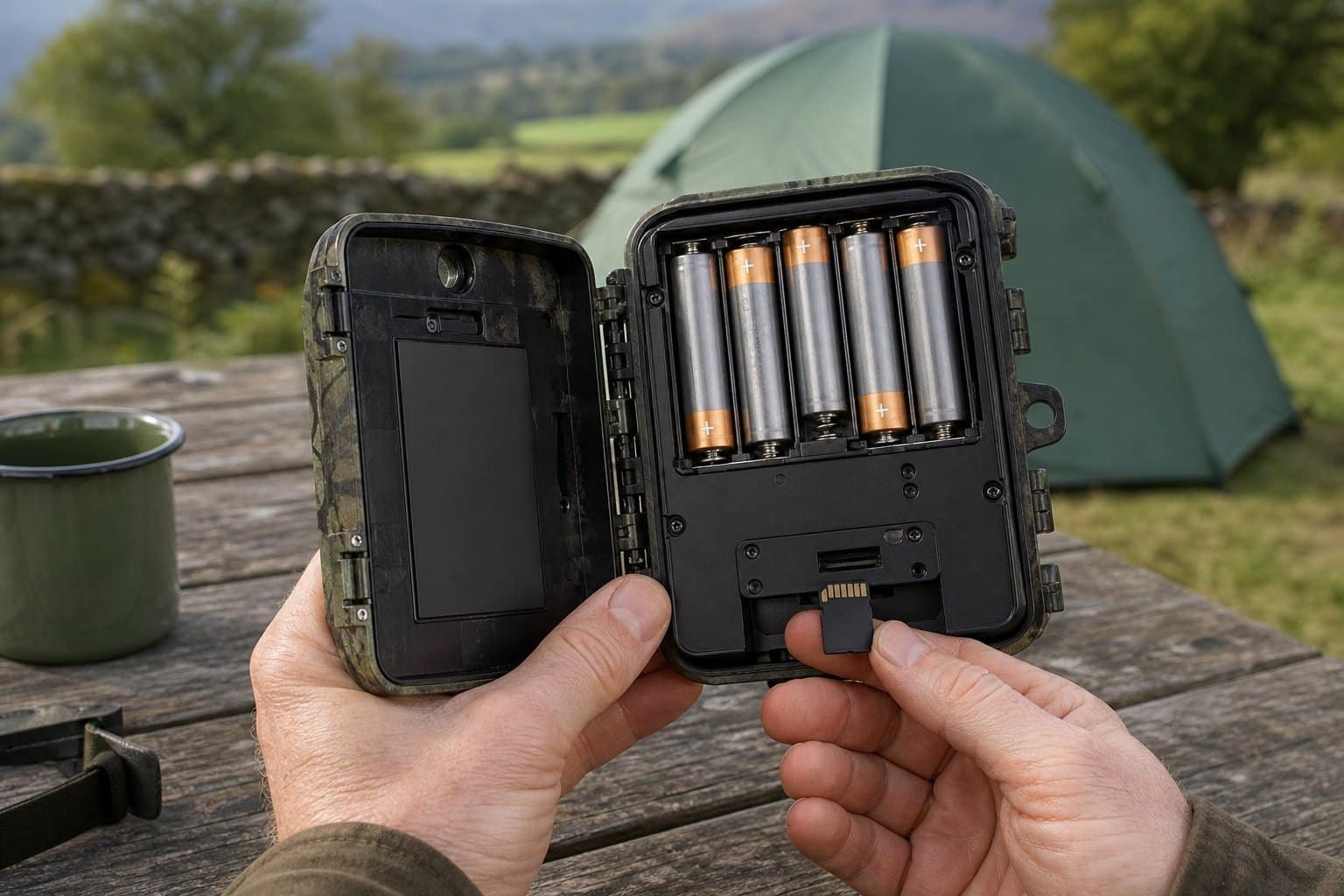
Most trail cameras run on 6 to 12 AA batteries, and a game trail camera that records lots of video will need them changed more often. Lithium AAs cost more but hold their voltage in cold weather far better than alkaline cells, and they are what Bushnell recommends for the CORE S-4K. Cellular cameras drain power faster because they transmit every photo, so a solar panel or rechargeable lithium pack is worth considering. Our guide to solar power systems for campers explains how panels and batteries work together.
Storage
SD-card cameras need a card, often sold separately; the Bushnell takes cards up to 512GB. A 32GB or 64GB card holds thousands of photos and plenty of short clips, but 4K video fills cards quickly. A cellular game trail camera such as the Tactacam or Moultrie has built-in memory, so you have nothing to buy or lose.
Weatherproofing and build
Look for an IP66 or IP67 rating on any game trail camera you buy. IP66 resists heavy rain, while IP67 means the camera can survive brief immersion, which helps in floods or on a wet riverbank. Check that the door latch closes firmly and the seal is clean, because condensation inside the lens window is a common cause of foggy morning photos.
Where to put a game trail camera
Placement matters more than price when you set up a game trail camera. A cheap camera in the right spot beats an expensive one pointed at the wrong patch of brambles. Look for signs of use: a worn path, tracks in mud, droppings, hair on wire fences or a gap under a hedge.
Mount the camera at roughly knee to waist height, about 2 to 3 ft off the ground for deer and lower for foxes, badgers or hedgehogs. Angle it slightly down the trail rather than straight across it, so animals walk into the frame instead of flashing past. If you can, face it north or south so the rising and setting sun doesn’t shine into the lens and cause false triggers.
Clear away grass, ferns and twigs in front of the lens. Moving vegetation warmed by the sun is the most common cause of hundreds of empty photos. A wide nylon strap is kind to the tree and easy to adjust; the same tree-friendly webbing we recommend in our hammock straps guide works well. Then walk past the camera yourself and check that it fires and frames you properly.
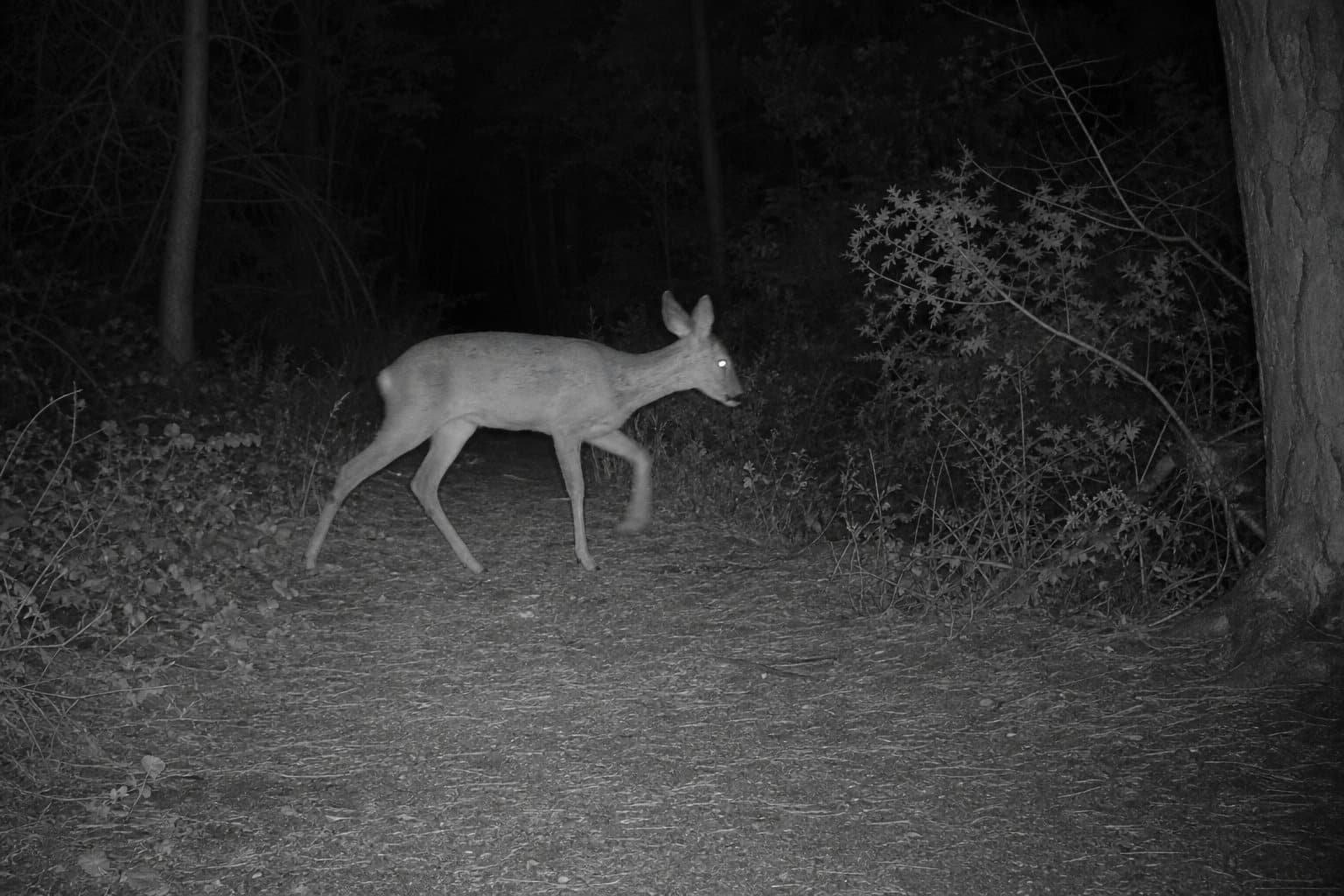
Game trail camera settings that make a difference
On a new game trail camera, start with photo mode and a three-shot burst on a trail, because a burst gives you a better chance of a sharp, centred animal. Switch to video when you want to see behaviour, such as deer feeding or badgers playing, and keep clips short, around 10 to 20 seconds, to save battery and card space.
Set sensitivity to medium if you get lots of blank frames, and high in cold weather when the temperature difference between animals and the background is bigger. Time-lapse mode, which the SPYPOINT Flex-M offers, takes photos at set intervals and is useful over a large field where animals may be too far away to trigger the sensor. Finally, set the date and time correctly so you can see patterns.
Running costs: batteries, cards and data plans
The price of a game trail camera is only part of the bill. A set of 8 lithium AAs costs about as much as a budget camera every few months if you use video heavily, so rechargeable batteries or a solar panel can pay for themselves. Our article on powering devices without hook-ups covers rechargeable options for kit like this.
Cellular plans are the biggest ongoing cost. SPYPOINT offers a free plan of 100 photos a month per camera, with paid plans from $5 for 250 photos and $15 for unlimited; Tactacam’s plans start at $5 a month. Video requests and full-resolution downloads often use extra credit, so read the plan terms before you buy several cameras.
Using a game trail camera in the UK
Every camera in this guide links to Amazon US. The SD-card models work anywhere, but the cellular versions listed here are sold for US networks: Tactacam names AT&T and Verizon, and the SPYPOINT twin pack is a US model. If you live in the UK, buy a cellular camera sold for UK networks, or choose an SD-card camera.
Get the landowner’s permission before you put a camera on land you don’t own. Point it away from footpaths, roads and neighbours’ gardens, because recording people can bring data protection duties. Never put a wildlife camera where checking it could disturb nesting birds or protected species, and remember that some US states restrict cellular cameras during hunting season.
Game trail camera for hunting vs wildlife watching
Hunters and wildlife watchers want slightly different things from a game trail camera. A hunter mostly wants to know which deer are using a trail, at what time and how often, so fast triggering, burst photos, a long battery life and, ideally, phone alerts matter most. A clear time and date stamp on every image helps you spot patterns before the season.
A wildlife watcher usually cares more about video, sound and a flash that won’t disturb the animal. An SD-card wildlife camera with no-glow LEDs and good video, such as the Bushnell CORE S-4K, is ideal for filming badgers at a sett entrance or a fox visiting the garden. Short clips of natural behaviour are far more rewarding than a stack of blurry stills.
Many owners end up running both: a cellular game trail camera on a remote feeder or field edge, and a cheaper SD-card game camera or two on paths closer to home. Starting with a budget model like the GardePro E5S is a sensible way to learn placement before you spend more.
Looking after your game trail camera
A game trail camera lives outdoors for months, so a little care keeps it working. Each time you visit, wipe the lens window and the PIR sensor cover with a soft cloth, because dirt, pollen and spider webs blur photos and cause false triggers. Check the door seal for grit or pine needles before you close it.
Take batteries out if you store the camera for more than a few weeks, as leaking cells can ruin the contacts. Format the SD card in the camera, not on a computer, every time you swap it, and keep a spare card so you can swap rather than wait. In a public wood, a lockable steel security box and a cable lock make your game trail camera much less likely to walk off.
Common game trail camera problems and fixes
Hundreds of blank photos. Grass, ferns or branches are moving in the sun. Clear the area in front of the lens, lower the sensitivity and avoid aiming at bright open sky.
Only tails and back legs. The animal is crossing too fast for the trigger. Angle the camera down the trail rather than across it, move it a little further back and use a burst or a short video.
Dark or washed-out night shots. Animals are beyond the flash range or too close. Keep the main path within 10 to 40 ft, and fit fresh lithium batteries, because weak cells dim the infrared flash.
Foggy photos at dawn. Condensation is forming on the lens window. Put a silica gel sachet inside, check the door seal and avoid opening the camera in the rain.
Batteries die in days. Long videos, high sensitivity, cold weather and weak cellular signal all drain power. Shorten clips, use lithium cells and, on a cellular game trail camera, move it to a spot with a better signal or add a solar panel.
No photos on the app. The camera has no usable signal or the plan isn’t active. Test the connection before you leave the site; Field & Stream found some cameras took several minutes to send their first photo.
Which game trail camera suits you?
If you hunt land a long way from home, a cellular game trail camera such as the Tactacam Reveal X 3.0 saves trips and tells you when deer are moving. On field edges with plenty of sun, the Moultrie Edge 4 Solar means far fewer battery changes. To watch two spots on a tighter budget, the SPYPOINT twin pack is the cheapest way in.
For wildlife watching and filming, or for any area without signal, choose an SD-card camera. The Bushnell CORE S-4K is the best all-rounder with true 4K video. The GardePro E5S gives you a fast, invisible-flash wildlife camera for very little money, and the Meidase P70’s large screen makes it the easiest for beginners and garden use.
Final thoughts on choosing a game trail camera
For most people, the best game trail camera is the one that matches how often you can visit it. If you can check it weekly, the Bushnell CORE S-4K or GardePro E5S gives excellent results with no monthly bill. If you can’t, a cellular game trail camera such as the Tactacam Reveal X 3.0 is worth the plan. Whichever you choose, spend time on placement, clear the vegetation and use good batteries; those three habits matter more than any spec sheet. For independent test results, see Digital Camera World’s field-tested picks.
Trail camera myths
Many trail cameras interpolate their headline figure. Sensor, lens, trigger speed and flash matter more.
No-glow 940nm flashes are invisible, but low-glow 850nm LEDs give off a faint red glow some animals notice.
They need a usable signal on a network they support where they hang. Check coverage at the exact spot.
What to look for in a game trail camera
Phone alerts and a plan, or no fees and card checks.
0.5 s or faster; 0.2 s or less is ideal on trails.
No-glow for stealth, low-glow for a little more range.
Lithium AAs, a lithium pack or solar for long deployments.
IP66 or IP67 and a firm door latch.
Bushnell and Moultrie quote 2 years here.
How to set up a trail camera
- Pick the spot
Find fresh tracks, a worn path, droppings or a gap under a fence or hedge.
- Mount it low
Strap it at knee to waist height, angled slightly down the trail and away from the sun.
- Clear the view
Remove grass, ferns and twigs that could move in front of the lens.
- Set it up
Set the date and time, a 3-shot burst or short clips, and medium sensitivity.
- Walk test
Walk past at animal height, check the shot, then leave it for a week or more.
How we chose these trail cameras
We have not tested every camera in this list ourselves. Our picks are based on the Amazon listings, maker information and published field tests from Outdoor Life, Field & Stream and Digital Camera World. Where a listing didn’t state a spec, we said so rather than guessing.
-
Proven brands
We favoured makers with clear specs and a stated warranty.
-
Real-world performance
We weighed trigger speed, night flash, battery life and reliability.
-
A mix of types
Three cellular and three SD-card cameras across a range of budgets.
What is the best game trail camera?
For phone alerts, the Tactacam Reveal X 3.0. For no monthly fees, the Bushnell CORE S-4K No Glow. On a budget, the GardePro E5S.
Do cellular trail cameras need a subscription?
Yes, to send photos. SPYPOINT offers a free 100-photo plan per camera; Tactacam and SPYPOINT paid plans start at $5 a month.
Is no-glow or low-glow better?
No-glow is invisible and best for shy animals or security. Low-glow gives slightly brighter, longer night shots but shows a faint red light.
How high should I mount a trail camera?
About 2 to 3 ft for deer, lower for foxes, badgers and hedgehogs, angled slightly down the trail.
How long do trail camera batteries last?
From weeks to months, depending on traffic, video, cold and cellular use. Lithium AAs and solar panels last longest.
Will these cellular cameras work in the UK?
The versions linked here are sold for US networks. UK users should buy a UK-network cellular model or an SD-card camera.
More outdoor kit guides
Heading out at dusk to check your cameras? See our guide to the best rechargeable head torches. Camping near wildlife? Read how to store food while camping to keep animals away from your pitch, and use our camping essentials list before your next trip. If you like capturing the outdoors, our Camp Snap camera review covers a simple screen-free camera.
Which game trail camera should you buy?
- Best cellular: Tactacam Reveal X 3.0 Cellular Trail Camera
- Best SD-card camera: Bushnell CORE S-4K No Glow Trail Camera
- Best value: GardePro E5S Non-Cellular Trail Camera
- Best cellular value: SPYPOINT Flex-M Twin Pack Cellular Trail Camera
- Best solar: Moultrie Edge 4 Solar Cellular Trail Camera
- Best screen: Meidase P70 Non-Cellular Trail Camera
Choose the Tactacam Reveal X 3.0 if you want photos on your phone, and the Bushnell CORE S-4K No Glow if you want the best camera with no monthly fees. The GardePro E5S is the best value, the SPYPOINT Flex-M Twin covers two spots cheaply, the Moultrie Edge 4 Solar cuts battery changes and the Meidase P70 is the easiest for beginners.
CampEquipmentPlus relies on reader support. Purchases made via links on our website may earn us an affiliate commission at no extra cost to you, helping keep the site running.