
Best Hammock Straps
Good hammock straps hang you at the right height in under a minute, don't stretch overnight and don't damage the tree. Our top pick is the Kammok Python 10, while the ENO Atlas is the easiest set for beginners.
Hammock campers want the same things from tree straps: enough length to reach the trees they find, enough adjustment to get a comfortable sag, no stretch, a light packed weight, and wide webbing that protects bark. The common complaints are consistent too: straps that come up short, loops in the wrong place, slipping on smooth trunks and straps that sag after the first hour.
Below we compare five suspension systems from 4.3 oz to about 11 oz, explain the main types of hammock suspension and show how to hang a hammock the Leave No Trace way.
- Use webbing at least 1 in wide on the tree
- Aim for about a 30 degree strap angle
- Your safe limit is your weakest part, not the strap's claim
- Best overall: Kammok Python 10 Two 10 ft straps, 40 loops, 500 lb and a lifetime warranty.
- Best for beginners: ENO Atlas Simple 30-loop daisy chain with wide, tree-friendly webbing.
- Best ultralight: ENO Helios 4.3 oz with stepless Microtune adjustment.
- Best value: Wise Owl 10 ft straps with two carabiners in the box.
The right hammock straps make the difference between a comfortable night and a saggy, frustrating one. Your straps (also called tree straps or hammock suspension) connect the hammock to the trees, set its height and angle, and protect the bark from rope burn. In this guide we compare five strap systems chosen from maker specs, Amazon listings and expert advice from REI, Leave No Trace and The Ultimate Hang, and explain how strap length, width, adjustment and weight ratings affect your hang. Building a lightweight sleep system? See our foam sleeping pad guide for insulation that works in a hammock too.


Top pick Python 10 | Beginners ENO Atlas | Ultralight ENO Helios | Value kit Wise Owl | |
|---|---|---|---|---|
|
|
|
|
| |
| Length per strap | 10 ft | 9 ft | 8 ft 1 in | 10 ft |
| Adjustment | 40 loops | 30 loops | Microtune (stepless) | 38 loops |
| Rated load | 500 lb | 400 lb | 300 lb | 500 lb combined |
| Set weight | 8.2 oz (REI) | 9 oz | 4.3 oz | Not quoted |
| Width at tree | 1.5 in (REI) | 1.5 in | Not quoted | 1 in |
| Carabiners | Not listed | Not listed | Sold separately | 2 included |
| Warranty | Lifetime | Not quoted | Not quoted | 1 year |
| Check price | Check price | Check price | Check price |
The best hammock straps: our reviews
Each review covers strap length and reach, adjustment, weight and packed size, rated load, webbing width at the tree, included hardware and warranty, plus what owners and testers say about stretch and ease of use.
Two 10 ft straps with 20 connection points each (40 in total), knotless setup, patented Nanoweave no-stretch polyester webbing, reflective tracers, rated to 500 lb, stuff sack included; lifetime warranty. REI lists 8.2 oz and webbing that tapers from 1.5 in at the tree to 0.75 in at the hammock.
The Python 10 is the set of hammock straps we’d recommend to most campers. Each strap is 10 feet long, so the pair reaches wider tree gaps than the 8 or 9 ft straps that come with many hammocks, and Kammok gives you 20 connection loops per strap for fine control over hang height and sag. You simply wrap the strap around the trunk, pass it through its end loop and clip your hammock’s carabiner or toggle into the loop that gives the right angle.
Kammok’s Nanoweave construction builds the loops into the webbing instead of stitching them on, which is how the set stays light: REI lists 8.2 oz for the pair. The polyester webbing is wide at the tree end (1.5 in per REI) and narrower at the hammock end, and reflective tracers help you avoid walking into the straps after dark. The 500 lb rating is generous, and the lifetime warranty is the best here. A few REI owners mention the straps absorbing a little water after rain and the sack being a snug fit.
- 10 ft per strap for wide tree gaps
- 40 adjustment points
- Light for a daisy chain
- Lifetime warranty
- Carabiners not listed as included
- Pricier than budget kits
- Snug stuff sack
Two 9 ft (2.8 m) straps with 30 attachment points in total, no knots needed, polyester webbing 1.5 in wide tapering to 0.75 in, 9 oz set, rated to 400 lb. Warranty not quoted on the listing.
The Atlas is the strap set many people start with, and for good reason: it’s simple, strong and almost impossible to set up wrong. Each 9 ft strap has 15 sewn loops, giving 30 attachment points in total, and the wide 1.5 in section that touches the tree spreads the load to protect the bark. ENO rates the set to 400 lb and lists it at 9 oz.
The trade-off is fewer, more widely spaced loops than the Kammok, so you sometimes have to choose between a hang that’s slightly too tight or slightly too saggy. The Ultimate Hang’s long-running review called the Atlas a good fit for new hangers who don’t mind a little extra weight and bulk, and praised the polyester for stretching far less than older nylon straps. If you already own an ENO DoubleNest or SingleNest, the Atlas is the natural match.
- Very easy to use
- Wide, tree-friendly webbing
- 400 lb rating
- Widely available
- Loops spaced further apart
- Shorter than the Python 10
- Warranty not on the listing

Two 8 ft 1 in straps made with SilverLite HMPE line, Microtune knotless adjustment, 4.3 oz total, rated to 300 lb, suits trees 10 to 14 ft apart, 3 x 5 in storage sack; carabiners sold separately.
The Helios swaps the daisy chain for a thin, very strong HMPE line with ENO’s Microtune adjuster, so you can set the exact length you want instead of picking the nearest loop. The whole set weighs 4.3 oz, about half the Atlas, and packs into a 3 x 5 in sack that disappears in a hip-belt pocket.
There are limits. Each strap is just over 8 ft long, and ENO says the system suits trees 10 to 14 ft apart, so it can come up short on wide gaps. The 300 lb rating is the lowest here, carabiners are sold separately, and adjustable line systems take a few practice runs before they feel as foolproof as loops. For thru-hikers and ultralight backpackers, though, it’s the pick.
- Only 4.3 oz
- Stepless Microtune adjustment
- Tiny packed size
- No knots
- 300 lb limit
- Short reach (trees 10 to 14 ft apart)
- Carabiners sold separately
Two 10 ft x 1 in polyester straps with 38 loops, two carabiners and a pouch, rated to 500 lb combined, no-stretch webbing; 1-year limited warranty.
Wise Owl’s straps are a complete, ready-to-hang kit: two 10 ft straps with 38 loops between them, two carabiners and a pouch. That makes them a good buy if your hammock didn’t come with hardware, or if you need a second set for a friend. Wise Owl rates the pair to 500 lb combined and says the polyester webbing resists stretching, fraying and moisture.
The webbing is 1 inch wide, which meets the Leave No Trace minimum but is narrower at the tree than the Kammok and ENO straps. Wise Owl doesn’t list the weight, and the warranty is a 1-year limited one rather than lifetime. For the price, it’s a solid, no-fuss set.
- Carabiners included
- 10 ft straps, 38 loops
- 500 lb combined rating
- Good price
- 1 in webbing is the minimum width
- Weight not quoted
- 1-year warranty
Two straps, 20 ft combined, with 40 hammock loops plus 2 tree loops, triple-stitched no-stretch polyester, 0.66 lb set with carry bag; maker claims 1,000 lb per strap. Width and warranty not quoted.
At around $10, the Foxelli XL set is the cheapest way to get long hammock straps. You get two straps totaling 20 feet with 40 hammock loops and 2 tree loops, triple-stitched polyester webbing and a carry bag, and the whole set weighs 0.66 lb (about 10.6 oz).
Foxelli claims each strap holds 1,000 lb. Treat that as a breaking-strength style marketing number: your safe limit is set by your hammock and carabiners, which are usually rated far lower. The listing doesn’t give the webbing width or a warranty, and carabiners aren’t mentioned. For casual use it’s hard to argue with the price.
- Very low price
- Long 20 ft combined reach
- 42 loops
- Carry bag
- Width and warranty not quoted
- 1,000 lb claim is marketing
- No carabiners listed
What makes good hammock straps?
Hammock straps look simple, but small details decide whether a set is pleasant to use. The best hammock straps reach the trees you actually find at camp, adjust in small enough steps to get a comfortable sag, hold their length overnight and spread the load across the bark so the tree isn’t damaged. They also need to pack small and dry quickly, because they spend half their life wet and muddy at the bottom of a pack.
Five things matter most. First, length: longer tree straps let you use trees that are further apart. Second, adjustment: more loops, or a stepless adjuster, means a better hang. Third, low stretch: polyester and HMPE stretch far less than nylon. Fourth, width at the tree: at least 1 inch, and wider is kinder to bark. Fifth, a rated load that comfortably exceeds your weight plus gear. Weight, packed size and warranty come next.
Types of hammock suspension
There are four common ways to hang a hammock. Each has its fans, and the right one depends on how much you value simplicity, weight and fine adjustment. Territory Supply’s strap guide sums up the trade-off well: daisy chains are the easiest and strongest, while lighter systems give finer control at the cost of a learning curve.
Daisy-chain tree straps
Daisy-chain hammock straps, like the Kammok Python, ENO Atlas, Wise Owl and Foxelli sets, are a length of webbing with a row of sewn or woven loops. You wrap the strap around the trunk, feed it through its end loop and clip the hammock into whichever loop gives the right angle. They’re quick, intuitive and strong, which is why most beginners start here. The downsides are weight (typically 8 oz to 1 lb for a pair), bulk and fixed loop spacing, so you sometimes can’t get the exact sag you want.
Whoopie slings and tree huggers
Whoopie slings are adjustable loops of hollow-braid line, usually paired with a short webbing strap called a tree hugger. You pull the line to shorten it, and the braid locks under load. They’re light and give stepless adjustment, which is why many ultralight hammock campers use them. They take a little practice, and some users report slipping if the sling is set up incorrectly.
Cinch buckles and adjustable line systems
Cinch buckles and systems like ENO’s Microtune on the Helios sit between the two. You get stepless adjustment without learning knots, and the weight is low. The Helios uses thin HMPE line for most of its length, which is how it gets down to 4.3 oz, but its reach is shorter and its rated load lower than a daisy-chain set.
Rope and knots
Plain rope is the cheapest hammock suspension and the lightest if you use thin cord, but it’s the hardest on trees. Thin rope concentrates the load on a narrow band of bark and can cut through it, and knots can slip or jam. If you use rope at all, use it only between the hammock and a wide tree strap, never wrapped directly around the trunk.
How long should hammock straps be?
Strap length decides which trees you can use. Most camping hammocks are around 9 to 11 feet long, and the straps fill the gap between the hammock ends and the trees. With short straps you need trees close together; with long straps you can span wider gaps and still get a good angle. That’s why 10 ft straps like the Kammok Python 10 and Wise Owl set are a sensible default, and why long sets such as the Python 15 or Atlas XL exist.
ENO says its 8 ft Helios hammock straps suit trees 10 to 14 feet apart, which is a useful reference point for shorter systems. If you often camp in open woodland or on campsites with few trees, choose 10 ft straps or carry an extension. Online tools such as The Ultimate Hang’s hang calculator will work out the strap length you need for a given tree distance, hammock length and sit height.
Longer isn’t always better. Extra strap length adds weight and bulk, and the unused tail has to go somewhere. For thru-hiking with short gaps between trees, the Helios’s reach is enough; for family campsites, the extra reach of 10 ft tree straps saves a lot of hunting around.

Weight capacity: what the ratings mean
Every set of hammock straps carries a weight rating, from 300 lb for the ENO Helios to 500 lb for the Kammok Python 10 and Wise Owl set. Some budget brands quote much bigger numbers: Foxelli claims 1,000 lb per strap. Those figures are usually closer to breaking strength than a safe working load, so read them as marketing rather than a reason to overload your setup.
Your real limit is the weakest part of the system. That includes the hammock, the carabiners or toggles, the ridgeline if you use one and the straps. If your hammock is rated to 300 lb and your straps to 500 lb, the limit is 300 lb. Remember that flopping into a hammock creates a bigger momentary load than lying still, and that a shallow strap angle multiplies the force on the straps. Two people in a double hammock should check every component, not just the straps.
Tree-friendly hammock straps and Leave No Trace
Tree-friendly hammock straps are the whole point of using webbing instead of rope. The Leave No Trace hammock camping guidelines recommend webbing at least 1 inch wide and say you should only hang from healthy trees at least 6 inches in diameter. They also advise wrapping the strap around the trunk once rather than several times, because multiple wraps and knots can twist and crush the bark.
REI’s guide to hammocking responsibly adds a few more rules worth following: camp at least 200 feet from water, never hang more than one hammock from a single tree, and avoid dead trees, which can drop branches or fall. Wide straps like the ENO Atlas and Kammok Python, at 1.5 inches where they touch the trunk, spread the load better than the 1-inch minimum.
Some parks and forests have their own rules, and a few ban hammocks on certain trees or in busy areas. Check before you go, and if there’s any doubt, ask a ranger. Using proper tree straps is often the condition for being allowed to hang at all.
How to hang a hammock with tree straps
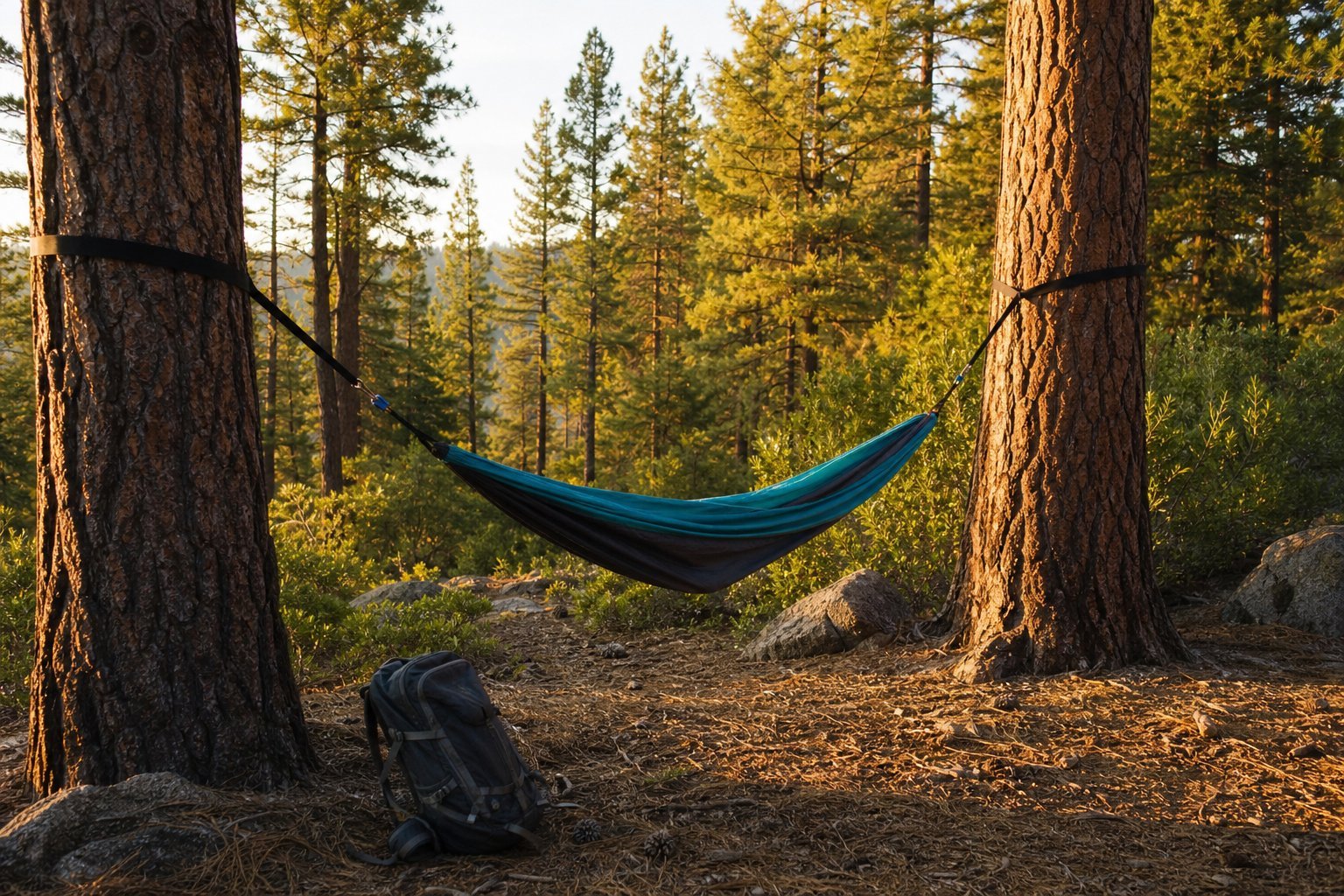
A good hang is about angle and height, not tension. REI recommends hanging the straps at about a 30 degree angle from the ground, which gives a comfortable sag and keeps the forces on the straps and trees reasonable. Pulling the hammock tight like a banjo string makes it uncomfortable and multiplies the load on every component.
For height, REI suggests the lowest point of the hammock should be no more than 18 inches off the ground, roughly chair height, so you can sit in it easily and won’t fall far. Wrap each strap around the trunk at about head height, choose the loop that gives the right angle, then sit in the hammock and adjust. Hammock straps settle slightly the first time they’re loaded, so check the height again after a few minutes.
Lie diagonally across a gathered-end hammock for a flatter position. If your head or feet feel too low, move one end up a loop or two. A short ridgeline, if your hammock has one, keeps the sag the same every time regardless of how far apart the trees are.
Carabiners, toggles and other hardware
Most daisy-chain hammock straps connect to the hammock with a carabiner or toggle. Only some sets include hardware: the Wise Owl kit comes with two carabiners, while ENO sells carabiners separately for the Helios. Use load-rated carabiners, ideally ones made for hammocks or climbing, never keyring clips or cheap decorative ones. The carabiner’s strength rating should be printed on its spine.
Some hammocks use toggles or a soft shackle instead of a carabiner. These are lighter and quieter, and they work with daisy-chain loops too. Whatever you use, check that the gate is fully closed before you climb in, and inspect hardware for cracks or sharp edges that could cut webbing.
Common complaints about hammock straps and fixes
The straps stretch overnight
Stretch is the number one complaint with cheap tree straps. Nylon webbing stretches noticeably, especially when wet, so you can go to sleep at chair height and wake up close to the ground. Polyester and HMPE stretch far less, which is why all five sets in this guide use them. If you notice sag, move up a loop and check the angle; a shallower angle also stretches straps more.
The loops are in the wrong place
With a daisy chain, the perfect hang can fall between two loops. More loops help, which is one reason the Python 10’s 40 points beat the Atlas’s 30. You can also slide the strap up or down the trunk to fine-tune the height, or switch to a stepless system like the Helios or whoopie slings.
The strap slips down a smooth trunk
Smooth-barked trees like beech or birch can let a strap slide down slowly. Wrap the strap once and cinch it firmly, keep the strap angle close to 30 degrees and avoid wet, slimy bark. Wider straps grip better than thin ones.
Wet, muddy hammock straps
Straps lying on the ground soak up water and grit. Polyester absorbs little, but some owners report the Python straps holding an ounce or two after rain. Pack wet straps separately from your sleeping gear and dry them when you can.
Care and storage
Hammock straps last for years with basic care. Rinse off mud and sand with clean water, let them air-dry out of strong sun, and store them loosely in their sack rather than tightly knotted. Grit inside the webbing slowly wears the fibers, and UV breaks down synthetic webbing over time, so don’t leave straps up on trees for weeks at a time.
Inspect your tree straps before each trip. Look for fraying, cuts, glazed or melted patches, and damaged stitching on the loops. Retire any strap with visible damage, because suspension failures happen suddenly and you’ll usually fall at the worst possible moment.
If you’re building a complete hammock or lightweight kit, pair your straps with a warm bag and insulation underneath you. Our guides to compact backpacking sleeping bags and cold weather sleeping bags cover the rest of the sleep system, and our headlamp guide helps with setting up after dark.
Hammock straps vs a tent
Hammocks are light and comfortable on uneven or rocky ground, but they need trees, and you’ll want a tarp for rain and insulation under you in cool weather. A tent works anywhere, including above the tree line and on open campsites. If you’re deciding between the two for backpacking, our lightweight backpacking tents guide compares the tent side of the choice.
Final thoughts on choosing hammock straps
For most campers, the Kammok Python 10 offers the best mix of reach, adjustment, weight and warranty. The ENO Atlas is the simplest set for beginners, the ENO Helios is the lightest for backpackers, the Wise Owl kit includes carabiners for a fair price and the Foxelli XL is the cheapest long set. Whatever you choose, hang from healthy trees at least 6 inches across, keep the angle near 30 degrees and treat the lowest-rated part of your system as your real limit.
Hammock strap myths
False. A tight, flat hang puts far more force on the straps, trees and hardware. A 30 degree angle with a good sag is safer and more comfortable.
Thin rope can cut into bark and slip. Leave No Trace recommends webbing at least 1 inch wide around the tree.
Not really. Big claims are often closer to breaking strength, and your hammock and carabiners set the real limit.
What to look for in hammock straps
10 ft per strap reaches most campsite trees; 8 ft suits close trees.
At least 1 in; 1.5 in or wider spreads the load better.
Polyester or HMPE, not nylon.
More loops or a stepless adjuster for a better hang.
Comfortably above your weight plus gear; check the hammock and carabiners too.
Under 10 oz for backpacking; ultralight systems go below 5 oz.
How to set up hammock straps
- Pick healthy trees
Choose live trees at least 6 in across, 200 ft from water, with no dead branches overhead.
- Wrap once
Wrap each strap once around the trunk at about head height and pass it through its end loop.
- Clip in
Clip the hammock’s carabiner or toggle to the loop that gives about a 30 degree angle.
- Sit and check
Sit in the middle; the lowest point should be no more than about 18 in off the ground.
- Fine-tune
Move up or down a loop, or slide the strap on the trunk, until the sag feels right.
How we chose these hammock straps
We have not tested every strap set in this list ourselves. Our picks are based on Amazon listings, published specifications from Kammok, ENO, Wise Owl Outfitters and Foxelli, retailer specs from REI, and advice from Leave No Trace, REI, Territory Supply and The Ultimate Hang. Where a listing didn’t state a spec, we marked it “Not quoted”.
-
Reach and adjustment
We compared strap length and the number of loops or adjusters.
-
Tree friendliness
We favored wide webbing that meets Leave No Trace guidance.
-
Strength and stretch
We checked rated loads and low-stretch materials.
-
Honest specs
We flagged missing or inflated claims rather than repeating them.
What are the best hammock straps?
For most people, the Kammok Python 10: two 10 ft straps with 40 loops, a 500 lb rating and a lifetime warranty.
How long should hammock straps be?
About 10 ft per strap suits most campsites. Shorter 8 ft systems like the ENO Helios suit trees roughly 10 to 14 ft apart.
How wide should tree straps be?
Leave No Trace recommends webbing at least 1 inch wide around the tree. Wider straps spread the load and protect bark better.
What angle should hammock straps be?
About 30 degrees from the ground, according to REI. That gives a comfortable sag without overloading the straps and trees.
Do hammock straps come with carabiners?
Some do. The Wise Owl kit includes two; ENO sells carabiners separately for the Helios. Check the listing before you buy.
Can I use rope instead of hammock straps?
Not around the tree. Rope concentrates pressure and can damage bark. Use wide webbing on the trunk and rope only between the strap and hammock, if at all.
More hammock camping help
Planning your first hammock night? Pair your straps with a warm sleep setup from our cold weather sleeping bag picks, and read our foam sleeping pad guide for simple insulation that works under you in a hammock.
Which hammock straps should you buy?
- Best overall: Kammok Python 10
- Best for beginners: ENO Atlas
- Best ultralight: ENO Helios
- Best value kit: Wise Owl Outfitters
- Best budget: Foxelli XL
For most campers, the Kammok Python 10 is the best set of hammock straps because it’s long, light, adjustable and covered by a lifetime warranty. Pick the ENO Atlas for the simplest setup, the ENO Helios for ultralight backpacking, the Wise Owl kit if you need carabiners and the Foxelli XL for the lowest price.
CampEquipmentPlus relies on reader support. Purchases made via links on our website may earn us an affiliate commission at no extra cost to you, helping keep the site running.