
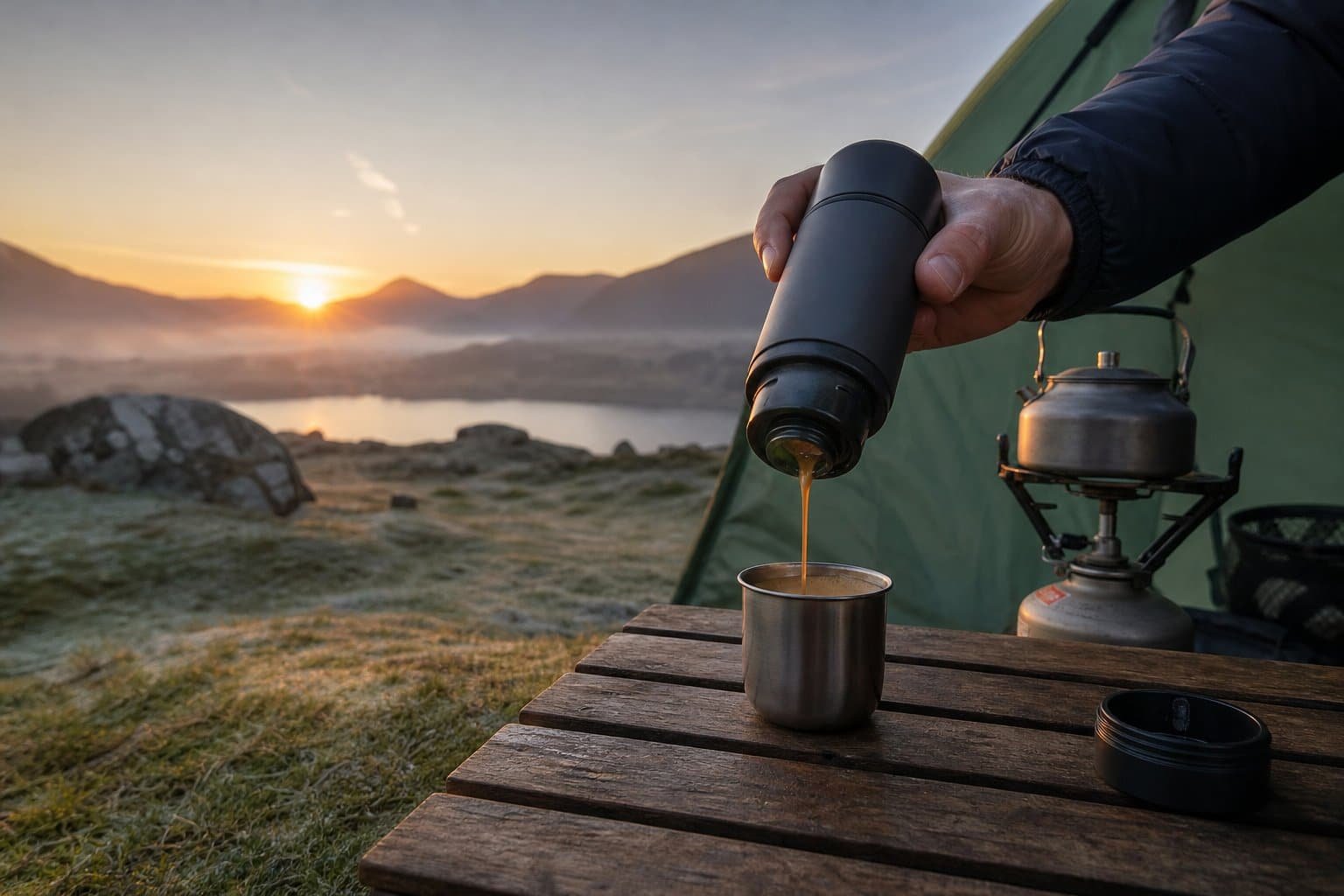
Best Portable Espresso Makers for Camping UK
A portable espresso maker for camping gives you a proper short coffee by the tent without a café in sight. Our top pick is the Wacaco Nanopresso for most campers, while the Bialetti Moka Express is the easiest choice if you already cook on a gas stove.
Campers judge these makers on a short list: how good the shot tastes, how light and packable the kit is, how much effort each coffee takes and how easy it is to clean with limited water. The common complaints are just as consistent: lots of small parts, coffee that cools too fast, slow service for groups and self-heating machines that run out of battery.
Below we compare six options, from hand-pumped and battery-powered makers to stovetop pots, and explain pressure, grind size, heating water and campsite care.
- Manual makers give the best shot for the weight
- Moka pots are easiest on a gas stove but aren't true espresso
- Self-heating makers are convenient but need recharging
- Best overall: Wacaco Nanopresso 336 g, up to 18 bar, case included.
- Best espresso quality: Wacaco Picopresso 18 g basket for café-style shots with fresh, fine coffee.
- Best for gas stoves: Bialetti Moka Express 3-cup Three cups at once, no pumping or batteries.
- Best self-heating: OutIn Nano One button and USB-C charging for vans and hook-ups.
Choosing a portable espresso maker for camping comes down to three questions: how you will heat the water, how many people you are making coffee for and how much fiddling you will put up with before breakfast. Hand-pumped makers such as the Nanopresso are light and make real espresso, stovetop pots suit anyone with a gas stove, and self-heating machines like the OutIn Nano trade weight and battery life for convenience. If you want filter coffee or a cafetière instead, see our guide to the best camping coffee makers.


Best overall Nanopresso | Quality Picopresso | Gas stoves Moka 3-cup | Self-heating OutIn Nano | |
|---|---|---|---|---|
|
|
|
|
| |
| Type | Manual pump | Manual pump | Stovetop moka | Battery, self-heating |
| Pressure | Up to 18 bar | Not quoted | Below 9 bar (moka) | Up to 20 bar |
| Weight | 336 g / 0.74 lb | Not quoted | Not quoted | 670 g |
| Serves | 1 shot (80 ml tank) | 1 shot (18 g basket) | 3 espresso cups | 1 shot (50 ml heated) |
| Coffee | Ground (capsule add-on) | Fresh, very fine grind | Ground | Ground or capsules |
| Water heating | Kettle or stove | Kettle or stove | On the stove | Built-in (USB-C) |
| Warranty | Not quoted | Not quoted | 1-year manufacturer | 12-month support |
| Check price | Check price | Check price | Check price |
Our portable espresso maker for camping reviews
Each review covers how the maker works, its size and weight, the coffee it makes and the trade-offs testers and owners report. We have ranked them for typical UK tent and campervan trips, starting with the best all-rounder.
Manual hand-pumped portable espresso maker, up to 18 bar, 80 ml water tank, 15.6 cm long, 336 g (0.74 lb), protective case included.
The Wacaco Nanopresso is the portable espresso maker for camping we would hand to most people first. It is a 15.6 cm cylinder that weighs 336 g, holds 80 ml of hot water and builds up to 18 bar of pressure as you pump the piston with your thumb. Wacaco says it needs 15% less pumping force than its earlier Minipresso, and this bundle includes a hard protective case, which matters when it rattles around in a camping crate.
Testers rate the coffee highly: OutdoorGearLab scored its taste 9 out of 10 and called the shots rich, with real crema. The complaints are consistent too. There are lots of small parts to keep track of and rinse, the puck of spent grounds doesn’t always tap out cleanly, and making shots for a whole family is slow because you brew one at a time. One reviewer also found shots slightly cool, so preheat it with a splash of hot water first. Wacaco sells separate add-ons for Nespresso Original capsules and double shots. The warranty is not clearly quoted on the Amazon listing.
- Real espresso with crema from ground coffee
- Light and pocket-sized at 336 g
- Hard case included
- No battery or power needed
- Many small parts to clean
- One shot at a time, slow for groups
- Shots can cool quickly without preheating
Manual portable espresso maker with commercial-style 18 g basket and naked portafilter, about 10 cm tall, metal construction, protective case included.
The Wacaco Picopresso is the pick if taste matters more than convenience. It uses a wide commercial-style 18 g basket and a naked portafilter, so it behaves more like a lever espresso machine than a pressurised travel gadget, and it packs down to about 10 cm tall in its case. Wacaco makes it largely from metal, which feels robust on a campsite.
The trade-off is effort. Wacaco says supermarket pre-ground coffee “will not work well”: you need fresh beans ground very fine, which in practice means carrying a hand grinder and dialling in the grind on the first morning. The Coffee Chronicler found it easy to preheat and said the side pump felt “awkward at first” but builds enough pressure. The Amazon listing gives no weight or warranty, so we marked those as not quoted.
- Best shot quality of the manual makers
- 18 g commercial-style basket
- Very compact and solidly built
- No power needed
- Needs a fine grinder and fresh beans
- Learning curve to dial in
- Most expensive manual pick here
- Weight not quoted on the listing
Original Italian aluminium stovetop moka pot, 3 espresso cups, patented safety valve, suits gas and electric hobs (induction with an adapter plate), made in Italy, 1-year manufacturer warranty.
If you already cook on a camping gas stove, the Bialetti Moka Express is the simplest way to make strong espresso-style coffee for two or three people. Fill the base to the safety valve, add ground coffee without tamping, screw it together and put it on a low flame; when it starts to gurgle, the coffee is ready. It is made in Italy, has a patented safety valve and comes with a 1-year manufacturer warranty.
Be clear about what it makes. A moka pot can’t reach the 9 bar of a true espresso machine, but Expedition Portal says the result in the cup is close enough for most people. It is aluminium, so Bialetti says rinse it with water only, no detergent, and don’t use it on an induction hob without the separate Bialetti adapter plate. Narrow pan supports on small canister stoves can make a 3-cup pot wobbly, so a stable two-burner or a single burner with wide arms suits it best.
- Makes 3 cups at once
- Nothing to charge or pump
- Simple, proven design
- 1-year manufacturer warranty
- Not true 9-bar espresso
- Needs a stable stove and low flame
- Hand wash with water only
- Weight not quoted on the listing
Battery-powered portable espresso machine with self-heating, 20 bar, 2500 mAh battery, USB-C charging (10–15 W), ground coffee and Nespresso-style capsules, 670 g, 12-month support.
The OutIn Nano is the portable espresso maker for camping that does the hard work for you. Add water and coffee (ground or Nespresso Original-style capsules), press the button and it heats the water and pumps at up to 20 bar. OutIn says it heats 50 ml of room-temperature water to about 92°C in 200 seconds, and that the 2500 mAh battery gives up to five self-heated shots, or 200+ shots if you pour in already-hot water and let it just pump. It charges by USB-C from a 10–15 W charger, so a car socket, power bank or portable power station works.
Reviewers like the convenience but are less sure about the coffee. CNN Underscored found some pours watery and said one self-heated shot took the battery from 100% to 50%, and The Coffee Chronicler noted a slightly low brewing temperature that doesn’t suit light roasts. OutIn’s figures assume 25°C water; on a cold UK morning, expect fewer heated shots, so pre-boil the water when you can. At 670 g it is twice the weight of a Nanopresso. Read our full OutIn Nano review for more detail.
- One-button operation, no pumping
- Heats its own water
- Takes ground coffee and capsules
- USB-C charging from a car or power bank
- Only a few self-heated shots per charge
- Heaviest maker here at 670 g
- Some testers found shots watery
- Must be carried in hand luggage when flying
Manual portable espresso maker for ground coffee, up to 18 bar, 80 ml tank (shots up to 60 ml), adjustable 8–12 g basket, double-wall body, 12.5 cm, 285 g, 1-year after-sales support.
The Wacaco Minipresso GR2 is the cheapest of the hand-pumped makers here and the lightest at 285 g. It holds 80 ml of water, makes shots of up to 60 ml and uses an adjustable basket that takes 8–12 g of coffee, so you can brew a lighter or stronger shot. Unlike the Picopresso, it is designed to work with ordinary pre-ground coffee as well as freshly ground beans, which keeps the kit list short.
Its double-wall body stays cooler to hold after you preheat it, and the outer shell uses 20% plant-based material. Pumping takes more strokes than on the Nanopresso, and like every manual maker it brews one shot at a time. Wacaco offers one year of after-sales support. If you prefer capsules, see our Wacaco Minipresso NS review.
- Usually the cheapest pick here
- Lightest maker at 285 g
- Works with pre-ground coffee
- Adjustable basket
- More pumping than the Nanopresso
- No case included
- One shot at a time
Stovetop single-serve espresso maker in Glacier stainless steel, one double shot (2.5 fl oz / 74 ml) in under 90 seconds, double-wall stainless cup and foam case included.
The GSI Outdoors MiniEspresso Set is a small stovetop brewer for one person. It is made from GSI’s Glacier stainless steel, so it shrugs off knocks that would dent aluminium, and it brews a double shot (about 74 ml) in under 90 seconds straight into the included double-wall stainless cup. Everything packs into a foam case.
CNN Underscored found that it pours in 2.5–3.5 minutes on a real stove, makes little to no crema and can get messy if the flame is too high. Like a moka pot it doesn’t reach true espresso pressure, but it makes strong, short coffee for a solo camper without pumping or charging. The listing doesn’t quote a weight or warranty.
- Very tough stainless steel
- Fast single double shot
- Cup and case included
- Nothing to charge or pump
- Little or no crema
- Messy if overheated
- Single serving only
- Weight and warranty not quoted
Types of portable espresso maker for camping
There are three main ways to make espresso-style coffee away from mains power, and each one suits a different kind of trip. Knowing which type you want narrows the choice quickly.
Manual hand-pumped makers
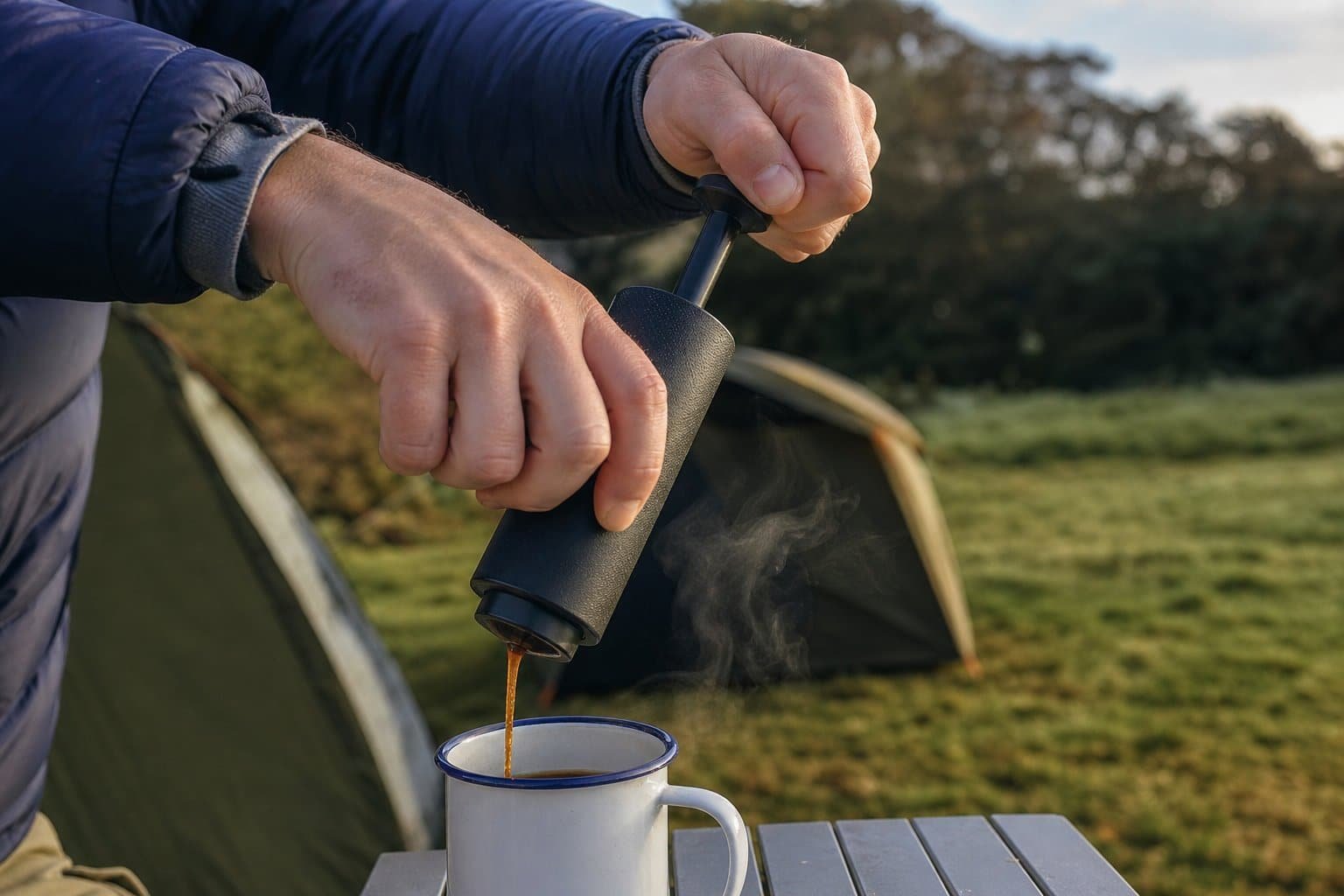
The Nanopresso, Picopresso and Minipresso GR2 are all manual. You pour in hot water, add coffee to the basket and pump a piston to push the water through at high pressure. Wacaco quotes up to 18 bar for the Nanopresso and Minipresso, which is more than the 9 bar used as the benchmark for espresso. They need no batteries, weigh around 300 g and give the best coffee for their size. The downside is effort: every shot takes a minute or two of pumping, and you need a separate kettle or stove to heat the water.
Stovetop moka pots and brewers
A moka pot sits straight on your stove. Steam pressure in the base pushes water up through the coffee into the top chamber. It can’t reach espresso pressure, so there is little crema, but the coffee is strong, short and rich, and a 3-cup pot serves two or three people at once. The GSI MiniEspresso works on a similar principle for a single double shot. Both are ideal if you already carry a single burner camp stove and want nothing to charge or pump.
Battery-powered self-heating machines
Self-heating machines such as the OutIn Nano heat their own water and pump electrically at the press of a button. They are the most convenient portable espresso maker for camping when you have a way to recharge, such as a car socket, a power bank or an electric hook-up. Heating water takes a lot of energy, though, so the battery manages only a few fully self-heated shots per charge. Our guide on how to power devices while camping explains the options.
How to choose a camping espresso maker
How many people you are serving
This is the deciding question for most families. Every manual and battery maker here brews one shot at a time, so four coffees means four rounds of filling, pumping and cleaning out the basket. OutdoorGearLab specifically says the Nanopresso is not recommended for large groups. If you regularly make coffee for three or more, a 3-cup moka pot, or a bigger 6-cup pot, will keep everyone happier.
Weight and packed size
The manual makers weigh 285–336 g and are about the size of a large torch, so they fit easily in a rucksack lid. The OutIn Nano weighs 670 g, and a moka pot is bulkier because of its handle and shape. For car camping, weight hardly matters; for backpacking, the Minipresso GR2 or Nanopresso make the most sense.
Coffee type and grind
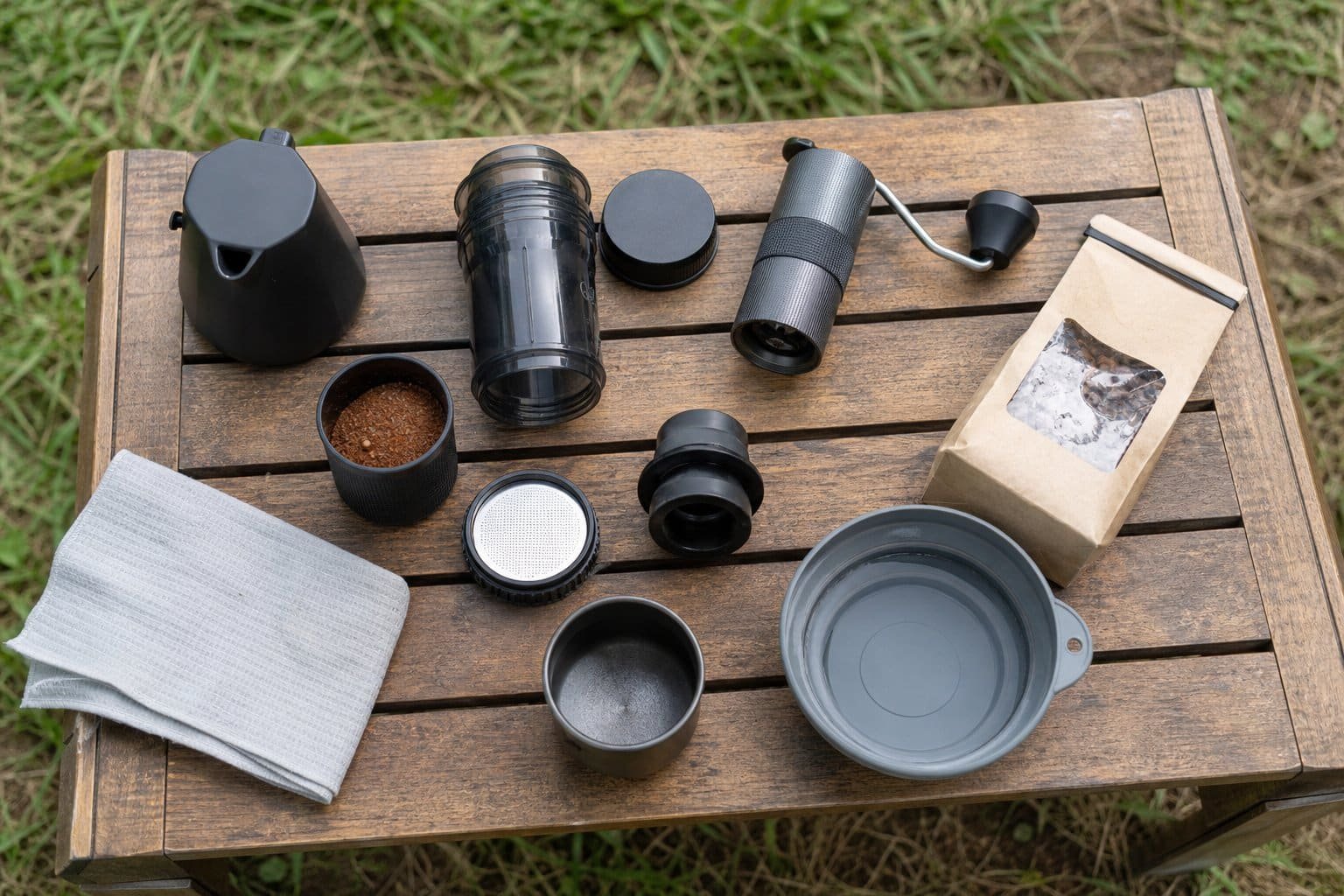
Check what coffee the maker needs before you buy. The Minipresso GR2 and Nanopresso work with ordinary espresso-grind coffee from the supermarket. The Picopresso needs fresh beans ground very fine, which means carrying a hand grinder. A moka pot needs a grind a little coarser than espresso, and the OutIn Nano and the Nanopresso (with an adapter) can use Nespresso Original-style capsules, which are the tidiest option at a campsite but create packaging waste.
How you will heat the water
Every option except the OutIn Nano relies on a kettle or stove. If you already boil water for tea, a manual camping espresso maker adds only a few hundred grams. If you would rather not light a stove at 6am, or you are in a campervan with USB power, a self-heating machine starts to make sense. Our guide to the best kettles for camping covers fast-boiling options.
Durability and spare parts
Portable espresso makers have seals, gaskets and small plastic parts that wear over time, and The Coffee Chronicler warns that many portable devices develop problems down the line. Look for a maker from a brand that sells spare seals and baskets, keep it in a case and avoid overtightening parts when they are hot.

Moka pot vs portable espresso maker: which is better?
A portable espresso maker for camping such as the Nanopresso makes genuine espresso with crema because it pushes water through tightly packed coffee at high pressure. A moka pot works at much lower pressure, so the coffee is closer to a very strong filter coffee. Expedition Portal puts it simply: a moka pot can’t reach the 9 bar needed for true espresso, but most people can’t tell the difference once it is in a mug with milk.
In practice, choose a moka pot if you want several cups at once, cook on gas anyway and don’t want to pump or charge anything. Choose a manual camping espresso maker if you want the best shot for the least weight, drink mostly black espresso or travel light. Many keen campers carry both: a moka pot on family weekends and a Nanopresso for backpacking.
How to make good espresso at a campsite
Most disappointing camp espresso comes down to temperature, grind or technique rather than the maker itself. These habits make a big difference.
Use water just off the boil
Espresso extracts best with water around 90–96°C. Boil the kettle, then let it sit for 20–30 seconds before filling the tank. On a cold British morning the small metal and plastic parts suck heat out of the water, so the first shot often tastes thin.
Preheat the maker
Run a splash of hot water through the empty maker before you brew, and warm your cup too. One tester found Nanopresso shots tasted slightly cold, and preheating fixes that. The Picopresso is easy to preheat this way, and the Minipresso GR2’s double wall keeps it comfortable to hold afterwards.
Match the grind to the maker
Pre-ground espresso coffee suits the Nanopresso, Minipresso GR2 and OutIn Nano. The Picopresso needs a much finer grind from fresh beans, and a moka pot needs something slightly coarser. If coffee spurts out too quickly and tastes sour, grind finer or tamp harder; if you can barely pump, grind coarser.
Keep coffee fresh and dry
Store coffee in an airtight tin or zip bag, away from direct sun in the tent. Damp, stale coffee is the quickest way to lose crema. Pre-measure doses into small bags at home to save mess at the campsite.
Using a portable espresso maker for camping on a UK campsite
For stovetop pots, always cook outside the tent or in a ventilated cooking porch, keep the flame low so it doesn’t lick up the sides of the pot and never leave a moka pot unattended. Narrow canister stoves can make a 3-cup pot wobble, so a double burner camping stove or a single burner with wide pan supports is more stable, ideally on a level portable camping kitchen table.
For self-heating machines, charge them fully at home and top up from the car while driving. A 300 Wh power station can recharge a small espresso machine several times. If you’re on an electric hook-up, a mains USB-C charger works, but the OutIn Nano is limited to 10–15 W charging, so it won’t charge any faster from a big adapter.
For manual makers, a flat, stable surface helps you pump without spilling. Wacaco’s makers are designed to be held, but resting the base on a table or your knee takes the strain off your wrist when you make several shots.
Cleaning and care at the campsite
Clean your camping espresso maker straight after use, while the grounds are still damp. Knock the puck out into a bin bag, rinse the basket and shower screen with a little hot water and wipe them with a cloth. OutdoorGearLab found the Nanopresso puck doesn’t always release cleanly, so a small brush or the back of a spoon helps. Avoid tipping coffee grounds into campsite sinks or streams; bag them with your rubbish.
Moka pots are easier: the spent coffee comes out as a solid puck that taps out, then you rinse the pot with water. Bialetti says not to use detergent on the Moka Express or put it in a dishwasher. Dry every part fully before packing, especially seals and aluminium, and store the maker in its case so the gasket and basket aren’t crushed.
Common problems and fixes
Coffee is lukewarm. Use water just off the boil and preheat the maker and cup. Cold mornings make this worse, so keep the maker in the tent overnight rather than outside.
Hard to pump or nothing comes out. The grind is too fine or the coffee is packed too hard for that maker. Use a slightly coarser grind or tamp more lightly.
Watery shot with no crema. Grind finer, use fresher coffee or dose a little more. On the OutIn Nano, pre-boiled water helps the shot and saves battery.
Leaks around the seal. Check the gasket is seated and clean, and don’t overtighten the parts. Most brands sell replacement seals.
Moka pot spits or tastes burnt. The flame is too high. Use a low flame and take it off as soon as it starts to gurgle.
Milk drinks and other coffees at camp
A short espresso is only the start. Add hot water from the kettle for an Americano, or warm milk in a small pan and whisk it with a mini frother for a camp flat white or latte. UHT milk in small cartons keeps without a cool box, and oat milk froths well on a camping stove. For iced coffee on a hot day, pour a shot over ice from the cool box.
A 3-cup moka pot gives enough coffee for two milky drinks at once, which is why it is so popular with couples. With a manual camping espresso maker, brew the shots first, then heat the milk while the maker cools, so the espresso doesn’t sit for long.
Buying a portable espresso maker in the UK
The makers in this guide link to Amazon listings. Availability, delivery times and prices for UK buyers vary by seller, so check the listing before you order. The manual and stovetop makers work anywhere you can boil water, and the OutIn Nano charges from any USB-C charger, so there are no plug or voltage issues for UK campers.
Sizes on US listings use ounces: 1.7 oz of water is about 50 ml and 2.5 fl oz is about 74 ml. Moka pot “cups” are small espresso cups of around 50 ml each, not mugs, so a 3-cup pot makes roughly two small mugs of strong coffee. If you drink large mugs, size up or plan to top up with hot water. Before your first trip, practise at home: dialling in grind and dose on your kitchen table is far easier than doing it in the rain.
Final thoughts on choosing a portable espresso maker for camping
For most UK campers, the Wacaco Nanopresso is the best portable espresso maker for camping: light, reliable and capable of a proper shot with crema. Coffee enthusiasts should step up to the Picopresso, families and gas-stove cooks will get more from a Bialetti Moka Express, and campervan owners who hate pumping should look at the OutIn Nano. The Minipresso GR2 is the best budget pick and the GSI MiniEspresso is the toughest. For more ideas, see our guide to the best portable coffee makers and our camping kitchen essentials.
Camp espresso myths
Moka pots work well below the 9 bar used for espresso, so they make strong coffee with little crema.
Grind, dose, freshness and water temperature matter as much as the maximum pressure on the box.
They can heat their own water, but only for a few shots per charge. Pre-boiled water makes the battery last far longer.
What to look for in a portable espresso maker for camping
Manual makers do one shot at a time; a moka pot serves several.
Kettle or stove for manual and stovetop makers; built-in heating needs recharging.
Pre-ground, fresh fine grind or capsules: check before you buy.
About 300 g for manual makers; heavier for battery machines.
Fewer parts are easier with limited water.
Replacement seals and baskets extend a maker’s life.
How to brew with a hand-pumped espresso maker
- Boil water
Let it rest 20–30 seconds off the boil.
- Preheat
Run hot water through the empty maker and warm your cup.
- Dose and tamp
Fill the basket with espresso-grind coffee and level it.
- Fill the tank
Add hot water and screw the parts together firmly but not too tight.
- Pump steadily
Pump until the shot flows, then keep a steady rhythm.
- Clean straight away
Knock out the puck, rinse and dry the parts.
How we chose these espresso makers
We have not tested every maker in this list ourselves. Our picks are based on the Amazon listings, maker information and published testing from OutdoorGearLab, CNN Underscored, The Coffee Chronicler and Expedition Portal. Where a listing didn’t state a spec we marked it “Not quoted” rather than guessing.
-
Coffee quality
We weighed tester findings on taste, crema and temperature.
-
Campsite practicality
We compared weight, water heating, serving size and cleaning.
-
Value and support
We looked at price, warranties and common owner complaints.
What is the best portable espresso maker for camping?
For most campers, the Wacaco Nanopresso: 336 g, up to 18 bar and a protective case included. Families cooking on gas may prefer a Bialetti Moka Express.
Is a moka pot real espresso?
Not strictly. Moka pots work below the 9 bar of an espresso machine, so the coffee is strong but has little crema.
Do I need a grinder?
Not for the Nanopresso, Minipresso GR2, OutIn Nano or a moka pot, which work with pre-ground coffee. The Picopresso needs fresh, very finely ground beans.
How many shots does the OutIn Nano make per charge?
OutIn says up to five self-heated shots from room-temperature water, or 200+ if you add hot water. Testers found fewer heated shots in practice.
Can I use a portable espresso maker in my tent?
Manual makers are fine once the water is boiled, but always boil water and use stovetop pots outside or in a ventilated cooking porch.
Can I take a portable espresso maker on a plane?
Manual makers are usually fine. OutIn says its battery machine must go in hand luggage and not be used during the flight.
More camp coffee and kitchen guides
Still planning your camp kitchen? See our guides to the best camping coffee makers, the best kettles for camping, single burner camp stoves and camping kitchen essentials, plus our Wacaco Minipresso NS review.
Which portable espresso maker for camping should you buy?
- Best overall: Wacaco Nanopresso with Protective Case
- Best espresso quality: Wacaco Picopresso Pro-level Portable Espresso Maker
- Best for gas stoves: Bialetti Moka Express 3-Cup Stovetop Espresso Maker
- Best self-heating: OutIn Nano Portable Electric Espresso Machine
- Best budget: Wacaco Minipresso GR2 Portable Espresso Maker
- Most rugged: GSI Outdoors MiniEspresso Set 1 Cup
For most campers, the Wacaco Nanopresso is the best portable espresso maker for camping. Choose the Picopresso for café-quality shots, the Bialetti Moka Express for gas stoves and groups, the OutIn Nano for push-button convenience, the Minipresso GR2 on a budget and the GSI MiniEspresso for toughness.
CampEquipmentPlus relies on reader support. Purchases made via links on our website may earn us an affiliate commission at no extra cost to you, helping keep the site running.