
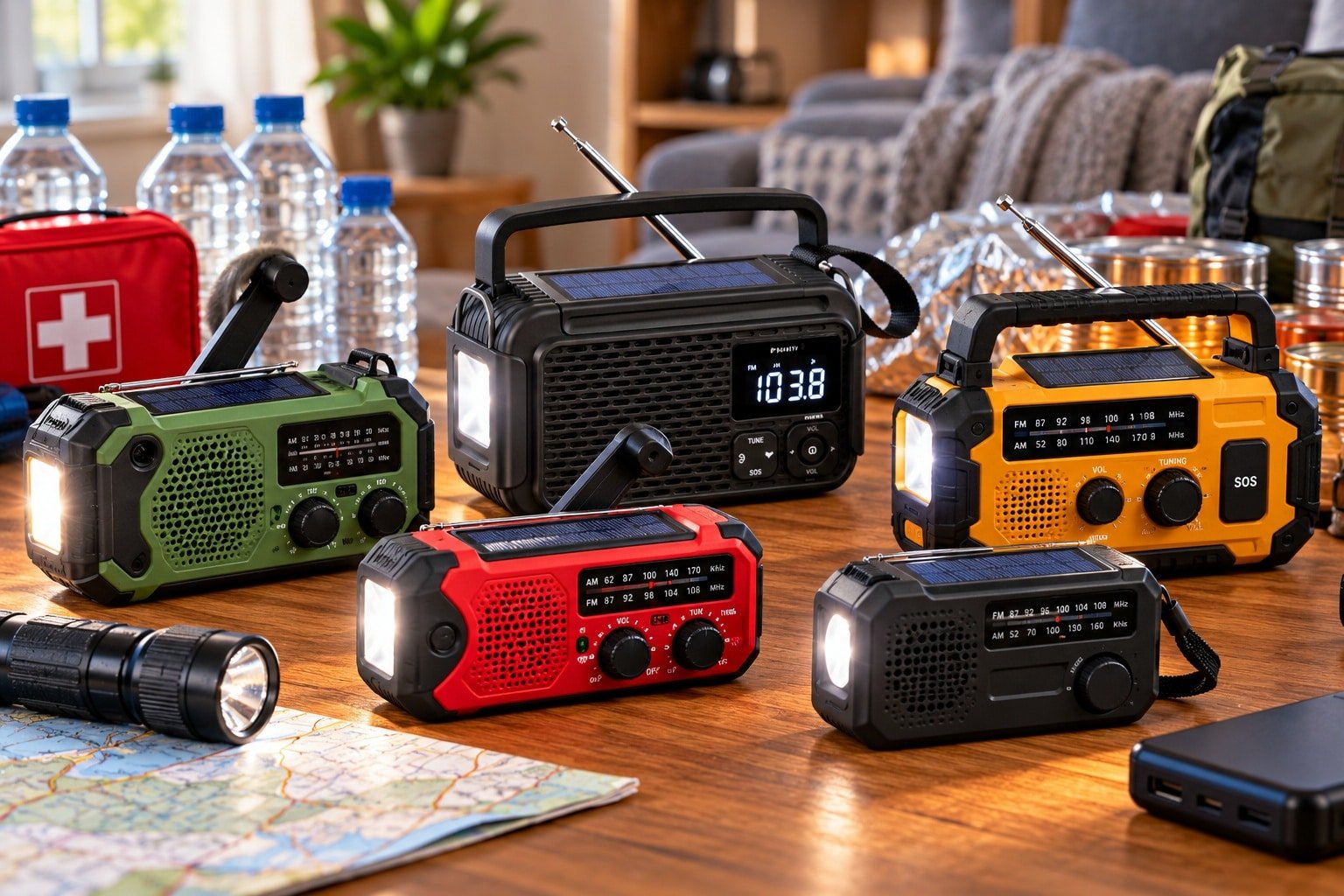
Finding the best wind up emergency radios UK households can depend on means looking beyond the hand crank. Reliable FM reception, sensible battery backup and easy-to-use controls matter more than a long list of emergency features.
During a power cut, your television, broadband router and phone charger may stop working. Mobile coverage can also be affected if local communications infrastructure loses electricity.
A portable emergency radio provides another way to receive news and local information without depending on an internet connection.
The UK Government recommends keeping a battery-powered or wind-up radio at home and writing down useful radio frequencies before an emergency.
This guide compares four emergency radios for UK households, from compact budget models to larger radios with additional charging options.
Affiliate disclosure: This guide contains Amazon.co.uk shopping links. We may earn a commission from qualifying purchases through qualifying affiliate links, at no additional cost to you. Recommendations are based on published product information and research. We have not personally tested these radios.
Best Wind Up Emergency Radio UK: Quick Comparison
| Emergency radio | Best for | Reception | Power options | Main advantage |
|---|---|---|---|---|
| Philips TAR3500 | Best overall | FM/AM | USB-C, hand crank, solar, AAA batteries | Replaceable battery backup |
| Duronic Hybrid | Compact option | FM/AM | USB, hand crank, solar | Small, simple design |
| SOLARBABY 2000mAh | Budget option | FM/AM | USB, hand crank, solar | Built-in torch and SOS alarm |
| Midland ER300 Pro | Backup charging | FM/AM | USB-C, hand crank, solar | Larger rechargeable battery |
All four radios offer FM reception, making them relevant for UK emergency preparedness.
The main differences are their battery arrangements, physical size and additional functions.
For a household emergency kit, a radio that accepts ordinary replaceable batteries can be particularly useful during prolonged electricity outages.
A larger rechargeable battery is helpful if you also want limited USB charging for other devices, although a separate power bank remains the better option for smartphones.
Recommended Wind-Up Emergency Radios
Best Overall Emergency Radio: Philips TAR3500 Multi-Powered Emergency Radio
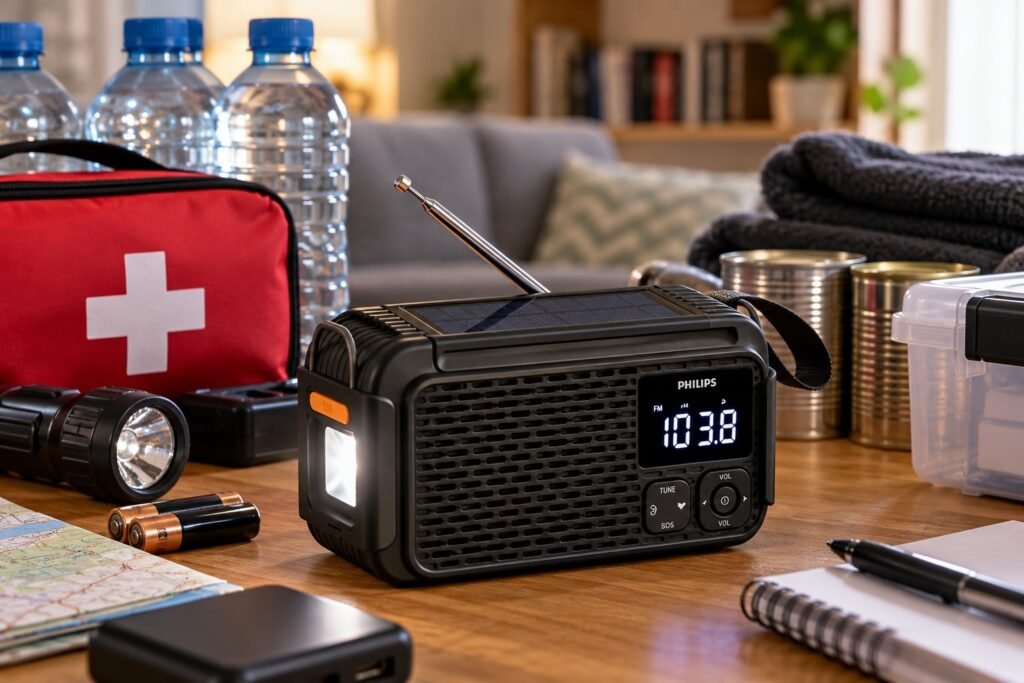
The Philips TAR3500 Multi-Powered Emergency Radio is our best overall recommendation for UK households preparing for power cuts.
It combines FM/AM radio reception with several power options, making it suitable for situations where mains electricity is unavailable.
The radio includes a built-in rechargeable battery, hand-crank generator, solar panel and USB-C charging connection. It also supports AAA batteries, providing an additional way to keep listening when the internal battery cannot be recharged.
Key specifications
- Radio reception: FM and AM.
- Power sources: USB-C, hand crank, solar panel and AAA batteries.
- Lighting: Built-in LED torch.
- Emergency features: SOS alarm.
- Protection: Manufacturer-stated IP55 dust and water resistance.
- Design: Portable housing with carrying handle.
Short review
The Philips TAR3500 stands out because it offers several ways to keep the radio operating during an extended power cut.
Its replaceable-battery option is particularly useful. You can keep spare AAA batteries in your emergency kit instead of relying entirely on the internal rechargeable battery.
The built-in torch provides convenient lighting for finding items in a dark room, while the hand crank can generate limited power if other charging methods are unavailable.
The solar panel offers another backup, although charging is likely to be slow, particularly during cloudy UK weather.
Its IP55 rating provides a stated level of protection against dust and water jets, making the radio suitable for occasional outdoor use. It should not be submerged in water.
Pros
- Replaceable AAA batteries offer a practical fallback during prolonged outages.
- FM reception allows access to UK national and local radio broadcasts.
- IP55 protection makes it better suited to occasional outdoor use than an unprotected indoor radio.
- USB-C charging is convenient for regular battery maintenance.
Cons
- No DAB or DAB+ reception.
- Hand-crank and solar charging provide limited power.
- Larger than compact pocket radios.
Best for: UK households wanting a multi-powered emergency radio for power cuts, emergency kits and occasional camping trips.
Amazon.co.uk: View Philips TAR3500 Multi-Powered Emergency Radio
Best Compact Emergency Radio: Duronic Hybrid
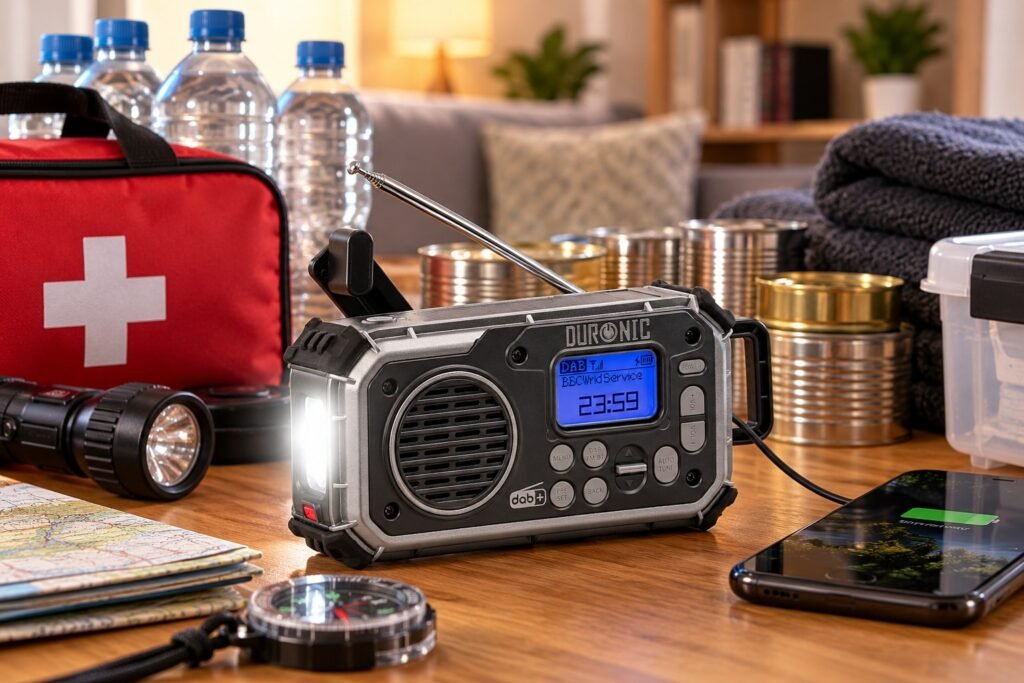
The Duronic Hybrid is a compact wind-up radio designed for simple portable listening.
It provides FM/AM reception and can be powered using its internal rechargeable battery, hand crank, solar panel or USB charging connection.
Its small size makes it suitable for storing in a kitchen drawer, emergency box or compact grab bag.
Key specifications
- Radio reception: FM and AM.
- Power: Internal rechargeable battery, USB charging, hand crank and solar panel.
- Battery capacity: Approximately 300mAh, depending on version.
- Design: Compact portable radio.
- Lighting: No built-in emergency torch on the basic Hybrid model.
- Phone charging: Not intended for charging a smartphone.
Short review
The Duronic Hybrid is aimed at people who want a radio rather than a collection of additional features.
Its compact design makes storage easy, and the hand crank provides a way to generate power when the battery runs down.
The trade-off is limited stored energy.
Its small rechargeable battery means it is less suitable for prolonged listening without occasional recharging.
It also lacks the replaceable AA or AAA battery option available on some larger emergency radios.
If you already have a separate LED torch and power bank, the Duronic may provide the basic radio functionality you need without taking up much space.
Pros
- Compact enough for small emergency kits.
- Straightforward FM/AM radio operation.
- Suitable for people who already own separate emergency lighting.
Cons
- Small internal battery limits extended listening.
- No replaceable battery backup on the basic version.
- No built-in torch.
Best for: Households wanting a small backup radio with basic wind-up functionality.
Amazon.co.uk: Duronic Hybrid Wind-Up Radio
Best Budget Emergency Radio: SOLARBABY 2000mAh
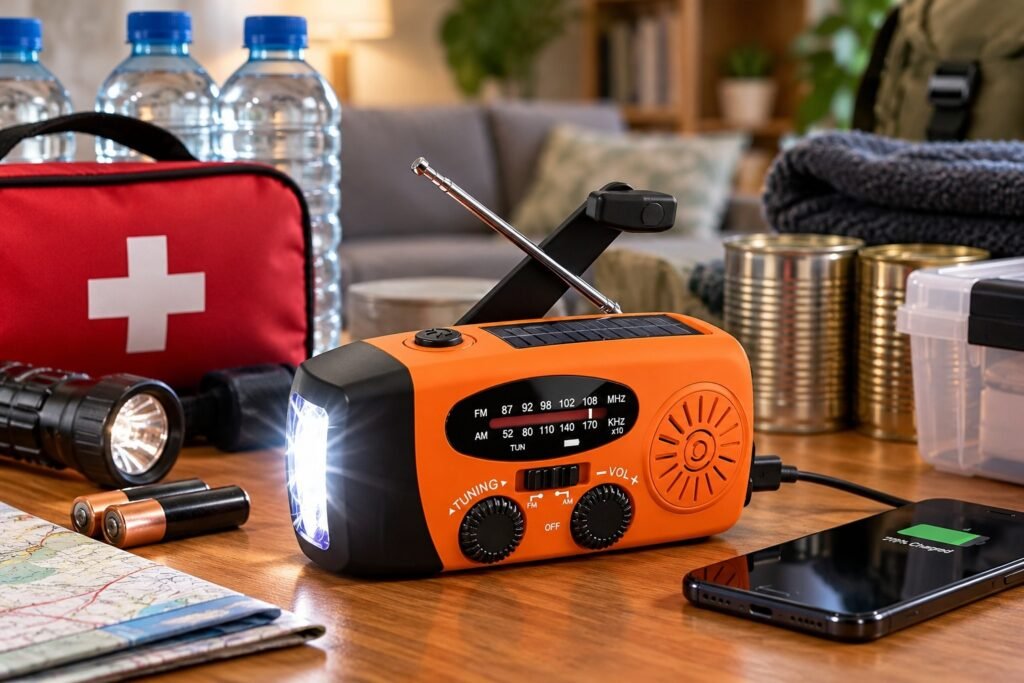
The SOLARBABY 2000mAh emergency radio combines basic radio reception with a hand crank, solar charging and a built-in torch.
It is designed as an affordable emergency radio for households and outdoor activities.
Key specifications
- Radio reception: FM and AM.
- Battery: Advertised 2000mAh rechargeable battery.
- Power: USB charging, hand crank and solar panel.
- Lighting: Built-in LED torch.
- Emergency features: SOS alarm.
- USB output: Limited emergency phone charging.
Short review
The SOLARBABY offers several emergency features in a relatively inexpensive package.
The built-in torch and SOS alarm may be useful additions, particularly if the radio is also kept in a camping bag.
However, the battery capacity is modest compared with larger emergency radios.
Although USB phone charging is advertised, it should be considered a last-resort option rather than a reliable way to recharge a modern smartphone.
The radio also relies on its internal rechargeable battery, with no clearly established replaceable-battery option for this version.
Product names and specifications can vary between marketplace sellers, so check the exact listing carefully before purchasing.
Pros
- Combines a radio and emergency torch in one unit.
- Hand-crank operation provides a backup charging method.
- May suit households seeking an inexpensive starter radio.
Cons
- Limited capacity for charging other devices.
- No confirmed replaceable AA or AAA battery option.
- Charging and runtime claims need checking against the exact listing.
Best for: Budget-conscious households wanting a basic emergency radio with a torch.
Amazon.co.uk: SOLARBABY 2000mAh Emergency Radio
Best Radio With Backup Charging: Midland ER300 Pro
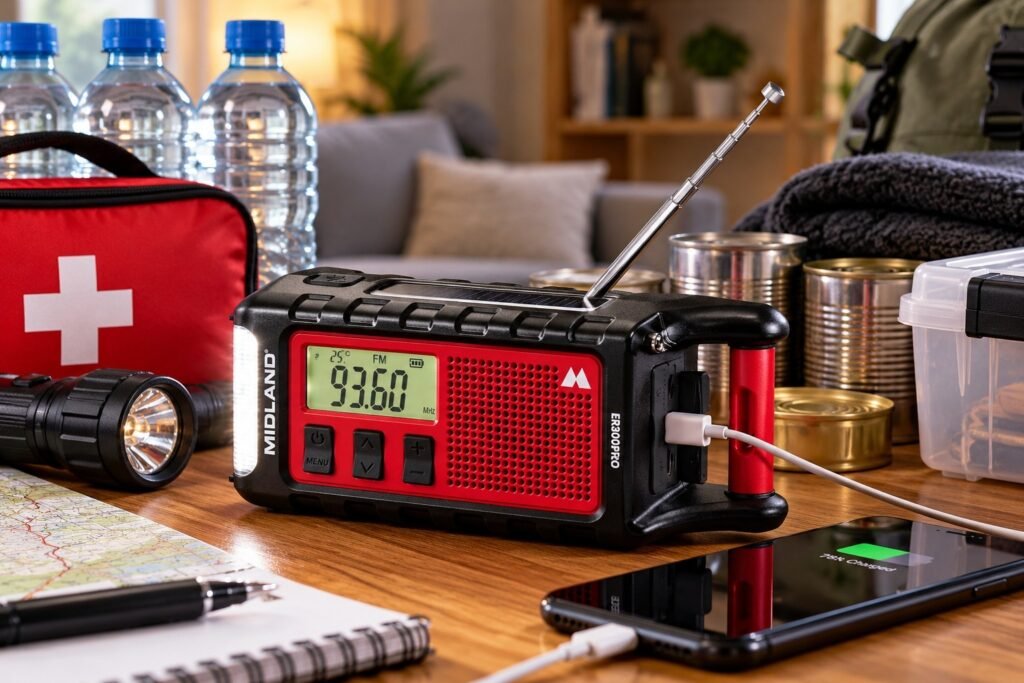
The Midland ER300 Pro is a larger emergency radio intended for people who want substantial rechargeable battery capacity alongside FM/AM reception.
It combines a hand crank, solar panel and USB-C charging with a manufacturer-advertised 10,000mAh internal battery.
This makes it different from compact radios with batteries intended primarily for listening.
Key specifications
- Radio reception: FM and AM.
- Battery capacity: Advertised 10,000mAh.
- Power: USB-C charging, hand crank and solar panel.
- Lighting: Built-in LED torch.
- Additional features: SOS function and Bluetooth connectivity.
- Charging output: USB charging for compatible devices.
- Weight: Approximately 650g.
Short review
The Midland ER300 Pro is worth considering if you want a radio that can also provide some backup charging for a mobile phone.
Its larger battery capacity is the main advantage over simpler emergency radios.
However, that capacity is most useful when the battery has been charged before the power cut.
The hand crank and solar panel are not realistic replacements for normal USB charging when replenishing a large battery.
The ER300 Pro is also bulkier than a compact emergency radio.
For households already keeping a separate 20,000mAh power bank, a smaller radio may be sufficient.
Pros
- Larger advertised battery capacity than most compact emergency radios.
- USB-C charging is convenient for regular maintenance.
- Can supplement a separate power bank.
Cons
- Heavier than basic models.
- Hand-crank charging cannot quickly refill the large battery.
- Additional features increase complexity.
Best for: Households wanting a radio with additional stored energy for limited backup device charging.
Amazon.co.uk: Midland ER300 Pro Emergency Radio
How to Choose an Emergency Radio
An emergency radio should be easy to operate, capable of receiving local broadcasts and able to function without a mains socket.
The following features deserve particular attention.
FM vs DAB Reception
FM is a sensible starting point for a UK emergency radio.
BBC national stations and many local radio services broadcast on FM, making it useful for receiving news and local information.
DAB and DAB+ provide access to additional digital stations, but they are not essential for a basic emergency radio.
A DAB radio may also consume more power than an equivalent FM-only radio, depending on the equipment.
If you choose a DAB emergency radio, look for one that also supports FM.
Avoid buying a radio based mainly on an advertised NOAA weather band. NOAA weather radio services are intended for the United States and do not provide a UK emergency warning network.
Hand-Crank and Solar Charging
A hand crank generates a small amount of electricity when you turn the handle.
This can be useful if the radio battery is flat and you have no other power source.
However, winding a handle for a few minutes does not provide the same energy as charging from a mains socket.
The amount of listening time gained depends on the generator, battery and radio’s power consumption.
Solar panels fitted to compact emergency radios are also relatively small.
They may help maintain or slowly recharge a battery in suitable sunlight, but charging can be slow during overcast UK weather.
For normal preparedness, charge the radio from USB before storing it.
Treat hand-crank and solar charging as backups.
Battery Capacity and Runtime
Emergency radios use different battery arrangements.
Some rely entirely on an internal rechargeable battery. Others can also accept ordinary AA or AAA batteries.
A replaceable-battery option is particularly useful during prolonged outages because you can keep spare batteries ready.
Rechargeable battery capacity is often advertised in milliamp-hours, or mAh.
A larger capacity can indicate more stored energy when comparing similar battery systems, but it does not guarantee longer radio runtime.
Actual listening time depends on volume, reception conditions, battery condition and additional features.
Look for manufacturer-stated listening runtime rather than comparing battery capacity alone.
Built-In Torch and USB Features
A built-in LED torch can be helpful for finding a charging cable or checking equipment during a power cut.
However, a radio torch is usually a secondary light source.
A separate battery-powered torch or lantern is better suited to general household lighting.
Some emergency radios also advertise USB phone charging.
This can be useful for limited emergency charging, but the internal battery may be small and charging output modest.
For reliable phone charging, keep a dedicated power bank.
A radio is only one part of your emergency supplies. For a broader look at lighting, charging equipment and other useful items, read our Best Emergency Kit UK: Essential Home Supplies buying guide.
Do You Need a Wind-Up Radio During a Power Cut?
A wind-up radio is useful, but it is not the only suitable option.
The UK Government recommends keeping a battery-powered or wind-up radio available for emergencies.
During a power cut, home broadband may stop working. Mobile coverage can also be disrupted if local infrastructure loses power.
A radio provides another way to receive information when those services are unavailable.
However, it can only receive broadcasts from stations that remain operational and within range.
A basic FM radio powered by AA or AAA batteries may be just as suitable as a wind-up model.
The main benefit of a hand crank is that it offers a limited additional charging method when batteries and mains electricity are unavailable.
For most households, the important point is having a working radio that can receive FM broadcasts without needing a wall socket.
If you’re preparing for a prolonged power cut, our 3 Day Emergency Kit UK: Complete Household Checklist covers the additional supplies worth keeping at home.
How to Prepare Your Radio Before an Emergency
Buying an emergency radio is only the first step.
It needs to be ready to use when electricity or internet access is interrupted.
Charge the Battery
If your radio has an internal rechargeable battery, charge it according to the manufacturer’s instructions.
Check it periodically rather than leaving it unused for years.
Rechargeable batteries gradually lose charge during storage.
Keep Spare Batteries
If the radio accepts AA or AAA batteries, keep a suitable supply with your emergency kit.
Check battery expiry dates and storage recommendations.
Avoid leaving disposable batteries inside equipment for prolonged periods if the manufacturer advises against it.
Find Your Local FM Stations
Tune the radio before an emergency.
Identify national and local stations that provide useful news coverage.
Write their frequencies on paper and keep the information with your radio.
If your radio has preset stations, save the ones you are most likely to need.
Test the Hand Crank
Check that the crank operates correctly and that the radio can receive a station after a short period of winding.
Follow the manufacturer’s operating instructions.
Do not wait until a power cut to learn how the charging system works.
Store Everything Together
Keep the radio, charging cable, spare batteries and written frequency list in an accessible location.
A labelled emergency box or cupboard can work well.
Store a separate torch nearby so you can find the radio safely in the dark.
For a complete list of household supplies, see our 72-Hour Emergency Kit Essentials guide.
How We Selected These Emergency Radios
The radios in this guide were compared using published product information and their relevance to UK household preparedness.
We considered FM reception, backup power sources, battery arrangements, additional features and suitability for home storage.
Particular attention was given to whether a radio could continue operating when mains electricity was unavailable.
We also considered the limitations of solar charging, hand-crank generators and USB phone-charging functions.
These are research-based recommendations. We have not independently tested reception quality, charging performance, battery runtime or durability.
Product specifications and availability may change, so check the exact model before buying.
Frequently Asked Questions
What Is the Best Wind-Up Emergency Radio in the UK?
The Philips TAR3500 is our recommended overall choice because it combines FM/AM reception with USB-C, hand-crank, solar and replaceable-battery power options.
The best model depends on your budget and whether you need additional features such as a torch or USB charging.
Are Wind-Up Radios Worth Buying?
Yes, if you want a radio that can generate limited backup power without a mains socket.
However, a battery-powered FM radio with spare batteries can also meet basic household emergency needs.
How Long Does a Wind-Up Radio Last?
Runtime depends on the radio’s battery capacity, volume and power consumption.
Manufacturer figures vary between models.
Hand-crank charging generally provides limited additional listening time rather than fully recharging a depleted battery quickly.
Can a Wind-Up Radio Charge a Mobile Phone?
Some models include USB charging outputs.
However, many provide only limited emergency charging.
A separate power bank is more suitable for keeping a smartphone charged during a prolonged power cut.
Do Emergency Radios Work Without Electricity?
Battery-powered and wind-up radios can operate without mains electricity, provided they have sufficient stored or generated power.
They still depend on receiving a broadcast signal from an operational transmitter.
Is FM or DAB Better for Emergency Use?
FM is a practical priority because it is widely used for national and local radio broadcasts.
DAB can provide additional stations, but a DAB radio should ideally include FM reception as well.
Do NOAA Emergency Radios Work in the UK?
A radio’s ordinary FM or AM bands may work in the UK if they cover the correct frequencies.
However, NOAA weather alert services are US-specific and should not be relied upon for UK emergency warnings.
Where Should I Keep an Emergency Radio?
Store it somewhere accessible with its charging cable, spare batteries and a written list of useful frequencies.
Keep it with your household emergency supplies and check it regularly.
Which Emergency Radio Should You Choose?
For most households, the Philips TAR3500 offers a practical combination of FM reception and backup power options.
The Duronic Hybrid is worth considering if storage space is limited, while the SOLARBABY provides a lower-cost option with a built-in torch.
The Midland ER300 Pro suits households wanting additional rechargeable battery capacity.
Whichever model you choose, charge it, learn how to operate it and write down useful local radio frequencies.
A working emergency radio is more valuable than an expensive one that has been left uncharged at the back of a cupboard.
Complete Your Household Emergency Kit
A wind-up radio can help you stay informed, but it should be supported by enough food, drinking water and other essential supplies for your household.
Our Emergency Water Supply UK guide explains how to plan drinking water storage for a household emergency.
For suitable cupboard supplies and practical meal planning, see 3 Day Emergency Food Supply UK.
You can also use our Best Emergency Kit UK guide to compare other useful equipment for power cuts and household emergencies.
Official UK guidance: UK Government: Be Ready, Power Cuts
CampEquipmentPlus relies on reader support. Purchases made via links on our website may earn us an affiliate commission at no extra cost to you, helping keep the site running.