
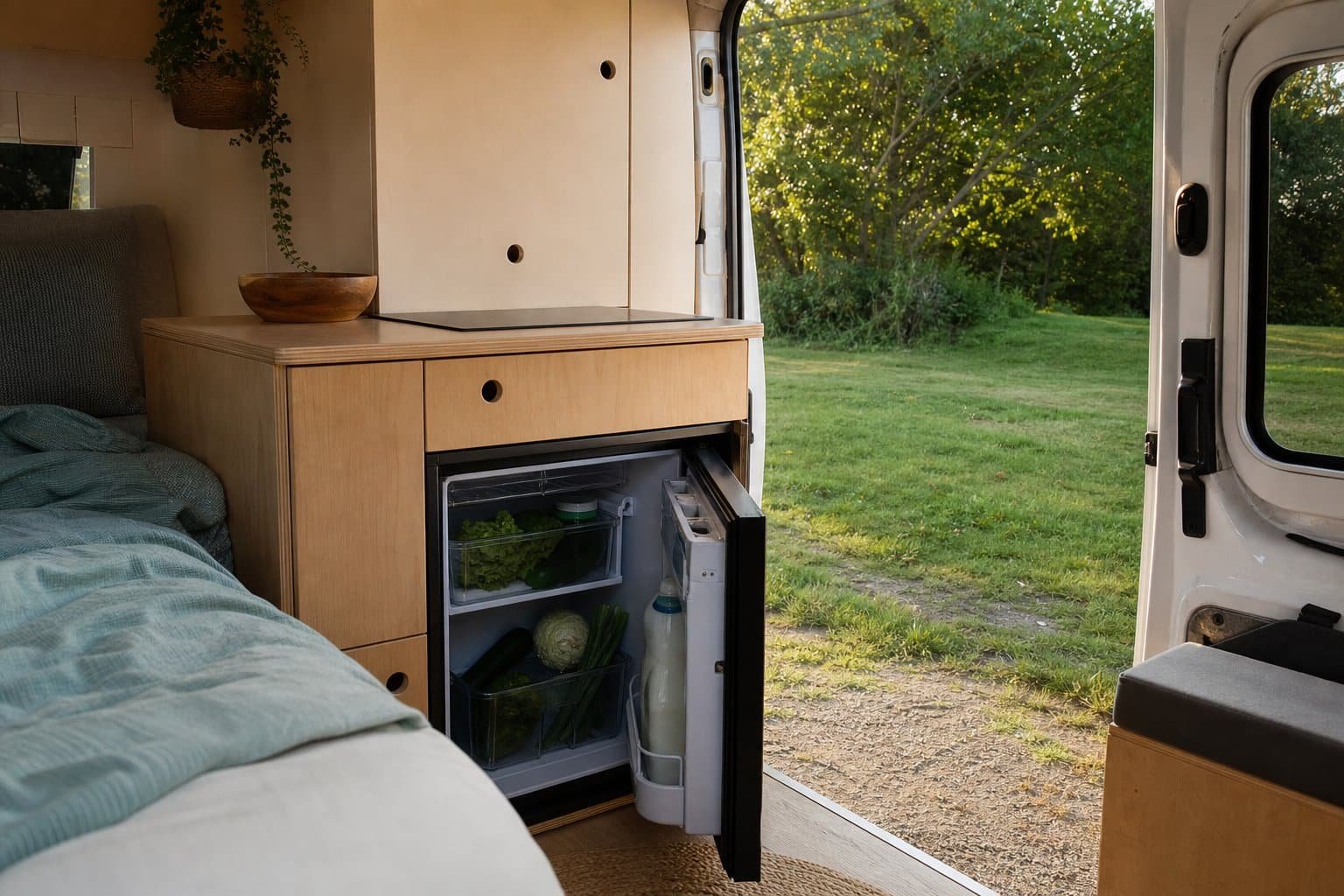
Best Camping Fridges for Campervans UK
A campervan fridge has to fit the van, run from a leisure battery and survive the road. Our top built-in pick is the Dometic NRX 50E, while the ICECO JP40 Pro is the best portable fridge for tight van layouts.
We compare built-in, chest and drawer fridges for van conversions and motorhomes, and explain compressor vs absorption, wiring, ventilation and how much battery and solar you need.
- Pick the fridge type before the brand
- Wire it to the leisure battery with heavy, fused cable
- Leave an air gap and a high vent for the compressor
- Best built-in: Dometic NRX 50E Front-opening, DC only, with Eco, Boost and Silent modes.
- Best portable: ICECO JP40 Pro SECOP compressor and a lid that opens from either side.
- Best motorhome brand: Truma C44 43 litres usable, freezes to -22°C, tie-down handles.
- Best drawer fridge: DEAPRULL D31A Slides out from under a bed or worktop.
A campervan fridge has a harder job than a camping fridge in a car boot. It lives in the van all year, runs off a leisure battery for days at a time, and has to fit a cabinet, a bed platform or a gap beside a seat. We’ve already covered family camping fridges, budget compressor fridges under £200 and 12V electric cool boxes, so this guide looks at the fridges and fitting choices that suit a van conversion.
Below we compare six options: two front-opening built-in fridges, a drawer fridge and three portable chest fridges that work well on a slide or tie-down. We also explain compressor vs absorption, how to wire and vent a van fridge, how much battery and solar you need, and the problems owners most often run into.
All six fridges are listed on Amazon US, where prices change often, so we haven’t quoted them. US listings give sizes in quarts; one quart is just under a litre, and we’ve converted them throughout. Where a listing doesn’t state a spec, we say so rather than guess.


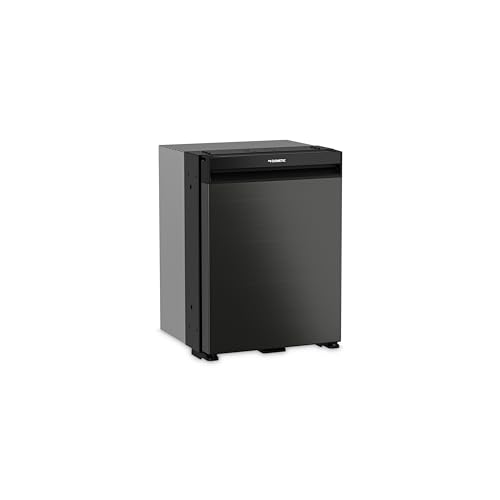

Built-in pick NRX 50E | Portable pick ICECO JP40 | Truma pick Truma C44 | Drawer pick Deaprull | |
|---|---|---|---|---|
|
|
|
|
| |
| Type | Built-in, front door | Portable chest | Portable chest | Drawer |
| Capacity | 50 L | 40 qt (~38 L) | 43 L usable | 31.5 L |
| Lowest temperature | Not quoted | -20°C | -22°C | -20°C |
| Power | DC only | 12/24V + 110–240V | 12/24V + 110V | 12/24V DC |
| Access | Front door | Lid, either side | Top lid | Slide-out drawer |
| Warranty | Not quoted | 1 yr parts, 5 yr compressor support | 1 yr + 1 yr on registration | 1 year |
| Check price | Check price | Check price | Check price |
Our campervan fridge reviews
Each review covers the type of fit, capacity, power and warranty, plus what we’d check before buying. We’ve avoided fridges already featured in our other fridge guides.
50-litre front-opening compressor refrigerator/freezer from Dometic’s NRX range, Economy version, DC only. Three operating modes (Eco, Boost and Silent), integrated LED light bar, full-width handle and a frameless door. Dual-function locks double as vents so the door can be left ajar for storage. Ships without the flange frame, which is sold separately in black or stainless steel. Dimensions, weight, freezer size and warranty length are not quoted on the listing.
If you’re fitting out a van and want a fridge that looks and works like a kitchen appliance, the Dometic NRX 50E is our pick. It’s a front-opening compressor fridge that slots into a cabinet, so you reach food from the front instead of lifting a lid, and the worktop above stays free for cooking. Dometic is the brand most UK converters already know, and the NRX range replaced the long-running CRX fridges that many older vans use.
This Economy version runs on DC only, which is exactly what a campervan fridge should do: it wires straight to the leisure battery through a fused, switched feed. Eco, Boost and Silent modes let you trade cooling speed against power and noise at night. The catch is that the listing is thin. It doesn’t give the outer size, weight or warranty, and the mounting frame costs extra, so check Dometic’s installation sheet for the cut-out before you build the cabinet.
- Front door keeps the worktop free
- DC only, made for leisure batteries
- Eco, Boost and Silent modes
- Vent-lock so the door can stay ajar in storage
- Mounting frame sold separately
- Size, weight and warranty not on the listing
- Needs a cabinet, wiring and ventilation
40 qt (about 38 L) single-zone portable compressor fridge freezer with a SECOP compressor, -4°F to 68°F (-20°C to 20°C). MAX and ECO modes, runs at up to 40° tilt. Lid opens from either side or lifts off completely. 12/24V DC and 110–240V AC ports, wheels and trolley handle, free insulated cover. 5-year tech support on the compressor and 1 year on other parts. Weight and outer size not quoted on the listing; ICECO sells a matching slide mount separately.
A portable chest fridge is the simplest campervan fridge to fit: strap it down or bolt on a slide, run a 12V socket to it and you’re done. The ICECO JP40 Pro stands out for van use because its lid opens from either side or comes off completely, so it still works when it’s tucked beside a seat base or under a bed platform where a single hinge would hit something.
It uses a SECOP compressor, a respected European brand, and ICECO says it keeps working at up to 40° of tilt, so a sloping lay-by won’t stop it. You get both a 12/24V lead and a 110–240V AC cable, wheels for lifting it out on to the pitch, and an insulated cover that helps in a hot van. The listing doesn’t quote the weight or outer size, so measure carefully, and remember the slide mount is an extra.
- Lid opens either side or lifts off
- SECOP compressor, works at 40° tilt
- 12/24V DC and 110–240V AC included
- Insulated cover in the box
- Weight and outer size not quoted
- Slide mount costs extra
- Single zone only
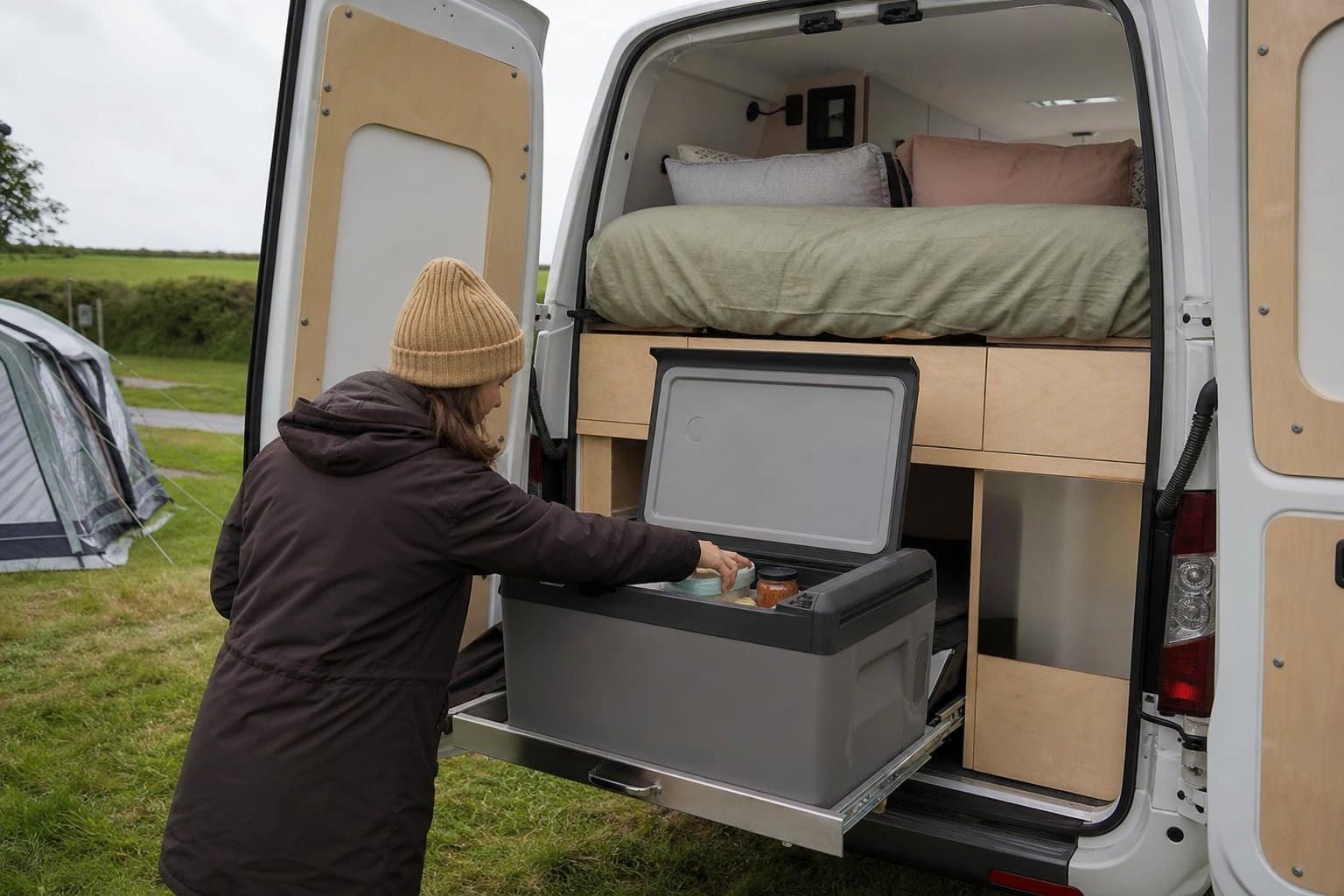
46 qt / 11.5 gal (Truma: 43 L usable) single-zone compressor cooler, -8°F to 50°F (-22°C to 10°C). Digital display and app control, LED interior light, removable basket, room for upright bottles, USB charging port, built-in drain, flat carry and tie-down handles. 12/24V DC and 110V AC (listing). Truma quotes 23.4 kg and 652 x 412 x 488 mm. Warranty 1 year standard plus a 1-year extension after registration.
Truma is a household name in UK caravans and motorhomes thanks to its heaters, and its Cooler range brings that support network to portable fridges. The C44 holds 43 litres usable, takes upright bottles and goes down to -22°C, so it can work as a deep freezer on a long trip. Flat tie-down handles are a thoughtful touch for van use, because you can strap it to floor rails without the handles getting in the way.
The built-in drain makes cleaning easier, and there’s a USB port for charging a phone. Truma’s own FAQ says a 60 W solar panel is the minimum for this size. The downsides are weight, at 23.4 kg empty by Truma’s figure, and the fact that this US listing quotes a 110V AC lead, so UK owners should plan to run it on 12V or buy the correct mains lead.
- Freezes to -22°C
- Tie-down handles and built-in drain
- App control and USB port
- Warranty extends to 2 years on registration
- Heavy at 23.4 kg (Truma figure)
- AC lead listed as 110V
- Top-opening lid needs headroom
31.5-litre (33 qt) compressor drawer fridge freezer, -4°F to 68°F (-20°C to 20°C). Slide-out drawer, app control, cooling and freezing modes, three-level battery protection (High, Medium, Low). 12/24V DC power. 1-year manufacturer warranty. Outer size, weight and power draw are not clearly stated on the listing.
A drawer fridge is the van builder’s favourite, because it slides out from under a bed platform or kitchen unit and you never have to clear the worktop to get the milk. Branded drawer fridges cost a lot, so the DEAPRULL D31A is a budget way in: 31.5 litres, compressor cooling down to -20°C and an app for setting the temperature without crouching down.
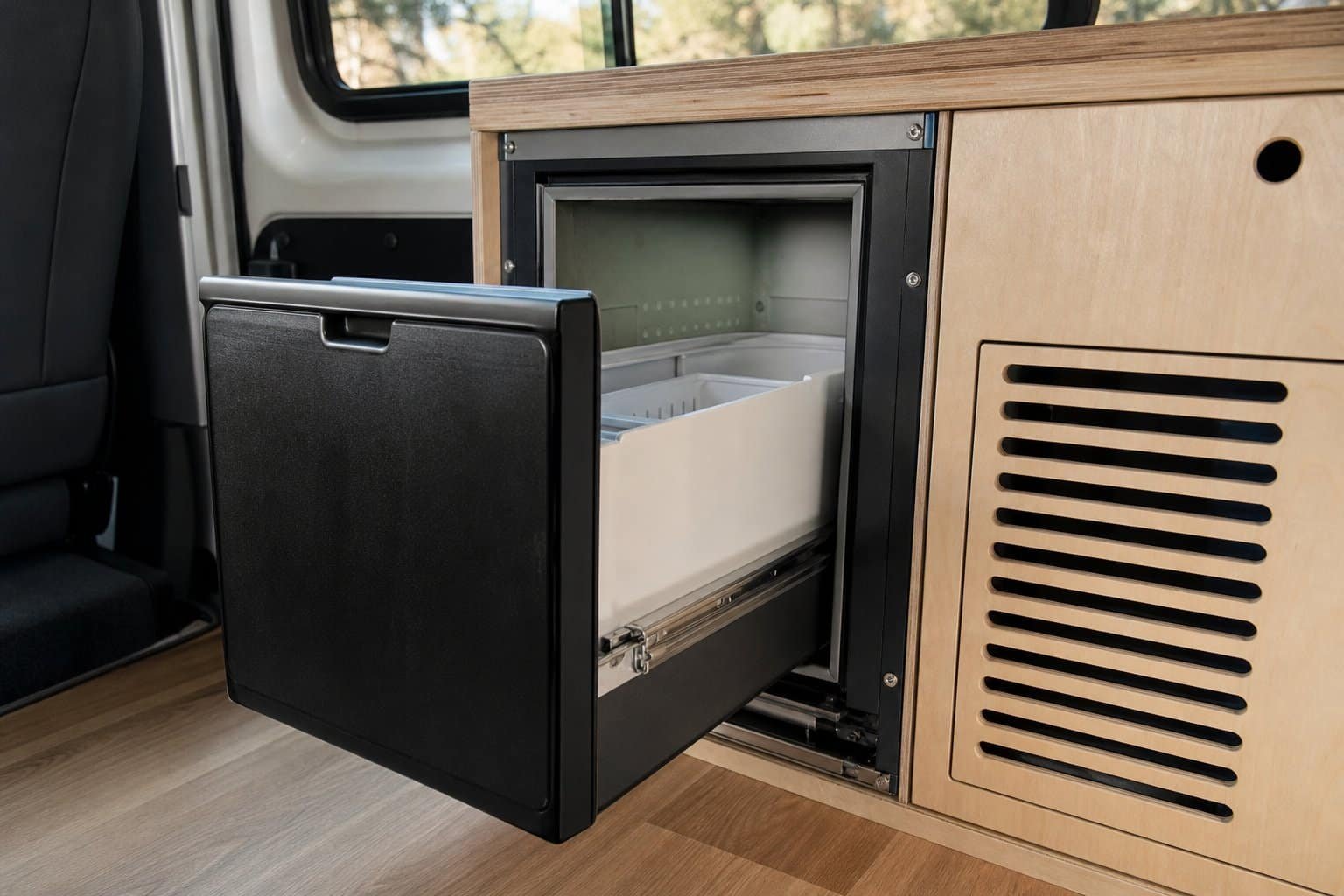
It’s 12/24V DC only, which suits a leisure battery, and it has three-level battery protection. Be aware that the listing text is partly garbled and doesn’t give the outer size or weight, so ask the seller for dimensions before you build around it. Drawer fridges are also the hardest type to install, because they need a solid frame and a clear path for warm air out of the back.
- Slide-out drawer, no lid to lift
- Freezes to -20°C
- App control
- Three-level battery protection
- Size and weight not clearly quoted
- Listing text partly garbled
- Needs a solid, ventilated frame
34-litre (1.2 cu ft) front-opening compressor refrigerator with no freezer compartment. Compressor adapts to ambient temperature; Dometic claims over 18% energy savings versus previous models. 5 temperature settings and 4 operating modes, side and front-edge LED lighting, vent-mode lock, top and bottom latches. Flush or extended mounting (universal frame sold separately). Voltage, size and warranty length not stated on the listing.
Many couples never use the little freezer box in a van fridge, and it eats space and power. The Dometic NRX35-E skips it: all 34 litres are fridge, which is plenty for milk, cheese, meat and a few drinks on a long weekend. Its compressor adjusts to the temperature around it, and Dometic claims more than 18% energy savings over the previous models.
It has latches top and bottom, which matters on bumpy roads, plus a vent mode that holds the door slightly open when the van is laid up. Like the NRX 50E, the frame is extra and the listing doesn’t state the voltage or size, so confirm both with the seller before you order.
- All the space is fridge
- Top and bottom latches
- Vent mode for storage
- Compact for small vans
- No freezer at all
- Voltage, size and warranty not on the listing
- Frame sold separately
37-litre portable compressor fridge freezer, holds up to 48 cans or 4 x 1.5 L bottles, -7°F to 68°F (-22°C to 20°C). 3-stage battery protection, Bluetooth app control, 12/24V DC and 100–240V AC power, no internal battery. 2-year warranty. Weight and outer size not quoted on the listing.
If you’d rather have a portable fridge but want a Dometic badge, the CFX2 37L is the size most campervan owners go for. It holds 4 x 1.5 litre bottles upright, freezes to -22°C and has three-stage battery protection that watches the battery and switches off before it runs flat.
Unlike several US listings, this one quotes 100–240V AC as well as 12/24V DC, so it will work on a UK hook-up with the correct mains lead. It’s expensive for its size, and the listing doesn’t give the weight or outer dimensions, but the 2-year warranty and Dometic’s UK service network are a reassurance.
- Freezes to -22°C
- 100–240V AC and 12/24V DC
- 3-stage battery protection
- 2-year warranty
- Pricey for 37 litres
- Weight and size not quoted
- Single zone
Built-in, chest or drawer: choosing a campervan fridge type
The first decision isn’t the brand, it’s the shape. There are three ways to put a campervan fridge in a van, and each changes how you build the rest of the kitchen.
A built-in front-opening fridge, like the Dometic NRX range, sits in a cabinet with its door facing you. It looks tidy, keeps the worktop free and is the easiest to reach while standing in a small van. The downsides are cost, the need for a cabinet and frame, and the fact that cold air spills out every time you open the door, because cold air sinks.
A portable chest fridge, like the ICECO JP40 Pro or Truma C44, is the simplest to fit and the most flexible. You can lift it out on to the pitch or into the car for a weekend away from the van. The van build site Always the Adventure points out that a chest can double as a seat and nothing falls out when you open it, but you need space above the lid and digging for food at the bottom gets old.
A drawer fridge slides out from under a bed or worktop. It gives the best of both worlds once it’s in, but the same source calls drawer models the most difficult to install and among the most expensive. If you’re new to van building, a chest fridge on a slide is a good middle ground.
Compressor vs absorption: which motorhome fridge technology?
Older motorhomes and caravans often have a three-way absorption fridge that runs on gas, 230V or 12V. Almost every new campervan fridge is a 12V compressor fridge instead, and there are good reasons for that.
Thetford, which makes both types, says an absorption fridge must stay level, with less than 2.5° of tilt, while a compressor fridge works at any angle. Thetford also says a compressor model cools down in under two hours, where absorption needs several hours of pre-cooling. On the other hand, absorption is silent and a compressor is quiet but not silent, which is why many compressor fridges have a night or silent mode.
The bigger issue is power on the move. The Caravan Club notes that modern smart alternators can cut their output, so a 12V absorption fridge may stop working while you drive, and says a compressor fridge is the better choice if you need cooling on the road. A compressor fridge running from a leisure battery doesn’t care what the alternator is doing.
Absorption still makes sense if you already have one that works, or if you rely on gas for long stays without hook-ups. For a new van conversion, though, a compressor campervan fridge is the sensible default.
What size campervan fridge do you need?
Van space is precious, so it’s tempting to fit the biggest campervan fridge the cabinet will take. A fridge that’s half empty works harder, though, because it has more air to cool every time you open it, and a bigger box draws more power across the day.
As a rough guide, 30–40 litres suits a couple on weekend trips, and 40–50 litres suits a couple on longer tours or a small family. If you mostly stay on campsites with shops nearby, the smaller end is plenty. If you wild camp for a week or more, size up and consider a freezer section.
Decide whether you need a freezer at all. The little freezer box in a front-opening van fridge is handy for ice cubes and an ice pack, but it isn’t a proper freezer, and switching it off saves power. Thetford claims switching off the freezer compartment can save up to 45% of the energy on its models. If you never use it, a fridge-only model such as the Dometic NRX35-E gives all its space to chilled food.
Measure the outside as well as the inside. Compressor fridges need room for the compressor at the back or base, plus an air gap around it. Several of the listings in this guide don’t quote outer dimensions, so get the installation sheet from the maker or seller before you cut any cabinet.
Powering a van fridge: leisure battery, solar and hook-up
A campervan fridge should run from the leisure battery, not the starter battery. Wire it on its own fused, switched circuit straight from the battery or fuse box. UK motorhome owners on MotorhomeFun recommend heavy 12V cable, around 4–6 mm², because a compressor draws a spike when it starts and thin cable causes voltage drop that trips the fridge’s low-voltage cut-out.
Don’t use a feed that only works when the engine runs. Owners on the same forum warn that relying on an ignition-switched supply is not enough. The fridge needs a permanent feed from the leisure battery, with the battery charged by a DC-DC charger while you drive, solar when parked and a mains charger on hook-up.
How much power will it use? It depends on size, insulation and weather. US retailer Defender lists Dometic’s NRX 50 at 0.22 kWh per 24 hours, which by our arithmetic is about 18 Ah a day at 12V before losses. One MotorhomeFun owner reported a compressor fridge using about 12 Ah overnight in hot weather. Plan for roughly 20–40 Ah a day for a 40–50 litre fridge in a UK summer, and more in a heatwave.
Solar makes a big difference for a van fridge. Truma’s FAQ gives 60 W of solar as the minimum for its C44, and that’s a sensible floor for a small fridge. Most van owners fit 100–200 W on the roof so the panel covers the fridge plus lights and phone charging. See our guide to solar power systems for campers for panel sizing, and our portable power station guide if you’d rather not wire anything permanent.
On a hook-up, a mains battery charger keeps the leisure battery topped up and the fridge carries on running from 12V. Portable fridges can also plug straight into the mains, but check the adapter. Several US listings, including the Truma C44 here, quote a 110V lead, so UK owners need a 230V-rated lead or should stay on 12V. For more on charging gadgets off-grid, see how to power devices while camping.
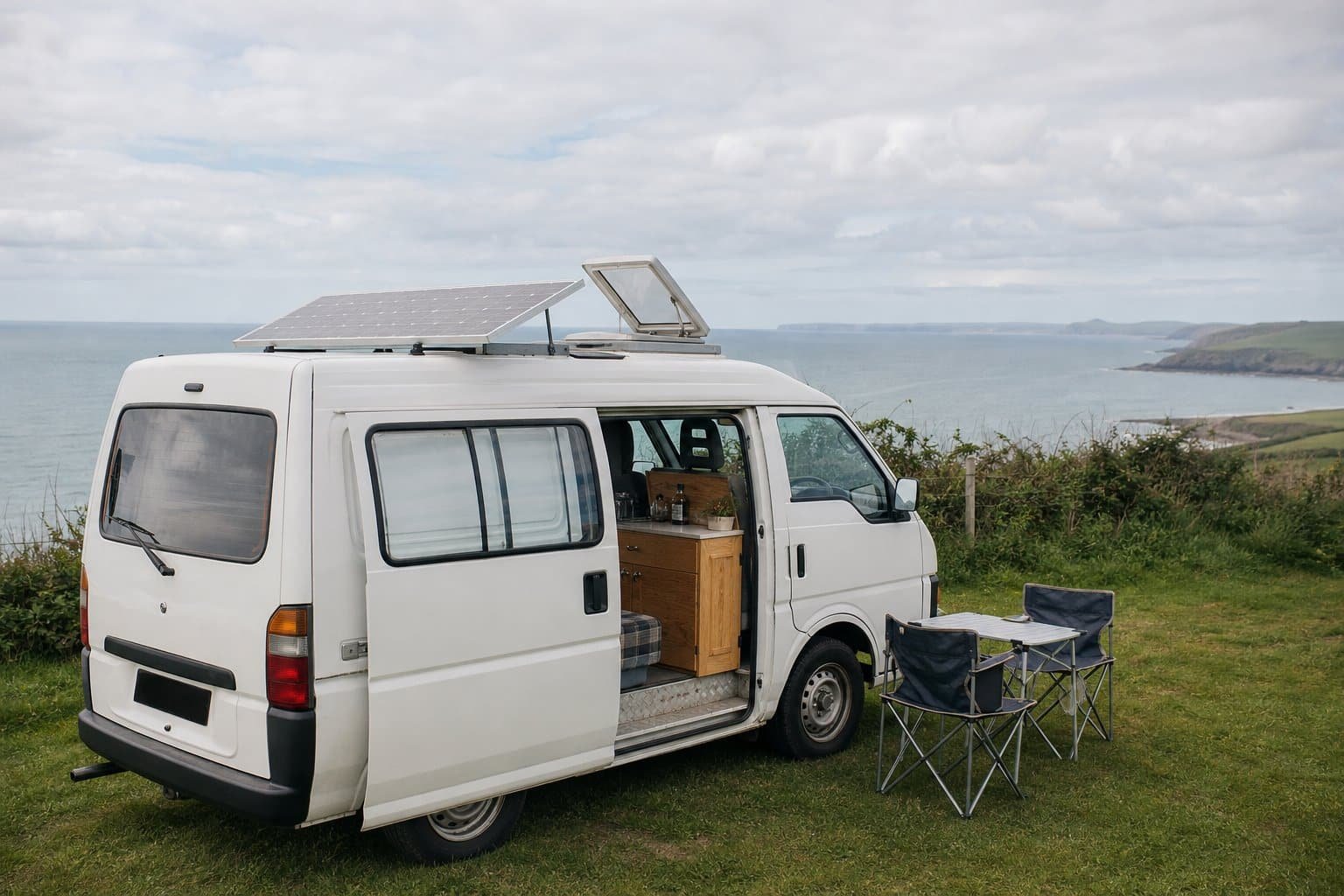
Fitting and ventilating a campervan fridge
A campervan fridge with a compressor pushes heat out through its condenser, and if that heat has nowhere to go the fridge runs longer, draws more power and wears out sooner. Thetford says compressor fridges don’t need external wall vents like absorption models, but that doesn’t mean they need no airflow.
UK owners discussing a Dometic CRX on MotorhomeFun say any extra ventilation helps, quote the manual’s guidance of a free-flowing air gap of around 75 mm, and suggest venting high up, because warm air rises. One owner’s simple test is to run the fridge and feel the liquid line or condenser: if it’s too hot to touch, the cabinet needs more air.
For a built-in campervan fridge, leave the gaps the maker asks for, add a low vent below and a high vent above the compressor, and don’t pack bedding or bags into the space around it. For a chest fridge on a slide, leave the vent side clear of the van wall and don’t cover it with a coat. Thetford’s own tip is never to block the vents, for example with an awning.
Secure the campervan fridge properly. A loose 20 kg fridge is dangerous in an emergency stop. Bolt a built-in fridge to its cabinet, use a proper slide or tie-down straps to floor rails for a chest fridge, and make sure the door or lid can’t fly open on a bend. The latches top and bottom on the NRX35-E and the tie-down handles on the Truma C44 are worth having for exactly this reason.
Matching a campervan fridge to your van size
In a small van such as a VW Transporter or a compact day van, space decides everything. A 30–40 litre chest fridge on a slide, or a slim fridge-only unit like the NRX35-E, leaves room for a bed and seating. Many small-van owners keep the campervan fridge portable so they can take it out when the van is used for the school run.
Medium vans such as long-wheelbase panel vans have room for a proper kitchen unit, and this is where a built-in campervan fridge like the NRX 50E makes sense. Put it at the end of the kitchen run near the sliding door, so you can reach it from inside or from the pitch, and keep it away from the hob and heater outlets.
In a large van or small motorhome, you may have space for both a built-in fridge and a portable chest fridge used as a freezer or drinks box. That combination works well for long tours: the built-in fridge handles daily food and the chest freezes meat and ice packs. Just make sure the battery and solar can cover both.
Whatever the van, think about the lid or door direction. A front door should open towards the living space, a drawer needs a clear path to pull out fully, and a chest lid needs headroom. A campervan fridge that’s awkward to open soon becomes the most annoying thing in the van.
Campervan fridge running costs
Once fitted, a campervan fridge costs almost nothing to run on solar, and very little on hook-up. If a 50 litre fridge uses around 0.22–0.5 kWh a day, that’s only a few pence a day at typical UK electricity prices, and many campsite pitches include electricity in the fee.
The real cost is the power system around it: a leisure battery, a DC-DC charger, a solar panel and controller, and the cable, fuses and switch. For a lot of van owners, the electrics cost as much as the fridge. Budget for them from the start, rather than buying the fridge first and discovering the battery can’t keep up.
A van fridge on the road and on the pitch
Turn the campervan fridge on the night before a trip, ideally on hook-up or with the leisure battery on charge, and load food that’s already cold from the house fridge. Cooling warm food from scratch is the hardest work a fridge does.
On the drive, a DC-DC charger keeps the leisure battery topped up, so the fridge can run on its normal setting. Once parked, park so the fridge side of the van is in shade where you can, open a roof vent to let hot air out, and keep the fridge out of direct sun through the windows.
Open the campervan fridge door or lid as little as possible. Decide what you want before you open it, keep drinks in one place and use baskets so you can lift everything out at once. Read our guide to storing food while camping for more on packing food safely.
Put a cheap fridge thermometer inside. Displays on some fridges read a few degrees out, and the real temperature is what matters for food safety. Aim for about 3–5°C in the fridge section.
Common motorhome fridge problems and fixes
The campervan fridge cuts out while driving or overnight. This is usually the low-voltage protection doing its job. Check the battery voltage, the cable size and the connections. Thin cable or a loose crimp can drop the voltage enough to trip the cut-out even when the battery is fine. Setting a lower cut-out level helps on a leisure battery, but keep a high setting if the fridge is ever on the starter battery.
It runs all the time and never seems cold. The usual causes are poor ventilation, a door seal that doesn’t close properly, or a fridge loaded with warm food. Feel the condenser; if it’s very hot, improve the airflow. Close the door on a slip of paper; if it pulls out easily, the seal needs attention.
Condensation and mould. Moisture inside a campervan fridge is normal, especially in a damp UK autumn. Wipe it out regularly and keep food in sealed boxes. When the van is laid up, leave the door ajar. The vent-lock positions on the Dometic NRX models do this for you.
Noise at night. A compressor hums and clicks as it cycles. Use the fridge’s silent or night mode if it has one, and make sure the fridge isn’t touching the van wall or cabinet, which can turn a quiet hum into a rattle.
Buying a campervan fridge in the UK
The fridges in this guide are listed on Amazon US, so the listings use quarts, Fahrenheit and US plugs. For a campervan fridge that’s less of a problem than for other appliances, because the main power source is 12V DC from the leisure battery, which is the same worldwide.
Check three things before you order. First, the voltage: DC-only models such as the NRX 50E are ideal for a van, while portable models need a 230V-rated mains lead if you want to plug them in on hook-up. Second, the warranty and who handles it: Dometic and Truma both have UK service networks, while smaller brands may mean sending the fridge abroad. Third, the size and weight, which several listings leave out.
If you’re converting a van that will be insured or sold as a campervan, keep the paperwork for the fridge and its wiring. A tidy, fused installation is part of a safe conversion, and a professional auto electrician can check your work if you’re unsure.
Which campervan fridge should you buy?
For a full conversion, the Dometic NRX 50E is the campervan fridge we’d choose: it’s front-opening, DC only and from the brand most UK van builders already use. If your van is small and you don’t need a freezer, the NRX35-E gives you a compact fridge-only option.
If you’d rather keep the fridge portable, the ICECO JP40 Pro is the best fit for tight van layouts thanks to its lid that opens either side. The Truma C44 is the one to pick if you want deep freezing and a motorhome brand, and the Dometic CFX2 37L suits owners who want 100–240V AC and a 2-year warranty. Choose the DEAPRULL drawer fridge if you’re building under a bed or worktop on a budget.
Final thoughts
The best campervan fridge is the one that suits how you build and use your van, not just the biggest or most expensive. Pick the type first, size it for real trips, wire it properly to the leisure battery and give it room to breathe, and almost any compressor fridge in this guide will keep food cold for years. For the rest of the kitchen, see our camping kitchen unit and camping fridge freezer guides, and our camping essentials list so nothing gets left at home.
Campervan fridge myths
It needs no outside wall vents, but it still needs an air gap and somewhere for warm air to go.
Smart alternators can cut output, so it may stop. A compressor fridge on the leisure battery is more reliable.
That’s true of absorption fridges. Compressor fridges work on a slope.
Yes. Thetford claims up to 45% on its models.
What to look for in a campervan fridge
Built-in for a full conversion, chest for flexibility, drawer for under-bed builds.
Works on a slope and from the leisure battery while you drive.
30–40 L for a couple on weekends, 40–50 L for longer tours.
A low-voltage cut-out you can set for a leisure battery.
Latches, tie-down points or a slide so it can’t move on the road.
A brand with a UK service network makes repairs easier.
How to fit a campervan fridge
- Get the install sheet
Check the cut-out size, air gaps and cable size before building.
- Run a dedicated feed
Use 4–6 mm² cable, fused and switched, from the leisure battery.
- Ventilate
Leave the air gap, add a low and a high vent, and keep it clear.
- Fix it down
Bolt it in, or use a slide or tie-downs for a chest fridge.
- Test it
Run it for a day with a thermometer and feel the condenser for heat.
How we chose these campervan fridges
We have not tested every fridge in this list ourselves. Our picks are based on the Amazon listings, maker and retailer spec pages (Truma, Defender), Thetford’s and the Caravan Club’s technical guidance, and UK owner forums such as MotorhomeFun. Where a listing didn’t state a spec, we said so rather than guessing.
-
Van fit
We looked for built-in, drawer and portable fridges that suit a van layout.
-
Compressor only
Every pick works on a slope and from a leisure battery.
-
Power and protection
We checked DC and AC options and battery protection.
-
No repeats
We avoided fridges already covered in our family, budget and fridge freezer guides.
What is the best campervan fridge?
For a full conversion, the Dometic NRX 50E: front-opening, DC only and from a brand most UK van builders know. For a portable option, the ICECO JP40 Pro.
Is a compressor or absorption fridge better for a campervan?
For most new conversions, a compressor fridge. It works on a slope, cools quickly and runs reliably from a leisure battery. Absorption is silent and can run on gas, but must be level.
How much battery does a campervan fridge use?
Roughly 20–40 Ah a day for a 40–50 litre fridge in a UK summer, more in hot weather. Defender lists the Dometic NRX 50 at 0.22 kWh per day.
How much solar do I need for a van fridge?
Truma gives 60 W as the minimum for its C44. Most van owners fit 100–200 W to cover the fridge and other loads.
Does a 12V compressor fridge need vents?
It doesn’t need external wall vents like an absorption fridge, but it does need an air gap and a path for warm air out of the cabinet.
Can I run a campervan fridge from the starter battery?
Only briefly, with the battery protection on its highest setting. A leisure battery charged by a DC-DC charger is the proper solution.
More camp kitchen guides
Still deciding? See our family camping fridges, our budget camping fridges, our electric cool boxes, our camping fridge freezer guide and our portable camping kitchens.
Which campervan fridge should you buy?
- Best built-in: Dometic NRX 50E Built-In Compressor Fridge (50 L, DC only)
- Best portable: ICECO JP40 Pro 12V Portable Fridge Freezer (40 qt)
- Best motorhome brand: Truma Cooler C44 Single Zone Fridge Freezer (46 qt)
- Best drawer fridge: DEAPRULL D31A 12V Drawer Fridge Freezer (31.5 L)
- Best small built-in: Dometic NRX35-E Built-In Fridge (34 L, no freezer)
- Best premium portable: Dometic CFX2 37L 12V Portable Fridge Freezer
For a full van conversion, the Dometic NRX 50E is the best campervan fridge thanks to its front door, DC-only design and low-noise modes. Choose the ICECO JP40 Pro for a portable fridge in a tight van, the Truma C44 for deep freezing, the DEAPRULL D31A for an under-bed drawer, the NRX35-E for a small fridge-only build and the Dometic CFX2 37L for a premium portable.
CampEquipmentPlus relies on reader support. Purchases made via links on our website may earn us an affiliate commission at no extra cost to you, helping keep the site running.