

Best Electric Cool Boxes for Camping UK
A good electric cool box keeps food cool from your car's 12V socket or a hook-up, with no ice to buy. Our top pick is the Igloo IE24, while the Koolatron P25 offers the strongest cooling claim for the money.
Thermoelectric cool boxes are cheaper and simpler than compressor fridges, but they cool relative to the air around them and draw power all the time.
Below we compare six boxes, from a 6-litre personal cooler to a 43 qt roller for families, and explain how to get the best from them.
- Expect about 20°C below the outside air, not a fixed fridge temperature
- Don't run one all night from a car battery
- Pre-chill food and keep the vents clear
- Best overall: Igloo IE24 Upright 25 qt box with both 12V and mains leads, cools up to 20°C below ambient.
- Best value: Koolatron P25 Compact 24 L hard box with the strongest cooling claim here (22°C below ambient).
- Best for families: Igloo IE42 Roller 59-can capacity with wheels and a telescopic handle.
- Best compact: Wagan EL6206 6 L personal box that runs on 12V or 24V.
An electric cool box keeps food and drinks cool without ice by running from your car’s 12V socket or a campsite hook-up. It’s the simple, affordable middle ground between a passive hard cool box and a compressor camping fridge, and it suits weekend trips where you can keep it plugged in.
Below we compare six thermoelectric models, from a 6-litre personal box to a 43 qt roller for families. We explain how much cooling to expect on a British summer day, how much power they use, and the mistakes that leave you with warm milk and a flat car battery.
All six boxes are listed on Amazon US, where prices change often, so we haven’t quoted them. Each is a 12V thermoelectric (Peltier) cooler rather than a compressor fridge. We checked the listings in November 2026.


Best overall Igloo IE24 | Best value Koolatron P25 | Best for families Igloo IE42 | Budget wheels AooDen 35qt | |
|---|---|---|---|---|
|
|
|
|
| |
| Capacity | 25 qt / 32 cans | 26 qt / 31 cans | 43 qt / 59 cans | 35 qt / 40 cans |
| Cooling claim | 20°C below ambient | 22°C below ambient | 20°C below ambient | 17–19°C below |
| Leads included | 12V + AC | 12V only | 12V + AC | 12V + AC |
| Warms food | Yes, 58°C | Yes | Yes, 58°C | Yes, 60–63°C |
| Wheels | No | No | Yes | Yes |
| Warranty | Not quoted | 1 year | Not quoted | 12 months |
| Check price | Check price | Check price | Check price |
Our electric cool box reviews
Each review covers capacity, cooling claim, power leads and warranty, plus what testers and owners say about this type of 12V cool box.
Upright 25 qt (about 24 L) electric cool box: cools up to 36°F (20°C) below ambient without ice, heats to 136°F (58°C), Cool Riser feet lift the body off hot surfaces, lid-locking carry handle, built-in cord storage, holds 32 cans. 12V DC car lead and 100–240V AC lead both included (the AC plug is a US type). Warranty on the listing says “see manufacturer”; EU retailer Coolblue lists 3.8 kg and a 2-year warranty for the 24-litre IE24.
The Igloo IE24 is the electric cool box we would start with for car camping because it comes with both power leads in the box. You get a 12V lead for the car’s accessory socket and a 100–240V mains lead, so it can run from a campsite hook-up with only a UK plug adapter. Many rivals sell the mains adapter separately.
Igloo quotes cooling of up to 36°F (20°C) below the surrounding air, which is typical of thermoelectric boxes. OutdoorGearLab measured the same 36°F drop on Igloo’s older Iceless 40, so the claim is realistic, but it also means the IE24 can’t make warm food cold on a hot day. Pre-chill everything. The upright shape fits tall bottles and a footwell, the Cool Riser feet help airflow, and it doubles as a food warmer. The listing doesn’t quote weight or power draw.
- Both 12V and mains leads included
- Cools up to 20°C below ambient
- Upright shape fits tall bottles
- Also warms food to 58°C
- US-type mains plug needs a UK adapter
- No thermostat or battery protection quoted
- Weight and wattage not on the listing
Hard-sided 24 L (26 qt) thermoelectric cool box: cools to 40°F (22°C) below ambient, brushless fan motor, holds 31 cans and stands 2 L bottles upright, injection-moulded shell, stain-resistant interior, self-locking lid, carry handle and cord storage. 12V DC lead included; 110V AC adapter sold separately. 1-year warranty.
Koolatron has been making 12V coolers in North America for more than 30 years, and the P25 is its simple, compact hard box. The 24-litre interior takes 31 cans or 2-litre bottles standing up, and the self-locking lid stops it flipping open when you brake. It’s a good size for a weekend for two people.
Its claimed cooling of 40°F (22°C) below ambient is the best figure in this list, and Koolatron’s larger 45 qt model was the only thermoelectric box OutdoorGearLab tested that reached 40°F. The catch for UK campers is power: only the 12V lead comes in the box, so you’ll need a separate 230V-to-12V adapter for hook-up pitches. Testers also found Koolatron’s fans noisy, so don’t plan to sleep next to it.
- Strongest cooling claim here (22°C)
- Fits 2 L bottles upright
- Self-locking lid
- 1-year warranty
- Mains adapter sold separately
- Fan hum can be noticeable
- Weight not quoted
Large 43 qt (about 41 L) electric cool box on wheels: holds 59 cans, cools up to 36°F (20°C) below ambient, heats to 136°F (58°C), built-in wheels and a locking telescoping handle, Cool Riser feet. 12V DC and 100–240V AC leads included (US-type mains plug). Warranty “see manufacturer”; weight and wattage not quoted.
For a family of four, the IE42 Roller is the electric cool box we’d choose. It holds 59 cans, which is roughly double the IE24, and the wheels and telescopic handle mean you can roll it from the car to the awning instead of carrying a heavy box across the field.
It shares the IE24’s cooling claim, both power leads and the warming mode. Remember that a bigger box takes longer to cool, so it helps to load it with food that is already cold and to fill empty space with frozen water bottles. Check your boot first: a 43 qt box on wheels takes up a lot of room, and Igloo doesn’t quote the outside dimensions or weight on the listing.
- Big 59-can capacity
- Wheels and telescopic handle
- Both 12V and mains leads
- Cooling and warming modes
- Takes a lot of boot space
- Higher price
- Weight, size and wattage not quoted
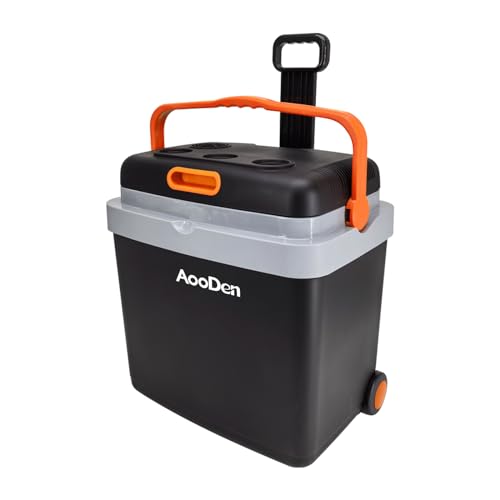
35 qt (33 L) thermoelectric cool box with draw bar and wheels: holds 40 x 12 oz cans, inner size 13.94 x 8.66 x 14.96 in (35 x 22 x 38 cm), cools 30–35°F (17–19°C) below ambient, warms to 140–145°F (60–63°C), removable lid and divider, 12V DC and 110V AC leads included. 12-month warranty. Wait 30 minutes before switching between cooling and warming.
The AooDen gives you wheels and a draw bar for less than Igloo’s roller. Its 33-litre interior holds about 40 cans, and AooDen quotes the inside dimensions (35 x 22 x 38 cm), which makes it easy to check that your food boxes and bottles will fit. A removable divider keeps drinks away from food.
AooDen is honest about cooling: 30–35°F (17–19°C) below ambient, a little less than Koolatron and Igloo claim. That is fine on a mild British day but means contents will only be cool, not fridge-cold, in a heatwave. Both leads are included, although the mains lead is built for US 110V sockets, so check the adapter’s input rating before you plug it into a UK hook-up.
- Wheels and draw bar
- Inside dimensions quoted
- Both power leads included
- 12-month warranty
- Weaker cooling claim (17–19°C)
- US mains lead
- Lesser-known brand
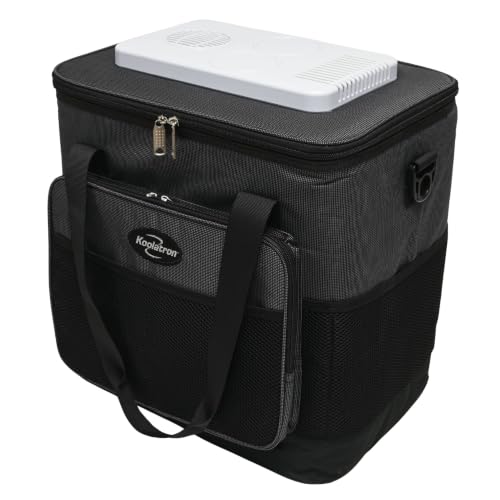
Soft-sided 25 L (26 qt) thermoelectric cool bag: cools to 40°F (22°C) below ambient, holds 23 cans, collapses when empty, multiple exterior pockets, cord storage, dual carry handles and adjustable shoulder strap. 12V DC lead included; 110V AC adapter sold separately. 1-year limited warranty.
If boot space is tight on the way home, the Koolatron D25 is the electric cool box to consider. It’s a soft bag with a 12V cooling unit, so it collapses when empty and is easier to carry on a shoulder strap than a hard box.
The trade-off is insulation. Soft sides hold cold for less time when the power is off, and the bag takes 23 cans against 31 in Koolatron’s hard P25 of the same quoted size. Use it for drinks and lunches on the drive, or as a second box. As with the P25, the mains adapter is extra.
- Collapses when empty
- Shoulder strap and pockets
- Strong 22°C cooling claim
- 1-year limited warranty
- Soft sides insulate less when unplugged
- Only 23 cans
- Mains adapter sold separately
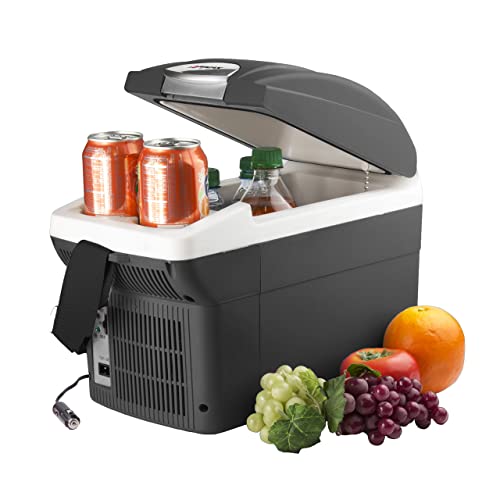
Personal 6 L electric cool box: cools about 36°F (20°C) below ambient, warms to about 140°F (60°C), runs on 12V or 24V DC, holds 9 x 12 oz cans, internal 8.1 x 5.3 x 8.1 in (21 x 13 x 21 cm), external 15 x 11 x 8 in (38 x 28 x 20 cm), carry strap, UL listed, no refrigerant. 1-year warranty.
The Wagan EL6206 is a small electric cool box for one person: lunch, medicines that need to stay cool, or a few drinks on the passenger seat. It runs on 12V or 24V, so it also suits vans and lorries, and the carry strap makes it easy to take into the tent.
Wagan advises pre-chilling or pre-heating your items so the unit can reach its lowest or highest temperature quickly, which applies to every box in this list. OutdoorGearLab tested Wagan’s larger 14-litre model and found it reached just over 36°F below ambient but warmed up quickly once switched off, so don’t expect it to hold its cold overnight without power.
- Small enough for a car seat
- 12V or 24V
- Quoted inside and outside sizes
- 1-year warranty
- Only 9 cans
- No mains lead included
- Small box warms quickly when unplugged
How an electric cool box works
Most electric cool boxes use a thermoelectric module, also called a Peltier plate. When current flows through it, one side gets cold and the other gets hot. A small fan blows air across a heat sink inside the box, while a second fan pushes the heat out through vents in the lid or side. There’s no gas, no compressor and almost nothing to wear out except the fans.
The key point is that a thermoelectric cool box cools relative to the air around it, not to a set temperature. Makers quote figures such as “36°F below ambient” (about 20°C). On a 20°C day that could mean around 0–5°C inside once the box has settled, but on a 30°C day in a hot car you may only get down to 10–13°C, as UK retailer Totalcool points out.
Flip the current and the plate heats instead, which is why most of these boxes double as food warmers. That’s handy for takeaway on the drive home, but never switch straight from cooling to warming. AooDen asks for a 30-minute rest between modes, and other makers give similar advice.
Electric cool box vs compressor fridge vs passive cool box
A passive cool box with ice packs costs least and needs no power, but it warms up day by day. Our guide on choosing the best cool box for camping covers how long ice lasts in different boxes. An electric cool box keeps going as long as it has power, so it suits a pitch with hook-up or a day of driving.
A compressor fridge works like a home fridge. It holds a set temperature whatever the weather, can freeze, and uses far less power because it cycles on and off. It also costs several times more. If you camp off-grid for a week or in hot weather, a compressor model is worth the money. For weekends in the UK with a hook-up, a 12V cool box does the job for much less.
The main weaknesses of an electric cool box are its steady power draw, its limited cooling in hot weather and fan noise. In our view it is the right tool for drives, day trips and powered pitches, and the wrong one for running all night from a car battery.
How to choose an electric cool box
Capacity
Capacities are quoted in quarts on US listings. One quart is just under a litre, so a 26 qt box is about 24–25 L. As a rough guide, 6–15 L suits one person’s lunch and drinks, 24–30 L suits a couple for a weekend, and 35–45 L suits a family of four. Can counts are a useful sanity check: Koolatron’s 24 L hard box holds 31 cans, while its soft bag of the same quoted size holds 23.
Also check whether 2-litre bottles stand upright. Upright boxes such as the Igloo IE24 and Koolatron P25 take tall bottles, which saves you laying milk on its side where it can leak.
Cooling performance
Compare the “below ambient” figure: 17–19°C is modest, 20°C is typical and 22°C is the best you’ll see from a thermoelectric box. OutdoorGearLab’s test of the Igloo Iceless 40 measured a 36°F (20°C) drop, matching Igloo’s claim, and found that the box couldn’t bring room-temperature items down quickly. Treat every electric cool box as a way to keep cold food cold, not a fast chiller.
Power leads and UK hook-ups
Every box here includes a 12V car lead. Only some include a mains lead, and the ones that do are made for US sockets. Igloo’s mains lead is rated 100–240V, so it should work on a UK hook-up with a plug adapter, but check the label on the power brick first. If the brick only says 110–120V, don’t use it on 230V. Buy a UK 230V-to-12V adapter rated for at least 5 A instead.
Power draw
A typical 12V cool box draws about 4–5 amps, or 45–65 watts, all the time it’s switched on. OutdoorGearLab measured 55 W on the Igloo Iceless 40 and 62 W on a Koolatron 45. Few budget models have a thermostat, so the fans and plate run constantly whether the box is full of ice-cold drinks or not.
Hard box, soft bag or roller
Hard boxes insulate better, protect food and can take a stacked bag on top. Soft bags fold away and are easier to carry but warm up faster when unplugged. Rollers with wheels and a handle make a full 40 qt box much easier to move across a field, at the cost of extra boot space.
Noise
An electric cool box hums because its fans never stop. OutdoorGearLab described one Koolatron as “very noisy” and the Igloo as “a bit noisy to sit next to”. In a small tent that can keep you awake, so keep the box in the awning, porch or car at night.
Warranty
Warranties on 12V cool boxes are short. Koolatron, Wagan and AooDen quote one year, while Igloo’s listings just say “see manufacturer”. Keep the receipt and test the box at home as soon as it arrives, so any fault shows up while you can still return it.
What can you keep in an electric cool box?
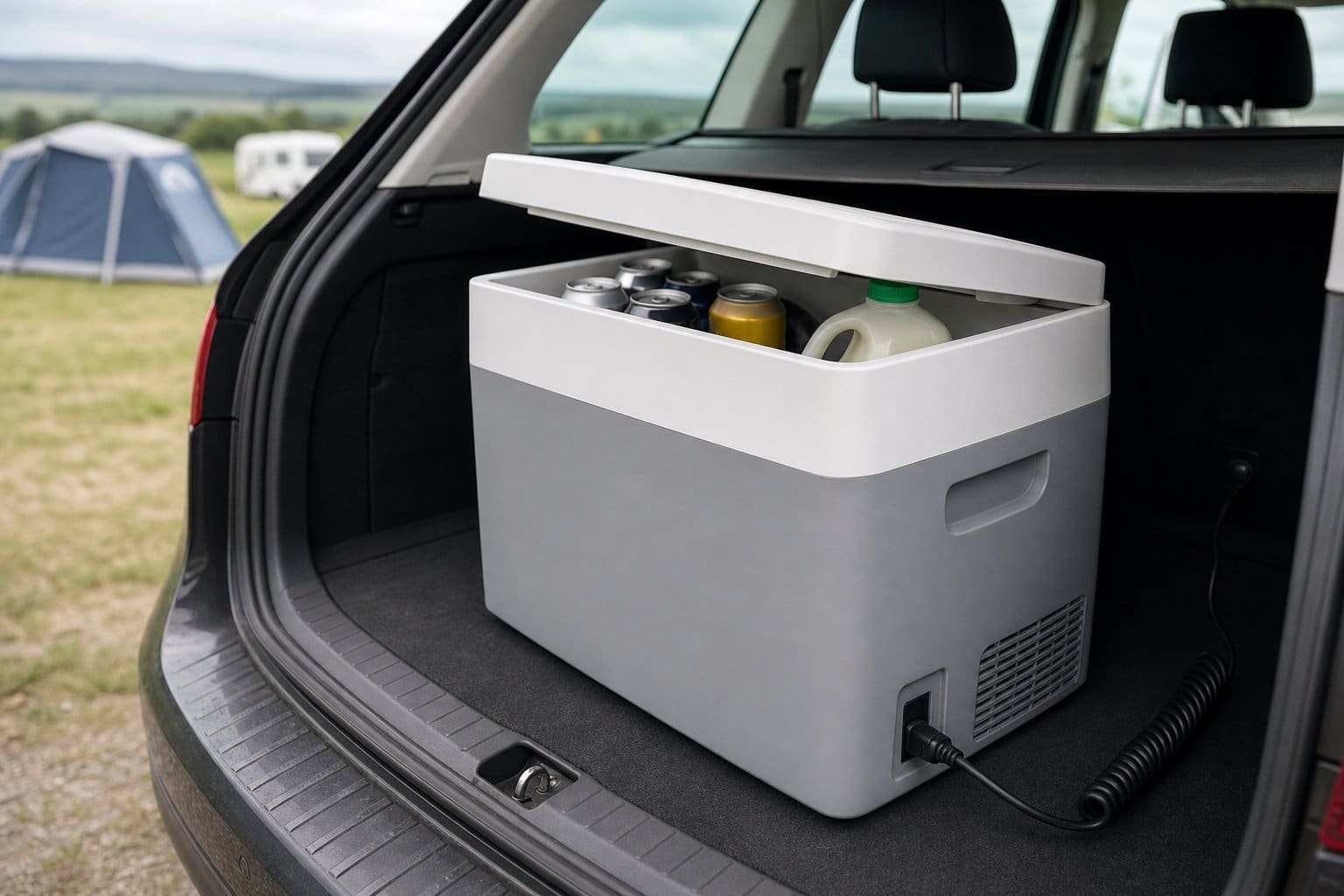
An electric cool box is ideal for the things that spoil quickly or taste better cold: milk, butter, cheese, yoghurt, cooked meats, salad and soft drinks. Raw meat and fish are fine for a day or two if they go in cold and the box stays plugged in, but plan to cook them early in the trip.
Hard vegetables, bread, tins and fruit don’t need cooling, so leave them in a camping cupboard or crate and save the space for food that does. Insulin and other medicines can go in a small electric cool box such as the Wagan, but check the storage range on the packet and use a thermometer, because a thermoelectric box can freeze on a cold night.
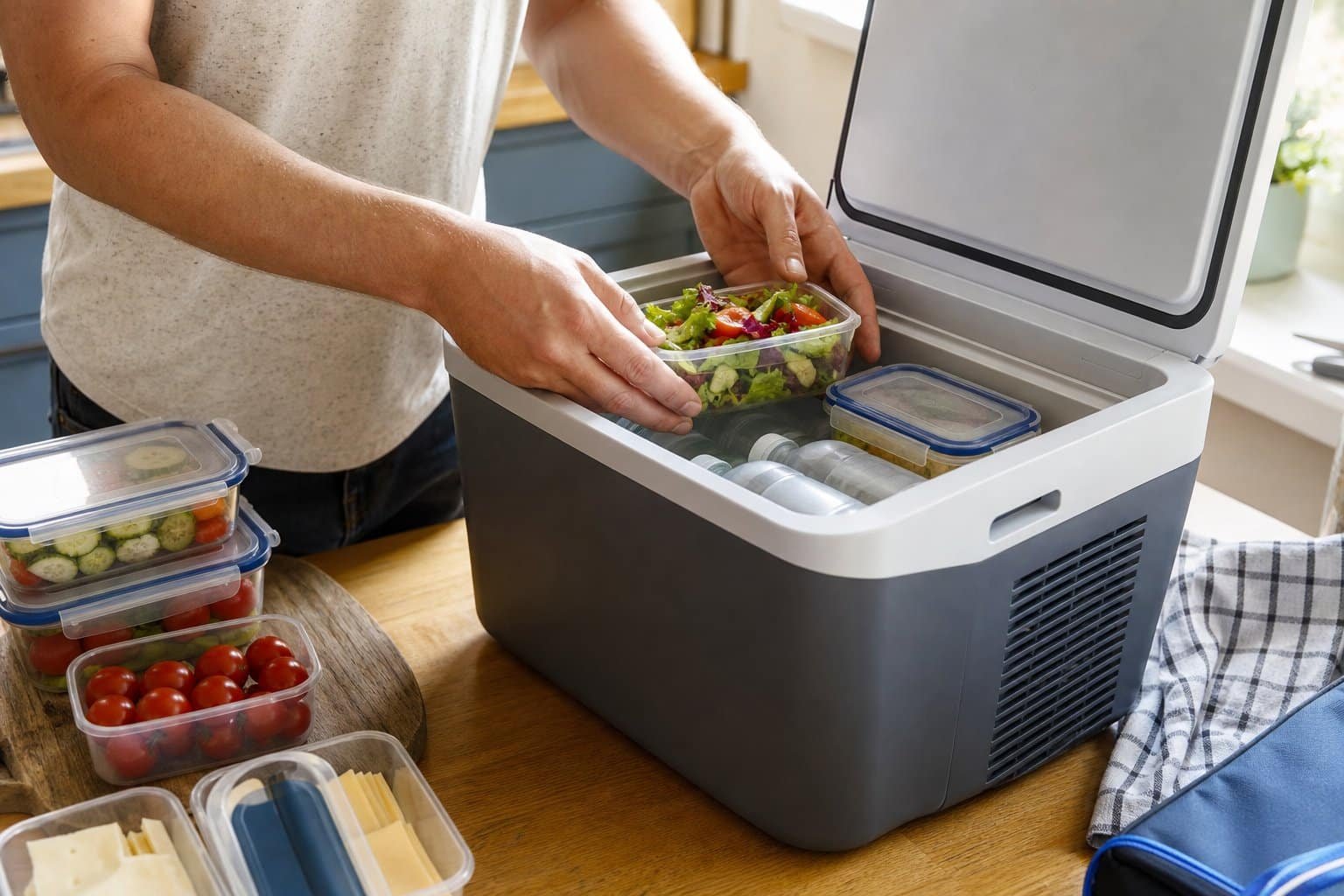
Avoid putting hot food straight in. Let leftovers cool first, then pack them in sealed boxes. Warm food makes the electric cool box work harder and raises the temperature of everything else inside.
Electric cool box running costs
Running an electric cool box on a hook-up costs very little. At about 50 W, it uses roughly 1.2 kWh a day if left on around the clock. Most UK campsites include electricity in the pitch fee, and even at home rates that’s well under the price of a bag of ice a day.
The bigger cost is buying ice or ice packs you no longer need, and food you don’t have to throw away. Over a summer of weekends, an electric cool box can pay for itself compared with buying ice every day, especially for families who go through a lot of milk and cold drinks.
How long can you run a 12V cool box from a car battery?
Not as long as most people expect. A box drawing 4.5 A uses about 36 amp-hours over an eight-hour night. That’s a large share of a typical car starter battery, which isn’t designed to be run flat. Igloo’s manual for the Iceless 40 limits use in a car with the engine off to two hours, and owners on UK forums report flat batteries after leaving a box on overnight.
Run the box while you drive, then switch it off or move it to mains power when you park. Some cars cut power to the 12V socket when the ignition is off, which protects the battery but stops the box. If yours keeps the socket live, set a reminder to unplug it.
For off-grid pitches, a portable power station is a better option. A 500 Wh unit could run a 50 W cool box for roughly eight hours (500 x 0.85 ÷ 50), and you can recharge it while driving or from a solar panel. Our guides to portable power stations, solar power systems for campers and powering devices while camping explain the sums in more detail.
Using an electric cool box on a campsite hook-up
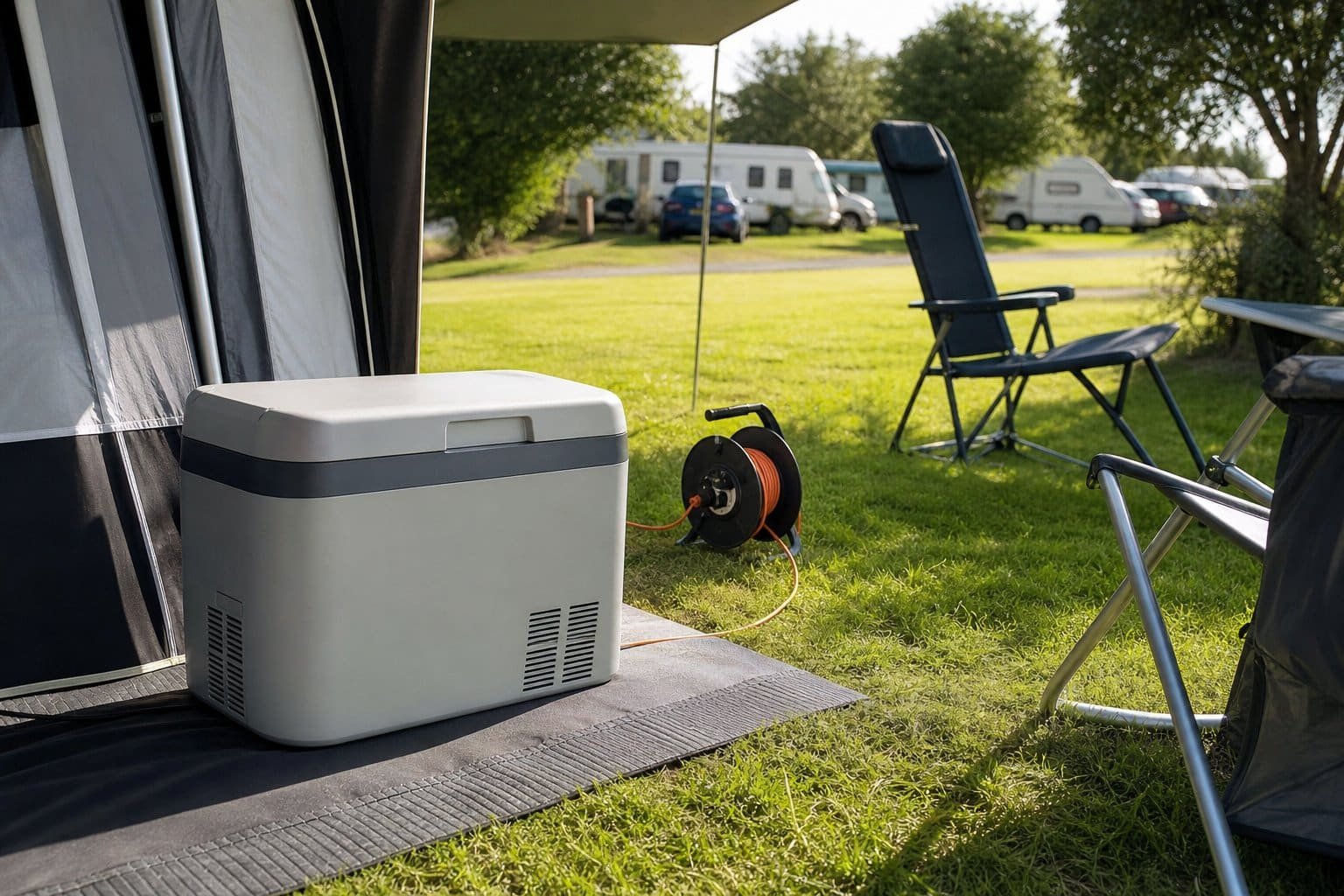
On an electric pitch, a 12V cool box is at its best. It draws well under half an amp at 230V, so it barely touches a typical 6–10 A campsite supply even with a kettle running. Use a proper outdoor hook-up lead and keep the adapter and box off wet grass, ideally under the awning or on a camping kitchen unit.
Leave space around the vents. The box has to push heat out, and if the hot side is pressed against a tent wall or buried under bags, cooling drops sharply. A gap of a hand’s width on each vented side is a sensible minimum. Keep it in the shade, because sun on the lid works directly against the cooling plate.
Getting the most from your electric cool box
Switch the electric cool box on the night before you leave and run it on mains so it’s already cold. Load it with food and drinks straight from the fridge, not from the cupboard. Freeze a few bottles of water and pack them in the gaps: they add cold, cut the air space and give you drinking water later.
Open the electric cool box lid as little as you can. Every opening lets cold air spill out, and a thermoelectric box takes a long time to recover. Keep drinks in a separate passive cool bag if people will be raiding it all day, and save the electric cool box for food.
Pack raw meat at the bottom in sealed boxes, away from ready-to-eat food. The Food Standards Agency advises keeping chilled food at 5°C or below. A cheap fridge thermometer inside the box tells you whether it’s actually reaching that, which it may not on a hot afternoon. Our guide to storing food while camping has more tips.
Common electric cool box problems and fixes
If your electric cool box isn’t getting cold, check the fuse in the 12V plug, make sure the plug is fully seated in the socket, and listen for both fans. A dead inside fan means cold air won’t circulate. Blocked vents and a hot car are the next most likely causes.
If the box freezes food on a cold night, that’s normal. Because it cools relative to the air, a box set to cool on a 5°C night can drop below freezing. Switch it off or put milk and salad at the top, away from the cold plate.
Condensation can pool at the bottom. Put a small rack or a folded tea towel under the food and wipe the box out each morning. If the box smells after warming food, wash it with mild soap and leave the lid open to dry. Koolatron warns against running its heat mode for long periods because it can damage the lining.
If the car battery keeps going flat, stop running the box with the engine off. A low-voltage cut-off, a power station or a hook-up pitch fixes the problem. There’s no setting that makes a thermoelectric box frugal enough for an all-night car battery.
Caring for a 12V cool box
Empty and dry the electric cool box after every trip and store it with the lid slightly open so it doesn’t go musty. Wipe dust out of the vents and fan grilles at the start of each season, because a clogged fan cuts cooling and makes more noise. Check the 12V lead for cracks and keep a spare fuse in the cord compartment.
Don’t use the box as a seat or a step, and don’t stack heavy bags on the lid while it’s running. Most of these boxes have plastic hinges and latches that crack under load, a complaint OutdoorGearLab raised about the Koolatron’s thin hinges.
Buying an electric cool box in the UK
The boxes in this guide are listed on Amazon US, so the listings use quarts, inches and Fahrenheit, and the mains leads have US plugs. As a quick conversion, 36°F below ambient equals 20°C, 40°F equals 22°C, and a quart is 0.95 litres. UK retailers stock similar 12V cool boxes from brands such as Campingaz, Dometic, Mobicool and Outwell, often with a UK 230V lead in the box.
Whichever you choose, look for the same things: a realistic cooling claim, both power leads or a clear note of what’s extra, a self-locking lid and a quoted warranty. If a listing promises fridge temperatures in any weather, or freezer performance, from a thermoelectric box, treat it with suspicion.
Which electric cool box suits your trip?
For a couple on a hook-up pitch, the Igloo IE24 is the easiest choice because both leads come in the box. For families, the Igloo IE42 Roller holds twice as much and rolls to the awning, while the AooDen 35 qt gives you wheels for less. The Koolatron P25 has the best cooling claim, the Koolatron D25 bag folds away, and the Wagan EL6206 suits one person’s lunch.
If you plan to camp off-grid for several days, or in hot weather, consider a compressor fridge instead. A 12V cool box is best when it has a steady supply: the car while you drive and the hook-up once you arrive. Add it to your camping essentials list alongside a fridge thermometer and a few frozen bottles.
Final thoughts on choosing an electric cool box
An electric cool box is a simple, affordable way to keep food cool without buying ice every day, as long as you respect its limits. Pre-chill everything, keep it in the shade with clear vents, run it from the car only while the engine’s on, and plug it into a hook-up once you’re pitched. Do that and any of the six boxes above will keep your milk, cheese and drinks cool through a British summer weekend.
Electric cool box myths
A thermoelectric box cools to about 17–22°C below the surrounding air. A compressor fridge holds a set temperature.
At 4–5 A it can flatten a starter battery overnight. Igloo’s manual limits engine-off use to two hours.
Testers found thermoelectric boxes struggle to cool room-temperature items. Pre-chill everything.
On a cold night it can drop below freezing because it cools relative to the air. Switch it off or move delicate food.
What to look for in an electric cool box
20–22°C is good for a thermoelectric box; 17°C is modest.
Check that a mains lead is included and rated for 230V, or budget for a UK adapter.
About 25 L for a couple, 35–45 L for a family of four.
A tall interior keeps 2 L milk and squash bottles upright.
A self-locking lid stops spills when you brake.
Worth it above about 35 qt if you carry it across a field.
How to pack an electric cool box for a trip
- Pre-cool it on mains
Switch it on the night before so the inside is already cold.
- Load cold food only
Pack straight from the fridge, with raw meat sealed at the bottom.
- Fill the gaps
Add frozen water bottles or ice packs to cut air space.
- Run it while you drive
Plug into the 12V socket with the engine running.
- Switch to hook-up on arrival
Use mains power at the pitch and keep the box in the shade with clear vents.
How we chose these electric cool boxes
We have not tested every box in this list ourselves. Our picks are based on the Amazon listings, maker information and published tests and buying advice from OutdoorGearLab, UK retailer Totalcool and UK owner forums. Where a listing didn’t state a spec, we said so rather than guessing.
-
Cooling claim
We favoured realistic figures that match independent tests of the same brand.
-
Power options
We checked which leads come in the box and how they suit UK hook-ups.
-
Range of sizes
We covered personal, couple and family sizes, plus a soft bag.
-
Warranty and stock
Each box was in stock when we checked in November 2026.
What is the best electric cool box for camping?
For most campers, the Igloo IE24. It includes both 12V and mains leads and cools up to 20°C below the outside air.
How cold does an electric cool box get?
Most thermoelectric boxes cool 17–22°C below the surrounding air. On a 20°C day that can mean close to fridge temperature; in a hot car it won’t.
Can I leave an electric cool box on overnight in the car?
Not from the car battery. At 4–5 A it can flatten a starter battery overnight. Use a hook-up or a portable power station.
Can I use a US electric cool box on a UK hook-up?
Only if the mains adapter is rated 100–240V, with a UK plug adapter. Otherwise buy a UK 230V-to-12V adapter rated for at least 5 A.
Electric cool box or compressor fridge?
A cool box suits weekends with a power supply. A compressor fridge holds a set temperature, can freeze and uses less power, so it suits long off-grid or hot-weather trips.
Do I still need ice packs?
They help. Frozen bottles add cold, cut air space and keep food cool while the box is unplugged.
More camp kitchen guides
Still deciding? See our hard camping cool boxes, our camping fridge freezer guide, our portable camping kitchens, our camping kitchen essentials and our camping cupboards and storage units.
Which electric cool box should you buy?
- Best overall: Igloo IE24 Thermoelectric Cooler & Warmer (25 qt)
- Best value: Koolatron P25 Iceless 12V Cooler & Warmer (26 qt)
- Best for families: Igloo IE42 Roller Thermoelectric Cooler & Warmer (43 qt)
- Best budget with wheels: AooDen Electric Car Cooler and Warmer (35 qt)
- Best soft-sided: Koolatron D25 Electric Cooler Bag (26 qt)
- Best compact: Wagan EL6206 6 Quart Personal Thermoelectric Cooler
For most campers, the Igloo IE24 is the best electric cool box because both power leads come in the box. Choose the Koolatron P25 for the strongest cooling claim, the Igloo IE42 Roller for a family, the AooDen 35 qt for wheels on a budget, the Koolatron D25 bag to fold away and the Wagan EL6206 for one person.
CampEquipmentPlus relies on reader support. Purchases made via links on our website may earn us an affiliate commission at no extra cost to you, helping keep the site running.