
Best Camping Ice Packs UK
The right ice packs keep a cool box cold for the whole weekend without puddles. Our top pick is the Arctic Ice Alaskan Series, while Cooler Shock is the coldest choice for hot weather.
We compare food-safe, sub-zero, hard-block and slim camping ice packs, and explain how many you need, how to freeze them and how to pack a cool box so it stays cold.
- Buy more frozen fill than you think you need
- Freeze packs flat for at least 24 hours
- Pre-cool the box and keep it in the shade
- Best overall: Arctic Ice Alaskan Series Holds food at around 0°C without freezing it, lifetime warranty.
- Coldest: Cooler Shock -8°C packs keep a box colder than ice, but the first fill is fiddly.
- Best for big boxes: Igloo Performance XL 6.5 lb of gel in one good-value block.
- Ice still has a place In ATK’s test bagged ice kept cans colder; combine packs with ice for long trips.
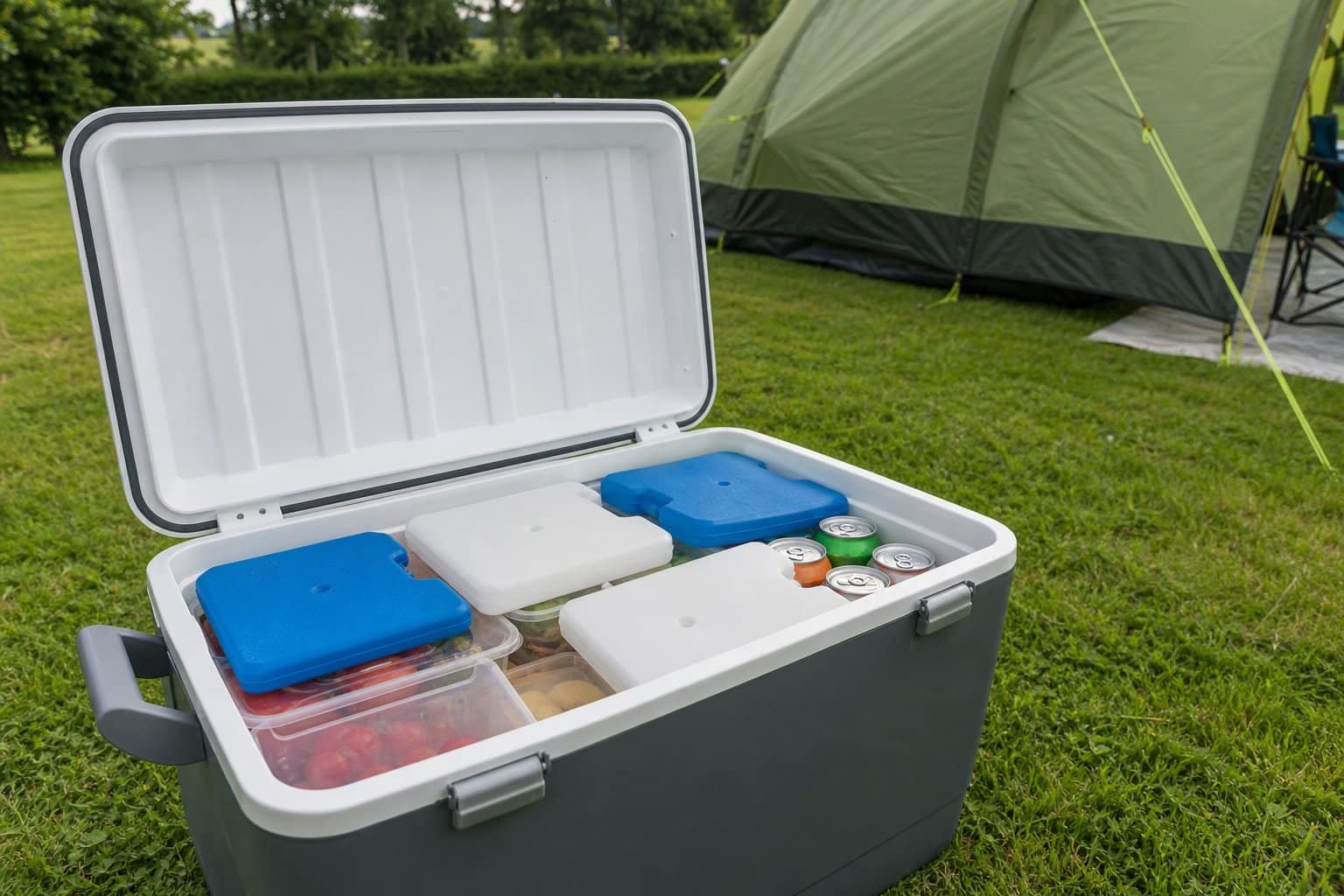
Camping ice packs decide how long your cool box really stays cold, often more than the box itself. A good passive box can still let food warm up by lunchtime on day two if the packs inside are too small, too few or half frozen. We’ve covered the boxes themselves in our guides to hard camping cool boxes and choosing a cool box, and powered options in our electric cool box guide. This guide is about what goes inside.
Below we compare six reusable camping ice packs: food-safe packs that hold around 0°C, sub-zero packs for the coldest box, tough hard blocks, a big gel block for family boxes, a drinks pack and a slim sheet for cool bags. Then we explain how to choose, how many you need, and how to pack a cool box so it lasts the weekend.
All six are listed on Amazon US, where prices change often, so we haven’t quoted them. Where a listing doesn’t state a spec, we say so rather than guess.



Best overall Arctic Ice | Coldest Cooler Shock | Toughest YETI 4 lb | Big boxes Igloo XL | |
|---|---|---|---|---|
|
|
|
|
| |
| Type | Hard pack | Refillable packs | Hard block | Gel block |
| Fill / weight | 2.5 lb | 4 x 10×10 in | 4 lb | 6.5 lb |
| Phase change | About 0°C | -8°C | Not quoted | Not quoted |
| Size | 19 x 24 x 3 cm | 25 x 25 x 2.5 cm each | 27 x 20 x 4 cm | Not quoted |
| Warranty | Limited lifetime | Not quoted | Not quoted | 90 days |
| Check price | Check price | Check price | Check price |
Our camping ice pack reviews
Each review covers the pack’s type, size, freezing point and warranty, plus what independent testers found and what we’d check before buying camping ice packs for a UK trip.
2.5 lb hard-shell reusable ice pack filled with a non-toxic, vegetable-oil-based formula that the listing says cools at around 32°F (0°C), so chilled food stays cold without freezing solid (one bullet gives 33.8°F). 7.5 x 9.5 x 1.25 in (about 19 x 24 x 3 cm), leak-proof ultrasonic spin-welded cap, dishwasher safe (top rack). Made in the USA with a limited lifetime warranty against defects. Also sold in 0.75, 1.5, 5 and 10 lb sizes.
The Alaskan Series is the ice pack we’d put in a family cool box first. It’s designed to sit at around freezing point rather than well below it, which is exactly what you want for milk, cheese, salad and cooked meats: cold enough to stay food-safe, but not so cold that the lettuce turns to mush where it touches the pack. America’s Test Kitchen picked the X-Large version as its overall winner, saying it “kept a 38-quart cooler chilly for 14 hours” and froze without bulging.
The Large 2.5 lb size suits a 25–40 litre cool box on its own, or a bigger box when you use two or add a bag of ice. The flat, rigid shape stacks neatly on top of food, and the spin-welded cap is a nice touch because cheap screw caps are where many packs start to seep. It’s made in the USA and carries a limited lifetime warranty, which is rare in this category. The trade-off is that it won’t keep things as cold as a sub-zero pack, so it isn’t the one for frozen food.
- Holds around 0°C, so food doesn’t freeze
- ATK’s overall winner (X-Large size)
- Spin-welded, leak-proof cap
- Limited lifetime warranty
- Not cold enough to keep frozen food frozen
- Listing quotes both 32°F and 33.8°F
- Pricier than basic gel blocks
Four 10 x 10 x 1 in (about 25 x 25 x 2.5 cm) refillable ice packs with an 18°F (-8°C) phase-change point. You add water with the included funnel, shake, cap and freeze. Nylon-reinforced construction. Cooler Shock claims up to 48 hours of safe temperatures in a size-matched cooler and says each pack replaces 5–6 lb of ice. Warranty not quoted on the listing.
If you want the coldest cool box possible, Cooler Shock is the brand to look at. Its packs change phase at -8°C, well below the 0°C of ordinary ice, so they hold a cool box colder for longer. Outdoor Life named a Cooler Shock set its coldest pick, noting it stayed “under freezing temps for five hours” on the pack surface and was still under 40°F (4°C) after nine hours in its test.
The packs arrive dry and flat, which keeps postage low: you fill each one with tap water, shake to mix in the powder, cap it and freeze it. That’s also the main complaint. Outdoor Life called them “a hassle to assemble” and found they can freeze “kind of lumpy” if you don’t lay them flat. Because they’re so cold, keep salad, eggs and soft fruit away from direct contact, and give them a full day or more in the coldest part of your freezer. A four-pack of 25 cm squares lines the bottom and sides of a mid-size cool box nicely.
- -8°C phase change keeps boxes colder
- Outdoor Life’s coldest pick
- Four flat packs line a box well
- Ships light, you add the water
- Filling and mixing is fiddly
- Can freeze lumpy if not laid flat
- Can frost food that touches it
- Warranty not quoted
4 lb hard-shell ice block, 10 3/4 x 8 x 1 5/8 in (about 27 x 20 x 4 cm). Break-resistant design built to survive drops, custom shape the maker says reduces freezing time. Works on its own or alongside regular ice. Also sold in 1 and 2 lb sizes. Freezing point and warranty not stated on the listing.
YETI ICE is the premium, built-like-a-brick option. The 4 lb block has thick walls that shrug off being thrown in the boot, and its ridged shape is meant to freeze faster than a plain slab. Bob Vila lists YETI ICE with a 28°F (-2°C) freezing point, and America’s Test Kitchen found it froze to about 17°F (-8°C), the coldest of any pack it tried.
That early chill doesn’t last as long as you might hope, though. ATK rated it “Recommended with Reservations” because the cooling was inconsistent and it “fully thawed about 2 hours ahead of top-performing ice packs”, adding: “For its high price tag, we expected better.” So buy it for toughness and fit rather than record cold. It sits flat on the floor of a 30–50 litre hard cool box, and the 1 and 2 lb sizes fill gaps or go in a lunch bag.
- Very tough, break-resistant shell
- Gets very cold early on (ATK)
- Flat block fits most hard cool boxes
- Smaller sizes to fill gaps
- Thawed sooner than the best packs in ATK’s test
- Expensive for the amount of fill
- Freezing point and warranty not on the listing
Extra-large 6.5 lb refreezable ice block filled with non-toxic gel, modular shape for a custom fit. Igloo recommends at least one XL block for a 16–30 qt (15–28 L) hard cooler, two for 48–75 qt (45–71 L) and three for 94–165 qt. 90-day manufacturer warranty.
For a big family cool box, one large block beats a handful of small ones, because a big mass of frozen gel thaws more slowly. The Igloo Performance XL holds 6.5 lb, and Igloo gives a useful rule of thumb: one block for a 15–28 litre box, two for 45–71 litres and three for anything bigger. ATK’s testing backs the idea that size matters most, finding that “the amount of liquid in each pack matters far more than the type”.
In Outdoor Life’s test the Performance range tracked very close to Igloo’s cheaper MaxCold blocks, so you’re paying mainly for the bigger single block. It’s good value for the amount of fill, though the 90-day warranty is short compared with Arctic Ice. Lay it on the floor of the box with food on top, and add a smaller pack over the top layer.
- 6.5 lb of fill in one block
- Clear sizing guide by cooler size
- Good value per pound
- Non-toxic gel
- Only a 90-day warranty
- Heavy to handle when frozen
- Too big for small boxes and bags
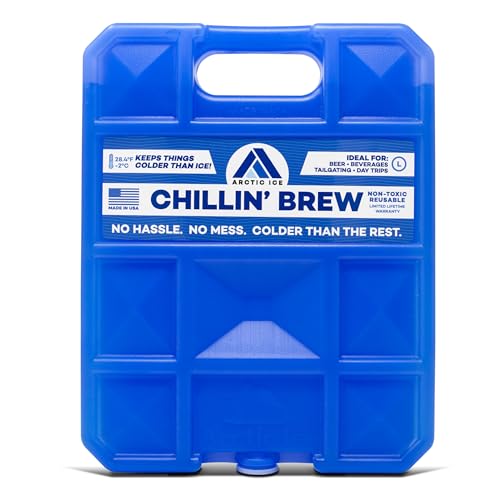
2.5 lb reusable ice pack with a 28°F (-2°C) phase-change formula, designed to keep beer and other drinks colder than ice. Non-toxic phase-change materials. Made in the USA with a limited lifetime warranty. Also sold in 0.75, 1.5, 5 and 10 lb sizes.
The Chillin’ Brew is the drinks-box version of the Alaskan Series. Its formula sits at about -2°C, a couple of degrees below ice, so cans come out properly cold rather than just cool. Outdoor Life found it stayed “awfully close” to its target “for about three hours” before slowly warming.
That slightly colder point is the reason to keep it in a separate drinks cool box: drinks get opened all day, and keeping that lid away from your food box helps both. It shares the Alaskan’s lifetime warranty and USA build. In Outdoor Life’s longer test it warmed faster than the top packs, so pair it with a bag of ice for a full day at the beach or a festival.
- -2°C point chills drinks well
- Limited lifetime warranty
- Range of sizes
- Warmed faster than the best packs in Outdoor Life’s test
- Can freeze food it touches
- Pricey for one pack
Slim refreezable ice sheet that YETI says is nearly 50% slimmer than its standard YETI ICE, designed to replace loose ice in Hopper soft coolers and Daytrip lunch bags. Impact-resistant, freezes fast thanks to its custom shape, no meltwater to drain. Size, weight and warranty not quoted on the listing.
A soft cool bag has no room for a fat block, so a thin sheet is the better shape. The YETI ICE Sheet is designed to slide down the back of a soft cooler or lunch bag, chilling the contents without taking up the space you need for food. Outdoor Life tested YETI’s Thin Ice and summed it up neatly: “It’s noticeably more expensive than the competition. It’s also marginally better.”
It’s a good choice for day walks, picnics and the first day’s lunch on a trip. The listing doesn’t give its size or weight, so check it against the inside of your bag before buying. For a hard cool box, a thicker pack gives far more cold for the money.
- Slim enough for soft cool bags
- Impact-resistant
- Freezes quickly
- Expensive for its size
- Size and weight not on the listing
- Thin packs thaw sooner than blocks
Types of camping ice packs
Not all camping ice packs work the same way, and the difference matters for what you’re keeping cold. There are four broad types, and most campers end up using two of them together.
Hard-shell packs at around 0°C
Packs like the Arctic Ice Alaskan Series are filled with a liquid that freezes and thaws close to the melting point of water. They behave like a block of ice that never makes a puddle. That makes them the safest choice for fresh food, because nothing that touches them gets colder than about 0°C, so salad, eggs and soft cheese don’t freeze.
Sub-zero packs
Sub-zero camping ice packs, such as Cooler Shock at -8°C or Arctic Ice Chillin’ Brew at -2°C, use a salt or phase-change mix that freezes below 0°C. They hold a cool box colder and suit drinks, raw meat and frozen food. The catch is that anything touching them can freeze, and they need a cold freezer and plenty of time to freeze solid.
Gel blocks
Gel blocks, such as Igloo’s MaxCold and Performance ranges, are the cheap, familiar blue bricks. They’re filled with a thickened gel and usually freeze a little below 0°C. They’re good value for the amount of fill, and the bigger sizes perform well in tests, but the thinner plastic can split after years of freezing and thawing.
Thin sheets and soft packs
Thin sheets and flexible gel mats wrap around food or slide down the side of a soft cool bag. They’re ideal where space is tight, but there’s less frozen mass, so they thaw sooner. Use them for day trips and lunch bags rather than as the only cold source in a big box.
Are camping ice packs better than ice?
It’s the question everyone asks, and the honest answer is: not always. In America’s Test Kitchen’s ice pack test, plain bagged ice was “the clear winner”. It kept cans about 10°F colder than any pack over 36 hours, because loose ice wraps snugly around the contents in a way a rigid pack can’t.
So why use camping ice packs at all? Because ice melts into water. Meltwater soaks bread, floods sandwiches and turns cardboard packaging to pulp, and you have to drain it and buy more ice every day or two. Reusable packs stay dry, stack neatly, cost nothing after the first purchase and can be refrozen in a campsite freezer if there’s one on site. ATK’s advice was simple: if you want a reusable option “that won’t leave your cooler dripping wet, go for a hard-sided ice pack.”
The best approach for a long weekend is to combine them. Put large camping ice packs on the floor and against the sides, pack the food, then fill the gaps with ice or frozen water bottles. You get the long, dry cold of the packs plus the snug fit of ice, and the bottles double as drinking water as they thaw.
How to choose camping ice packs
Size matters most
The biggest factor in how long camping ice packs last is how much frozen material they contain. ATK found that “the amount of liquid in each pack matters far more than the type”, and that packs of 2 lb (about 900 g) or less gave up sooner than 4–5 lb packs. One big block beats several small ones, because a large mass has less surface area for its weight and thaws more slowly.
Freezing point
Check what temperature the pack holds. Around 0°C is best for mixed fresh food. Packs that hold -2°C to -8°C keep a box colder for longer, which helps in hot weather, but they can freeze food that touches them. If a listing doesn’t state the phase-change point, assume it’s an ordinary gel that sits a little below freezing.
Shape and fit
Measure the inside of your cool box before buying. Flat, rectangular packs lie on the floor or stand against the walls without wasting space. Bulky or bulging packs rock about and leave gaps; ATK noted that packs with large bumps “were unsteady in coolers”. For soft cool bags, slim sheets fit best.
Toughness and warranty
Camping ice packs get dropped, sat on and crushed under tins. A thick shell and a welded cap last longer than thin plastic with a screw lid. Warranties vary a lot, from 90 days on the Igloo Performance XL to a limited lifetime on Arctic Ice packs, which tells you something about how long the maker expects them to last.
How many ice packs do you need for a cool box?
A useful starting point is Igloo’s own sizing guide for its 6.5 lb XL block: at least one in a 15–28 litre hard cool box, two in a 45–71 litre box and three in anything bigger. If you’re using smaller camping ice packs, aim for roughly the same total weight of frozen fill.
As a rule of thumb, plan on about a quarter of the cool box’s volume being frozen packs or ice for a weekend, and closer to a third in hot weather or for three days or more. A 40 litre box therefore wants roughly 10–13 litres’ worth of frozen material. That sounds a lot, but it’s the difference between cold milk on Sunday and a box of warm water.
Don’t forget the food. Cold food from the fridge, and frozen food from the freezer, adds to the cold store. Freezing Saturday’s mince or Sunday’s sausages before you go means they act as extra camping ice packs until you cook them.
How to freeze camping ice packs properly
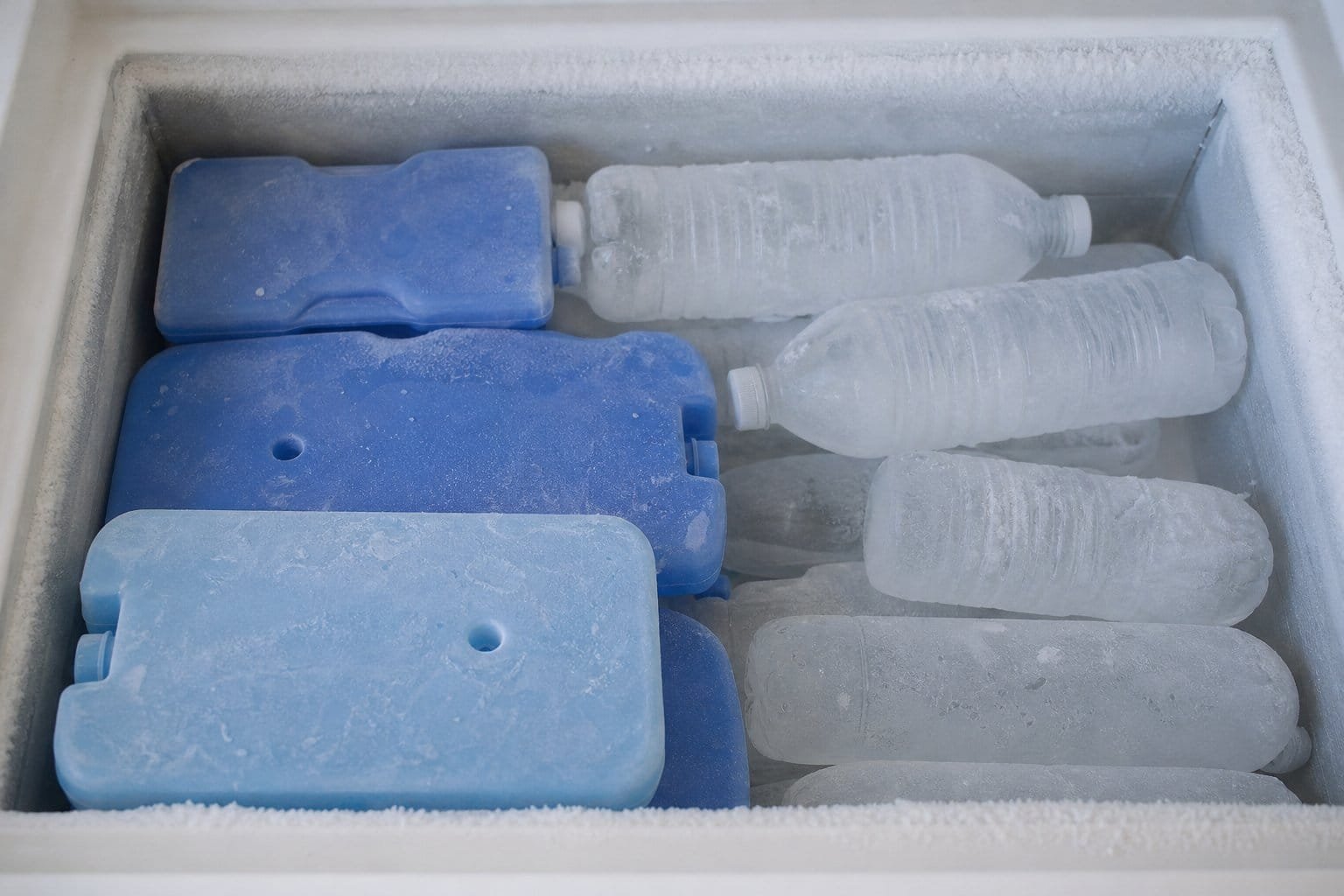
A half-frozen pack is the most common reason a cool box fails. Give hard packs and gel blocks at least 24 hours in the freezer, laid flat, and sub-zero packs longer. Outdoor Life found some sub-zero packs struggled to freeze in the maker’s recommended time, and suggests turning the freezer to its coldest setting the day before a trip.
A standard UK freezer runs at about -18°C, which is cold enough for every pack in this guide. Packs with a -8°C phase change need that full cold, though, so don’t keep them in the door or pile warm shopping on top of them. Freeze them flat and separately so cold air can reach every side, then stack them once they’re solid. Shake a pack: if you hear sloshing, it isn’t ready.
Freeze water bottles at the same time. Leave a gap at the top for expansion, and lie them down. They’re cheap extra cold, and on the last day they give you chilled drinking water.
How to pack a cool box with ice packs
Pre-cool the box. A box stored in a warm shed or car boot soaks up a lot of cold before it starts working for you. Bring it indoors the night before, and if you can spare one, put a frozen pack or a bag of ice in it for a few hours, then swap it for fresh camping ice packs when you pack.
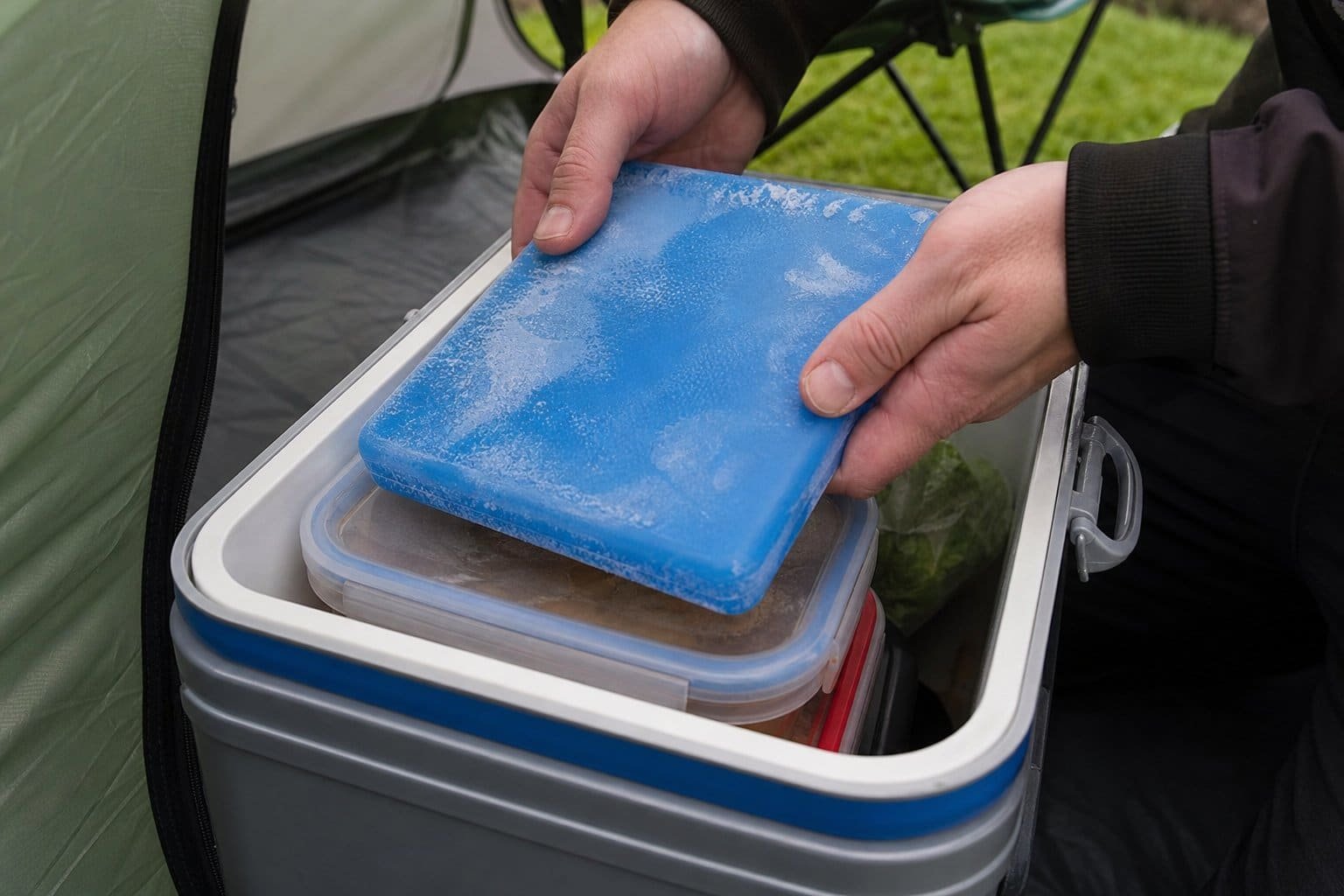
Cold sinks, so put the biggest packs on the floor and stand thinner ones against the sides. Load raw meat in sealed boxes at the bottom, then dairy, then salad and fruit near the top, and lay one more pack over everything. Keep sub-zero packs away from delicate food, or wrap them in a tea towel.
Fill the box as full as you can. The Takeout’s cooler advice is to pack it “as tightly as possible”, because “the more air pockets in your cooler, the quicker the temperature will rise.” Fill the gaps with frozen bottles, ice or a folded towel.
For more on keeping food safe once you’re on site, see our guide to storing food while camping, and use sealed food containers so nothing leaks onto the packs.
Matching camping ice packs to your trip
For a day trip or picnic, a soft cool bag with one or two slim camping ice packs is plenty. Freeze them overnight, pack the bag straight from the fridge and keep it closed until you eat.
For a weekend under canvas, choose ice packs for cool boxes that add up to a quarter or more of the box: two Arctic Ice Alaskan packs or one Igloo XL in a 30–45 litre box, plus frozen bottles in the gaps. Keep drinks in a second box so the food box stays shut.
For a week-long holiday, cool box ice packs alone won’t last without help. Take two sets and use the campsite freezer, top up with bagged ice from the site shop, or plan meals so the most perishable food is eaten in the first two days. Tins, UHT milk and dried food fill the rest of the week.
For hot spells and festivals, choose colder camping ice packs. Sub-zero packs such as Cooler Shock hold the box below freezing for longer, and a reflective cover or damp towel over the box slows the warm-up. Check the thermometer each morning and evening so you know when to swap packs.
Keeping food safe at the campsite
The UK Food Standards Agency’s hot-weather advice says a fridge should be between 0 and 5°C, and asks people to “use frozen ice packs and cool bags or boxes to keep food cool for longer”. It also advises keeping cool bags closed until you eat, minimising how often you open the lid and keeping them out of direct sunlight.
In warm weather, the FSA says to try not to leave food out for more than two hours, and to throw away perishables that have been out of the fridge longer than that. A cheap fridge thermometer in the cool box is the easiest way to know whether your camping ice packs are still doing their job. Once it reads above about 5°C, cook or bin the riskiest foods first: raw chicken, mince, fish and dairy.
Use two cool boxes if you can: one for drinks, which gets opened all day, and one for food, which you open at mealtimes only. That single change can add a day to how long your food box stays cold.
Making camping ice packs last longer on site
Shade is free cold. Keep the cool box under an awning, in the tent porch or beneath the car, never in the sun or in a closed car. Raise it off hot ground on a chair or a mat, and drape a damp towel or a reflective cover over it on very hot days.
Some UK campsites will freeze ice packs for you in the shop or reception, sometimes for a small fee, so ask when you book. Take two sets of camping ice packs, freeze one while the other works, and swap them each morning. Write your name on the packs with a marker so yours come back.
For longer trips, a powered box changes the maths. A thermoelectric cool box, or a compressor fridge such as those in our family camping fridge guide, keeps food cold without ice at all. Even then, a couple of frozen packs inside help it pull down to temperature and cover the times it’s unplugged.
Common camping ice pack problems and fixes
The packs thawed by lunchtime. Usually the packs weren’t fully frozen, the box wasn’t pre-cooled, or it sat in the sun. Freeze packs for a full day, chill the box overnight and keep it in the shade.
Food froze next to the pack. That’s the downside of sub-zero camping ice packs. Wrap them in a tea towel, use them for drinks and frozen food, or switch to a 0°C pack for fresh food.
The pack bulged or cracked. Trapped air and repeated freezing stress the plastic. Lay packs flat to freeze, check for cracks before each trip, and replace any that leak. Most fills are non-toxic, but don’t let a split pack sit against food.
The refillable packs froze lumpy. Mix them well, lay them flat and freeze them on a tray the first time so they set into an even slab.
Buying camping ice packs in the UK
The camping ice packs in this guide are listed on Amazon US, so the listings use pounds, inches and Fahrenheit. As a quick conversion, 1 lb is about 450 g, 1 inch is 2.5 cm, 32°F is 0°C and 18°F is about -8°C. Several of these brands, including YETI and Igloo, are also sold in the UK, so it’s worth checking local stockists for the same models.
Before you order, check the pack’s outer size against the inside of your cool box, and whether it’s designed for hard boxes or soft bags. If you’re still choosing a box, our camping essentials list covers what else to pack for the camp kitchen.
Which camping ice packs should you buy?
For most family cool boxes, the Arctic Ice Alaskan Series is our pick. It holds food at around freezing point without frosting it, is built to last and has a lifetime warranty. Pair two of them with a bag of ice or frozen bottles for a long weekend.
If you want the coldest box for hot weather or frozen food, choose Cooler Shock and accept the fiddly first fill. For rough handling, YETI ICE is near-indestructible. For a big family box on a budget, one or two Igloo Performance XL blocks give the most cold for the money. Add a Chillin’ Brew to a separate drinks box, and a YETI ICE Sheet for soft cool bags.
Final thoughts
The best camping ice packs are the ones that suit what you’re keeping cold and the box you’re keeping it in. Buy more frozen fill than you think you need, freeze it properly, pre-cool the box and keep it in the shade, and even a basic cool box will see you through a British summer weekend. For independent test data, Outdoor Life’s ice pack test and ATK’s results are both worth a read.
Camping ice pack myths
Not in America’s Test Kitchen’s test: bagged ice kept cans about 10°F colder over 36 hours. Packs win on being dry and reusable.
Sub-zero packs keep a box colder but can freeze salad, eggs and soft fruit that touch them.
Give packs at least 24 hours laid flat, and sub-zero packs longer.
Yes. ATK found the amount of liquid matters far more than the type.
What to look for in camping ice packs
Big packs thaw more slowly; aim for 4–6 lb blocks in a family box.
About 0°C for fresh food, -2°C to -8°C for drinks and frozen food.
Flat packs for hard boxes, slim sheets for soft bags.
Thick plastic and a welded cap resist cracks and leaks.
Check the pack fits flat in your freezer.
From 90 days to lifetime; longer suggests a tougher pack.
How to pack a cool box with ice packs
- Freeze the packs
Lay them flat in the freezer for at least 24 hours, plus a few water bottles.
- Pre-cool the box
Bring it indoors and chill it with a spare pack the night before.
- Packs on the bottom
Lay big packs on the floor and stand thin ones against the sides.
- Load cold food
Raw meat sealed at the bottom, dairy next, salad on top.
- Top and fill
Add a pack over the top and fill gaps with ice, bottles or a towel.
- Keep it shaded
Store it under an awning or in the porch and open it as little as possible.
How we chose these camping ice packs
We have not tested every pack in this list ourselves. Our picks are based on the Amazon listings, America’s Test Kitchen’s and Outdoor Life’s ice pack tests, Bob Vila’s buying guide and the UK Food Standards Agency’s hot-weather food safety advice. Where a listing didn’t state a spec, we said so rather than guessing.
-
Independent tests
We favoured packs and brands that did well in published tests.
-
Different jobs
We picked packs for fresh food, frozen food, drinks, big boxes and cool bags.
-
Build and warranty
We checked shell design, caps and warranty terms.
-
Honest specs
Metric sizes are our conversions of the listing figures.
What are the best camping ice packs?
For most family cool boxes, the Arctic Ice Alaskan Series: it holds food at around 0°C without freezing it and has a lifetime warranty. For the coldest box, Cooler Shock.
How long do ice packs last in a cool box?
It depends on the box, the amount of fill and the weather. In ATK’s test, every pack kept a cooler under 50°F for more than 8 hours, and the best kept one chilly for 14 hours. Pre-cooling, shade and more fill all add time.
Are ice packs better than ice?
Ice cools more evenly, but melts into water. Packs stay dry and are reusable. Using both together works best on long trips.
How many ice packs do I need?
Igloo suggests one 6.5 lb XL block for a 15–28 litre box and two for 45–71 litres. As a rough guide, aim for a quarter to a third of the box filled with frozen packs or ice.
How long should I freeze ice packs?
At least 24 hours, laid flat, and longer for sub-zero packs. Turn the freezer to its coldest setting the day before.
Should ice packs go on top or bottom?
Both. Put large packs on the floor and against the sides, and lay one more over the top of the food.
More camp kitchen guides
Keeping food cold for longer? See our guides to the best family camping fridges, budget camping fridges, campervan fridges and the best camping fridge freezers, plus our camping kitchen units for somewhere to put it all.
Which camping ice packs should you buy?
- Best overall: Arctic Ice Alaskan Series Reusable Ice Pack (Large, 2.5 lb)
- Coldest: Cooler Shock Mid-Size Reusable Ice Packs, 10 x 10 in (4-Pack)
- Toughest: YETI ICE Refreezable Reusable Cooler Ice Pack (4 lb)
- Best for big cool boxes: Igloo Performance Ice Block, XL (6.5 lb)
- Best for drinks: Arctic Ice Chillin' Brew Series Reusable Ice Pack (Large, 2.5 lb)
- Best for cool bags: YETI ICE Sheet Refreezable Reusable Cooler Ice Pack (Large)
For most family cool boxes, the Arctic Ice Alaskan Series is the best camping ice pack thanks to its food-safe 0°C point and lifetime warranty. Choose Cooler Shock for the coldest box, YETI ICE for toughness, the Igloo Performance XL for big boxes on a budget, Arctic Ice Chillin’ Brew for drinks and the YETI ICE Sheet for soft cool bags.
CampEquipmentPlus relies on reader support. Purchases made via links on our website may earn us an affiliate commission at no extra cost to you, helping keep the site running.