
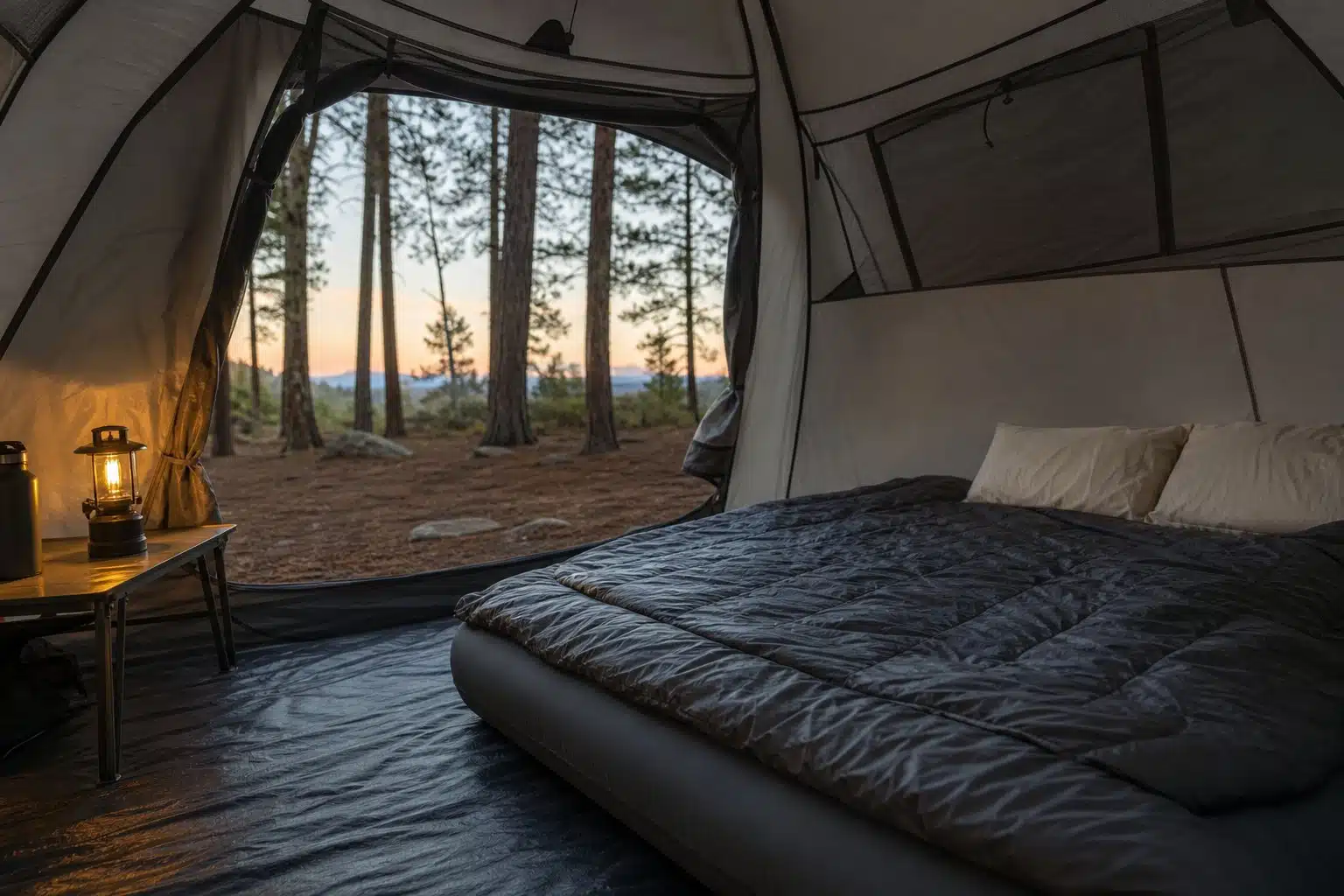
Best Air Mattresses for Camping With Built-In Pumps
An air mattress with built-in pump saves you from packing a separate pump, hunting for an outlet or wheezing into a valve after dark. Our top pick is the Coleman River Gorge, a tough queen with a battery pump built in, while the COMMOUDS 18 in bed gives you real-bed height with a rechargeable pump.
Campers judge these beds on a short list: how fast and quietly the pump works, whether it needs an outlet, how well the bed holds air overnight, how it fits in the tent and how cold it feels. The complaints are consistent too: beds that seem to deflate on the first night, pumps that are dead when you arrive and thin vinyl that pulls the warmth out of you on cool nights.
Below we compare six beds with three kinds of built-in pump (D-cell battery, rechargeable and 120V AC) and explain how to choose, set up and look after one.
- Cordless pumps work at any site; AC pumps need hookups
- Most new air beds stretch for 2–3 nights
- Air beds need insulation underneath in cold weather
- Best overall: Coleman River Gorge Queen with a built-in 4 x D battery pump and a 772 lb rating.
- Best raised cordless: COMMOUDS 18 in Bed-height queen with a 2000 mAh rechargeable pump.
- Best for families: Naturehike Compact King 79 x 71 in with a USB-rechargeable pump.
- Best for electric sites: Intex 13 in Comfort Plush Built-in 120V pump fills it in about 3 minutes.
Choosing an air mattress with built-in pump comes down to one question first: where will the power come from? A battery or rechargeable pump works anywhere, while a plug-in AC pump is faster but needs a hookup. We compared six beds using the Amazon listings, maker specs and published testing, so you can pick the right camping air mattress for your tent, your campsite and the nights you camp. If you want more options without built-in pumps, see our wider guide to the best air beds for tent camping.


Best overall River Gorge | Raised Commouds 18in | Family size Naturehike King | Plug-in Intex 13in | |
|---|---|---|---|---|
|
|
|
|
| |
| Size | Queen, 80 x 60 in | Queen (L x W not quoted) | Compact King, 79 x 71 in | Queen (L x W not quoted) |
| Height | 9.5 in | 18 in | 9.84 in | 13 in |
| Pump power | 4 x D batteries (sold separately) | 2000 mAh rechargeable | USB rechargeable | 110–120V AC |
| Inflation time | Not quoted | About 4 min | About 3 min | About 3 min |
| Capacity | 772 lb | 650 lb | 992 lb | 600 lb |
| Packed size | Not quoted | Not quoted | 16.5 x 13.4 x 6.7 in | Not quoted |
| Warranty | Not quoted | Not quoted | Not quoted | 1-year limited |
| Check price | Check price | Check price | Check price |
The best air mattresses with built-in pumps: our reviews
Each review covers the pump type, size, height, weight rating and the trade-offs owners and testers report, so you can match a bed to the way you camp.
Queen airbed, 80 x 60 x 9.5 in, Tough Guard exterior (Coleman says 150x more abrasion resistant and 75% more puncture resistant than PVC), built-in pump that runs on 4 D batteries (sold separately), rated to 772 lb.
The Coleman River Gorge is the air mattress with built-in pump we would pick for most tent campers. The pump is part of the bed and runs on four D batteries, so it works at a primitive site with no outlet, power station or charging. Batteries are sold separately, so pack a fresh set and a spare. At 80 x 60 x 9.5 in it is a true queen but a low one, which suits dome tents with sloping walls.
Coleman’s Tough Guard outer is the other reason it ranks first. The listing claims it is 150 times more abrasion resistant, 92% more stretch resistant and 75% more puncture resistant than standard PVC, which matters on rough tent floors. The 772 lb rating is the highest of the queens here. Coleman doesn’t quote the inflation time, packed size or warranty on the listing, and D cells add weight, so it is a car-camping bed rather than one to carry far.
- Built-in pump needs no outlet or charging
- Tough Guard outer resists punctures
- 772 lb rating
- Low profile fits most tents
- D batteries sold separately
- Inflation time not quoted
- Warranty not quoted on listing
18 in raised queen, eight I-beams, flocked top, built-in removable 2000 mAh rechargeable pump (inflates in about 4 minutes, up to 25 minutes per charge), rated to 650 lb, repair patches and storage bag.
If getting up off the floor is the hard part of camping, an 18 in raised bed helps, and the COMMOUDS is one of the few raised queens with a cordless pump. Its 2000 mAh lithium pump sits in the side of the bed but lifts out to charge. COMMOUDS says it inflates the bed in about 4 minutes and runs for up to 25 minutes on a full charge, which is enough for several top-ups.
Eight I-beams and 30% thicker PVC (maker’s figure) aim to stop the bulging that cheaper raised beds suffer, and the flocked top keeps sheets from sliding. Rated to 650 lb, it comes with patches and a storage bag. The catch is size: an 18 in queen needs a tent with near-vertical walls and plenty of headroom, and tall beds hold more cold air, so add insulation on chilly nights. The listing doesn’t quote packed size, weight or warranty.
- Raised 18 in height
- Rechargeable pump, no cord
- Eight I-beam support
- Repair patches included
- Needs a tall cabin-style tent
- More cold air to warm
- Weight and warranty not quoted
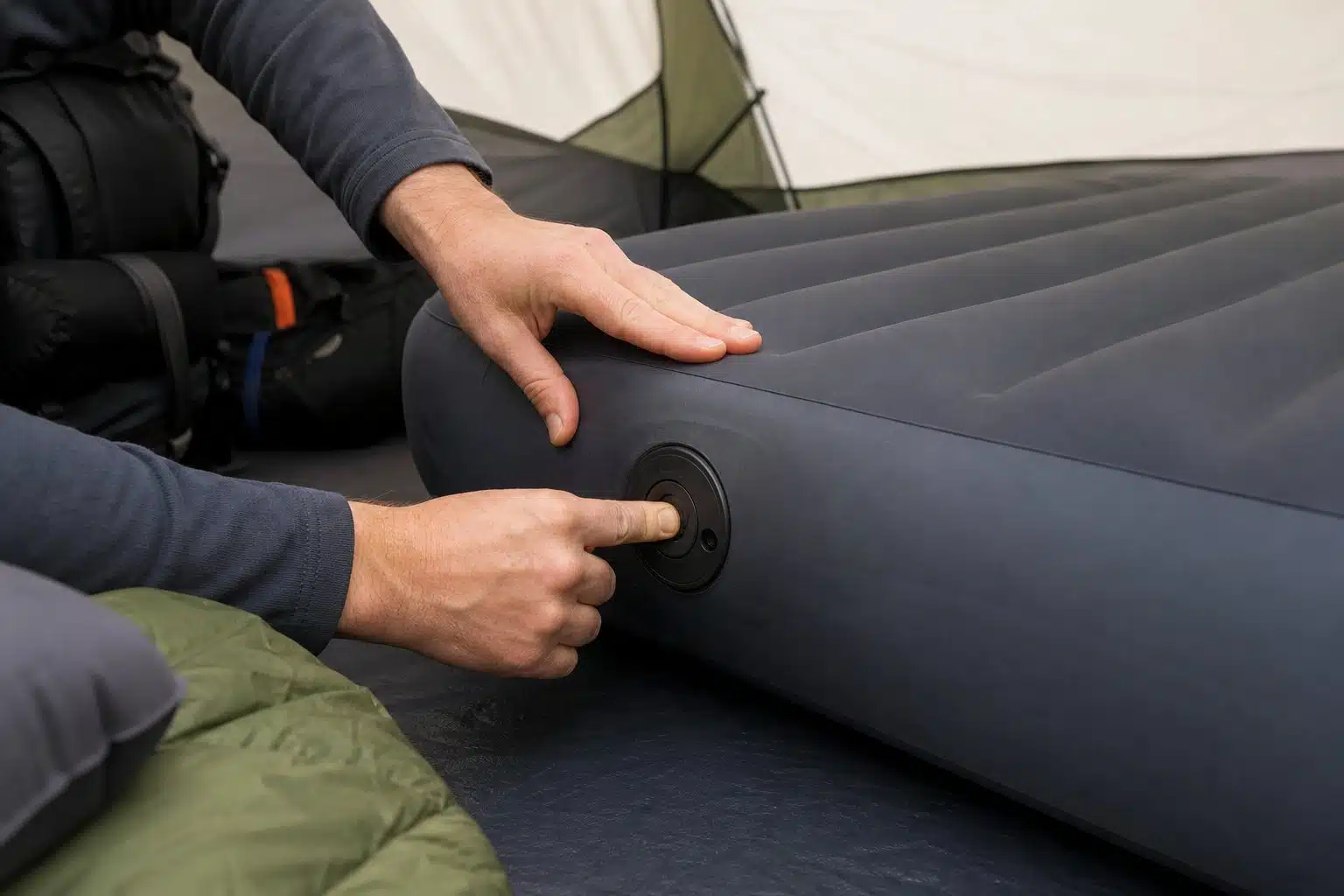
Compact King, 79 x 71 in, 9.84 in high, honeycomb support, thicker PVC with welded seams, built-in USB rechargeable pump (about 3 minutes to inflate or deflate), rated to 992 lb, packs to 16.5 x 13.4 x 6.7 in with a carry bag.
The Naturehike Compact King is the widest bed here at 79 x 71 in, about 11 in wider than a queen, so two adults and a small child, or two adults and a dog, can share it. The built-in pump charges over USB, which means you can top it up from a car port or power bank, and Naturehike says it inflates or deflates the bed in about 3 minutes.
It folds to 16.5 x 13.4 x 6.7 in, small for a bed this big, and the 992 lb rating is the highest in this guide. Naturehike’s own listing warns that the bed softens a little on first use as the PVC stretches, which is normal for any camping air mattress, and suggests topping it up with the pump. Check your tent floor first: at 71 in wide it needs a large family tent. Warranty isn’t quoted on the listing.
- Widest sleeping surface here
- USB-rechargeable built-in pump
- Packs to 16.5 x 13.4 x 6.7 in
- 992 lb rating
- Needs a large tent floor
- Softens while new PVC stretches
- Warranty not quoted
13 in mid-rise queen, dual-layer air chambers, Fiber-Tech Dura-Beam construction, velvety top and sides, built-in 110–120V AC pump (about 3 minutes to inflate), rated to 600 lb, carry bag, 1-year limited warranty.
If you camp at sites with electric hookups, an AC pump is still the fastest and most powerful option, and the Intex Dura-Beam Comfort Plush is a sensible pick. The built-in 110–120V pump fills the 13 in queen in about 3 minutes, according to Intex, and runs from a campground pedestal outlet, an RV outlet or a power station with an AC outlet.
Intex’s Fiber-Tech Dura-Beam inner structure uses polyester fibers in place of old vinyl coils. Intex is upfront about the classic complaint: the listing says the material stretches at first, which people mistake for a leak, and that the bed settles within 2 to 3 nights. Rated to 600 lb with a 1-year limited warranty, it is also one of the cheapest beds here. The downside is obvious: no outlet, no pump, so bring a battery pump as backup for primitive sites.
- Fast built-in AC pump
- 13 in height is easy to get in and out of
- 1-year limited warranty
- Usually the cheapest here
- Needs a 110–120V outlet
- Stretches over the first 2–3 nights
- No cordless option
Queen, 80 x 60 x 10 in, flocked top, built-in rechargeable pump that detaches for instant deflation (about 2 minutes to inflate), packs to 15 x 12 x 6 in with a carry bag.
The AYAMAYA is a 10 in camping queen built around portability. Its rechargeable pump sits in the bed for inflation (about 2 minutes, per the maker) and then detaches, which lets the air rush out for fast packing. Folded, it goes into a 15 x 12 x 6 in carry bag, the smallest packed size quoted in this guide.
At 80 x 60 x 10 in it fits most four-person and family tents, and the flocked top stops a sleeping bag sliding off. AYAMAYA doesn’t state a weight capacity, pump battery size or warranty on the listing, so treat it as a lighter-duty bed and keep the patch kit handy. Its claim of “exceptional insulation” is marketing; like any air bed, it needs a pad or blanket underneath on cold nights.
- Smallest packed size quoted here
- Detachable pump speeds deflation
- Fits most family tents
- Flocked top
- Weight capacity not quoted
- Warranty not quoted
- Insulation claims are optimistic
Queen, 80 x 60 x 9 in (Twin 75 x 39 x 9 in also sold), flocked top, air-coil beams, built-in cordless rechargeable pump with about 2-minute inflation and deflation, 1-year service.
The Luxchoice keeps things simple: a 9 in queen with a built-in cordless pump that inflates or deflates it in about 2 minutes, according to the listing. The low height makes it stable in a tent and easy to fit under sloping walls, and a twin version is available for solo campers or kids.
Luxchoice tells buyers to fully charge the pump before the first use and before each trip, which is good advice for every rechargeable bed. The listing also says a little air loss on first use is normal as the material stretches. It includes 1-year service but doesn’t quote a weight rating or packed size, so check the twin and queen dimensions against your tent before ordering.
- Cordless pump, 2-minute inflation
- Low, stable 9 in profile
- Twin size available
- 1-year service
- Weight capacity not quoted
- Packed size not quoted
- Thin for cold ground
Types of built-in pump on a camping air mattress
Not every air mattress with built-in pump works the same way, and the pump type decides where you can use it. There are three main kinds in this guide, and each suits a different style of camping.
Battery pumps (D cells)
The Coleman River Gorge uses a pump that runs on four D batteries. The big advantage is that you can carry spare cells and swap them in seconds, with no charging and no outlet. D cells also hold up reasonably well in storage, so a bed that lives in the garage between trips is ready to go. The downsides are cost, weight and waste, and alkaline cells lose power in the cold, so keep them in the car or your sleeping bag on frosty nights.
Rechargeable lithium pumps
The COMMOUDS, Naturehike, AYAMAYA and Luxchoice beds all use rechargeable pumps. These are usually removable or detachable so you can charge them at home, from a car USB port or from a power bank. COMMOUDS quotes about 25 minutes of run time from its 2000 mAh battery, which covers a full inflation plus several top-ups. The catch is that a rechargeable pump that has sat in a cupboard for months may be flat when you arrive, so charge it before every trip.
120V AC pumps
Plug-in pumps like the one in the Intex Dura-Beam are the most powerful and the cheapest to build, which is why most home airbeds use them. BestReviews notes that beds with internal AC pumps need a nearby outlet, and recommends a manual or battery-capable pump if you won’t have one. At a site with electric hookups, an AC pump is hard to beat. At a primitive site, it is just dead weight unless you bring a power station with an AC outlet.
How to choose an air mattress with built-in pump
Match the pump to your campsite
Start with where you camp. If you mostly book electric sites, cabins or RV parks, a 120V bed is fine. If you camp at state forest, national forest or walk-in sites, choose a cordless camping air mattress. If you do both, a rechargeable bed is the most flexible option, and our guide on how to power devices while camping explains how to keep pumps, lights and phones charged.
Size and tent fit
A queen camping air mattress is about 80 x 60 in, and the Naturehike Compact King is 79 x 71 in. Measure your tent floor, not just its person rating. A queen fills most of a small four-person dome, leaving no room for bags, and dome walls slope inward, so the usable floor at mattress height is smaller than the floor area printed on the box. Leave a few inches between the bed and the tent walls so condensation on the fabric doesn’t soak your bedding.
Height: low profile vs raised
Each air mattress with built-in pump in this guide sits between 9 in and 18 in high. Low beds (9 to 10 in) are more stable, pack smaller and fit dome tents. Raised beds (13 to 18 in) are easier to sit on and get out of, which matters for stiff knees and backs. Bob Vila notes that air beds range from about 3 in camping pads to 22 in mattresses, and that taller beds are heavier and cost more. In a tent, a raised bed also means more air to cool overnight and less headroom when you sit up.
Weight capacity
Weight ratings for each camping air mattress here run from 600 lb (Intex) to 992 lb (Naturehike). Bob Vila suggests leaving some wiggle room above the combined weight of the sleepers, and that is sensible advice. Treat the number as a limit for the seams, not a measure of comfort; two adults near the limit will feel the middle sag on any air bed.
Material and puncture resistance
Most camping air mattress designs use PVC with a flocked top. Thicker PVC, reinforced seams and tougher outer layers, like Coleman’s Tough Guard, resist punctures better on rocky ground. Always use a tent footprint, sweep the floor for sharp stones, sticks and pine cones, and pack the patch kit that came with the bed.
Packed size and weight
Packed size matters for any air mattress for camping if you share a car with a family’s worth of gear. The AYAMAYA packs to 15 x 12 x 6 in and the Naturehike to 16.5 x 13.4 x 6.7 in. Bob Vila puts the weight of air beds anywhere between 5 and 50 lb, and raised beds and D-cell pumps sit at the heavier end. None of these beds is meant for backpacking; for that, look at insulated sleeping pads instead.
Why your camping air mattress feels flat in the morning
The most common complaint about any air mattress with built-in pump is that it seems to lose air overnight. Often it isn’t leaking at all. Sleep Advisor lists improper use, temperature changes and holes as the main causes, and new beds add one more: stretch.
New vinyl stretches
PVC stretches when a bed is first inflated and loaded. Intex’s listing says the material stretches at first, which is sometimes mistaken for a leak, and that the bed settles within 2 to 3 nights. Naturehike and Luxchoice say the same. The fix is to inflate a new bed at home, sleep on it or leave weight on it for a night or two, and top it up before your trip.
Cold air takes up less space
Air contracts as it cools. A bed pumped up in a 70°F afternoon will lose about 6% of its pressure by a 40°F night, simply from the temperature drop, and it will feel softer even with no leak. Pump the bed up in the evening rather than at midday, and top it up just before bed. This is where a built-in pump earns its keep: one press of a button adds the air back without getting out of your sleeping bag.
Real leaks
If the bed goes flat within a few hours at a steady temperature, look for a real leak. Valves and seams are the usual culprits. Close the valve fully, spray soapy water over the seams and valve and look for bubbles, then use the patch kit. Overinflating stresses seams, so inflate until the bed is firm, not drum tight.
Staying warm on an air mattress
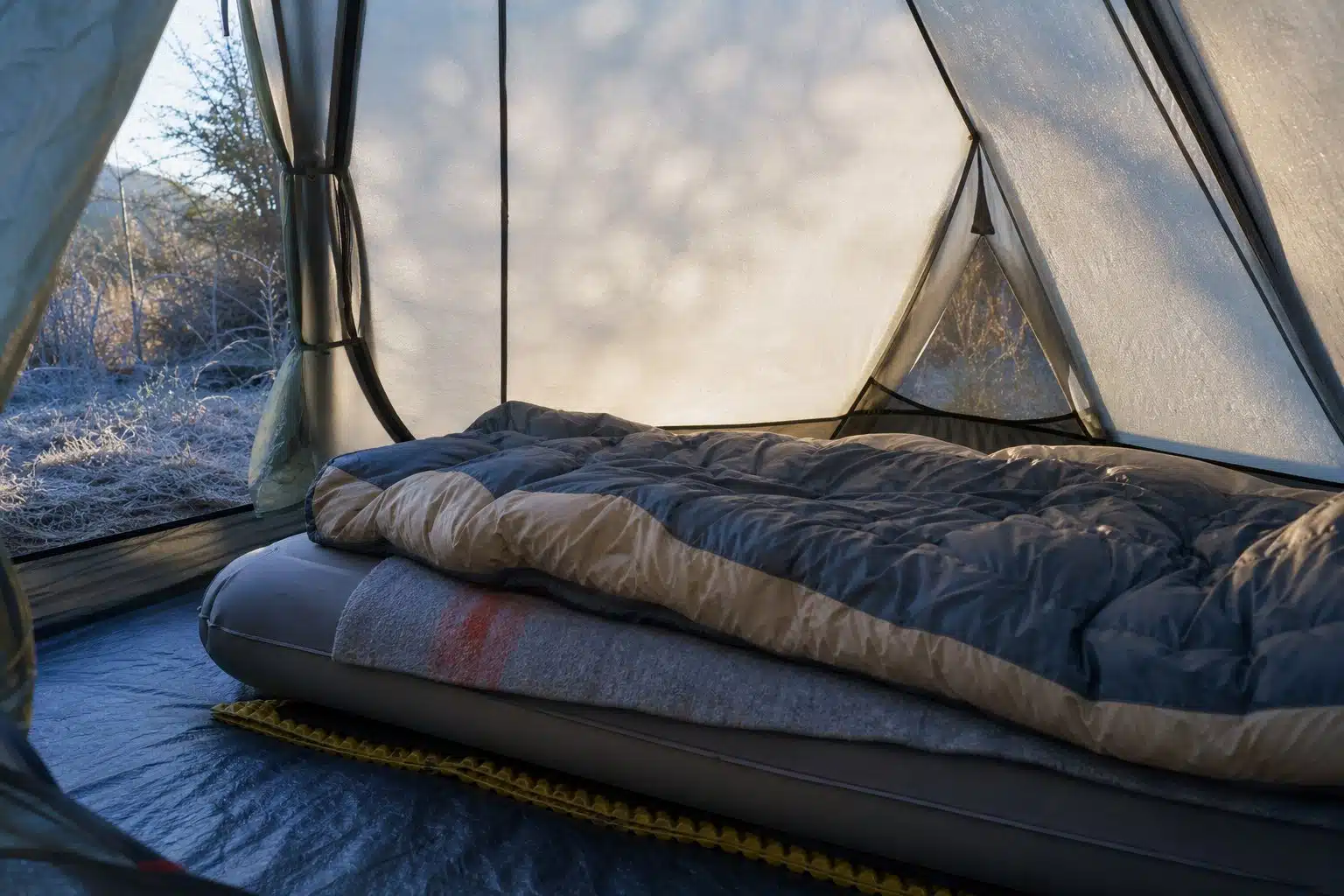
An air mattress is comfortable, but it is a poor insulator. BestReviews says most air mattresses have an R-value of 1 to 4, and that beds like the Intex Dura-Beam have no rated R-value at all. The air inside circulates and carries your body heat into the cold ground, so a thick bed can feel colder than a thin foam pad.
On nights below about 50°F, put insulation under you. A closed-cell foam pad under the bed and a wool or fleece blanket on top of it make a big difference. Our guides to R-values for winter camping and stacking sleeping pads for warmth explain how much you need, and a foam sleeping pad is the cheapest way to add it. Pair the bed with a sleeping bag rated for the nights you camp; see our cold weather sleeping bags for colder trips.
Raised beds are the coldest, because they hold the most air and expose more surface to the tent air. If you camp in spring and fall, a low 9 to 10 in camping air mattress with a foam pad underneath is warmer than an 18 in bed on its own.
Setting up your air mattress in a tent
Pitch the tent on flat ground first and clear the floor before you unroll your air mattress with built-in pump. Unroll the bed with the pump side facing the door so you can reach the controls and the outlet or charger. Inflate the bed inside the tent; a queen inflated outside often won’t fit through the door. Once it is firm, lie on it, then add or release a little air to set the firmness you like.
Put a fitted sheet or blanket on top to stop the sleeping bag sliding on the flocking, and keep pillows and phones off the pump panel. If you camp as a couple, our guide to camping mattresses for couples has more ideas for sharing a bed without rolling into the middle.
Car camping with an air mattress
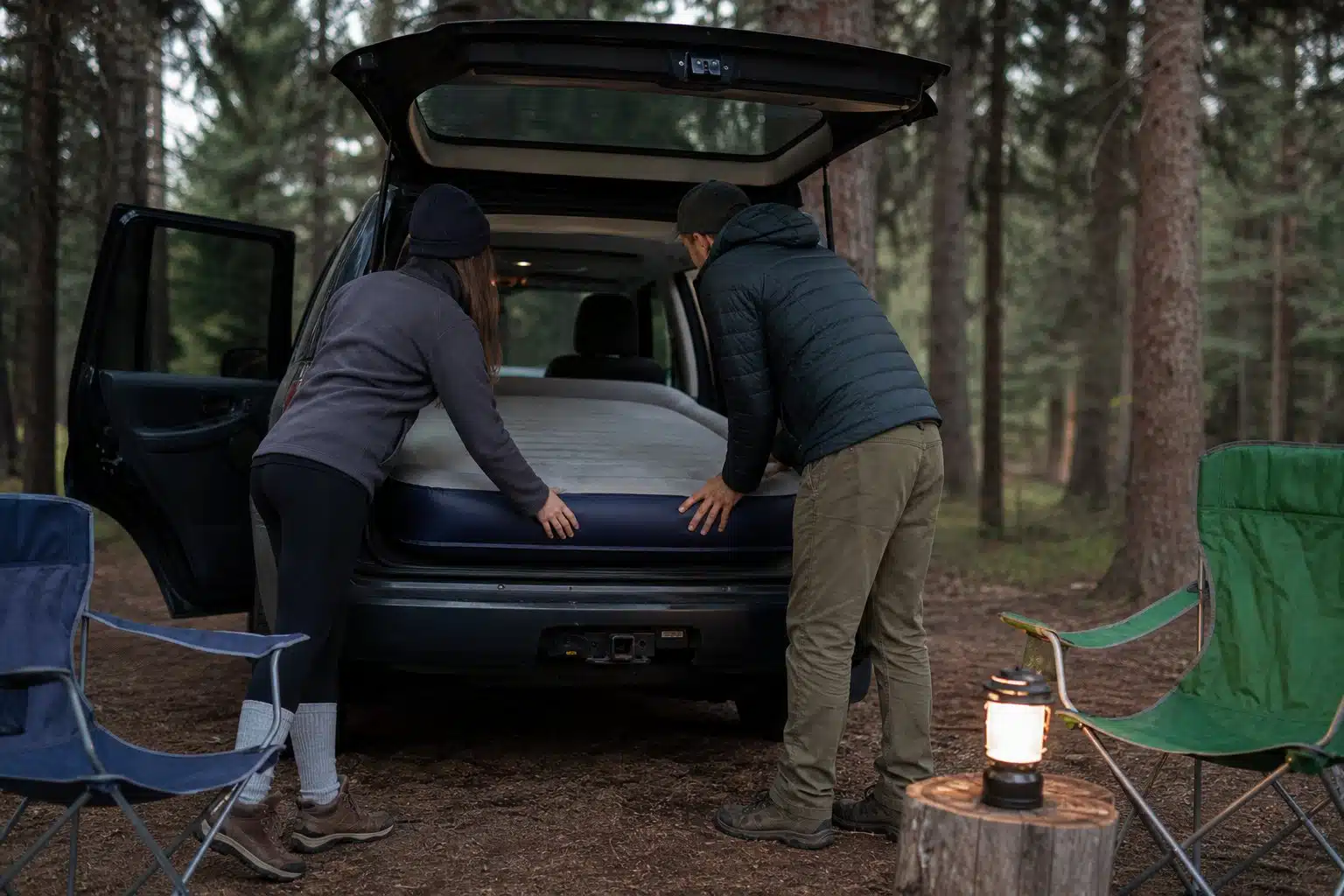
Many campers use an air mattress with built-in pump in the back of an SUV or truck bed rather than a tent. Measure the cargo area with the seats folded, because wheel wells cut into the width and a queen rarely fits flat. A twin or a low queen, partly inflated, often conforms better. Cordless pumps make this easy, since you can inflate the bed in the vehicle without running a cord. Crack a window for ventilation to cut condensation.
Battery care and pump problems
The pump is dead when you arrive
Charge the pump on a rechargeable air mattress with built-in pump fully the night before you leave, as Luxchoice tells buyers to do, and pack a USB cable and power bank. For D-cell pumps, fit fresh batteries before the trip and carry a spare set.
The pump is noisy or gets hot
Every electric pump makes noise, even on the best camping air mattress, so inflate the bed early in the evening rather than after neighbors go to sleep. Bob Vila found that one AC airbed pump could stop and heat up if it ran for more than 5 minutes, so let a pump rest if it feels hot and finish inflating once it cools.
The bed won’t deflate fully
Use the pump’s deflate setting, or open the valve and roll the bed slowly from the far end toward the valve. With detachable pumps like the AYAMAYA’s, removing the pump lets the air out quickly.
Care and storage
Let your camping air mattress dry fully before packing it, wipe off grit, and store it loosely folded in its bag in a cool, dry place. Sleep Advisor warns that folding increases the chance of tears, so avoid sharp creases and don’t store heavy gear on top. Take rechargeable pumps out to charge every few months, and remove D batteries during long storage to avoid corrosion.
Air mattress vs cot vs sleeping pad
An air mattress for camping gives the most bed-like feel at a drive-up site, but it is bulky and cold without insulation. A cot lifts you off the ground and stays the same firmness all night; add a cot mattress for comfort. A self-inflating or foam pad is warmer and lighter but firmer. If back pain is the issue, see our air beds for bad backs guide.
Who should buy an air mattress with built-in pump?
A built-in pump makes the most sense for car campers, families and anyone who sets up camp after dark. You skip the separate pump, the tangle of hoses and the hunt for the right valve adapter, and you can add air from inside your sleeping bag. If you camp a few weekends a year at drive-up sites, an air mattress with built-in pump is the most comfortable bed you can set up in a few minutes.
It makes less sense for backpackers, paddlers and anyone short on space. Every air mattress for camping in this guide weighs several pounds and packs larger than a sleeping pad, and the pump adds a part that can fail. Solo campers who move every night are better served by an insulated pad or a cot.
Running the pump from a power station or car
A rechargeable pump can be topped up from almost anything with a USB port: a car charger, a power bank, a solar panel or a portable power station. An AC pump needs a power station or inverter with a 120V outlet. Check the pump’s input on the label before you rely on a small inverter, and run the engine only when the vehicle is outdoors and well ventilated, never inside a closed garage.
If you camp off grid for several nights, a rechargeable camping air mattress is easier to live with than a plug-in one. A quick top-up each evening uses little battery, so one charge often lasts a long weekend. Keep a hand or foot pump in the car as a backup; it weighs little and saves the trip if the built-in pump fails.
Air mattress with built-in pump buying mistakes
The most common mistake is buying the tallest bed you can find for a small dome tent. An 18 in bed under sloping walls leaves no room to sit up and pushes bedding against damp fabric. The second is skipping the trial run at home, then blaming a stretching new bed for a leak at camp. The third is relying on the bed for warmth: without a pad or blanket underneath, any camping air mattress will feel cold by the early hours on a fall night.
Finally, read the listing carefully. Some beds quote a weight rating, pump battery size and warranty, and some leave them out. We marked missing specs as not quoted in our comparison table, and it is worth asking the seller before you buy if a number matters to you.
Final thoughts on choosing an air mattress with built-in pump
For most tent campers, the Coleman River Gorge is the best air mattress with built-in pump: a tough queen with a D-cell pump that works anywhere. Choose the COMMOUDS 18 in for bed height, the Naturehike Compact King for families, the Intex Comfort Plush for electric sites, the AYAMAYA for small packed size and the Luxchoice for a simple cordless queen. Whatever you buy, break it in at home, top it up at bedtime and put insulation under it when the nights turn cold.
Air mattress myths
New PVC stretches for 2–3 nights and cold air contracts. A bed pumped up at 70°F loses about 6% of its pressure by 40°F.
More air means more circulation and heat loss. Insulation under the bed matters more than height.
Only AC pumps do. Battery and rechargeable built-in pumps work at any campsite.
What to look for in an air mattress with built-in pump
Battery or rechargeable for primitive sites; 120V AC for hookups.
Measure the tent floor; a queen is about 80 x 60 in.
9–10 in for stability and warmth; 13–18 in for easy getting up.
Comfortably above the combined weight of the sleepers.
Thick PVC or tougher outer layers, reinforced seams, patch kit.
Matters when the car is already full.
How to set up an air mattress with built-in pump
- Charge or check the pump at home
Fully charge rechargeable pumps and fit fresh D cells before you leave.
- Clear and protect the tent floor
Use a footprint and remove stones, sticks and pine cones.
- Add insulation underneath
On cool nights lay a foam pad or blanket down first.
- Inflate inside the tent
Face the pump toward the door and inflate until firm, not drum tight.
- Top up at bedtime
Add a little air once the bed and the night air have cooled.
How we chose these air mattresses
We have not tested every bed in this list ourselves. Our picks are based on the Amazon listings, maker specifications and published buying advice and testing from BestReviews, Bob Vila and Sleep Advisor. Where a listing didn’t state a spec we marked it “Not quoted” rather than guessing.
-
Pump type and convenience
We included only beds with a pump built in or docked in the bed, and covered battery, rechargeable and AC types.
-
Comfort and fit
We compared size, height and weight ratings against typical tent floors.
-
Durability
We looked at materials, warranties and the complaints owners report most.
What is the best air mattress with built-in pump for camping?
For most tent campers, the Coleman River Gorge: a queen with a built-in 4 x D battery pump, a Tough Guard outer and a 772 lb rating.
Can you use an air mattress with a built-in pump without electricity?
Yes, if the pump runs on batteries or a rechargeable battery, like the Coleman, COMMOUDS, Naturehike, AYAMAYA and Luxchoice beds. AC pumps such as the Intex need a 110–120V outlet or a power station.
Why does my air mattress lose air the first night?
New PVC stretches, and cooling air contracts. Intex says its beds settle within 2–3 nights. If the bed goes flat within hours at a steady temperature, check the valve and seams for a leak.
Will a queen air mattress fit in my tent?
A queen is about 80 x 60 in. It fits most large four-person and family tents, but measure the floor and allow for sloping walls.
Are air mattresses warm enough for cold camping?
Not on their own. BestReviews says most air mattresses rate only R 1–4, so add a foam pad and blanket underneath below about 50°F.
How long does a rechargeable air mattress pump last per charge?
It varies by model. COMMOUDS quotes up to 25 minutes of run time from its 2000 mAh pump, enough for a full inflation and several top-ups.
More camping sleep guides
Still deciding? See our guides to double camping mattresses, camping cot mattresses, choosing a sleeping pad and choosing a camping tent that fits your bed.
Which air mattress with built-in pump should you buy?
- Best overall: Coleman River Gorge Queen Airbed
- Best raised cordless: COMMOUDS Queen 18 in Air Mattress
- Best for families: Naturehike Compact King Air Mattress
- Best for electric sites: Intex Dura-Beam Comfort Plush 13 in Queen
- Most packable queen: AYAMAYA Queen Camping Air Mattress
- Best value cordless: Luxchoice 9 in Queen Air Mattress
For most campers, the Coleman River Gorge is the best air mattress with built-in pump: tough, cordless and rated to 772 lb. Choose the COMMOUDS 18 in for bed height, the Naturehike Compact King for families, the Intex Comfort Plush for electric sites, the AYAMAYA for small packed size and the Luxchoice for a simple cordless queen.
CampEquipmentPlus relies on reader support. Purchases made via links on our website may earn us an affiliate commission at no extra cost to you, helping keep the site running.