

Best Camping Fridges for Family Holidays UK
A family camping fridge keeps a week of milk, meat and drinks cold without buying ice every day. Our top pick is the ICECO VL60 dual zone, while the BougeRV CRD2 52 qt offers the best value.
Family holidays need more space than a weekend cool box can give, and ideally a separate freezer side for ice packs and frozen meals.
Below we compare six 12V compressor fridge freezers from 48 to 75 litres, and explain how to size, power and pack one for a week away.
- About 40 L suits a family of four; 50–60 L for longer trips or bigger families
- Dual zones let you run a fridge and freezer at once
- Use battery protection, a leisure battery or a hook-up for overnight running
- Best overall: ICECO VL60 60 L dual zone with a SECOP compressor and a 5-year compressor warranty.
- Best value: BougeRV CRD2 52 qt Independent dual zones, wheels and a 2-year warranty for a mid-range price.
- Best for big families: Dometic CFX5 75 DZ 113-can capacity, vacuum insulation and a -22°C freezer.
- Best battery-powered: Anker EverFrost 2 288 Wh battery included, with a quoted 52 hours at 4°C.
A family camping fridge is a 12V compressor fridge freezer big enough for a whole household’s food on a week-long holiday. Unlike a thermoelectric electric cool box, it holds a set temperature whatever the weather, and most family-sized models have two zones so you can freeze and chill at the same time. If you’re after a smaller single-zone model, see our camping fridge freezer guide.
Below we compare six fridges from about 48 to 75 litres. We explain how much space a family really needs, how long one runs from a car or leisure battery, and how to keep food safe on a busy pitch with children opening the lid all day.
All six fridges are listed on Amazon US, where prices change often, so we haven’t quoted them. Each is a 12V compressor fridge rather than a thermoelectric cool box. We checked the listings in November 2026.


Best overall ICECO VL60 | Best value BougeRV 52qt | Big families Dometic CFX5 | Battery power Anker EverFrost | |
|---|---|---|---|---|
|
|
|
|
| |
| Capacity | 60 L (63 qt) | 52 qt (~49 L) | 75 L / 113 cans | 58 L (61 qt) |
| Zones | Dual, independent | Dual, independent | Dual | Not quoted |
| Temperature range | -18°C to 10°C | -20°C to 20°C | -22°C to 20°C | -20°C to 20°C |
| Battery | No | Optional 240 Wh | Optional (Dometic) | 288 Wh included |
| Wheels | Not quoted | Yes | Not quoted | Not quoted |
| Warranty | 5 yr compressor / 1 yr parts | 2 years | 2 years | 5 years |
| Check price | Check price | Check price | Check price |
Our family camping fridge reviews
Each review covers capacity, zones, power options and warranty, plus what testers and owners say about this type of fridge.
60-litre (63 qt) dual zone compressor fridge freezer with a SECOP compressor: cools from 0°F to 50°F (-18°C to 10°C), each zone set independently as fridge or freezer, or one zone switched off to save power. MAX and ECO modes, runs at up to 40° tilt, metal shell, thickened inner wall, fold-down lock, interior lights and two removable wire baskets. Separate 12/24V DC and 110–240V AC ports with both cords included, plus an insulated cover. 5-year compressor warranty and 1 year on other parts. Weight not quoted on the listing.
The ICECO VL60 is the family camping fridge we’d start with if you want one box to last many summers. Its 60 litres are split into two zones that you set separately, so you can freeze mince and ice packs on one side while milk, salad and yoghurt sit at fridge temperature on the other. If you only need a fridge on a short trip, you can run both sides as fridges or switch one off to save power.
It uses a SECOP compressor, the German-designed unit found in many premium fridges, with MAX and ECO modes. The metal shell and two wire baskets feel built for years of use, and the AC lead is rated 110–240V, so it will run from a UK hook-up with a plug adapter. The listing doesn’t give a weight or wheels, so treat it as a two-person lift when full. The 5-year compressor warranty is the best cover here alongside Anker.
- Independent dual zones
- SECOP compressor with ECO mode
- Metal shell and two baskets
- 5-year compressor warranty
- Weight not quoted on the listing
- No wheels mentioned
- Other parts only covered for 1 year
52 qt (about 49 L) dual zone compressor fridge: two compartments each adjustable from -4°F to 68°F (-20°C to 20°C), set as fridge or freezer in any combination. Wheels and telescopic handle, two removable baskets, lights in each zone, app control up to 32 ft. Works with BougeRV’s optional 240 Wh LiFePO4 battery (sold separately; up to 18 hours quoted). DC cord and AC adapter included. 2-year manufacturer warranty.
The BougeRV CRD2 V2.0 52 qt gives you most of what a family needs from a camping fridge for families at well under half the price of the premium brands. Both zones run from -20°C to 20°C independently, it rolls on wheels with a telescopic handle, and the app lets you check the temperature without opening the lid.
T3’s review of the smaller 40-litre CRD2 found the freezer read about -16°C on a thermometer when set to -20°C, and noted the dark casing heats up in direct sun. That’s normal for budget fridges, so check with your own thermometer and keep it in the shade. You can add BougeRV’s clip-on 240 Wh battery later for time away from the car. The 2-year warranty is longer than most budget rivals offer.
- Independent dual zones
- Wheels and telescopic handle
- Optional clip-on battery
- 2-year warranty
- Display can differ from real temperature
- Dark casing warms in sun
- Battery costs extra
75-litre dual zone compressor fridge freezer holding up to 113 x 12 oz cans. Temperature range -7°F to 68°F (-22°C to 20°C), vacuum insulated, “using less power than a 60W light bulb”. Runs on 110–240V AC or 12/24V DC, and works with Dometic batteries and solar panels. 3-stage dynamic battery protection to avoid draining a vehicle battery. 2-year manufacturer warranty. Weight not quoted on the listing.
For a family of five or more, or a fortnight with little chance to shop, the Dometic CFX5 75 Dual Zone is the big one. It holds up to 113 cans across two zones and reaches -22°C, the coldest figure in this guide, so ice lollies and frozen meals stay hard. Vacuum insulation helps it hold temperature with less running.
Dometic’s 3-stage battery protection watches the incoming voltage and shuts the fridge down before the car battery gets too low to start. A Gear Patrol tester who lived with Dometic’s earlier CFX 75 on a five-day trip praised it but found the 12V lead very short, so plan where the fridge sits. It’s also the most expensive pick and, at 75 litres, a lot of fridge to lift into a boot. Only buy this size if you’ll fill it.
- Biggest capacity here (113 cans)
- Coldest freezer (-22°C)
- Vacuum insulation
- 3-stage battery protection
- Most expensive pick
- Heavy and bulky when full
- Weight not quoted on the listing
58-litre (61 qt) compressor cooler with a removable 288 Wh LFP battery. Cools from -4°F to 68°F (-20°C to 20°C); Anker quotes 77°F to 32°F (25°C to 0°C) in 15 minutes and 52 hours at 39°F (4°C) on one battery, or 3.2 days with two. Max, Eco and Smart modes. Recharge from a 100 W solar panel, car socket, wall outlet or USB-C. Box includes AC adapter, car cable, accessory container and wheel chock. 5-year warranty. Number of zones not stated on the listing.
The Anker SOLIX EverFrost 2 58 L is the pick for families who camp away from hook-ups. Its removable 288 Wh lithium iron phosphate battery is included, and Anker quotes 52 hours at 4°C on one charge. That covers a weekend on a non-electric pitch without touching the car battery, and the battery recharges from a solar panel, the car, a wall socket or USB-C.
It cools from 25°C to 0°C in a quoted 15 minutes and goes down to -20°C. Battery runtimes are always tested in kind conditions, so expect less on a hot day or with the lid opened often. The listing doesn’t say whether it has one or two zones, so check before buying if you need separate fridge and freezer sides. The 5-year warranty is reassuring for a fridge with a built-in battery.
- Battery included in the box
- Long quoted runtime
- Solar, car, mains or USB-C charging
- 5-year warranty
- Expensive
- Zones not stated on the listing
- Runtime will drop in hot weather
60-litre (64 qt) dual zone compressor fridge: left zone 34 L plus right zone 26 L, each with independent temperature control from -4°F to 68°F (-20°C to 20°C). 12/24V DC and 100–240V AC, H/M/L battery protection, 15 minutes to 32°F (0°C) in the left zone on max quoted. Wheels, retractable handle, USB socket, interior LED and app or manual control. 1-year warranty on the fridge and 5 years on the compressor.
The BODEGACOOLER 64 qt is the cheapest way to get a genuinely family-sized dual zone fridge. The split is generous on both sides, 34 litres and 26 litres, so you could run a full freezer and a full fridge at the same time. Wheels, a retractable handle and a USB socket for charging a phone add to the value.
It includes both a 12/24V lead and a 100–240V AC lead, with three-level battery protection. Budget fridges like this tend to be less accurate on the display and noisier than SECOP-powered models, and the main warranty is only a year, but the compressor is covered for five.
- Big 34 L + 26 L dual zones
- Wheels and retractable handle
- Both power leads included
- 5-year compressor cover
- Only 1 year on the rest of the fridge
- Weight not quoted
- Budget build quality
51 qt (about 48 L) SECOP-powered compressor fridge freezer: -4°F to 68°F (-20°C to 20°C), MAX and ECO modes. Removable partition switches between single and dual zone, with two independent digital controllers and a colour display. Reversible lid opens left, right or up. Heavy-duty wheels, reinforced handles, runs at up to 45° tilt, magnetic metal exterior, protective cover included. 5-year tech support on the compressor and 1 year on other parts.
The ICECO JP50 ProD suits families who load the fridge in the boot and grab things from either side. Its lid opens left, right or straight up, and the partition lifts out when you need one big fridge instead of two zones. Heavy-duty wheels and a SECOP compressor rated for 45° tilt make it a good match for bumpy campsite tracks.
At about 48 litres it’s right for a family of four on a week’s holiday if you shop every few days. Note that ICECO’s listing quotes “5-year tech support” on the compressor, which isn’t the same as a 5-year warranty, and one year on other parts.
- Lid opens left, right or up
- Removable partition
- SECOP compressor
- Wheels and protective cover
- “Tech support” rather than a clear compressor warranty
- Smaller than the 60 L picks
- Weight not quoted
What makes a good family camping fridge?
A family camping fridge has a harder job than a couple’s weekend cooler. It’s opened dozens of times a day, it holds several days of fresh food at once, and it often has to keep ice lollies frozen next to the milk. That calls for three things: enough capacity, a compressor that holds a set temperature, and ideally two zones.
A compressor fridge works like the one in your kitchen. It switches on and off to hold the temperature you set, so a warm afternoon doesn’t spoil the chicken. A thermoelectric cool box only cools to about 20°C below the air around it, which is fine on a cool weekend but not on a week-long holiday in August.
Look for battery protection as well. Every fridge in this guide can cut out before it flattens a car battery, and that matters when the fridge is plugged in during a long drive and left on at a service station stop.
How big should a family camping fridge be?
Bigger isn’t always better. Expedition Portal’s lab test of six 12V fridge freezers recommends buying “a smaller unit than the marketing material might suggest”, and suggests about 25 litres for one or two people, 40 litres for two to four, and 50 litres for larger families or longer trips. A fridge that’s half empty wastes power and boot space.
As a rough guide, a family of four on a week’s holiday who shop every two or three days will manage with 40–50 litres. Choose 55–60 litres if you want a proper freezer side or shop only once a week, and 70 litres or more only for families of five or more, or for two-week trips to remote sites.
Remember that capacities on US listings are often in quarts. One quart is just under a litre, so a 52 qt fridge is about 49 litres. Can counts are useful for comparing, but they assume you fill every corner with drinks.
Dual zone vs single zone camping fridges
A dual zone camping fridge has two compartments, each with its own temperature setting. On a family holiday that usually means one side as a freezer for mince, sausages, ice packs and lollies, and the other side as a fridge for milk, cheese, salad and drinks. Most let you run both sides as fridges, or switch one off to save power.
The downside is that two zones use a little more power and the divider takes up space. Expedition Portal’s testers also found some dual zone fridges managed their two zones less efficiently than the best performers. If you rarely need frozen food, a single zone fridge of the same size can be cheaper and slightly more efficient.
For most families, though, a dual zone fridge is worth it. Being able to refreeze ice packs overnight and keep frozen meals for later in the week cuts down on shopping trips and wasted food.
How we sized these fridges for families
We included one fridge per family size: about 48–52 litres for a family of four, 58–60 litres for families who want a real freezer side, and 75 litres for big families. Each has a mains lead suitable for UK hook-ups with a plug adapter, so you can run it on an electric pitch as well as from the car.
Types of family camping fridge
Most family camping fridges are chest-style compressor fridges that open from the top, like the six in this guide. They’re efficient because cold air stays in when you lift the lid, and they fit neatly in a car boot. Some, like the ICECO JP50 ProD, have lids that open from either side, which helps when the fridge sits behind the back seats.
Three-way absorption fridges, the kind built into many caravans, run on gas, 12V or mains. They’re silent but need to stand level and work poorly on 12V, so they’re rarely sold as portable boxes now. Thermoelectric cool boxes are the cheapest electric option, but they aren’t a true family camping fridge because they can’t hold a set temperature or freeze.
Battery-powered compressor fridges are the newest type. The Anker EverFrost 2 and BougeRV CRD2 can take a lithium battery that clips on or slides in, so the fridge keeps running when you carry it away from the car or camp on a non-electric pitch.
Choosing a family camping fridge for your car
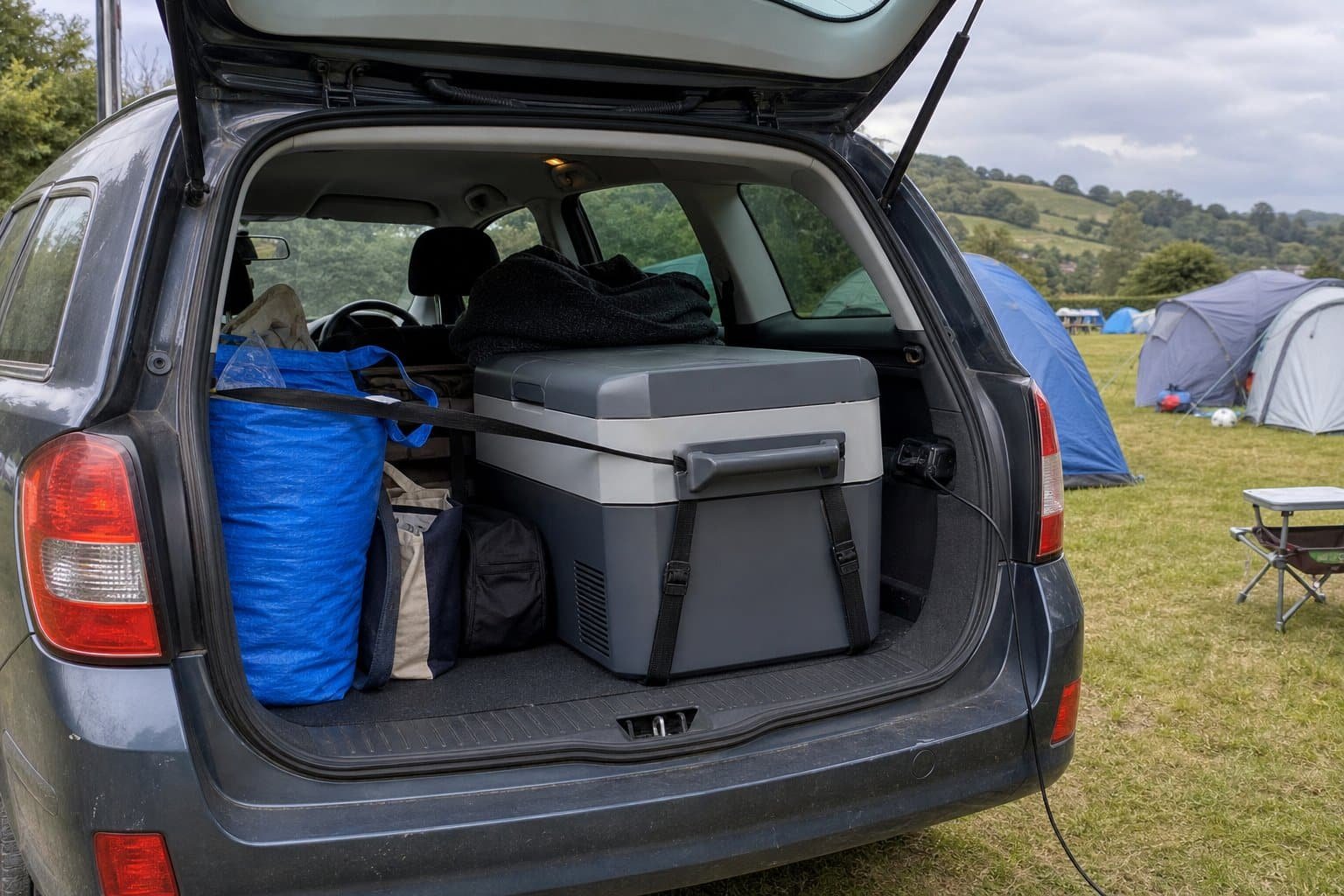
Measure your boot before you buy. A 60-litre family camping fridge is often 70–80 cm long and close to 50 cm tall, and once it’s in, it takes the space of two big holiday bags. Check it will fit with the parcel shelf in place and leave room for the tent. If space is tight, a slimmer 48–52 litre model may suit you better than a 60-litre one you can’t load.
Think about the lift as well. Full of food and drinks, a family camping fridge can weigh well over 30 kg, so wheels and strong handles are worth paying for if you’re camping on a field where you can’t park beside the pitch.
How long will a family camping fridge run from a battery?
In Expedition Portal’s lab test, mid-sized compressor fridges averaged about 3.1–3.7 amps while cooling a load of drinks, roughly 40–50 watts. Once a fridge reaches temperature, the compressor cycles on and off, so the average draw drops. Owners on UK motorhome forums report figures of about 2.5 amps for a well-insulated box.
That still adds up. A family camping fridge averaging 2–3 amps uses roughly 50–70 amp-hours a day on a warm day with plenty of lid opening. A car starter battery can’t give that without risk, which is why battery protection matters. On the Caravan Club forum, one owner said they “couldn’t do two nights off grid with a 100 ah battery without solar” and switched to lithium.
For non-electric pitches, a leisure battery, a battery-powered fridge such as the Anker EverFrost 2, or a portable power station is the safer route. Adding a solar panel helps on longer stays; our guide to solar power systems for campers explains the sizes.
Running a camping fridge for families on a hook-up
An electric hook-up is the easiest way to power a camping fridge for families. Plug the AC lead into your hook-up unit and the fridge runs all week without any battery worries. Most of these fridges draw well under half an amp at 230V, so even a 6-amp pitch leaves plenty for a kettle and phone chargers.
The fridges in this guide come with AC leads rated 100–240V, which work in the UK with a simple plug adapter. Check this before you buy any fridge from a US listing: a 110V-only lead would need a transformer. If in doubt, run the fridge on its 12V lead from a quality UK mains-to-12V adapter.
For more on what you can run from a pitch, read our guide on how to power devices while camping.
Placing a family camping fridge on the pitch
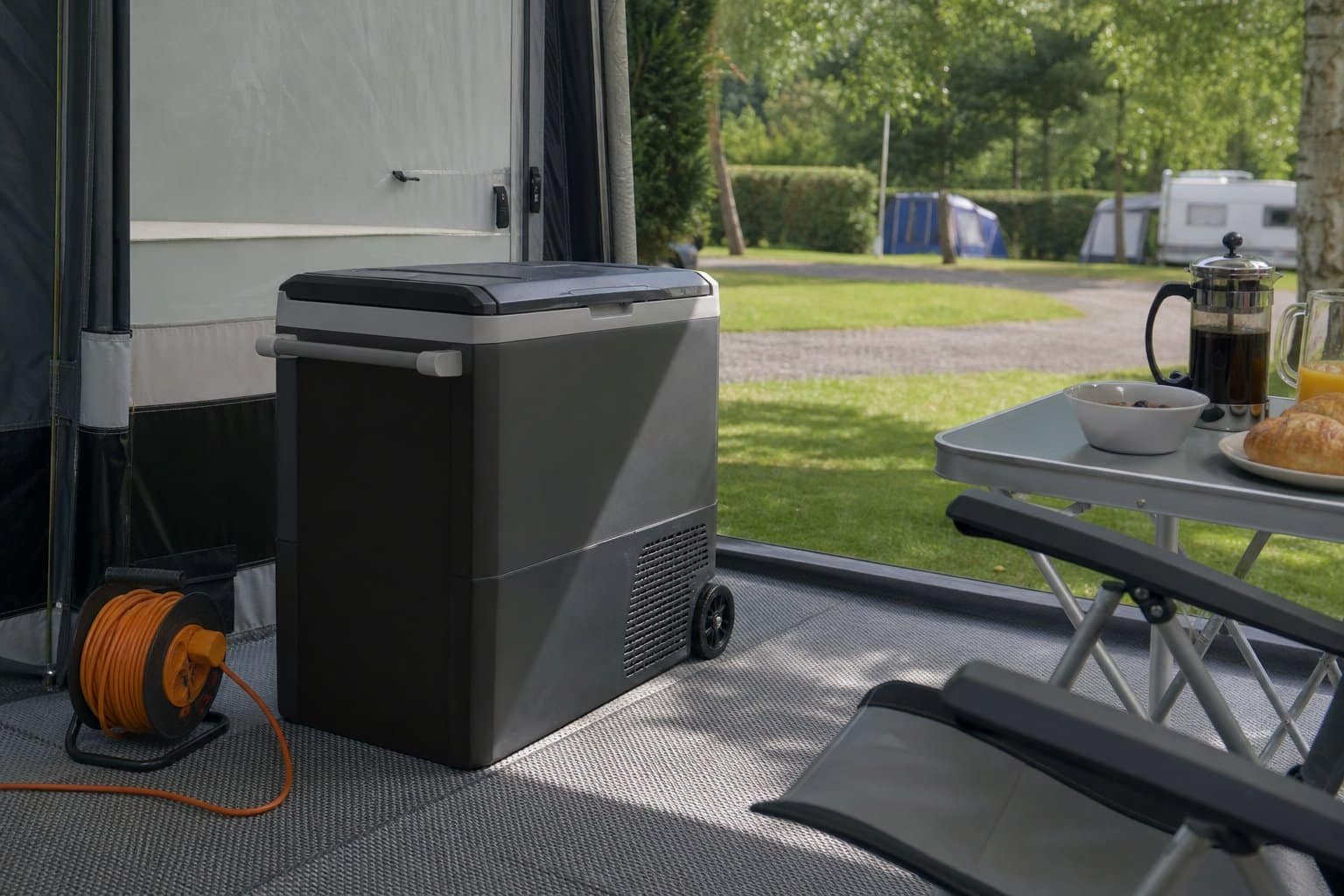
Where you put the fridge makes a big difference to how hard it works. Keep it in the shade, out of the tent’s sun-facing porch, and leave a gap of at least 10 cm around the vents so warm air can escape. T3’s reviewer noticed that a dark casing gets hot in direct sun and makes the compressor run more.
Stand the fridge on firm, level ground or a board, especially on soft grass. Compressor fridges cope with tilt, often 30–45°, but a level base keeps the lid sealing properly. Keep cables tidy so children don’t trip over them, and never cover the fridge with coats or bags.
If you’re camping in a large family tent, the awning or porch is the best spot. It’s shaded, close to the cooking area and out of the sleeping space, so the hum of the compressor won’t keep anyone awake.
Packing a family camping fridge for a week away
Switch the family camping fridge on at home the night before, on mains power, so it’s cold before you load it. Then pack food straight from your kitchen fridge and freezer. A compressor fridge can cool warm food, but it takes a lot of power, and Expedition Portal found cooling a load of drinks from 20°C to 4°C took between about four and seven hours.
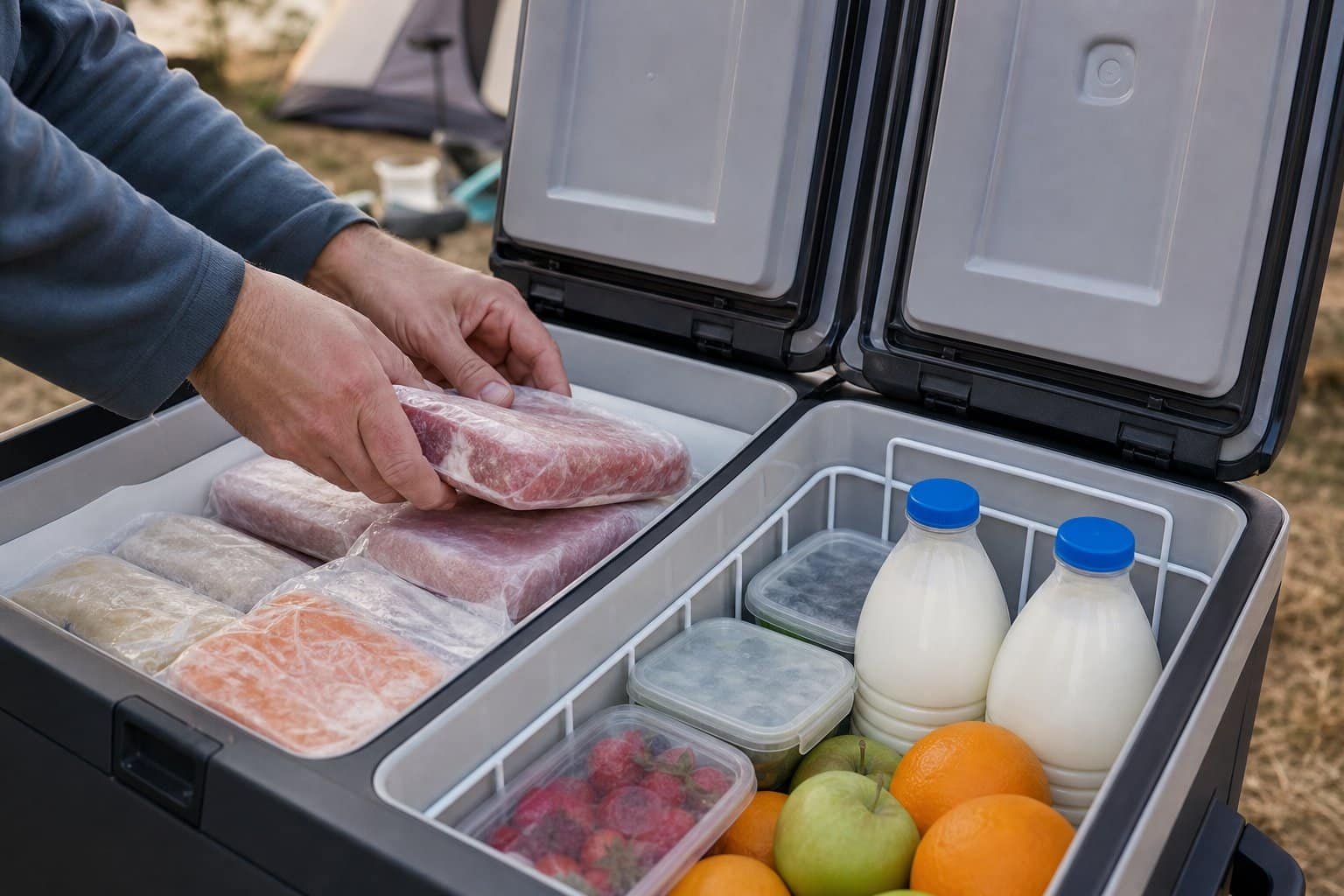
Put frozen food and ice packs in the freezer side, and raw meat in sealed boxes at the bottom of the fridge side, away from ready-to-eat food. Keep everyday items such as milk, butter and squash near the top so children can grab them quickly and close the lid.
Hard vegetables, bread and tins don’t need cooling, so keep them in a crate or camping cupboard to leave room in the fridge. Our guide on how to store food while camping covers the rest.
Family camping fridge running costs
On a hook-up, a family camping fridge costs very little to run. If one averages about 40 W across a day, it uses roughly 1 kWh, which at typical UK electricity prices is around 25–30p a day. Many campsites include electricity in the pitch fee, so the real saving is the ice and spoiled food you no longer pay for.
Running from a battery costs more in equipment than in energy. A leisure battery, battery box and charger, or a portable power station, can cost as much as the fridge itself. Factor that in when you compare a battery-powered fridge, which has the battery built in, with a cheaper fridge that needs one added.
Keeping food safe on a family camping holiday
Fridges should keep food at 5°C or below. Set the fridge side of your family camping fridge to about 3°C, and the freezer to -18°C. Check both with a thermometer on the first day, because displays aren’t always accurate.
Teach children to take what they need and shut the lid straight away, because every opening lets cold air out. A small separate drinks cool bag for the day takes pressure off the main fridge and keeps it colder. Throw away anything that has been above 8°C for more than a few hours.
Family camping fridge vs cool box
A passive hard cool box with ice packs is cheaper and needs no power, but it warms up a little every day, and on a week-long holiday you’ll be buying ice or refreezing packs at the campsite shop. That’s fine for a long weekend, not for seven days of family meals.
A thermoelectric electric cool box is a step up, but it can’t hold a set temperature and struggles in hot weather. A family camping fridge costs more, but it keeps food at a safe temperature all week, can freeze, and pays for itself in ice and wasted food over a few summers.
Common problems and fixes
If your family camping fridge won’t start in the car, check the 12V plug is pushed fully into the socket and that the fuse in the plug hasn’t blown. Many cars switch the socket off with the ignition. If the battery protection keeps cutting in, set it to a lower level only if you have a separate leisure battery.
If the fridge seems to run all the time, check the vents and condenser are clean and clear. On the Caravan Club forum, a compressor that never stopped turned out to be a faulty thermostat, so contact the maker if cleaning doesn’t help.
If the display says 3°C but drinks feel warm, put a cheap fridge thermometer inside. Testers found displays on some fridges can be several degrees out, so set a degree or two lower than you need.
Condensation will collect at the bottom of the fridge, especially in humid British weather. Wipe it out each morning and keep food in sealed boxes or on the baskets.
Caring for a dual zone camping fridge
After each trip, empty the family camping fridge, wipe it out with warm soapy water and dry it. Store it with the lid propped slightly open so it doesn’t smell musty. Check the seal for cracks and the cables for damage before each holiday.
Vacuum the vents now and then, especially after a dusty summer. A clean condenser lets the compressor run less, which saves power and extends its life.
Buying a family camping fridge in the UK
The fridges in this guide are listed on Amazon US, so the listings use quarts, Fahrenheit and US plugs. Before you buy, check the AC lead’s voltage range and whether the warranty is honoured in the UK. Dometic, ICECO, BougeRV and Anker all sell in Europe, so you may find UK versions with the same model names.
Whichever you choose, look for the same things: the right capacity for your family, dual zones if you want frozen food, adjustable battery protection, both 12V and mains leads, and a warranty of at least two years on the compressor.
Which family camping fridge should you buy?
For most families, the ICECO VL60 is the best all-rounder: 60 litres, two independent zones and a SECOP compressor with five years of cover. The BougeRV CRD2 52 qt gives most of that for much less money, with wheels and a 2-year warranty. Big families on two-week trips should look at the Dometic CFX5 75 Dual Zone.
If you camp on non-electric pitches, the Anker EverFrost 2 is the easiest choice because its battery comes in the box. The BODEGACOOLER 64 qt is the budget route to a big dual zone fridge, and the ICECO JP50 ProD suits families who load from the side.
Final thoughts on choosing a family camping fridge
A good family camping fridge changes how you eat on holiday. No more soggy sandwiches from melted ice, no daily trips to the shop and no wasted food. Choose the size you’ll actually fill, pick dual zones if you want frozen food, and plan your power before you go. For the rest of the kit, see our camping essentials list and our family camping tents.
Family camping fridge myths
A half-empty fridge wastes power and space. About 40–50 L suits most families of four.
Battery protection will cut it out first. Use a hook-up, leisure battery or power station.
Testers found some displays several degrees out. Use a fridge thermometer.
Yes. Most go down to about -18°C to -22°C, and dual zone models freeze and chill at once.
What to look for in a family camping fridge
About 40–50 L for a family of four; 55–75 L for bigger families or two-week trips.
Separate fridge and freezer sides for frozen meals and ice packs.
Adjustable low-voltage cut-off so you can still start the car.
12V lead plus a 100–240V mains lead for UK hook-ups.
A full 60 L fridge is heavy; wheels help across a field.
At least two years, ideally five on the compressor.
How to pack a family camping fridge
- Pre-cool at home
Run it on mains the night before you leave.
- Freeze on one side
Load frozen meals and ice packs into the freezer zone.
- Chill on the other
Pack cold food straight from your fridge, with sealed raw meat at the bottom.
- Run it while you drive
Use the 12V lead with battery protection on.
- Plug in and shade it on arrival
Move to hook-up power, keep it in the shade and clear the vents.
How we chose these family camping fridges
We have not tested every fridge in this list ourselves. Our picks are based on the Amazon listings, maker information, Expedition Portal’s lab test, reviews from T3 and Gear Patrol, and UK owner forums. Where a listing didn’t state a spec, we said so rather than guessing.
-
Family capacity
We covered roughly 48 to 75 litres to suit families of four to six.
-
Zones and temperature
We favoured independent dual zones and freezer temperatures of -18°C or lower.
-
Power and protection
We checked for 100–240V mains leads, 12V leads and battery protection.
-
Warranty and stock
Each fridge was in stock when we checked in November 2026.
What is the best camping fridge for a family?
For most families, the ICECO VL60: 60 litres, two independent zones and a SECOP compressor with a 5-year compressor warranty.
What size camping fridge does a family of four need?
About 40–50 litres if you shop every few days, or 55–60 litres if you want a proper freezer side or shop once a week.
Is a dual zone fridge worth it?
Usually, for families. It lets you keep frozen food and refreeze ice packs while chilling milk and drinks.
Can I run a camping fridge overnight from my car?
Only with battery protection, and it may cut out before morning. A hook-up, leisure battery or power station is better.
Will a US camping fridge work on a UK hook-up?
Yes, if its AC lead is rated 100–240V, with a UK plug adapter. All the fridges here quote 100–240V or 110–240V AC.
How much power does a compressor camping fridge use?
Mid-sized models averaged about 3.1–3.7 A while cooling in Expedition Portal’s test, then less once at temperature.
More camp kitchen guides
Still deciding? See our electric cool boxes, our camping fridge freezer guide, our hard camping cool boxes, our camping kitchen units and our portable camping kitchens.
Which family camping fridge should you buy?
- Best overall: ICECO VL60 Dual Zone Portable Fridge Freezer (60 L)
- Best value: BougeRV CRD2 V2.0 Dual Zone 12V Fridge (52 qt)
- Best for big families: Dometic CFX5 75L Dual Zone Portable Fridge Freezer
- Best battery-powered: Anker SOLIX EverFrost 2 58 L Electric Cooler with 288 Wh Battery
- Best budget big: BODEGACOOLER 64 Quart Dual Zone 12V Fridge Freezer (60 L)
- Best for easy access: ICECO JP50 ProD Dual Zone Fridge Freezer (51 qt)
For most families, the ICECO VL60 is the best family camping fridge thanks to its independent dual zones, SECOP compressor and long compressor warranty. Choose the BougeRV CRD2 52 qt for value, the Dometic CFX5 75 for big families, the Anker EverFrost 2 for battery power, the BODEGACOOLER 64 qt on a budget and the ICECO JP50 ProD for easy access.
CampEquipmentPlus relies on reader support. Purchases made via links on our website may earn us an affiliate commission at no extra cost to you, helping keep the site running.