

Best Camping Lanterns for Large Tents UK
A big family tent needs more than one bright lantern in the middle. Our top pick is the Coleman Multi Panel, which splits into five lights, while the Fenix CL28R is the brightest and most adjustable.
We compare lanterns for multi-room tents, living areas and awnings, and explain how many lumens a large tent really needs, how to spread light between rooms and how to keep everything charged over a long weekend.
- Spread several small lights rather than one glaring one
- Dim and warm light inside, bright light outside
- Plan charging before you leave home
- Best overall: Coleman Multi Panel 800L Base lantern plus four detachable panels, one for each bedroom.
- Brightest: Fenix CL28R 2,000 lumens with a warm-to-cool dial and power bank outputs.
- Best for awnings: BougeRV T1 Tripod light with three heads and a 15,600 mAh battery.
- Lumens aren't everything BioLite suggests 75–150 lumens inside a tent; spread light out instead.
Choosing a camping lantern for large tents is a different job from lighting a two-person dome. In a six- or eight-berth family tent, one bright lantern hung in the middle lights the living area and leaves the bedrooms in shadow, while turning it up full blinds whoever is sitting opposite. We’ve covered lanterns in general in our guides to the best rechargeable lanterns for camping and camping lanterns; this guide is about lighting a big tent properly.
Below we compare six options: lanterns that split into several lights, a very bright adjustable lantern, a stand-up light for the awning, a simple hanging lantern, chainable lights and a budget backup. If you’re still choosing the tent itself, see our 6 person family tents and tents with standing room.
All six are listed on Amazon US, where prices change often, so we haven’t quoted them. Where a listing doesn’t give a spec, we say so rather than guess.


Overall Coleman Quad | Brightest Fenix CL28R | Awnings BougeRV T1 | Hanging lantern Coleman 800L | |
|---|---|---|---|---|
|
|
|
|
| |
| Type | Base + 4 panels | Lantern / work light | Tripod area light | Hanging lantern |
| Max brightness | 800 lm (panels 100 lm) | 2,000 lm | 3 x 1,000 lm (claimed) | 800 lm |
| Power | D cells (base), panels recharge | Built-in, USB-C | 15,600 mAh, USB-C | 4,800 mAh, rechargeable |
| Water rating | IPX4 | Not quoted | IPX5 | IPX4 |
| Warranty | 3-year limited | 2 years | 1 year | 3-year limited |
| Check price | Check price | Check price | Check price |
Our camping lantern for large tents reviews
Each review covers the lantern’s brightness, power, water rating and warranty, plus what independent testers and owners say, and which part of a big tent it suits best.
800-lumen base lantern with four detachable 100-lumen magnetic light panels that recharge on the base. Up to 18 m beam from the base and 13 m from each panel; up to 20 hours on the base and 3 hours per panel on high. USB port to top up a phone, IPX4 water resistance, individual controls on the base and each panel, 3-year limited warranty. Coleman’s own page lists it as model 2000030727 (Quad Pro), 3.05 lb (about 1.4 kg), 9.6 in (24 cm) tall, with the base running on D batteries sold separately.
The Multi Panel is the lantern we’d buy first for a big family tent, because it solves the real problem with large tents: one bright light in the middle never reaches the bedrooms. Here the base sits in the living area at up to 800 lumens, and the four magnetic panels pop off so each child, each bedroom pod or the porch gets its own 100-lumen light. Clip them back on and they recharge from the base.
There are catches. Coleman’s own product page says the base runs on D cells (sold separately), not a built-in rechargeable battery, and some owners there report that the panels drain the D cells in storage, so take the batteries out between trips. Owners also mention lost or loose panels, and the page showed a mixed 3.2/5 rating when we checked. Even so, nothing else in this list lights a multi-room tent as neatly.
- Five lights in one: base plus four detachable panels
- Panels recharge on the base
- USB port for a phone
- 3-year limited warranty
- Base runs on D batteries, not a built-in battery
- Owners say panels can drain the batteries in storage
- Panels are only 100 lumens and last about 3 hours on high
2-in-1 rechargeable lantern and wide flood work light, up to 2,000 lumens with stepless brightness and colour temperature adjustment. USB-C charging in under 4 hours; Fenix claims over 15 days of light on the low setting. Magnetic carry handle for hanging or sticking to metal, tripod mount, and both USB-C and USB-A outputs to charge phones. 24-month manufacturer warranty. Weight and water rating aren’t quoted on the listing.
If your tent has a big central living area, the CL28R has more light than you’ll ever use indoors, and that’s the point: you can run it at a fraction of its 2,000 lumens for a long time, and still have a floodlight for pitching in the dark or hunting for a dropped peg. The stepless brightness and colour-temperature control is the feature that matters inside a tent. Turn it warm and low for evenings, cool and bright for packing.
The magnetic handle hangs from a roof loop or sticks to a car tailgate, and the tripod thread lets you stand it up high outside. It also doubles as a power bank through USB-C and USB-A. Fenix’s listing is light on details: no weight, no IP rating and only “over 15 days” on low, so treat it as a careful-use lantern in heavy rain rather than one to leave out.
- Up to 2,000 lumens with stepless dimming
- Adjustable warm to cool light
- USB-C and USB-A power bank outputs
- Magnetic handle and tripod mount
- Far too bright at full power inside a tent
- No weight or water rating on the listing
- Flood beam is more work light than soft lantern
Telescopic area light with three swivelling light heads (listed as up to 3 x 1,000 lumens) on a foldable tripod that extends to 5.5 ft (about 1.7 m). Daylight, amber and red modes plus SOS; heads rotate 270° horizontally and 180° vertically. Built-in 15,600 mAh battery with BougeRV’s claimed 8–102 hours of runtime (about 12 nights at 8 hours on low amber with one panel), 30 W two-way fast charging in about 3 hours, and power out for devices. All-metal body, IPX5, folds to about 2.7 x 11.5 in (7 x 29 cm), 2.4 lb in the description and 2.76 lb in the spec field. 1-year warranty.
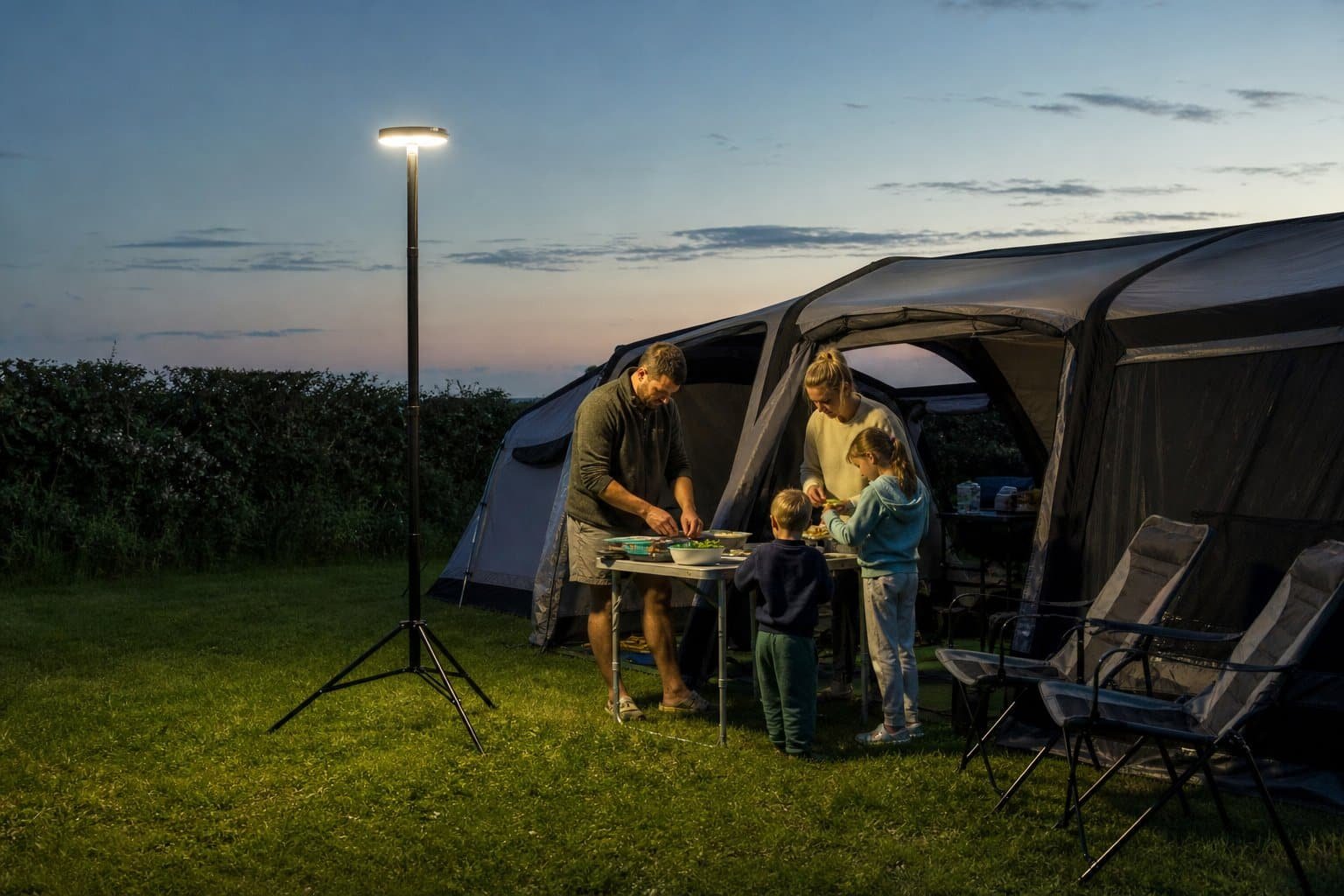
Large tents usually come with a big porch, an awning or a gazebo, and a hanging lantern struggles to light a table out there. The T1 stands on its own tripod at up to about 1.7 m and has three heads you can aim independently: one at the cooking area, one at the table and one at the tent door. BougeRV says it can light about 100 square metres, and the amber mode is gentler on eyes and less of a beacon for neighbours.
The 15,600 mAh battery is the biggest here, and the 30 W charging means a full top-up in about three hours from a power station or a hook-up socket. It isn’t a lantern to hang inside a sleeping area, and the listing is only partly clear (two different weights), but as a pitch light for a big family setup it does a job nothing else in this list does as well.
- Stands up to about 1.7 m on its own tripod
- Three heads aim in different directions
- Big 15,600 mAh battery with power out
- IPX5 and all-metal body
- Not designed to hang inside a tent
- Listing gives two different weights
- Only a 1-year warranty
Rechargeable 800-lumen lantern with a built-in 4,800 mAh lithium-ion battery and charge-level indicator. 100, 300 and 800 lumen settings: up to 5 hours on high and up to 45 hours on low or flashing. IPX4 water resistant and impact resistant to 1 m. Large bail handle with a built-in carabiner for hanging, USB charging station for devices (usable while the lantern is on), and a screw-off base that stores the cable. 3-year limited warranty. Weight not quoted on the listing.
Not everyone wants panels or a tripod. If you’d rather hang one dependable light from the middle of the tent, the Classic Rechargeable 800L is the straightforward choice. Three clear brightness steps make sense in a big tent: 100 lumens for a calm evening, 300 for cards and reading, 800 when you’re hunting for a lost sock.
The carabiner in the handle clips straight onto a roof loop or a hanging cord, the base unscrews to hold the charging cable, and you can charge a phone from it while it’s lit. Coleman quotes up to 5 hours on high and 45 on low, so for a long weekend in a big tent you’ll mostly run it on low or medium and top it up from a power bank. It’s IPX4, so it’s fine in a porch in drizzle but shouldn’t be left out in a downpour.
- Built-in rechargeable battery with level indicator
- Carabiner handle hangs easily
- Charges a phone while lit
- Impact resistant to 1 m, 3-year warranty
- Only about 5 hours on high
- Weight not on the listing
- IPX4 only
Four USB-powered mini LED lights, 30–110 lumens each, with white and coloured shades and a collapsible diffuser. Each light has a 4 ft (1.2 m) cable and they chain together to 16 ft (about 4.9 m). Each weighs only 2.5 oz (about 70 g) and draws 0.5 W on low and 1.7 W on high. Four carabiners included. There’s no built-in battery: they run from any USB port, such as a power bank or power station.
The Light-A-Life Minis take a different approach. Instead of one bright lantern, you string four small 110-lumen lights along the roof of a tunnel tent, one over each bedroom door and two over the living area, all running from a single power bank. Spread-out light is kinder in a big tent than one glaring point, and the colour shades are a hit with kids.
They have no battery of their own, so you need a power bank or power station. Our rough maths: a 10,000 mAh power bank (about 37 Wh) runs all four on high (6.8 W) for roughly 4–5 hours, or around 15 hours on low. Goal Zero doesn’t quote a water rating or warranty on the listing, so keep them inside the tent.
- Four lights spread through a long tent
- Very low power draw
- Coloured shades for kids
- Light and packable
- Needs a separate power bank
- Cables to route along the roof
- No water rating or warranty on the listing
1,000-lumen rechargeable lantern with five modes: warm white (low), cool white (medium), daylight white (high), red and red flashing. Up to 15 hours of runtime on the built-in Zithion-X rechargeable battery, or run it on 4 x AA alkaline batteries (sold separately) as a backup. USB-C in and out, so it doubles as a power bank. Folding handle, 7.9 x 4.5 in (about 20 x 11 cm). COAST lifetime warranty.
Most large-tent families end up with two or three lanterns, and the EAL30R is the one we’d add as the second or third. It’s inexpensive, puts out up to 1,000 lumens and, unusually at this price, takes AA batteries as a backup when the built-in battery runs flat on day three of a wet weekend.
The warm-white low mode suits bedrooms, and the red light is handy for night-time toilet trips without waking everyone. USB-C in and out means it can top up a phone in an emergency, and COAST backs it with a lifetime warranty. The trade-off is that the lowest mode is also the warm one, so you can’t have bright and warm at once.
- Low price for 1,000 lumens
- AA backup as well as rechargeable
- Red modes for night-time trips
- Lifetime warranty
- Warm light only on the low setting
- Up to 15 hours, less on high
- No water rating on the listing
How bright should a camping lantern for large tents be?
Lumens measure total light output, and when you shop for a camping lantern for large tents it’s tempting to buy the biggest number on the box. Inside a tent, though, you need far less than you think. BioLite suggests 75–150 lumens inside a tent, enough to read or play cards without dazzling anyone, and 200–500 lumens to light a table. Its advice for a whole campsite is that two or three lanterns at about 500 lumens is more than enough even for a large site.
A large tent is really several small spaces joined together: two or three bedrooms, a living area and often a porch or canopy. So rather than one camping lantern for large tents running at 1,000 lumens, aim for a main light that can sit at 200–300 lumens in the living area, plus 50–150 lumens in each bedroom. Keep the high setting for pitching in the dark, packing and searching for things.
Bright lanterns also have a cost. Higher output drains batteries faster, and REI’s lantern buying advice points out that runtimes vary dramatically by setting, so the maximum runtime is never at maximum brightness. A 2,000-lumen lantern run at 20% will often light a living area better, and for far longer, than a 400-lumen lantern run flat out.
Warm light, cool light and red light
Colour matters as much as brightness in a camping lantern for large tents. Cool daylight white looks bright and crisp, which is useful for cooking and finding things, but it feels harsh late in the evening and glares off pale tent fabric. Warm white is softer and makes a tent feel cosy. Several lanterns in this guide, including the Fenix CL28R and the COAST EAL30R, let you switch between them.
Red light is the feature families forget. It’s dim enough not to wake sleeping children, and it keeps your night vision for a trip to the toilet block. The COAST and BougeRV lights have red modes; for everything else, a head torch with red light does the same job. Our guides to the best rechargeable head torches and running headlamps cover those.
How many lanterns does a large tent need?
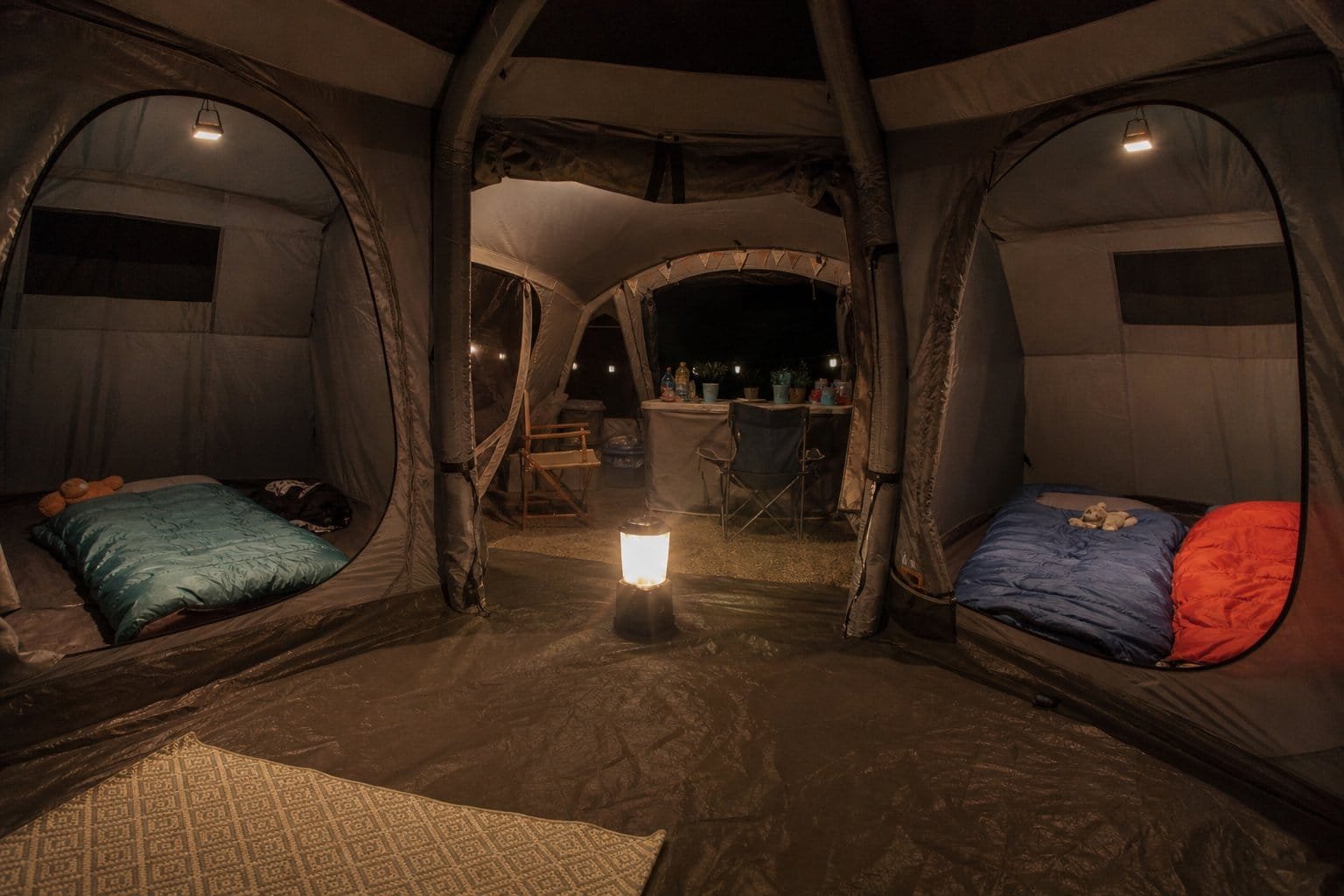
For most family tents, the answer is three lights, and a good family tent lantern is only one of them: one main lantern in the living area, a small light for each bedroom and one for the porch or awning. That sounds like a lot, but the small ones can be very small, and a single large tent lantern that splits into several, such as the Coleman Multi Panel, covers most of it in one box.
Think about how the tent is used after dark. Children usually go to bed first, so their bedroom light needs to be soft, ideally dimmable, and easy for them to switch off. Adults then sit in the living area for another couple of hours, which is where a dimmable main light earns its keep. The porch or awning is for cooking, washing up and boots, and that’s where a brighter or stand-up light helps.
If your tent is a long tunnel design, a single large tent lantern in the middle won’t do it, and spreading the light along its length works better than one point in the middle. Chainable lights such as the Goal Zero Light-A-Life Minis, or a set of camping string lights, run along the roof seam and light the whole length softly. A solar camping light can add light outside without using any batteries at all.
Matching lights to tent size
As a rough guide: a four- or five-person tent with one bedroom and a small living area is fine with one dimmable camping lantern for large tents plus a head torch each. A six-person tent with two bedrooms works best with a main lantern and one small light per bedroom. An eight-berth or larger tent, especially with a big front room or a canopy, benefits from a main lantern, bedroom lights and an outdoor light.
Don’t overestimate how much light a single small lantern gives. Switchback Travel found a 150-lumen LuminAID was “plenty for illuminating a six-person tent or picnic table in full darkness” in its lantern tests, but that was as the only light in a single space. In a multi-room tent, the light simply doesn’t get round the inner walls into the bedrooms.
Types of camping lantern for large tents
Multi-panel lanterns
A multi-panel camping lantern for large tents has a base light with detachable panels that you can spread around the tent. They’re the neatest answer for multi-room tents, because each bedroom gets its own light and they all recharge or store back on the base. The drawback is that the panels are small and only last a few hours on high, so they work best on low as night lights and reading lights.
High-output rechargeable lanterns
These are the most popular camping lantern for large tents choice: bright, often 1,000 lumens or more, with built-in lithium batteries charged by USB-C. Many double as power banks. Inside a large tent you’ll run them well below full power, which is fine: they last much longer that way. Look for stepless dimming and a warm setting, otherwise the low mode can still be too bright or too blue.
Stand-up area lights
Telescopic or tripod lights, like the BougeRV T1, are the outdoor partner to an indoor large tent lantern. They stand on the ground and lift the light up to head height or above. These lights are ideal outside under an awning or gazebo, where there’s nothing to hang a lantern from, and their aimable heads can light a table and a cooking area at the same time.
Chainable and string lights
Several small lights on one cable spread soft light along a long tent. They draw very little power and look good, but most need a separate power bank, and you have to route the cables along the roof. They’re a mood light rather than a work light.
Battery lanterns
A battery-powered camping lantern for large tents is worth considering for long trips without hook-up, because a spare set of batteries is instant power. OutdoorGearLab’s lantern tests found a D-cell UST Duro ran for 33 days on a 30-day claim. The catch is cost and waste, and REI notes alkaline batteries lose power quickly below about -7°C. A lantern with both a rechargeable battery and AA backup, such as the COAST EAL30R, gives you both options.
Lighting a large tent on a budget
You don’t need to spend a lot to light a big tent well. The cheapest good setup is one budget camping lantern for large tents, such as the COAST EAL30R, as the main light, plus a head torch for each person. Run the lantern on its warm low mode in the evening and use head torches for reading in bed and for trips outside. That covers most families for a weekend.
The next step up is a second budget lantern for the porch or awning, so the main light can stay inside. After that, a set of small chainable lights or a multi-panel lantern makes the bedrooms easier. Spend on the main family tent lantern first, because it’s the one you’ll use every evening, and add the smaller lights over time.
Avoid the cheapest no-name lanterns with huge lumen claims. Many of them don’t quote runtimes at each setting, a water rating or a warranty, and those are exactly the details that matter on a wet weekend. A lantern with a clear warranty, like COAST’s lifetime warranty or Coleman’s three years, is usually the better buy even if the lumen figure is lower.
Where to hang a large tent lantern
Most large tents have hanging loops sewn into the roof of the living area and sometimes inside each bedroom. Hang the main large tent lantern from a loop slightly to one side of the main table, so it lights the table without shining straight into the eyes of people sitting around it. A short length of cord or a small carabiner lets you lower it to a better height.
Check the hook before you buy any camping lantern for large tents. Switchback’s testers found one lantern was too thick to hang from the webbing loops in their large camping tent and had to use zip pulls instead. Carabiner handles, like the Coleman Classic Rechargeable’s, and small clip hooks work with most tents. Magnetic handles, like the Fenix CL28R’s, won’t stick to fabric, but they do grab a steel pole, a car tailgate or a camping kitchen frame.
Keep lanterns away from the inner tent fabric if they get warm, and never hang anything heavy from a single roof loop in strong wind. In bedrooms, a low, warm light on the floor at one end often works better than a hanging one, because it doesn’t shine through the inner tent onto the flysheet and wake the neighbours.
Keeping lanterns charged on a long weekend
Rechargeable lanterns are cheap to run, but a big family tent with more than one camping lantern for large tents can easily go through two or three lanterns’ worth of charge a night. Plan for it. Fully charge every light the night before you leave, and bring a power bank or a portable power station to top them up. Our guide to powering devices while camping explains how much capacity you need.
A simple rule is to work out how many hours you’ll use each light on its usual setting, then compare that with the listing’s runtime for that setting, not the headline maximum. For example, Coleman quotes up to 5 hours on high and 45 on low for its Classic Rechargeable 800L, so two evenings on medium should be comfortable, but a weekend on high won’t be.
With electric hook-up, life is easier: plug a USB charger into the hook-up unit each morning and charge lanterns while you’re out. Without it, a 20,000 mAh power bank (about 74 Wh) will refill most lanterns in this guide once or twice. Lights like the Goal Zero Light-A-Life Minis, which have no battery of their own, will run for several evenings from one bank on their low setting.
Lantern safety in a big family tent
Use LED lanterns inside the tent. REI warns that gas lanterns need ventilation and shouldn’t be used in small, enclosed places, and that candles are risky in a tent even in a lantern case. A family tent may feel big, but it’s still a closed fabric space full of sleeping bags. Keep gas and flame outside, and see our notes on safe warmth in our battery powered heater guide.
With small children, choose a family tent lantern that stays cool, have no small parts that come loose, and can’t be knocked into a sleeping bag. Lanterns with an impact rating, such as the Coleman Classic Rechargeable’s 1 m drop resistance, survive being knocked off a table. Put the main light up high, and give children a small light they can switch on themselves rather than letting them borrow the main lantern.
Common camping lantern problems and fixes
The camping lantern for large tents dies by the second night. Usually it was run on high, or it wasn’t fully charged before the trip. Run it on medium or low, top it up from a power bank each day, and check the listing’s runtime for the setting you actually use.
The family tent lantern is too harsh. Turn it down and switch to warm white if you can, hang it higher and to one side, or bounce it off the tent roof. A diffuser, or even a white stuff sack over a small lantern, softens the light.
The bedrooms are still dark. One central light rarely reaches through the inner tent doors. Add a small light in each bedroom, use detachable panels, or string chainable lights along the roof.
The batteries in the family tent lantern are flat when you get it out. Some battery lanterns, including the Coleman Multi Panel according to owners on Coleman’s site, can drain their cells in storage. Take batteries out between trips, and charge rechargeable lanterns to about half before storing them for winter.
Moths gather round the light. Bright, cool-white lights attract more insects than dim, warm ones. Keep doors zipped, turn the light down, and put the brightest light outside away from the door.
Buying a camping lantern for large tents in the UK
The lanterns in this guide are listed on Amazon US, so listings use inches, pounds and US terms such as “flashlight”. We’ve converted the key figures. Rechargeable lanterns charge from any USB charger, so there’s no plug problem in the UK, and battery lanterns use standard AA or D cells.
Check the water rating if your large tent lantern will live in a porch or under an awning. IPX4 means splash resistant, fine for drizzle but not for being left out in a downpour, while IPX5 and higher cope better. Several listings here don’t quote a rating at all, so treat those as indoor lights. For a full packing list, see our camping essentials list.
Which large tent lantern should you buy?
For most families in a multi-room tent, the Coleman Multi Panel 800L is our pick, because its four detachable panels give every bedroom its own light while the base lights the living area. Just remember the base runs on D batteries, so take them out between trips.
If you want the brightest, most adjustable camping lantern for large tents, choose the Fenix CL28R and run it warm and low indoors. For the awning or gazebo, add the BougeRV T1. For one simple rechargeable hanging lantern, the Coleman Classic Rechargeable 800L is easy to live with, the Goal Zero Light-A-Life Minis give soft light along a tunnel tent, and the COAST EAL30R is a cheap, bright backup with AA power.

Final thoughts
The best camping lantern for large tents isn’t necessarily the brightest one. It’s the setup that puts gentle light where each person needs it: a dimmable main light, small lights in the bedrooms and a brighter light outside. Spend a little time planning the zones and the charging, and evenings in a big family tent become much more comfortable. For more on lighting a campsite, see our guide to what lights you need for camping.
Large tent lighting myths
Inside the tent, BioLite suggests just 75–150 lumens. Spreading two or three dimmer lights works better than one glaring one.
REI notes runtimes vary dramatically by setting; the longest figure is always on the lowest mode.
REI warns gas lanterns need ventilation and shouldn’t be used in enclosed spaces. Use LED inside.
Yes. A warm, dimmed light is more relaxing and less glaring than cool daylight white.
What to look for in a camping lantern for large tents
Detachable panels, chained lights or two or three lanterns reach every room.
Low, warm settings stop glare in sleeping areas.
Check the runtime at a useful setting, not just the low-mode maximum.
A hook, carabiner or magnet that fits your tent’s roof loops.
USB-C, a power bank output or AA backup for long trips.
IPX4 for porches; higher if it lives outside under an awning.
How to light a large family tent
- Plan the zones
Count the bedrooms, the living area and the porch or awning.
- Pick a main light
Hang one dimmable lantern from the centre of the living area.
- Add room lights
Give each bedroom a small light, panel or chained light.
- Light the outside
Use a stand-up or hanging light for the awning and cooking area.
- Charge everything
Fully charge lanterns and a power bank the night before you leave.
- Run them low
Use low and medium settings and save high for pitching and packing.
How we chose these camping lanterns for large tents
We have not tested every lantern in this list ourselves. Our picks are based on the Amazon listings, the manufacturers’ pages, REI’s and BioLite’s lantern advice and lantern tests by Switchback Travel and OutdoorGearLab. Where a listing didn’t state a spec, we said so rather than guessing.
-
Big-tent fit
We favoured lanterns that light several rooms or a large living area.
-
Light quality
We looked for dimming, warm modes and red light.
-
Power
We checked battery capacity, charging and backup options.
-
Honest specs
Metric figures are our conversions of the listing figures.
What is the best camping lantern for large tents?
For most multi-room family tents, the Coleman Multi Panel 800L, because its four detachable panels give each bedroom its own light. For the brightest, most adjustable light, the Fenix CL28R.
How many lumens do I need in a large tent?
BioLite suggests 75–150 lumens inside a tent and 200–500 for a table. In a big tent, run a main lantern at 200–300 lumens and add small lights in the bedrooms.
How many lanterns does a family tent need?
Usually two or three: one for the living area, small lights for the bedrooms and one for the awning or porch.
Are rechargeable lanterns better than battery lanterns?
Rechargeables are cheaper to run and easy to top up from a power bank. Lanterns with AA or D battery backup are useful on long trips without hook-up.
Can I use a gas lantern in a tent?
No. REI warns gas lanterns need ventilation and shouldn’t be used in enclosed spaces. Use LED lanterns inside.
Where should I hang a lantern in a big tent?
From the roof loop in the centre of the living area, slightly off to one side of the main table, with smaller lights near each bedroom door.
More camp lighting guides
Lighting the rest of your pitch? See our guides to the best rechargeable camping lanterns, camping solar lights, camping string lights and rechargeable head torches, plus our best family camping tents.
Which camping lantern for large tents should you buy?
- Best overall: Coleman Multi Panel 800L LED Lantern (Quad Pro)
- Brightest: Fenix CL28R 2000 Lumen Camping Lantern and Work Light
- Best for awnings: BougeRV Telescopic Camping Light T1 (15,600 mAh)
- Best hanging lantern: Coleman Classic Rechargeable 800L LED Lantern
- Best for zone lighting: Goal Zero Light-A-Life Mini Chainable LED Lights (4-Pack)
- Best budget: COAST EAL30R 1000 Lumen Rechargeable Camping Lantern
For most multi-room family tents, the Coleman Multi Panel 800L is the best camping lantern for large tents, because its panels light every bedroom. Choose the Fenix CL28R for the brightest, most adjustable light, the BougeRV T1 for awnings, the Coleman Classic Rechargeable 800L for one simple hanging light, the Goal Zero Light-A-Life Minis for soft zone lighting and the COAST EAL30R on a budget.
CampEquipmentPlus relies on reader support. Purchases made via links on our website may earn us an affiliate commission at no extra cost to you, helping keep the site running.