
Best Camping Extension Leads for Electric Hookups UK
The right hook-up lead keeps the kettle, fridge and phone chargers running without tripping the bollard. Our top pick for tents is the Maypole MP3766 mains unit; caravanners should start with the Maypole 25 m site lead.
We compare mains units and site leads for UK campsite electric hook-up, and explain amps, cable sizes, RCDs and how to set everything up safely.
- Never use a household extension reel in a tent
- Look for an RCD, IP44 and orange cable
- Always unwind the whole cable
- Best overall: Maypole MP3766 Mains unit with RCD, breaker, 3 sockets, 2 USB and a 15 m lead.
- Best for damp tents: Eurohike Mobile Mains Kit 10A MCB, RCD and IP44 socket covers; hangs from a pole.
- Best for caravans: Maypole MP377 25 m 2.5 mm² copper, NCC compliant, the standard site lead.
- Watch the amps A 2 kW kettle draws about 8.7A; many units are limited to 10A.
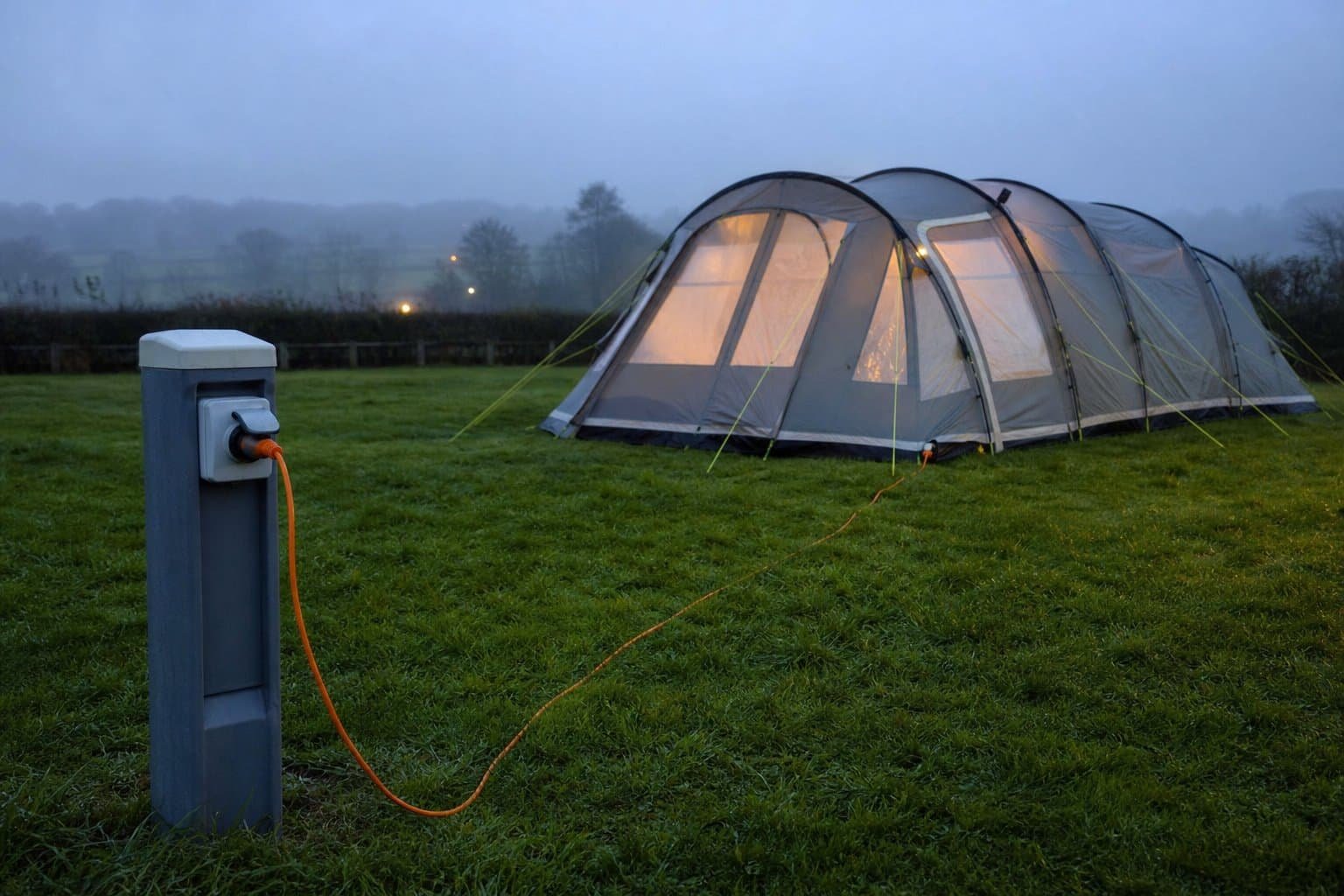
A camping extension lead is the one bit of kit that turns a grassy pitch into somewhere you can boil a kettle, charge phones and keep a fridge cold. On a UK campsite it isn’t an ordinary household extension: it’s a 16A blue site plug, a long orange cable and, for a tent, a socket box with its own RCD. If you’re still deciding whether you need mains at all, our guide to powering devices while camping covers the alternatives; this guide is about choosing and using an electric hook up lead safely.
We compare four tent mains units, a 25 m caravan site lead and a short RCD-protected lead, and explain amps, cable sizes and the mistakes that trip sites or overheat cables.
All six are listed on Amazon UK, where prices change often, so we haven’t quoted them. Where a listing doesn’t give a spec, we say so rather than guess.




Overall Maypole Unit | Tents Eurohike Kit | Roller Hi-Gear Roller | Caravans Maypole 25m | |
|---|---|---|---|---|
|
|
|
|
| |
| Type | Hanging mains unit | Hanging mains kit | Roller mains unit | Site lead (16A to 16A) |
| Cable length | 15 m | 15 m | 15 m | 25 m |
| Sockets | 3 x UK + 2 USB | 3 x UK + 2 USB | 3 x UK + 2 USB | None (16A coupler) |
| Protection | RCD + breaker | 10A MCB + RCD | RCD + breaker | None (van's own RCD) |
| Water rating | Not quoted | IP44 | IP44 | IP44 |
| Warranty | 12 months | 1 year | Not quoted | 12 months |
| Check price | Check price | Check price | Check price |
Our camping extension lead reviews
Each review covers the sockets, protection, cable length and water rating, plus what the clubs and retailers say about using a camping extension lead like it.
230V mobile mains unit with three UK 3-pin sockets angled for large plugs and adaptors, plus two USB ports (1A and 2.1A). Built-in RCD and circuit breaker, indicator light to show the supply is live, and a 15 m high-visibility orange cable ending in a 16A EN60309 site plug. 12-month warranty. The listing doesn’t quote the weight, the cable’s core size or an IP rating.
Maypole is one of the most familiar names in UK caravan and camping electrics, and the MP3766 is the kind of mains unit the Camping and Caravanning Club describes as proprietary tent hook-up equipment: a site plug, a long orange lead and a socket box with its own RCD and circuit breaker. That second layer of protection matters, because if something in your tent trips, it’s your unit that switches off rather than the bollard you share with the next pitch.
The sockets are turned so that chunky plugs and phone chargers sit side by side, and the two USB ports mean you can charge phones and lanterns without using a 13A socket. The 15 m lead suits most tent pitches with a nearby bollard. What it doesn’t tell you is the cable grade or a water rating, so hang it up off the groundsheet and keep it under cover.
- RCD and circuit breaker built in
- Sockets angled for big plugs
- Two USB ports
- Bright orange 15 m lead
- Cable grade and IP rating not on the listing
- 15 m may not reach distant bollards
- Weight not quoted
Mobile mains kit with three UK 3-pin sockets and two 2.1A USB ports. Protected by a 10A double-pole mini circuit breaker and a 25A RCD. Splash-proof IP44 construction with socket covers, a hanging design that clips to tent poles, and a strengthened 15 m orange cable with a 240V site plug. Weighs 3.4 kg. 1-year manufacturer warranty.
The Eurohike kit is the one we’d pick for a tent where the mains unit will live in a porch or a damp living area. It’s the only unit in this list whose listing states both the protection devices in detail (a 10A double-pole breaker and a 25A RCD, which matches the typical spec Towsure recommends) and an IP44 splash-proof rating with socket covers. IP44 is the minimum the Camping and Caravanning Club asks for in tent hook-up kit.
It’s designed to hang or clip to a tent pole, which is exactly where the Club wants it: off the ground and close to the appliances. At 3.4 kg it’s not light, and like most tent kits it uses a 15 m lead, so check how far the bollards are from your pitch before you book.
- IP44 with socket covers
- 10A double-pole MCB and RCD
- Hangs from a tent pole
- 1-year warranty
- 3.4 kg is heavy to hang from a light pole
- 15 m lead
- Cable grade not quoted
Free-standing roller mains unit with three UK 3-pin sockets and two 2.1A fast-charging USB ports. 15 m cable, carry handle, built-in RCD and circuit breaker, IP44 splash proof, IP44 site plug, maximum output 10A. Measures 26 x 16 x 34 cm and weighs 3.5 kg. Warranty not quoted on the listing.
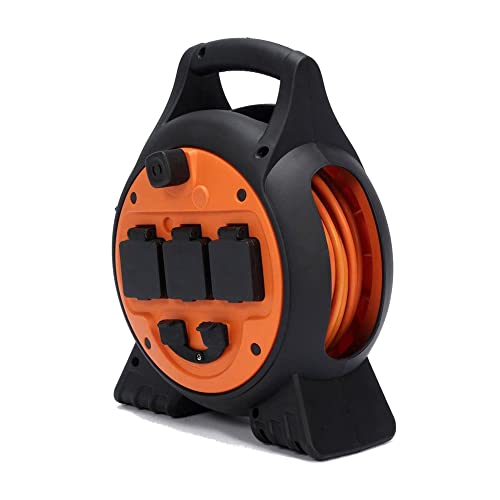
Roller units keep the lead neatly wound on a drum, so packing up in the rain is quicker and there’s no tangle in the boot. The Hi-Gear stands on its own with a carry handle, has the usual three sockets and two USB ports, and its listing confirms an RCD, a circuit breaker, IP44 splash protection and a 10A maximum output.
The catch with every roller unit is heat. The Camping and Caravanning Club says to always uncoil the supply cable fully, because a cable left wound on a reel can overheat, and its thermal images show wound cable running much hotter. So unroll all 15 m every time, even if the bollard is close, and lay the spare in loose parallel runs rather than leaving it on the drum. A free-standing unit also tends to sit on the floor, so raise it on a box or table.
- Neat roller storage, quick to pack
- RCD, breaker and IP44
- Two fast USB ports
- Carry handle
- Must be fully unwound every time
- Sits on the floor unless raised
- Warranty not quoted
25 m caravan site lead made from 100% 3-core 2.5 mm² copper cable, with 16A/230V site connectors (plug and socket approved to EN60309). NCC (National Caravan Council) compliant, IP44 rated, splash-proof plug and socket, orange cable. 12-month warranty.
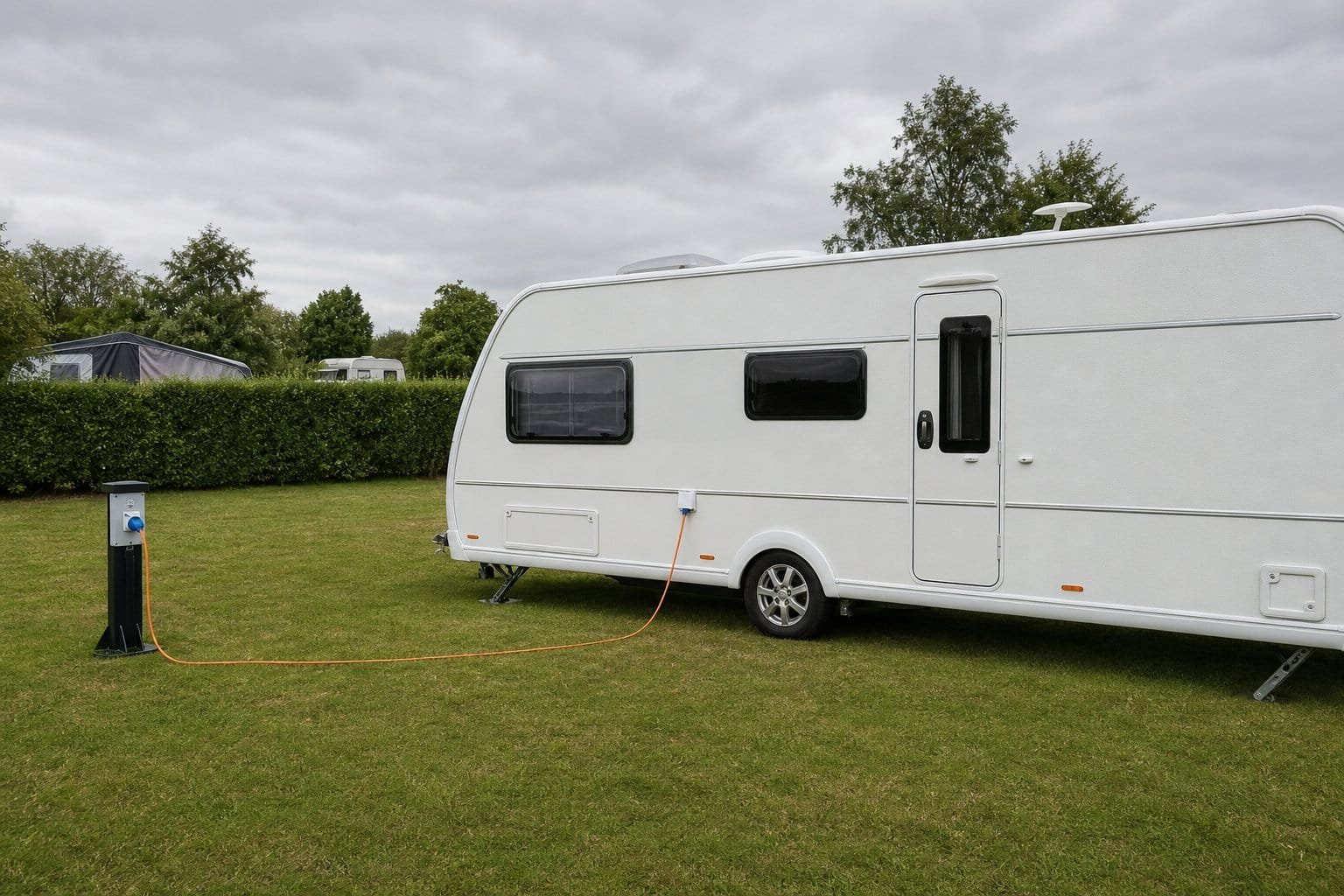
If you tour with a caravan, motorhome or campervan with its own consumer unit, you don’t need a socket box at all: you need a proper site lead from the bollard to the inlet on your van. The Maypole MP377 ticks every box the clubs set out. It’s a single 25 m length (the Caravan Club specifies a continuous 25 m, plus or minus 2 m, with no joins), it uses 2.5 mm² copper cores, which is the size the clubs ask for on a 16A supply, and the connectors are blue EN60309 16A plugs.
It’s also bright orange, which the Caravan Club recommends so nobody trips or mows over it. There’s nothing clever here, and that’s the point: it’s the standard lead most touring campers should carry.
- 2.5 mm² copper cores
- 25 m single length
- NCC compliant, IP44
- 12-month warranty
- No sockets: needs a van with its own consumer unit
- Heavy and bulky to coil
- No storage bag included
230V 10A roller mains unit with three BS 13A sockets, two 5V/2.1A USB sockets, built-in RCD and circuit breaker, integrated LED light, carry handle and free-standing roller design. 12-month warranty. The listing doesn’t state the cable length, weight or IP rating.
The MP3767 is Maypole’s roller version, and its party trick is a built-in LED light, which is handy when you’re plugging in at the bollard after dark or hunting for the kettle in the porch. It has three 13A sockets, two 2.1A USB ports and the RCD and circuit breaker you’d expect from a proper camping mains unit.
Frustratingly, the listing doesn’t give the cable length or an IP rating, so check the box or the retailer’s spec sheet before you rely on it for a far bollard or a damp porch. As with any roller, unwind the lead completely before you switch on.
- Built-in LED light
- RCD and circuit breaker
- Two 2.1A USB ports
- Roller storage
- Cable length not on the listing
- IP rating not quoted
- Must be fully unwound
UK-made 5 m 16A CEE mains lead with a heavy-duty inline RCD. IP44 plug and coupler and an IP44 RCD. Arctic-grade blue 1.5 mm² cable rated to 16A. Weight and warranty not quoted on the listing.
This is a specialist pick rather than an everyday camping lead. It’s a short 16A lead with an inline RCD built into the cable, so whatever you plug into the far end is RCD protected. That makes it useful for kit that has no protection of its own, such as a trailer tent, a catering gazebo at an event, or testing gear at home with a proper 16A outlet.
At 5 m it won’t reach most campsite bollards, and you shouldn’t join it to another lead to make up the distance: the Caravan Club doesn’t allow joins or splitters on its sites. Its 1.5 mm² cable is fine over a short run, but for a 25 m lead to a caravan, stick with 2.5 mm².
- Inline RCD protects whatever you plug in
- IP44 plug, coupler and RCD
- Arctic-grade cable stays flexible
- UK made
- Only 5 m
- 1.5 mm² cable
- Not a substitute for a 25 m site lead
What a camping extension lead actually is
In UK camping talk, a camping extension lead usually means one of two things. For tent campers it’s a mobile mains unit: a blue 16A plug that goes into the campsite bollard, around 15 m of orange cable and a socket box with two or three ordinary 13A sockets, a residual current device (RCD) and a circuit breaker. For caravans and motorhomes it’s a site lead: 25 m of heavy cable with a blue 16A plug on one end and a blue 16A coupler on the other, which plugs into the van’s own inlet and consumer unit.
What it is never is a household extension reel with a blue plug swapped on. The Camping and Caravanning Club’s advice on using electricity in your tent is blunt about this: never use a household extension cable, even with an RCD plug, instead of proprietary hook-up equipment. Household reels aren’t built for damp grass, aren’t weatherproof and often use thinner cable.
So the first question is simple. Are you plugging sockets into a tent, or plugging a vehicle with its own electrics into the bollard? Tent campers want a camping mains unit; caravanners want a 25 m site lead. Some families end up with both, using the site lead for the caravan and a mains unit in the awning.
Amps, watts and what you can run
Campsite bollards are rated in amps. The Camping and Caravanning Club’s electricity guide for campers and caravanners says most of its sites supply 16A, some are limited to 10A and some, particularly abroad, offer as little as 5A. Campsites.co.uk lists 6A, 10A and 16A as the usual UK figures. Multiply the amps by the voltage to get the watts you can draw: at 230V, 16A is about 3,680 W, 10A is 2,300 W, 6A is about 1,380 W and 5A is about 1,150 W.
Your camping extension lead has its own limit too. Many tent mains units, including the Eurohike and Hi-Gear in this guide, are protected by a 10A breaker, so even on a 16A pitch you can only draw about 2,300 W through the sockets. Add up everything that might run at once and stay well under the lower of the two figures.
The usual culprit is a domestic kettle. The Club gives a typical home kettle as about 2 kW, which is around 8.7A, and a fast-boil kettle can be 3 kW. Put one of those on a 10A supply while a fan heater is running and the bollard trips, often for the whole row. A low-wattage camping kettle of around 750 W, which Towsure says suits all supplies, is the easiest fix.
Typical appliance loads
As a rough guide from the Club’s figures: a phone charger or LED lantern uses a few watts, a 12V cool box on a mains adaptor around 50–60 W, a toaster about 900 W, a camping kettle about 750 W, a camping fan heater about 750 W and a domestic fan heater 2 kW. Microwaves draw more than their rated output; the Club says an 800 W microwave may draw about 1,000 W. Check the rating plate on each appliance rather than guessing.
If you plan to run a fridge or heater off hook-up, see our guides to electric cool boxes, family camping fridges and low-amp electric heaters, which explain how much each draws.
How to choose a camping extension lead
RCD and circuit breaker
Every campsite bollard has its own breaker and RCD, but the Club says your unit should have its own RCD too, and every tent unit in this guide does. Towsure’s typical spec is a 10A double-pole breaker and a 25A RCD. The benefit is practical as well as safety: if your kettle or a damp plug trips, your camping extension lead switches off and you can reset it yourself instead of finding the warden.
Cable length and size
For caravans and motorhomes, the Caravan Club’s hook-up cable advice specifies a single continuous 25 m length, plus or minus 2 m, and the clubs ask for 2.5 mm² cores on a 16A supply. Joined leads aren’t allowed on Club sites. Tent kits are different: the Club notes that a tent unit’s cable will likely be the lower 1.5 mm² grade and only 15 m long, so reduce the load and check that the bollard is close enough before you book.
Water rating
The Club asks for an IP rating of 44 or better on tent hook-up kit, and Campsites.co.uk says never to buy one that isn’t IP44. IP44 means splash resistant from any direction. It doesn’t make a camping extension lead safe to sit in a puddle, so hang it up and keep it under the flysheet.
Sockets and USB
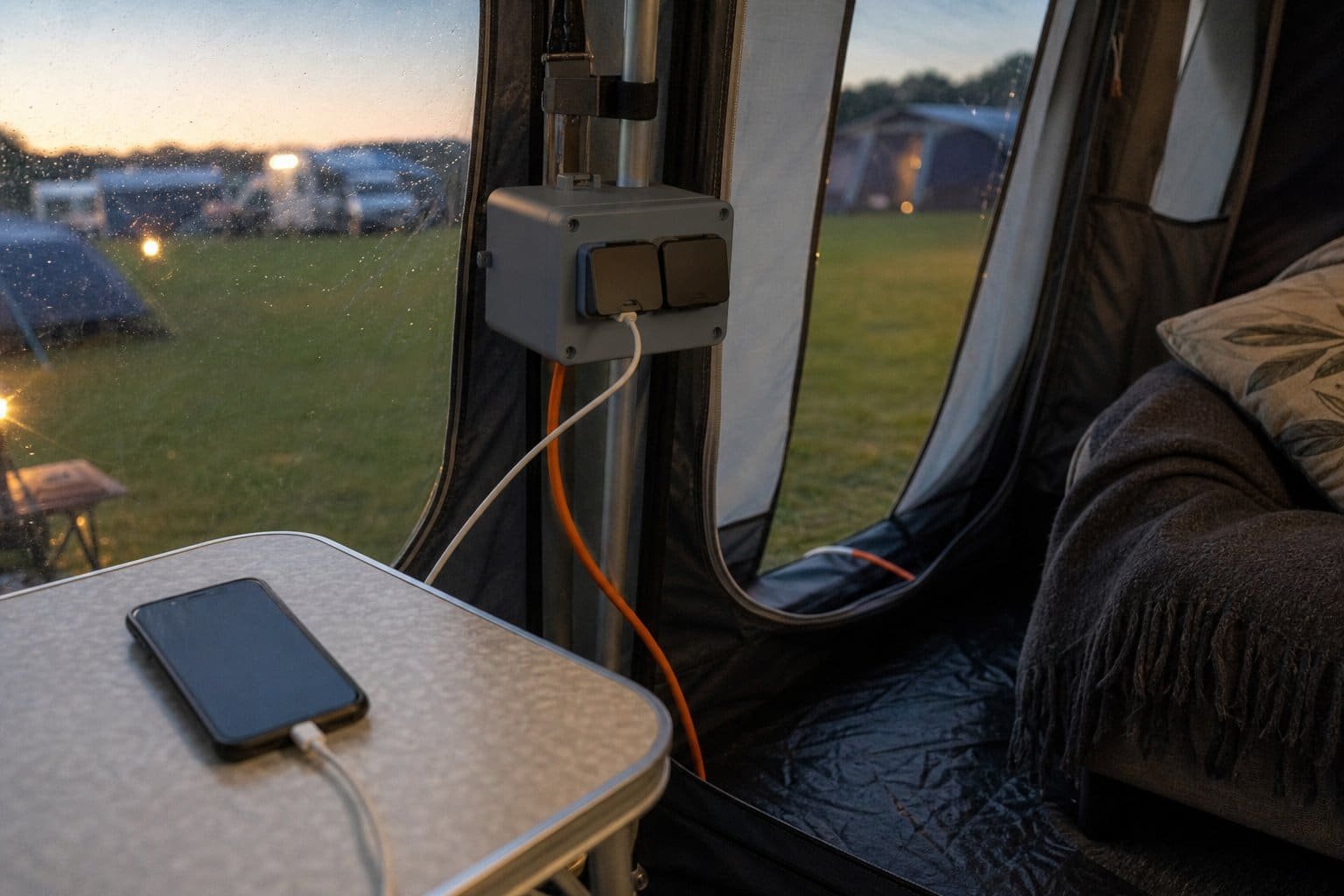
Three 13A sockets is the usual tent setup, and sockets turned sideways or angled down, like the Maypole and Leisurewize designs, leave room for bulky plugs and keep rain out. USB ports are worth having because they free up a socket for the kettle. Remember the Club’s rule: one appliance per socket, and no household plug adaptors or 4-way blocks plugged into your camping mains unit.
Visibility and build
Choose orange or yellow cable, which the Caravan Club recommends so other campers can see it. Towsure warns that grey or dark cable vanishes into long grass. Look for a named brand and a clear cable grade printed on the sheath; the Caravan Club also warns against copper-clad steel cables, which a magnet will pick up.
Mains unit or site lead: which do you need?
If you camp in a tent with no built-in electrics, you need a mains unit. It brings the bollard supply into the tent, adds an RCD and gives you sockets. A caravan, motorhome or campervan with a hook-up inlet and its own consumer unit only needs a site lead, because the van’s own RCD and breakers do the protecting.
Trailer tents and older campervans sit in between. Many trailer tents carry no electrical certificate, according to the Club, so check what’s fitted. If there’s no RCD inside, use a mains unit or an RCD-protected lead such as the HDIUK. For a campervan conversion, see our guide to the best campervan fridge, which covers fitting 12V and mains kit.
How to set up an electric hook up lead safely
Connect in the right order. With the unit’s RCD switched off, plug the cable into your tent unit or van first, then into the bollard, and only then switch on. To disconnect, turn off your appliances and the RCD first, unplug from the bollard and then from the tent or van. Test the RCD with its test button each time you connect.
Unroll the whole cable, every time. The Club’s thermal images show a wound cable running far hotter than one laid out straight, and Towsure warns that a coiled cable acts as a heating element. Lay any spare in loose parallel runs rather than a tight coil, and route the lead along the edge of the pitch so nobody trips over it or catches it with a mower.
Inside the tent, hang the camping mains unit from a pole or clip, off the groundsheet and close to the appliances, and keep it away from the door where rain blows in. Stop using it if the tent is damp inside, unplug it when you go out, and don’t let children plug things in or reset it.
Check polarity with a cheap plug-in tester, especially abroad. If it shows reversed polarity, the Club suggests trying another socket on the bollard first, as it’s often a coin toss which way round a continental outlet is wired.
Using a camping extension lead abroad
European sites often have lower supplies, sometimes 5–6A, and bollards that are further than 25 m from the pitch. The Club says some continental sites accept a second cable joined with a proprietary weatherproof connector, but never a taped joint or a household plug and socket, and Club sites in the UK don’t allow joins at all. A 25 m lead is still the best starting point.
Many French, Dutch and German bollards use the same blue 16A plug, but some older sites still have local two-pin sockets. Carry a polarity tester and, if you go to such places, a proper continental adaptor lead from a caravan dealer rather than a travel adaptor.
Matching a camping extension lead to your setup
A small dome tent used for a weekend needs very little: a camping extension lead with two or three sockets will run a phone charger, a lantern and perhaps a low-wattage kettle. Choose a compact hanging unit and don’t pay extra for a roller.
A large family tent with a fridge, a heater on cold nights and several people charging devices needs more planning. Pick a camping extension lead with USB ports so the 13A sockets are free for the big loads, and keep a written list of what each appliance draws so nobody switches on the kettle while the heater is running.
If you camp in an awning beside a caravan, you may not need a separate camping extension lead at all, because the caravan usually has external or internal sockets protected by its own consumer unit. Run awning appliances from the caravan rather than adding a second lead to the bollard, which many sites don’t allow anyway.
For gazebos at events and festivals, check what supply the organisers provide before you buy. Some use the same blue 16A sockets as campsites; others supply a standard 13A socket, in which case a proper outdoor-rated lead with an RCD is the right tool, not a camping extension lead with a 16A plug.
Hook-up etiquette and campsite rules
Only plug into the socket allocated to your pitch, and don’t unplug anyone else’s lead, even if it looks unused. If the bollard trips, tell the warden rather than opening the box yourself; on many sites only staff can reset it. Site staff can refuse a connection they think is unsafe, so a tidy, branded camping extension lead in good condition avoids awkward conversations.
Keep your cable on your own pitch where you can, run it along the hedge line rather than across paths, and coil it away as soon as you unplug when you leave. If you’re a light sleeper, remember that a camping extension lead running a fan heater all night uses a lot of the shared supply in a cold snap; the Club notes that high occupancy in cold weather can cut power to a whole field.
Problems with a camping extension lead and how to fix them
The bollard keeps tripping. You’re drawing more than the site supply. Check the bollard’s rating, then swap the domestic kettle for a low-wattage one and don’t run the heater and kettle together.
Your unit’s RCD trips but the bollard doesn’t. Something on your side is leaking current, often a damp plug, a wet socket or a faulty appliance. Unplug everything, dry the unit, then add appliances back one at a time to find the culprit. If it keeps tripping, stop using that appliance.
The cable feels warm. Make sure it’s fully unwound and not running under a groundsheet in a coil. A warm 1.5 mm² tent lead on a heavy load is a sign to cut the load. The Caravan Club says a cable showing deterioration or overheating likely needs replacing.
The lead won’t reach. Book a pitch near a bollard, carry a 25 m site lead, or ask the site to move you. Don’t join two household leads to make up the distance.
Why cheap hook-up leads are a false economy
Towsure’s warning about cheap hook-up leads found that many discount camping mains leads are little more than a standard household 4-way socket wired to a blue site plug, with no RCD, no weatherproofing and an unmarked cable grade. They look like a bargain until something gets wet. A good camping extension lead costs a little more, but it’s something you’ll use on every trip for years.
When you’re comparing listings, look for the cable size and length, the RCD and breaker ratings, an IP44 rating and a warranty. If a listing doesn’t mention an RCD at all, assume it hasn’t got one. We left several unbranded leads out of this guide for exactly that reason, and one 25 m kit because its listing claimed both 10 m and 25 m of 1.5 mm² cable.
Looking after your hook-up kit
Check the plug and socket ends each trip, because the Club says the ends wear fastest. Look for cracked housings, bent pins, scorch marks or a loose outer sheath, and replace the lead rather than taping it. Dry the cable before you pack it, store it in a bag away from sharp tent pegs, and test the unit’s RCD at the start of every season.
Add your camping extension lead to the list you check before you leave home; it’s on our camping essentials list with the polarity tester and a low-wattage kettle. If you’d rather camp without hook-up, a portable power station runs lights and chargers for a weekend.
Which camping extension lead should you buy?
For most tent campers, the Maypole MP3766 is the camping extension lead we’d choose: a familiar UK brand with an RCD, a circuit breaker, well-spaced sockets and USB ports. If your mains unit will hang in a damp porch, the Eurohike kit has the clearest safety specs and IP44 socket covers, and the Hi-Gear roller suits campers who want a tidy drum, provided they unwind it fully.
For caravans, motorhomes and campervans, get the Maypole MP377 25 m site lead with its 2.5 mm² copper cores. The Maypole roller adds a built-in light, and the HDIUK RCD lead is a specialist pick for trailer tents and events.
Final thoughts
The best camping extension lead is the one that matches your pitch: a mains unit with an RCD for a tent, a 25 m 2.5 mm² lead for a van, both in bright orange and both fully unwound. Pair it with low-wattage appliances, hang the unit off the floor and check the bollard’s amps when you arrive. For lighting once you’re plugged in, see our guides to lanterns for large tents and what lights you need for camping, and if you’re cooking on hook-up, our camping kitchen units guide.
Hook-up myths
The Camping and Caravanning Club says never use a household extension cable, even with an RCD plug, instead of proprietary hook-up equipment.
Both clubs say to unwind the cable fully; a coiled cable can overheat.
Many tent units have a 10A breaker, and two 2 kW appliances together will trip most supplies.
The Caravan Club doesn’t allow joins or splitters on its sites. Carry a single 25 m lead.
What to look for in a camping extension lead
Your own RCD protects you and trips before the bollard does.
25 m of 2.5 mm² for vans; tent units are often 15 m of 1.5 mm², so limit the load.
The Club’s minimum for tent hook-up equipment.
A hook or clip keeps the unit off the groundsheet.
Easy to see, so nobody trips or mows over it.
Free up 13A sockets for the kettle and fridge.
How to connect to campsite hook-up
- Check the bollard
Find out the site’s amp rating and which socket is yours.
- Unwind the whole lead
Lay it straight along the pitch edge; no coils.
- Switch off your RCD
Plug into your tent unit or van first.
- Plug into the bollard
Push the blue plug home and twist if it has a locking ring.
- Switch on and test
Turn on the RCD, press its test button, then reset it.
- Add appliances slowly
One per socket, and keep the total under the site limit.
How we chose these camping extension leads
We have not tested every lead in this list ourselves. Our picks are based on the Amazon UK listings and on hook-up advice from the Camping and Caravanning Club, the Caravan and Motorhome Club, Towsure and Campsites.co.uk. Where a listing didn’t state a spec, we said so rather than guessing. This is general guidance, not electrical advice; if in doubt, ask a qualified electrician or the site warden.
-
Protection
We favoured units with a stated RCD and circuit breaker.
-
Cable
We checked length, core size and visibility.
-
Weatherproofing
We looked for IP44 and designs that hang up.
-
Honest listings
We dropped leads with contradictory or missing safety specs.
What is the best camping extension lead?
For tents, the Maypole MP3766 mains unit, with an RCD, breaker, three sockets and two USB ports. For caravans and motorhomes, the Maypole MP377 25 m site lead.
Can I use a normal extension lead for camping?
No. The Camping and Caravanning Club says never to use a household extension cable, even with an RCD plug, instead of proprietary hook-up equipment.
How long should a hook-up lead be?
The clubs recommend a single 25 m lead for caravans and motorhomes. Tent units are often 15 m, so check the bollard distance.
What can I run on a 10A hook-up?
About 2,300 W at 230V. A low-wattage kettle, lights, chargers and a cool box are fine; a 2 kW kettle plus a heater is not.
Do I need to unwind the cable fully?
Yes. Both clubs say a coiled cable can overheat, so unwind it completely every time.
More campsite power guides
Planning the rest of your power setup? See how to power devices while camping, our electric heaters for campers, electric cool boxes, campervan fridges and the best family camping tents.
Which camping extension lead should you buy?
- Best overall: Maypole MP3766 Mobile Mains Power Unit with USB
- Best splash-proof tent kit: Eurohike Mobile Mains Kit (3 UK Sockets, 2 USB, 15 m)
- Best roller unit: Hi-Gear Mobile Mains Roller Power Unit (15 m)
- Best for caravans and motorhomes: Maypole MP377 25 m 230V Caravan Site Extension Lead
- Best with built-in light: Maypole MP3767 Mobile Mains Roller Power Unit with LED Light
- Best RCD-protected short lead: HDIUK 16A CEE Hook-Up Cable with Inline RCD (5 m)
For most tent campers, the Maypole MP3766 is the best camping extension lead, thanks to its RCD, breaker and USB ports. Choose the Eurohike kit for a damp porch, the Hi-Gear roller for tidy storage, the Maypole MP377 25 m lead for a caravan or motorhome, the Maypole roller for its built-in light and the HDIUK lead for specialist RCD-protected short runs.
CampEquipmentPlus relies on reader support. Purchases made via links on our website may earn us an affiliate commission at no extra cost to you, helping keep the site running.